Category Archives: Vegetable Gardening in Dallas

Lakota Squash, An Heirloom Vegetable For Fall Gardens

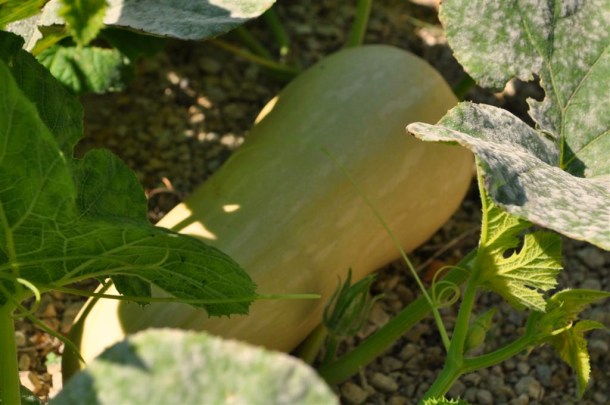
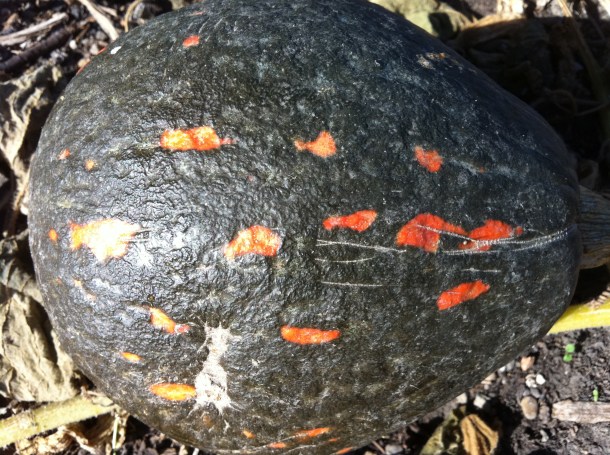
Lakota Squash Planted In  Early August

Lakota squash is one of the winter storage types of squash. It’s a medium sized,  pear-shaped squash, weighing an average of about seven pounds. The outer shell is hard with interior flesh a golden yellow. The flavor is nutty and sweet. The Lakota squash derives its name from the Lakota Tribe of the Sioux Indians who prized this hardy winter squash for cooking and baking.   We like to think we are continuing their history by growing it at The Demonstration Garden. 

Store Lakota squash in a cool, dry place for up to three months or more after picking them. Since this is our first time to grow this heirloom vegetable, we may try one of these cooking ideas from Chef Kyle Shadix :

• Purée in food processor with light coconut milk, curry, and freshly minced and sautéed ginger and garlic.
• Add brown sugar, vanilla extract, and toasted walnuts.
• Add maple syrup and toasted almonds.
• Serve mashed with salt and pepper and a touch of real butter.
• Mix with prepared pesto and sprinkle with Parmesan or Pecorino Romano cheese.

Because Lakota Squash is an heirloom variety not a hybrid, the seeds will produce offspring like the parent. Next year we can share the seed and all get a little taste of Sioux history!

Ann

Beets And Turnips From A Dallas Garden

When my husband called tonight and asked “what’s for dinner”, I said “beets”. Silence ensued. What he didn’t know was that a stampede almost took place in the garden today when we were harvesting our turnips and beets.  Our Dallas County Master Gardeners know eating your vegetables is not only good for you, it is downright tasty. 

Beets And Turnips Harvested At The Demonstration Garden

Turnips can be mashed like potatoes or used in gratins, couscous, or  frittatas.

Tokyo Cross Hybrid Turnips Grown At The Demonstration Garden

Tired of pickled beets?  Try a beet cocktail for something different.  Eat the tops of both of these vegetables for an extra nutrition boost.

Burpee Golden Beets

 Aside from the enthusiasm over our harvest, the most astonishing thing was that just six weeks ago we were planting these crops by seed.  We planted Purple Topped and White Tokyo HyBrid Turnips, Detroit Dark Red Beets and Burpee’s Golden.  We are hoping for a repeat performance when it is time to plant beets and turnips again February 1.

All the talk was of dinner when we left the garden today and I knew each pot would hold some of our harvest.  We had Beets and Beet Greens with Maple Walnuts. Now he’s talking!

Ann

Bushels Of Butternuts

Even the name—butternut—brings fall to mind.  Nature brings us such end of the season treats in November.  The queen of winter squash hides hers in a soft beige overcoat, revealing the rich, orange-yellow flesh when cut.

Butternut Squash Growing In Our Garden With Unfortunate Mildew On Leaves

Jim, our vegetable expert at the garden, has harvested bushels of lovely butternuts.  He planted the exuberant vines in the heat of the summer, with harvest plans for November. All squash are types of gourds.  Butternuts should be harvested when firm, well shaped, and heavy for their size.  Unlike their thin-skinned summer cousins, winter squash have a hard tough shell.  Butternuts can be stored for several months in a cool, dark place. 

Of course, the fun is deciding how to serve butternuts.  Soup? Such a lovely, rich addition to the Thanksgiving table.  Roasted? Add a bit of fresh ginger and butter. Or enjoy its sweet, slightly nutty flavor in filled pastas, spicy curries, or stews. 

Butternut–and other winter squash like acorn, pumpkin, and Hubbard–are a nutritional bonanza. They are rich in Vitamin A (beta-carotene), fiber, folate (folic acid) and potassium.

Butternut Squash Harvested From Our Garden Atop A Store Bought Pumkin

So don’t pass up these lovely winter squash for your Thanksgiving table.   You might try my daughter Molly’s favorite: Butternut Squash Soup.

Butternut Squash Soup 

1 Tbs olive oil

5 oz. pancetta, cut into small dice

1 yellow onion, chopped

1 tsp sugar

1 tsp minced garlic

1 sprig fresh sage leaves

3 ¼  cups low-sodium chicken broth

3  cups butternut squash, peeled, seeded, and cut into 1 ½ inch chunks

 1 ½ Tbs. Marsala wine

Salt and pepper to taste

¼ cup heavy cream

Lightly whipped cream for garnish

¼ cup hazelnuts, toasted and chopped 

In a stockpot over medium-low heat, warm the olive oil.  Add the pancetta and cook, stirring occasionally, until lightly crisp, 5-7 minutes.  Transfer to a paper towel-lined plate; reserve the oil in the pot.

Add the onion and sugar to the pot and cook, stirring occasionally, until the onion is tender and slightly caramelized, 8-10 minutes. Add the garlic and sage sprig and cook, stirring, for 1 minute.  Add the broth and squash and simmer, covered, until the squash is tender, 20-25 minutes.  Remove the sage sprig and discard.  Add the Marsala and season with salt and white pepper.  Simmer for 3 minutes, and then remove the pot from the heat.

Puree the soup in a blender until smooth, then whisk in the cream.  Ladle the soup into warmed bowls.  Garnish with the pancetta, a dollop of whipped cream, and hazelnuts.

Adapted from a Williams-Sonoma recipe 

Elizabeth

Keyhole Gardening

Keyhole gardening is considered an “African survival strategy” in a land of scarce resources and unforgiving climate.  According to reports from the BBC, 3 keyhole gardens can feed an African family of 10 for an entire year. 

A humanitarian aid organization in southern Africa developed this particular sustainable gardening method.  The design originates in permaculture which is a branch of ecological design & engineering that develops sustainable human settlements & self-maintained agricultural systems modeled from natural ecosystems. 

          A keyhole garden is the “ultimate raised-bed planter.” It consists of a circular shape w/ a 6 foot diameter & stands about waist-high.  A notched-in section like a pie-shaped wedge allows access to the plants.  It can be constructed from local recycled materials & incorporates a central composting basket into which food scraps/organic wastes are placed.  The garden is also watered through this basket.  It uses far less water than conventional gardens & recycles as it grows.  From a birds-eye view this garden reminds one of a keyhole.  
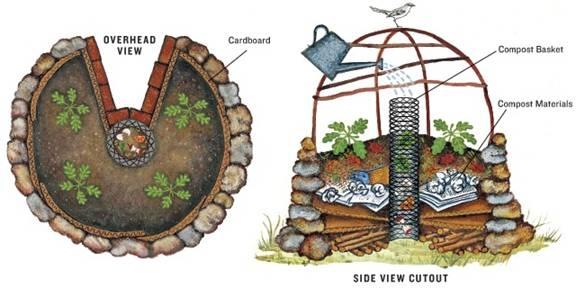
Keyhole Garden Bird's Eye View and Side View

 Keyhole gardening is an adaptable concept & almost any kind of raised bed of about a 6 foot diameter can be converted.  The basic idea is functionality & efficiency: producing the most nutritious organic produce in the least amount of space using minimal water.  Cattle water troughs, tractor & truck tires, old bathtubs, & boats are repurposed examples.

     This concept has been replicated by landscape architect Dr. Deb Tolman in partnership w/ ranchers Jim & Mary Lou Starnater.  Their property, located on the edge of the Hill Country in the  community of Clifton, Texas is similar to southern Africa, “scorching heat, thin layers of topsoil, & elusive rainfall that can make for a brutal summer.”
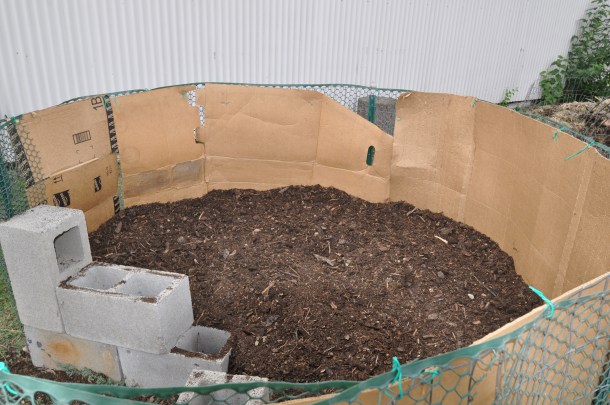
The Beginnings Of Our Keyhole Garden

     We constructed our version in the Composting area using reclaimed materials & a bit of ingenuity.  Kevin used heavy cord & a large screwdriver to scribe a 6 ft. diameter circle on the ground as our reference point.  He and  Roger set 4 ft. metal stakes to hold fence wire into the basic circular shape w/ an inset wedge to provide access (keyhole) to the garden.  Into the center went the temporary vent/self-watering stack (later we’ll construct an inner basket measuring 1 ft. diameter & 4 ft. in height).  
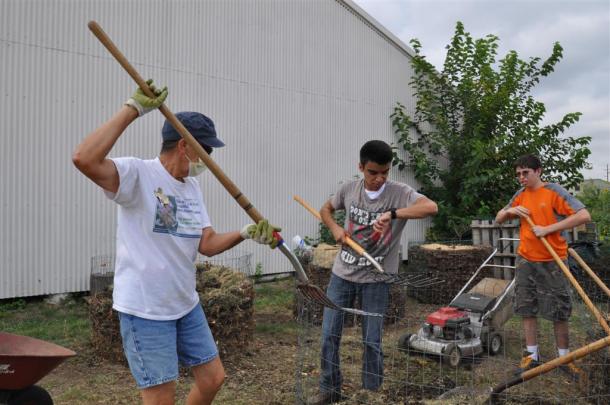
Harvesting Compost For The Keyhole Garden

  The students from Independence Life Preparatory School  lined the interior and base of the keyhole garden structure w/ cardboard & set up alternating layers, 3 in. deep, bottom to top, of brown & green compostable matter.  The inner stack will also be filled w/ alternating layers (kitchen scraps & other herbaceous matter) of green & brown.

Annette With Students from Independent Life Prepatory School

 Unlock your own Keyhole Garden

Follow these guidelines to get started: 

1. Measure a 6-ft. diameter circle to define the inside wall of your garden.

2. Notch the circle (like cutting a wedge of pie) so you can access the basket at the center.

3. Construct the exterior walls about 3 ft. high using rocks, metal, timbers or any material that can support the weight of wet soil.

4. Use wire mesh to create a tube about 1 ft. in diameter & about 4 ft. high. Stand the tube in the center of the circle.

5. Line the outer walls with cardboard & fill the garden area (but not the wire mesh tube in the center), with layers of compostable materials, wetting down as you go. Fill the last few inches with compost. The soil should slope from a high point at the top of the center basket downward to the edges of the garden.

6. Fill the center basket with alternating layers of compostable material, along with layers of kitchen scraps & herbaceous weeds that provide the plants with moisture & nutrients.

7. Water the center basket & the garden only when the plants will not survive without it. This forces the plants’ roots down toward the center basket.

8. Feed the garden by adding more kitchen scraps, lawn clippings, etc. to the center basket.

9. Consider arching framework of thin wires over the garden. During the hottest months, the wires can support a shade cloth, & in winter, plastic sheeting creates an instant greenhouse.

10. Enjoy the fruits & vegetables of your labor!

Sources: Texas Co-op Power, Feb. 2012, pp14-15 “Keyhole Gardening: Unlocking the secrets of drought-hardy gardens” by G. Elaine Acker; http://www.urbanoasisproject.org/; www.sendacow.org.uk (Send a Cow Charity, Africa).

Watch this inspirational video,  Keyhole Gardening in Africa.

Annette
Fall-What’s Not To Love?

What’s my favorite season? Easy peasy. FALL. Jacket wearing, college football cheering, leaf rustling, turkey roasting, Halloween mini-Snickers sneaking—Fall!

This lovely autumnal season is so much more than pulling up summer-scorched annuals and popping in mums for a few weeks.  At a time when northern gardeners are closing up shop for the winter, Texas gardeners have realized that the fall months may very well be the best time of the year to plant.

Think about it.  A Sweet Innocent Perennial you might plant in the spring is just being lined up for the furnace blast of summer from late May through August.  It’s hard to even survive—much less thrive–in temperatures in the 100s, no rainfall, and nighttime lows that hover in the 80s.  But if you’re a savvy gardener and plant that same Sweet Innocent in the fall, you’ve tucked it in when the future holds cooling temperatures and more frequent rain.  Voila.  Plant Success.

Most plants will put on a fall flush of growth and bloom in fall weather conditions.  Roses can be spectacular in the fall, often with blooms more vibrant than spring or summer.  Trim roses back now, fertilize, and give a deep soaking to promote bloom.

Raised Bed with carrots, radish seeds and trowel

If you’re planting a fall school garden with kids, it’s time to get busy.  If you want a warm season garden, plant bush beans and pinto beans by seed until September 15.  Be sure to baby your seeds; they need to be kept moist until they sprout and are established. 

Dallas County Master Gardeners Busy With Fall Gardening

Fall is Prime Time for cool season crops, those vegetables that love a nip in the air in November and December.  Plant beets, spinach, lettuce, and carrots by seed now through October 15.  Kids love transplants; they’re veggies in miniature.  Plant broccoli, Brussels sprouts, cabbage, and cauliflower transplants now through late-November.  Mustard greens, Swiss chard, spinach, parsley, leeks and kale transplants can be tucked in the garden from September 15 through the winter.  (Harvest your warmer season crops in late October, then plant cole transplants for a continued harvest.)

Spring flowering bulbs can be a fun thing to plant with kids.  Purchase your bulbs now when nurseries start stocking bulbs, but wait on planting them until soil temperatures cool significantly, for us in mid- to late-November.  Daffodils are probably your best bet with kids.  They are dependable, don’t require pre-chilling (like tulips), and some will naturalize.  The Southern Bulb Co. in Golden, Texas  is known for propagating old varieties of bulbs, often found in deserted homesteads. 

The best reason to garden in the fall is to enjoy it.  Your garden is filled with new blooms and growth.  Pests have taken a vacation with the cool temperatures.  So nibble a bit of early Halloween candy and enjoy the season.

Elizabeth

School In The Garden

A s summer fades away. here’s a look at some of our crops and more reasons to have school outside in our learning center at the Earth-Kind® WaterWise Demonstration Garden.

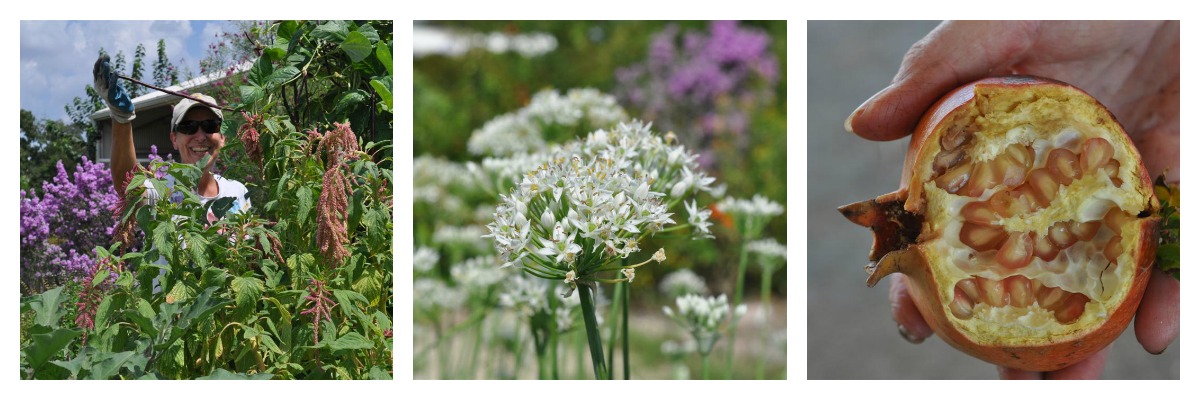
Chinese Red Yardlong Noodle Beans, Garlic Chives, Pomegranate

 Chinese Red Yardlong Noodle Beans and Amaranth Love Lies Bleeding

We are growing these two exotic edibles at the Demonstration Garden to learn more about them ourselves. In our first picture Cindy is stretching out the yardlong bean and the amaranth is blooming with cascading ropes of flowers in front of it.

 To find out how to cook the yardlong noodle beans read Garden Betty.  

Amaranth aka, Love Lies Bleeding, loves the heat and does not need much water. The leaves and seeds are highly nutritious.  Its creepy name refers to its use in the middle ages to stop bleeding.  A whole social studies unit could be written about Amaranth and the uses of it around the world today and historically.  Our garden setting would be the perfect place to teach this!

Garlic Chives  Plop the ornamental seeds heads into your salad along with the chopped up  stems or leave them so you can gather their seeds.

 Pomegranate  We grow the variety, ‘Wonderful’, and it started producing for us the summer after we planted it in 2009.  It will become a multi-trunked small to mid-size tree .  We have an orchard in the planning stages with  Pomegranate trees and other Dallas oriented fruit trees to be planted and more school lessons to be taught!

Ann

The “Mild” Habanero And The Eggplant

Never take your daughter with you to buy vegetable transplants. Molly seemed like a safe bet; this 24-year-old hasn’t cooed over anything but boyfriends and clothes since she turned 11. But show her the 4-inch veggies all waggling their cute little leaves and begging to come home with you, and don’t you know it, Molly’s like a preschooler with a batch of free puppies.  She wanted them all.

That’s how we ended up with The “Mild” Habanero and The Eggplant.

Eggplants And Habaneros On The Kitchen Counter

For the summer garden, we planted squash, cantaloupe, and watermelon seeds and transplants of tomatoes—plus the habanero and eggplant.  Now two months later, the cantaloupe seeds never sprouted, beetles decimated the squash and watermelon, and the tomatoes have decided that it’s too hot to do much of anything.

Of course, the habanero and eggplant have thrived.  

The tag on the habanero read “mild”—as compared to what? A ghost chili?  And you’ve never seen a more prolific pepper; at least 25 chilies in shades of green, yellow, and orange hang from its branches.  Perhaps one could blend up a concoction of chilies and vinegar strong enough to repel squirrels or wayward cats, but otherwise the peppers are too hot to use in anything.

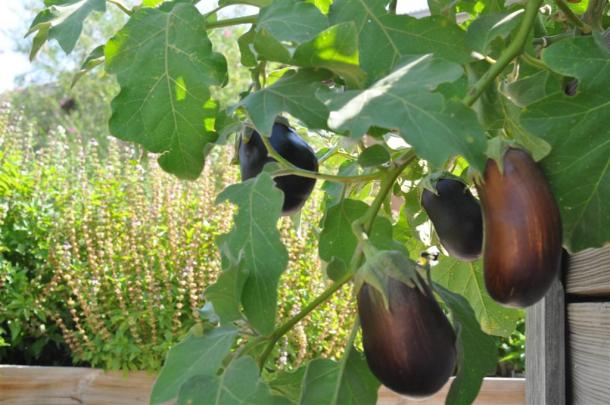
Eggplant growing in a raised bed at the Demonstration Garden in Dallas

The eggplant is now the size of a small shrub.  At least six of the most beautiful aubergine purple globes dot its sturdy branches.  Eggplants are much loved by cooks; the English and French call them aubergines.  Crayola even named a pink-purple-grey color crayon eggplant in 1998. 

In my kitchen, I have grilled, fried, stewed, stuffed, and rolled eggplant—all with the same conclusion.  I don’t like eggplant.  I tried, but no.

So, here we have it.  The stars of my August garden are inedible or underappreciated. Perhaps I could put a little vegetable stand out by the mailbox with an honor system jar for quarters.  Habaneros and Eggplant—Name Your Price…

Elizabeth

Okra, An Olympic Hopeful For Dallas Gardens

This morning I woke up wanting to be like Gabby, the American gymnastics darling of the Summer Olympics.

I wanted to look like her, smile like her, have her discipline, WIN like Gabby!

My next thought was of my garden and what I needed to do out there in the early morning before it gets hot.  Before any more depressing thoughts of never winning an Olympic gold medal entered my head,I jumped out of bed and into my vegetable garden to coax my veggies into looking like Olympiads.

At this time of year, tomatoes are hanging on waiting for fall, cucumbers have stopped producing and the leaves look weathered, bell peppers and red peppers are stable but also wait for a drop in temperature. 

The super performers for Texas gardens in August  are okra, eggplant, and jalapeños. 

Maybe I am more like Gabby’s Olympic coach, Liang Chow. Okra will be my Olympic hopeful.

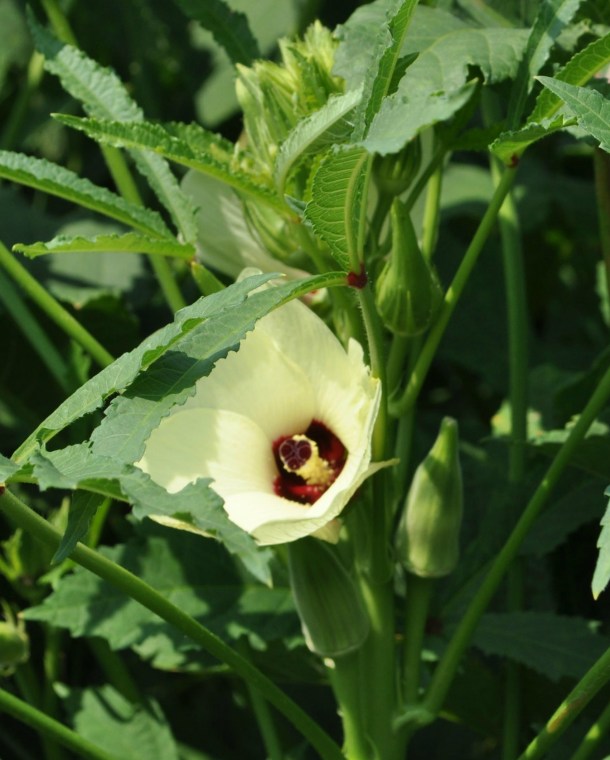
Okra Blossom and Okra Pods

 I will squirt the aphids off my okra with water, pick okra pods on time before they get too big and stringy tasting, and turn them into culinary delights that will cause even the pickiest of eaters to say, I LOVE OKRA!

Now I am imagining stands filled with fans, chanting we want okra, we love okra, and okra can win!

If you want to be a winner with okra remember these tips:

Planting Time: Don’t plant too early, the soil temperature needs to warm up and minimum average temperature should be above 65°. Plant seed in April for summer harvest and July15-August 25 for fall harvest.

Needs: Full Sun, adequate spacing, moderate water needs. Texas A&M recommends one inch of water weekly in the absence of rainfall for good production.

Harvest: pick the pods every day; they should be less 3-3 ½ inches in length. 

Varieties:  We have had great success with Clemson Spineless at the Demonstration Garden. Try Burgundy for the burgundy colored okra pods.  Other suggested varieties are Emerald, Louisiana Green Velvet, Annie Oakley (smaller stature-I like this one), Red Velvet and Beck’s Big.

Cooking:    Click here for a good Dallas Morning News okra recipe.

The burgundy varieties turn green when cooked and taste just like the green okra pods.  Okra blossoms are edible.

Ann

Peach, Watermelon, and Tomato Salad With Mint and Basil

Peach, Watermelon, and Tomato Salad With Mint And Basil

½ medium size watermelon, cubed

3 medium peaches, cubed

2 medium size heirloom tomatoes (green variety) cubed

½ red onion, thinly sliced

1-2 stalk’s worth of basil leaves

1-2 stalk’s worth of mint leaves

Juice of one lime

1 teaspoon salt

¼ teaspoon freshly  ground pepper

1 teaspoon sugar

¼ teaspoon chili powder

1 teaspoon white wine vinegar

¼  cup good quality  olive oil 

1.  Toss together the watermelon, peaches, tomato, and onion in a large bowl.  Chiffonade the basil and mint and add to the fruit  mixture. 

2.  In a separate bowl, whisk the remaining ingredients and toss with the watermelon mixture.  Chill or serve at room temperature. 

Makes 6 to 8 servings.  Can easily be doubled or tripled.

Linda

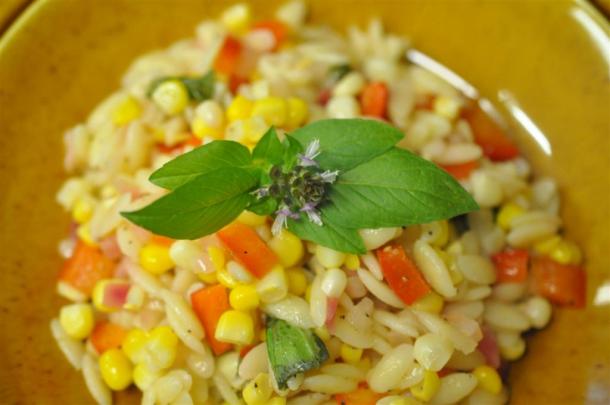
Corn, Orzo, and Basil Salad

Basil, Corn, Orzo Salad With Basil Garnish  

½ medium red onion, finely diced

¼ cup white wine vinegar

3 tablespoons fresh lime juice

2 teaspoons kosher salt

3/4 teaspoon freshly ground black pepper

4 ears sweet corn, shucked

8 ounces orzo pasta

¼ cup plus 2 tablespoons extra virgin olive oil

1 red bell pepper, seeded and diced into ¼-inch pieces

1 ½ cups torn leaves of sweet basil or lemon basil 

Stir the red onion, vinegar, lime juice, salt and pepper together  in a large mixing bowl.  Let it sit while you continue with the recipe, allowing the acidic ingredients to mellow the raw bite of the onion.  

Hold the ears of corn upright on a large cutting board and cut off the kernels, being careful not to cut so deep you shave the cob.  They should give you about 5 cups of kernels. 

Bring a large pot of salted water to the boil.  Add the orzo and when it is just tender, after about 8 minutes, add the corn kernels to the pot.  Cook until the water boils again, then drain in a colander, and rinse with cold water. 

Stir the olive oil in to the bowl with the dressed onion.  Toss in the pasta and corn, red bell pepper, and basil until evenly combined.  Refrigerate at least 1 hour before serving. 

Yield:  10 servings

Recipe from The Herbal Kitchen by Jerry Traunfeld

Linda