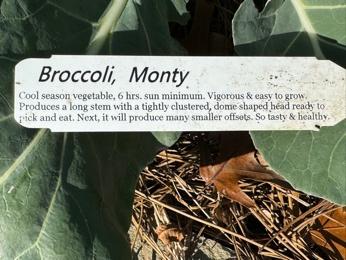
This past fall, I decided to try several different varieties of broccoli in my garden. A few are still growing and I’m hoping they reach the harvesting stage very soon. But, as you can see from the photo, this particular variety produced a beautiful head of broccoli just a few days ago. There are five or six smaller side shoots, but none will be as large as the original.
One definition of “monty” describes it as the whole thing; everything that is wanted or needed.
The recipe I selected for ‘monty’ is from our family cookbook. We refer to it as Bethy’s Crunchy Broccoli Salad. It is delicious any time of year but bringing it in straight from the garden on a chilly winter morning was the best ever! It certainly met, and exceeded, our expectations.
*Johnny’s Seeds currently has packets of Broccoli, Monty seeds in stock.
Linda Alexander, Dallas County Master Gardener Class of 2008
Jon and Joe meticoulsly laying the floor for the greenhouse.We’re excited to be getting the space to start seeds for the north garden. The other greenhouse gets extremely crowded in spring with the combination of north garden and plant sale seedlings. Tig said the brick floor is too nice to cover up with a greenhouse!
Here are a few pictures by Starla from our recent Christmas lunch.
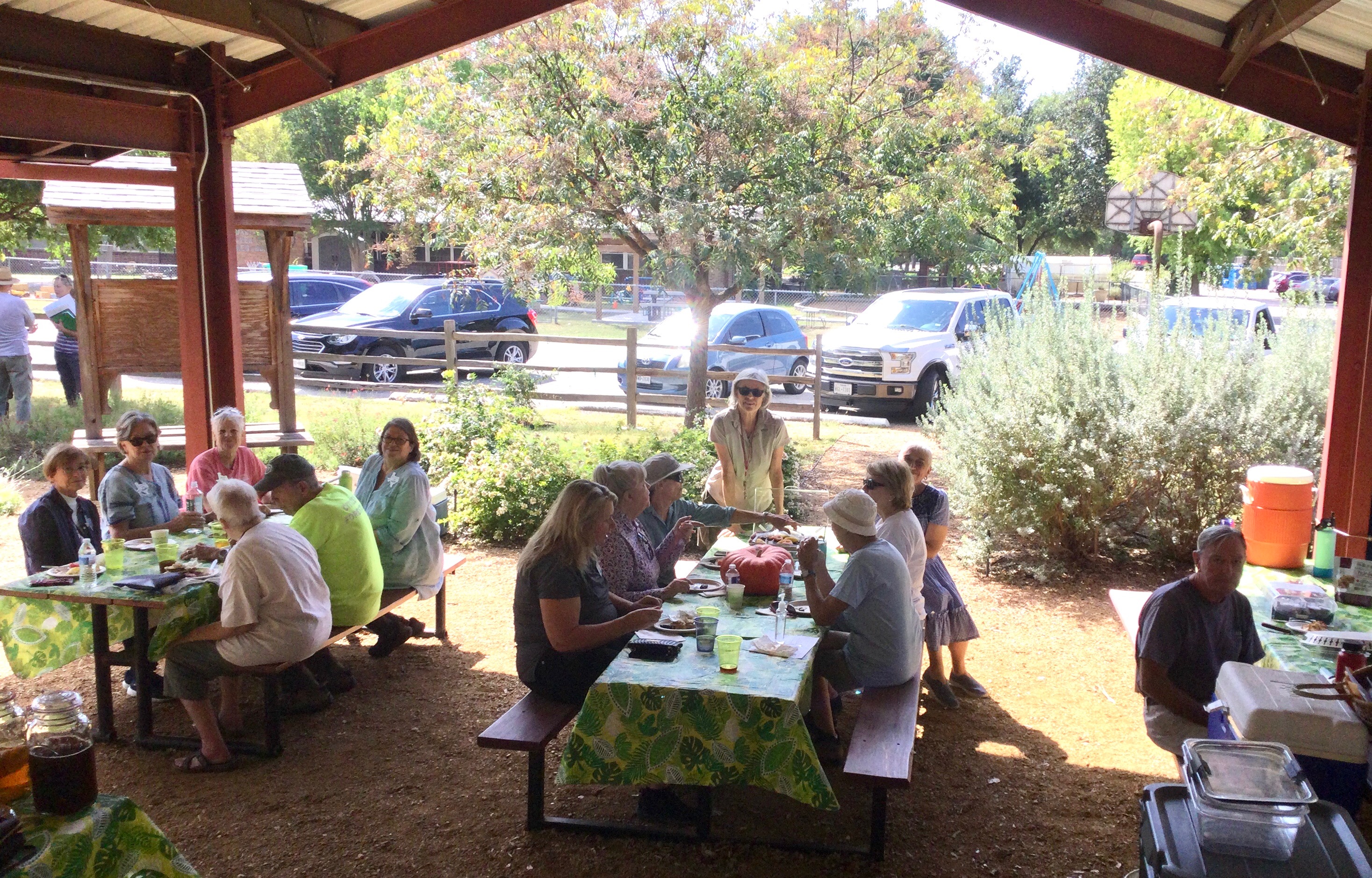
After an especially punishing summer, it was refreshing for Raincatcher’s volunteers to pause and reconnect.
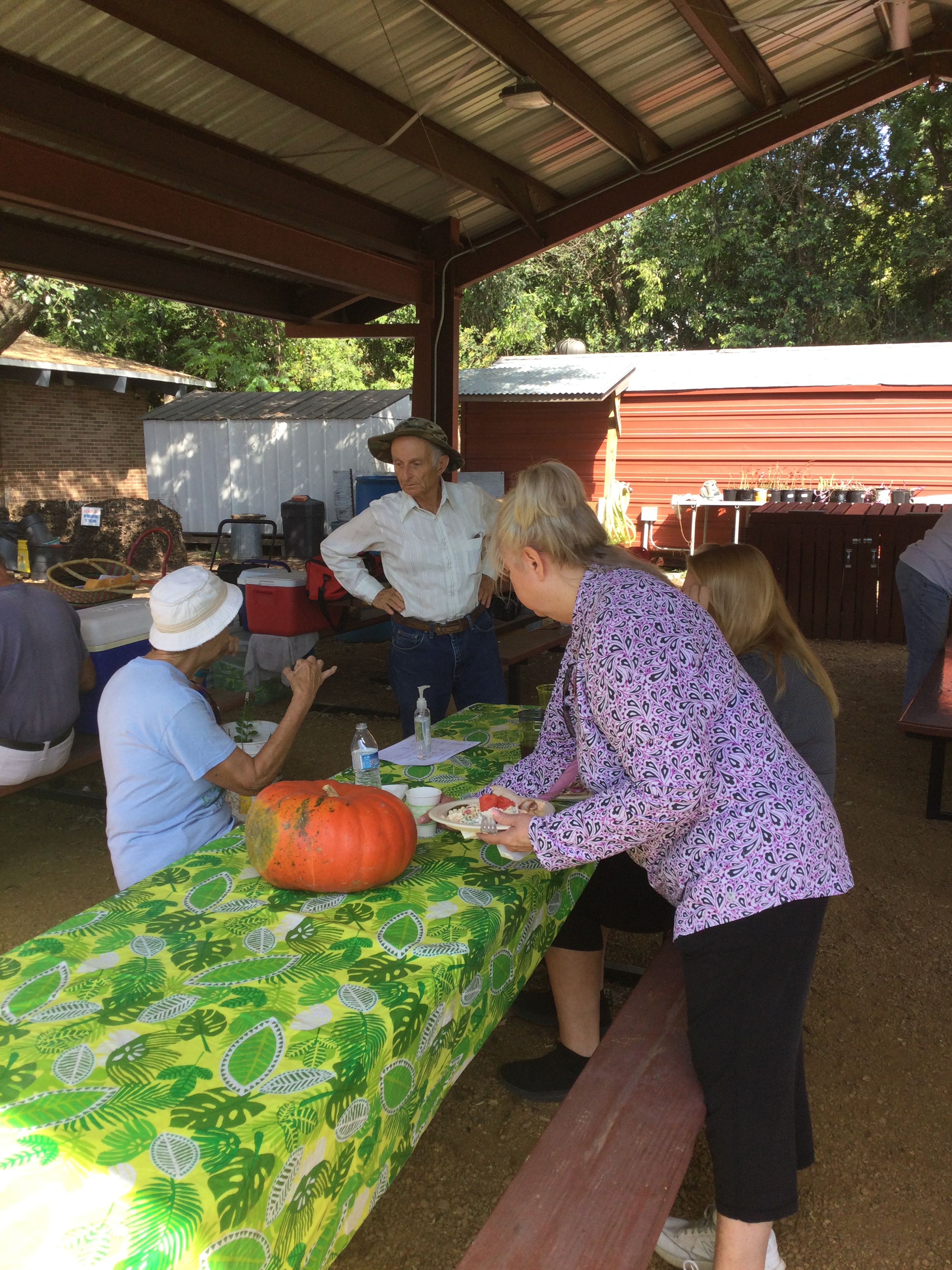
The garden budget including planned improvements was presented by Lisa.Raincatcher’s volunteers gathered for lunch to celebrate fall gardening!
Many of us think fall is the best gardening season of the year. In the north garden we are harvesting okra, peppers, eggplant, long beans, and zucchini as well as preparing space for our new greenhouse.
Don Heaberlin, Beverly Allen and Ann Lamb, Dallas County Master Gardeners compiled this article.
Raincatcher’s pansy sale is November 8th, more information is coming.
Dining locally at Suze restaurant for dinner is something my husband and I enjoy doing a few times a month. So, for my birthday just a few weeks ago, it was my first choice. As always, the appetizers and entrées were superb, but it was the dessert that left us swooning.
Gilbert Garza, our dear friend and chef-owner, said he would be bringing out an “off the menu” dessert for us. He mentioned that one of the ingredients was only seasonally available and in his words, “difficult to get my hands on”. But, as luck would have it, that special ingredient had been delivered to the restaurant earlier in the day.
As we leisurely finished the main course, Gilbert appeared with a bowl of something so intriguing it required an explanation. As told to us by Gilbert, once a year he puts in a request for a very hard to obtain plum from California known as Green Gage Plum. His dessert presentation was an artfully designed bowl of caramelized Green Gage plums warmed and served with house made vanilla gelato, crushed almond tuille and crème anglaise. Freshly harvested spearmint with a splash of balsamic was the final touch. It was a perfectly delicious, light and refreshing birthday treat!
Curious as to the unusually sweet taste of the rather small green plums, we did an internet search later that evening to learn more. The story behind Green Gage plums was fascinating.
‘Green Gage’ Plum (Prunus domestica) produces fruit that is sublimely sweet. They are a naturally occurring hybrid of the European plum, Prunus domestica and P. insititia, a species that includes Damsons and Mirabelles. Possibly, first grown in Iran in ancient times, the plums were spread to early civilizations along the Silk Road. In the 16th century they were planted in the royal gardens of Francis I in France.
Green Gage plums were brought to England by Sir William Gage in the 18th century. The story is told that Gage purchased a tree from Paris and planted it in his home garden. Having lost the label that identified the tree, Gage eventually renamed the tree after himself. Green Gage plums then spread throughout Europe, Asia, New Zealand and Australia.
On March 31, 1773, Thomas Jefferson recorded sending slips of the tree to Monticello. In 1783, he planted twenty-one of these trees in the South Orchard. Records from Monticello show that Green Gage Plum was the most intensively documented variety of fruit that Jefferson grew at Monticello.
In describing the look, texture and taste of Green Gage plums, we found the following information helpful. Green Gage plums are small, averaging 2 to 4 centimeters in diameter with a round, ovate to oval shape, curved shoulders and a slightly flattened base. The plum’s skin is smooth, taut, and thin, ranging in color with variegated hues of green and yellow to gold. Beneath the surface, the flesh is dense, finely textured and succulent, displaying yellow-green hues with a translucent quality.
After finishing every tiny morsel of our dessert, Gilbert brought out a few Green Gage plums for us to sample. We agreed with the vivid description from Specialty Produce…” Greengage plums have a sweet, honeyed and syrup-like flesh with a balanced and ambrosial flavor composed of dried apricot, ripe mango and citrus marmalade nuances.”
Don’t be misled by their green-colored appearance, which is often associated with unripe, sour flavors. What we experienced was an exceptionally sweet tasting plums, both enjoyable and suitable for eating fresh!
An update on our plum journey: The next morning, we ordered two Green Gage plum trees from plantmegreen.com. They arrived last week and are now at home in our Texas garden.
Growing Information
Green Gage Plums can be grown in USDA zones 5 through 9. They thrive in regions with sunny, hot summers combined with cool nights. We followed the planting instructions and placed them in a sheltered, sunny area of our garden with well-draining, fertile soil. We are hoping that the trees will be ready for a bountiful plum harvest by summer to late fall of 2024.
Linda Alexander, Dallas County Master Gardener Class of 2008
What’s happening at Raincatcher’s Garden: We are harvesting okra, peppers, eggplant, black-eyed peas, and long beans. Radish seeds are being planted anywhere there is unused growing space.
Make plans to join us on Saturday, October 14, for a unique day-long educational event sponsored by the Dallas County Master Gardener Association and Dallas College featuring well-known horticulturalists Felder Rushing and Callie Works-Leary. The $20 cost of registration includes lunch. To review the schedule of presentations, to read more about our speakers, and to register, visit dallascountymastergardeners.com. All who love gardening are welcome to attend!
Tomatoes, I owe you an apology. All is forgiven. We had some rain and a mild beginning to the summer. You behaved reasonably under those circumstances and gave us an abundance of delicious fruit. I’m sorry for all the negative things I’ve said about you. I have called you names. I have described you as difficult. I have suggested to beginning gardeners that they avoid you and try peppers instead.
Our biggest problem with you this year was that certain bushy tailed scoundrels found you irresistible even when you were green. That was not your fault. Never fear, we are planning our squirrel defense strategies for next year.
Now our high temperatures are in the triple digits and you have developed blight and begun providing food and shelter to stink bugs. You held out as long as could be expected and for this I thank you.
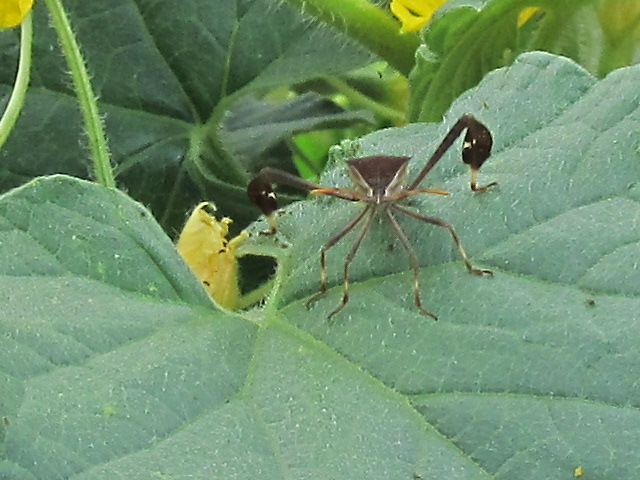
Diane, our photographer friend, snapped this picture of a stink bug. Notice its fierce mustachioed look. It has already begun assaulting our tomatoes.
Tomatoes, despite the pain of previous seasons, I am grateful for what I have learned from you-mostly patience.
Beverly Allen, Dallas County Master Gardener, Class of 2018
If African Blue Basil could speak it might first suggest introducing you to the “parentals”. In this case, that would be a good idea. The African parent is a perennial shrub from forests of Kenya, Tanzania and Uganda.
In 1983, African Blue basil was first seen by a nurseryman named Peter Borchard, owner of Companion Plants in Athens, Ohio. He noticed it growing in the path between beds of the two presumed parents, East African basil and ‘Dark Opal’. Borchard dug the hybrid out and brought it into the greenhouse hoping to save seed. No seed formed leaving Borchard with the task of growing more plants from cuttings. Shortly thereafter, African Blue Basil (Ocimum gratissimum) entered the market.
African Blue basil is now identified as a hybrid plant in the Lamiaceae family made by crossing East African camphor basil and a varietal of purple sweet basil called ‘Dark Opal Basil’. Its strong camphor scent was inherited from the East African basil used to breed the plant. Though some people may find the camphor odor and taste too strong to use in the kitchen, others embrace its culinary uses. While doing morning chores in the garden, the dark purple leaves of African basil tempt me to experience their crisp, semi-chewy and woodsy flavor with notes of menthol, musk and cloves. With a refreshing and earthy taste filling my mouth,it’s time to move out of the way and give the honeybees time to forage for nectar.
Before planting in the garden, familiarize yourself with its specific characteristics. African Blue basil is a rare, aromatic, perennial shrub that can grow up to five feet tall in some gardens. Plants produce abundant flowers that are pink with a dark purple base, making it attractive to bees and beneficial wasps. African blue is one of the few basils that is sterile, meaning it will not produce seeds. Fortunately, this unique trait allows the plant to stay in bloom for a longer season. As with other basils, African Blue does best in well-draining soil amended with compost. Plants thrive in full sun and will form rounded mounds.
Suggestions for cooking with African Blue basil offer a wide range of possibilities. While best suited as a fresh flavoring or garnish, the leaves may also be used in pesto’s, chimichurri sauce, salad dressing and dips or sprinkled over soups, tossed into salads or layered over bruschetta. Also, try it mixed into pasta, spread over sandwiches, used as a pizza topping or for elevating desserts.
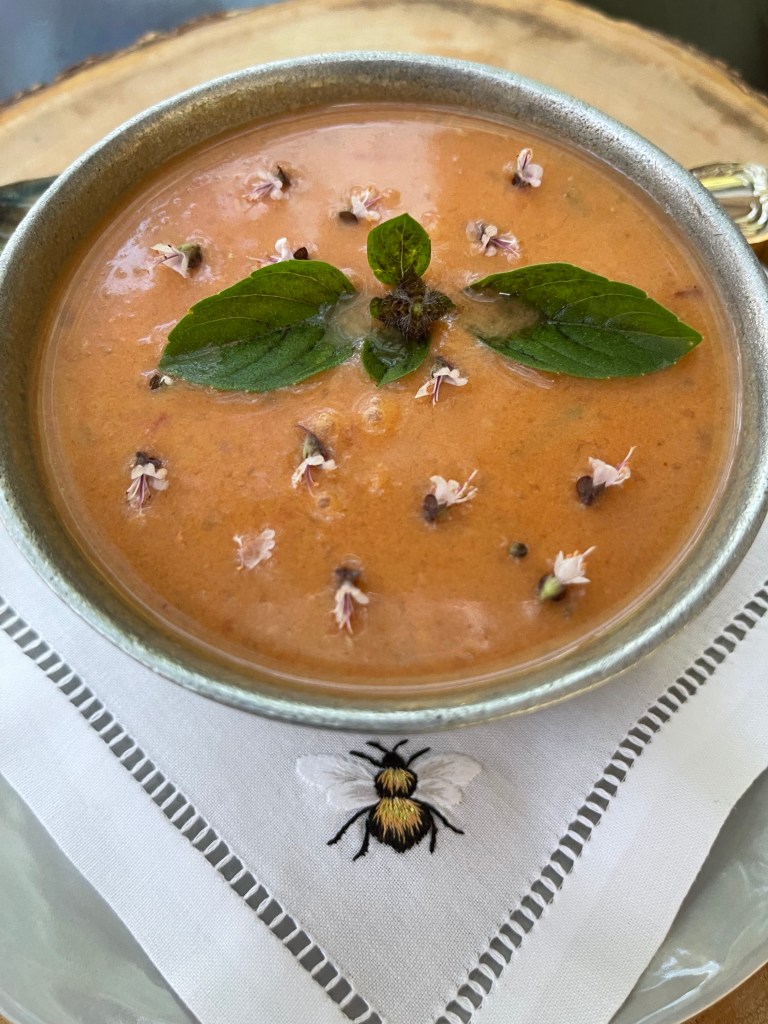
Along with the leaves, African Blue basil flowers are edible and can be used as a garnish in soups, salads and grain bowls.
They can also be incorporated into cocktails, floated on sparkling beverages or stirred into teas. African Blue basil pairs well with parsley, cardamom, ginger ale, champagne, green beans, tomatoes, potatoes, lentils, rice, and feta cheese. For best quality and flavor, use the leaves and flowers shortly after harvesting.
Linda Alexander, Dallas County Master Gardener Class of 2008
Me-Ann at the Ann Norton Sculpture Garden in Florida
Like a bee going from flower to flower for different types of nectar, I am flying all over gathering information from many sources about tomatoes. Last year I learned of a grower, Bobby’s Best. You can find him on instagram-Bobby’sbeststarts.com
Recently he was kind enough to share his compelling explanation of the advantages of using organic fertilizers. Remember if you feed your soil, it will feed you!
You may not be thinking about tomatoes tonight but I am. March 15th is the frost free date for the Dallas area which means it is not likely we will have a frost after that date. However, next week we may have a few low temperature nights so you may want to wait to plant. Regardless of the date you choose to plant, you are going to want to come to our garden on Tuesday to purchase tomato and pepper plants; lovingly started and tended by Raincatcher’s volunteers. See details below. Ann
It’s time to plant!!!
TOMATOES and PEPPERS, TOMATOES and PEPPERS, TOMATOES and PEPPERS
The MG volunteers of Raincatchers at Midway Hills have grown several varieties of tomatoes and peppers from seed and will have them for sale.
Tuesday, March 14th, 10:00 am – 12:00 noon
Courtyard Garden
Midway Hills Christian Church
11001 Midway Rd. Dallas 75229
$2.00 per 4” pot
Cash or Check only, please
Sarah Sanders, Dallas County Master Gardener Class of 2006
Jackie James, Dallas County Master Gardener Class of 1998
Don’t be confused-we have our big plant sale coming up May 4th and will talk it up over the next few weeks.
It was only a few years ago when just an ordinary piece of toast topped with gently smashed avocado became the rage. You’ll find it now on menus across the country from small cafes to upscale restaurants. Everyone seems to have created their own version by using an alphabetical listing of edibles including everything from artichokes and micro greens to tomatoes and tarragon for appeal. My approach tends to be more simplistic in style.
An early morning harvest from my edible garden provides a seasonally fresh selection of blossoms, greens, herbs and vegetables. On Saturday mornings from April until November a visit to our local farmer’s market gives me additional options. Here are a few delicious suggestions that my husband and I have recently enjoyed but be creative with your choices because any combination that pleases your palate is a winner.
Springtime
*Thinly Sliced French Breakfast Radishes, Onion Chives and Nasturtium Blossoms
*Broccoli Florets, Arugula and Mrs. Taylor’s Scented Pelargonium Blossoms
*Thinly Sliced Carrots Topped with Caraway Sprigs
*Swiss Chard Perpetual Spinach and Nepitella Blossoms
Summertime
*Sliced East Texas Peaches and French Tarragon
*Campari Tomatoes Sprinkled with Chopped Balsamic Blooms Basil Leaves
*Sliced East Texas Peaches, Sweet Banana Peppers and Purple Basil
*Armenian Cucumbers with Salad Burnet and Watercress
Avocado toast is something we enjoy for breakfast, brunch, lunch and as a delightful appetizer. For a light summer dinner we often serve it alongside homemade gazpacho or chilled cucumber soup. Our goal is simply to use garden fresh ingredients! The only exception is when I’ve made a visit to purchase fresh eggs from my master gardener friend who raises chickens at her ranch. A delicately fried egg sitting on top makes for a very scrumptious breakfast experience.
**Additional edibles from summer’s bounty will include anise hyssop blossoms, blueberries, shaved yellow crooked neck and zucchini squash, onions, jalapeno and shishito peppers. To complete the flavor kick be sure to consider a sprinkling of these herbs; anise, dill, fennel, lovage, mint, papalo, pipicha, lemon thyme and rosemary or any of your personal favorites.
Linda Alexander, Dallas County Master Gardener Class of 2008