Here at Raincatcher’s, we have a wide variety of demonstration gardens spread all around: we have an orchard, raised vegetable beds, ornamental trees, five types of turf, butterfly gardens, compost demonstrations and even a mixed ornamental bed in the courtyard. But there is one, last, orphaned space; it’s known as the old playground, and in some ways, it’s the church’s secondary entrance. Which means it’s a very visible space that most people walk past and all cars drive by. Wrapped in cyclone fencing, the playground was deemed ‘unsafe’ by regulatory agencies, and had been sitting unused when we moved to the church from Joe Field, the location of our previous garden. We initially used the old playground as storage for all the plants, soil, and other large objects we brought over during our move. Then we disassembled the playground equipment and put it aside, in case we might be able to use it for another purpose.
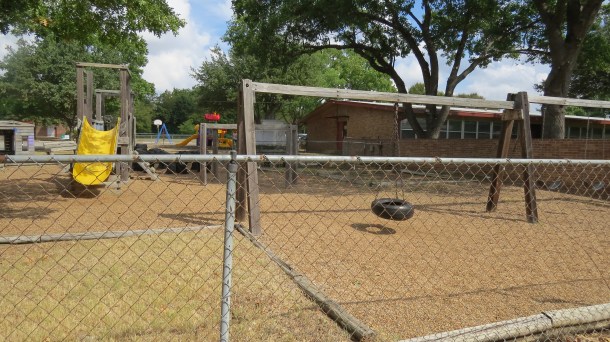
Playground “Before” Transformation
A year has gone by. The gardens have been installed. The plants, soil, and other large objects have been moved into their new homes, and it became clear that the playground parts were not going to be needed. We removed them, and what was left inside the cyclone fence was a greenhouse, the air conditioning mechanism for the church, a couple of compost bins, a chicken coop, mature trees, and the frame for the old swing set. When you step back from that, you realize that the space is reminiscent of what most homeowners have in their own yards: some nice things, some not so nice things, a fair amount of shade, some sun.
What it’s inspired us to do is play. (The space was a playground, after all!) We’re going to be experimenting in this, last, garden, but we’ll be experimenting with a purpose. Over the next year(s?), we’ll be installing an edible landscape in this space, this crowded, pre-owned space with some sun and a fair amount of shade. We’ll be designing around our obstacles, turning them into features, and we’ll make the shade our ally instead of our adversary. We’ll be showing off all sorts of different techniques from hugelkultur to vertical gardening to straw bales to edible flower beds. Some will be raised, some will be inground; everything will be edible. There will be some new crops, variations on common crops, and some old crops with new parts to eat. And so in addition to growing these foods, we’ll also show you how to prepare and eat them.
Why are we going to do this? Because this space has so many similarities to the average homeowner’s yard, it’s a perfect teaching and demonstration tool, and teaching is our mission. Why do it as an all-edible landscape? Because there are many examples of ornamental landscaping, and plenty of examples of edible gardening, but there are not as many of edible landscaping. We’re doing this because people are becoming interested in growing at least some of their food, but are often concerned that it won’t look good, or they can’t because they have too much shade. This old playground gives us the opportunity to show everyone how they can create a beautiful landscape with edibles.
How are we going to do this? We’re going to do this in stages. First, we’re going to start with the hardscape. One of the biggest concerns people have about landscaping with edibles is the aesthetics – whether it’s an overgrown tomato plant, or the fallow season (too hot, too cold to grow edibles) for their climate. To have a beautiful edible landscape, the first thing you need to do is make sure the landscape looks good before any plants are planted. Plants (crops) are the ornamentation on top of a good looking base structure, your hardscape. After all, there will be times when you may not have plants in your landscape; you might have had a crop failure, or have just harvested dinner!
In our next post, we’ll talk about hardscape ‘rules’, and show you how we’ll be incorporating them into our landscape.
Come along and follow our adventures – celebrate with our successes, and learn from our failures!
The Incredible Edible Landscape Team
Lila Rose
Picture by Starla
Note: Lila Rose will be speaking at the Whole Foods at Preston Forest soon about Edible Landscaping. Will add date to this post, so check back with us.
 As with many plants, Tagetes lemmonii is known by so many common names (Copper Canyon Daisy, Mexican Bush Marigold, Mountain Marigold, Mount Lemmon Marigold, tangerine-scented marigold, and Perennial Marigold) that it is almost easier to refer to it by its Latin nomenclature. Yet even its Latin name has a fascinating story behind it.
 There is one word of caution when pruning or working with Tagetes lemmonii. Some people are extremely sensitive to the oils in the leaves and can develop a painful, itchy rash when their skin is exposed to sunlight. Sometimes this rash can continue for several days. Therefore it might be best not to plant Tagetes lemmonii where it can be brushed against, be sure and wear gloves and long sleeves when working with it, or at least wash your skin well with soap and water after handling.
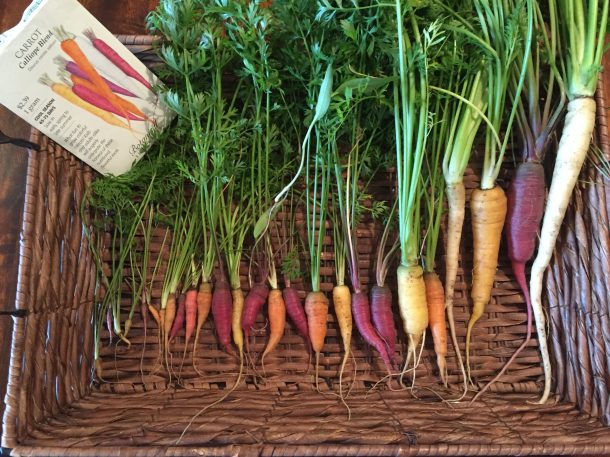
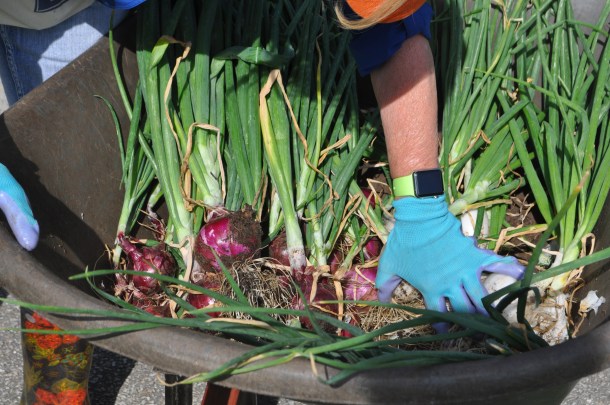
 Broccoli and cabbage went in first along with a few herbs, followed by lettuce and arugula in October. I had some success with broccoli, but not so much with the cabbage, lettuce or arugula ( they bolted). Radishes and carrots were planted from seeds. After the first of the year onions were added and then potatoes came and went (I had the wrong soil, so they never sprouted). There was minimal success with the radishes (not properly thinned), but the carrots – I waited, looking for a glimpse of the carrots(roots)? under the leafy tops — until right before Mother’s day, and then I pulled them. Once again the results were mixed; I had a range of carrots from 1/4 inch to over 6-7 inches long and counted 26 of the prettiest multicolored carrots I have ever grown.