Dallas County Master Gardeners welcome visitors. If you would like to come to our garden at 11001 Midway Road while we are working, come Tuesday mornings. For a planned visit, leave a note in our comment section.
Ann Lamb
Pictures by Starla Willis
Sign up for our Taste the Heat Pepper event. The educational class and lunch will be at our garden on Wednesday, July 28th. Deadline to sign up is Sunday.
Kaleidoscope Garden Glass Ball to be Placed in the New Garden Area
July 16, 2021
The history of a much-loved children’s toy takes us back to Great Britain in July of 1817. British patent no. 4136 “for a new Optical Instrument called “The Kaleidoscope” for exhibiting and creating beautiful “Forms and Patterns of great use in all the ornamental Arts” had just been granted to its inventor Sir David Brewster.
The name is derived from the Greek words kalos (“beautiful”) eidos (“form”) and skipein (“to view”). Interestingly, kaleidoscope roughly translates to beautiful form watcher. From the Brewster Society we discovered this lovely explanation of its purpose. “Kaleidoscopes are portals of remembrance that open onto the familiar, yet unexpected. Allowing the eye to marvel, the mind to explore and the heart to leap, the mirrored tubes of magic have developed into a significant new art form.”
When searching for a more illustrious and descriptive name for our underused Forest Garden bed Beverly Allen, Master Gardener Class of 2018, thoughtfully tossed out the idea of a Kaleidoscope Garden. After spending over an hour discussing the possibility of embracing not only the concept but the practical approach to its design and functionality, we agreed that it would be an exciting project. Here is Beverly’s description of how she views our new garden bed through the lens of the natural world.
“The idea of light diffused through the overhanging oak branches brought to mind a kaleidoscope. We realized this was a good opportunity to use color and pattern to engage the mind and senses. It is challenging to find a variety of edible plants that will look and perform well in a setting that transitions from morning sun on the east end to bright afternoon sun on the west end with deep shade in the middle.
Planning a themed garden is captivating. Stay tuned as we consider the possibilities of such plants as tulips, peonies, lilac, elderberry and a surprise herb we are hoping to feature.”
-Beverly Allen
And so, our newly named Kaleidoscope Garden has been introduced. It will remain as is during the heat of July and August. Moving into September and cooler fall temperatures, watch for an explosion of color and patterns to appear within its borders. We hope you will experience its childlike wonder.
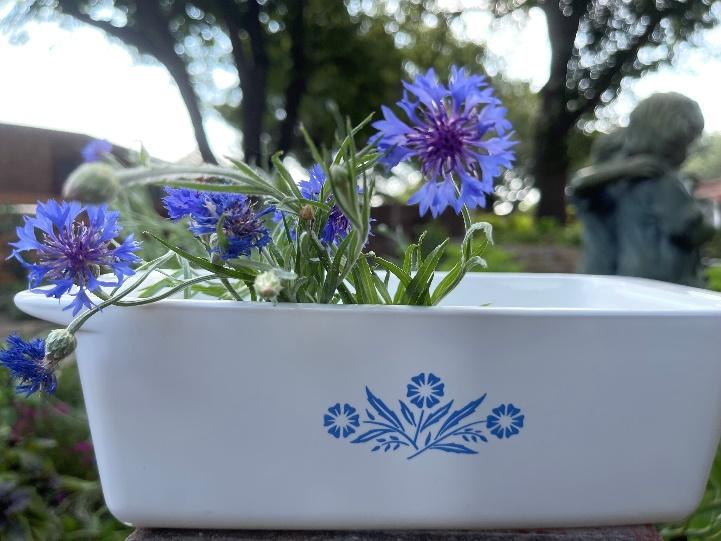
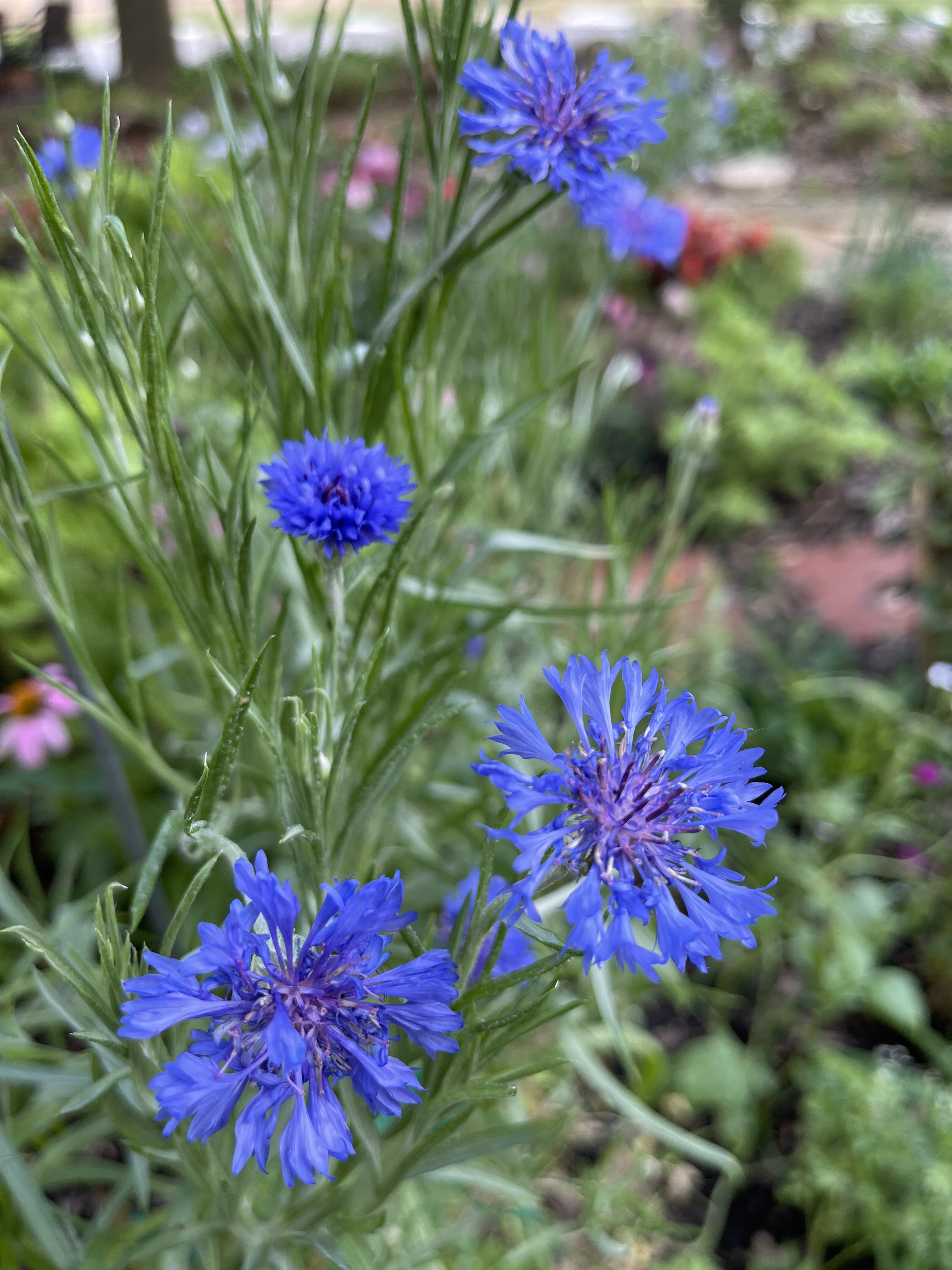
If you are a baby boomer like me, this is probably a familiar dish. Chances are you might have received similar pieces as wedding gifts during the late 60’s – 70’s. I certainly did. And for the early part of our marriage, corning ware was used often in my kitchen. But I never gave much thought to the blue floral design embossed on the side until we started growing bachelor’s buttons at Raincatcher’s in the edible landscape cottage garden.
A quick google search led me to a fascinating story dating back to the time of Napoleon. As Queen Louise of Prussia was being pursued by Napoleon’s army, she sought protection for her children by concealing them in a field of cornflowers. In order to distract them and keep them quiet, she made wreaths from the flowers. In 1871, the year of Germany’s unification, Wilhelm, son of Queen Louise, honored his mother when he made the cornflower the symbol of unity. Later, the cornflower became the National flower of Germany.
The name “bachelor’s button” refers to a time when single men with an interest in a specific woman wore them on the lapel of their jacket. If the flower faded too quickly, it was a sign that a woman’s interest in him was not mutual. Additionally, English maidens wore the cornflower as a sign they were eligible for marriage. If the girl concealed the cornflower under her apron, she had her choice of bachelors.
So, why then, did Joseph Baum, an artist at the Charles Brunelle Advertising Agency in Hartford, Connecticut, choose to feature the cornflower as Corning Ware’s trademark design in 1958? That part of the story seems to have been lost but an endearing answer might be found in the flower’s symbolism. Today, the cornflower symbolizes remembrance, anticipation, fertility, wealth, prosperity, love and the future. Could it be that he was suggesting we should use our lovely corning ware dishes for favorite family recipes that would transcend time? If so, I’m thrilled to still have one of those memorable vintage dishes in my kitchen. And, that adorable blue cornflower emblem on the dish has a new and special meaning for me.
Tips for Growing Cornflowers (Centaurea cyanus)
*To get the most blooms and sturdier stems, plant in a location that receives full sun. (At Raincatcher’s, our cornflowers get a little afternoon shade.)
*If soil is predominantly clay or is sandy, mix in some organic material. We add compost yearly.
*Place plants at least 7 inches apart. Mature growth height is around 15-30 inches.
*Deadhead plants regularly to prolong their flowering periods. For taller species, staking may be necessary. We’ve had ongoing issues with them falling over so all plants are now supported with bamboo stakes.
*Mulch around plants with bark to keep soil moist and to prevent the root system from getting too much sun.
*Regular watering will keep the plants healthier.
*Cornflowers make excellent cut flowers and attract bees, butterflies and other pollinating and beneficial insects.
*Cornflower seeds are easy to harvest. When the seeds are ripe, the seedpods open up. Once this happens, extract the seeds for next year.
*Enjoy the vibrant blue flowers in salads, raw or cooked. Their sweet to spicy flavor will remind you of cloves.
A bit of trivia:
Bachelor Buttons were the favorite flower of President John Kennedy. His son John John wore one at his wedding to honor his father.
And, it has been reported that the most valuable blue sapphires are called Cornflower blue, having a medium-dark violet-blue tone.
Cornflowers Growing in the Edible Landscape Cottage Garden
Linda Alexander, Dallas County Master Gardener Class of 2008
If you are like me, you dread the thought of pests like the squash vine borer invading your garden. Beverly sent this helpful note this afternoon with a few tips.
I have been enjoying the stunning growth of the squash “volunteers” around Raincatcher’s. Last year’s plants dropped seeds that have become this year’s squash plants. Having a big concern about squash borers, I read up on the subject.
It seemed necessary to check each plant daily for the sawdust colored frass (poop) that appears at the stem when the larva is present.
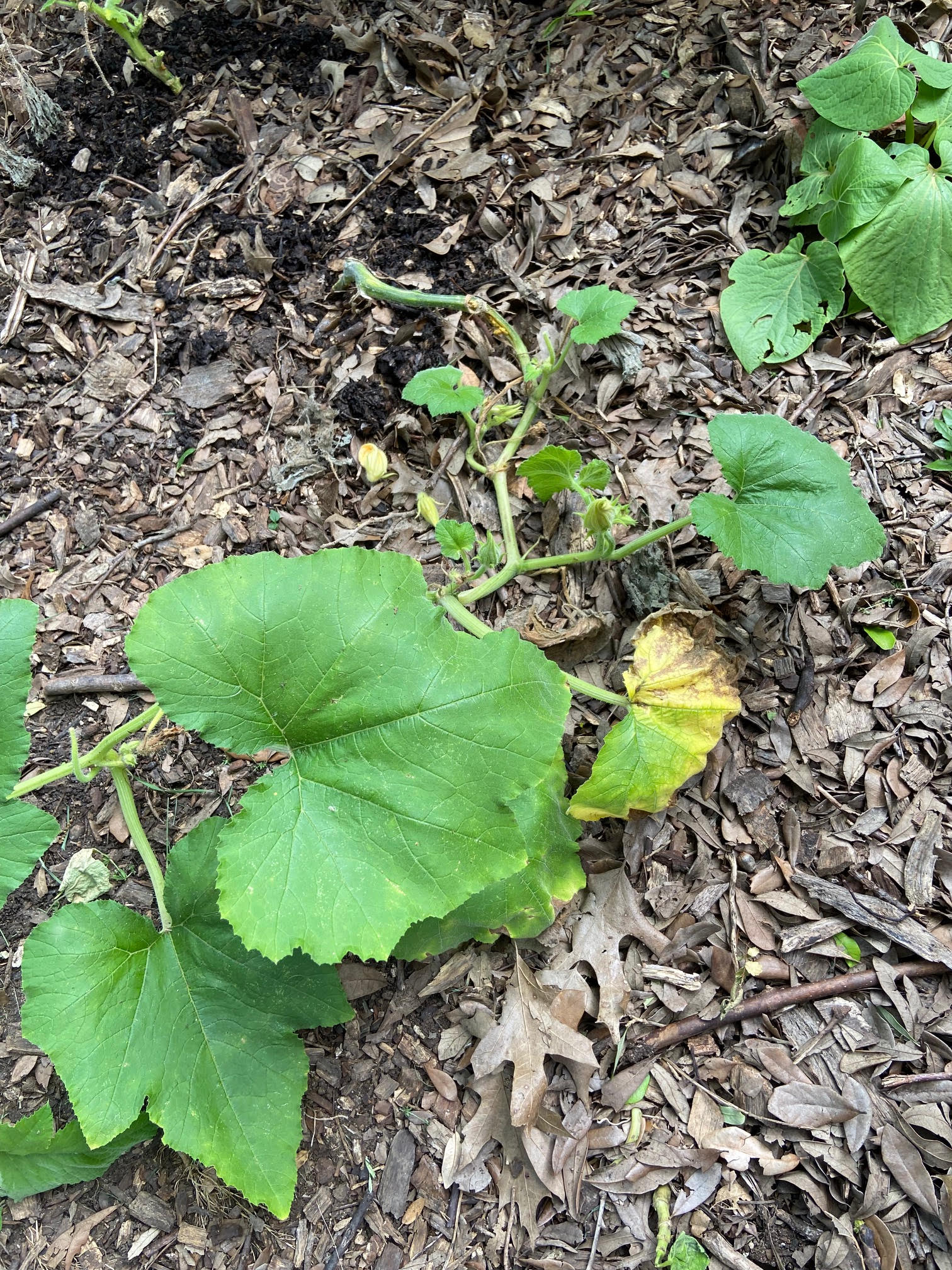
After a week of wondering if I would be able to identify it, eureka! The squash plant below was planted in the Sensory Garden of the Edible Landscape. It went from healthy looking to kind of unhealthy looking overnight.
The next picture shows a close-up of the frass. I removed the diseased section of the plant and replanted the remainder of the squash plant with 3 nodes in the soil.
Extra mulch seems to be helping other squash plants evade the borer so far. Continued vigilance will help us to slow down the squash borer population at least a little bit.
Beverly Allen, Dallas County Master Gardener Class of 2018
Many years ago at our Joe Field Location we had a lunch with every menu item made from squash starting with squash blossoms quesadillas! Links to the articles are provided below.
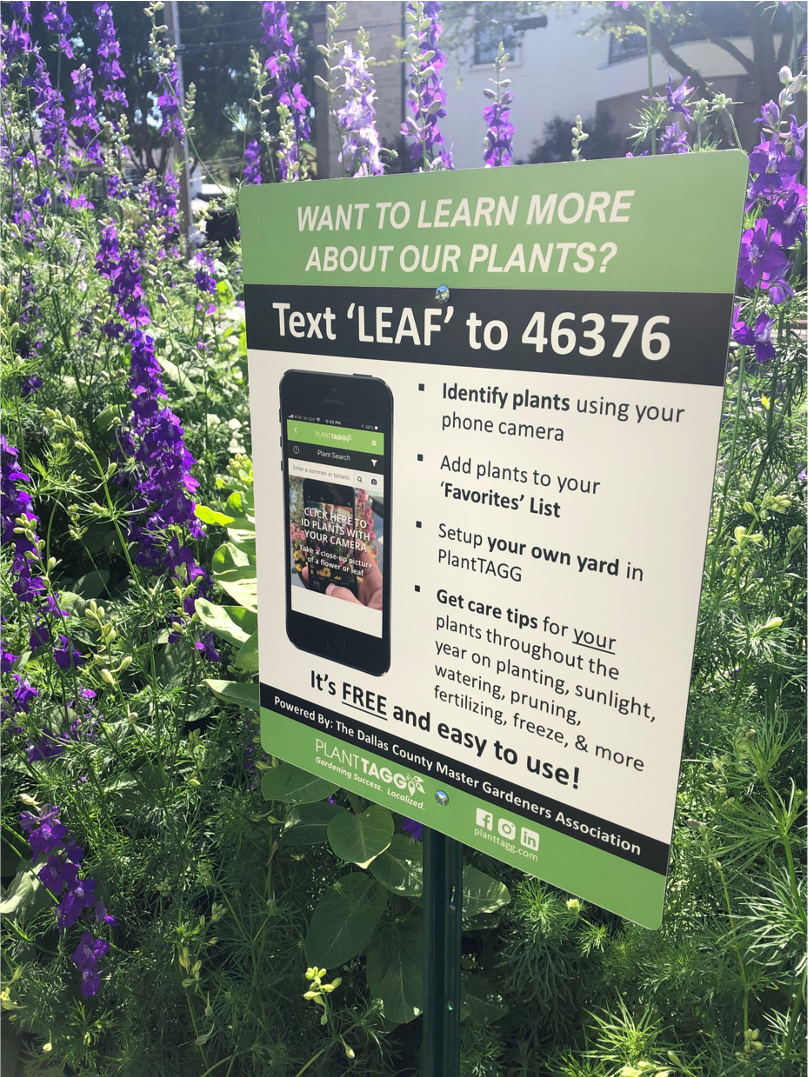
Gardening in North Texas has a unique set of challenges. We know there’s always a story to be told and advice to share, from coping with the scorching, dry summer heat to planting in the unforgiving, heavy clay soil. Part of our mission at Dallas Garden Buzz is to share our journey through the triumphs and missteps of gardening. To that end, we are delighted to announce the new partnership between the Dallas County Master Gardener Association (DCMGA) and PlantTAGG!
What is PlantTAGG?
PlantTAGG is the most technically advanced mobile solution for helping gardeners learn about and care for their plants. It’s FREE to use; and because it’s a web app, there’s nothing to download or install and no credentials to remember. PlantTAGG uses patented formulas to analyze data from NOAA, USDA, Texas A&M AgriLife, and Master Gardeners from around the country. This data is turned into accurate, easy-to-follow plant care guidance localized for your yard and plants.
Beyond the technology, PlantTAGG’s goals to educate gardeners blends seamlessly with the mission of the Master Gardener program. Abbe Bolich, President of the DCMGA, said it best,
“We’re thrilled to partner with PlantTAGG on this exciting new program. Our shared mission to educate the public about best horticultural practices really comes to life in our community gardens with this new mobile experience.”
What does the partnership mean for Dallas gardeners?
This partnership sets the gold standard in gardening by coupling sophisticated, easy-to-use technology with proven, research-based horticultural information for gardeners of all levels. As part of the partnership, we’re rolling out PlantTAGG-enabled gardens across the DCMGA ecosystem – and Raincatcher’s Garden is one of the first to benefit from this new mobile experience.
It’s easy to use PlantTAGG in the DCMGA gardens – as you can see in this quick video:
For now, you can also try the PlantTAGG mobile experience at R&B 1, Bath House Cultural Center, Lakewood Elementary School Gardens, and Plano East Senior High Pollinator Garden. Other community gardens will launch in the coming weeks, including the Texas Discovery Master Gardeners’ Garden.
What’s next?
Come and see us! We’d love for you to visit Raincatcher’s (or any of the DCMGA gardens) and try out the new PlantTAGG-enabled mobile experience.
Thank you, Starla Willis, for the video and Beverly Allen and Sharon L. Wright for teaching us about salad gardening. It is my understanding that your lettuce varieties were planted the first week of March and may last through June.
If you are like me, and hate to see your salad garden coming to an end, make summer plans!
I hear Beverly is trying a heat resistant romaine lettuce from Johnny’s seeds called Monte Carlo. Along with using a location with part shade, she plans to harvest often and early to beat the effects of our summer heat. She also said with this cool spring, there might be time to get one more round of quick growing radish seeds such as Cherry Belle or French Breakfast planted and harvested before summer. Her favorite sandwich consists of thinly sliced radishes from the garden and arugula. Sounds good, Beverly!
More summer salad ideas-Swiss Chard and Malabar Spinach. Buy transplants from your local garden center and put them in your garden when your spring lettuce begins to bolt or turn bitter.
Ann Lamb, Dallas County Master Gardener Class of 2005
Beverly Allen, Dallas County Master Gardener Class of 2018
Here’s more information from Johnny’s Seeds about heat resistant varieties. We can’t vouch for them yet, but plan to try some in our gardens. Dallas Garden Buzz readers, what do you grow for your salad bowl when the heat comes on? We would love to know.
Jewels of Opar, an edible plant and cottage garden favorite
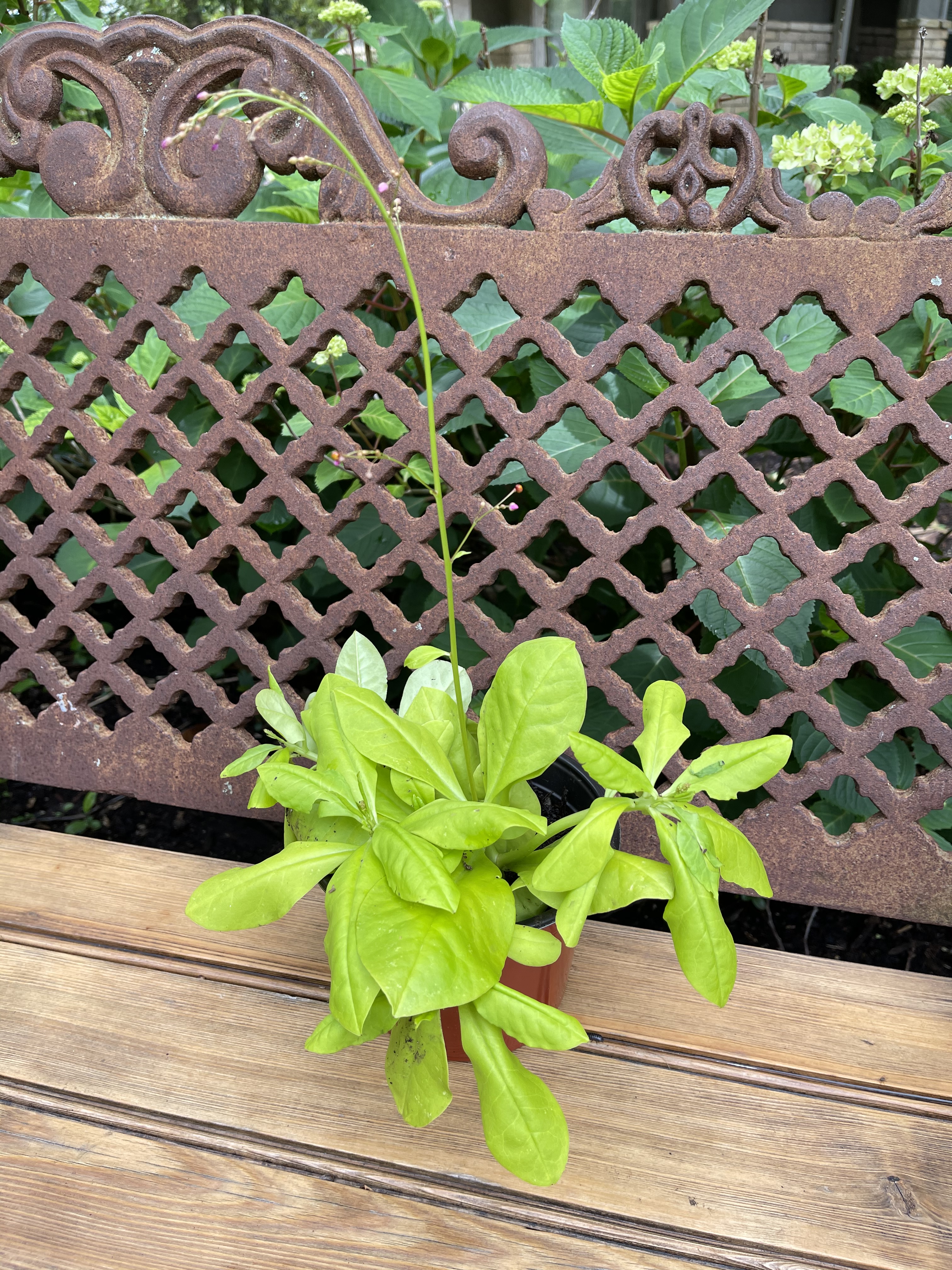
Are you imagining a rare and brilliant necklace worn by a beautiful Persian woman of antiquity? If so, it may surprise you to learn that Jewels of Opar (Talinum paniculatum) is a plant which is native to the New World. My first experience with it was a few years ago when ‘A Year on the Plate’ was being created for the Dallas County Master Gardener Association.
Ann Lamb, my dear friend and one of the photographers for the cookbook, brought a small floral arrangement to the photo shoot for Lemon Verbena Scones. Earlier that morning, she had gone to her yard and gathered up a lovely collection of flowers and herbs. Placed perfectly in an ordinary “ball jar”, its simplicity was stunning. But it was the delicate addition of a branched display filled with tiny jewel-colored balls that caught my eye.
My curiosity led to a discussion of the plant which she quickly identified as Jewels of Opar. And so, the story continues with the gift from her garden and a recently discovered piece of information. True gardeners are always learning about the plant world. And, that information is easily shared through emails and texts or as we are working together in the garden.
Thanks to Susan Swinson, one of the volunteers at Raincatcher’s, we have just learned that Jewels of Opar is also an edible plant. Hooray! Remembering what Ann had told me back in 2016, to “choose your location carefully because once planted, your will always have it your garden”, our “Jewels” is growing in a small, manageable garden bed.
Growth Habits and Characteristics:
*A self-seeding perennial that prefers full sun but can tolerate a small amount of shade during the day. Grows to about 24” tall.
*Does best in well drained soils and is tolerant of poor soils and heat.
*Stunning lime green leaves with sprays of tiny pink flowers followed by ruby-orange seedpods.
*Elliptical to rounded oval leaves are succulent and make an excellent addition to salads and sandwiches.
*Seeds are tiny but nutritious and have recently been compared favorably with flaxseed.If you would like to add this beaded beauty to your garden, stop by Raincatcher’s on Tuesday, May 25th from 9:00am – 1:00pm. We have about two dozen small Jewels of Opar plants ready to be “gifted” on a first come, first served basis.
Linda Alexander, Dallas County Master Gardener Class of 2008
Want to bring some unexpected tastes to your palate? A recent walk around our edible landscape gave us the answer. Yes, we are growing kale for the foliage, chervil for its delicate, lacy leaves and chives to top baked potatoes and egg dishes but many other beautiful spring blossoms offer special gifts not to be missed.
Salads become more vibrant and enticing, soup receives a touch of elegance and lightly steamed or sauteed vegetables sparkle when flower blossoms garnish the dish. We’ve selected ten of our favorite spring blossoms to whet your appetite. Some are familiar, others may surprise you with their distinctive and very pleasant tastes. Enjoy your springtime visit to our garden to catch a glimpse of these lovely blossoms before they fade away.
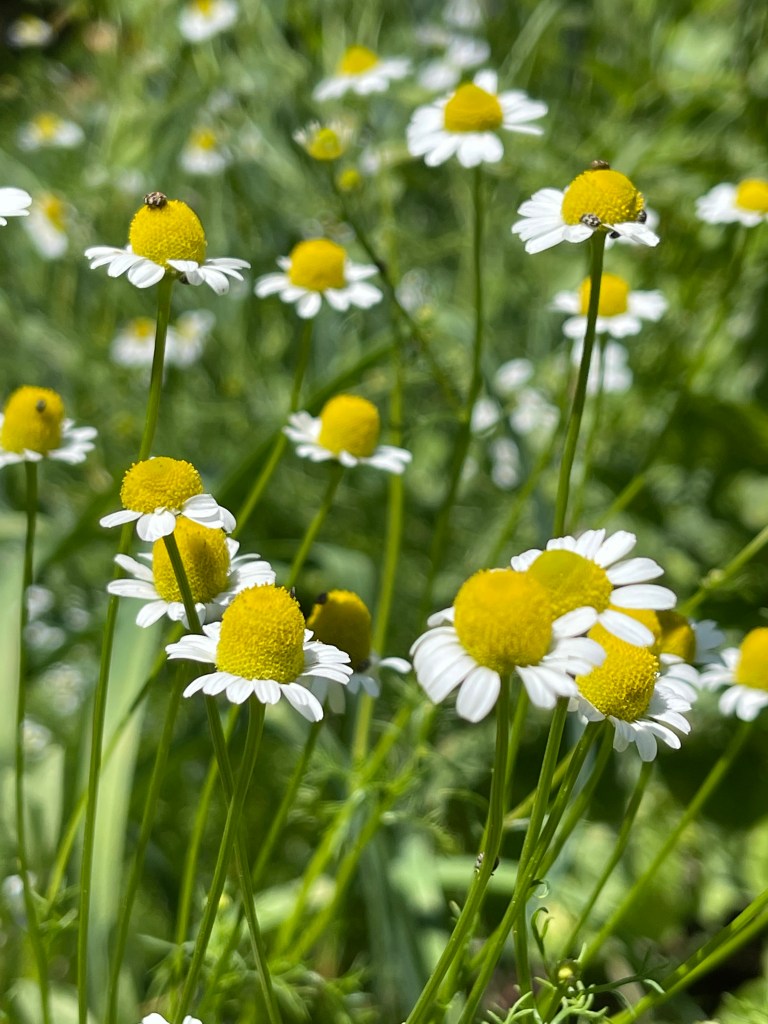
Dainty, apple scented, daisy-like spring blossoms become the perfect ingredient for brewing a cup of German chamomile tea. To make the tea, place 1 tablespoon fresh (or 1 teaspoon dried) flowers in a cup. Pour 1 cup boiling water over the top and steep for 5 minutes. Strain out the petals before drinking or using in a recipe. Let the soothing taste calm and comfort you on a crisp spring morning. Petals can also be used in salads.
#9…Scented Geraniums (Pelargoniums spp.)
At Raincatcher’s we’ve fallen head over heels with scented pelargoniums (geraniums). Their fragrance is so captivating that we’re constantly searching for new varieties. This spring, we’re growing some of the following: chocolate peppermint, lavender, lemon fizz, rose, peach and pink champagne. From smooth-as-velvet rounded leaves to deeply lobed, the foliage of scented pelargoniums makes a lovely statement in the garden. Use scented geranium leaves to lend a nice fragrant addition to cookies, cakes, butter, drinks, and many other types of foods. Garnish the beverage of your choice with a tiny blossom. For a sweet finish, give it a gentle swish in the liquid before consuming.
#8…Chervil (Anthriscus cerefolium)
After the deep freeze of February, chervil gave us a spirit-lifting surprise. Our tender little plants growing in the Hügelkultur stayed nestled in the ground just long enough to survive the bitter cold. Over the past few weeks, we’ve been drawn to tiny white anise-flavored blossoms covering the plants. Harvest chervil blossoms and leaves as close to preparation time as possible. Partner it with eggs, salmon, cream soups, and many classic sauces. Use the blossoms to garnish watercress for a simply divine salad.
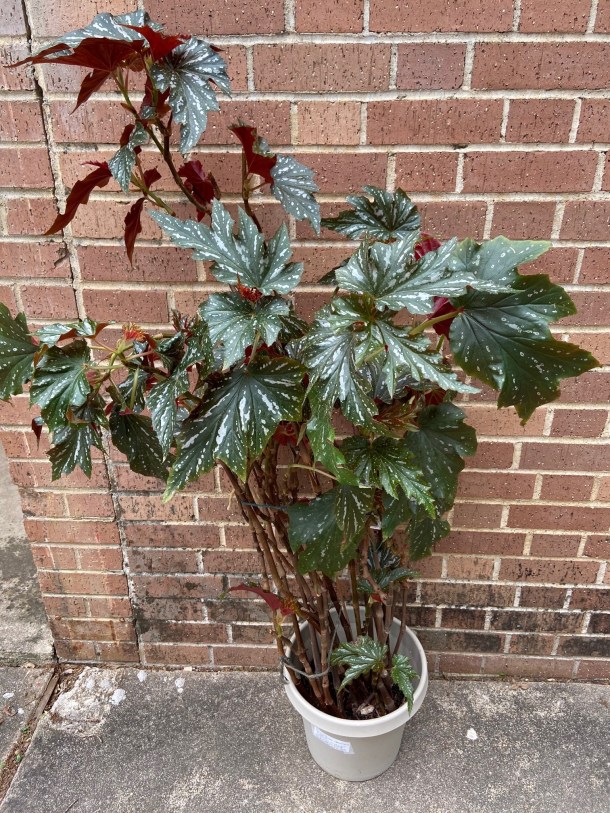
We are growing the wax leaf variety in our Statuary/Cottage Garden. The fleshy leaves and flowers are edible both cooked and raw. In Japan, India and Indonesia they have been cooked up as potherbs. The Chinese use them to make a sauce for meat. Children in northern Mexico and China eat them as a snack. Tuberous begonias are also edible. The flowers have a delicious, light, lemon taste and a crisp texture. We hope to add some in the shady parts of our garden.
#6…Rat’s Tail Radish(Raphanis sativus var. caudatus)
Edible podded radish plants look very similar to traditional radish plants except that the flowers are allowed to go to seed and form seed pods. Rat’s Tail radish is grown for its edible pods. The pods are green and pencil-thin with a smooth, somewhat lumpy appearance. Flowers can range from white to pink and purple and can be added to salads. Pods can be eaten raw or cooked, sliced and added to salads or crudité platters. Because Rat’s Tail radish plants are heavy producers, it’s fun to use both flowers and pods in different dishes.
#5…Kale, Red Russian (Brassica napus)
Kale is typically grown as a leafy green crop. But have you tasted the blossoms? Surprisingly, they are very tender and delicious. And, with the extreme cold in February, it brought out their sweetness even more. If fully opened, use them in salads. If they are still in the bud stage, try adding them to stir fry dishes. Or, after a light sauté, add them to soup or pasta. Other members of the brassica family also produce these tender flowering tops known as raabs. Raab is a tangible, edible sign that the kale (or broccoli or whatever you have) “overwintered” and survived into spring.
#4…Calendula (Calendula officinalis)
With nicknames like pot marigold and poor man’s saffron, you might have missed the opportunity to grow calendula. At Raincatcher’s, we’re thrilled to have it growing alongside the greenhouse beds and in our sensory garden. Springtime is the best time to enjoy calendula flowers in the landscape and, especially, for culinary purposes. Calendula flowers have a spicy, peppery taste that give a nice flavor to cornbread, quiche, ravioli and sweets.
#3…Wasabi Arugula (Diplotaxis erucoides)
If you’re ready for tasting notes of horseradish and peppery aromatics, give wasabi arugula a try. It has deep green spoon-shaped leaves with slightly toothed edges and stems that are delicately crisp. Once it bolts, let the edible flowers attract pollinators or enjoy their tender, tangy bite in salads and as a garnish for your favorite bowl of soup.
#2…Borage(Borage officinalis)
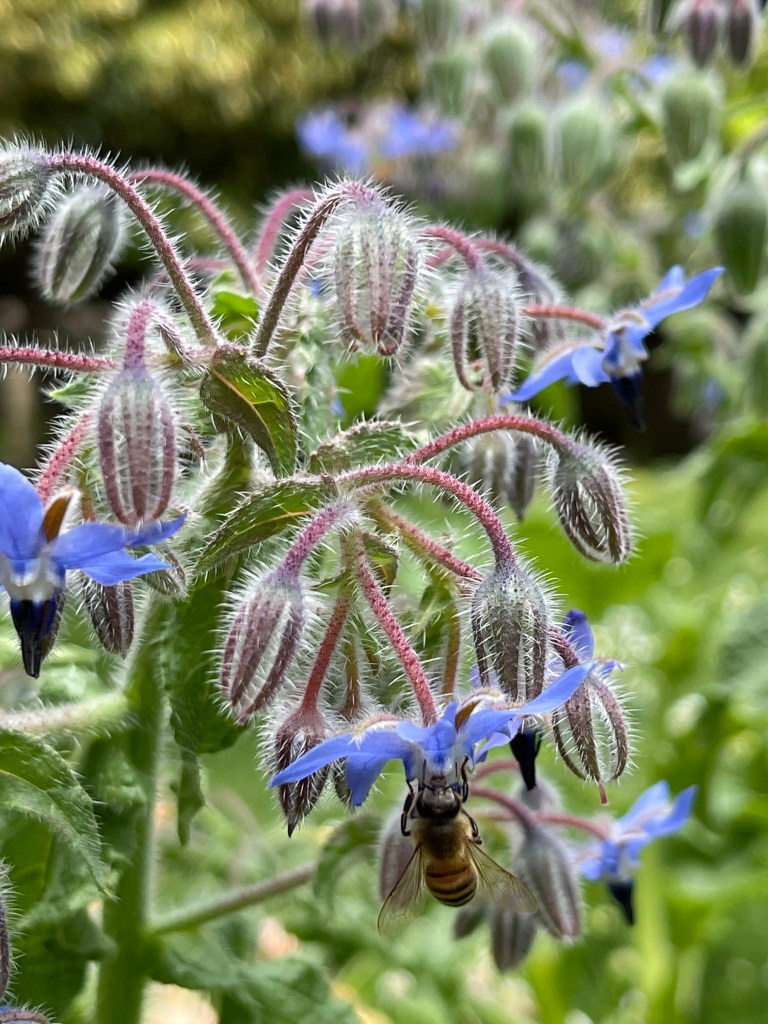
In our crescent bed, you’ll find both white and blue borage in full bloom. Bees are buzzing and can’t stay away from the striking star-shaped blossoms. Borage is an extremely old plant, originating from an area around Aleppo, a Syrian city that dates back to the eleventh century B.C. After spreading to Europe, Pliny the Elder wrote, “it maketh a man merry and joyful.” His comment, along with others, may refer more to the wine it was drunk in than the herb itself. Fresh borage flowers can be used in salads, dips and cold soups as a garnish.
#1…Nasturtiums(Tropaeolum majus)
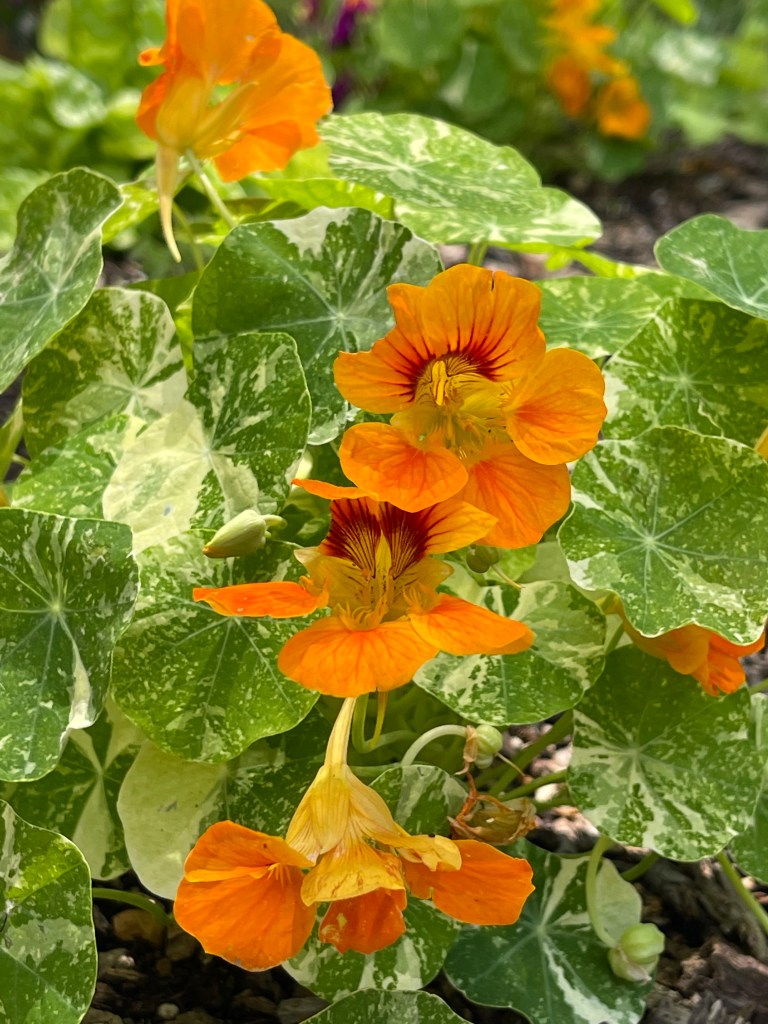
Not surprisingly, nasturtiums are the number one pick in our edible landscape. There are almost a dozen varieties of nasturtium on the market but this year we chose ‘Variegated Alaska Mix’ for our Statuary/Cottage Garden bed. Their unique variegated foliage delivers a colorful display of gold, orange, salmon and mahogany flowers on compact plants reaching about one foot in height. A big attraction for growing nasturtiums is that the flowers, leaves and seed pods are all edible. Their tangy flavor is mustard like with an added perfume and sweetness. (For a special treat, go to our link for Nasturtium Risotto. This incredible recipe includes all parts of the nasturtium plant.)
(FYI…Come back in a few months for our next seasonal look at a Baker’s Dozen favorite edible summer flowers.)
Linda Alexander, Dallas County Master Gardener Class of 2008
Our annual plant sale started many years ago during the time when our garden was on Joe Field Road (too many years ago to remember the exact date of the first sale!). Raincatchers Garden at Midway Hills Christian Church is our home now and we have continued our annual plant sale at our new location. We have always enjoyed having an in person sale on our beautiful courtyard but last year due to the pandemic we put on our thinking caps and came up with a socially distanced, online, drive thru sale. Thanks to all of our loyal customers, it was a great success!
This year, we are happy to announce that our sale will be on the courtyard again. All volunteers are fully vaccinated, masks will be required and hand sanitizer will be available. We plan to limit the amount of shoppers on the courtyard if needed so there might be a short wait directly outside the courtyard before you can start your shopping spree!!!
Now for the fun part – we have tons of decorative planters of all sizes planted with succulents, house plants and a variety of herb pots including pizza pots (a combination of a bell pepper plant with oregano and thyme). We will have a good variety of perennials, annuals, herbs, veggies, and ground cover starting in 4 inch pots or larger. We have apricot trees from Oklahoma and both red yucca and soft leaf yucca plants plus many more plants to numerous to list here. There will also be yard art and when you check out, you can select a packet of free seeds from our garden. However, a photo is worth a thousand words so please check out our slide show below to see a sample of what you will have to look forward to at our sale.
Hope to see you on the courtyard on Thursday, May 13th. More details will follow closer to the date of the sale!
Jackie James Dallas County Master Gardener Class of 1993
Sarah Sanders Dallas County Master Gardener Class of 2006
Please thank Beverly Allen for this preview of some of the plants that will be for sale:
If the title sounds like the name of a new novel, continue reading for a charming introduction into an often-forgotten herb, sweet woodruff – Waldmeister (Galium odoratum formerly known as Asperula Odorata.) According to German folklore it is known by many sources as master of the woods. Delving deeper into its history and uses, you may want to obtain some quickly for a refreshing sip of Maiwein to celebrate May 1st.
In the edible landscape we chose sweet woodruff because it is an ideal herb to use for planting under trees and along shady walkways. With its whorls of emerald green leaves and white starry flowers, it is a welcome sight in late spring while the foliage is attractive all season long.
Sweet woodruff prefers a rich, loamy, well-drained slightly acidic soil but tolerates both sandy and heavy, alkaline clay soils. The shady side of our hügelkultur bed provides it with an optimum growing environment. It typically grows to about a foot tall and spreads indefinitely by stringy yellow underground runners. In our Zone 8 climate it is considered an evergreen. A light covering of mulch this winter helped it survive during the freeze.
The German name, Waldmeister (master of the woods), reflect its habitat, the common name bedstraw, applied also to other members of the genus, refers to its use. During the middle ages it was used as a fragrant strewing herb and mattress filling. When dried, the leaves smell pleasantly of new-mown hay, honey and vanilla.
Maiwein Garnished with Strawberries
Today, sweet woodruff is probably best known as an ingredient of German May wine. It is traditionally drunk on May Day both to welcome the season and as a spring tonic. Follow this simple recipe for a refreshing sip of an historical beverage. The recipe was taken from a German Culture website which specified that only the tender, young leaves should be used in this drink, before sweet woodruff is in bloom. As you can see from the photograph, our sweet woodruff fits that description, so we are ready to enjoy a glass of Maiwein on Saturday, May 1st!
Sweet Woodruff Wine
Ingredients
1 bottle dry German Riesling
7 sprigs young sweet woodruff
Instructions
Tie the stems of the woodruff with a string and stuff it into the opening of the wine bottle, leaving the string outside the bottle. Let it soak for 15-20 minutes. Remove the bunch and serve the wine chilled. Note: Germans like to garnish the Maiwein with fresh strawberries and mint.
Here is a link to a wonderful recipe for Creamy Maiewien cake: gathervictoria.com.
Linda Alexander, Dallas County Master Gardener Class of 2008
















 DALLAS GARDEN BUZZ