Make plans to join us on Saturday, October 14, for a unique day-long educational event sponsored by the Dallas County Master Gardener Association and Dallas College featuring well-known horticulturalists Felder Rushing and Callie Works-Leary. The $20 cost of registration includes lunch. To review the schedule of presentations, to read more about our speakers, and to register, visit dallascountymastergardeners.com. All who love gardening are welcome to attend!
Old sayings are so often true and in the garden this summer, there is no doubt at all.
No way, is this post full of cheer, the summer is miserable for gardeners and plants alike. But as always we can learn a lot and really we have to. Like it or not gardens are just essential for birds and lizards and insects of all sorts. They count on plants for their very life—and what would a gardener be—without a garden —so what to do?
Don’t forget about grasses. This is seep muley, not dramatic but looks good in a quiet way.Common Mullein has lots of bad habits but don’t overlook all the good ones.
Observation comes to the rescue and brings a bit of joy and hope. Some plants are holding on—and even blooming—if not right this minute they are planning to—soon. These are the plants we must remember, be sure to plant again for the next summer—which we sincerely hope will be more pleasant but –we can’t count on it.
Mealey blue sage is a self seeder, sometimes too much, but tries hard and what lovely color in hard times.When plants self seed, they find what works for them and are often far healthier than the ones planted by us.
Some of these plants are not the most spectacular but they are lovely in their own right and most important provide essential nutrition for the little lives counting on the garden. Fennel is a host plant for black swallowtails, plus we can enjoy using fennel and it is still alive.
Carry on watering mulching deadheading and trimming—it honestly isn’t so bad early in the morning. But don’t stop there. Take pictures make notes do what it takes to keep the plants that are surviving and even succeeding in your garden in your mind. That way there will be less wasted work and money next year. Sadly of course remember also what failed miserably. When the going gets tough—some plants just give up. More than likely not their fault at all they just were never intended for this weather. Best to face it and remember it clearly.
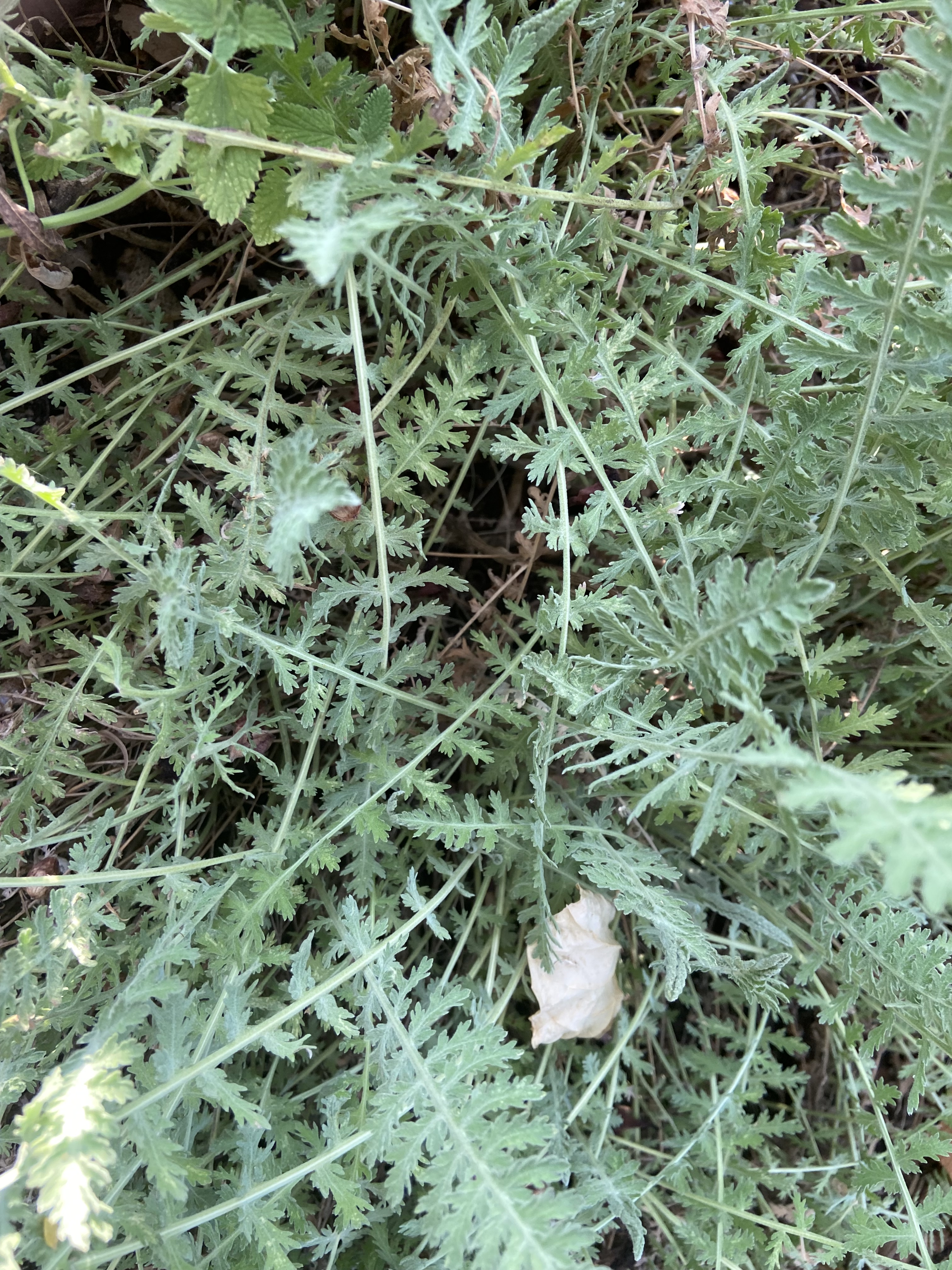
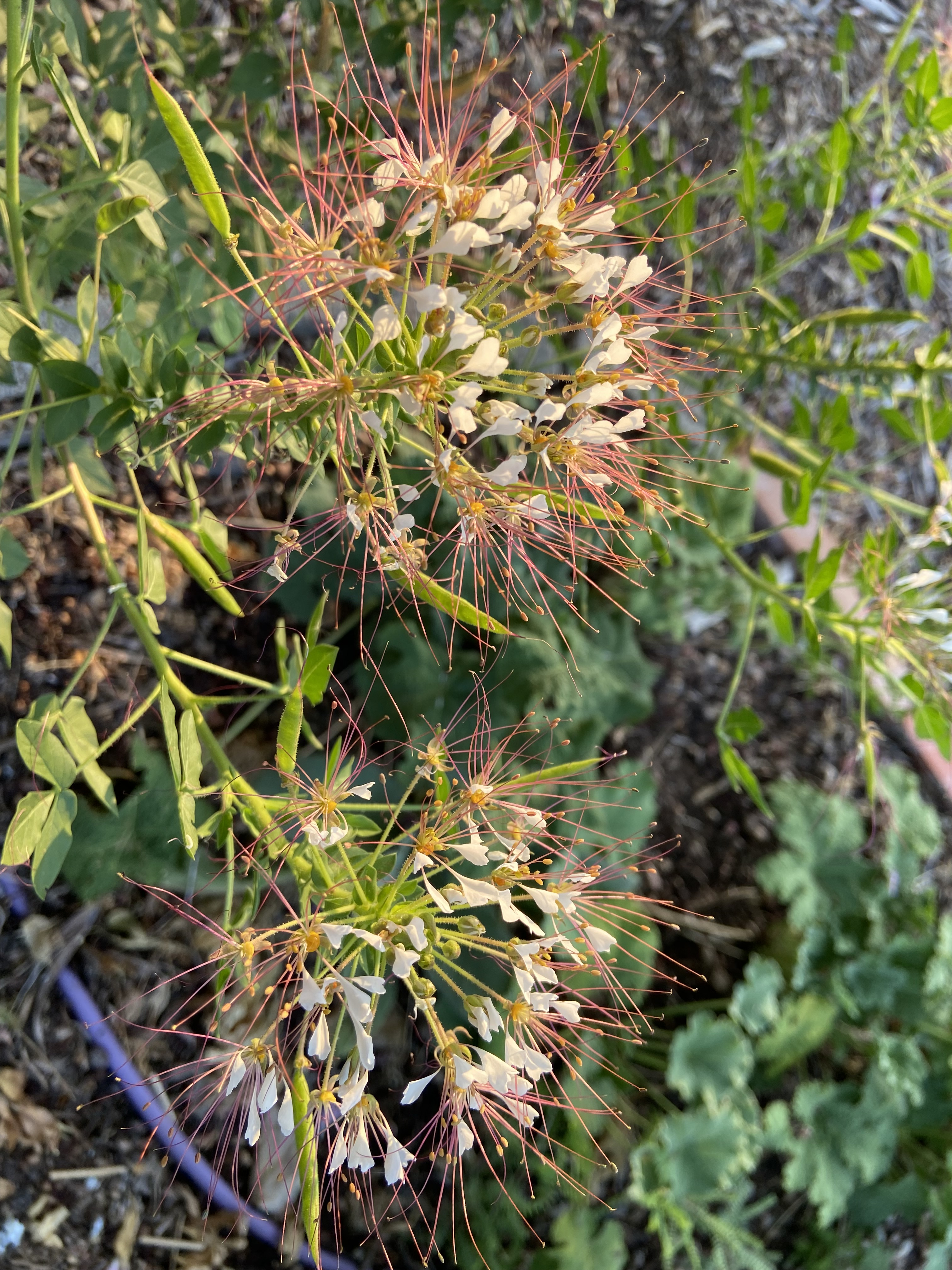
Yarrow, not blooming, but healthy and will bloom again when the time is right.Candelstick trees seend themselves then send down roots before they grow tall. This is a great plant for dealing with adverse conditions.Amaranth has a long history of living in hot places.Clammy weed doesn’t give up. This plant is in a little shade which helps.Tithonia requires upkeep but it’s worth it for flowers in serious heat.
Hope isn’t the best strategy for the summer garden –at least around here. Look at what works in your garden and in gardens you visit, Raincatcher’s welcomes visitors any time. Tuesday mornings there will be gardeners available to answer questions. You might even enjoy summer gardening!
Make experience; even of this dreadful summer—count for knowledge of what works—and what doesn’t. That will make us all better gardeners!
Susan Thornbury, Dallas County Master Gardener Class of 2008
You’ve probably noticed them in numerous landscapes across the metroplex. Their bold, bodacious, fluffy flowers create an eye-catching spectacle in the garden. They grow tall and strong in almost any type of environment from morning sun to full sun, dappled shade to mostly shade. How can you not love those dramatic blooms that hang around from late June until mid-October with colors ranging from lime green to creamy white to dusty rose and sometimes burgundy?
Of course, this proven winner beauty is the plant known as ‘Limelight’, Hydrangea paniculata. It’s a unique hydrangea that has literally revolutionized landscaping across North America. Mine were planted in a backyard bed flanking our fire pit area about a year ago and I am still captivated by their huge, football-shaped irresistible flowers. During periods of extreme heat (100 – 110+) as we’ve experienced most of August, blossoms will go through a time of weeping and loosing their vibrancy. Just hold on until September when a refreshing rain will perk them up!
Driving around neighborhoods in our area and beyond, I’ve seen them used in some pretty imaginative ways: as a showy flowering hedge to screen off those unsightly air conditioning units, in circular beds surrounding old, stately live oaks, and in large entry way stone containers welcoming guests to a front door.
For me, the real bonus is found in the drama they bring to floral displays in my home. When height is needed, Limelight stems are snipped close to the ground and used in long, slender vases. Shorter stems can be carefully arranged in floral foam for a low-profile option. Placed in the center of a dining room table set for dinner with guests or gracing a cherished antique entry chest they never fail to lend an air of elegance to any room.
Another summer flower that goes into my garden around mid-April and stays until late October is the showy, colorful little darling known as Pentas (Pentas lanceolata). Did you know that they are also known as Egyptian stars for the bloom’s five-pointed petals?
Pentas color palate offers gardeners a profusion of jewel tones that range from white to pink, red, lavender and purple. Across Dallas you’ll find everything from single tone beds to the most stunning mixed combinations of two, three or four colors. The possibilities are endless with pentas filling both in ground beds and gorgeous containers. Each year I like to experiment with a different color combination. So far, my favorite is pink, purple and red!
Some of the perks for growing pentas include:
*Pentas are low maintenance plants. Give them plenty of water, sunshine and heat and they will perform beautifully and reward you with an abundance of flowers.
*They are not prone to many diseases.
*Once in the ground, their blooms continue until a cold snap or light freeze. In Zone 8 we get to enjoy them for around six to seven months.
*Pentas can be enjoyed as cut flowers for your indoor arrangements.
*Bees love pentas!
FYI…After taking so many photos of limelight’s, I’ve observed that when the temperature soars to 100+ degrees they tend to do best with some afternoon to evening shade. The limelight’s flanking our firepit are covered with shade starting at 3:00pm and continuing for the remainder of the day.
Limelights in the Spotlight and Pentas on Parade
Linda Alexander, Dallas County Master Gardener Class of 2008
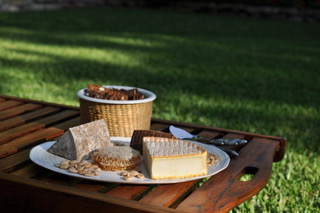
In 2016, a wonderful new cookbook was published by the Dallas County Master Gardener Association. The title was ‘A Year on the Plate’. One of the cookbook committees’ favorite photographs was taken late in the afternoon with long shadows stretching across the yard as sunlight drifted slowly behind the trees. The dish to be photographed was from the honey section of the book. It was a charcuterie board featuring an assortment of salty cheeses and nuts with a lovely round honeycomb serving as the main attraction. Looking through several options, we were thrilled with the dreamy look of one particular photograph that captured the essence of our star ingredient.
Since that day over seven years ago every imaginable type of charcuterie board has been created. And, as you might have guessed, each one is almost always designed around a honeycomb. Carefully cut and oozing with sweet honey, it is a magical gift of nature that comes from honeybees. During the months of July and August, we’ll take a look inside the hive to discover some of the most amazing facts about honeycomb construction and why it is considered to be the building block of the hive.
What is honeycomb? Honeycomb is a cluster of repeating hexagonal beeswax cells made by honeybees and used for raising brood and storing honey and pollen. Honeycombs store honey because honey is valuable to bees. It feeds their young and sustains the hive.
Why are honeycombs constructed using the hexagonal shape? First consider spheres, pentagons and octagons. All of these produce gaps. Bees are efficient creatures so anything with gaps isn’t the answer. As it turns out, there are only three geometrical figures with equal sides that can fit together on a flat surface without leaving gaps: equilateral triangles, squares and hexagons. So, which one is best? It’s a very old question and one that a Roman soldier/scholar/writer named Marcus Terentius Varro proposed an answer to in 36 B.C. Ever since then, Varro’s answer has been referred to as “The Honeybee Conjecture”. Simply stated, he thought that a honeycomb built of hexagons could hold more honey and, maybe, hexagons require less building wax. Why is the issue of wax important? It takes thousands and thousands of bee hours, tens of thousands of flights back and forth to the foraging source to gather nectar from countless flowers just to start the process of building a honeycomb. Is it, therefore, reasonable to assume that bees want a tight, secure structure that is as simple to build as possible?
As was eventually determined, compactness matters. The more compact your structure, the less wax needed to construct the honeycomb. Wax is a precious material. A honeybee must consume about eight ounces of honey to produce a single ounce of wax. It is an accepted fact that the hexagon shape uses the least amount of wax. Additionally, years and years of research have demonstrated that honeybees use the shape of their bodies as rulers to build each cell exactly the same. Even Charles Darwin himself once wrote, the honeycomb is a masterpiece of engineering. It is “absolutely perfect in economizing labor and wax.”
Linda Alexander, Dallas County Master Gardener Class of 2008
July is National Ice Cream Month and July 16th is National Ice Cream Day. Thomas Jefferson is credited with the first ice cream recipe, read the cold, hard facts here.
If you love homemade ice cream on a sizzling hot summer day, Blueberry Honeycomb No-Churn Ice Cream is a super easy treat that will take you into dreamland!
Beginning this month, dallasgardenbuzz.com will introduce a new idea which allows the natural world to speak to us as seasons change and our gardens evolve. Once each month, we hope to share with our readers the joy of using seasonal gifts from the garden in floral displays, arrangements and more.
Look for fresh and innovative ways of gathering unusual combinations of flowers, herbs, branches and other natural ingredients to display in your home. Let creations from your garden bring happiness to a friend, neighbor or family member. Embrace a mindset of filling your life with beautiful gifts from the garden every month of the year.
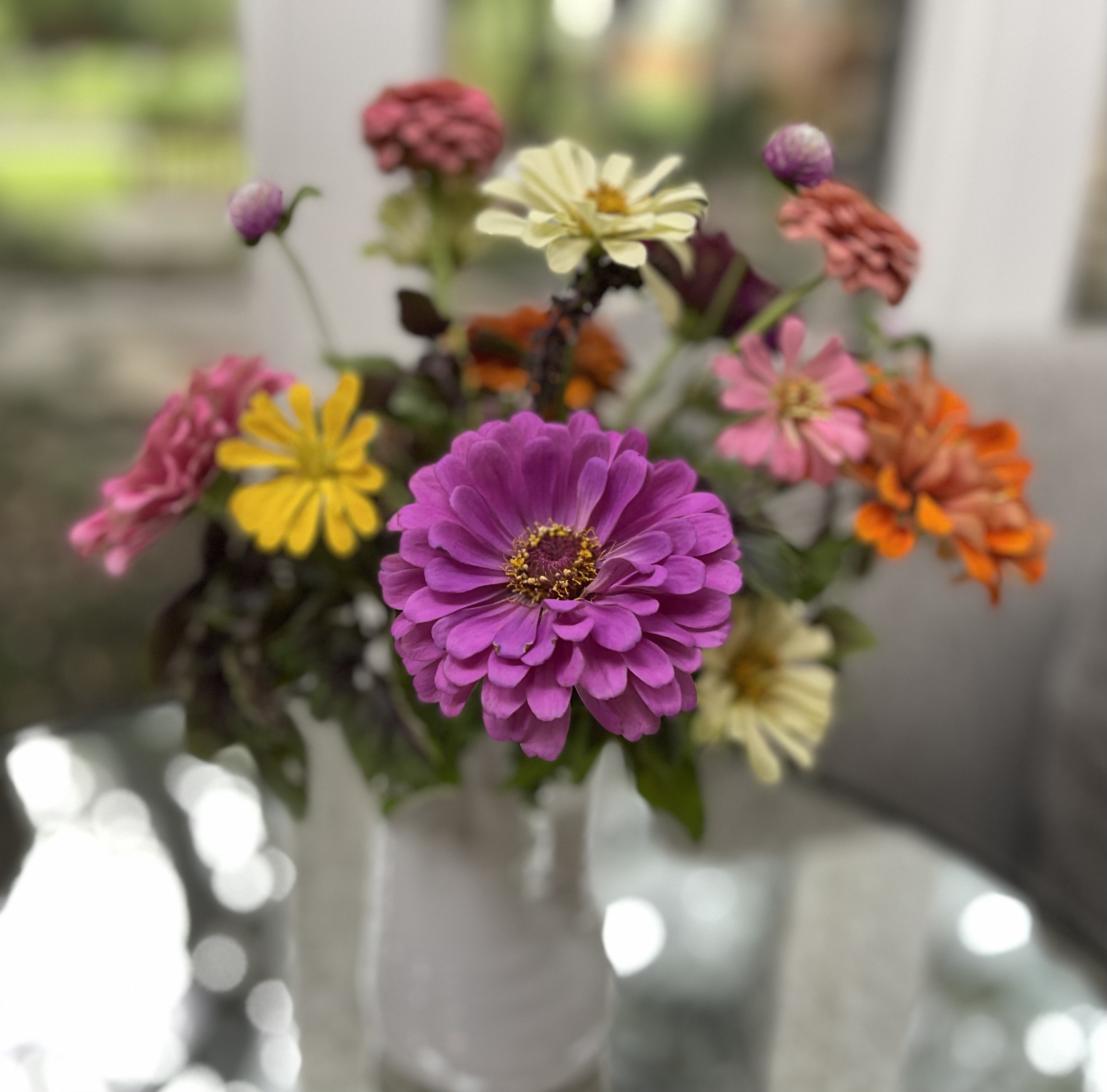
To start, we’ll begin with a quintessential summer flower – zinnias! Offering one of the most colorful palates found in the garden, zinnias bold and bright blooms range from white to orange, pink, yellow, purple and red. We’ve chosen to combine our blooms with another plant that is thriving in the Dallas heat – basil.
With dozens of varieties to consider, two types currently growing in the garden were the perfect complement to our monthly arrangement. Basil ‘Wild Magic’ is a robust grower with purple/violet flowers and dark green leaves with purple margins. For leaves with an even deeper purple presence, ‘Red Rubin’ also adds an aromatic touch to arrangements.
If a compact, tight arrangement seems a little too crowded, consider going in a different direction. Give each zinnia space to breath while making its own individual statement. A flower show judge might suggest that a more open design reflects the natural habit of flowers growing in the garden. In this type of arrangement, there’s plenty of room for “a butterfly to move from bloom to bloom”.
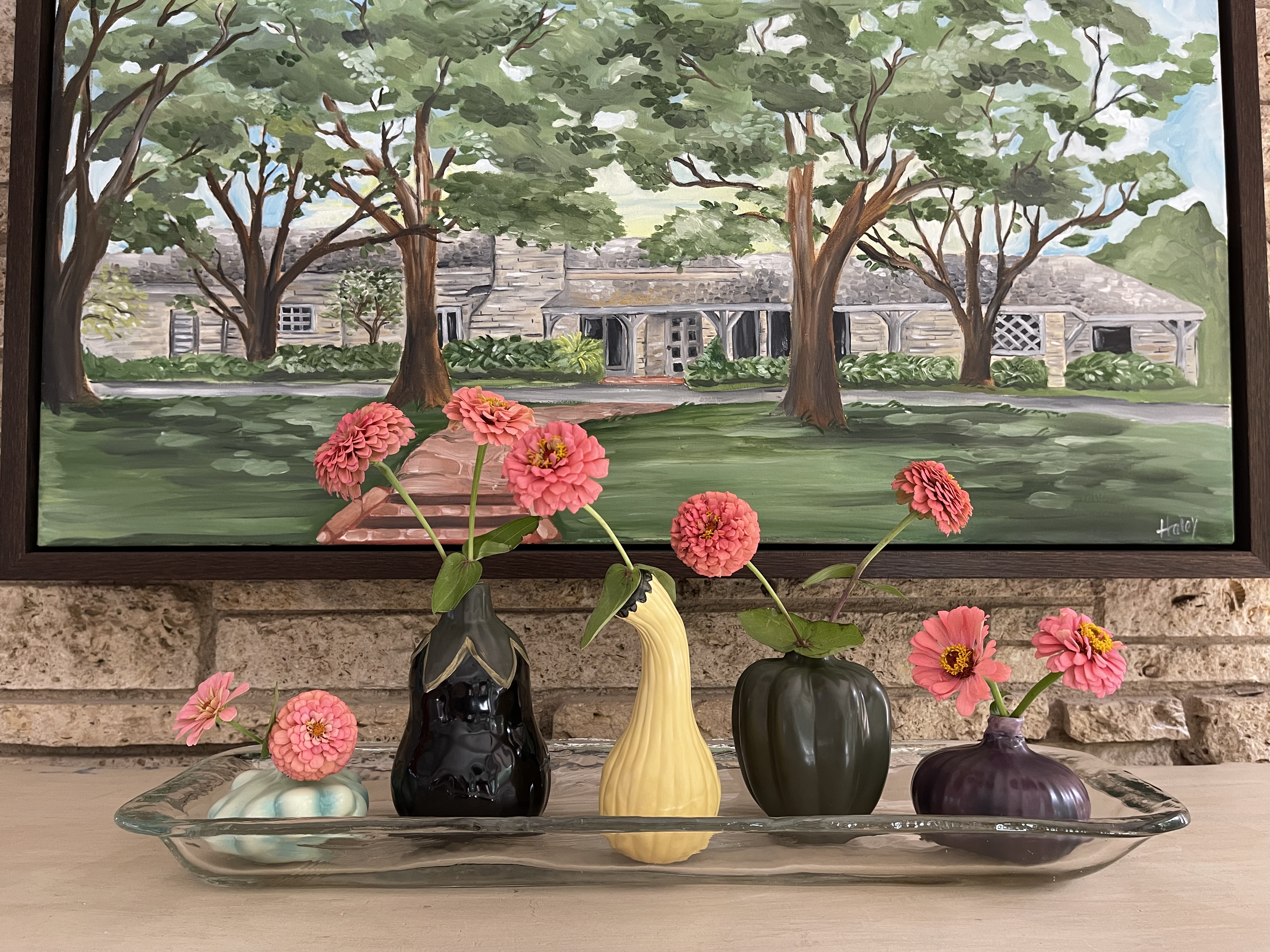
And finally, for a moment of simplicity, use individual blooms as illustrated in this arrangement. A collection of vintage ceramic vegetable vases sitting under an oil painting of our house needs only a delicate touch to enhance its beauty. The soft tones of puffy little salmon zinnias are the right choice!
Our promise to you is that all of our displays will feature botanical material growing in the home garden. In other words, these are not flower shop creations. We want you to be inspired and encouraged to appreciate the simple elegance of using gifts from your garden to bring a touch of beauty and charm to everyday life.
Linda Alexander, Dallas County Master Gardener Class of 2008
Tomatoes, I owe you an apology. All is forgiven. We had some rain and a mild beginning to the summer. You behaved reasonably under those circumstances and gave us an abundance of delicious fruit. I’m sorry for all the negative things I’ve said about you. I have called you names. I have described you as difficult. I have suggested to beginning gardeners that they avoid you and try peppers instead.
Our biggest problem with you this year was that certain bushy tailed scoundrels found you irresistible even when you were green. That was not your fault. Never fear, we are planning our squirrel defense strategies for next year.
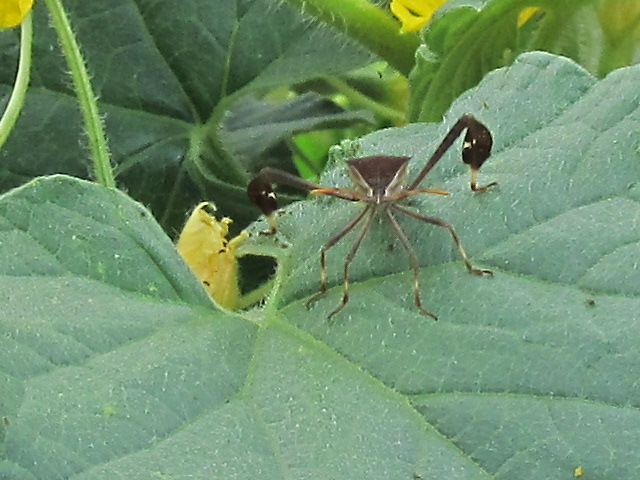
Now our high temperatures are in the triple digits and you have developed blight and begun providing food and shelter to stink bugs. You held out as long as could be expected and for this I thank you.
Diane, our photographer friend, snapped this picture of a stink bug. Notice its fierce mustachioed look. It has already begun assaulting our tomatoes.
Tomatoes, despite the pain of previous seasons, I am grateful for what I have learned from you-mostly patience.
Beverly Allen, Dallas County Master Gardener, Class of 2018
(These are excerpts from a story by Rosemary Mosco and orginially published on mentalfloss.com and updated for 2023)
Ladybugs are named after the Blessed Virgin Mary.
One of the most common European Ladybugs is the seven-spot ladybug, and its seven marks reminded people of the Virgin Mary’s seven sorrows. Germans even call these insects Marienkäfers, or Mary’s beetles.
They are not bugs!
Ladybugs are not bugs – they are beetles. They are part of Coleonptera, the beetle order.
Some people call ladybugs birds, bishops, or cows.
In parts of England, and for reasons that are unclear, the ladybug is a bishop. Nowadays, most people in England use the word ladybird, perhaps because these insects are able flyers.
In several languages, the portly, spotted ladybug is affectionately known as a little cow. French people sometimes use the term vache à Dieu, which means “cow of God”.
Ladybugs come in a rainbow of colors.
You’ve probably seen red ladybugs with black spots – but members of the ladybug family come in a wide range of hues, from ashy gray to dull brown to metallic blue. Their patterns vary, too; some have stripes, some have squiggles, and some have no pattern at all.
Those colors are warning signs.
To avoid being eaten, ladybug species with bright colors are walking billboards that say, “Don’t eat me, I’ll make you sick!” And that is because…
Ladybugs defend themselves with toxic chemicals.
A lot of ladybugs produce toxins that make them distasteful to birds and other would-be predators. These noxious substances are linked to a ladybug’s color, the brighter the ladybug, the stronger the toxins. Don’t panic: Ladybugs won’t harm you unless you eat many pounds of them!
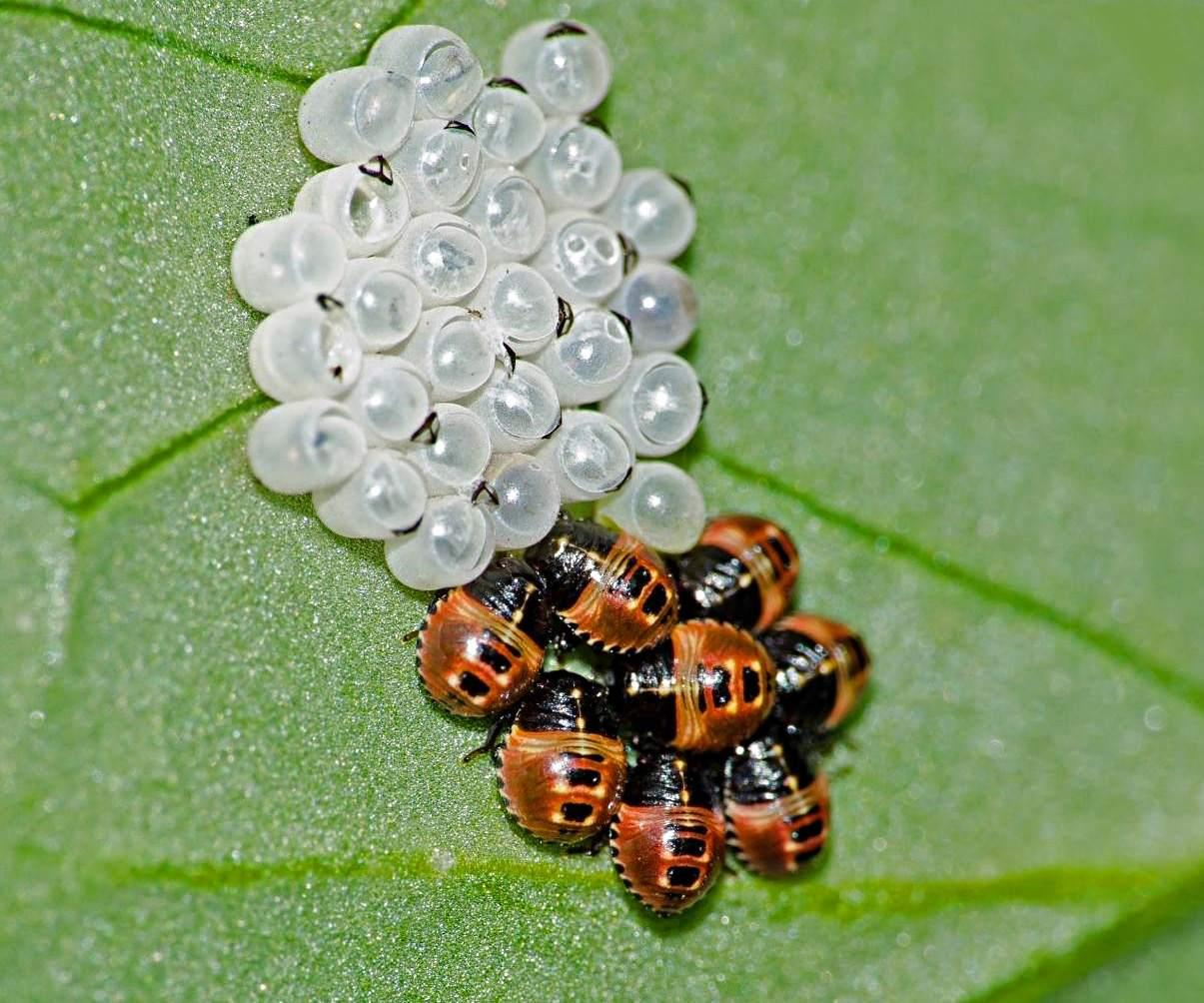
They lay extra eggs as a snack for their young.
Ladybug moms lay clusters of eggs on a plant, but not all of those eggs are destined to hatch. Some of them lack embryos. They’re a tasty gift from the mother ladybug; the newly hatched larvae will gooble them up.
Ladybug larvae look like alligators.
What hatches out of those ladybug eggs is a long, spiny larva that looks a little like an alligator. Though ladybug larvae may be intimidating, they’re not harmful to humans. They crawl around, feeding and growing, until they’re ready to turn into something even weirder…
Ladybug pupae look like aliens.
Once the larvae find a nice spot in the garden, they turn into an alien-looking pupa. Protected by a hard covering, the ladybug then makes an incredible transformation from larva to adult, bursting out of its old skin.
Adult ladybugs fly with hidden wings.
When a ladybug takes flight, it lifts up its protective, hard covered wings, that are not suitable for flight, and slides out another pair of wings that are light weight, slender and perfect for flight.
Ladybugs survive the winter as adults.
They enter a state of rest and cuddle together in groups, often in logs or under leaves. Some even find comfort in our homes, the harlequin ladybug enjoys the warmth that is provided.
They’re voracious predators – mostly.
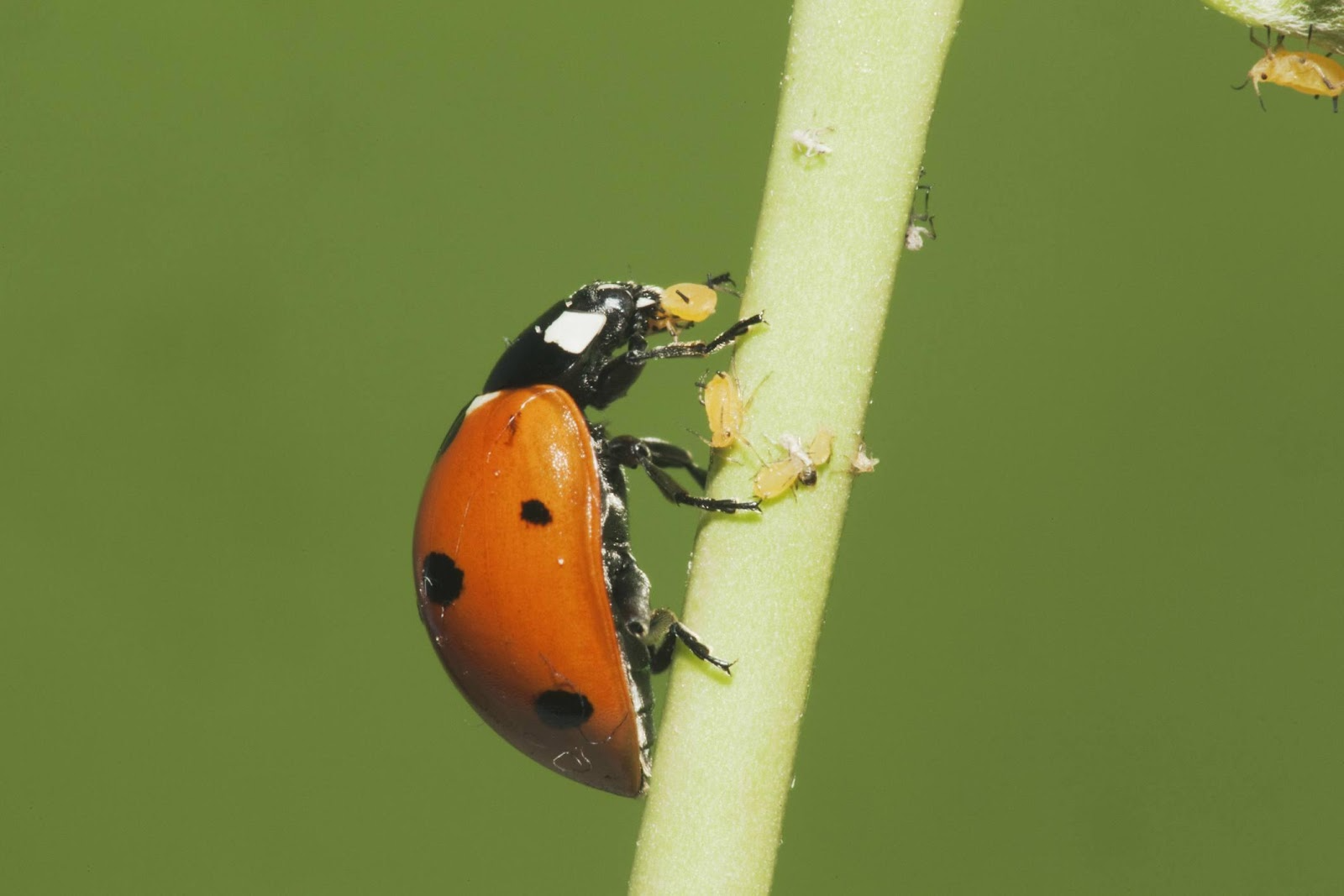
They are a natural form of pest control. They’re favorite foods are some of our worst plant pests: aphids, scale bugs, and mealybugs. A single ladybug can eat 5000 aphids across its lifetime.
Humans are spreading ladybug species around the world.
People have introduced non-native ladybugs to combat agricultural pests, and in some cases they’ve hitchhiked on imported goods. The results have not always been beneficial as they push out the native species and introduce a deadly fungal parasite.
They can be bad for your wine.
After devouring the aphids on nearby crops, such as soybeans, if vineyards are nearby, the ladybugs take up residence in bunches of grapes. When ladybugs become frightened during harvesting, they squirt out a smelly defensive liquid fluid. The resulting wine has a particular stinky flavor that has been likened to peanuts or asparagus.
There are additional sources on the use of beneficial insects at:
If African Blue Basil could speak it might first suggest introducing you to the “parentals”. In this case, that would be a good idea. The African parent is a perennial shrub from forests of Kenya, Tanzania and Uganda.
In 1983, African Blue basil was first seen by a nurseryman named Peter Borchard, owner of Companion Plants in Athens, Ohio. He noticed it growing in the path between beds of the two presumed parents, East African basil and ‘Dark Opal’. Borchard dug the hybrid out and brought it into the greenhouse hoping to save seed. No seed formed leaving Borchard with the task of growing more plants from cuttings. Shortly thereafter, African Blue Basil (Ocimum gratissimum) entered the market.
African Blue basil is now identified as a hybrid plant in the Lamiaceae family made by crossing East African camphor basil and a varietal of purple sweet basil called ‘Dark Opal Basil’. Its strong camphor scent was inherited from the East African basil used to breed the plant. Though some people may find the camphor odor and taste too strong to use in the kitchen, others embrace its culinary uses. While doing morning chores in the garden, the dark purple leaves of African basil tempt me to experience their crisp, semi-chewy and woodsy flavor with notes of menthol, musk and cloves. With a refreshing and earthy taste filling my mouth,it’s time to move out of the way and give the honeybees time to forage for nectar.
Before planting in the garden, familiarize yourself with its specific characteristics. African Blue basil is a rare, aromatic, perennial shrub that can grow up to five feet tall in some gardens. Plants produce abundant flowers that are pink with a dark purple base, making it attractive to bees and beneficial wasps. African blue is one of the few basils that is sterile, meaning it will not produce seeds. Fortunately, this unique trait allows the plant to stay in bloom for a longer season. As with other basils, African Blue does best in well-draining soil amended with compost. Plants thrive in full sun and will form rounded mounds.
Suggestions for cooking with African Blue basil offer a wide range of possibilities. While best suited as a fresh flavoring or garnish, the leaves may also be used in pesto’s, chimichurri sauce, salad dressing and dips or sprinkled over soups, tossed into salads or layered over bruschetta. Also, try it mixed into pasta, spread over sandwiches, used as a pizza topping or for elevating desserts.
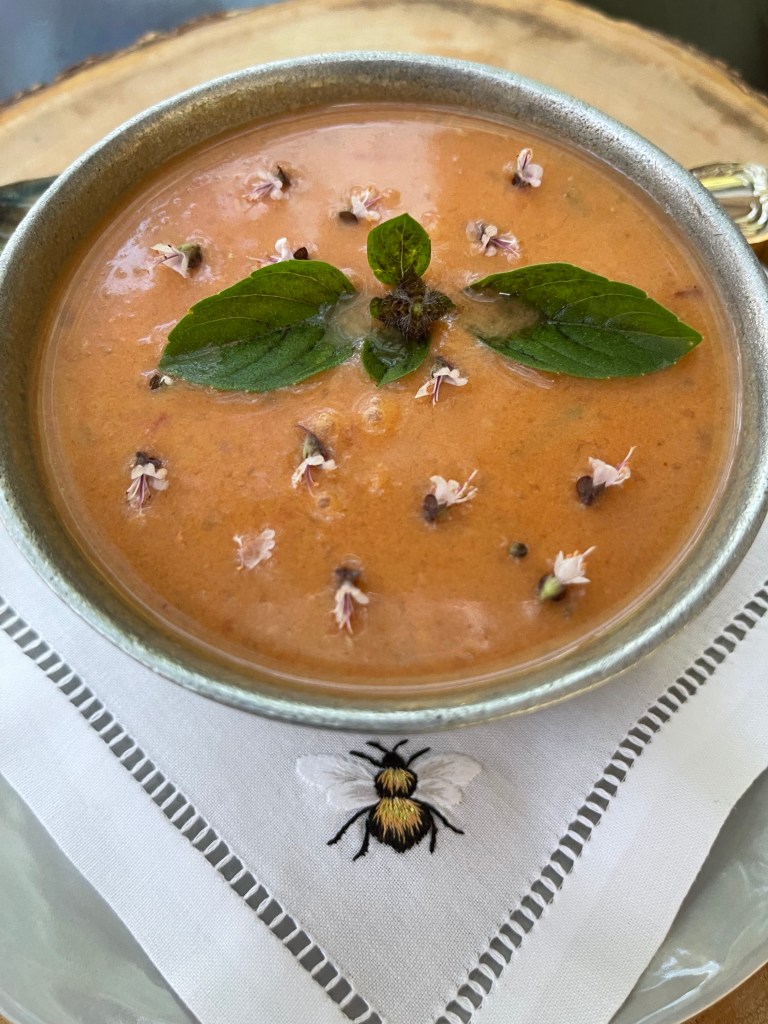
Along with the leaves, African Blue basil flowers are edible and can be used as a garnish in soups, salads and grain bowls.
They can also be incorporated into cocktails, floated on sparkling beverages or stirred into teas. African Blue basil pairs well with parsley, cardamom, ginger ale, champagne, green beans, tomatoes, potatoes, lentils, rice, and feta cheese. For best quality and flavor, use the leaves and flowers shortly after harvesting.
Linda Alexander, Dallas County Master Gardener Class of 2008
Take a quick look at the six jars of honey shown above. What did you notice? If the first thing that caught your eye were the different colors, then a brief description of honey’s relative visual properties might provide some insightful information. And, yes, it’s true that most of us generally choose honey based on color.
Honey Colors
The U.S. Department of Agriculture classifies commercial honey (the jars you typically find in the grocery store) into 7 color categories:
*Water White (0 mm – 8 mm) (Colorless and transparent)
*Extra White (8 mm – 17 mm) (Very light-yellow tint while remaining transparent)
*White (17 mm – 34 mm) (Slightly more yellow/very light amber, also transparent)
*Extra Light Amber (34 mm – 50 mm) (Transparent with a light orange/amber hue)
*Light Amber (50 mm – 85 mm) (Deeper orange /amber hue, not fully transparent)
*Amber (85 mm – 114mm) (Deep orange color and not transparent)
*Dark Amber (114 mm – 140 mm) (Very dark and opaque, referred to as “motor oil black”)
How Honey Color is Measured
The color of honey is typically measured using a continuous scale known as the Pfund scale of measurement. The scale consists of a glass wedge that varies in its color from lightest to darkest amber. The honey to be evaluated is poured into another wedge-shaped container and then the color is compared with the amber scale. The place where the color of the honey matches closest to the scale is then marked as the result. The final measurement is thus given in a number ranging from 0 to 140 mm (according to the scale length where the match occurs).
What Determines Color?
The color of honey is determined by its floral source, or blossoms of the nectar, and mineral content. Honeybees forage for both nectar and pollen. Nectar is the bee’s source of energy while pollen provides protein and other nutrients. As the bee forages, pollen grains collect on its head. The bee then uses its front legs to transfer the pollen to the pollen baskets located on its hind legs. Bees mix dry pollen with nectar to compact the pollen in the pollen basket. Honey, therefore, gets its color from the pollen that a hive gathers to make it.
Light colored honeys like citrus, rosemary, lavender, eucalyptus and thyme contain high amounts of calcium. Darker honeys contain higher amounts of potassium, chlorine, sulfur, sodium, iron, manganese and magnesium. Iron is what gives buckwheat honey its deep brown color.
Lighter-colored honeys generally have a milder flavor but with a pronounced floral aroma often accompanied by herbal, spice, vanilla, butterscotch or other enticing flavor notes. As the honey gets darker in color, the aroma and taste become more distinctive. All honey tends to deepen in color as it ages, but this change does not affect its flavor.
Finally, it is important to keep in mind that soil, climate, water, wind and sun all contribute to every honey’s sensory attributes, including color, aroma and flavor. This unpredictable mosaic of natural conditions is a gentle reminder of the ever-changing profile of varietal honey. Clover honey from this year may surprise your taste buds with a slightly different flavor profile in the future.
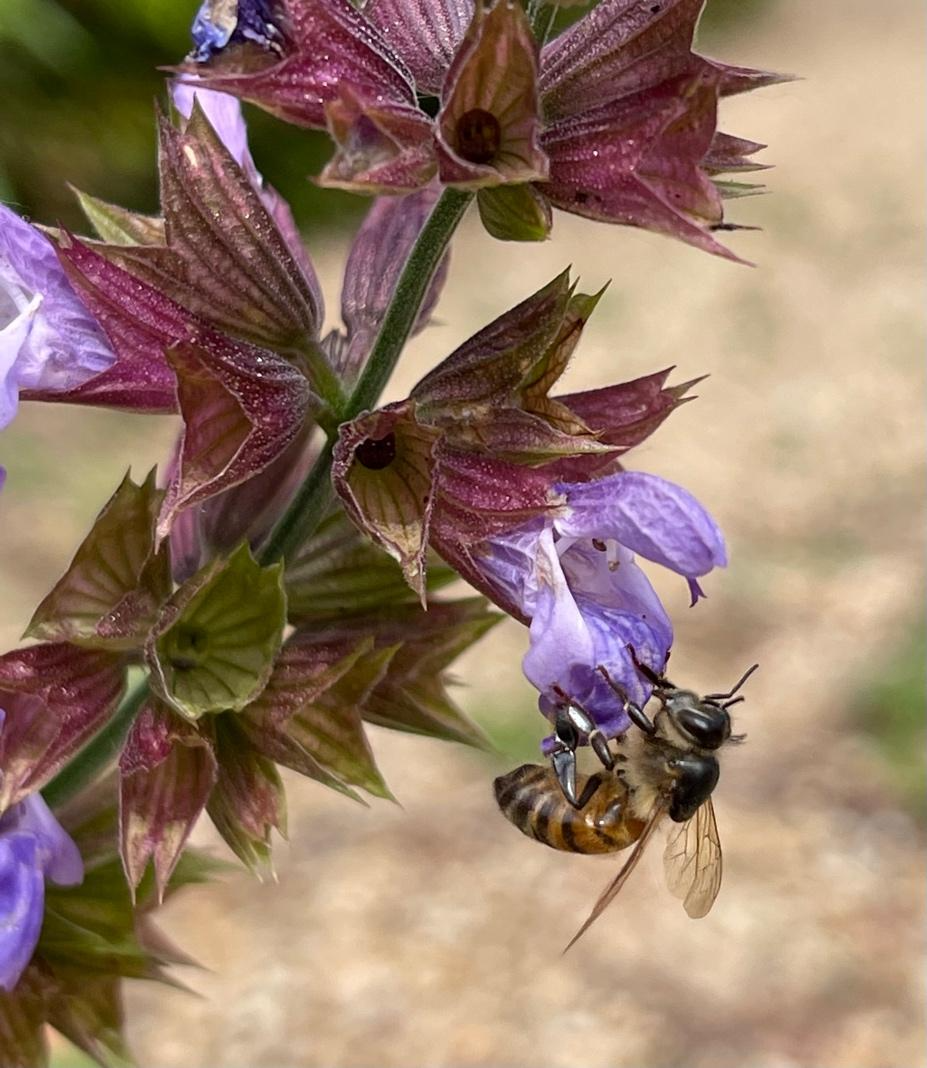
(Honeybee gathering nectar from Sage blossoms)
Examples of light honey floral sources:
*Sage
*Clover
*Fireweed
*Cotton
*Acacia
*Alfalfa
*Apple Blossom
*Blackberry
*Blueberry
*Palmetto
*Tupelo
Examples of dark honey floral sources:
*Buckwheat
*Avocado
*Chestnut
*Dandelion
*Huckleberry
*Manuka
*Tulip
Linda Alexander, Dallas County Master Gardener Class of 2008



















 DALLAS GARDEN BUZZ