Tag Archives: Dallas County Master Gardeners

Merry Christmas From the Demonstration Garden on Joe Field Road

Merry Christmas From The Demonstration Garden

T’was the weekend before Christmas, and all through the yard,
Not a gift was being given, not even a card
The tools were all hung, in the garage with care,
With hopes that St. Nicholas soon would repair.
The shovel with blade all rusty and cracked,
The pitchfork still shiny, but handle it lacked.
When out on my lawn, (its brown and abused)
I could see poor old Santa, looking confused.
No list had been left for Santa to see,
No gardening gifts were under the tree.
But wait there’s still time, it’s not Christmas yet,
And gardening gifts are the quickest to get.
You can forget the silk tie, the fluffy new sweater;
Give something to make the garden grow better.
If she wants a gift shiny, then don’t be a fool,
It’s not a dumb diamond, but a sparkling new tool.
If fragrance is listed you can forget French perfume,
It’s a pile of manure that’ll make gardeners swoon.
Give night crawlers, not nightgowns, a hose that sprays water.
(Anything for the kitchen is not worth the bother.)
Give a great gift that can dig in the dirt,
It’s better than any designer-brand shirt.
Now look quick at Santa, this guy’s not so dumb,
Under his glove, he hides a green thumb.
His knees are so dirty, his back how it aches,
His boots stomp on slugs, (he gives them no breaks).
The guy works only winter, you can surely see why,
For the rest of the year it’s as easy as pie.
He has elves plant through spring, pull weeds in the summer,
In fall they all harvest, but winter’s a bummer
And so Christmas gives Santa a part-time employment,
‘Till spring when the blooms are his real enjoyment.
So ask the big guy for garden gifts this year,
Seeds, plants and tools, Santa holds them all dear.
You see, malls may be crowded, vendors hawking their wares,
But visit a nursery; stress-free shopping is there.
Now Santa’s flown off, to the nursery he goes,
And his voice fills the night with a loud Hoe! Hoe! Hoe!
Reprinted from Rhode’s Newsletter with permission.

Plant Your WildLife Habitat

The flowers that are blooming in our WildLife Habitat right now were selected with a purpose.  We wanted to provide food for all kinds of creatures and yes, they are flying in to feast on our plants and eat our berries.   Monarch, Gulf Fritillary, and Giant Swallowtail butterflies have been identified. Skippers, bees, dragonflies, and birds are in residence.

Consider these Suggestions from landscapers around the USA of  The National Wildlife Federation for Your Backyard Habitat:

In every landscape I design and with the volunteer consultations that I do there is one plant that I always suggest: Asclepias (milkweed). I try to use native varieties, and A. incarnata (swamp), A. speciosa (showy) and A. verticillata (whorled) milkweeds are my gold medal winners—the wildlife garden equivalents to Shaun White. I like them not just for their importance in habitats—they are host plants for the monarch butterfly—but because of their educational value for children. My kids love to go out into our flower garden and check to see if there are any new monarch eggs, larvae or chrysalides, and they love watching the butterflies fly in to feed on the nectar.”—Mat Paulson of Moorhead, Minnesota.

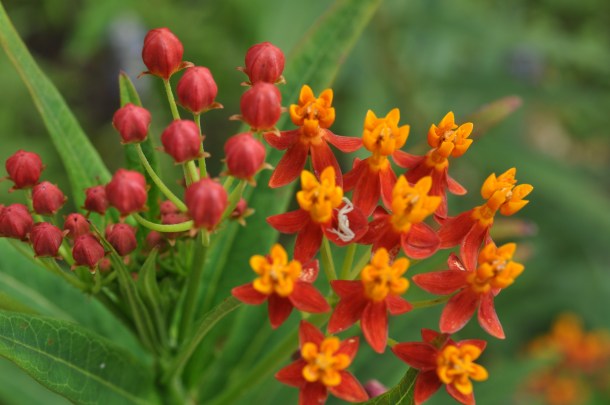
 At the Earth-Kind® Water Wise Demonstration Garden we have planted Asclepias currassavica, tropical milkweed. (Love the super star reference made to Shaun White-Olympic snowboarding Gold medalist.)

Tropical ButterFly Weed In The Wildlife Habitat

 “The purple flowers of aromatic aster (Aster oblongifolius) provide color in the late summer and fall and attract swarms of pollinators. The plant’s short, shrublike appearance makes it a good candidate for more formal landscaping applications. The silvery checkerspot butterfly, pearl crescent butterfly, and asteroid moth utilize this plant as a host. Tolerance to poor soil conditions has allowed me to add it to my own suburban residential lot. This aster is naturally found in the eastern and north-central United States.”—Perry Eckhardt of St. Charles, Missouri

Aster Growing At The Demonstration Garden Wildlife Habitat

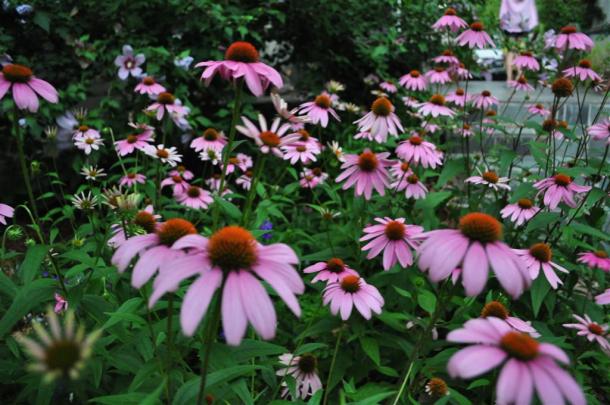
“Purple coneflower (Echinachea purpurea) is a great nectar plant in any butterfly garden and is used by many other insects as well. I think it’s like candy to them. Purple coneflower is also a favorite of American goldfinches and sparrows, who love the seeds. Plant big clumps for the best effect.”—

Purple Coneflower In A Dallas Garden

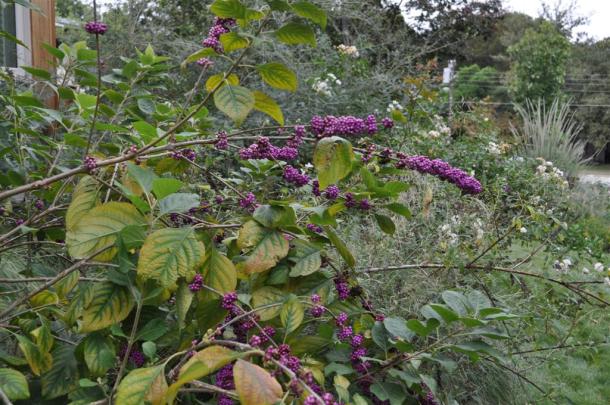
“One of my favorite native beauties, which is also a hit with the birds, is the American beautyberry. This large shrub makes a wonderful understory plant, perfect for shady areas in your yard or along riparian areas in need of restoration. This beautyberry takes care of itself in the maintenance department, requiring little effort on the part of the caretaker. The open branching structure, brilliant green leaves, and fuchsia-colored berries of this plant make it a lovely addition to any habitat garden. The birds will thank you by devouring the tasty berries, and the butterflies will come calling to taste the sweet nectar of the dainty whitish pink flowers.”—Alice Nance of Austin, Texas

Butterfly Weed, Aster, Coneflower, and Beauty Berry are a benefit to our Demonstration Garden and we thought you might like to include them in yours!

Ann

Texas Style Fall Color

Fall Gardens in Dallas trump summer gardens!   Remember this instead of  falling into discouragement in our 100° plus days with hardly a drop of rain. The Dallas County Master Gardeners who garden at the Demonstration Garden on Joe Field Road all agree we  love our version of fall color!

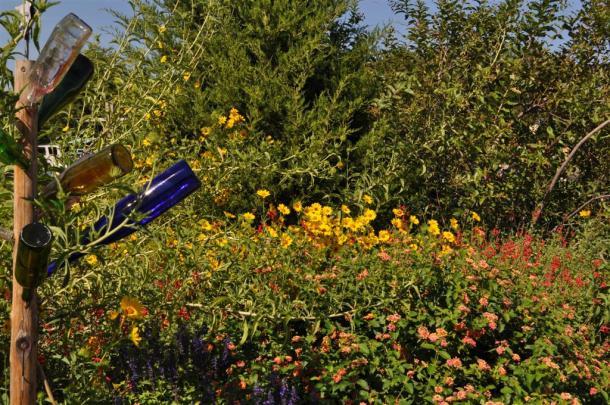
Bottle Tree Framing a view of Maximillian Sunflower, Desert Sage, Lantana, and Salvia Blue Spires

This area of the garden is relatively carefree after amending the soil, careful plant selection, and mulch, mulch, mulch!

Rosy Creek Abelia, Salvia Blue Spires, Muhly Grass, Papyrus On The Right In Our Pond

We do have an agonizing  bind weed issue that keeps us humble, but we will save that part of the story for another time. 

 Enjoy the mellow quality of Autumn in Texas. Temperatures are less and color is more!

Ann

The “Mild” Habanero And The Eggplant

Never take your daughter with you to buy vegetable transplants. Molly seemed like a safe bet; this 24-year-old hasn’t cooed over anything but boyfriends and clothes since she turned 11. But show her the 4-inch veggies all waggling their cute little leaves and begging to come home with you, and don’t you know it, Molly’s like a preschooler with a batch of free puppies.  She wanted them all.

That’s how we ended up with The “Mild” Habanero and The Eggplant.

Eggplants And Habaneros On The Kitchen Counter

For the summer garden, we planted squash, cantaloupe, and watermelon seeds and transplants of tomatoes—plus the habanero and eggplant.  Now two months later, the cantaloupe seeds never sprouted, beetles decimated the squash and watermelon, and the tomatoes have decided that it’s too hot to do much of anything.

Of course, the habanero and eggplant have thrived.  

The tag on the habanero read “mild”—as compared to what? A ghost chili?  And you’ve never seen a more prolific pepper; at least 25 chilies in shades of green, yellow, and orange hang from its branches.  Perhaps one could blend up a concoction of chilies and vinegar strong enough to repel squirrels or wayward cats, but otherwise the peppers are too hot to use in anything.

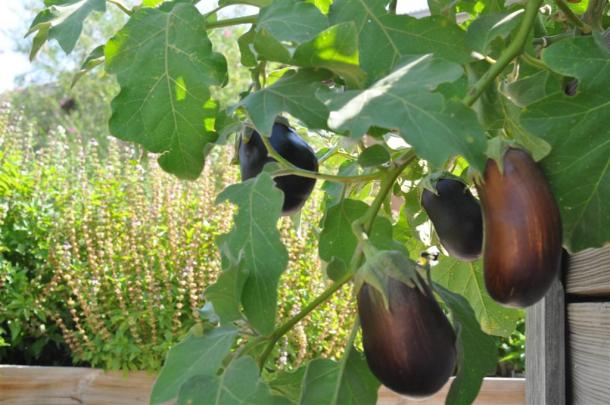
Eggplant growing in a raised bed at the Demonstration Garden in Dallas

The eggplant is now the size of a small shrub.  At least six of the most beautiful aubergine purple globes dot its sturdy branches.  Eggplants are much loved by cooks; the English and French call them aubergines.  Crayola even named a pink-purple-grey color crayon eggplant in 1998. 

In my kitchen, I have grilled, fried, stewed, stuffed, and rolled eggplant—all with the same conclusion.  I don’t like eggplant.  I tried, but no.

So, here we have it.  The stars of my August garden are inedible or underappreciated. Perhaps I could put a little vegetable stand out by the mailbox with an honor system jar for quarters.  Habaneros and Eggplant—Name Your Price…

Elizabeth

Dividing Iris At The Demonstration Garden

There are many paradoxes in gardening: bury something so it will live, divide to multiply, prune to bear more fruit.

We have a trove of blue Iris at the Demonstration Garden and it is time to divide them. Watch this video to learn the art of  satisfactory Iris division: 

 Our Iris  were purchased from the Iris Society of Dallas Public Sale. This year it is scheduled for September 15, 2012, from 9am to 1pm or until sold out at Northhaven Gardens.

Dig further into Iris information via the Dallas Morning News here.

Ann

Have A Blast With Basil


One of the stars of summer surely is the well-loved herb – basil.  But did you know how many ways this fragrant little plant could be incorporated into cooking, healing and pleasure? 

Tomato Tart Basil Pesto; Corn, Orzo, Basil Salad; Watermelon, Peach, Tomato, Basil In Cup

Starting in May then continuing on until October the possibilities for allowing Basil to grace both table,  home, and garden are endless.  Here are some of our favorites: 

Basil Lunch Medley 

Tomato Tarts with Basil Pesto 

Corn, Orzo, and Basil Salad 

Peach, Watermelon and Tomato Salad With Mint and Basil 

Italian Bread with Basil Butter 

Basil Lime Shortbread 

Citrus Basil Punch

Linda

Dallas Garden Buzz would like to know if you would like some of these recipes!

Basil Tips For Dallas Gardens

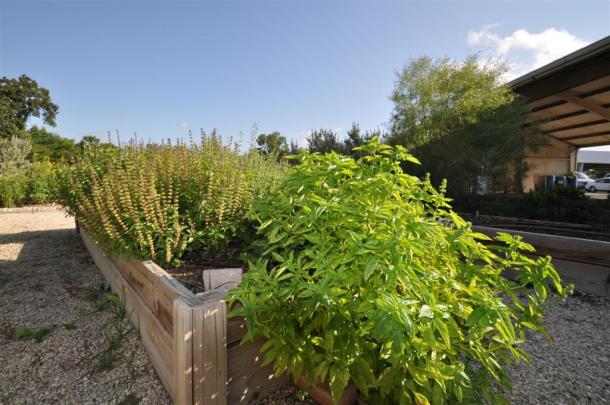
Basil Growing in Raised Beds at the Demonstration Garden

Some of Paula’s growing tips for basil are:

            Wait until May to plant basil whether from seeds or transplants.  Though it is tempting to plant basil in March as soon as the plants are available in nurseries, basil loves hot weather and will often be stunted if planted too early.

            Basils and tomatoes are consider “companion” plants and seem to do well planted near each other.  Of course, everyone knows that a basil, tomato and mozzarella sandwich is a culinary delight.

            In general, basil does not like to be pampered.  However a light application of a synthetic or organic fertilizer can be used to give the plants a boost as the growing season progresses.

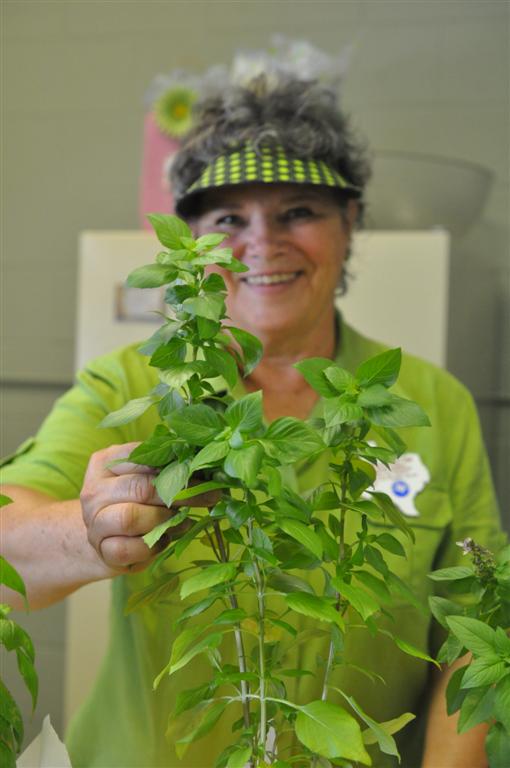
Paula the  Basil Queen Showing Where to Cut Basil for Harvest

            Never prune off more than 1/3 of the plant at a time.  Paula also does not recommend letting the plant go to bloom as this seems to change the flavor of the leaves. 

            It is best to pick basil early in the morning when there is the highest concentration of oils in the leaves.  Paula either keeps the stems in water on her counter top or she washes the leaves, rolls them in paper towels and places them in the refrigerator.  They will keep this way for a few days.  Basil can also be frozen as ice cubes (Paula freezes the leaves in broth.)

            It is best to add basil to recipes at the end of the cooking cycle to preserve more flavor.

     In general, basil is a fairly hardy plant that is not attacked by many insects.  However caterpillars, grasshoppers, slugs and snails, white flies and aphids can be a problem.  Many of these can be controlled by organic means such as the use of Bt, Sluggo, or a strong stream of water.

      Basil is also able to be used as both an aromatherapy and medicinal agent.  It is said to relieve aches and pains.  Essential oil of basil can be added to bath water.  Paula also uses a poultice of basil on ant and bee stings.  She says this helps bring down the swelling.

     Some of Paula’s favorite places to find unusual varieties of basil are:  Round Top’s Herb Festival which takes place the third weekend in March, NorthHaven Gardens, Central Market, Southwest Nursery, and Plants and Planters in Richardson, TX.

Carolyn

All About Basil

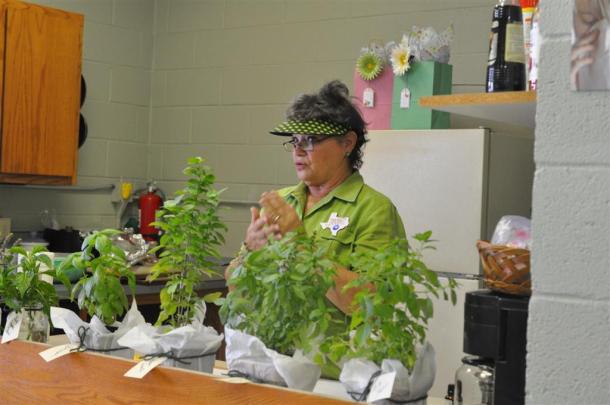
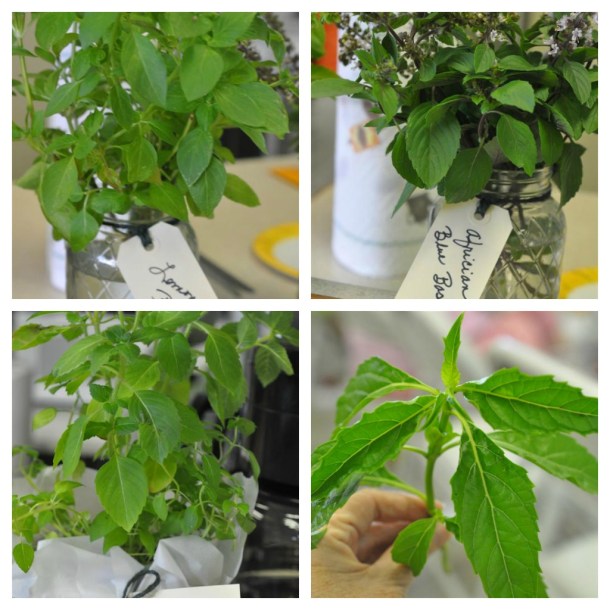
  Paula With 6 Varieties of Basil for Class  

The delightful smell of fresh basil greeted over 30 Dallas County Master Gardners as they feasted on a delicious basil based light lunch (recipes will be forthcoming) and learned all about basil from our own Basil Queen, Paula.   The first topic in her talk was: just how do you pronounce “basil.”  Is it “basil” with a long “a” (bay-sil) or with a short “a” (baa-sil)?  According to Paula, either pronunciation is correct—- and however you pronounce it, fresh basil is delicious.

     Basil has a long and varied history.  It is mentioned in literature pre 206 BCE.  The Greeks and Romans used it as a symbol of hatred.  They said that the gardener had to rant, rave and cuss when planting it.  As the centuries passed, basil became the symbol for love in Italy.  Young women would put a sprig of basil on their clothes to proclaim their chastity.   However, centuries’ later, in a complete symbolic reversal, women would put a pot of basil on their window sill when they were “entertaining” their lovers.  Voodoo priestesses used basil in their rituals as a symbol of love and devotion; while in Victorian times basil symbolized “best wishes” when given to a friend.   In Europe, basil was said to keep evil spirits away and, if a man carried basil in his pocket, it was supposed to bring him wealth.  (Paula tried this with her husband.)

     Low in saturated fat, cholesterol and sodium, basil is high in many nutrients such as riboflavin and Vitamins E and A.  However, Paula warned that it is also high in Vitamin K and should not be consumed by people who are on the blood thinner Coumadin.

     With over 150 varieties of basil, ranging from a shrub to compact varieties, with many different flavors, there is a basil variety for every taste and place in the garden.  Paula has found that though basil likes full sun, it will even grow in part shade.  Though most basils are annuals in Dallas, there is one type, a Bell Pepper basil, that can be grown as a perennial if well mulched in the winter.  

Sweet Basil, Lemon Basil, Holy Basil, Green Pepper Basil

    Some of Paula’s favorite basils are:

            Aussie Sweet Basil:  This is a columnar/upright basil that grows about 24 inches tall and is only 8-10 inches wide.  It does not set seed quite as quickly as some other varieties.

            African Blue Basil:  Primarily a landscape rather than culinary variety, this basil is grown by Paula to attract butterflies and bees.

            Holy Basil:  Used in Hindu and Muslim burial rituals, this clove/spicy basil is best used in potpourris and as a mosquito repellent.  Just rub a few leaves on your skin.

            Sweet Basil:  This type of basil is the favored basil of many people for use in cooking and making pesto.  One of Paula’s favorite varieties of sweet basil is Genovese. 

            Lemon Basil:  Leaves of this basil impart a lemony flavor to dishes.

            Thai Basil:  Used in Asian dishes, this basil imparts a licorice/anise flavor to food and drinks.

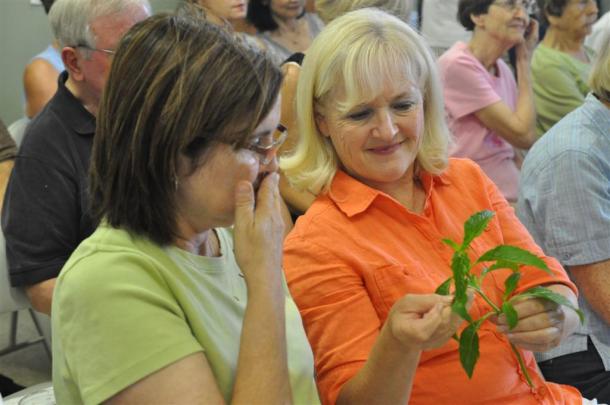
            Bell Pepper Basil:  A “Paula find” at the Herb Festival at Round Top, TX, this basil grows as a shrub in Houston.  Leaves of this variety can be substituted for bell pepper in salads.  They can also be infused in vodka and, according to Paula, make a great Bloody Mary.

Bell Pepper Basil Sampled by Dallas County Master Gardeners Sheridan and Linda

For basil growing tips and some great basil recipes, keep following Dallas Garden Buzz.

Carolyn

Dragonfly Sugar Cookies

Dragonfly Iced Sugar Cookies

 Shortbread:

2 cups (4 sticks) unsalted butter, at room temperature

1 ½ cups powdered sugar

2 T vanilla extract

4 cups all purpose flour

2 tsp baking powder

Powdered Sugar Icing: 

2 cups powdered sugar, sifted

¼ cup milk

1 tsp vanilla or almond extract (optional)

To make the shortbread:  Preheat oven to 350 degrees. Line baking sheets with parchment paper or silicone mats, or grease generously with butter or cooking spray.  Using a mixer fitted with a paddle attachment, beat the butter and sugar in a large bowl on medium-high speed until fluffy.  Add the vanilla and beat until combined.  In a separate bowl, stir together the flour and baking powder.  Add the flour mixture slowly to the butter mixture, stirring on low speed.  Stop beating as soon as the flour mixture is completely incorporated.  (Overbeating will produce a tough cookie)

Form the dough into a ball, cover in plastic wrap and refrigerate for 30 minutes before rolling out.  On a flat, smooth floured surface, roll the chilled dough out to ¼ inch thickness.  Cut out the cookies  Use a spatula to transfer the cookies to the prepared baking sheets, placing them ½ inch apart.  Combine the dough scraps and reroll the dough to cut out more cookies.  Roll any subsequent scraps into a thick log, wrap in plastic wrap and freeze for 10 minutes. Cut ¼ inch thick rounds of the log to make round cookies.

Bake the cookies for 10-12 minutes, until light brown around the edges. Cool the cookies for 10 minutes on the baking sheet. Remove with a spatula and cool completely on racks about 5 minutes before icing.

To make icing:  Whisk together the powdered sugar, milk and extract.  Divide the icing into parts for different colors.  Use food coloring to tint. Can brush on or dip cookies face down into icing, being sure to cover the whole cookie.

Store the cookies in an airtight container at room temp up to 1 week or tightly wrapped in aluminum foil or plastic wrap for 1 month in the freezer.

Iced Sugar Cookies from Rebecca Rather’s “The Pastry Queen”

Karan


Fresh Peach Pound Cake


Dallas Garden Party Fresh Peach Pound Cake Slices

Ingredients:

1 cup butter, softened

3 cups sugar

6 eggs

3 cups all-purpose flour

¼ teaspoon baking soda

¼ teaspoon salt

2 cups peeled, chopped fresh ripe peaches

½ cup sour cream

1 teaspoon vanilla extract

1 teaspoon almond extract

Directions:

Cream butter; gradually add sugar, beating well at medium speed of an electric mixer.  Add eggs, one at a time, beating after each addition.

Combine flour, soda, and salt; stir well.  Combine peaches and sour cream.  Add flour mixture to creamed mixture alternately with peach mixture, beginning and ending with flour mixture.  Mix just until blended after each addition. Stir in flavorings.

Pour batter into a greased and floured 10-in tube pan.  Bake at 350 degrees for 1 hour and 10 minutes or until a wooden pick inserted in center of cake come out clean.  Let cake cool in pan 10 minutes; remove from pan, and let cool completely on a wire rack.  Yield: one 10-inch cake.

Linda