Tag Archives: The Raincatcher’s Garden

I’M GOING TO STAND MY GROUND AND YOU CAN TOO

Don’t give up, Susan Thornbury has some words of inspiration and an action plan for us during these hot days of summer.

August 15, 2024

Memory is strange.  Most thoughts and memories are unhelpful.  So much so that often a deep breath and a reminder that they are just thoughts and memories and not reality seems to be indicated.      But then when least expected a flash of amazingly helpful inspiration!! 

After listening to a weather forecast –given after the meteorologist  offers an apology for what will be coming–and then stepping out to look at the garden already in a negative frame of mind and naturally seeing trouble everywhere—a song came –the words very loud and clear:  “I”M GOING TO STAND MY GROUND YOU KNOW I WON’T BACK DOWN I’M GOING TO STAND MY GROUND”  

Now don’t rush to judgement on that song–in this case it was crystal clear what the meaning was–it was aimed  at gardeners!!

Not those  in “other places”  Places where the nights are cool it rains at least once a week and where things “just seem to grow”  Oh no, they don’t get a song–it was not meant for them.  

It was meant for gardeners here–it was meant for US!!

It is just such a temptation to give up–Its so hot and yet weeds are thriving–the list of “NOT FAIR” is a long one

But not for us to dwell on that: WE WILL NOT BACK DOWN WE WILL STAND OUR GROUND”

We can’t just think about it though–a plan is needed!

Each plan must suit the planner of course but–there are some important point that might be universal.

First give serious thought to becoming a morning person–if you start at 7AM –its not so bad and you can get a lot done in an hour or two.  If this is not your usual habit–well just tell yourself–when November comes you can sleep late!!

Second set priorities.  Take a good look and decide what must be done now  some things can and should wait until later.  One thing is usually deadheading..  The poor plants are stressed they don’t need to be trying to set seeds or supporting yellowing leaves.  When you tidy them up they are really helped–and you get some encouragement–things are looking better already.

Third don’t give up on weeding.  Weeds are cleaver plants and they can grab water and use it to set their seeds faster than one can believe–so don’t let them–you sure don’t need more weeds and your plants need all the water they can get.

Healthy and happy mulberry weeds edited out of the garden-they thought they were safe hiding in the salvia

Fourth–look for what is working.  Which plants are showing a fighting spirit and a will to live  they must be encouraged and rewarded–as they are encouraging and rewarding you.

But of course you must also face what isn’t working–Bite the bullet–remove dying plants there is just no use in trying to care for them and waste precious water on them–make a mental note to avoid them in the future.

Last–congratulate  yourself!!  you deserve it YOU STOOD YOUR GROUND NO YOU DIDN’T BACK DOWN YOU STOOD YOUR GROUND!!! 

Susan Thornbury, Dallas County Master Gardener Class of 2008

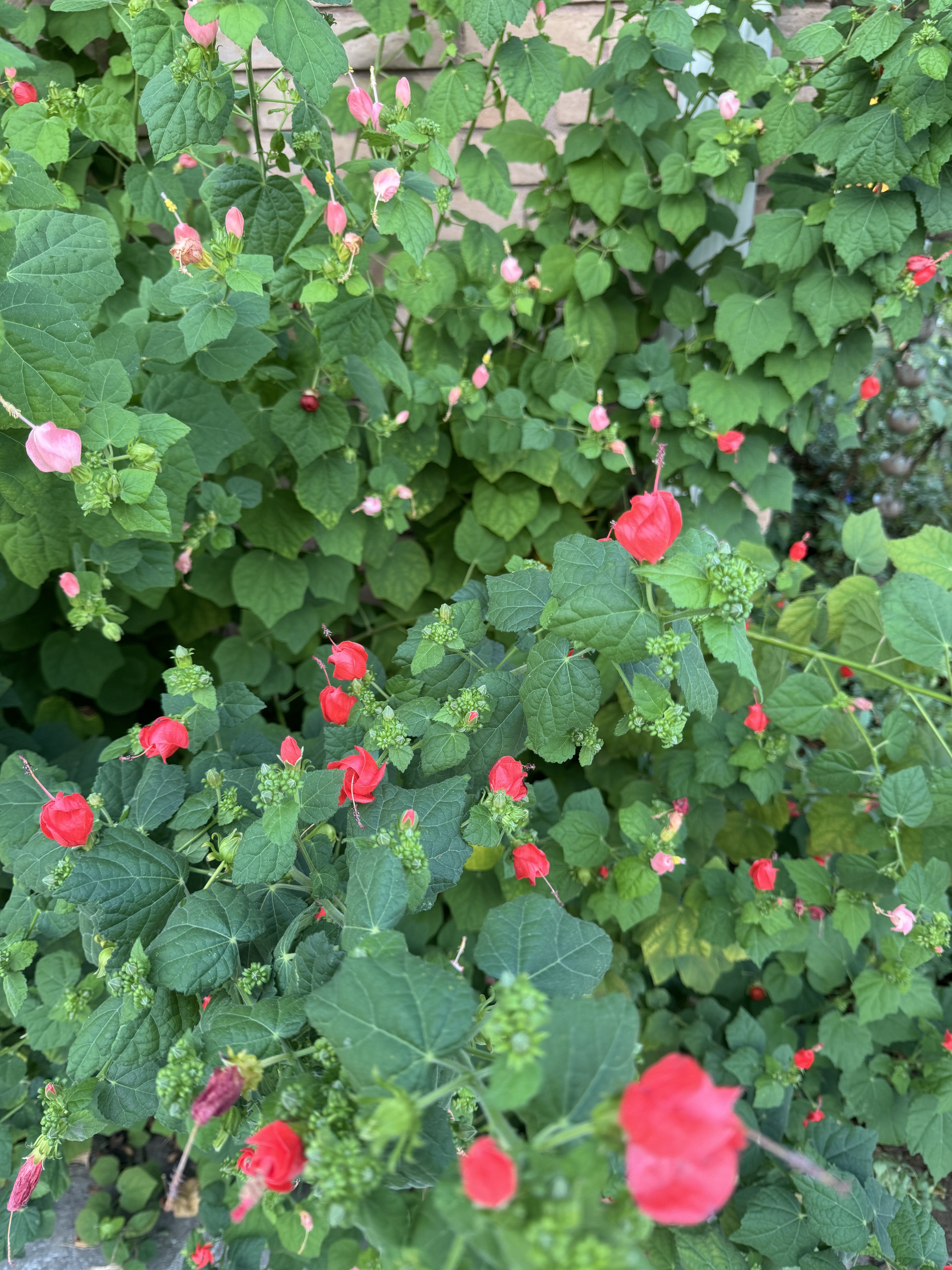
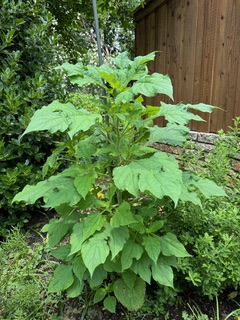
More information about Turk’s Cap

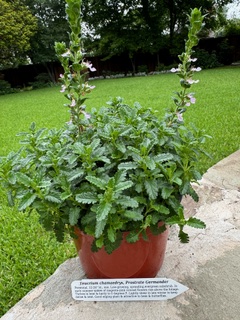
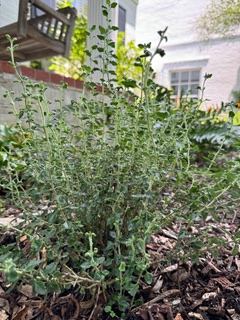
Germander, Teucrium chamaedrys

August 1, 2024

Germander Upright

If you’re contemplating a substitute for boxwood, consider these words from Cyrus Hyde, the late garden herb folklorist and founder of Well-Sweep Herb Farm in New Jersey. He referred to germander as “poor man’s box”. Why then, has it not received more recognition in the world of herbs? 

Even our first president, George Washington was such an admirer of germander that it was planted at his Mount Vernon, Virginia estate. But sadly, it seems to have faded from view until recently when garden centers began featuring lesser known herbs alongside the more desirable customer favorites. Thankfully, it was a wise decision with germander finding its place as a decorative evergreen border plant and as a substitute for boxwood in the beloved knot-garden design.

Germander is a Mediterranean native in the mint family (Lamiaceae) with small, dark green scalloped leaves and a mild garlic-spice aroma. It is a hardy perennial and evergreen, keeping its tidy appearance throughout the year. In early summer whorls of purple-pink flowers appear. Bees are attracted to the tiny flowers. 

Grow it: 

  • *Space plants 2 feet apart and at least 3 feet away from companion plants. 
  • *Germander prefers full to partial sun and well-drained soils. 
  • *Follow a regular watering schedule to establish, then cut back to maintain health.
  • *Fertilize lightly with an all-purpose organic fertilizer once or twice a year. 
  • *Pruning right after bloom will help to renew the plants faster. 

Germander with single stem gerbera daisies gently nestled in the glossy green foliage

Linda Alexander, Dallas County Master Gardener Class of 2008

Cool as a Cucumber

July 25, 2024

Did you know that not all cukes are created equal? To simplify, there are two main types of cucumbers, American and English. Both can be used for pickling and slicing. This year I decided to try the English variety in my raised garden bed. Also, to save space, I used a trellis type support system for growing it vertically. That proved to be a very good decision.

13 inch long English cucumber ready to be harvested from my garden

After about two and a half months in the ground, my little cucumber transplant has covered the trellis and produced over a dozen cucumbers. English cucumbers generally grow thinner and straighter than their American counterparts and can grow in the range of 12 to 24 inches long. So far, I’ve been harvesting them at around 12 to 14 inches in length. 

English cucumbers have a sweeter flavor and delicate skin that is less bitter than that of other cucumbers. Many sources say that English cucumbers tend to have very few seeds but, as you can see from the photo, mine had a generous amount. 

A person peeling cucumber on a cutting board

Description automatically generated
Seeding an English cucumber with a serrated grapefruit spoon

Tips for growing:

*Plant in an area of the garden that receives a minimum 6 hours of sunshine daily. 

*Prepare the soil by tilling well while adding aged compost to a depth of 6 inches.

*On average, cucumbers require: 1 inch of water per week in moderate conditions, twice per day when temperatures exceed 90°F. 

*Add a 4-inch layer of organic mulch around base, but not touching the stem.

One of my favorite cucumber recipes is from a place in the Texas hill country where my husband and I, for over 35 years, always enjoyed having lunch. It was an absolutely charming restaurant in Fredericksburg known as ‘The Peach Tree Tea Room’. The Pedregon family opened their new venture in the fall of 1984. It brought in diners from all over the United States and internationally, as well. Sadly, it closed a few years ago leaving a void in the Fredericksburg culinary scene. Thankfully, over the years, I purchased all three of their wonderful cookbooks. The recipe I’m sharing is from their first cookbook, published in 1990. It is the recipe for ‘Chilled Creamy Cucumber Soup’. 

Making the recipe over the weekend brought back cherished memories from those early days in Fredericksburg. It was especially rewarding to use three of the ingredients called for in the recipe from my garden; English cucumbers, parsley and garlic that was curing in my pantry. 

A bowl of food on a plate

Description automatically generated
Chilled Creamy Cucumber Soup Garnished with Freshly Chopped Parsley and Tomatoes

Hope you will be inspired to take a cool and refreshing break with ‘Chilled Creamy Cucumber Soup’. In the meantime, chill out with these tasty, sliced cucumber appetizers.

Cucumber slices with flowers and a small glass vase of herbs on a wood surface

Description automatically generated
English cucumber slices topped with Herbed Cream Cheese, Salad Burnet and Borage Blossoms

And, just in case you were curious about the title…’Cool as a Cucumber’. I did a quick online search and learned something new. First, the inside of cucumbers are approximately 20 degrees cooler than the outside air. And the phrase ‘cool as a cucumber’ first appeared in a poem by the English author John Gay in 1732. It expresses the narrator’s angst regarding a woman with unreturned love! Today, that phrase is used to describe someone who tends to remain calm, assured and composed in any situation.

Linda Alexander, Dallas County Master Gardener Class of 2008

Chilled Creamy Cucumber Soup

Cucumber Slices Topped With Herbed Cream Cheese

Calabacita – SVB Resistant and Productive

July 1, 2024

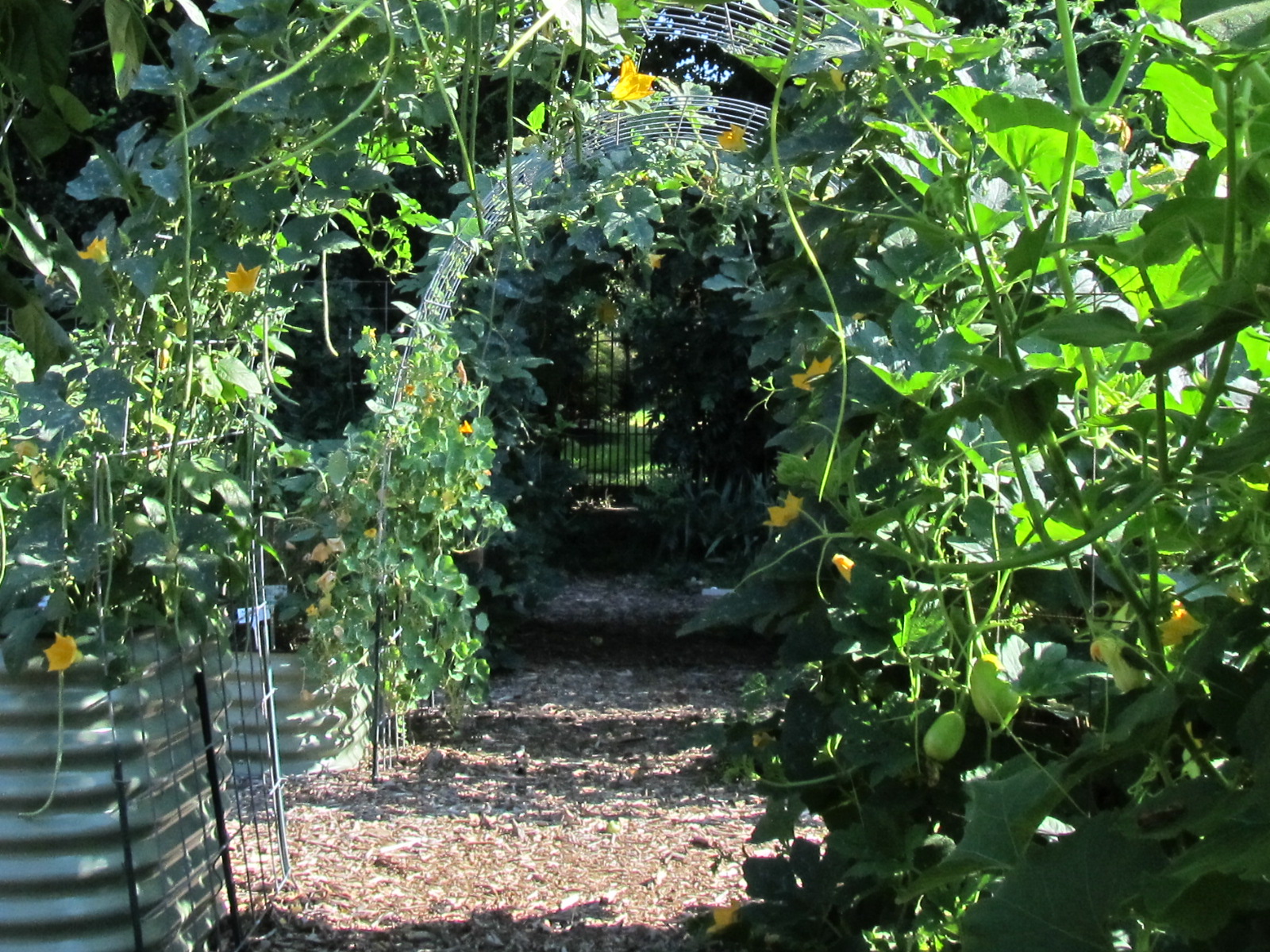
Congratulations to the Raincatcher’s Garden Veggie Team, who has harvested and donated 634 pounds of squash so far this year. It’s quite an accomplishment when you consider the ubiquity of the destructive squash vine borer (SVB) in the area.

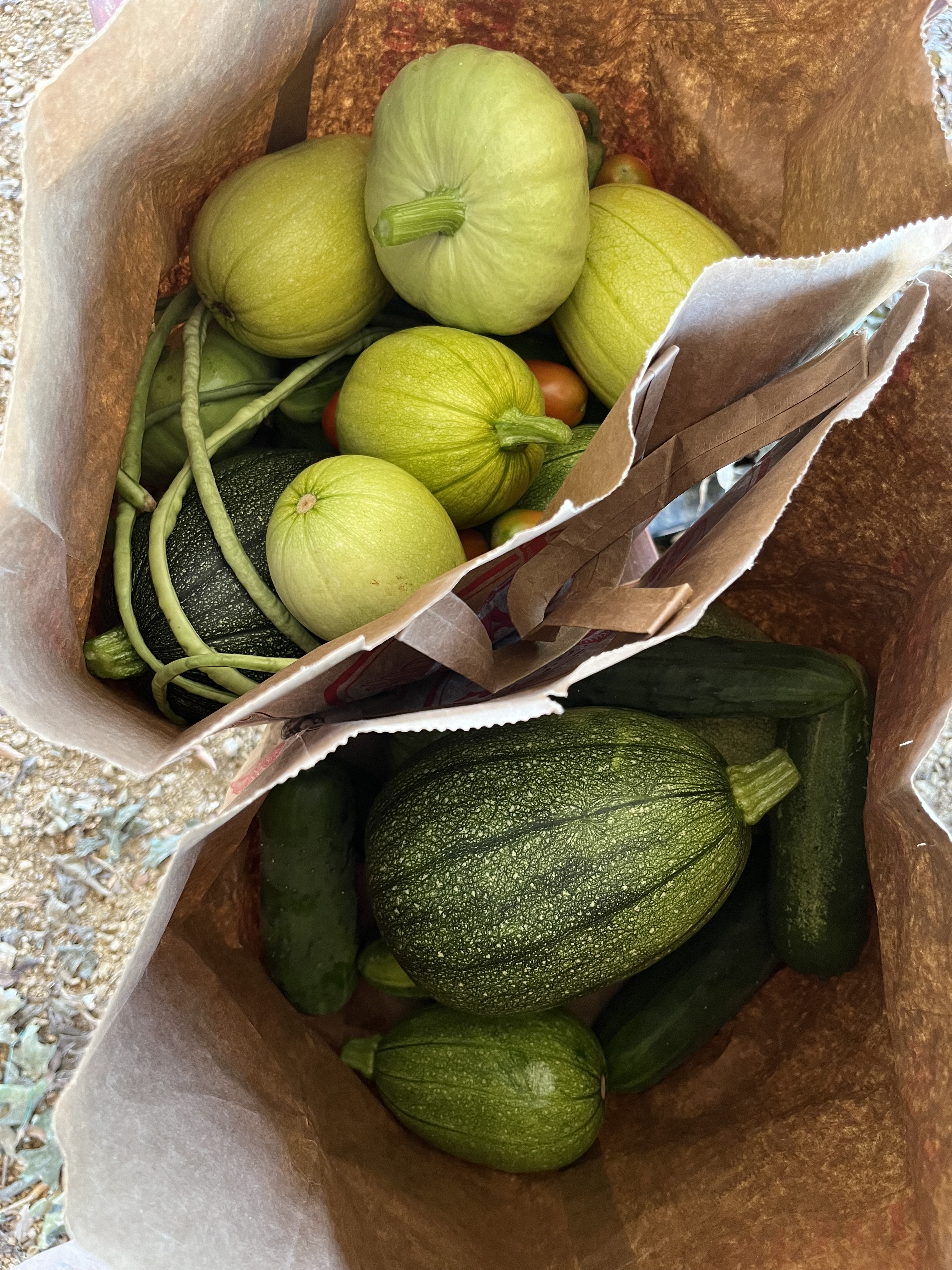
The team’s challenge was to find a squash variety that resists SVB. Over the past three years, gardeners have tried Zucchino Rampicante (Cucurbita moschata), Baby and Waltham Butternut (Cucurbita moschata) and Calabacita (Cucurbita pepo).  All overcame SVB damage, but the Calabacita production was much higher.

Calabacita is delicious, especially when harvested at tennis ball to softball size. It can also be eaten as a soccer ball size pumpkin and stores well at the larger size. It takes a little more effort to prepare the larger size, so the gardeners included cooking instructions with donations.

One difficulty, but a good problem to have, is finding the many fruits of this prolific plant before they reach a large size.

Another issue is the vines grow over 10 feet long and quickly sprawl throughout the garden. At Raincatcher’s they grew over large trellises and into the raised beds and grape arbor on the opposite side.

However, the trade off of space for productivity worked out well for the garden this year.

Well done Veggie Team, whose total production for 2024 has now surpassed 1200 pounds, providing fresh, nutritious food for the patrons of North Dallas Shared Ministries.

Cyntihia Jones and Beverly Allen, Dallas County Master Gardeners

The Veggie Team works hard every Monday morning (and many Thursday mornings during harvest), weather permitting, so please feel free to stop by with any questions you may have about growing vegetables in Dallas or just to look around and be inspired. Our garden is located on the grounds of Midway Hills Christain Church at 11001 Midway Road, Dallas, TX, 75229.

Sunflower Honey

June 14, 2024

A bee on a yellow flower

Description automatically generated

A recent Savannah Bee email was so inspiring to read that I immediately ordered three jars of what founder Ted Dennard described as “the happiest honey around”. Sourced from the beekeepers of Ukraine and Romania, it truly is “as sweet as a summer day.”

For more information about the women beekeepers who produce and distribute this remarkable sunflower honey, please follow the link to Savannah Bee. Their story is one of determination and perseverance in continuing the art of beekeeping for future generations. 

Also, please revisit a blog article posted by Master Gardener Starla Willis in August of 2022. It features her summer trip to Ukraine where she captured an amazing photo of sunflower fields from her train ride across the country. She has cherished memories of that special experience.

For a quick breakfast treat, spread this yummy, crystallized honey onto a toasted English muffin.

A plate with food on it and a jar of butter

Description automatically generated

Only 5 ingredients from this to this!

*Note: For all products and references to Savannah Bee go to savannahbee.com

Linda Alexander, Dallas County Master Gardner Class of 2008

Candied Sunflower Seed Snack Recipe as pictured above

Cilantro/Coriander

May 30, 2024

Coriandrum sativum

It’s as common in the garden and grocery isles as parsley but there seems to be a level of misunderstanding that needs addressing. First Coriander and Cilantro are the same plant. The confusion is found in the seeds.  It is also sometimes referred to as Chinese parsley because of its long history of use in that cookery.  To clarify, the name “coriander” comes from the Greek koris, meaning bug, in reference to the odor of the leaves. And who hasn’t heard the taste of cilantro described as having a “soapy” character? 

Historically, coriander has been used for culinary and medicinal purposes for over 3,000 years. It is mentioned in Sanskrit texts, on Egyptian papyri and in Tales of the Arabian Nights.

In the Bible it is compared with manna. (Exodus 16:31 – “And the people of Israel called the bread manna. It was white like coriander seed and tasted like wafers made with honey.” NASB)

Coriander was brought by the Romans to Europe, where it now grows wild. In Mexico and throughout the Southwest you’ll find cilantro leaves used as a necessary flavoring ingredient in salsas, salads, soups, chicken and meat dishes.

Today, coriander is grown primarily for the leaves, but chefs are discovering new ways of using the entire plant. Interestingly, for me, while working in the garden last week, a cilantro plant filled with lacey, petite white flowers caught my eye.  After taking a few colorful photos, I couldn’t resist snipping a delicate umbel and popping it into my mouth. While the leaves of coriander/cilantro have a much more assertive personality, the flowers offered a milder, citrus-like taste that was cool and refreshing. It was an “ah-ha” moment for me. Never before had I considered using the delicate flowers in my cooking. I’m now convinced that a creative approach to using them will be enjoyed and appreciated. It is recommended cilantro flowers always be used fresh, never dried.

A plate of food on a wood surface

Description automatically generated

(Avocado Toast with Tomato Slices, Freshly Snipped Cilantro Flowers and a Splash of Apple Balsamic Vinegar)

A plate of food on a wood table

Description automatically generated

(Asian Noodle Salad with Fresh Cilantro Flowers)

*Finally, here’s an easy way to simplify the confusion. When people speak of cilantro, they are referring to the stems, leaves and flowers of the plant. Coriander usually refers to dried seeds. All are edible so, please, enjoy using the entire the plant in your future cooking adventures. 

Linda Alexander, Dallas County Master Gardener Class of 2008
Garden Love

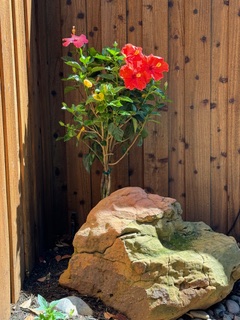
Many things connect us to our gardens. We have had a busy spring at The Raincatcher’s Garden.

Garden chores become pleasure when we work together. Spring has consisted of weeding, seed collecting, watering and learning from each other and then sharing the fruit of that knowledge with all ages and also agencies that assist others

Nature unfolds before our very eyes. This honeybee is about to forage for nectar on a beautiful cactus flower at the Raincatcher’s Garden.

Garden love also includes sharing life, having fun, and learning through our garden work experiences.  

Starla Willis, Dallas County Master Gardener Class of 2011

A Late Spring Update

According to the calendar, the first day of spring was Friday, March 20, 2024. Dallas natives know that early signs of spring started appearing in late February. One of the happiest moments for me was when two new additions to my garden in 2023 announced their comeback from winter’s cold. They are now showing signs of an exciting springtime welcome.

*Veggie Green Rose (Planted April 2023) – It has easily doubled in size, producing new buds over the past two months.

*Green Gage Plum (Planted September 2023) – It was thrilling to see both trees filled with delicate white blossoms during the last few days of February, continuing into March. Fresh, new green leaves started appearing in late March and early April. It’s now May and all is well.

*Black Sage (Planted September 2023) Sadly, this one did not survive those few days/nights of below freezing temperatures. But I’m not giving up on growing black sage in my garden. This time I’m trying a different strategy. Last month I ordered four new 4” plants from the same grower in California. Each one was planted in a different location of the garden with varying degrees of sun to shade. I’m encouraged today that all four plants have almost doubled in size. Hopefully, by this coming fall they will all be well established and ready for our unpredictable winter weather.

(Black Sage planted in early April 2024 is thriving)

A recent Savannah Bee email featured their Black Sage Honey and the amazing story of how it thrives in the lower mountain slopes and upper desert regions of the Sierra Nevada mountains. It is a fascinating look at what it takes to produce this uniquely flavored honey. Thankfully, I still have a few jars left from my last order!

Linda Alexander, Dallas County Master Gardener Class of 2008

Raincatcher’s Garden Annual Plant Sale

 Tuesday, May 7th 2024

10 AM – 3 PM

Midway Hills Christian Church 

11001 Midway Road 

Dallas, Texas 75229

So you think you want a GREENHOUSE!  Experiences from Acquiring a Green House for Raincatcher’s Garden

The allure of having a greenhouse is something that some gardeners dream of – a place to overwinter plants, start seedlings, and have workspace. How does this become a reality?  First of all,  determine your goals and ideas.  Do your homework and decide if it is a project worthy of the investment of your time, money and efforts?  

About the time Fall arrives and freezing weather makes its appearance, ads for greenhouses start flooding inboxes and social media sites.  It seems like a good idea to have a place to store tender plants that can’t handle it outside during our coldest temperatures of January and February. Another bonus is the ability to provide a head-start for seedlings to sprout before they are planted in the garden.  

There are a variety of styles, sizes, price points as well as optional accessories to consider – from heavy plastic, glass or plexiglass partitions, to brick surrounds, and various mortar and glass options, ranging in cost, size and function. A greenhouse can also be labor intensive, and impractical for those who don’t have the time, ability, or manpower to maintain it properly.

The preferred space needs to be of adequate size for your garden needs, level and in a sunny to mostly sunny location. Water needs to be close and the ability to heat, cool and monitor the space is an important consideration.

Dreaming of a place to overwinter my plants caused me to inquire online. My available location was not ideal-the space was not adequate and the prep and the assembly was more than daunting (in so many ways). Ultimately, the amount of time, effort and money to be invested caused me to pause, rethink and determine that installing a greenhouse was not my best move.  However, a well-utilized greenhouse is much more than just a storage space for tender plants.  

While contemplating this, Raincatchers’ acquired one that would be optimal for our North Garden. It was transported to the property and the plans for putting it into seedling production began to unfurl. It took about two months to get the “new to us” greenhouse relocated and in working order. The “team” at Raincatchers’ has spent many man hours preparing it for use, leveling the site, setting a brick floor on decomposed granite, anchoring the greenhouse against the strong Texas winds, building multiple two-tiered seedling tables, installing a solar powered cooling fan, and initiating water and electrical hookups. Maintenance will be ongoing.

Seedlings have now been started for our many vegetable beds and they appear to be very happy in their controlled environment.  Note: vegetable seedlings are started and then set out into our gardens at the proper time.

If you are thinking about  acquiring a greenhouse, either by purchase or building it yourself – the best of luck to you! Hopefully, you now have an idea of the reality of the effort to produce a functioning greenhouse and can make an informed decision  It can be very useful and an asset to your gardening efforts; whether starting vegetables, flowers or show plants, or just over wintering your houseplants or tropicals.  

A gardener’s considerations for Installing a greenhouse:

Manpower to construct the unit (most come in sections that require construction) 

$$ Cost (from a few hundred dollars to several thousands)

Overall Size and Options

Site selection –    

Sunny to mostly sunny location

Ground leveled for structure

Anchoring against the wind

Inside Flooring (Hard surface with the ability to drain) several options Shelving options (Water resistant)

Storage options (Greenhouse supplies)

Heating and Cooling Capability, i.e., a solar operated cooling fan

Electrical Considerations

Water Availability (For plant watering and seedling misting) 

Shade Capability (For the long, hot sunny days)

On-going Upkeep (several hours a week) 

Construction Permit (If required)


Starla Willis, Dallas County Master Gardener Class of 2011 with input from Jon Maxwell, Class of 2015

Two dates to remember:

Raincatcher’s plant sale-May 7th

Dallas County Master Gardener Association Garden Tour 2024-May 18th

Snowball Viburnum

March 27, 2024

A view of 3 Snowball Viburnums, looking thru my blackberry bushes. Eleagnus flanking the west side, hellebores underneath.

Spring comes and this is what I see every year out my south-facing windows. What a sight! I planted these 3 snowball viburnums 11 years ago. They have been the showiest, easiest plant choice I have ever made. The buds are chartreuse and and bloom into softball size white blossoms.

As you can see from my picture above, mine are now feet 15 tall and slightly crowded but I don’t mind. The winter honeysuckle that has gotten bigger than I ever expected is pushing one snowball to the East. It is going to be pruned!

Last year even with the unbearably hot temperatures, my viburnums bloomed a second time. There were’t as many blossoms but in that terrible summer heat it was nice to see a few snowballs.

Plant Attributes

This picture from Neil Sperry’s website shows the early chartreuse bloom.
  • Common Name: Chinese snowball viburnum, Chinese snowball tree
  • Botanical Name: Viburnum macrocephalum
  • Family: Adoxaceae
  • Plant Type: Perennial, Tree, Shrub
  • Mature Size: 6–20 ft. tall, 6–15 ft. wide (grows larger in warmer climates)
  • Sun Exposure: Full, Partial
  • Soil Type: Well-drained loamy, sandy, or clay soil
  • Soil pH: Acidic
  • Bloom Time: Spring
  • Flower Color: begins chartreuse then becomes white
  • Hardiness Zones: 6–9 (USDA)
  • In Dallas, Snowball Viburnums do not loose their leaves in winter
  • Excellent cut flower with long vase life!

Ann Lamb, Dallas County Master Gardener Class of 2005