Where, Oh Where is Dear Little Susie? (Answer: She’s Way Down Yonder in the Paw Paw Patch)
Where, Oh Where is Dear Little Susie? (Answer: She’s Way Down Yonder in the Paw Paw Patch)
Four years ago (Spring 2020) two small Paw Paw trees were planted in the Raincatcher’s Garden of Midway Hills Edible Landscape. As advised by the grower in Florida, we ordered two different varieties to ensure cross-pollination and fruit set; Collins Select and Eastern Seedling. At planting time, they were about 18” tall. Now, four years later our little trees are continuing to grow and have reached over 5 feet in height.
Paw Paw Tree ‘Collins Select’ Spring 2024‘Eastern Seedling’ September 2024
However, what we have yet to experience are those vibrant, maroon-colored spring blossoms.
Patience, according to the growth characteristics of paw paws, will need to be exercised for a few more years. In other words, if we consider the projected time frame for fruit production, a range of five to eight years is to be expected. Waiting will be a challenge but, hopefully, we’ve done all the right things to get our trees started on their journey to a delicious tropical harvest.
Hoping for a pleasant surprise in Spring 2025!
Paw paw Asimina triloba, is a species in the plant family Annonaceae, which is the largest family of the magnolia order and includes many tropical plants. They are the largest edible fruit trees native to the eastern United States.
Linda Alexander, Dallas County Master Gardener Class of 2008
For a fascinating article about paw paw trees, their characteristics and history, follow this link.
If the key to life is simply living it.. The key to understanding may be simply realizing that wisdom is all around even in unlikely places. Our job is to realize wisdom when we find it—and then apply it .
For an example let’s think about these simple lines:
YOU GOT TO KNOW WHEN TO HOLD EM
YOU GOT TO KNOW WHEN TO FOLD EM
YOU GOT TO KNOW WHEN TO WALK AWAY
YOU GOT TO KNOW WHEN TO RUN
Few words but the ideas are wise and useful. No where more so than in the garden at this time of the year. We start with the first of course. And actually this idea was most important a little earlier in the year.
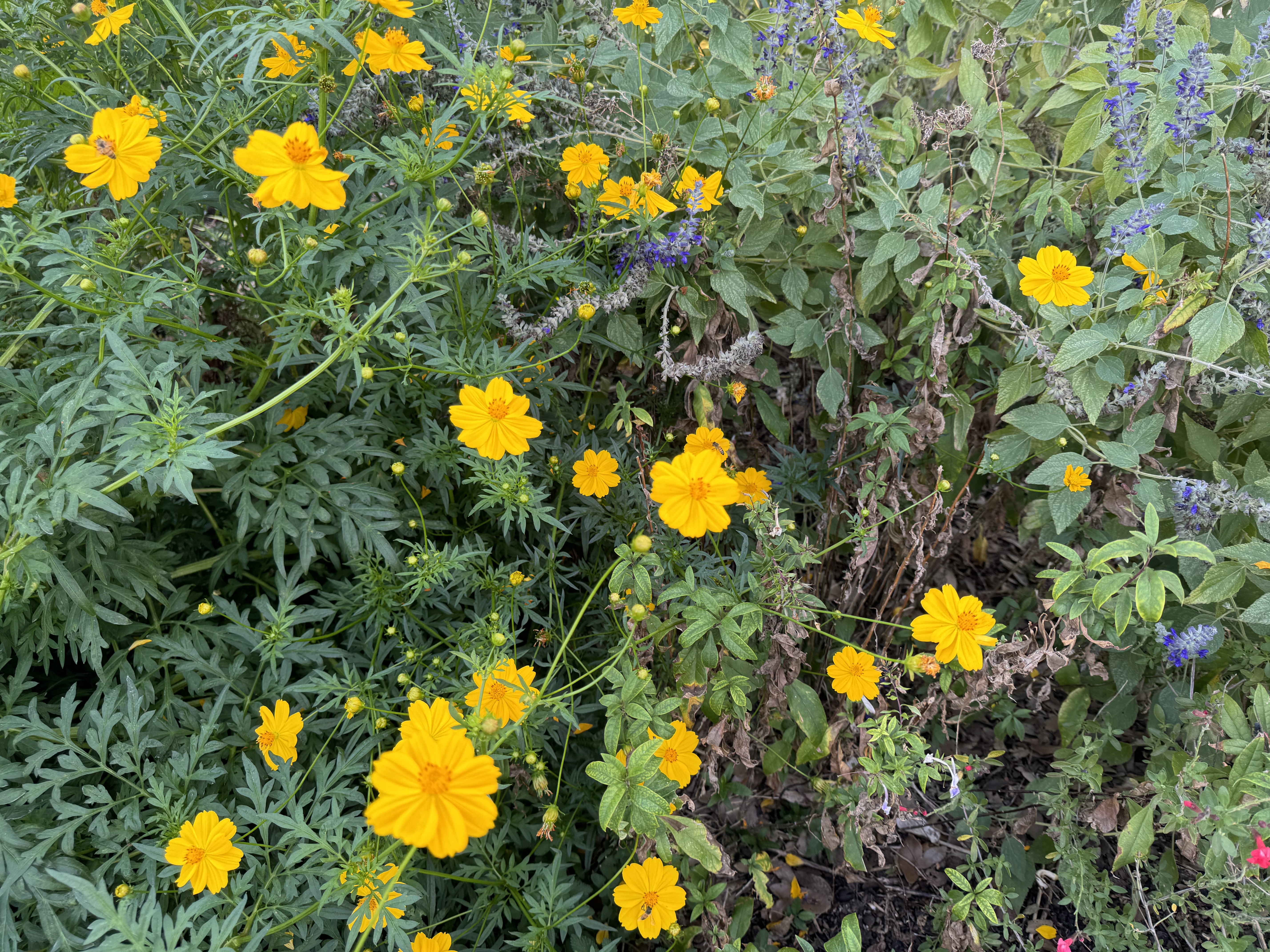
How was it so useful? well the yellow cosmos are a great example. All summer they grew and grew. No flowers at all. Some falling over due to the weight of stems and leaves. A passerby was heard to say ” I don’t know about those green leafy things they sure are big” Were they a terrible mistake? Are they ever going to bloom? Are they going to all fall over? Temptation grew to pull them all out. And then all at once they bust into huge numbers of lovely cheerful flowers. Butterflies and bees are just loving them. They even look great as cut flowers.
Yes!!! holding was the best choice for sure.
The big green leafy things that were bare all summer are blooming at last and they are amazing. Cosmos!
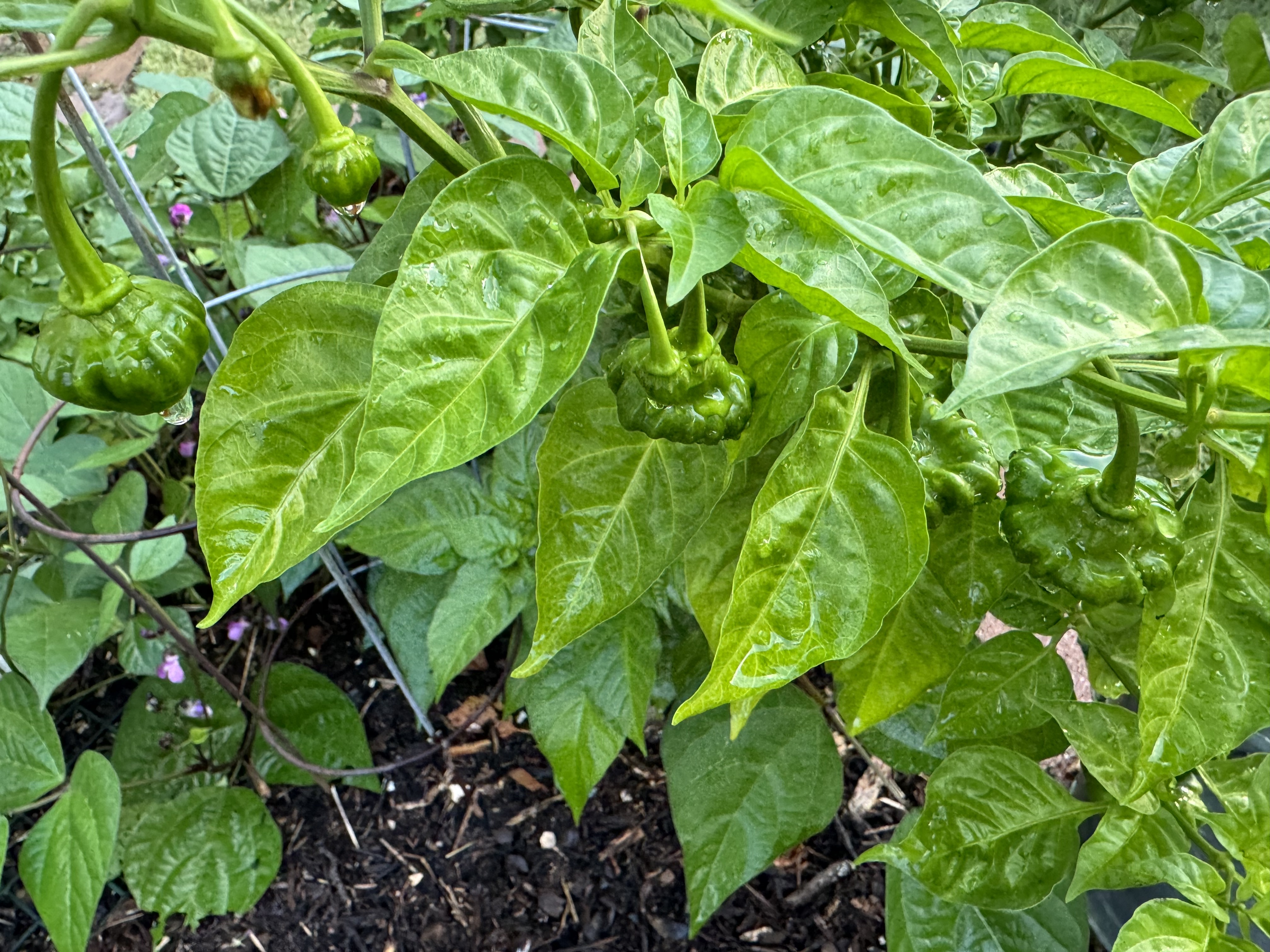
Aji dulce peppers –no peppers for months. All they were doing was taking up space and causing thoughts of “what on earth went wrong?” They were biding their time. Summer just didn’t suit. Just a small improvement in the weather–and blooms followed by lots and lots of little peppers. It was a temptation to give up–but it would have been a shame.
The Peppers finally realizing they have a job to do.
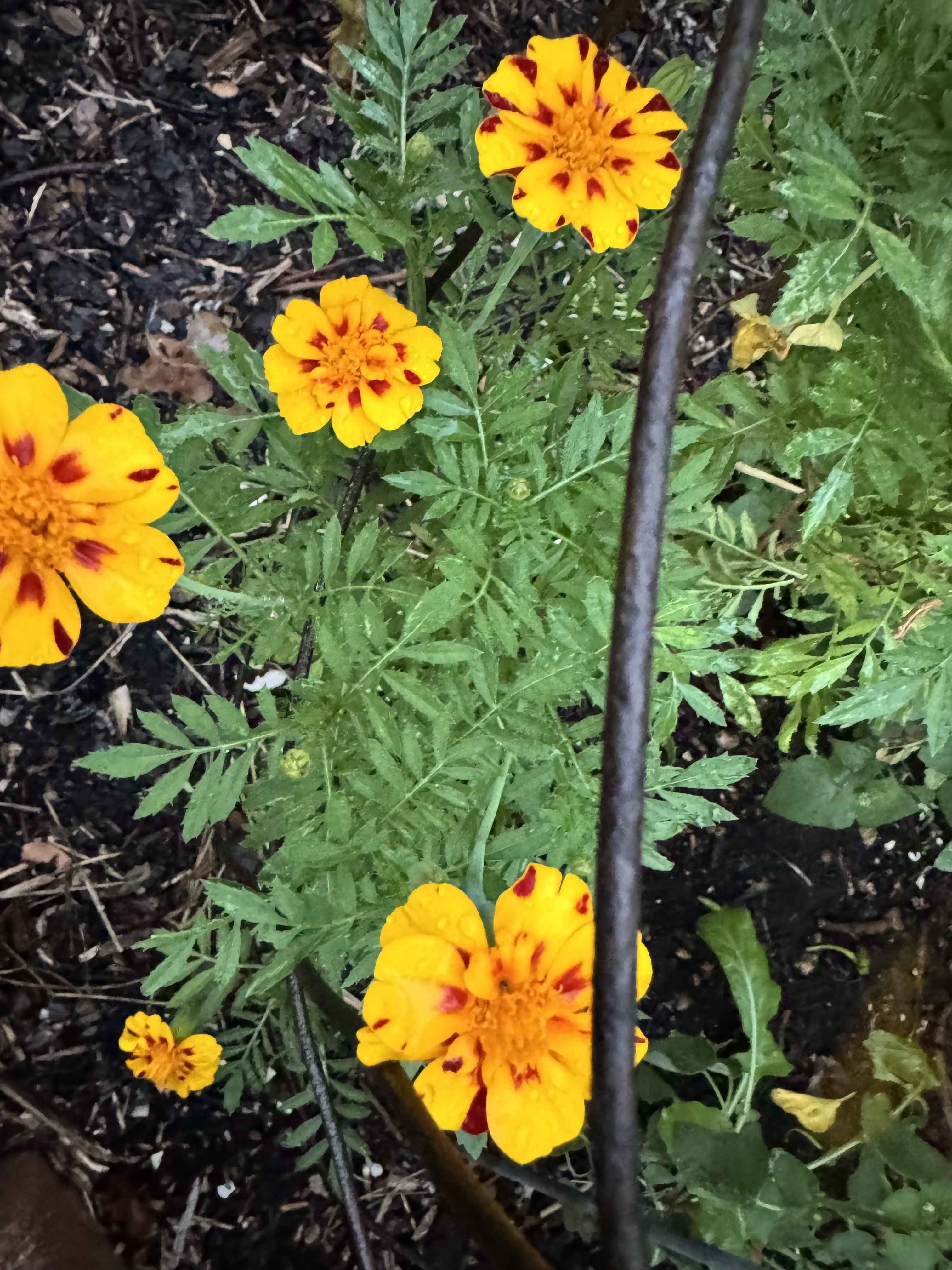
Marigolds–they also seemed to find the past few months not to their liking–the remaining tomatoes are happy maybe because the marigolds are happy.
The Marigolds were to keep the tomatoes company all summer. They are doing it now.
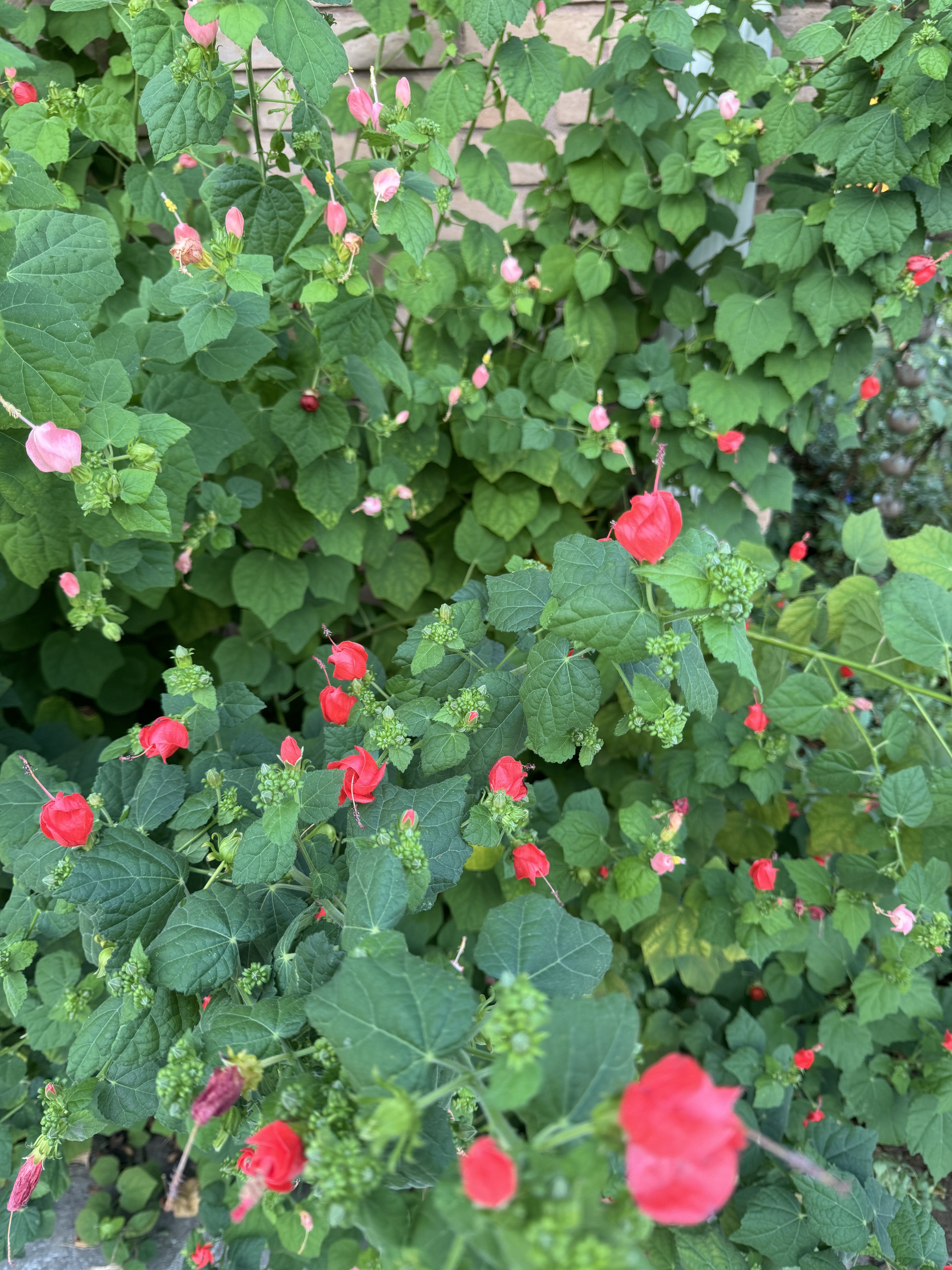
Turk’s cap–honestly it seemed to be asking to be cut to the ground–very few blooms and yet requiring constant pruning to keep it withing reasonable bounds–but–again a reward for avoiding extreme measures–countless flowers–and happy creatures.
Turk’s cap-all summer, some flowers but now covered in flowers.
Of course the facts are–that all doesn’t go as hoped.
The most obvious are annuals that have tried really hard but have now reached the end of the line. It is hard to do this when they aren’t quite done but face it–sad straggliy plants just distract from everything around them. Let them go its ok.
It’s time for an old friend to go. Sad but true.
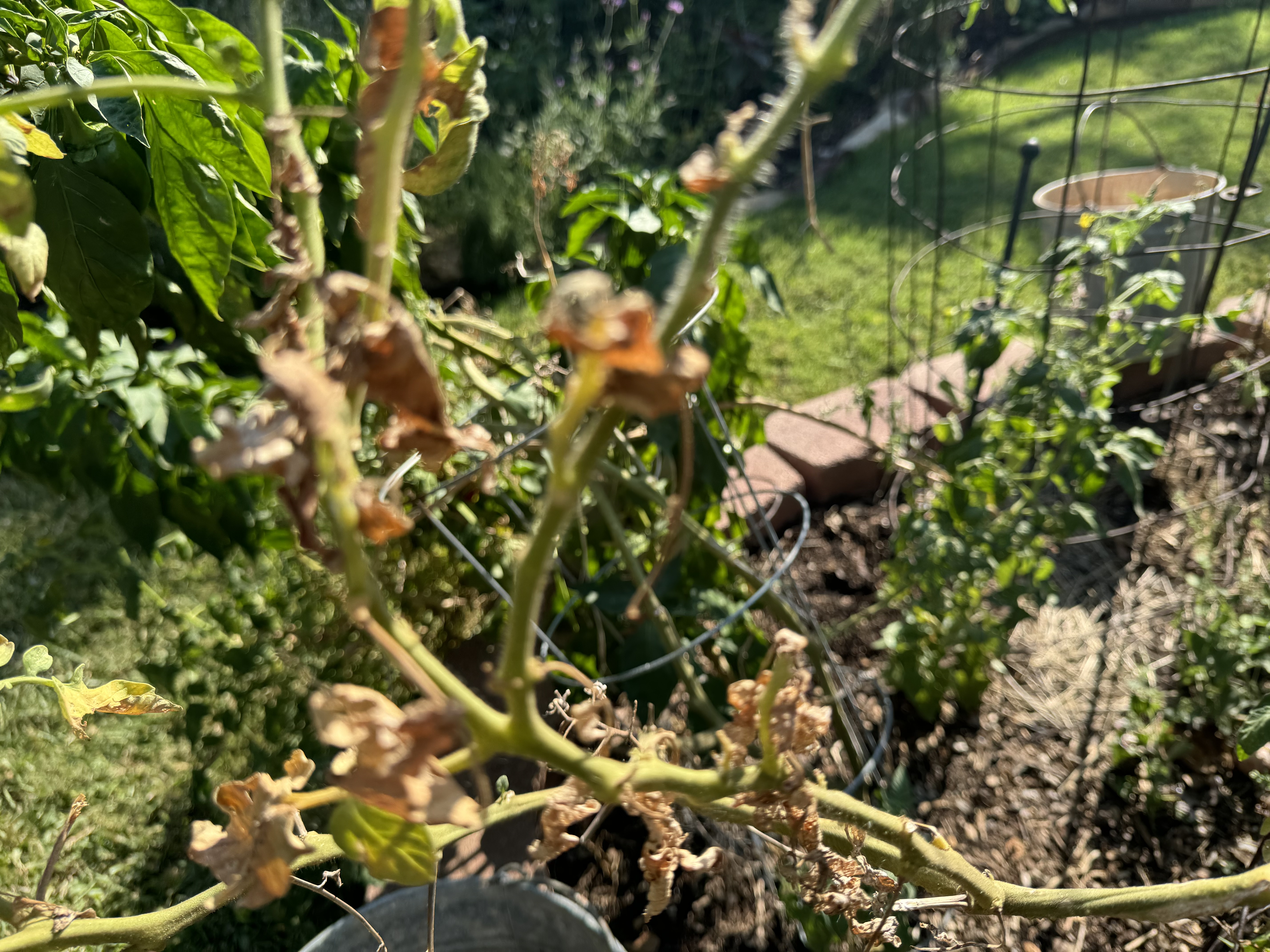
Same with vegetable plants. These plants work hard some can make it on into fall. But some just can’t. It is really best to get rid of them they can attract pests and diseases that are just doing what they do to eliminate the weak–but best to beat them to it.
This tomato in my garden just isn’t going to recover.
The really hard part of the fold ’em is facing that some of your efforts really were in vain. For some reason plants die. Sure try to figure out why. Was it lack of water–a common issue. Maybe over crowding? But sometimes its unknown. Pull them out anyway no use spending resources–including your time and energy on plants that just are not making it.
Perennial doesn’t mean live forever!
Those first two are pretty clear–but what about KNOW WHEN TO WALK AWAY?
Actually its an important one. This is the time of the year when plants have pretty well done what they are going to do. It can be so valuable to step back and away and look at the big picture. Could you do anything different ? Is it just that much too much? Or not quite enough? Walk away and take a good look and make some mental notes for next year.
Is it maybe just a little too much? Take a step back and look.
Can’t forget YOU GOT TO KNOW WHEN TO RUN. No it won’t be a big problem don’t worry. But do keep in mind that wasps and yellow jackets are very active at this time of the year. Of course they are part of nature and normally not an issue–but do look around they like to build nests in protected places–who doesn’t of course–but sadly when its right above the back door for example you may have to do what you would rather not. But be careful at times their temper can be kindly said to be “Uncertain” And i hope you don’t have to run–but—-.
YOU GOT TO KNOW WHEN TO HOLD EM
YOU GOT TO KNOW WHEN TO FOLD EM
YOU GOT TO KNOW WHEN TO WALK AWAAY
YOU GOT TO KNOW WHEN TO RUN.
Susan Thronbury, Dallas County Master Gardener Class of 2008
Fall is a good time to plant Hardy Hibiscus and Hydrangeas for spring and summer blooms.
Blissfully soaking rains in April ushered in the arrival of extraordinary May flowers. How refreshing to see these three stalwarts of the garden bursting with blossoms as they made their dramatic appearance in the landscape. New growth started to emerge on these three beauties sometime around early April. Continuing into May, they filled out with tender green leaves, buds and blossoms.
June’s gift to us was an explosion of color. The temptation to selectively snip and arrange them for indoor enjoyment was overwhelming. Restraint was needed but rather difficult to achieve.
Hibiscuses (Malvaceae)are in the Mallow family and, interestingly, also include such plants as okra, cotton and the old-fashioned hollyhock. My preference for dependable seasonal color is the tropical variety, which is considered an annual in our Zone 8 climate. Late winter is when I start planning the layout and design of my seasonal garden beds. Hibiscus is ALWAYS included. Who wouldn’t appreciate a flowering, seasonal plant that can go into the ground during the month of April and continue blooming until the first freeze? Another benefit: it’s the type of plant that manages itself well. During the growing season when glossy green leaves begin to turn yellow and die, they politely fall to ground. Blossoms that open for a few days, do likewise. They really are gardener friendly plants!
This year I’ve included tropical hibiscus in different shades of pink mixed in with existing limelight hydrangeas. They receive about 6 hours of morning to mid-day sun. And for a bit of whimsy, two hibiscus topiaries were added in areas that benefited from slightly more height. One is my favorite; it was placed behind my sunflower girl statue and features dreamy double yellow blossoms. The other is a sassy 4 foot tall, braided hibiscus topiary tree nestled in a corner bed. The multi-colored blossoms are a standout against our bronze colored fence.
Starting in late June our three hardy hibiscus plants began their seasonal show with those bodacious salad plate size flowers. These herbaceous perennials die to the ground in winter then around mid-April new growth signals their return to the garden.
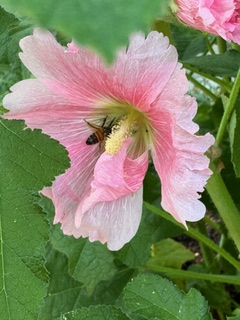
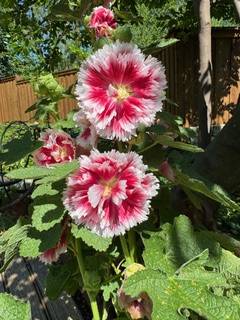
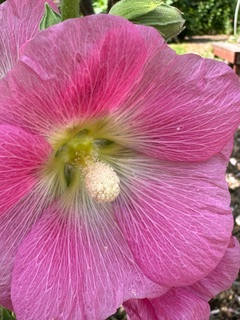
King Henry VIII Pink Hollyhocks with Honeybees Foraging for NectarPlanted 2023 in a location with morning sun and mid-afternoon shade‘Fiesta Time’ was added to my garden in May. Its fringed flowers are stunning
At Raincatcher’s Garden of Midway Hills, Master Gardener Susan Thornbury started seeds of a variety respectfully referred to as ‘Outhouse’. In days past, this treasured garden beauty was supposedly used as the perfect blocking for an unsightly outhouse while helping to mask the smell. Take a closer look at the multi-colored single blooms of white, pink, red and burgundy and you’ll see why it provided a pretty visual barrier.
Hydrangeas: When we moved into our home in May of 2006, oak leaf hydrangeas were already growing in a mostly shaded area of the garden. A few years later, they had overgrown the space and needed to be moved. A successful relocation to an area with filtered sun in the morning gave them more room to stretch their branches.
Since then, we’ve introduced a variety of hydrangeas to our garden beds:
*Big Leaf Hydrangea – Hydrangea macrophylla (Also, known as ‘mopheads’, these are the most common type of hydrangeas grown in home gardens and landscapes. Bloom time is usually late April through July. They are deciduous shrubs with large pom-pom heads of pink, purple or blue flowers. The flowers are greenish-white when young, picking up subtle shades of pink and brown as they age.
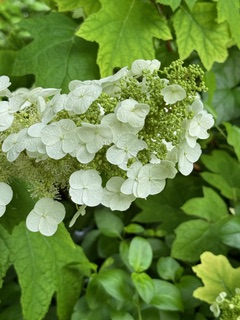
*Oakleaf Hydrangea – (Hydrangea quercifolia) Commonly referred to by its translation oak-leaved or oakleaf hydrangea, this variety offers year-round beauty with seasons of blooms, foliage and peeling bark. Blooms in spring and early summer. These beautiful plants were already growing when we moved to our home in 2006. Since then, I have searched for the compact, well-rounded deciduous hydrangea shrub known as ‘Ruby Slippers’. Finally, in mid-June, our local garden center received a shipment. I was first in line to purchase 3 plants. It was a special Father’s Day gift for my husband whose late mother was Rubye. He was thrilled! Oakleaf hydrangeas bloom on last year’s growth, so prune minimally after they bloom – not in early spring when new flower buds appear.
(This incredibly spectacular display of oakleaf hydrangeas is in the yard directly behind our house. It is the first thing that catches my eye when turning to leave our driveway. The photo on the left was taken in April when the plants were filled with those enormous white blossoms. Early to mid-summer they transitioned to lovely shades of deep pinkish/red. While the specific variety is unknown, something suggests to me that they could possibly be “Ruby Slippers’.)
*Panicle Hydrangea – (Hydrangea paniculata) This is one of the most cold hardy and heat tolerant of all species of hydrangea, thriving in Zones 3 through 9. Reaching 8’ + at maturity, there are now several dwarf varieties that stay under 5’ tall. For the strongest stems and the most abundant flowers, locate them in an area that receives 6+ hours of bright, direct morning sun then shaded during the hottest part of the day. We added ‘Limelight’ to our garden in 2022 and it has been a joy to watch them grow. Their huge, luxuriant conical flowers are mesmerizing. Bountiful blooms appearing in late May gradually turn from lime-green to creamy white in late summer followed by a rich deep pink which fades to beige as fall arrives.
*Of note, these hydrangeas are a recipient of the prestigious Award of Garden Merit of the Royal Horticultural Society and the Gold Medal Award of The Pennsylvania Horticultural Society.
Note: All photos were taken in the April – July time frame. The 100+ degree temperatures of the summer have left some plants struggling to endure the extreme heat. However, just as happened last year, the hardy hibiscuses, hollyhocks and hydrangeas will return next spring. The tropical hibiscus plants are going to be replaced with a new color palette in April of 2025.
Linda Alexander, Dallas County Master Gardener Class of 2008
The Dallas County Master Gardener Association Japanese Maple Sale opens October 9 Once again, we are offering a large selection of Japanese Maples from Metro Maples for purchase with all proceeds going to DCMGA. These are very small young trees that will do well in a container until you find a place for them in your garden; in fact, many of them would be perfectly happy in containers for several years, although you can certainly plant them directly in the ground. If your interests lean toward the unusual and rare, we have several varieties that qualify including the dwarf Kotohime, Beni hagoromo, Chiri hime, Nuresagi and Ogon Sarasa. Get online early to make your selections. The SignUpGenius website for ordering and purchasing maples will go live October 9 at 8 a.m. At that time, you can order and pay for your selection(s).
One-gallon trees are $35.00 (including tax) Two-gallon trees are $46.00 (including tax)
The SignUpGenius will close at 5 p.m. on October 16, or earlier if all trees are sold. This fall we have 20% more trees for sale, but don’t procrastinate because our inventory of trees has sold out within hours in the past. Please bring your confirmation to the pickup on Saturday, October 26 between 10 a.m. and 1 p.m. at 3015 Randy Ln., Farmers Branch (note: this is a new pick-up location.)
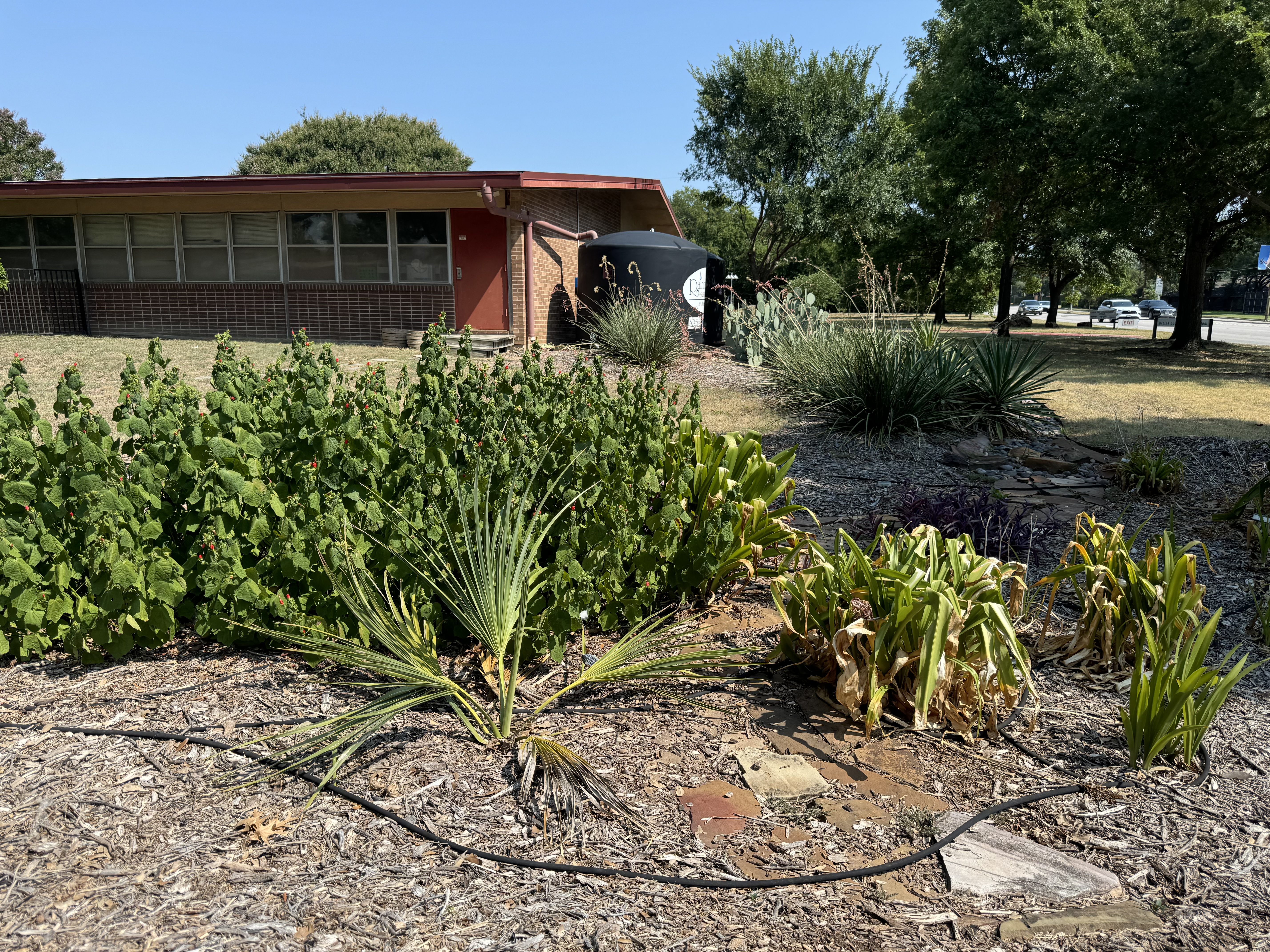
Panoramtic View of the Courtyard, Raincatcher’s Garden
Our garden has survived and even thrived this summer. The Raincatcher’s Garden was built using the 7 principles of Water Wise Landscaping:
Planning and design
Appropriate plant selection
Practical turf areas
Soil improvement
Efficient irrigation
Use of mulches
Appropriate maintenance
With fall temperatures giving us a respite, maybe you are looking for plants and practices that will endure our hot Texas summers. Take a look below at what worked for us and as always we would love to have you come for a vsit.
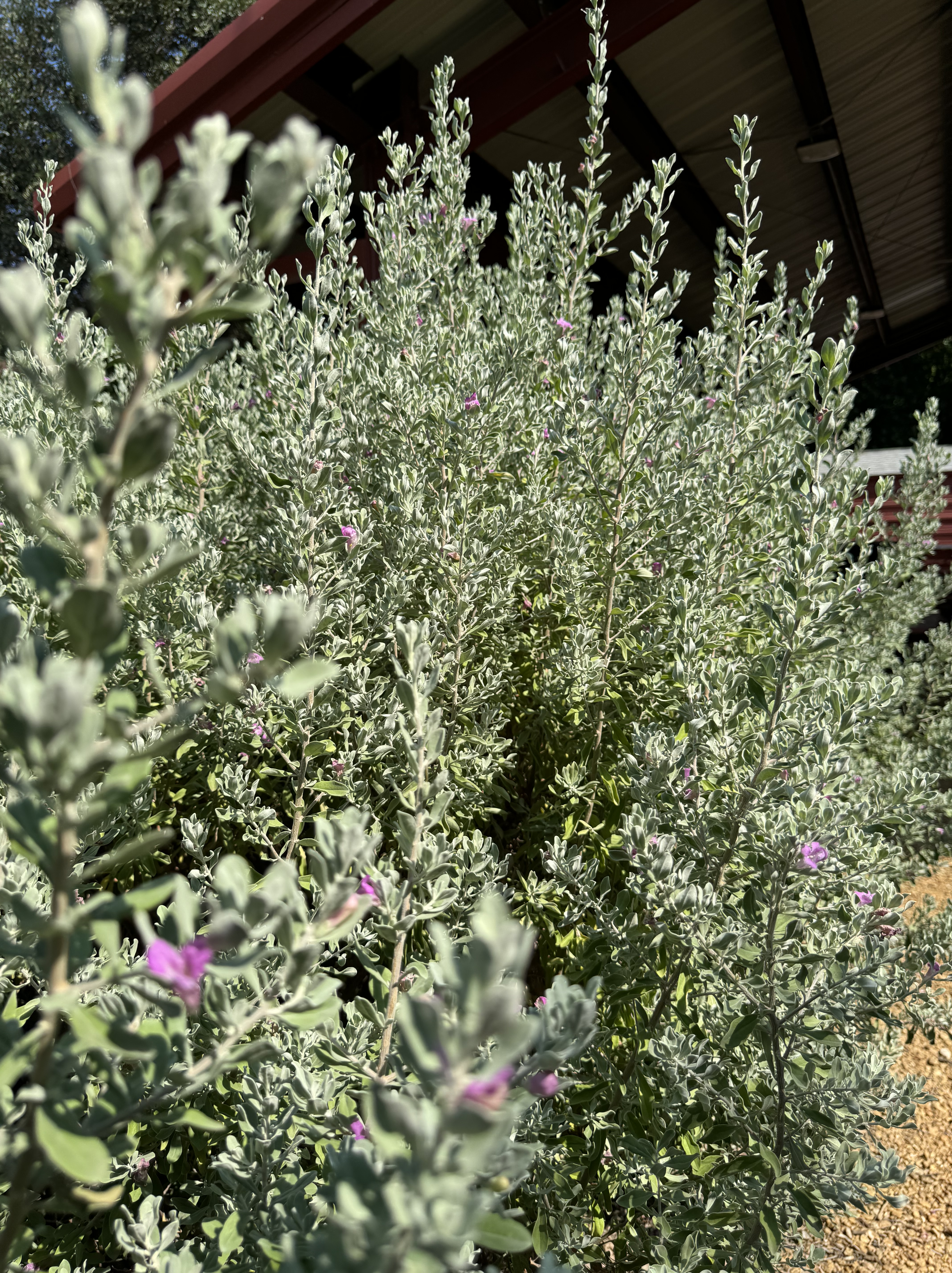
Rainctcher’s Prolific Vegetable GardenDesert Willow with attached polinatorFlame Acanthus for the HummingbirdsOkraTexas Sage, Leucophyllum frutescens, also known as the barometer bush-it blooms in periods of high humidity or rainGarden made Compost for Sale!A Crinum in bloom!Gardeners behind EsperanzaMexican Bird of Paradise, Caesalpinia pulcherrimaPentasA View of the Edible LandscapeZipper Spider-we think!Raincathcher’s Rain Garden with Rain Cisterns in BackgroundEvergreen Wisteria-we have a blog about this plant
Ann Lamb, pictures by Starla Willis- class of 2005 and 2008
Honestly, I’ve had a change of heart. But it didn’t happen suddenly. I must admit that, until a few months ago, an unknown plant with the characteristics of a weed was taking over strategic areas of my garden and had to go. I began yanking and pulling it up with ‘wild abandon’. And then I paused for a moment, allowing my curiosity time to reconsider. Thankfully, the plant finder app on my iPhone came to the rescue. The answer appeared quickly and offered helpful information. What I assumed to be just another noxious weed, was instead an herbaceous plant in the dayflower family. You may know it as Widow’s Tears, White-mouth Dayflower or Asiatic Dayflower. It gets its name because the tiny one-inch blooms last for only one day.
After reading more about the dayflowers growing in my garden, I was then redirected to an exceptionally moving YouTube video made by a lady in Israel. It was so beautifully done that my heart began to melt while watching the history of dayflower unfold on my computer screen. Common dayflower sprawls along the ground like a vine, often rooting at the nodes. Flowers emerge from a boat like sheath, one at a time. They are composed of 3 petals: 2 larger mouse- eared shaped blue petals above and a small curling white petal tucked beneath. Bloom time is generally May-October. If you have an adventurous spirit and feel inclined to experience something new, the stems, flowers, leaves and seeds of dayflower are all edible. Remember to harvest the tiny blue flowers early in the morning when they are fully open. Use them as a garnish for cheese and for an added splash of color in salads. My choice for the first ‘taste’ was to place the flowers atop a bowl of yogurt and fresh peaches. A light dusting of cinnamon sugar was the perfect finale.
Interesting facts about Dayflower:
*As one of the few flowers with a true blue bloom, the dayflower symbolizes reliability, steadfastness and trustworthiness. *Carl Linnaeus, the Swedish botanist, named the genus for three Dutch botanists, the Commelijn brothers. Linnaeus believed the unequal petals of the dayflower nicely represented the talents of the three brothers. *An exquisite Japanese woodblock print by Katsushika Hokusai, from the Edo Period, about 1800-05, gives credit to a distinctive blue dye created from the petals of the dayflower. The blue-gray color at the top of the tallest wave was identified as dayflower blue. For a fascinating in-depth look into the world of blue flowers, go to Science Friday and read the article entitled “How The Humble Asiatic Dayflower Revealed Clues To Blue Hues”. (Written by Lauren J. Young,on September 9, 2021).
Linda Alexander, Dallas County Master Gardener Class of 2008
Don’t give up, Susan Thornbury has some words of inspiration and an action plan for us during these hot days of summer.
August 15, 2024
Memory is strange. Most thoughts and memories are unhelpful. So much so that often a deep breath and a reminder that they are just thoughts and memories and not reality seems to be indicated. But then when least expected a flash of amazingly helpful inspiration!!
After listening to a weather forecast –given after the meteorologist offers an apology for what will be coming–and then stepping out to look at the garden already in a negative frame of mind and naturally seeing trouble everywhere—a song came –the words very loud and clear: “I”M GOING TO STAND MY GROUND YOU KNOW I WON’T BACK DOWN I’M GOING TO STAND MY GROUND”
Now don’t rush to judgement on that song–in this case it was crystal clear what the meaning was–it was aimed at gardeners!!
Not those in “other places” Places where the nights are cool it rains at least once a week and where things “just seem to grow” Oh no, they don’t get a song–it was not meant for them.
It was meant for gardeners here–it was meant for US!!
It is just such a temptation to give up–Its so hot and yet weeds are thriving–the list of “NOT FAIR” is a long one
But not for us to dwell on that: WE WILL NOT BACK DOWN WE WILL STAND OUR GROUND”
We can’t just think about it though–a plan is needed!
Each plan must suit the planner of course but–there are some important point that might be universal.
First give serious thought to becoming a morning person–if you start at 7AM –its not so bad and you can get a lot done in an hour or two. If this is not your usual habit–well just tell yourself–when November comes you can sleep late!!
Second set priorities. Take a good look and decide what must be done now some things can and should wait until later. One thing is usually deadheading.. The poor plants are stressed they don’t need to be trying to set seeds or supporting yellowing leaves. When you tidy them up they are really helped–and you get some encouragement–things are looking better already.
Third don’t give up on weeding. Weeds are cleaver plants and they can grab water and use it to set their seeds faster than one can believe–so don’t let them–you sure don’t need more weeds and your plants need all the water they can get.
Healthy and happy mulberry weeds edited out of the garden-they thought they were safe hiding in the salvia
Fourth–look for what is working. Which plants are showing a fighting spirit and a will to live they must be encouraged and rewarded–as they are encouraging and rewarding you.
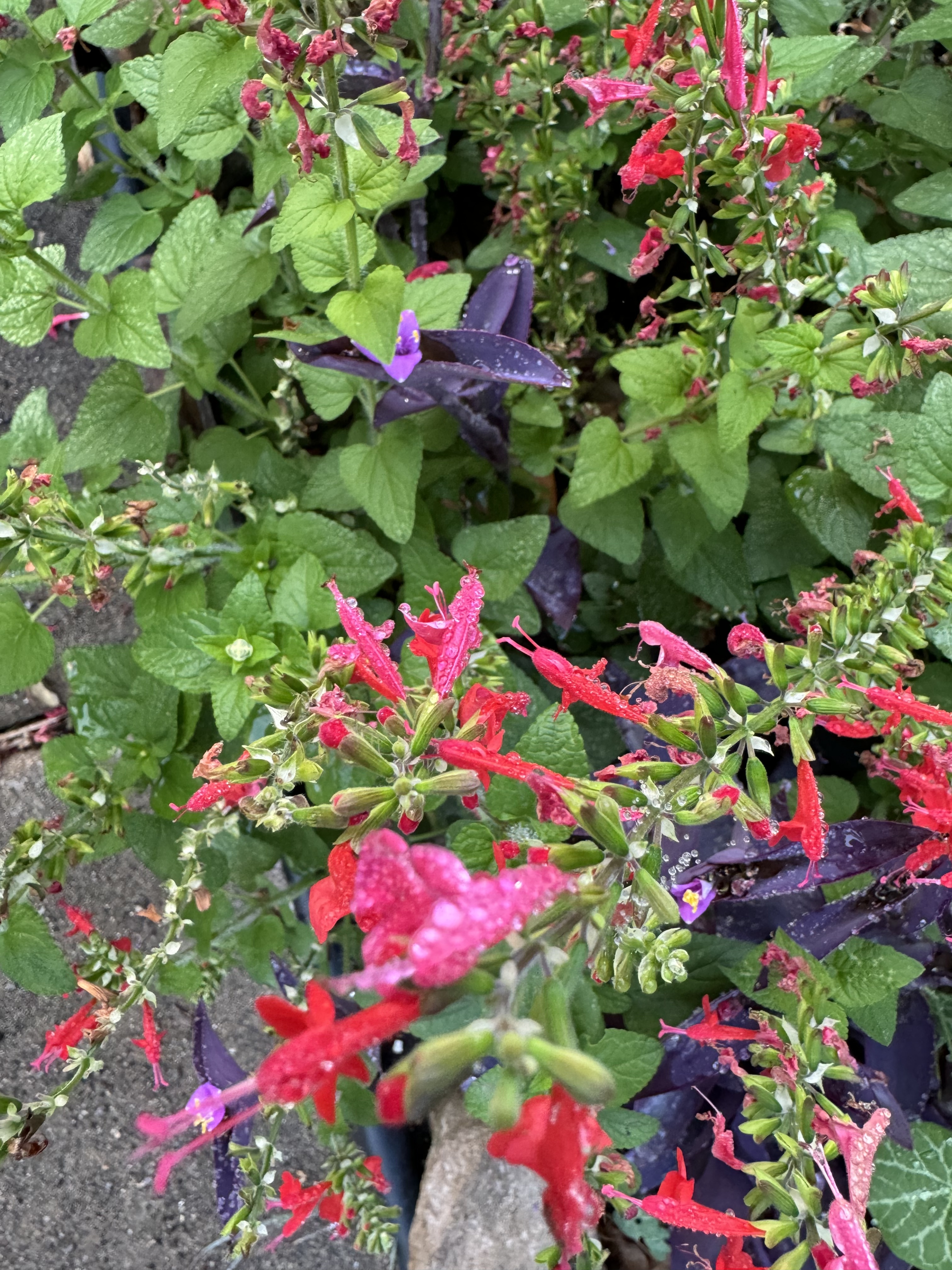
Turk’s Cap loves summerCenzio is ok with heat, even seems to like itRosemary is not complainingYard pointsetta and white veined piple vine are okay with heat but do like shadeSalvia coccinea keeps going when the going gets tough
But of course you must also face what isn’t working–Bite the bullet–remove dying plants there is just no use in trying to care for them and waste precious water on them–make a mental note to avoid them in the future.
Last–congratulate yourself!! you deserve it YOU STOOD YOUR GROUND NO YOU DIDN’T BACK DOWN YOU STOOD YOUR GROUND!!!
Susan Thornbury, Dallas County Master Gardener Class of 2008
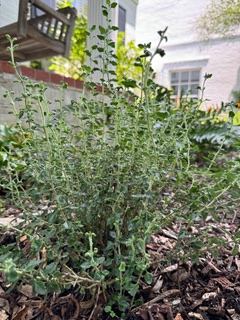
If you’re contemplating a substitute for boxwood, consider these words from Cyrus Hyde, the late garden herb folklorist and founder of Well-Sweep Herb Farm in New Jersey. He referred to germander as “poor man’s box”. Why then, has it not received more recognition in the world of herbs?
Even our first president, George Washington was such an admirer of germander that it was planted at his Mount Vernon, Virginia estate. But sadly, it seems to have faded from view until recently when garden centers began featuring lesser known herbs alongside the more desirable customer favorites. Thankfully, it was a wise decision with germander finding its place as a decorative evergreen border plant and as a substitute for boxwood in the beloved knot-garden design.
Germander ‘Upright’ surrounding the children’s statue in the Edible Landscape at Raincatcher’s GardenGermander ready to be planted at Linda’sGermander thriving in MG’s Patty Brewer’s Garden.
Germander is a Mediterranean native in the mint family (Lamiaceae) with small, dark green scalloped leaves and a mild garlic-spice aroma. It is a hardy perennial and evergreen, keeping its tidy appearance throughout the year. In early summer whorls of purple-pink flowers appear. Bees are attracted to the tiny flowers.
Grow it:
*Space plants 2 feet apart and at least 3 feet away from companion plants.
*Germander prefers full to partial sun and well-drained soils.
*Follow a regular watering schedule to establish, then cut back to maintain health.
*Fertilize lightly with an all-purpose organic fertilizer once or twice a year.
*Pruning right after bloom will help to renew the plants faster.
Germander with single stem gerbera daisies gently nestled in the glossy green foliage
Linda Alexander, Dallas County Master Gardener Class of 2008
Did you know that not all cukes are created equal? To simplify, there are two main types of cucumbers, American and English. Both can be used for pickling and slicing. This year I decided to try the English variety in my raised garden bed. Also, to save space, I used a trellis type support system for growing it vertically. That proved to be a very good decision.
13 inch long English cucumber ready to be harvested from my garden
After about two and a half months in the ground, my little cucumber transplant has covered the trellis and produced over a dozen cucumbers. English cucumbers generally grow thinner and straighter than their American counterparts and can grow in the range of 12 to 24 inches long. So far, I’ve been harvesting them at around 12 to 14 inches in length.
English cucumbers have a sweeter flavor and delicate skin that is less bitter than that of other cucumbers. Many sources say that English cucumbers tend to have very few seeds but, as you can see from the photo, mine had a generous amount.
Seeding an English cucumber with a serrated grapefruit spoon
Tips for growing:
*Plant in an area of the garden that receives a minimum 6 hours of sunshine daily.
*Prepare the soil by tilling well while adding aged compost to a depth of 6 inches.
*On average, cucumbers require: 1 inch of water per week in moderate conditions, twice per day when temperatures exceed 90°F.
*Add a 4-inch layer of organic mulch around base, but not touching the stem.
One of my favorite cucumber recipes is from a place in the Texas hill country where my husband and I, for over 35 years, always enjoyed having lunch. It was an absolutely charming restaurant in Fredericksburg known as ‘The Peach Tree Tea Room’. The Pedregon family opened their new venture in the fall of 1984. It brought in diners from all over the United States and internationally, as well. Sadly, it closed a few years ago leaving a void in the Fredericksburg culinary scene. Thankfully, over the years, I purchased all three of their wonderful cookbooks. The recipe I’m sharing is from their first cookbook, published in 1990. It is the recipe for ‘Chilled Creamy Cucumber Soup’.
Making the recipe over the weekend brought back cherished memories from those early days in Fredericksburg. It was especially rewarding to use three of the ingredients called for in the recipe from my garden; English cucumbers, parsley and garlic that was curing in my pantry.
Chilled Creamy Cucumber Soup Garnished with Freshly Chopped Parsley and Tomatoes
Hope you will be inspired to take a cool and refreshing break with ‘Chilled Creamy Cucumber Soup’. In the meantime, chill out with these tasty, sliced cucumber appetizers.
English cucumber slices topped with Herbed Cream Cheese, Salad Burnet and Borage Blossoms
And, just in case you were curious about the title…’Cool as a Cucumber’. I did a quick online search and learned something new. First, the inside of cucumbers are approximately 20 degrees cooler than the outside air. And the phrase ‘cool as a cucumber’ first appeared in a poem by the English author John Gay in 1732. It expresses the narrator’s angst regarding a woman with unreturned love! Today, that phrase is used to describe someone who tends to remain calm, assured and composed in any situation.
Linda Alexander, Dallas County Master Gardener Class of 2008
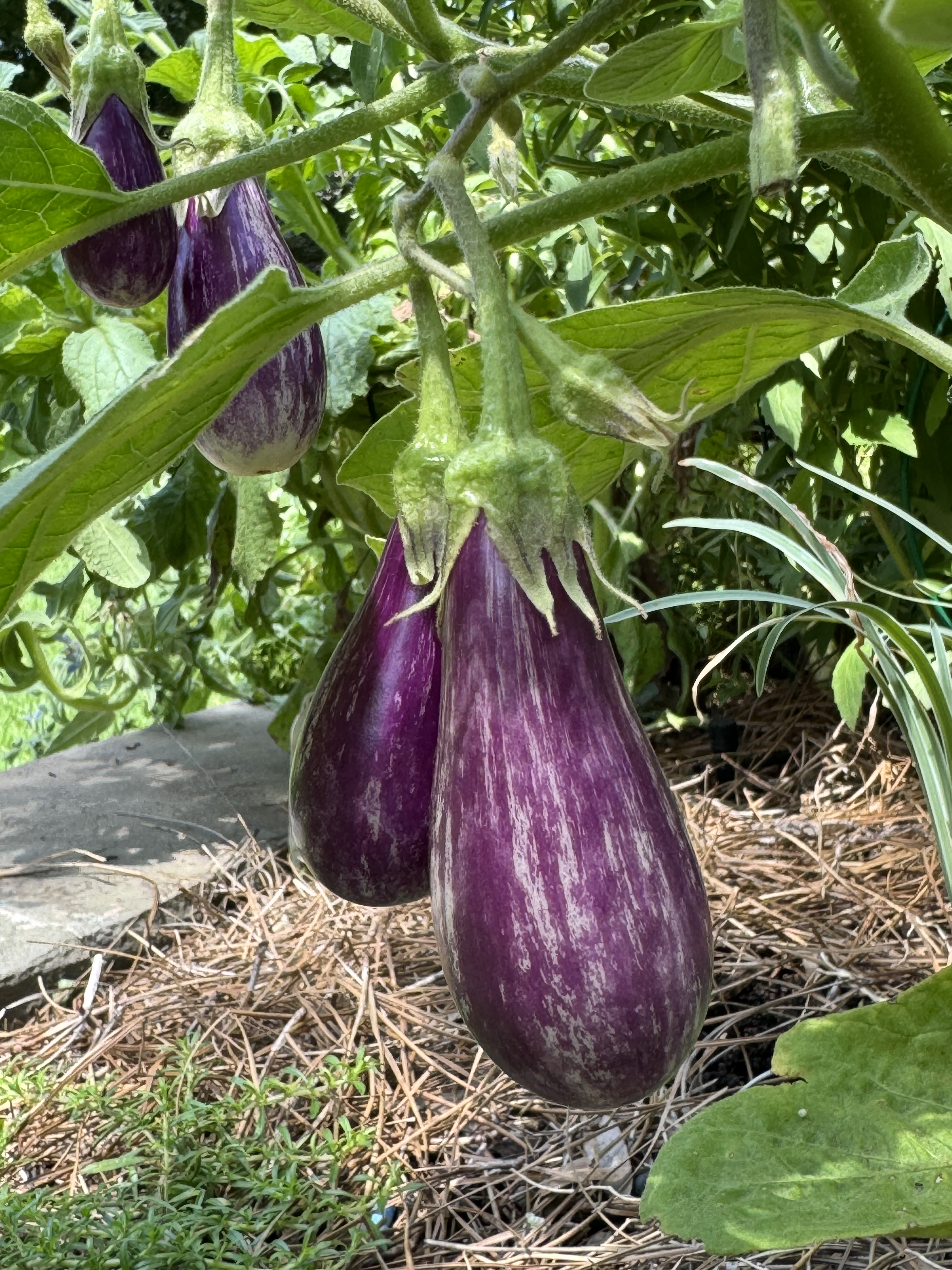
Does the familiar phrase ‘once upon a time’ bring back memories of your early childhood? Maybe it was when you heard the classic story of Little Red Riding Hood for the first time or were mesmerized when you saw Disney’s version of Snow White and the Seven Dwarfs. Throughout the years, fairy tales have given us wondrous characters in magical settings and left an indelible impression on young children throughout the world. But the fairy tale that has recently impressed me most is of a uniquely different variety. It is one that produces magically, ornamental plants for your garden. In this case, it is the adorable petite eggplant known as ‘Fairy Tale’.
Fairy Tale Eggplant
As you can see from the photo, it is a lovely mini eggplant, only 4 inches long, with stunning streaks of lavender and white. The plant itself grows to only 24” but produces tender-sweet fruits that are as beautiful as they are delicious. This variety can be grown in ground but, with its compact, dwarf size, is a just as suitable for container growing.
When it was time to harvest and enjoy, a quesadilla recipe was the perfect choice. Honey crisp apples gave it a sweet, tart taste while the smaller slices of savory fairy tale eggplant fit nicely on the tortilla. A handful of roughly chopped spinach along with some creamy Monterrey Jack cheese completed the combination of amazing flavors. Freshly made tortillas from Central Market held everything together while the quesadillas were baking in the oven.
A very unique feature of ‘Fairy Tale’ is the recognition it received in 2005 as an AAS* vegetable award winner. It was the first eggplant to win an AAS award since 1939. There is still time to grow ‘Fairy Tale’ in your garden so why not give it a try?
For transplants:
Pick a sunny site with rich, organic, well-draining soil. Eggplants require at least 6+ hours of direct sunlight per day. (Some sources advise not planting it in a plot where you grew tomatoes, peppers, potatoes or other eggplants the year before). Set transplants about 3 feet apart.
Mulch after planting.
Provide adequate water to produce the best-tasting eggplants. Fairy Tale eggplant enjoys deep, consistent watering throughout the growing season. Check often to be sure that Fairy Tale is receiving about 1-2 inches of water per week.
Harvest when fruits reach 2-4 inches in length for sweet, bitter-free enjoyment. Snip fruit with clean shears at their individual stems or in clusters. The skin should appear glossy (left side of photo), as dull skin can indicate overripe fruit (right side of photo). Harvest regularly to encourage new fruit production.
*All-America Selections winners are tested at trial grounds across North America. Each winner has superior qualities that distinguish it from similar varieties. ‘Fairy Tale’ was granted the prestigious AAS award by a nationwide panel of experts.
Linda Alexander,Dallas County Master Gardener Class of 2008


























 DALLAS GARDEN BUZZ