Gardening By The Yard

2016 FALL GARDENING SERIES

9:00 AM – NOON

  Raincatcher’s Garden Midway Hills Christian Church

 11001 Midway Road, Dallas, TX 75229

Cost: $15.00/session or $60/for all 5 sessions


July 23        Fall Into Gardening

Stephen Hudkins, County Extension Agent/Horticulture Texas A&M AgriLife Extension, Dallas County

  • Establishing the raised bed garden- construction, soil, irrigation
  • Square foot garden design
  • Selecting the vegetable varieties
  • Planting dates for successful fall harvest

August 6     Water Conservation in the Home Landscape

Dr. Dotty Woodson, Extension Program Specialist – Water Resources Texas A&M AgriLife Extension Service

  • Rain Water Harvesting – Rain barrels and cisterns
  • Drip irrigation for landscape beds
  • Calculating needs and programming your lawn sprinkler system


August 20            The Earth-Kind® WaterWise Landscape

  • Dr. Steve George, Extension Horticultural Specialist Texas A&M AgriLife Extension Service
  • Fall is the best time to plant shrubs and trees in your landscape. Come and learn what are the best proven Earth-Kind® plants to have in your landscape that will stand up to the tough soil and weather conditions that we have in the Dallas Metro area.

September 3                   Establishing a Backyard Vineyard

Michael Cook, Viticulture Specialist, Texas A&M AgriLife Extension Service

Come and learn the art of backyard viticulture production

  • When do I plant
  • What varieties are best for our area
  • What soil conditions do I need
  • What about frost
  • What do I need to have for support
  • When do I get to have my first glass of wine from my grapes

September 17       Healthy Home Lawns

                   Stephen Hudkins, County Extension Agent/Horticulture Texas A&M AgriLife Extension Service, Dallas County

    • Fall maintenance- fertilization, aireation, weed, insect and disease control
    • Maintaining the lawn during the winter
    • The pros and cons of over-seeding
  • You will also have the opportunity to see five turf grass types which are growing in the demonstration plots as well as view the drip irrigation system that has been installed under each plot.

Reservations not required, pay at the door. Master Gardeners can receive CEU credit. Public is welcome!

Some Like It Hot!

It’s that time of year again when it is too hot to do anything, much less garden in the full sun.  Cool weather crops of greens, lettuce, cilantro, and others have either withered away in the heat or gone to seed.  Even tomatoes, as the temperature climbs up into the high nineties, are beginning to get stressed.  Somehow, at this time of year, purchasing bags of pre-cut and washed lettuce and spinach at the grocery store doesn’t seem so bad.  Yet there are some green leafy vegetables that not only like the heat but thrive in it.

Malabar Spinach (Basella albra and Basella rubra) is an edible vine in the family Basellaceae.  It features dark green, glossy, thick leaves. In its native habitat of the Indian Subcontinent, New Guinea, and Southeast Asia it is a perennial plant.  Here in Dallas it dies in the winter but will often come up readily (occasionally too readily) from seed as the weather warms up in the spring.  It goes by several common names such as vine spinach, Ceylon spinach, and climbing spinach among others.  From its name you can see that it needs something to twine around.  Even an upside down large tomato cage will work, though a large trellis is better because the vines grow quickly and need to be constantly “put in their place.”

Malabar Spinach

Malabar Spinach at Hope Community Garden

There are two varieties of Malabar Spinach. B. alba has green stems and B. rubra has red stems and is quite ornamental.  Though both are called “spinach,” they are only distantly related to spinach and have an entirely different texture and taste.  In general, only the leaves are eaten, though in Africa the stems are cooked too.  Younger leaves have a very mild taste, though larger leaves, especially if not watered well, can have a peppery, astringent flavor.  When harvesting, it is recommended that about every other one of the small to middle sized, younger leaves be picked.
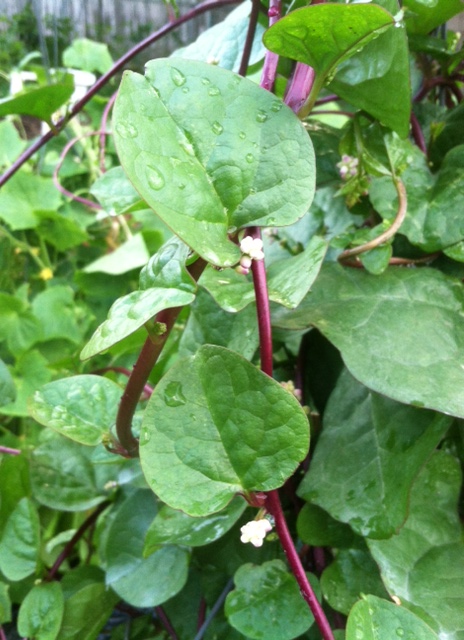
Malabar Spinach,Basella rubra

Malabar Spinach,Basella rubra

Malabar Spinach, like okra, is known as a “slippery vegetable” and some people find the mucilaginous texture of the succulent leaves takes some getting used to.  However, Malabar Spinach is high in Vitamin A and C, iron, and calcium.  It is also high in protein per volume and is a good source of soluble fiber.  It holds up particularly well in stir fries, egg dishes and curries.  Many recipes can be found on the internet for ethnic dishes using Malabar Spinach.  It is also good raw mixed with lettuce and other vegetables for a nutritious summer salad.

Growing Malabar Spinach is easy—just wait until the ground temperature is 65-70 degrees (like okra) since the plant thrives in hot and humid temperatures.  White flowers produce black seeds that will often readily reseed themselves.   Some internet sites recommend scarifying the seeds to help with germination or soaking them but often this is not necessary if the soil is kept moist.

Humans are not the only “animals” that enjoy Malabar Spinach.  Dallas County Master Gardeners who volunteer at the Dallas Zoo have helped grow Malabar Spinach in the past for the Zoo’s animals.  Aaron R. Bussell, Animal Nutrition Supervisor at the zoo, says this about the role of Malabar Spinach at the Zoo :

We had a great crop of Malabar Spinach last summer from the Green Life Education Garden, and it lasted into winter.  It was a great source of “Novel” greens for our primates that can get bored eating the same greens on the market.  Novel foods are rotated into the diets to provide nutrition and enrichment.  The diets we produce at the Animal Nutrition Center for over 2000 animals every day are tailor made for 400 plus species at the Dallas Zoo.        We substituted the Malabar Spinach into our Mixed Greens Salad which is shredded for birds, mammals, and reptiles throughout the zoo, and our full time Nutritionist evaluated it as an appropriate substitute for spinach or greens for our primates like chimpanzees, gorillas, and monkeys.  Having more variety of greens to offer these sometimes picky eaters is a great way to provide enrichment for their daily routine.  Malabar Spinach was grown not only for its nutritional value, but it provided natural stimulation when our Western Lowland Gorillas striped the leaves from the vine when served.  It continued to grow much further into the fall and winter as well.  We ended up serving the last of the harvest still entwined onto the bamboo trellis it was grown on.  Great vegetable.  We look forward to growing more again.”

So…. if you want to grow a spinach substitute and a plant favored by both man and beast, try growing Malabar Spinach. You may discover you like it.

Carolyn


Starla’s Garden Adventures #2

Well, Summer has arrived and things are heating up.   This is  garden2.0 in my raised beds .  The radishes and carrots were eradicated on Mothers Day, and now, a month later considerations of “what next” crosses my mind.

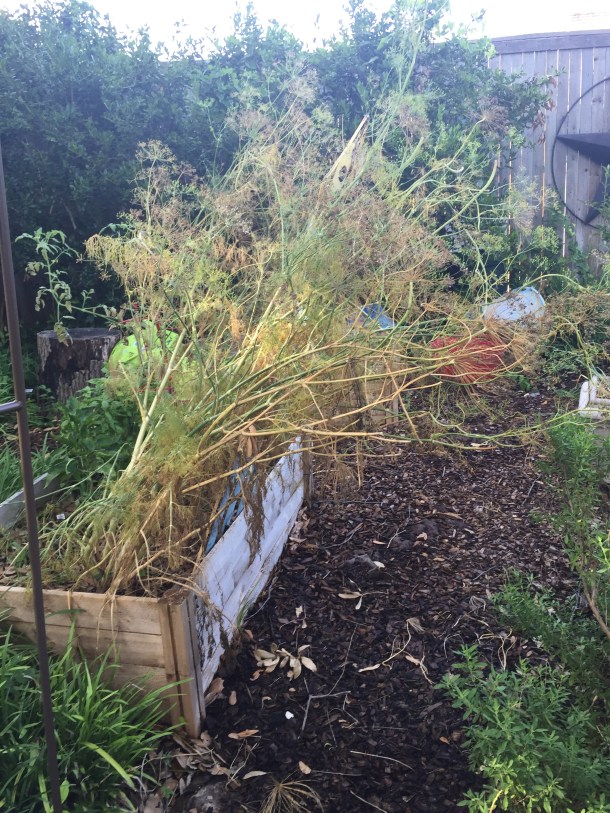
The last vestiges of the Fall garden,1.0 are waning. The onions , still in the ground have not become very bulbous, but the green tops will make a nice addition to a summer salad– the kale needs to come out but hasn’t quite made the trip  – And then there is the dill – It  has reached to the sky and given us a beautiful show of  delicate green but now it is very sad looking, with brown clumps of dill seeds hanging on the  umbels.

dill Starla

Yes, it is time to come out– it’s in the way of my path, it’s ugly and it must go …But wait,– hold on,  after making the decision to remove,  but before I yanked it out,  I spy not one, but 2 caterpillars munching on the dill seeds while enjoying the morning sun!   This plant must stay, at least a few days longer to house the honored guests.   So much for a neat and tidy garden right now – Maybe garden 3.0.

The Honored Guest: A Black Swallowtail Caterpillar on Dill

The Honored Guest:
A Black Swallowtail Caterpillar on Dill

Tomatoes, peppers, cucumbers and beans, are putting on new growth and blossoms  The tomatoes are surviving  — I wouldn’t say thriving, but they are not dead and gone  — I even get a few golden and red gems that never seem to make it back to the house.

The cucumbers were planted sinfully late, but are climbing up the wrought iron fence and acting like they want to perform. I must remember to water regularly, but with a trip planned, not sure how that is going to go.  But I continue, learning with each step and misstep, and enjoying the journey.

Thus continues the saga of this little garden that brings me joy in the most unexpected ways.

Starla


Leading TAMU Plant Pathologist to Explain Rose Rosette Disease

Are your roses exhibiting odd, thorny, or twisted growth? They probably are infected with Rose Rosette Disease (RRD), a virus that has forced the removal of thousands of roses in the Dallas area. Learn what you can do to help prevent the spread of the disease at a talk by one of the leading RRD researchers, Dr. Kevin Ong, Texas A&M University associate professor and director of the Texas Plant Disease Diagnostic Laboratory at TAMU.

The free talk will explain RRD symptoms, control, and removal of infected roses and is set for noon to 1 pm, Tuesday June 21st at the Fellowship Hall of Midway Hills Christian Church, 11001 Midway Road, Dallas.

A rose trial aimed at identifying roses that are resistant to RRD was recently installed at the Raincatcher’s Garden of Midway Hills, a project of the Dallas County Master Gardeners. The DCMG volunteers are trained by TAMU AgriLife Extension Service to distribute horticultural information to the public.

Visitors are welcome to tour the Raincatcher’s Garden and the rose trial located at Midway Hills Christian Church. Reservations are not necessary. For more details, contact Elizabeth Wilkinson, mwilkin1@swbell.net

Read up on Rose Rosette Disease here.

A Dallas Vegetable Garden

Starla and I have been photographing Dallas County Master Gardener’s vegetable gardens for the Dallas County Master Gardener cookbook, A Year on the Plate. We want to include photos of a few vegetable gardens because the emphasis of the cookbook is seasonal and fresh garden recipes combined with vegetable garden expertise.  Don’t worry we also promise plenty of tantalizing “foodie” type photos.

We visited Patti and her 8×8 garden this week.

Onions, Tomatoes, Herbs, Cucumber, and Flourish in Patti's Garden

Onions, Tomatoes, Herbs, Cucumber, and Melons Flourish in Patti’s Garden

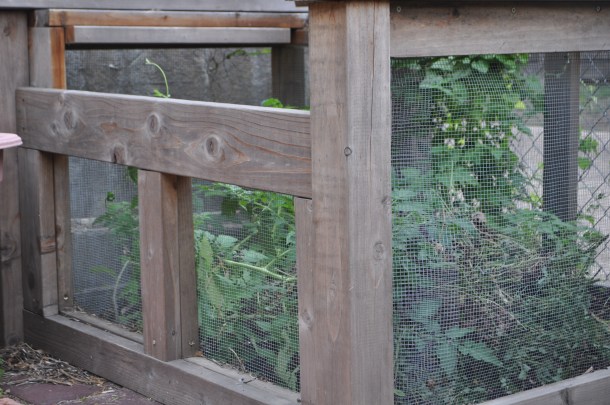
Garden success starts with compost.  When Patti’s husband, Rob, rebuilt their compost bin, he chose to upgrade to Redwood.  They used 1/4 inch fine mesh screen for extra protection against critters.

If you think it looks like tomatoes are growing in their compost bin, you are correct. Sometimes compost piles are less active but warm enough to start germination.

Compost Bin Of Redwood and Small Mesh Screening

Compost Bin Of Redwood and Fine Mesh Screening

Starla and I asked Rob to be in our video, he demurred saying “No, Patti’s the garden girl.” So  let’s hear from THE GARDEN GIRL:


Video by Starla

Ann


UN Declares 2016 the Year of the Pulse

    The Food and Agricultural Organization (FAO) of the United Nations and the 68th United Nations’ General Assembly has declared 2016 The Year of the Pulse.   If you are wondering, as I did, why the FAO would be nominating a heartbeat throb, it is because in agricultural terms a pulse is part of the legume family.  The term itself comes from the Latin puls meaning thick soup or potage.  The term “pulse” refers only to the dried seed.  Dried peas, edible beans, chick peas and lentils are the most common forms of pulses.  However plants like green beans which are used fresh, and soybeans and peanuts which have a higher fat content, are not called “pulses.”  Here at the Raincatcher’s Garden we are growing fava beans, which if left to dry before cooking would be considered a ‘pulse.”

Chickpeas Growing in the Edible Landscape at The Raincatcher's Garden

Chickpeas Growing in the Edible Landscape at The Raincatcher’s Garden

Pulses play an important part in not only contributing to a healthy diet for both people and animals but also are a sustainable crop able to be grown with less water and are able to fix nitrogen back into the soil.  They are little super foods with big benefits!  Some of the major benefits of pulses include:

Nutrition:  Pulses are an important part of a balanced diet and have been shown to play an important role in preventing some diseases such as heart disease, cancer, and diabetes.  They are high in fiber and low in fat.  They contain significant amounts of vitamins (Vitamin E) and minerals (iron, potassium, magnesium and zinc.) They also contain twice the amount of protein found in whole grain cereals such as rice, wheat, etc.  As such, the World Food Organization includes bags of pulses in their relief packages.

Pulses, especially dried peas, can also be used as feedstock.  A study in West Africa showed that animals fed cowpea hay, along with rice feed meal, during the dry season gain 95kg, compared to 62kg for animals that did not receive the cowpea fodder.

Sustainability: Like other legumes, pulses are able to fix nitrogen in the soil and have a positive impact on soil quality since they feed the soil microbes which benefits soil health. Pulses have also been shown to promote diversity in soil composition as they contain a greater and different amount of amino-acids than non-legumes. This may help plants thrive and perhaps offer greater protection from disease-causing bacteria and fungus.

Pulses also require very little water compared to other forms of protein such as animal protein. The United Nations estimates the water required to produce a kilogram of beef, pork, and chicken is 43-11 times higher than the water needed to grow pulses.

So…. Next time you are walking down the bulk produce aisle of your neighborhood grocery store, look at all the different varieties of dried legumes/pulses.   You may even want to celebrate The Year of the Pulse with a bowl of 7-Bean soup.

Carolyn

Revised Onion Harvesting at The Raincatcher’s Garden 2016

Onions have been harvested at the garden during the last two weeks.

They are now drying in our storage shed.

Fantastic Haul of Onions!

Fantastic Haul of Onions!

Harvest Onions when the tops begin to naturally fall over and turn brown. Dig the onions from the ground up with tops intact and to keep the bulb from being damaged. We used a garden knife or trowel to get them out of the ground carefully.  Onions that have bolted are past their prime and can be left to reseed.

As a reminder, here’s how to braid onions:

and here are notes on storing, eating, and lots of other onion thoughts in these articles: The Lowly Onion and Beginnings

Ann


The Edible Landscape Series-Learning to Plant Outside the Lines

As we embark on our edible landscaping adventure, we find out how ingrained the old gardening lessons are in our psyche. A great example – and lesson – is in our radish, carrot and onion bed.

When we planted our root crops, we placed each in its own row. Why?  Mostly because we didn’t think about our planting “design” and did what we always did in the past.  Everyone always plants in rows, right?  So we did too:  three rows of radishes (one for each type), then a row of carrots, and finally, to fill out the bed, a few rows of onions.  We placed our plant labels at the end of each row to help us remember what we’d planted, and went on our merry way.

Row Planting- We Might Rethink and Plant Differently Next Time.

Row Planting- We Might Rethink and Plant Differently Next Time.

A few weeks passed; we had unseasonably warm weather coupled with lots of rain. The onions were growing.  We seemed to have a little line of ferns we could attribute to the carrots, and up against the edge, we had three foot high stalks with pretty purple and white flowers on them.  Some (not all) of the radishes had bolted!

And this is the lesson we learned from this bed: plant outside the lines.  If we had sprinkled the radish and carrot seeds throughout the bed, with the onions interplanted, right now the whole bed would look like it was full of tall flowers, with a low fern covering the base, and smooth spikes interspersed for contrast.  Overall, it could have been a much more uniform bed.  Or, if we had known how tall our ferns (carrots) would grow, and if we could have anticipated our radishes bolting (and giving us those beautiful flowers), then we could have used the crops to ‘paint’ the bed:  planting the carrot seeds around the border of the bed, lining the border with the onions, and filling in the center with the radishes.  That’s part of the beauty and fun of landscaping with edibles:  we are encouraged to add an extra dimension to our planting:  we plant not just for the tasty edibles, but with an eye towards their intrinsic beauty.

A few other benefits to planting enough to let some of your harvest bolt:

The radish flowers (of course we tasted them!) taste like mild radishes – so now you have an extra flavor to add to your salad, or to your dishes as a garnish.

Not all the radishes bolted, but if you leave them to bolt (and give you pretty flowers), make sure to plant enough that you can harvest some to eat. We haven’t tasted our bolted radishes yet, but they will probably be woody in texture.

Leaving some of the plants to bolt means you now have another signpost up for the beneficals to come and visit.

Finally, if you let some bolt and eventually go to seed, you’ll have the seeds to plant the following season! However, if you choose to do that, make sure your seeds are heirloom or open-pollinated and not hybrid seeds.  The seeds from a hybrid plant will differ from the parent.  But if you like surprises, go ahead, plant the hybrids and see what you get!

Radish Flowers!

Radish Flowers!

So we’ve learned our lesson: instead of planting an area, we’ll “paint” it:  we’ll think about the shape and height of our final plants, and only plant in rows if we want to see a line in the final picture!

Lila Rose

Pictures by Starla

A Bright Spot in the Early Spring Garden

copper canyon daisy As with many plants, Tagetes lemmonii is known by so many common names (Copper Canyon Daisy, Mexican Bush Marigold, Mountain Marigold, Mount Lemmon Marigold, tangerine-scented marigold, and Perennial Marigold) that it is almost easier to refer to it by its Latin nomenclature.  Yet even its Latin name has a fascinating story behind it.

Tagetes lemmonii is native to the high mountain canyons of northwestern Mexico and southern Arizona.  A finely leafed plant with a very distinctive aroma often described as minty and fruity, lemon and tarragon, or (for some people) just plain “Yuck,” it can grow to a size of four to six feet tall and can spread to six to ten feet.  It can be sheared back however.  It grows best in full sun in well drained soil. It can be grown in part shade, though it may get leggy and have fewer blooms.  Once established it needs little to no supplemental watering.  If grown in an area where deer are a problem, deer will definitely avoid it.  However pollinators, including yellow sulpher butterflies and beneficial insects, are drawn to it.

T, lemmonii is considered to be photosensitive and blooms with bright yellow daisy-like flowers in the fall, winter and early spring when the daylight hours are shorter.  In mild winters, it provides a welcome bright spot in the garden since the flowers can last for quite a while.  However in colder winters, it will sometimes die back to the ground but return in the spring.

Though I always thought that its Latin name lemmonii came from its strong citrus/lemon aroma, a Google search from San Marcos Growers (smgrowers.com) reveals otherwise:  “This plant was discovered in southeastern Arizona, by the early plant collectors, self taught field botanists, and husband and wife, John (1832-1908) and Sara (1836 – 1923) Lemmon. These two incredible people met in Santa Barbara, California, where Sara Allen Plummer lived, in 1876 when she attended a lecture given by John, who at the time was the California State Board of Forestry Botanist. They married in 1880 and botanized throughout the southwest and in the process discovered over 150 new plants including an unknown species of Tagetes, from which they sent seed to Asa Gray at Harvard University, who then named the plant to honor them. Sara and John also climbed the highest mountain in the Catalina Mountains near Tucson, which is now called Mount Lemmon reportedly because Sara Lemmon was the first woman to climb it. Both authored books and articles which Sara often illustrated and she was instrumental in the efforts to name Eschscholzia californica as the official California State Flower, as it was done officially by Governor George Pardee in 1903. The Lemmons established plants of Tagetes lemmonii in their garden in Oakland, California and progeny of these plants were introduced to the nursery trade in southern California, and England by the early 1900’s.”

copper canyon daisy top downThere is one word of caution when pruning or working with Tagetes lemmonii. Some people are extremely sensitive to the oils in the leaves and can develop a painful, itchy rash when their skin is exposed to sunlight. Sometimes this rash can continue for several days. Therefore it might be best not to plant Tagetes lemmonii where it can be brushed against, be sure and wear gloves and long sleeves when working with it, or at least wash your skin well with soap and water after handling.

Carolyn

Picture by Roseann from Texas Discovery Garden.

My Garden Journey

In my first five years as a Dallas County Master Gardener (class of 2011), I have learned and experienced so much from working at our demonstration gardens; however, I had never attempted growing vegetables at home except in pots until this past fall when I saw sunlight streaming in a section of the backyard after a tree had been removed.

So this new adventure began – raised beds were found, plants were purchased and the garden grew – well some of it grew…

Brocolli by StarlaBroccoli and cabbage went in first along with a few herbs, followed by lettuce and arugula in October. I had some success with broccoli, but not so much with the cabbage, lettuce or arugula ( they bolted). Radishes and carrots were planted from seeds. After the first of the year onions were added and then potatoes came and went (I had the wrong soil, so they never sprouted).  There was minimal success with the radishes (not properly thinned), but the carrots – I waited, looking for a glimpse of the carrots(roots)? under the leafy tops — until right before Mother’s day, and then I pulled them. Once again the results were mixed;  I had a range of carrots from 1/4 inch to over 6-7 inches long  and counted 26 of the prettiest multicolored carrots I have ever grown.

Homegrown Carrots

Homegrown Carrots

This summer I’m trying things that we will eat as a family – tomatoes, peas, green beans , peppers. I have a space for cucumbers with hopes to make pickles like my family put up years ago.  My beds are few in number but just right for my learning curve. You can take this journey. it takes some planning, a little time and patience, but is well worth the effort.

Here are a few of the things I’ve gleaned from my raised beds:

  • Gardening with a group of people brings a broader depth of expertise
  • Information—ask questions, listen and apply–repeat.
  • Realize early on that everything won’t go according to plans. Don’t dwell on failures, but learn from them  — water properly, use the correct soil, compost, mulch, weed…
  • Celebrate success, no matter how small–they are victories!
  • Try new things, take notes (my garden journal currently has one entry, several months back, but there is value in the process)
  • Trial and error is another way of learning
  • Share your story, your experience, and the fruit of your labor —
  • Enjoy the adventure!

Starla