A Walk Around The Garden

June 18, 2019

When you’ve worked in a garden, something happens to you. You begin to pay more attention to the rain, the temperature and sunshine and how it affects your plot of land.

You peer down at the soil looking for signs of life. Have your squash seeds sprouted? Are the beans going to climb up that trellis?

Some plantings have flourished and are bearing fruit, others have  peaked and need tender loving care.

What I am saying is-you are now emotionally involved with a garden plot and it makes it very hard to leave town.

That is the state I am in and so yesterday I walked through our gardens and took these pictures.
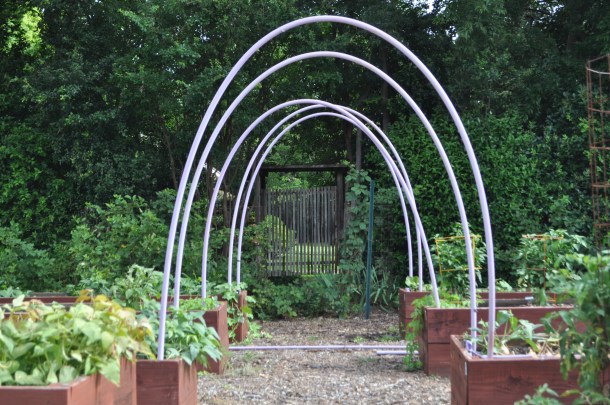
Above: Garden trellis made of irrigation tubing. Long beans will grow here and other vining crops.
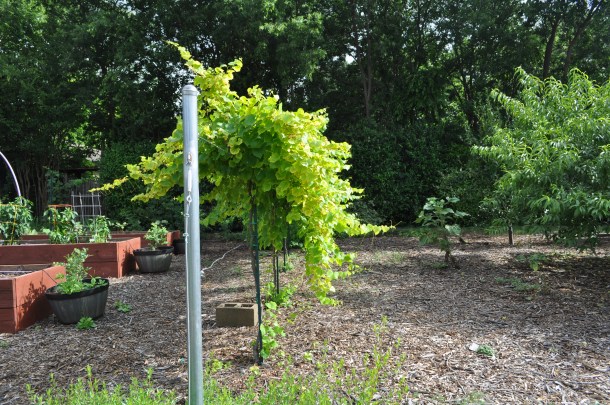
Above: the grape vines seem to be glowing
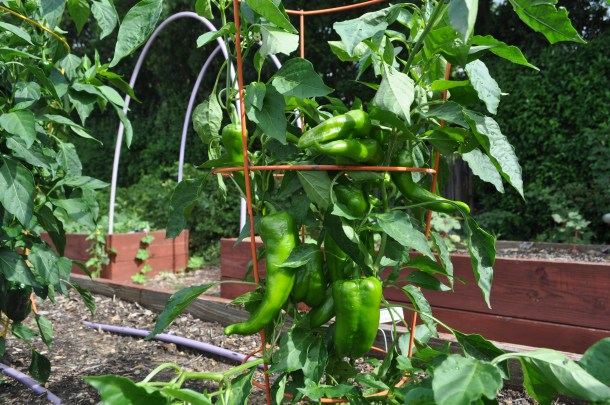
Above: Poblano Green Pepper
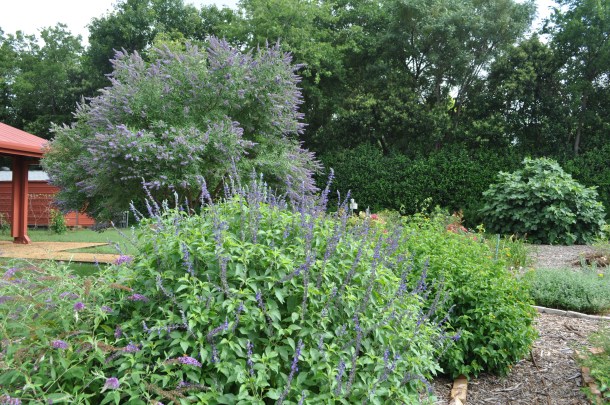
Above: Blue on blue-sage and vitex in our butterfly garden.

Above: Should be a good fig harvest this year!
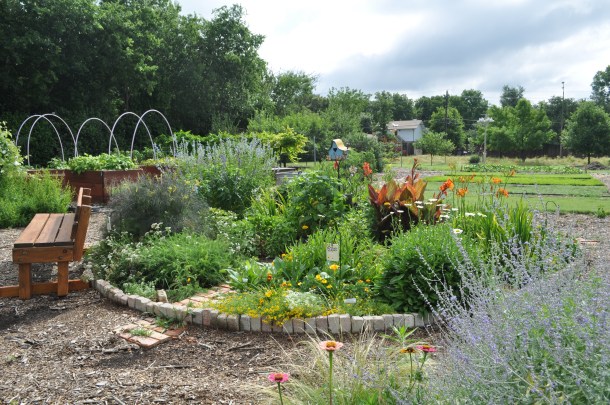
Above: The color wheel

Above: a view of our grass plots-looking mighty fine!
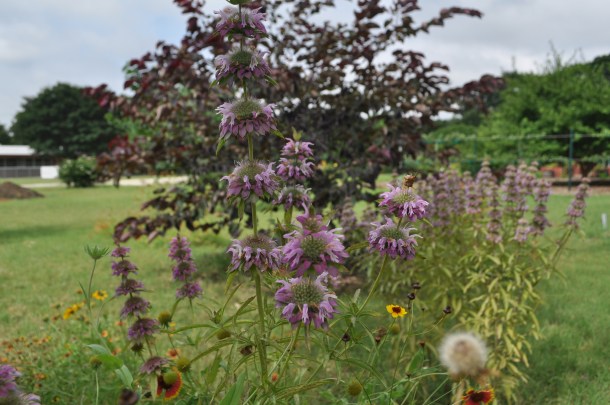
Above: Horsemint in front of our Redbud Tree

Ann Lamb

If you would like to learn more about herbs of the Mediterranean, come to our garden lecture by Marian Buchanan on Tuesday, June 25th at 10-11:00 am. Class will be held in the church sanctuary.

The lunch following the lecture has been sold out. No reservations required for the lecture. Just come! All welcome.

Location: 11001 Midway Road, Midway Hills Christian Church

(Master Gardeners earn two CEU’s)


Hybridizing Daylilies

June 12, 2019

The subject of genetics is fascinating. Will a blue-eyed Daddy and brown-eyed Mommy produce a child with blue eyes or brown? With daylilies you can marry the favorite characteristics of one variety to another and hope to produce your perfect “child.” Daylily hybridizing is a little bit about sex and a lot about science. Jim Dempsey, a Dallas County Master Gardener since 2007 and retired city of Dallas forensics expert lets us in on daylily details.

Jim, did you start hybridizing daylilies in 2016?
Yes, 2016 was the first attempt at hybridizing at Raincatcher’s.

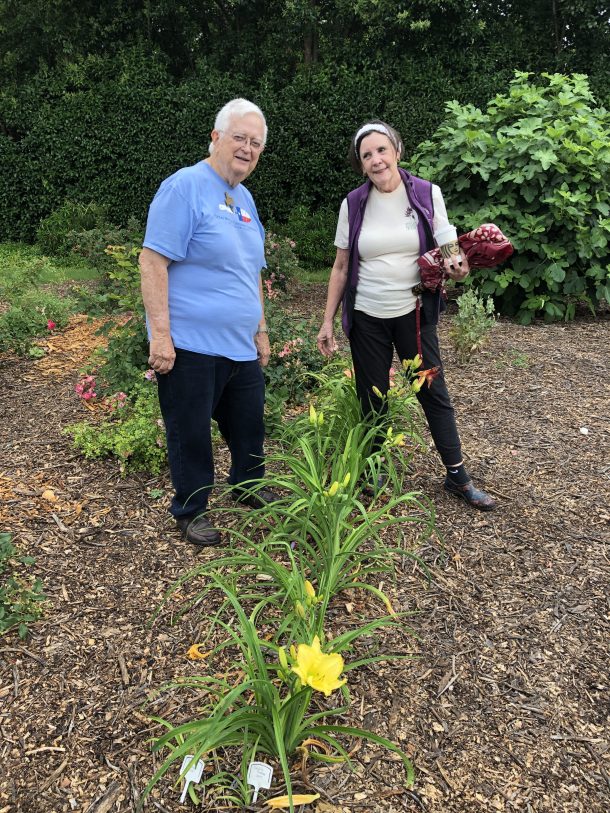
Above: Jim Dempsey talking to Beth Sonier about daylilies at Raincatcher’s.

 Do you use diploids or tetraploids?
 I prefer tetraploids because the flowers are usually larger and better color.
And how do you know which one it is, by the name of the daylily? Usually, when you buy from a grower or catalog they will tell you.  Unfortunately, you cannot cross a diploid to a tetraploid.
Do you have a goal in mind when hybridizing? Larger flowers, brighter colors and longer blooming periods.

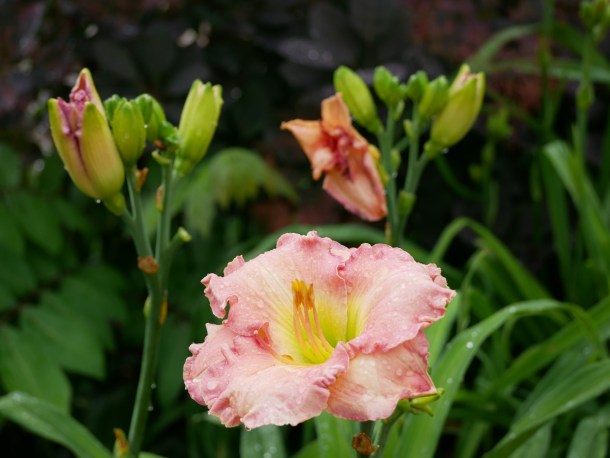
Above: Peach Daylily with ruffled edges

Are you looking for a more vibrant color, more ruffles or extended bloom time? Yes, to all of that. We do have a large yellow daylily of interest that that has a long bloom period.

Above: Yellow Daylily purchased by Jim. He was told he could name it and so he did: TBNL (to be named later)

When do you collect seeds? Collect seed pods just before they crack open and then let them dry out before planting.
Do you have a favorite? Merely Mystical – peach with yellow ruffled edges


Thank you, Jim, and thank you Starla for the pictures and videos.

Ann Lamb

Wildflowers in East Texas

June 4, 2019

The roads of East Texas are full of wildflowers and I got to be in East Texas at just the right time. A new grandson was born in May. One day during my visit, my grandaughter and I walked the fields looking at wildflowers.

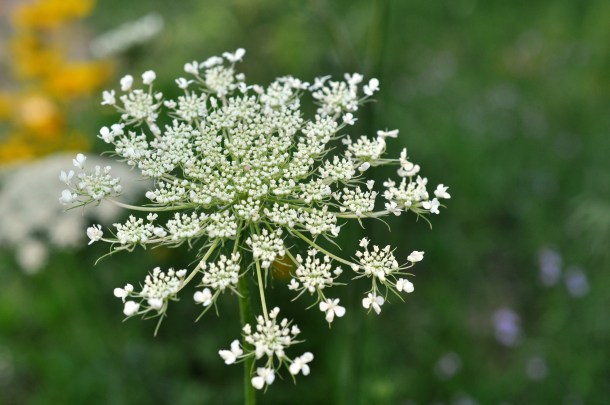
Queen Anne’s lace was everywhere. It is an ancestor of the garden carrot and it’s taproot can be cooked and eaten.

Above: Queen Anne’s Lace

Another white flower was en masse along the roads. Woolly-White is common in East Texas along roadsides and uncultivated land.

Above: Woolly-White or wild cauliflower

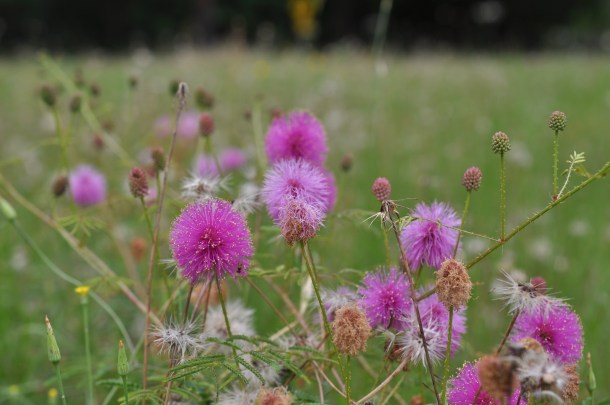
You’ve got to love a plant like sensitive brier that has feelings. Touch the foliage and it bashfully closes. The prickly stems protect it’s sensitive nature.

Above: Sensitive Brier

This picture was taken on a misty morning. Hope you don’t mind the blur effect. Enjoy this beautiful blue and the simplicity of the three petaled flower.

Above: Ohio Spiderwort

Cherokee Indians steeped the roots of Venus’s Looking Glass with other plants and drank the infusion for indigestion.

Above: Venus’s Looking-Glass

Cows enjoy grazing this daisy. Now that I am back home looking at these pictures and reading my wildflower guides, I realize how much was missed. This flower is fragrant and I never even noticed ! I’ll not chastise myself too much because fire ants and poison ivy were all around. Grandaughter and I had to stay clear of those dangers.

Above: Huisache Daisy

Another bright yellow flower but this one is not tasty. Honey made from pollen of this flower is very bitter and unpalatable. Hence the name-bitterweed.

Above: Yellow Bitterweed

Only a few Indian Paintbrush flowers were seen, but even one makes a brilliant statement.

Above: Indian Paintbrush

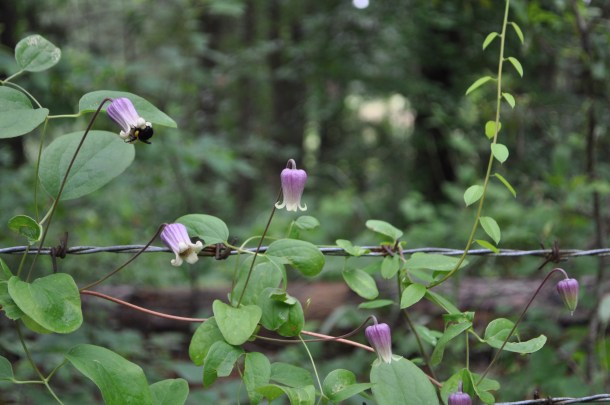
Wild clematis, what a find! The nodding bell shape flowers  are so unusual. Notice the bumble bee mining a blossom, upper left.

Above: Bellflower Clematis, Clematis pitcherii

These two wildflower books helped with plant id: Wildflowers of Texas by Geyata Ajilvsgi and Texas Wildflowers by Campbell and Lynn Loughmiller.

In future years, hunting wildflowers could become a family outing. The fields in May are full of them and they will always remind me of a special birthday.

Ann Lamb

Pictures by me and grandaughter!


Rose Rosette and Mites

For the past several years North Texas has been dealing with Rose rosette disease that affects roses.  It is caused by an araphid mite that causes deformation of the plant.

Maddi Shires, a doctoral student at Texas A & M university is conducting research on Rose Rosette and is educating the public and organizations concerning this disease.

In May, Maddie came to Farmers Branch Rose Garden to demonstrate  how  to locate the mites. Members from Dallas and Denton County Master Gardeners as well as those from the Dallas Area Historical Rose Society and the Dallas Rose Society were present.  Pam Smith, the Landscape Manager from Farmers Branch gathered the supplies to test a sampling of  roses at the garden.

Starla Willis

Rose Rosette Information here.

Herbs of the Mediterranean, A Grow and Graze Event

Herbs of the Mediterranean

Herbs activate our senses. Join us for a culinary trip to the Mediterranean where we’ll explore some of the world’s best tasting food. Be inspired by this delightfully aromatic way of using fresh and dried herbs in your cooking.

Tuesday, June 25th

A “Grow and Graze” Event Hosted by

 The Raincatcher’s Garden of Midway Hills

Time:  10:00 – 11:00

Location:  11001 Midway Road Church Sanctuary

Instructor: Marian Buchanan, Dallas County Master Gardener, Herb Specialist

(Master Gardeners earn two CEU’s)

Immediately following the program, please join us at our Mediterranean Table

Lunch: 11:15 – 12:30

$15 per person, Reserved seating for 60 available starting May 20th. Deadline June 18th

https://www.eventbrite.com/e/herbs-of-the-mediterranean-tickets-60462949309

Menu

Iced Herb Gazpacho and Toasted Baguette Slices spread with Every Herb Pesto

Black Olive & Swiss Chard Tart

Green Herbs & Butterhead Lettuce Salad with Herb-Seasoned Croutons

Salad of New Potatoes with Sweet Cicely, Lovage and Green Peppercorns

Mediterranean Summer Roasted Vegetable Ratatouille

Honey-Lemon Olive Oil Cake with Whipped Crème Fraiche and Fresh Berries

Lavender Honey Ice Cream

All members of the public invited for the free lecture. To make a reservation for the lunch use the eventbrite link above.

Linda Alexander

Lucinda Hutson’s Austin Garden

Starla and I visited Austin gardens last year in May as participants in the Garden Bloggers Fling.

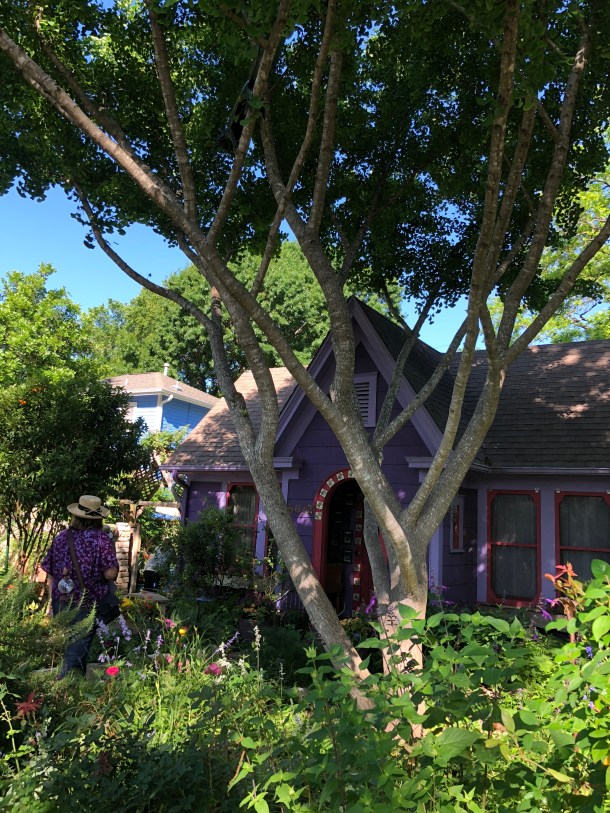
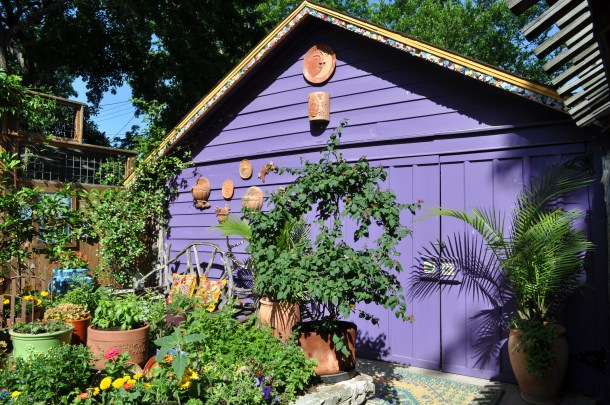
The color of this purple house and the merriment in its surrounding gardens have remained in my mind.

Lucinda Hutson’s home and garden in Austin

‘La Morada” or the little purple house is a perfect backdrop for the enchanting gardens.

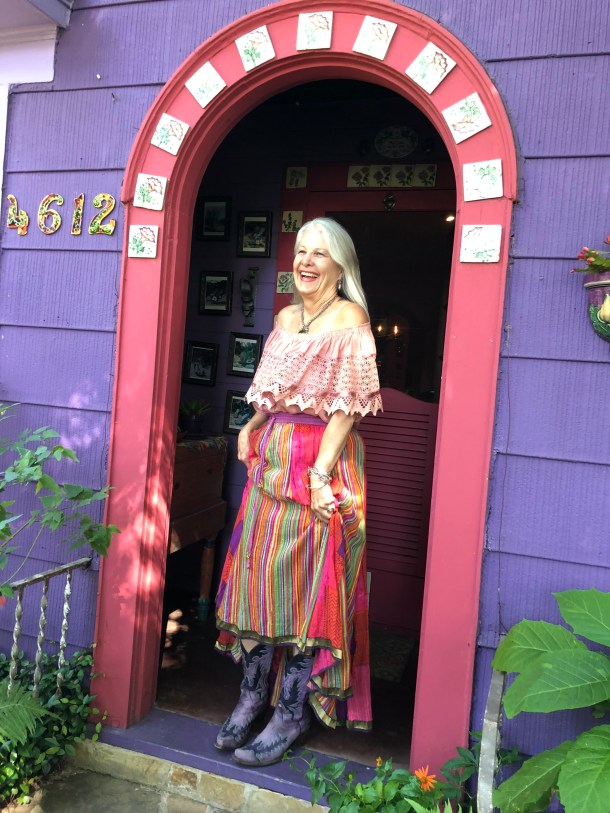
Lucinda Huston welcoming us from her front door. Note the boots adorned with purple foliage.

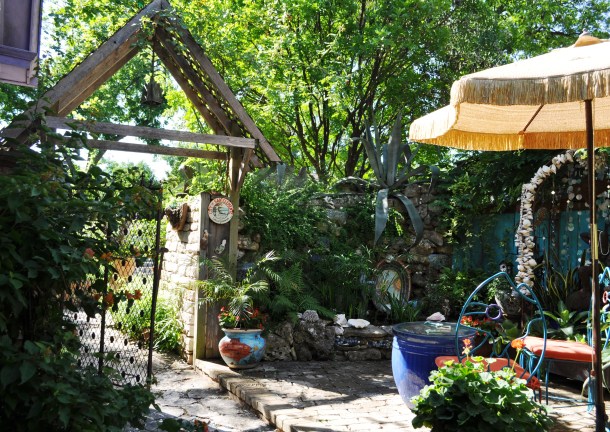
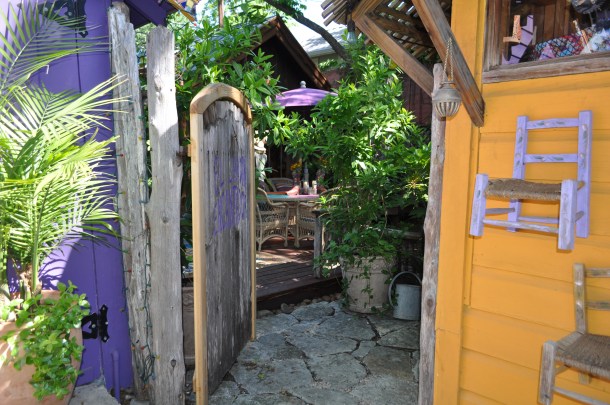
The narrow lot was made into a series of colorful garden rooms each with a theme.

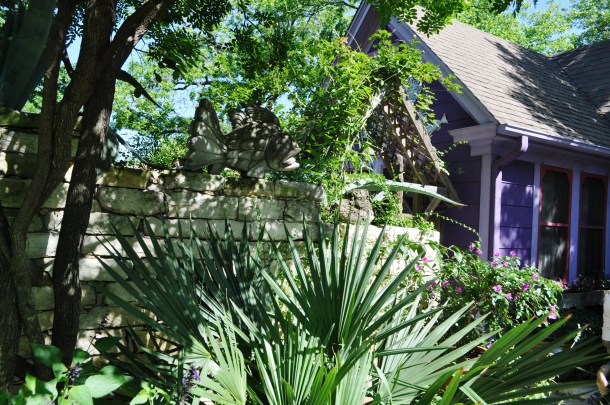
The fish atop the wall gives a hint of the mermaid grotto you are about to enter.

Fish chairs fish pots, a shell arch and a pond planted with papyrus and ferns. The shape of the plants suggest the ocean floor.

I first learned of Lucinda through her book the The Herb Garden Cookbook.  Garden herbs from around the world meld with edible flowers and other colorful flowers. Take a long look at the pots, the edge of the roof, the tiles on the door, and the zest she has built into this garden room.

Love the fern silhouette!

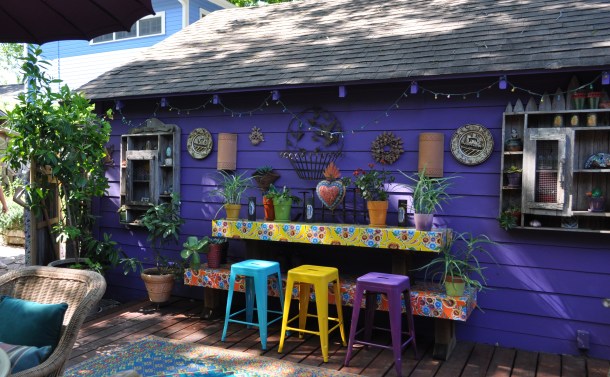
You knew there would be a bar and ourtdoor dining.  This is a high-spirited place!

Viva Tequila! Cocktails, Cooking, and Other Agave Adventures, Lucinda’s latest cookbook must have been written while sitting in this part of her garden.

Lucinda’s cantina!

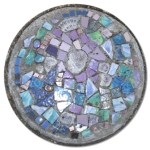
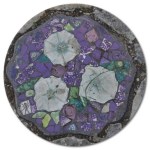
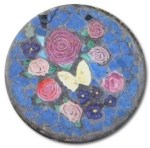
Th mosaic stepping stones in the garden suggest making the most of broken pieces-a reminder to enjoy life.


And that’s what gardens do, they remind us to enjoy life. Thank you Lucinda Hutson for sharing yours.

Ann Lamb


Edible Landscape Spring and Summer Planting 2019

May 4, 2019

Ana and Linda enthusiastically took center stage last week to proclaim the spring and summer plans for the Raincatcher’s Edible Landscape. The purpose of our edible landscape is to create a stylish and appealing outdoor space using vegetable, fruit, and herb plant materials. On top of that, think partial shade and an area formerly used as a children’s playground. Add in budget constraints and the lack of an irrigation system..

Without the fervor of Ana and Linda and their band of Master Gardeners, I doubt this garden would have flourished. But with its second birthday round the corner, the edible landscape is ready to take off its training pants and mature into a beautiful and thoughtful garden full of edible delights.

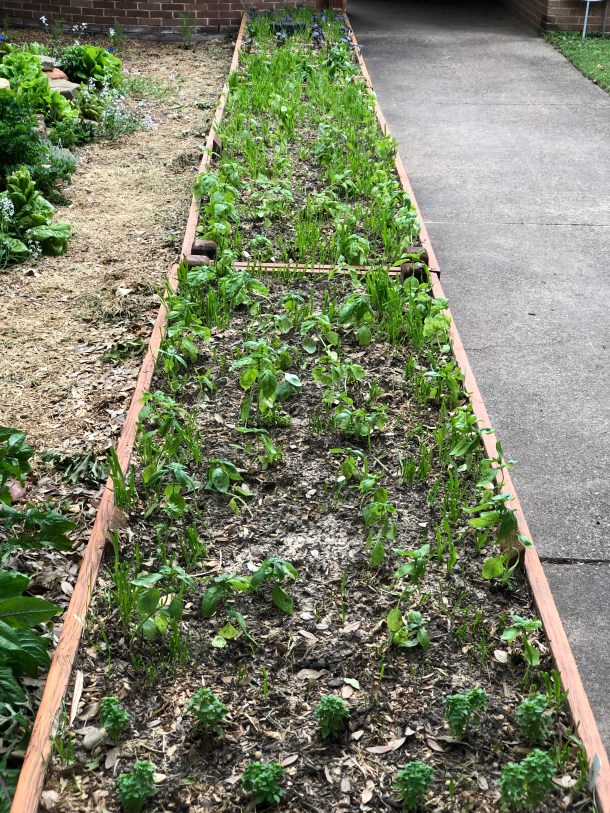
In the next few weeks, look for articles giving more detail about the 2019 design plan. The basil bed has just been planted with many different colors of basil. Hint: research the ombré look and we’ll explain later how it’s being used in the edible landscape.

South Sidewalk Raised Beds – Basil varieties/cultivars: Piccolino (Greek), Napoletano (Genovese), Eloenora (Genovese), Persian (Thai), Cardinal (Thai), Balsamic Blooms (Genovese), Red Freddy (Genovese), Amethyst Black (Genovese)

Ann Lamb

PIctures by Linda Alexander

Open this link for a list of the all the plants  and a plot plan of The Edible Landscape at The Raincatcher’s Garden.

The Edible Landscape Adds a Food Guild

April 30, 2019

The idea of a food guild or food forest is interesting because it is a less labor intensive way to grow food and more sustainable. Everyone likes the idea of low maintenance and more crops, so watch this video to see the food guild we are creating to in our Edible Landscape at The Raincatcher’s Garden.

The food guild utilizes layers of different types of plants. We are fortunate to have towering oak trees for our tall tree layer and also fortunate to have tasted acorn muffins made from acorn flour. So yes, our tall tree layer, the live oak tree is a food source. Next we will have a short tree, a vine will grow up that tree, then a shrub layer, an herb layer, ground cover and a root crop like horseradish or carrots.  As you read this, you should be getting the idea of plants growing together and utilizing each other’s strengths to create this sustainable food guild.

It’s a fascinating concept and you will get to hear of it’s successes and trials, as we watch it over the next few years.

Ana has given us a list of the plants we will be considering for The Raincatcher’s Food Guild. I’m excited about the mandarin orange tree.

Ann Lamb

video by Starla Willis

For more information about planting a food guild click here.

Raincatcher’s Plant Sale, April 25

April 23, 2019

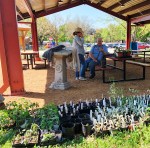
Master Gardeners are bringing the very best plants out of their gardens and you have an opportunity to purchase them on Thursday, April 25 before the Master Gardener meeting 10-11:30am and then afterwards from 1-2:00pm. The proceeds are plowed back into our garden so that we can continue the educational programs we enjoy bringing to you.

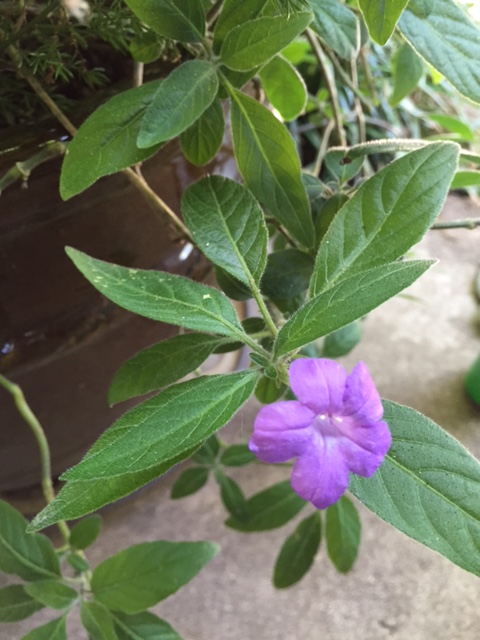
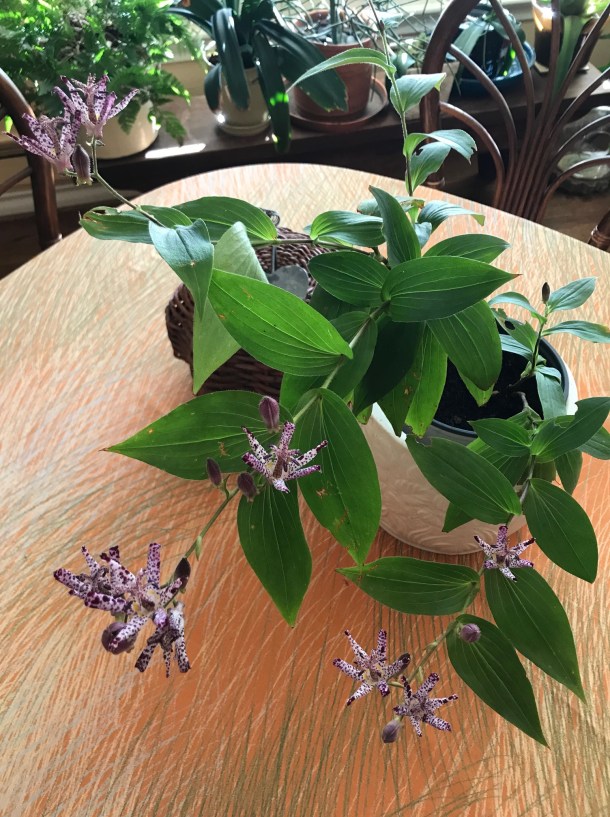
Lisa Centala has three toad lilies and has propagated purple trailing ruellia, a tender perennial. Lisa originally got the ruellia  from one of our favorite Master Gardeners, Tim Allsup. It had been in his grandmother’s garden.

Trailing Ruellia, pretty in a pot!

Toad Lilies

Jim Dempsey, a  true gentleman gardener, brings seedlings and rooted cuttings from his home garden to our sale. You may want to make a list of what you plan to buy before coming. I sure am!
Tomatoes:
Celebrity
Cherokee Purple
Brandywine Red
Beauty
Lemon Boy
Yellow Pear
Porter
Tomatillo: Grande Rio Verde
Eggplant: Black Beauty
Peppers: Hot Sunset
Gypsy
Cornito Giallo
Carmen
Poblano L
Dutura: Double Yellow
Marigolds:
Janie Yellow
Janie Orange
Disco Mix
Super Hero
Tithona (Mexican Sunflower): Fiesta del Sol
Zinnia:
Pinwheel Mix
Forecast
Giant Yellow
Giant Lavender
Basil:
Purple
Sweet
Rudbeckia:
Autumn Glorosia
Cuttings (rooted):
Champanel grape
Celeste grape
Winter Honeysuckle

Evelyn Womble is offering Hardy Amaryllis bulbs. They are blooming right now in our courtyard and are so pretty, so reliable and they multiply!

Evelyn holding Hardy Amaryllis blooms. You can buy these bulbs at our sale.

We are willing to part with some of the treasured members of our garden for a small price. So won’t you please come to our sale on Thursday; it’s a tax free day.  Cash, check or credit card accepted.

Ann Lamb


All Members of the public are invited to Master Gardener meetings.

Click here to find out more about this month’s meeting on Orchids Treasures of Texas.

Planting Corn at The Raincatcher’s Garden

April 15, 2019

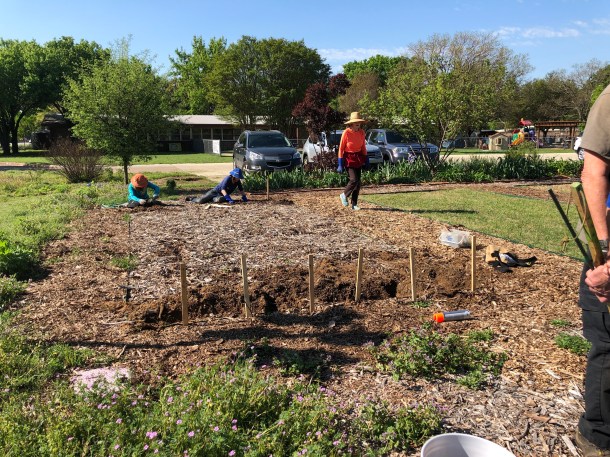
We are banking on a good crop of corn this year. After all, we have plenty of sun and warm, rich soil and dedicated gardeners staking out our new garden bed.

Let’s get those corn kernels in the ground!

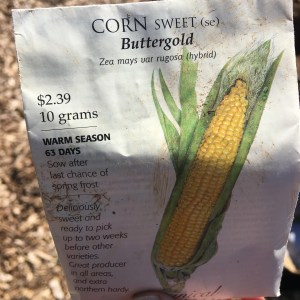
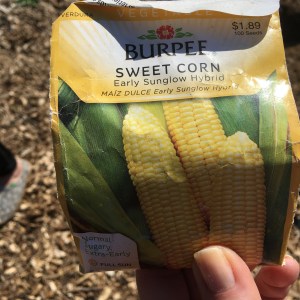
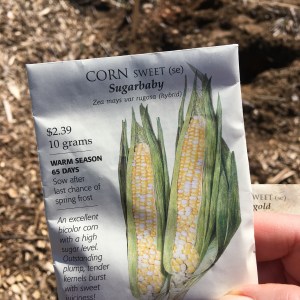
You can almost taste summer when looking at the seed packages.

Sugarbaby

Buttergold

Early Sunglow

Hwy, what do gardeners say after a corn harvest  when receiving a complement about their corn crop?

Aww shucks, thank you!

Ann Lamb

Pictures by Starla Willis


To learn about Glass Gem corn, read Christmas in July.