Roses and Valentine’s Day

Julia child rose from redneck rosarian

As many gardeners know, one of those easy-to-remember hints for when to prune your roses, is that you should prune nearly all your roses around Valentine’s Day, except for climbers and spring-blooming only roses.

However, with this year’s unusually mild winter, where several varieties of roses are already in full bloom, I found myself wondering whether they should be pruned now or not.  Ann Lamb says that her Julia Child rose is prettier this winter than it has been in any other time, so should she prune it now?  Thank goodness, Dallas County Master Gardener has several Consulting Rosarians in their membership, so the question was put to them.  Many thanks go to Susan Flanagan, Certified Master Gardener and Consulting Rosarian, who along with some of her Rosarian friends sent this response:

       “I just now talked to a friend who knows a ton about roses. There are a few roses (hybridized by Paul Readon) that are spring bloomers only but they don’t do well here.

      So my advice is to go ahead and prune all your roses. Cutting off the current blooms will not impede the coming spring blooms. If anything, they will make the roses stronger, as you are pruning out the dead, diseased and crossing limbs as well as the very thin ones. And you are cutting a portion of the top branches. The spring bloom will usually display bigger than the ones that are blooming now.  And again, if you have any climbers that are spring bloomers only, then prune them after they bloom just as you would prune once blooming plants like bridal wreath spirea and forsythia.”

     So, if you want, go ahead and make yourself a beautiful bouquet of roses for Valentine’s Day from those roses that are blooming now. Then prune your roses as you usually would.  With this year’s mild, confusing winter, we may receive ”two for the price of one” flushes of blooms.

Carolyn

Picture by The Redneck Rosarian


Chocolate Beet Cake

Chocolate Beet Cake with Beet Cream Cheese Frosting

Chocolate Beet Cake with Beet Cream Cheese Frosting

You may be thinking of Valentine’s Day but we are salivating over the recipes in our cookbook, A Year on the Plate,  only a few short months away from being published.

This cake scored the highest in all categories in our tasting this week.  But how can a cake be garden inspired?   The secret is in its main ingredient.  Can you guess what it is?  The clue is in the name.

By the end of the year this recipe will be in your hands and ready for your valentine when you purchase A Year on the Plate.  Hope that’s ok, this recipe is only a heart beet away!

Ann

Picture by Starla

Cake baking by Carol


A “Herd” of Aphids

A school of fish, a mob of crows, a gaggle of geese,   A “herd” of aphids?  Well, if you are from an ant species called “dairying ants” or “sugar ants,” you might call groups of your aphid charges just that.

Above: A Herd of Aphids

Above: A Herd of Aphids

As many gardeners know, aphids can be a common problem on plants, especially during the heat of the summer.  These soft bodied insects suck plant sap, wither foliage, and cause a generalized lack of vigor in plants.  Aphids come in many colors (yellow, white, green) depending on the type of aphid and the plant that they are feeding on.  One of the most interesting facts about aphids is that some are said to be “born pregnant.”     Though many aphids mate and lay eggs to reproduce, some aphids are capable of a true  “virgin birth.”  These parthenogenetic generations are produced by unfertilized females.

Aphids not only suck plant sap which eventually withers the foliage, but they can spread diseases from plant to plant.  When feeding on a plant, aphids excrete a sugar substance from their anus.  This substance, called honeydew, is very sticky.  It can also form the substrate for a black mold which blocks out the light from a leaf, thus leading to the further decline of the plant.

Above: Honeydew Close Up

Above: Yellow Aphids Close Up

In the garden, ants and aphids are often seen together on infected plants.  In my experience, beans, peas, and okra seem to be some of aphids’ favorite plants and harvesting produce from these plants is often a challenge from biting ants.  These ants are drawn to the honeydew, which is a perfect food for the ants.  To increase their supply of honeydew, the ants tend aphids like cows.  These sugar/dairying ants “milk” aphids by stroking the aphids with their antennae until they release a drop of sweet honeydew liquid. They even keep their “charges” from straying by chewing off the aphids’ wings.  In the fall, the ants carry aphid eggs into their nests, to be carried back out in the spring and set on the plants.

If you are having problems with aphids and ants in your garden, there are several environmentally safe methods of aphid control.  One of the best methods is to spray the plants with a hard stream of water.  This will kill some of the soft-bodied insects (it decapitates them) and the water will wash many others off the plant.  This method is said to be 80% effective, even better than some chemical controls.

Another environmentally safe control method is to be patient and “let nature take its course.”  Within a very short period of time, where you see aphids, you will also see lady bugs (lady beetles) laying their bright orange eggs on the leaves of infected plants.  The lady bug larva, which looks like a miniature spined alligator, is a voracious consumer of aphids.  Studies have shown that each larva can eat up to 40 aphids in a single hour.  This has earned the larva the name of “aphid wolf.”  Other important beneficial insect predators include soldier bugs, damsel bugs, big-eyed bugs, spiders, assassin bugs, syrphid flies, gall midges, and lacewings.

Above: Ladybug to the Rescue!

Above: Ladybug to the Rescue!

So if you are having problems with aphids and sugar ants, before you get out the chemicals, try some of these low impact methods of aphid control.  Not only will you be able to get aphid damage down to an “acceptable” level, but your biting sugar ant problem will decrease also.

Carolyn

Pictures by Starla

Radish Reminders and Onions

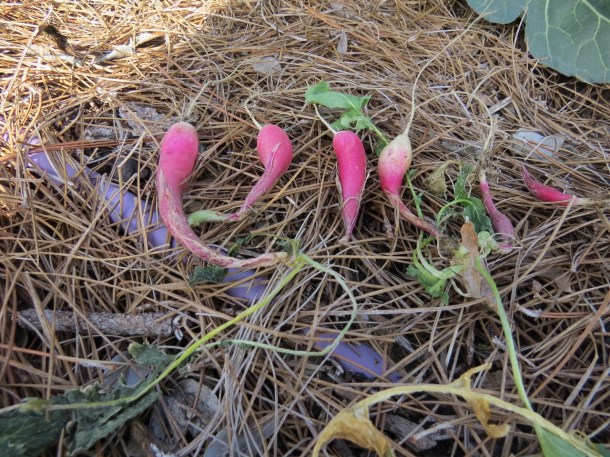
Sow radish seeds early February through mid- April. We enjoyed them all through fall and winter and now get a second chance. Radishes are perhaps one of the most satisfying crops because they germinate quickly and profusely from seed but don’t forget to thin them! At approximately two weeks old or one inch in height, snip off the leaves and add the tops right into your salad bowl. In fact, you can eat radish tops anytime. They are one of the “root to leaf” crops being touted by American chefs and gardeners.

Above: Stunted Radishes, No Room to Grow

Above: Stunted Radishes, No Room to Grow

A word from Jerry Parsons,  Ph.D., horticulture specialist with the Texas Cooperative Extension in San Antonio:  “Plants require a certain amount of space for optimum root expansion and foliage growth if maximum production is expected.” The key words to understand are “optimum” and “maximum” . Plants limited by space restrictions will produce, but not to the maximum. They will grow, but not in the optimum condition. This is true for those vegetables which need space to physically expand (the radish, turnip, onion bulb) as well as all vegetables which need the intensity of sunlight to energize the chlorophyll of cells to insure optimum functioning of plant processes and, consequently, maximum production.”

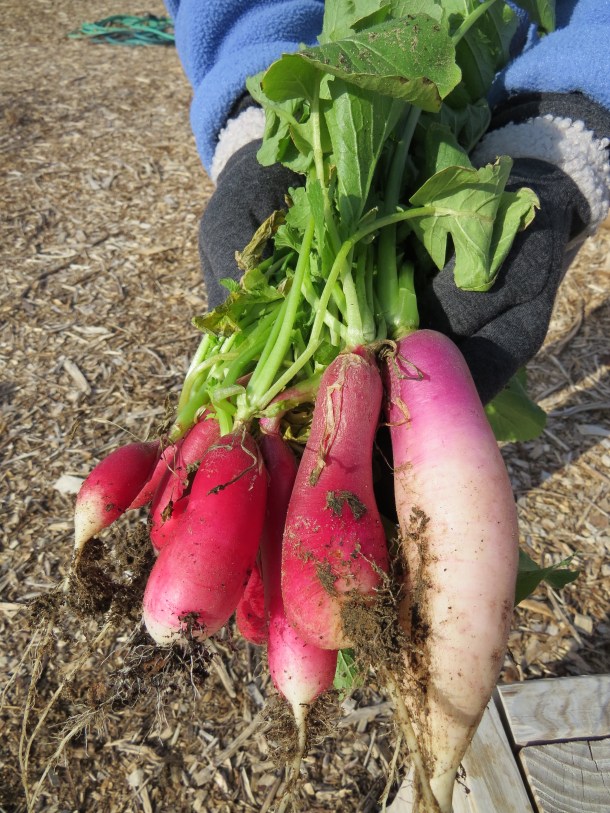
Radishes from our Garden, Properly Thinned

Radishes from our Garden, Properly Thinned

Onions-you have probably already planted them or are “fixin” to get them into the ground.

Above: Onion Sets Ready to be Planted

Above: Onion Sets Ready to be Planted

Remember to allow space for them to grow. Judge this by the expected size of the variety you are planting.

For example, green onions need less space than the larger bulbs of 1015Y onions. Spring is coming! Here’s what you can look forward to as an onion grower.

No worries about how to eat these crops. The Dallas County Master Gardener Cookbook, A Year On The Plate, will have plenty of recipes. (Publishing Date To Be Determined) But just like spring, it’s coming!

Onion Planting Advice : The Lowly Onion

Ann

Pictures and Video by Starla

Oh, oh, oh and don’t forget National Seed Swap Day at Preston Forest, Whole Foods Market today from 12-4.

Master Gardeners  will be there with seed activities and seeds to give away.

National Seed Swap Day, Saturday, January 30, 2016

seed collage with edgeWe have had a tradition of saving seeds at our garden. We carefully collect seeds, bag them, and give them to garden visitors. When Whole Foods Grocery at Preston Forest called and offered to let us participate in Seed Swap Day, we thought this would be a win-win situation!
 Volunteers from The Raincatcher’s Garden of Midway Hills will exchange seeds as part of the National Seed Swap Day from noon to 4 p.m. on Saturday, January 30. Whole Foods Market at Preston-Forest will host the fun event filled with garden ideas and live music. Volunteers will offer flower seeds and donated gardening books, promote RGMH, and help children make seed mats with zinnia and cosmos seeds.

Ann

Pictures by Starla

Click for Sage Seed Advice


Flavorful News from the Dallas County Master Gardener Cookbook Committee

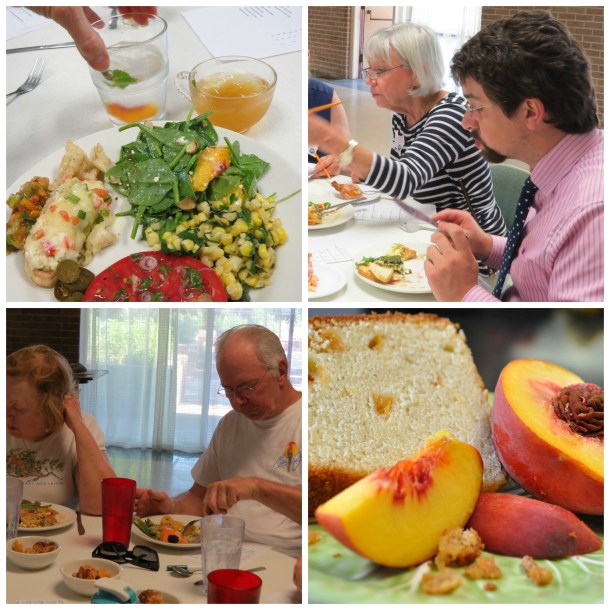
A new Dallas County Master Gardener Cookbook is on the way.  Our members have submitted a wheelbarrow full of recipes and gardening tips that the cookbook committee has been dutifully busy tasting and testing.

cookbook collage

We jumped into July with forks in hand. Tomato recipes were tasteful and tempting.  Corn, in abundance, brought comfort to our tummies.  Blackberries had us beaming with their beauty.  And, peaches just pushed us over the edge with their juicy goodness.  What could be better?  Well…

Cookbook August cropped overhead shot

In August we anguished over the okra. Which do we like best?  Fried, roasted, simmered, stewed or even finessed into little muffins?   And, oh how the squash recipes raised our spirits.  Shaved into salads, grated for quiche, pureed into soup, carpaccio and casseroles to consider.  How will we decide?

September, October and November we celebrated the harvest bounty. Sweet potatoes to savor, pumpkin recipes to ponder, an over-the-top apple recipe, a unique and very elegant pear presentation that left us swooning while Meyer lemon pie made us pucker with pride.

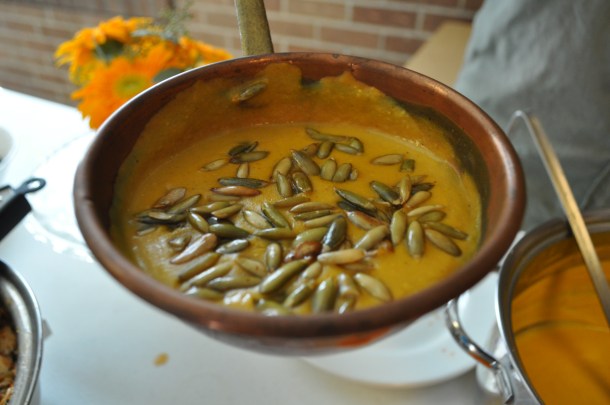
Creamy Southwestern Pumpkin Soup

Creamy Southwestern Pumpkin Soup

Our journey has been filled with flavor, fun and friendly evaluations. We’ve tasted, tested, eliminated some and accepted over 140 recipes.  Profound thanks to our faithful volunteers who have traveled with us.   The adventure continues to grow more exciting and we can’t wait to share our discoveries.

Until then, stay posted for more “flavorful news” from the cookbook committee and a special 2016 unveiling.

Take a peek at some “behind the scenes pics” courtesy of Ann and Starla!

Linda Alexander, Cookbook Chair

Winter at Raincatcher’s

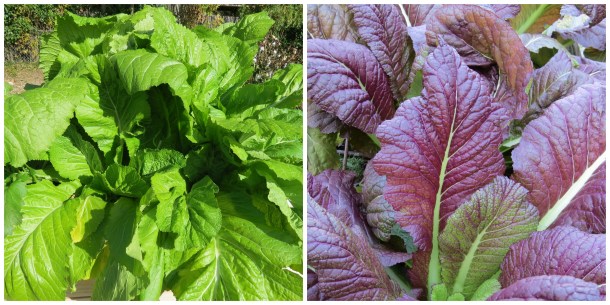
Green and Red Mustard Greens at The Raincatcher's Garden of Midway Hills

Green and Red Mustard Greens at The Raincatcher’s Garden of Midway Hills

If you have been eating your way through the garden this winter, no doubt you are acquainted with the  brassica family.  Members of this family include arugula, cabbage, cauliflower, broccoli, Brussels sprouts, kale, rutabaga, turnips, radishes, collard greens and mustard greens. They are cool season vegetables, planted in the fall in Dallas, Texas and harvested all through our mild winter.

Right now I am smacking my lips thinking of the cauliflower picked and  prepared at Linda’s yesterday. The recipe will be in our new Master Gardener cookbook, A Year on the Plate, which we hope, hope, hope to publish this year.

Along with harvesting and enjoying winter veggies, you should be planting onions now.  Onion planting instructions and recipes are all through our blog. You can’t escape them.

Ann

Pictures by Starla

What’s coming up in 2016?

Seed Swap Day at Whole Foods at Preston Forest, January 30

More information about our cookbook, A Year on the Plate.

A how-to video about braiding onions so you will remember to get yours planted right away


The time of year for the best of bushy bluestem

Source: The time of year for the best of bushy bluestem

10 Years of Gardening to Celebrate!

Merry Christmas y’all. Celebrate with us!


Video by Starla, of course!

Rain Garden Class

Dallas has had record rainfall  in 2015 totaling 57.95 inches. Could homeowners be doing something to slow and/or lessen storm water runoff, create less pollution in runoff, or direct water that falls on your property so that groundwater supplies are replenished? Dr Fouad Jaber will address these subjects next Tuesday.

Date: Tuesday, December 8

Time: 10:00 am

Place: The Raincathcher’s Garden of Midway Hills (we will meet in fellowship all)

11001 Midway Road, Dallas, Texas 75229

Cost: Free!

Master Gardeners can receive one hour of education credit

This class is open to the public. Bring a friend, all welcome.

Record Rainfall Data

Video by Starla

Ann

Information about our speaker, Dr.Fouad Jaber:

Associate Professor and Extension Specialist in Integrated Water Resources Management
Texas A&M AgriLife Extension Service
972.952.9672
f-jaber@tamu.edu

Dr. Jaber’s research emphasis is integrated water resources management. His area of study is focused on best management practices to mitigate the harmful effects of urbanization on storm water volume and water quality. He test the effectiveness of green infrastructure (GI) and low impact development (LID) practices such as porous pavement, bio-retention areas, green roofs, rainwater harvesting and wet detention ponds. Dr. Jaber also conducts research in water reuse in urban settings including grey water and A/C condensate reuse.