Houseplants Are Not Clutter!

Clutter control is the hot topic of the new year. It seems no blog or magazine is without advice.  Amazingly, some of the advice involves buying lots of new stuff to control the old stuff causing trouble.  Analysis of this is badly needed,  but we haven’t the time.  Not now.  Not when house plants, living things, have been put , by some, in the category of clutter.

Now what is meant by clutter? The logical thinking might be that clutter is what gets in the way of the enjoyment of our surroundings.  Clutter would be things that are not pulling their weight.  Things that take up space but are neither useful or beautiful.  Things that crowd out what we treasure.
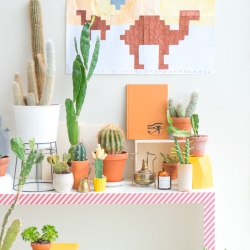
Another photo courtesy of www.urbanjunglebloggers.com

Another photo courtesy of http://www.urbanjunglebloggers.com

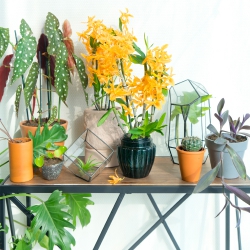
That couldn’t define indoor plants. First, they are useful.  Plants of course use carbon dioxide and give off oxygen—that has to be helpful.  Plants really do help in removing multiple toxins from indoor air.  Indoor air needs this.  In yet another example of the unfairness of life,  the more that has been invested in insulation and windows, the more likely toxins are to be building up in the air.  So, plants are good for physical health.  Breathing cleaner air has to be a benefit.  Mental health can suffer too when things outside are looking far too beige and grey.  Tending indoor plants can be a quick, and effective, therapy session.

Plants appreciate the attention paid to them. It doesn’t take much time or effort to clean a few leaves.  Clean leaves are more beautiful and also more effective at removing those toxins.  Take the time to check the soil before watering.  This one simple  thing can avoid  many problems, some of which are far from simple.  Small amounts of time and effort   lead to happy discoveries.  New begonia leaves are tiny works of art  and the sight of an emerging bloom spike on an orchid has to brighten any mood.

All these benefits—sounds expensive. It isn’t!! Friends and family may be glad to share plants—for free.  Clubs and organizations have sales and often offer interesting plants at bargain prices..

So plants aren’t clutter and they aren’t a luxury.  They bring nature to our homes every day—and nature is needed –every day.

Susan Thornbury

Indulge in an oasis of plant information from http://www.urbanjunglebloggers.com and thanks again for photos from urban jungle photographers and joelix.com.


Munching on Lasagna

The Edible Landscape team at Raincatcher’s has been sharing their progress over the past few months. Update #2 follows:

There’s a statistic out there (isn’t there always?!) that states 80% of all New Year’s resolutions are broken by February. …And since you haven’t seen another blog post from us since the first week of January, we bet you thought we belonged to that 80%, didn’t you?

Happily, that’s not the case, we’re still here. But with the New Year came some new regulations we had to work through which postponed our posts.  Now, we think we’ve gotten them figured out and we hope there will be no more interruptions.  So without further ado, here is our weekly post! 

Munching on Lasagna

In our last post, we showed you a picture of one of our sleeping beauties, a bed quietly growing soil under its blanket of mulch.  We cavalierly referred to it as “sheet mulching” or “lasagna gardening” and left it at that.  We also mentioned having written, but not published, posts of our activities during the past year.

Lucky Reader, this is the week your patience is to be rewarded – with a bonus! Not only are we about to share with you the recipe for a gardener’s lasagna, but since we’ve waited a nearly a year, we’re going to show you the tasty results, too.

So what is a gardener’s lasagna? (It’s also known as sheet mulching, no-dig, and no-till gardening, but we’re using the lasagna term; it sounds so much tastier, and this is an edible landscape after all.)  Unlike its culinary counterpart, it is not made up of layers of pasta, cheese, vegetables/meat and sauce.  But it is made up of layers.  Layers of carbon and nitrogen.  In Compostese (the language of compost), carbon-rich items are ‘brown’ and include leaves, straw, paper, cardboard, (shredded) wood, and other similar materials.  Nitrogen-rich items are ‘green’, and encompass vegetables and fruits, grass clippings, fresh manure, and coffee grounds.

To make lasagna, a cook repeats layers of pasta, sauce and cheese in a casserole until the pan is full. To create a lasagna bed, a gardener repeats two-inch layers of ‘brown’ with two-inch layers of ‘green’ until you have a two-foot-high bed (more or less).  A cook bakes their lasagna in the oven at 350°F for an hour.  They know it’s done because the top is bubbly and a little brown.  A gardener covers their lasagna with a layer of mulch and waits…somewhere between a few months and a year, depending on how hot and wet the weather is (warmer and wetter = faster).  They know it’s done because that two-foot-high bed has dropped to four to six inches, and when they peek under the mulch, they see rich, black soil, ready to feed seeds and seedlings, and build them into big, strong happy plants.

Building the bed

Building the bed


And that’s mostly how we’ve created our lasagna beds. We did one more thing to our bed:  before the first layer of compost or mulch went down, we put down a double layer of overlapping cardboard.  (You could use 6-8 sheets of newspaper instead, but the cardboard was free and faster than newspaper.)  Our brown was free shredded tree mulch from tree-trimming companies*, and our green was partly-decomposed compost we had on site.  We managed to get it about 18 inches high before we ran out of materials and muscle.

Newly finished bed

Newly finished bed


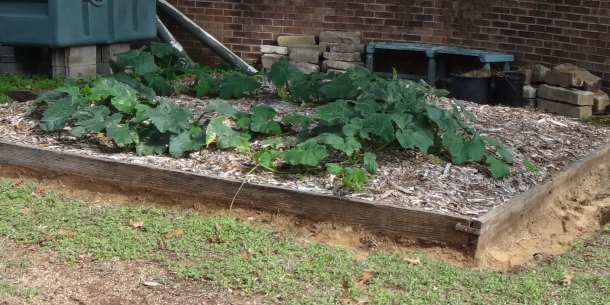
We built our first lasagna bed last April (2016), and by October, it had dropped to about six inches high and attracted a wayward seed. By December, that little traveler looked like this:

One butternut squash plant

One butternut squash plant


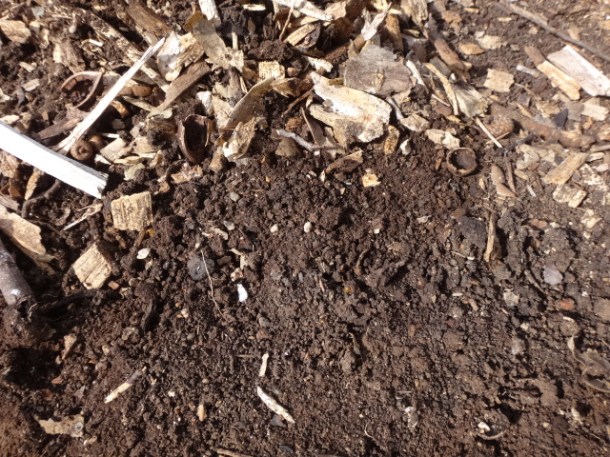
It lived in the shade of the nearby oak trees, and never got watered by us. But the soil was so rich, it fed our butternut squash plant well.  When we pushed aside the mulch, we saw nice, rich soil (black gold):

Our new soil

Our new soil


We’re looking forward to a good year.

That’s all for today – see you next week!

Lisa Centala

*http://freemulch.abouttrees.com

Onion Planting at The Raincatcher’s Garden, 2017

It’s January and time to plant onion sets! Onion sets can be purchased at your local garden center. Sets are immature bulbs that were started from seed the previous year. The seed are sown closely so that they stay small and then pulled when they are about a half an inch round. Onion sets are inexpensive and contain about 75 onions. At Raincatcher’s we are planting Red Creole, Early White, and Super Sweet. Next week- Lancelot Leeks.

Dallas Garden Buzz is loaded with onion stories and recipes. Type onion in the search box to catch up on alliums!

Video by Starla Willis

Onion Planting by Dorothy Shockley

Ann Lamb

And did you know…

Thank you from The Raincatcher’s Garden of Midway Hills!

Hanging Out At the Mall

      There are always problems with anthropomorphizing non-humans. Just think of those cute cat and dog “shaming” videos where animals are just being true to their nature but we humans attach reasons and feelings behind their behavior.  Still sometimes, even insects seem to display some “human” characteristics.

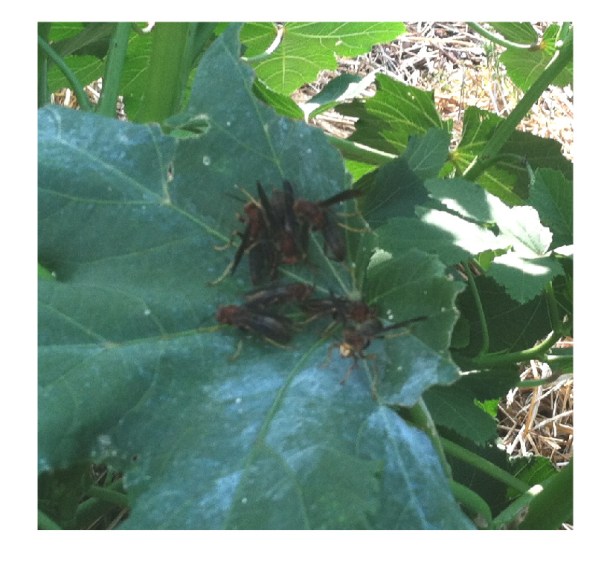
I thought about this a few years ago in autumn when I was picking the last of the okra.   Though an occasional brown paper wasp was often seen in the garden, suddenly, as I was disturbing the plants, I was surrounded by more than one wasp.  As they did not seem particularly aggressive, I kept on picking.  However, when the same thing happened the next day, I began to look more closely at the okra plants.  There to my horror were two clusters of about seven or more wasps on the underside of two leaves.  After getting over my shock, I began to observe their behavior.

wasps2

Every once in a while a new wasp would fly into the group.  The other wasps would rush to the “newcomer” and start feeling its body with their antennae.  At first I wondered whether the original group was trying to kill the newcomer, but realized that perhaps this was their way of communicating.  What was going on?

A quick Google search revealed that the behavior was common.  Stephen Bambara and Michael Waldvogel, Extension Entomologists with North Carolina Cooperative Extension say: “… paper wasps show types of swarming behavior during the cool and cold times of the year when there are no nests and no young larvae to protect.  During the fall, this behavior is connected with mating and is the wasp version of “boy meets girl.”  Male wasps look for the best place to “hang out” and attract females.  On these warm days during the fall, the future queens become active and fly about.  Dozens or hundreds might be seen around the upper stories of a building, transmission tower or other tall structures.” Were the male wasps that I was observing just acting like teenage boys and “hanging out at the mall,” waiting to find some cute girls?

Unfortunately for the male wasp, that is where the comparison to its human counterpart ends. At some time after mating, the males die and the impregnated females seek shelter for the winter.

Carolyn Bush


RAINCATCHER’S FUNDRAISER AT FISH CITY GRILL

Celebrate the new year with friends and family at Fish City Grill on Tuesday, January 10th and help the Raincatcher’s Garden.  The local gathering spot is known for Oyster Nachos, fresh seafood and a fun, casual atmosphere.

Fish City Grill supports local organizations through its First Tuesday Benefit.  Raincatcher’s will receive 15% of the day’s receipts, including take-out!

Fish City Grill is located on the southeast corner of Preston and Royal, near Central Market. Enjoy your Smokin’ Hot Shrimp and Fish Tacos from 11 am to 10 pm.

Address: 10720 Preston Road #1012
Dallas, Texas 75230
Phone: 214-891-9979


New Year’s Resolutions

A new year is here, and with it comes hope. All those good intentions come roaring back, ready to improve our lives.  Last year, we began creating an edible landscape in the old, disused playground.  We promised you updates on our activities, and sharing what we learned as we experimented in our new space.  Those posts got written, but never published.

So our resolution for 2017 is to both write and publish our edible landscape adventure (with pictures, of course!)  We’ll aim to do one a week, keeping you informed of our progress, our activities, our successes, our failures, and any lessons we glean from all of it.  …And we’ll probably slip in last year’s posts (as they become seasonally relevant.)

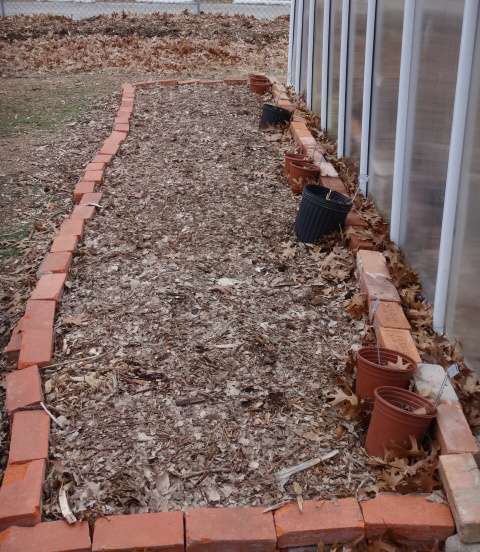
edible-garden-januaryAbove: growing soil!

Right now, we’re growing soil. Aboveground, the garden looks asleep; belowground, many organisms are busy converting multiple layers of compost and mulch into rich soil.  You may have heard of it, it goes by many names:  sheet-mulching and lasagna-gardening are two common ones.  Growing soil doesn’t take much effort from the gardener (other than patience), so while the garden doesn’t need our immediate attention, we are inside, warm and cozy, surrounded by a mountain of catalogs, dreaming up the landscape for the upcoming year.  If you’ve got any suggestions for us, we’d love to hear it!  The only caveat is that the plant must have an edible component.  With all the trees in our landscape, shade-tolerant edibles get bonus points.

That’s all for today – see you next week!


Porterweed

How often do you get an entertainment package with a nectar source?

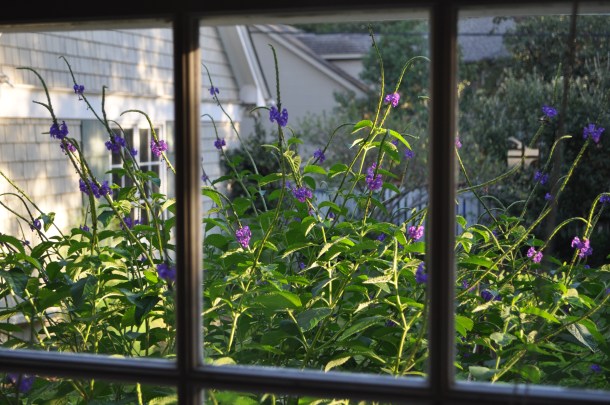
Blue Porterweed, Stachytarpheta jamaicensis

Blue Porterweed, Stachytarpheta jamaicensis

My husband has mentioned several times how entertaining the Porter weed is which can be seen through our den windows. We have watched hummingbirds, butterflies, and bees drinking from it.

Now we must say goodbye and hope that it returns from its roots next year. Proper mulch has been applied.

Porterweed comes in several colors and be careful because the names and growth habits will switch according to species or cultivar.

Raincatcher’s has Coral Porterweed, Stachytarpheta mutabilis, in our courtyard garden and Lavender Porterweed Stachytarpheta mutabilis var. violacea in our butterfly garden.

Coral Porterweed, Stachytarpheta mutabilis

Coral Porterweed, Stachytarpheta mutabilis

Make a note to look for this favorite nectar source at the Texas Discovery Garden spring plant sale in 2017.

In the meantime, Porterweed, we are going to miss you!

Ann

Hope you read yesterday’s freeze information yesterday and for further info click here.

Note: I have seen Porterweed spelled as two words and one word.


Freezing Weather Coming…

I talked to Lisa today. She and Jim  were headed to The Raincatcher’s Garden to drain the pipes alongside our cisterns so the pvc wouldn’t crack if we have freezing weather and to make sure all faucets were covered.

Last week our gardeners were busy harvesting green tomatoes, some sugar baby watermelons(one last taste of summer) and herbs that would freeze like thyme, lemon verbena, and lemon balm.  Our basil was already on it’s last legs so only a little bit of it was worth picking.

Ann

Here’s some advice  from seasoned gardeners (hohoho)

about preparing home gardens before a freeze.

We were so lucky this time to have had rain because watering before freezes is so important. Buying  frost cloth is a good investment; the little sack like things are useful.  I just put those on two clumps of narcissus that are just about to bloom; it won’t hurt the plants but the blooms could be destroyed.  I think the kale will be fine but covered it just to be safe  of course all tropical have to be inside–and taking a small clump of lemon grass and just putting in the garage will be sure you have some for the next year. Lemon grass usually comes back but is tropical and can freeze.

Pick all vegetables. Green tomatoes usually ripen spread them out single layer–I use plates and put them in back rooms–my kids used to say they couldn’t sleep without green tomatoes on the dresser!

Susan

I’ve pulled out all my summer veggies, because I like to avoid the ugly frozen plants.

dorothys-frost-coversBecause I have now acquired 5 citrus trees, I don’t have room to move them in, so I covered them and have a light bulb down in the bottom.


Dorothy


Thanksgiving Menu

Thank you to our many readers who have purchased the Dallas County Master Gardener Association cookbook, A Year On The Plate. Copies are available on our website and at North Haven Gardens while supplies last.slide08

Happy Thanksgiving to all!

Menu by Linda

Lakewood Elementary School Returns!

Teaching children about the natural world should be treated as one of the most important events in their lives. – Thomas Berry

The Raincatcher’s Garden hosted 156 children and 10 teachers and aides from Lakewood Elementary School this week as they learned about vegetables you can grow in your own garden, vermicomposting and the life cycle of worms, pumpkin math, city chickens, compost and gardening to attract butterflies. 

lakewood-sheridanStudents were led to each garden station by happy Master Gardener volunteers like this one!

lakewood-color-wheel

Exploring the garden with all senses is encouraged.

lakewood-vermiculture

And just think if you can hold a red wriggler worm in your hand, the science of vermicomposting may become more interesting.lakewood-field-trip-mg

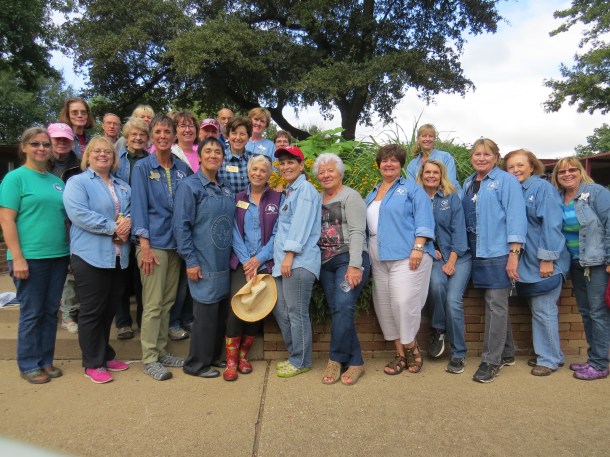
This is only a fraction of the army of Master Gardeners who helped with the field trip.  Great Job by our Master Gardener Education committee!

Pictures and observations by Starla