Summer rain tapped on our garden. And just like Johnny Rivers so sweetly sang, she stepped out of a rainbow. Lavender blossoms filled the air with their intoxicating fragrance as bee balm welcomed the bees with tiny, tubular petals in shades of pink, purple and red. The showy yellow flowers of baby butternut squash plants told us it was time to get out the recipe for Squash-Blossom Quesadillas.
Our Edible Landscape ‘Baker’s Dozen’ of summer blossoms and flowers continues to evolve. The early bloomers are starting to fade while the colorful hibiscus, impatiens and marigolds refresh us with their summer beauty. Stroll down the garden path for a glimpse of these seasonal stars. Or as the lyrics suggest…stay awhile, then sail into the sunset and let tomorrow be.
#1 Anise Hyssop (Agastache foeniculum)
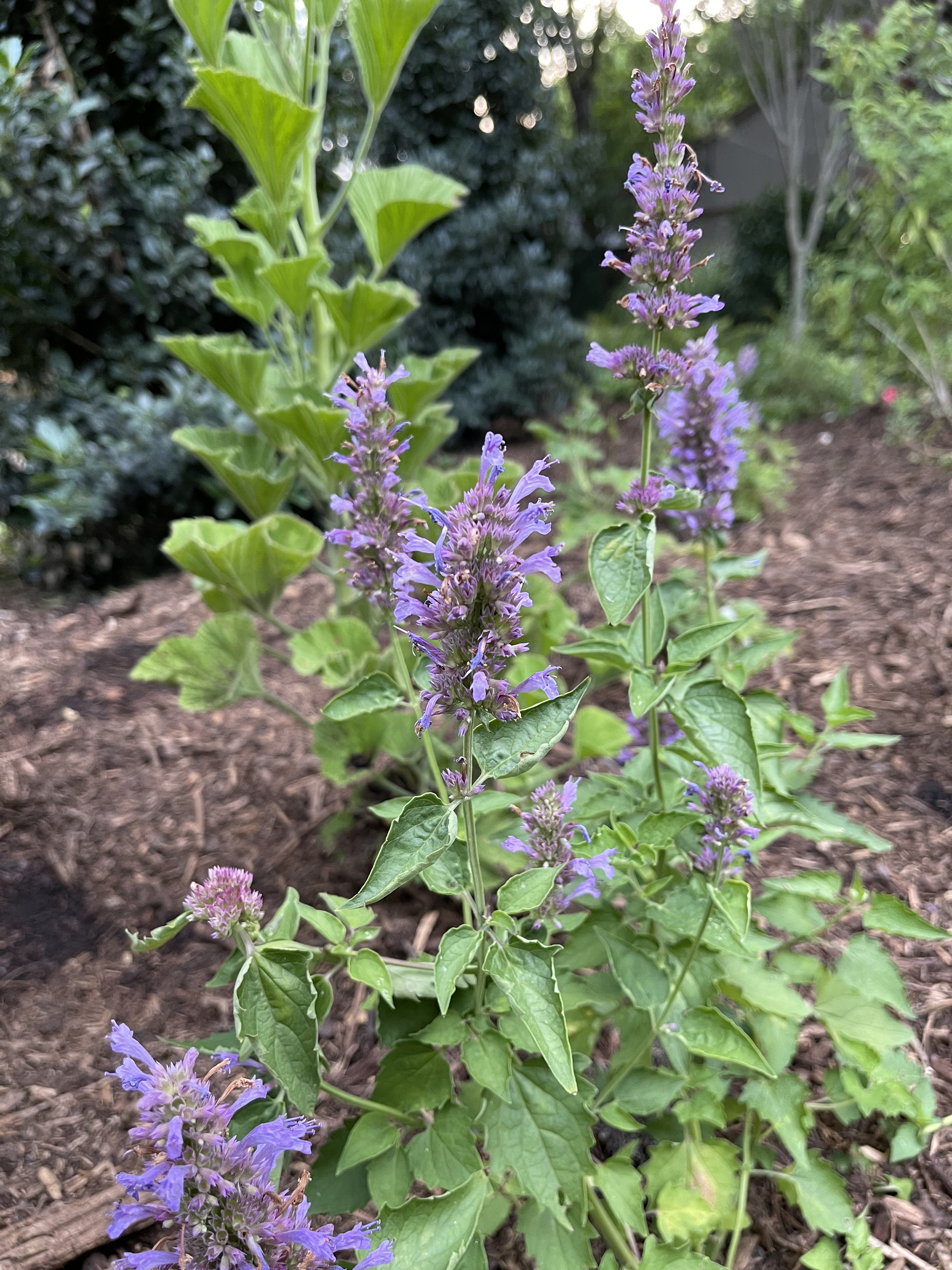
Some people believe that this is one of the tastiest edible flowers. If you are curious, stop by the Sensory Garden and pick a few tiny petals. You might taste a flavor somewhat between anise and root beer. Leaves and petals, if used sparingly, are very pleasant in salads, iced drinks, soups, tea breads and dessert.
This highly ornamental plant is an easily grown herbaceous perennial that reaches from three to six feet. Leaves are gray green with dense one- to three-inch flower spikes ranging from mauve to lavender to white. Grow it in full sun in average soil and keep it fairly moist. The plant dies down in winter and often reseeds itself the next spring. Our anise hyssop was lost to the extreme cold this winter but has been replaced with a new plant that is thriving in a sunny location.
#2 Basil (Ocymum basilium)
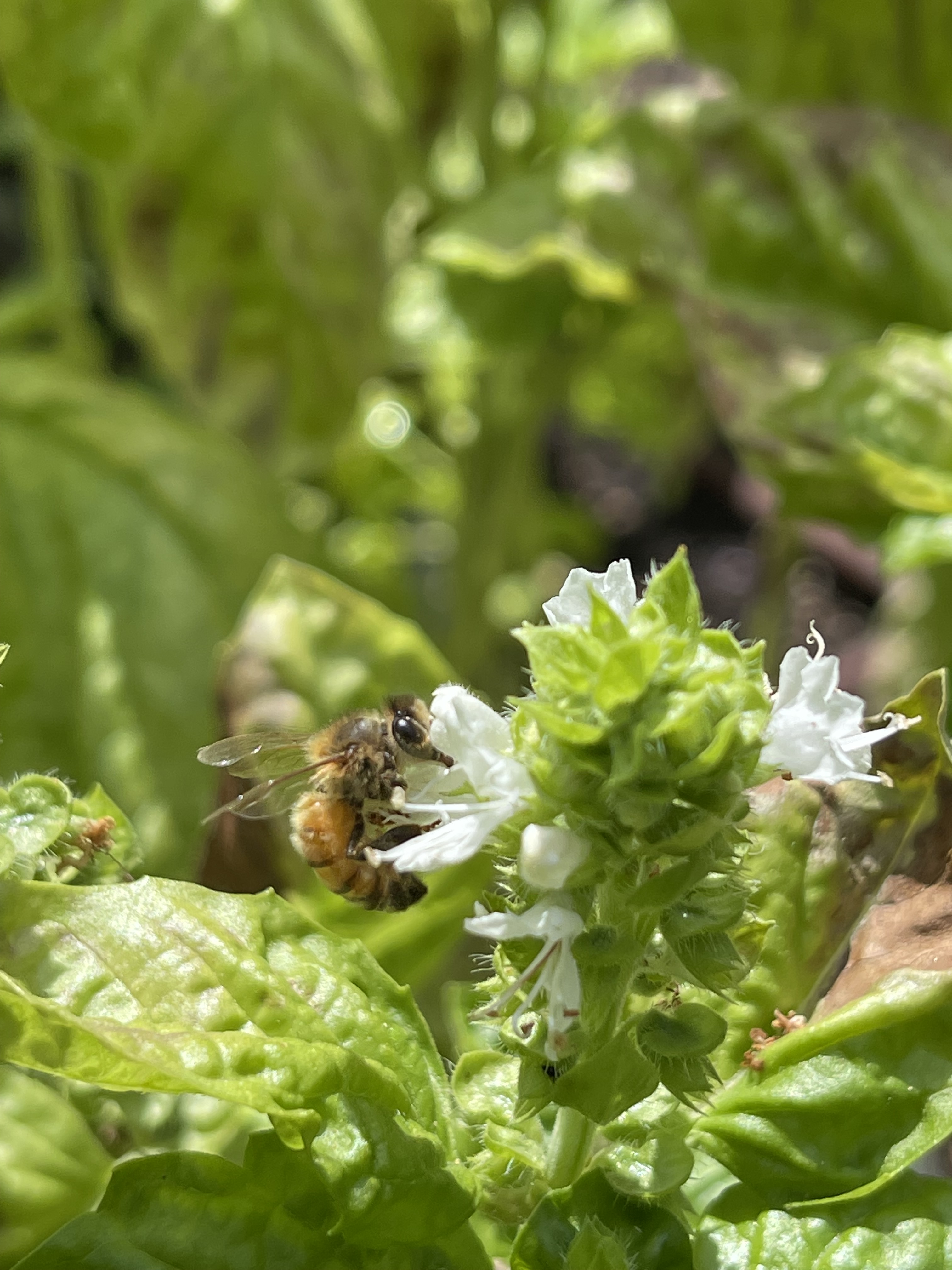
The Edible Landscape Garden is filled with over 12 different varieties of basil. Their blossoms and leaves vary in color, taste and texture. During the summer months our temptation to start deadheading is sometimes delayed by the bees. Bees love basil and can be found collecting both pollen and nectar from the white, pink, purple and light-blue flowers. That’s the dilemma we face once those fragrant blossoms start appearing. A convincing answer is found in the reason for removing the blossoms. Basil is grown primarily for the tender, fluffy leaves. Adding them to soups, tomato caprese and, best of all, whirring up a tasty batch of pesto is what summer is all about. But, once the plants develop flowers that mature and turn into seed pods, the taste profile changes and the plant becomes woody. Fortunately for the edible landscape, we generally plant three of each variety. That gives us the opportunity to allow one plant in each variety to grow from blossom to seed. For the remaining two plants, the entire flowering branch gets snipped off. With the flowers gone, the plant’s focus will shift back to growing new leaves, and it will become bushier. Since basil is a very edible plant, those flowering tops get added to salads or tossed with other greens. The bees keep buzzing and our culinary summer desires have been satisfied.
#3 Bergamot ‘Bee Balm’ (Monarda didyma)

This plant lives up to its name. Once it begins to bloom the bees arrive and find their happy place sipping its nectar. The variety we chose to plant on either side of the greenhouse is ‘Marshall’s Delight’, a lovely shade of lavender. Depending on your preference, it also comes in bright red, pink and white. Bergamot is a perennial, in the mint family, that prefers a rich, well-drained soil. Native Americans of the Oswego tribe showed the colonists how to make a substitute “freedom tea” from its fragrant leaves…thus another common name, Oswego tea.
Bergamot grows from 2-1/2 to 4 feet high. After reaching 12 inches in height, support the branches with stakes to help keep plants upright. Flowers appear in whorls of frilly tubes and have a lemony mint fragrance and taste. Use flowers sprinkled on fruit, cold dishes and fish. Or enjoy a refreshing cup of Oswego Tea. (Recipe: Use 3 teaspoons fresh or one teaspoon dried leaves per cup. Place in a glass or China pot, cover with boiling water and steep for 10 minutes. Sweeten with honey. Garnish with freshly picked bee balm blossoms.)
#4 Daylilies (Hemerocallis fulva)
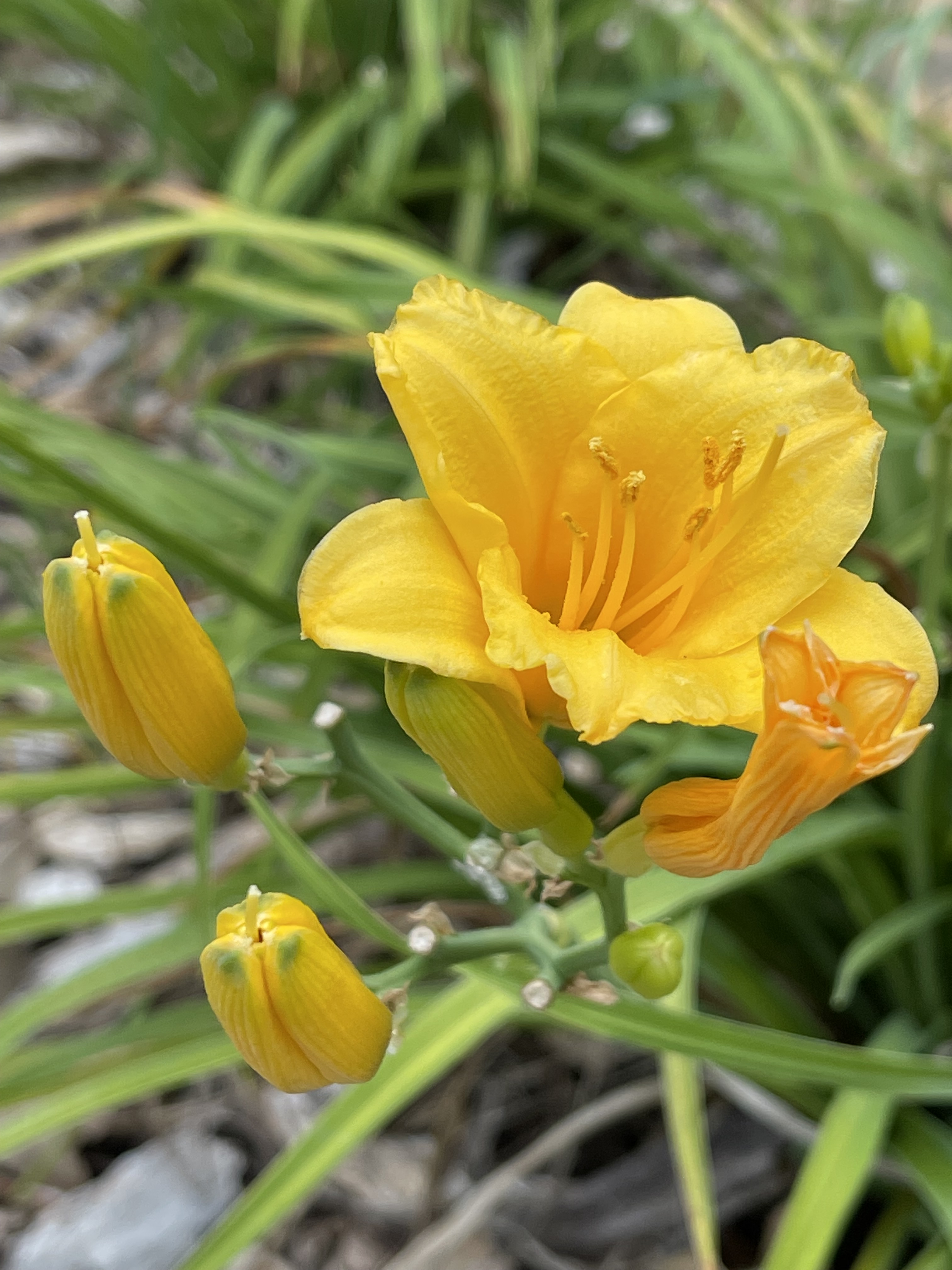
Daylilies got their name from the Greek hemera, for “day,” and kalles, for “beauty.” Each beautiful flower lasts for only a day, but another replaces it the next. The flowering period of an established clump is usually several weeks long. Daylilies perform best if given full sun and an area with well-drained, fertile soil. We’ve located our daylilies in the garden bed just in front of the greenhouse where they receive full sun most of the day. The variety we chose is the traditional ‘Stella de Oro’. It has numerous yellow flowers per scape that bloom all summer. Daylily buds will keep in the refrigerator for several days, but the delicate flowers should be consumed the day they are picked. Several interesting recipes for using them include Daylily Cheesecake, Daylily Curry and Daylily Petal Salad.
#5 Dianthus ‘Sweet William’ (Dianthus barbatus)

Gardeners have been cultivating this short-lived perennial since at least the 1500’s. In the language of flowers, dianthus stands for love, fasciation, distinction and pure affection. With such descriptive words, we should all be growing dianthus in our gardens. Dianthus flowers are in bloom from late spring until midsummer. (They are related to carnations, another edible, which we also have growing in the Sensory Garden.) The nickname “pinks” is derived from the color of the flower. If you’ve ever used a pair of “pinking shears” then you should know that they are so named because they create a fringe much like the ruffled petal edging on this beloved flower.
The variety growing in our cottage garden, ‘Sweet William’, has a spicy fragrance with hints of clove and cinnamon. When grown organically, the flower petals can be crystallized with sugar and used for decorating cakes or other desserts. And, if you happen to enjoy the liqueur Chartreuse, it is composed of distilled alcohol aged with dianthus petals and 130 other herbs, plants and flowers. This very historic French liqueur has been made by the Carthusian Monks since 1737.
#6 Summer Phlox (Phlox paniculate ‘Party Girl’)

Every cottage garden needs some type of phlox. This summer we chose one of the four “Garden Girl” varieties, ‘Party Girl’. Displaying bright white flowers with star-shaped pink centers, we’re hoping she will bring the party to the garden. Hardy in zones 3-8, ‘Party Girl’ flowers mid to late summer with an excellent rebloom. Two of our plants receive morning sun, afternoon shade while the other receive just the opposite. We’ll continue to monitor the progress of this long-blooming perennial and adjust the location, if needed. Phlox are pollinator-friendly plants known for attracting butterflies and hummingbirds. The perennial phlox is the only type that is edible. Their flavor is sometimes described as slight spicy but, also, quite sweet. Use them crystallized on cakes and desserts or floating in summer drinks.
#7 Coneflower (Echinacea purpurea)

Do you think of hedgehogs or sea urchins when admiring a coneflower? The genus name of Echinacea comes from the Greek word echinos meaning, you guessed it, hedgehog or sea urchin. A gentle touch of the spiny center cone found on most flowers in the genus explains the connection. Echinacea is an herbaceous perennial native to moist prairies, meadows and open woods of the central to southeastern United States.
Before growing echinacea, decide where you want them to grow permanently. Because they establish deep taproots, moving to a different location is not recommended. The plant can reach heights of five feet. Their showy daisy-like purple coneflowers bloom throughout summer making them an excellent, long-blooming flower for massing in the garden. Leaves and flower petals are edible. Harvest echinacea leaves for tea by cutting a few from each plant as needed. Use them fresh or dry the leaves and store them in a cool, dry place.
#8 Hibiscus (Hibiscus rosa-sinensis)
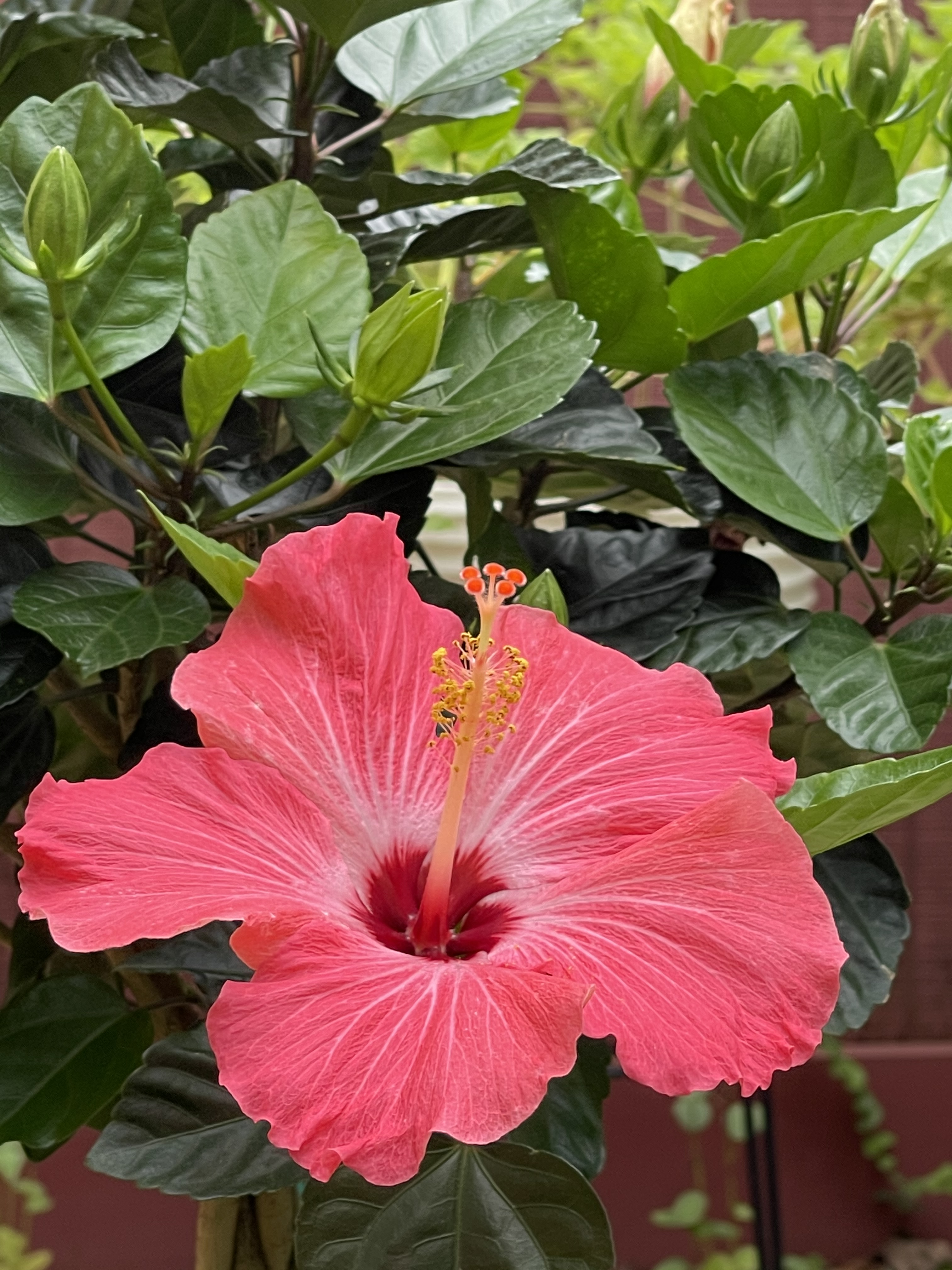
A summer garden without hibiscus is like a rainbow absent of color. Tropical-looking showy flowers in tones of yellow, coral, orange, pink, red and countless other color combinations make this member of the mallow family a true seasonal superstar. Even the well-known paint company, Sherwin-Williams, features SW 6851 Hibiscus in a stunning shade of deep pink for both interior and exterior use.
As a special culinary treat, combine hibiscus flowers with fresh summer blackberries to make Hibiscus Chutney or try the adult version of Hibiscus Popsicles made with champagne and hibiscus simple syrup. Petals can also be torn and tossed into your favorite salad. You’ll enjoy their mild flavor with just a slight tanginess.
Hibiscus plants are lovely grown in containers or in ground. For the best growth and flower production give them a full sun location. It is important to keep the soil moist, but they must have good drainage. Hibiscus flowers open daily and last for only one day, after which they die. Simply remove all wilted or unsightly flowers and keep grooming daily.
For a fascinating and very comprehensive look into the world of hibiscus plants go to:
#9 Impatiens (Impatiens walleriana)

My husband and I have lived in Dallas for almost fifty years, and I can’t think of a summer when we didn’t have impatiens growing in the shady areas of our garden. Their bright and cheerful flowers add a touch of pizzaz anywhere you choose to plant them. At Raincatcher’s this year we purchased four hanging pots of purple impatiens to feature as bedding plants in the Cottage Garden. They have almost tripled in size since their April addition to the garden and have maintained their large mounding shape.
We were already aware of their growing characteristics which require moist well-draining soil and partial to deep shade. The bed where they are located is irrigated but during extreme heat, we give them supplemental watering.
Impatiens are considered to be one of the most popular bedding plants in the Northern Hemisphere. As a big bonus for the edible landscape, they also have tasty edible petals. The sweet petals can be used to flavor desserts, salads and drinks. Thankfully, there is plenty of time left to enjoy beautiful and edible impatiens in your yard and on your plate.
FYI…next year we plan to use impatiens in other areas of the edible landscape. And, in those sunnier spots, SunPatiens will be making a showy appearance.
#10 Oxalis ‘Iron Cross’ (Oxalis deppei)

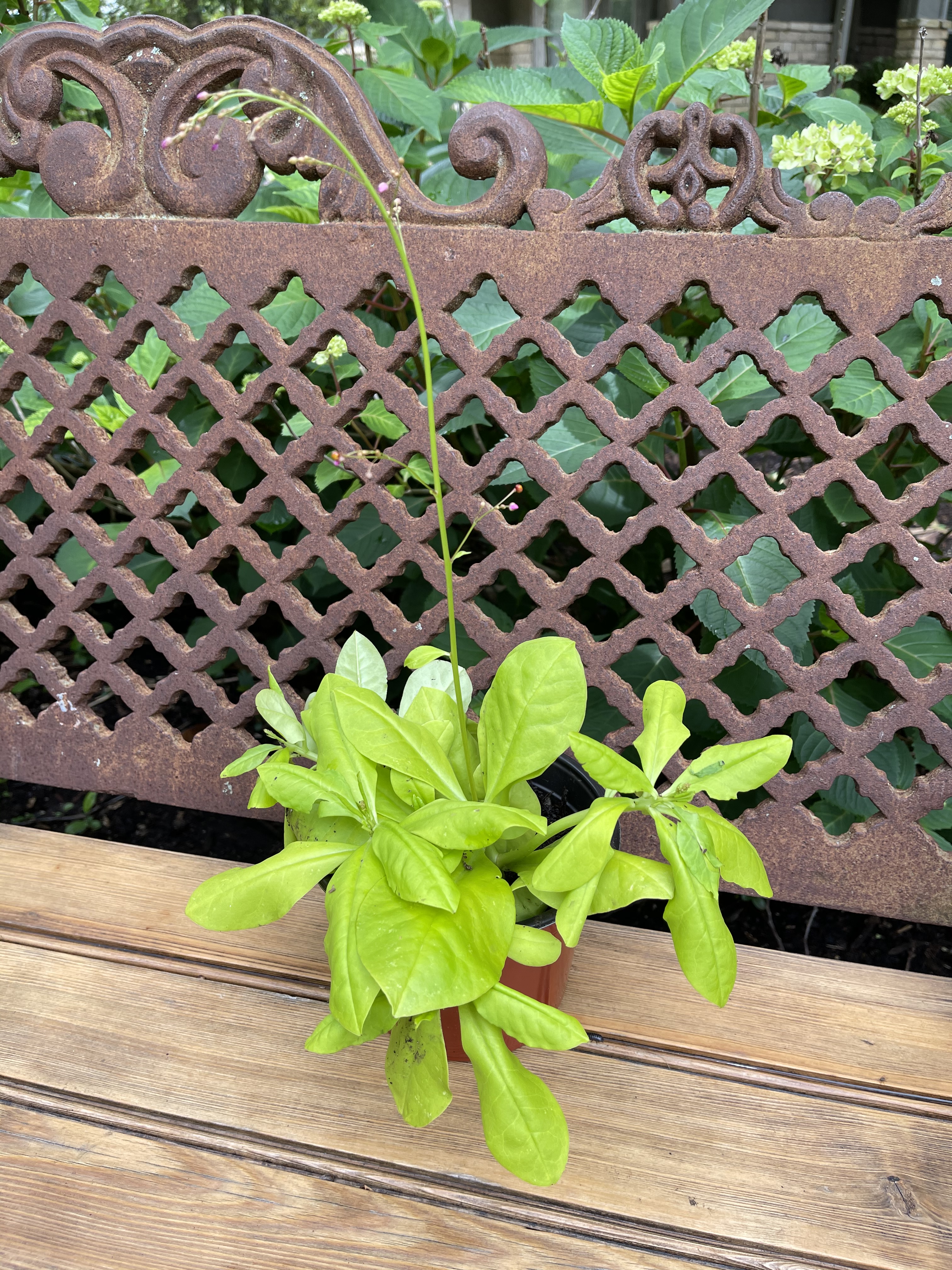
Do you need a bit of “good luck” in your garden? You may find ‘Iron Cross’ exceptionally rewarding. It is a bulbous perennial forming a lush mound of heart-shaped green leaflets. Each leaf has a dark purple blotch at its base which is reminiscent of a cross. During the day the leaves open out to receive sunlight but at night they retract and fold up like umbrellas. From early summer until frost, the rich green foliage is topped with sprays of trumpet-shaped bright pink flowers. Plant Iron Cross in a sunny to partly shady area of the garden where the soil drains well and has a light, loamy or sandy texture.
The edible leaves and stalk give salads and soups a pleasant, tangy taste. Dark pink oxalis flowers are a nice garnish for desserts and summer salads.
#11 Lavender (Lavandula angustifolia)

Lavender has been called the ‘fragrance of Provence’, and today, in France, it is still referred to as “blue gold.” If you’ve ever had the opportunity to visit Provence when lavender is bloom, it’s easy to appreciate the mesmerizing affect its beauty and fragrance have on you. My husband and I first made the trip over 20 years ago returning to Texas with the dizzying effects of lavender fever lingering in our heads. That’s when my love affair with lavender began.
It has grown wild throughout the Mediterranean for millennia. And now it’s found growing all over the state of Texas, especially down in the Hill country area. The story of how it came to the Texas dates back to the year 1999. Robb Kendrick, a photographer for National Geographic magazine was assigned to do an article about the perfume industry in France. While there, he was struck by the similarity of a lavender-growing area in southern France to his own land near Blanco, Texas. After a careful study of the soil and climate, he decided to start growing it on his property. Texans embraced the idea wholeheartedly and a booming new business was started. For a real Provence-type experience, be sure to put the Blanco Lavender Festival on your calendar. It’s held annually in June and features “all things” lavender.
Growing Tips:
*Lavender does best in a sunny location with well-drained soil. The ideal pH for lavender is between 7.5 and 8.5. A slight slope helps promote drainage.
*Best time for planting seedlings is March and mid-October, before the first frost. A fall planting will give the plants a better chance of getting established.
*Consider growing lavender in raised beds to help keep roots out of water during heavy rains.
*There are at least 47 varieties of lavender with an infinite number of cultivars. Do some research to determine the variety best suited for your location. We chose Provence Lavender.
*Lavender is a perennial, which should give you 8 to 12 years of beautiful growth if properly cared for.
#12 Marigolds (Tagetes tenuifolia)


If you are unfamiliar with Signet Marigolds, take a stroll around The Edible Landscape Cottage Garden where they are in full bloom. These showy, single-flowered marigolds feature small, but abundant, richly colored blossoms covering the finely divided lacy foliage. We expect the compact and busy plants to reward us with their tiny blooms summer into fall.
This year, the varieties we chose are ‘Lemon Gem’ and ‘Tangerine’. Master Gardener, Gail Cook, started the seeds for us in early spring. The four-to-six-inch seedlings were transplanted in May. Over the past few months, we’ve enjoyed the elegance of their petite, single, lemon and tangerine blossoms with a citrus-forward, subtly peppery flavor. Harvest the flowers just before using by separating petals from the flower base as it contains a bitter, unpleasant flavor.
#13 Roses (Rosa Meidrilfora’ (Coral Drift®))

Every color of rose has a different meaning. In the language of flowers, coral is desire or passion. We are excited to have four Coral Drift rose bushes growing in our Cottage Garden Bed, one in each wedge. Drift® roses are intended to function as groundcover or carpet type roses. As all gardeners know, roses are sweet and highly aromatic. While color doesn’t affect the flavor of roses, scent does. The stronger the scent of the rose, the stronger the taste. And, if it smells good chances are it will taste good. Roses generally bloom in early summer but Coral Drift blooms continuously from spring until frost. It produces abundant clusters of small, vibrant coral flowers about 1.5 inches across filled with up to 25 petals. They open up in a softly cupped shape to reveal the stamens. The glossy deep green foliage is noted for its strong disease-resistance. Sometime around mid-September our desire is to use those beautiful coral rose petals to make Pistachio Rose Shortbread and Fig and Rose Cream Trifle.
Linda Alexander, Dallas County Master Gardener Class of 2008