Earlier this week, we heard the news that the possibility of our first “freeze or frost” was in the forecast. For gardeners, that sends a signal to start preparing for the big event. Fortunately, my master gardener friend, Ann, sent a text on Friday morning asking if I had any extra basil to spare. My answer was a resounding, “YES”, and I was ready to share as much as she needed.
This year I was growing some of my favorite varieties; Balsamic Blooms, Cardinal, Cinnamon and Red Rubin. There was a plentiful amount of most, but especially the Cardinal. And so, the clipping began. As a bonus, Ann had offered to share a new recipe with me in exchange for the basil. We would both being making basil pesto, as requested in the recipe.
One of my favorite basil recipes is in the 2016 master gardener cookbook, “A Year on the Plate”. I decided to make 4 recipes of spinach basil to use when preparing Ann’s recipe and then freezing the remaining jars.
Basil Pesto: Two Back Jars, ‘Cardinal’, Front Jar ‘Red Rubin’
From Ann…
Chicken Pesto Meatballs
My good friend, Nancy, who survived junior high and high school with me gave me a recipe which allowed me to use up end of season basil. Chicken Pesto Meatballs uses ground chicken infused with 3/4 cup pesto. The flavor is complex and in a short time you have a beautiful dinner with it’s major ingredient coming from your very own garden or your friend’s garden!
Linda Alexander and Ann Lamb, Dallas County Master Gardeners
Here’s a hint – with its strong lemony scent and flavor, you’ll find many uses for it in the kitchen. You may have already guessed just by looking at the photo but, yes, the answer is Lemon Verbena (Aloysia triphylla). For over 30 years it has been my very favorite herb. I’ve used it countless times for breads, cakes, cookies, puddings, in savory dishes and beverages. From early spring when it emerges from the ground and sends up those first “shoots”, a fresh sprig goes into my daily glass of green tea. The ritual continues until at least November or whenever our first freeze of the season arrives.
Lemon Verbena Tea Garnished With Freshly Cut Lemon Verbena
Why should lemon verbena be growing in your garden? To start, lemon verbena is considered by some to be the queen of aromatic herbs, myself included. One whiff of its sweet lemony aroma explains why Southern ladies suffering from the “vapors” mopped their brows with a decoction made from its leaves. For this reason, it is sometimes called the Scarlett O’Hara herbs. Growing in our Zone 8 climate, you can expect lemon verbena to easily reach 4 to 5 feet in height when planted in full sun and in good garden soil. Consider placing it toward the back of your garden bed where it will become a nice informal shrub. Also, keep in mind that it tends to ramble off in different directions but can easily be trimmed to the shape you desire. Lemon verbena is a woody perennial that will start losing its slender, elongated leaves in late fall. If heavily mulched, it will survive a moderate winter. However, in the northern part of Texas, it may succumb to temperatures lower than 25° F. Over the years, I’ve lost at least five or more lemon verbena plants during a hard freeze. But once spring arrives, most local garden centers have it in stock. And, thankfully, it is a relatively quick growing plant.
Lemon Verbena Growing Gracefully in My Garden
Recently, I discovered a recipe in one of my 1995 herbal cookbooks that gave me a new appreciation for using lemon verbena with another well-loved herb, Anise Hyssop (Agastache foeniculum). In the summer section of ‘Today’s Herbal Kitchen’ published by the Memphis, Tennessee Herb Society, the recipe that caught my eye was Anise Hyssop Lemon Cake with Lemon Sauce.
Anise Hyssop is a pollinator-friendly plant whose blossoms are filled with honeybees
Reading through the short list of ingredients, I learned that anise hyssop was called for in the cake along with lemon verbena leaves in the sauce. Hooray! With both herbs growing in my summer garden, it was time to start baking.
Freshly snipped anise hyssop flowers ready to be chopped and mixed into the cake batter
Once out of the oven, and allowed to cool, it was time to slowly pour the luscious, warm lemon sauce over the top. I tried to imagine how the minty, licorice flavors of the cake would blend with the citrusy, floral taste of the sauce. Should I wait for my husband to come home from work before tasting? After carefully slicing the cake for the “photo shoot”, I yielded to temptation and willfully gave in to that first bite. It was a divine experience. My taste buds were rejoicing at the thought of this wonderfully harmonious combination. A new discovery is usually very satisfying and, in the case of anise hyssop and lemon verbena, I’ve determined that for as long as herbs are growing in my garden, these two “companions” will be there.
Dig a hole through time and you will hit a fig tree’s roots. Figs are one of the oldest cultivated plants.
Figs are interesting little fruits but not in the traditional sense. The structure of the fig is a called a syconium, a fleshy sac lined with tiny flowers inside. When you eat a fig, you’re technically eating hundreds of tiny inverted flowers that bloomed inside the syconium.
The word “fig” comes from the Latin ficus
There are over 700 species of fig trees worldwide
Figs grown in the USA are self pollinating but in other countries pollination is provided by fig wasps which crawl into the fig, complete their mission and then die inside the fruit.
Figs conatin fiber, copper, potassium, maganese, vitamin K and other nutrients
Plant your fig tree in full sun in soil with good drainage, mulch regularly and monitor moisture needs
My experience with growing figs started with a fig tree propagated by Master Gardener, Jim Dempsey. It was planted in my backyard about 10 years ago. Every year I have looked up into my trees large, deeply lobed leaves longing for figs. The winter storm of 2021 nicknamed “Snowmagdeddon” caused the tree to die back and it would be several more years of waiting and hoping as it recuperated.
Finally this year my family tasted the fruit! About 12 pounds of figs were harvested from our Celeste fig tree. We let it grow to a height of over 20 feet. Rather than try to protect the tree from birds with a net or other artificial means, we let the birds eat the fruit in the branches way up high leaving the rest for us. There’s nothing like the taste of a fig eaten at peak ripeness from your own backyard tree.
Our Celeste Fig Tree, note the neighbor’s two story chimney for height comparison.
Another personal story: My son and wife and three little children moved to a new house last year. They have a “Texas Everbearing” fig tree. To my great delight, my grandchildren are eating figs from thier own tree. Imagine me walking into their kitchen and seeing figs on their high chair plates. Surely this is tender hearted beauty!
Ann Lamb, Dallas County Master Gardener Class of 2005
Have you been feeling somewhat listless or despondent over the last few weeks? Are you experiencing a period of inactivity or lack of energy? If so, you are not alone. It may be that those summer doldrums have many of us in a wearisome summer slump!
We’ve all, no doubt, spoken those words many times over the years. However, for the first time, my curiosity motivated me to do a little investigating into the meaning of “doldrums”. Much to my surprise the doldrums are for real! In oceanographic terms, they are a part of the ocean near the equator abounding in calms and light shifting winds.
In the early 19th century, the word doldrums came to be applied to certain tropical regions of the ocean marked by the absence of strong winds. Sailing vessels, depending on wind propulsion, struggled to make headway in these regions, leading to long, challenging journeys.
While the exact etymology of doldrums is not certain, it is believed to be related to the Old English dol, meaning “foolish” – a history it shares with our adjective dull.
Click here for a much more scientific and very fascinating explanation from NOAA
If you are like other gardeners waiting for the winds to “pick up”, here are a few refreshing ideas to help you navigate through the summertime blues! One of the most delightful ways to celebrate the hot, sticky last few weeks of summer is found in the herb garden. When I’m in search of a culinary treat, summer herbs seem to have the answer. Let’s look at a few of the heat-tolerant, dependable standouts that satisfy the craving.
Whatever your preference, vibrant flavors ranging from sweet and floral to savory and pungent can be found in herbs that persevere through the high heat and icky humidity of summer.
Offering aromatic qualities from minty and citrusy to earthy and woodsy, consider these flavor profiles to suit your preference:
*Sweet and floral: basil, lavender and anise hyssop
*Citrusy: lemon verbena, lemon balm and French sorrel
*Minty: various mints (spearmint, ginger mint, peppermint, etc.), nepitella, oregano and thyme
*Earthy: sage, rosemary and thyme
*Pungent/Spicy: chives, papalo, French tarragon
Enjoy the simple pleasures of growing and harvesting summer herbs. Some of the most satisfying ways for using fresh herbs are found in sprinkling, scattering and tossing over fruits, salads, vegetables and desserts for a delectable finish. Other than a quick trip to the grill, bake free is the best way to savor the gifts of our summer gardens. Use freshly gathered herbs to elevate your food from tasty to irresistible!
Here are a few ideas for a cool ending to summer:
Grilled Peach and Blueberry Salad with Fresh Mint
Peaches grilling in a nonstick grill panHoney infused balsamico used as a dressing for the saladGrilled Peach and Blueberry Salad
Creamy Chilled Cantaloupe Soup Garnished with French Tarragon and Blue Borage Blossoms
Ground sumac spice for cantaloupe soupCantaloupe growing in my August garden.Creamy chilled cantaloupe soup
Yellow Pear Tomato Salad with Red Rubin Basil, Nasturtium Blossoms, Basil Pesto and Mozzarella Pearls
Yellow pear tomatoes growing in my August gardenYellow Pear Tomato Salad with nasturtium blossoms
First some good news; the persimmons that we are featuring won’t cause you to pucker up after taking a bite. These are locally grown, non-astringent Fuyu persimmons that have been ripening on the tree for the last few weeks. Honestly, they are sweet, delicious and ready to enjoy plucked straight from the tree. We’ve also included a few recipes that might convince you to become a persimmon enthusiast, as well!
A few weeks ago, I received a message from Susan Thornbury, a master gardener friend. We went through the Dallas County Master Gardener program together in 2008 and have volunteered at the same demonstration garden since that time. Susan’s message to me was delivered in the form of a special gift. Knowing how much I really like persimmons, she graciously shared over 25 juicy, ripe Fuyu persimmons with me from the tree in her backyard. I was thrilled to have them just in time for a big autumn bread baking project.
Anxious to see Susan’s tree, I headed over to her house a few weeks ago. We had a lovely visit sitting on a bench under her spectacular persimmon tree. Here a few things I asked Susan about persimmons.
Where and when did you find your persimmon tree?
“I found it about 12 years ago at North Haven gardens. It was in a 5 gallon pot and approximately 2 – 3 feet tall. I planted it in a full sun area of my backyard.”
When does the fruit appear?
“Hard, green orbs start appearing after flowering and continue developing until early fall. Persimmons are usually ready to be picked in early to mid-November.”
Approximately, how many persimmons does it produce during the season?
“Each year is different. Last year (2023) there was hardly any. This year, I’ve harvested over 200 beautiful persimmons.”
How do you pick the persimmons at the top of your 12’ tall tree?
“Well, the persimmons on those upper branches get harvested by the opossums. That’s my gift to them!”
Susan has a totally organic garden and doesn’t worry about fertilizing her persimmon tree other than with fresh compost from her bins, as needed. It has been a fairly low maintenance tree that sparkles with a beautiful display of colorful leaves each autumn.
If you are ready to add a jewel of a tree to your yard, here is some helpful information to get you started.
Fuyu persimmon trees (Diospyros kaki) bear a glowing, yellow-orange fruit that is sweet and filled with flavor once the color appears. In zone 8 look for fruits in mid-October that transition to a glowing orange. Be patient when planting a small seedling as it can take several years to bear fruit. Irrigate regularly, especially during the early years when it is getting established.
USDA Hardiness Zone: 7-1
Sun Exposure: Full Sun
Soil Type: Rich, Well-drained
Water Requirements: Medium
Maintenance: Low
Height: 20 – 30 feet
Bloom Time: Spring
Fruit Size: 2’ – 3’ across
Flower Color: Creamy white, pink
Resistant To: Heat, drought
Plant Spacing 20+ feet
The best reason for growing a Fuyu persimmon tree in your yard is for the abundance of sweet, non-astringent fruit. Enjoy persimmons fresh from the tree or in jams, jellies, puddings, breads, cookies and salads. Here are three of our very favorite persimmon recipes but, don’t tell, as they will be part of my Christmas gift giving this year!
Linda Alexander and Susan Thornbury, Dallas County Master Gardeners class of 2008
In observance of National Cookie Day yesterday we included a arecipe for Persimmon Cookies made with fresh persimmons from Susan’s tree.
Does the familiar phrase ‘once upon a time’ bring back memories of your early childhood? Maybe it was when you heard the classic story of Little Red Riding Hood for the first time or were mesmerized when you saw Disney’s version of Snow White and the Seven Dwarfs. Throughout the years, fairy tales have given us wondrous characters in magical settings and left an indelible impression on young children throughout the world. But the fairy tale that has recently impressed me most is of a uniquely different variety. It is one that produces magically, ornamental plants for your garden. In this case, it is the adorable petite eggplant known as ‘Fairy Tale’.
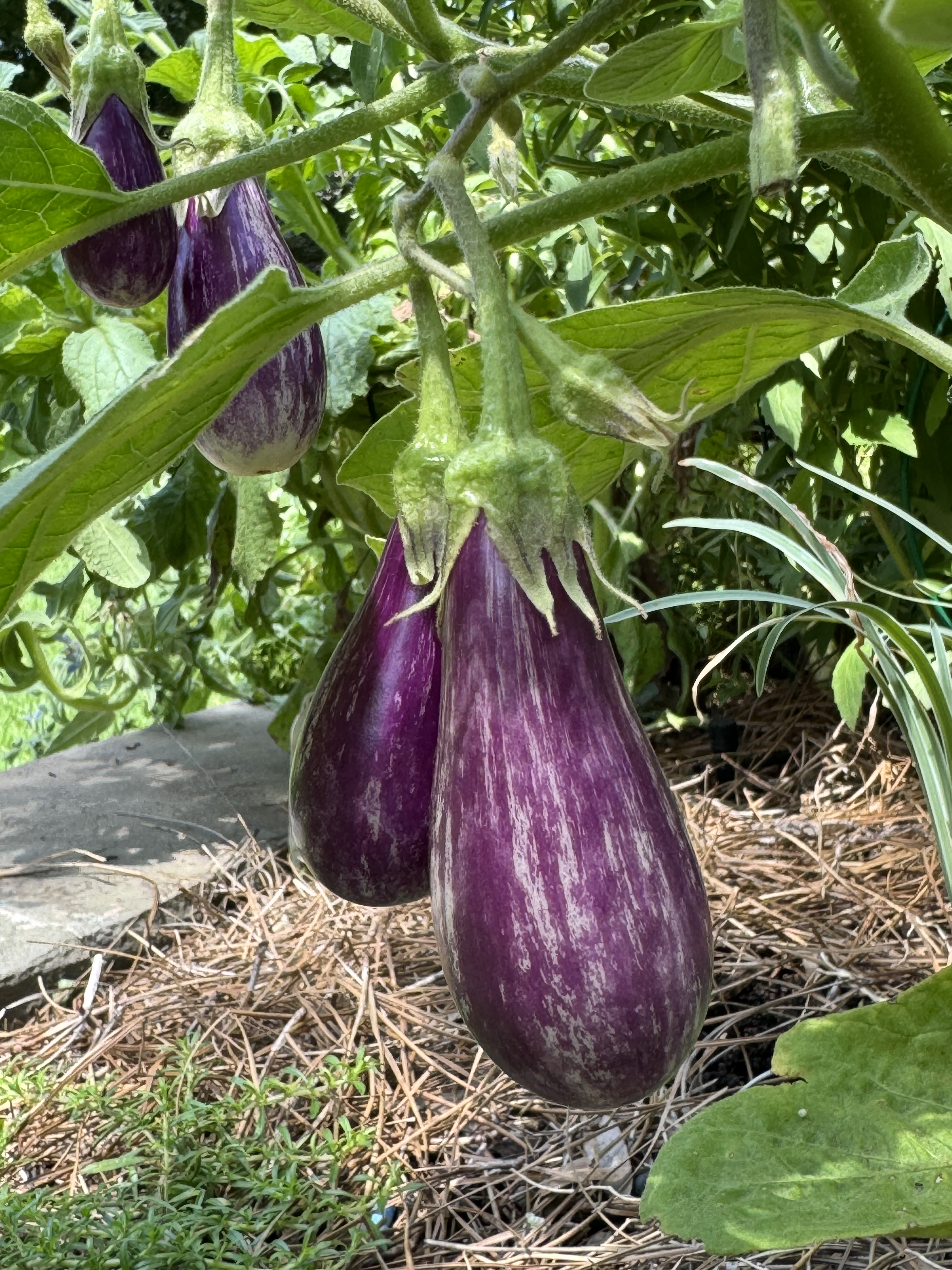
Fairy Tale Eggplant
As you can see from the photo, it is a lovely mini eggplant, only 4 inches long, with stunning streaks of lavender and white. The plant itself grows to only 24” but produces tender-sweet fruits that are as beautiful as they are delicious. This variety can be grown in ground but, with its compact, dwarf size, is a just as suitable for container growing.
When it was time to harvest and enjoy, a quesadilla recipe was the perfect choice. Honey crisp apples gave it a sweet, tart taste while the smaller slices of savory fairy tale eggplant fit nicely on the tortilla. A handful of roughly chopped spinach along with some creamy Monterrey Jack cheese completed the combination of amazing flavors. Freshly made tortillas from Central Market held everything together while the quesadillas were baking in the oven.
A very unique feature of ‘Fairy Tale’ is the recognition it received in 2005 as an AAS* vegetable award winner. It was the first eggplant to win an AAS award since 1939. There is still time to grow ‘Fairy Tale’ in your garden so why not give it a try?
For transplants:
Pick a sunny site with rich, organic, well-draining soil. Eggplants require at least 6+ hours of direct sunlight per day. (Some sources advise not planting it in a plot where you grew tomatoes, peppers, potatoes or other eggplants the year before). Set transplants about 3 feet apart.
Mulch after planting.
Provide adequate water to produce the best-tasting eggplants. Fairy Tale eggplant enjoys deep, consistent watering throughout the growing season. Check often to be sure that Fairy Tale is receiving about 1-2 inches of water per week.
Harvest when fruits reach 2-4 inches in length for sweet, bitter-free enjoyment. Snip fruit with clean shears at their individual stems or in clusters. The skin should appear glossy (left side of photo), as dull skin can indicate overripe fruit (right side of photo). Harvest regularly to encourage new fruit production.
*All-America Selections winners are tested at trial grounds across North America. Each winner has superior qualities that distinguish it from similar varieties. ‘Fairy Tale’ was granted the prestigious AAS award by a nationwide panel of experts.
Linda Alexander,Dallas County Master Gardener Class of 2008
Congratulations to the Raincatcher’s Garden Veggie Team, who has harvested and donated 634 pounds of squash so far this year. It’s quite an accomplishment when you consider the ubiquity of the destructive squash vine borer (SVB) in the area.
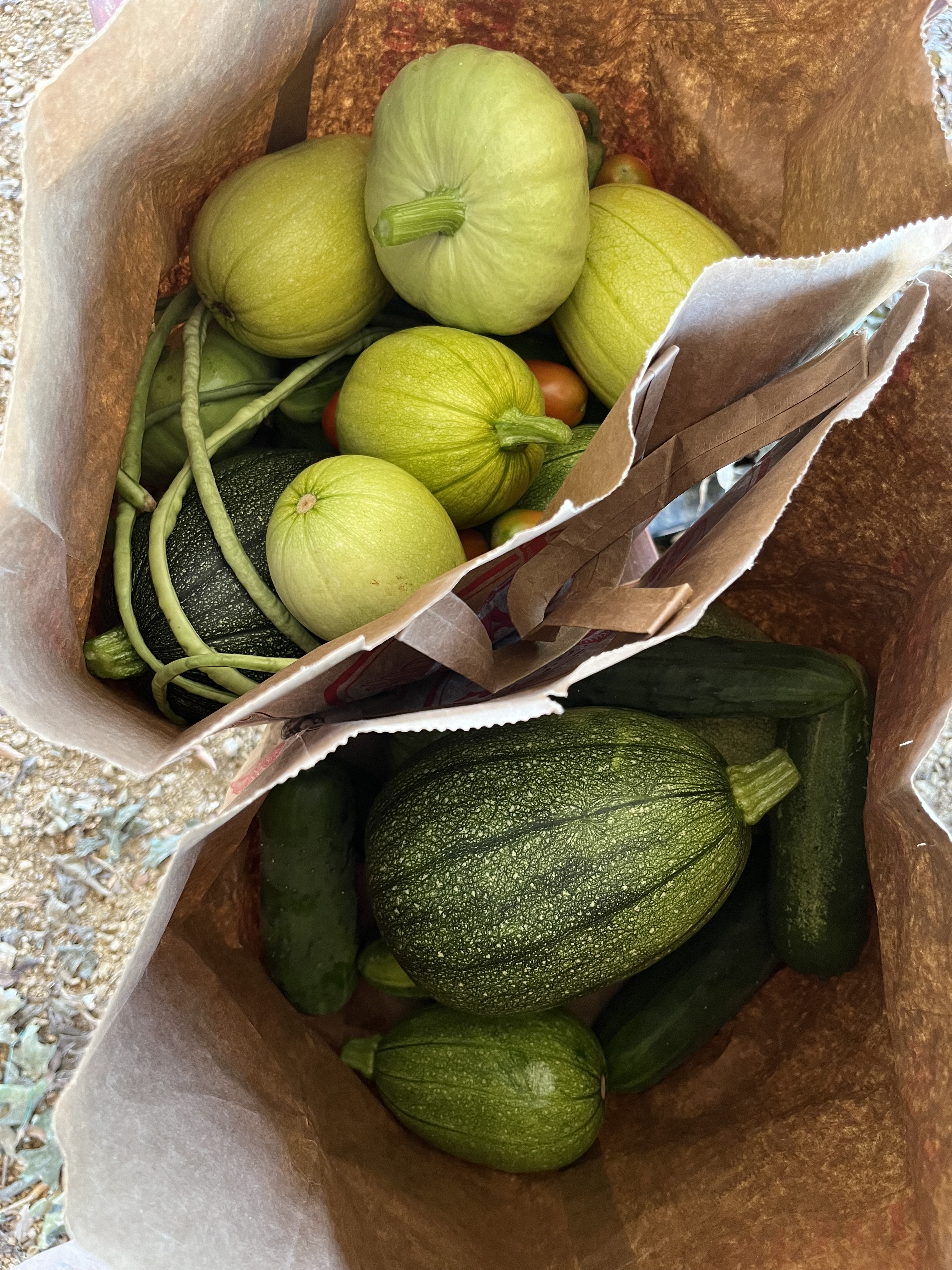
The team’s challenge was to find a squash variety that resists SVB. Over the past three years, gardeners have tried Zucchino Rampicante (Cucurbita moschata), Baby and Waltham Butternut (Cucurbita moschata) and Calabacita (Cucurbita pepo). All overcame SVB damage, but the Calabacita production was much higher.
Calabacita is delicious, especially when harvested at tennis ball to softball size. It can also be eaten as a soccer ball size pumpkin and stores well at the larger size. It takes a little more effort to prepare the larger size, so the gardeners included cooking instructions with donations.
One difficulty, but a good problem to have, is finding the many fruits of this prolific plant before they reach a large size.
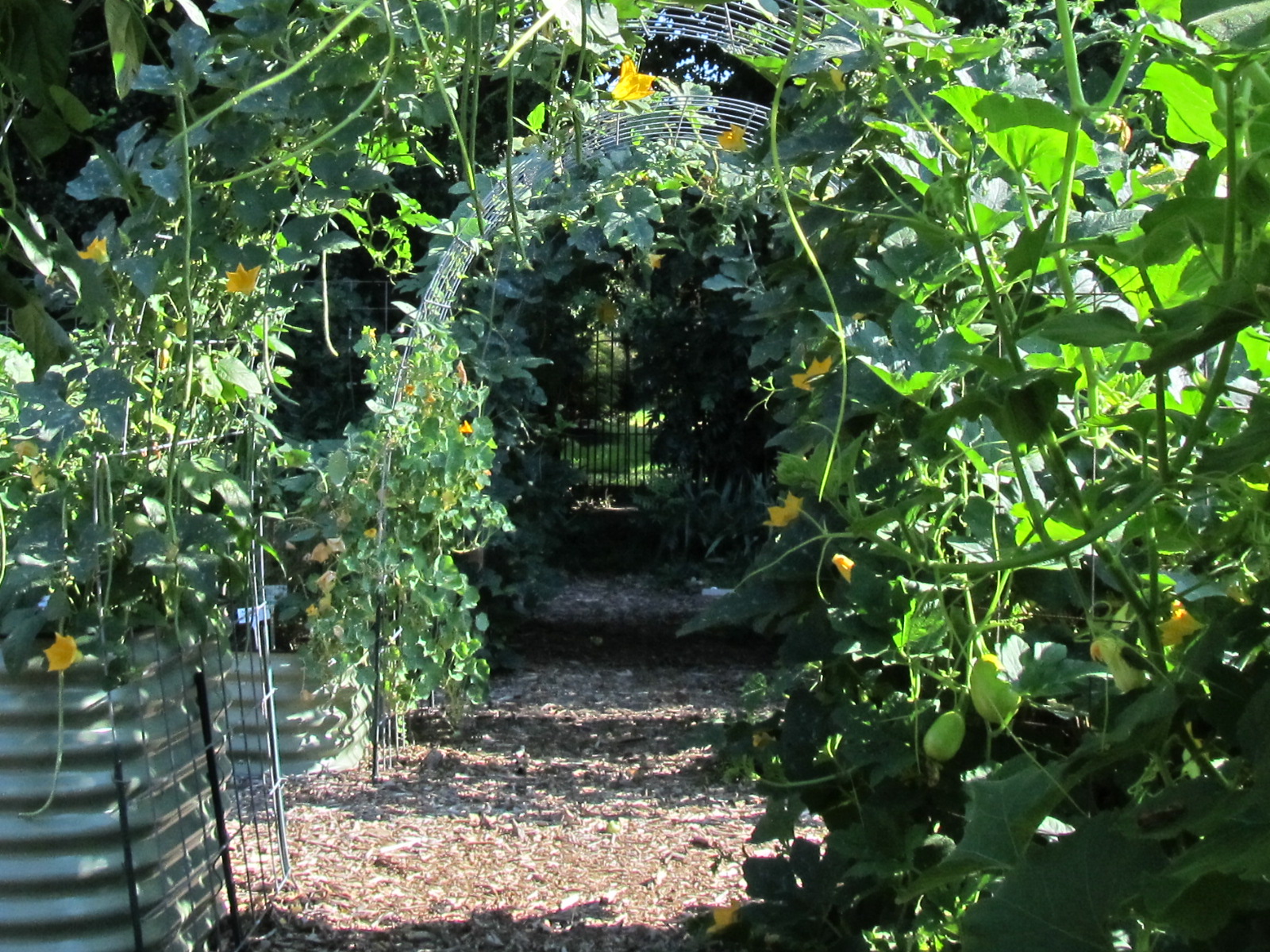
Another issue is the vines grow over 10 feet long and quickly sprawl throughout the garden. At Raincatcher’s they grew over large trellises and into the raised beds and grape arbor on the opposite side.
However, the trade off of space for productivity worked out well for the garden this year.
Well done Veggie Team, whose total production for 2024 has now surpassed 1200 pounds, providing fresh, nutritious food for the patrons of North Dallas Shared Ministries.
Cyntihia Jones and Beverly Allen, Dallas County Master Gardeners
The Veggie Team works hard every Monday morning (and many Thursday mornings during harvest), weather permitting, so please feel free to stop by with any questions you may have about growing vegetables in Dallas or just to look around and be inspired. Our garden is located on the grounds of Midway Hills Christain Church at 11001 Midway Road, Dallas, TX, 75229.
Sliced yellow squash with a bouquet garni of freshly snipped parsley, sage and thyme
Last year was disappointing. My yellow squash limped along with only a few blossoms and then fizzled! But in the world of gardening, we know that last year’s failures can easily be replaced with surprising success in the new year. Hopefully, this photo reveals my sentiments regarding the crop of yellow squash coming out of my garden over the past two weeks. It inspired me to search for the perfect yellow squash soup recipe seasoned with fresh herbs from my garden.
No surprise, then, that I landed on a recipe from the queen of flavor, Paul Deen. Her recipe called for 1 pound of yellow crookneck squash, but with much more than that amount ready to be harvested, I was motivated to double it and share with family and friends.
My tiny 4” yellow squash plant went into the garden around the last of April. It is now over three feet tall and three feet wide and has supplied me with over a dozen perfectly formed yellow squash, to date. Depending on how much longer it produces, I’m planning on sharing a few recipes in early July from our master gardener cookbook, ‘A Year On The Plate’.
As called for in Paula’s recipe, I added a bouquet garni made with a sprig each of thyme, parsley and sage from my garden. For a colorful garnish, freshly snipped blue borage blossoms added a touch of texture and interest. The soup was a very satisfying accompaniment to beef quesadillas topped with smashed avocado and snappy salsa. Ymmm!
Walking in the garden early this morning just as sunlight was spreading its glowing rays, I stopped for a moment to gently caress the winter savory. Dew had fallen softly upon it, leaving the cascading branches with a shimmery presence. It seemed to be saying…” use me please”. And that is exactly what happened!
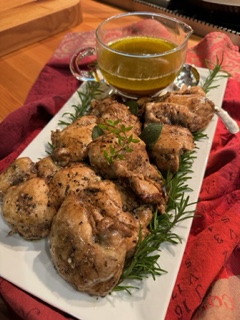
My husband and I love a cozy wintertime dinner by the fire. Thankfully, my winter herb garden had supplied me with the three ingredients needed to infuse the marinade for Balsamic Herb Baked Chicken Thighs: fresh rosemary sprigs, sage leaves and winter savory. This herb-garden inspired recipe delivered a pleasing amount of comfort and flavor for the perfect fireside meal.
Balsamic Herb Baked Chicken Thighs prepped and ready to bakeReady to serve!
Hopefully, you are growing a nice selection of herbs in your winter garden. If so, remember that they liked to be snipped, trimmed and used for culinary and decorative purposes in your home.
*For information about growing winter savory, click here.
*All herbs were harvested just before the cold front and freezing temperatures arrived. They were kept in a damp paper towel lined plastic baggie for two days.
Linda Alexander, Dallas County Master Gardener Class of 2008