Cinnamon Basil Swirl Cake

Cinnamon Basil Cake Swirl Cake

CAKE

2 tablespoons minced cinnamon basil leaves

1 ½ cups all-purpose flour

1 teaspoon baking powder

1/8 teaspoon coarse salt

6 tablespoons unsalted butter, softened

¾ cup granulated sugar

2 eggs

2 teaspoons vanilla extract

1 cup sour cream

1 teaspoon baking soda 

SWIRL

1/3 cup granulated sugar

2 tablespoons (packed) light brown sugar

2 teaspoons ground cinnamon 

1.  Preheat oven to 350 degrees.  Grease a 10-inch springform pan. 

2.  In a small bowl, whisk together cinnamon basil leaves, flour, baking p0wder, and salt; set aside. 

3.  In a large bowl, beat butter and sugar on high speed until light and fluffy.  Beat in eggs, 1 at a time until fluffy and well blended.  Beat in vanilla. 

4.  In a small bowl, whisk together sour cream and baking soda until smooth.  With mixer on low speed, beat half the flour mixture into the butter mixture just until blended.  Beat in sour cream mixture, then remaining flour, beating just until blended.  Spread into prepared pan. 

5.  Make swirl:  In a small bowl, whisk together granulated sugar, brown sugar and cinnamon.  Sprinkle evenly over batter; swirl into batter with the tip of a knife, being careful not to touch the knife to base of the pan. 

6.  Bake cake for 40 to 45 minutes, until a toothpick inserted in the center comes out clean.  Cool completely (or nearly so) on a wire rack before removing pan side and slicing.  Serve warm or at room temperature. 

Yield:  8 to 12 servings

Linda
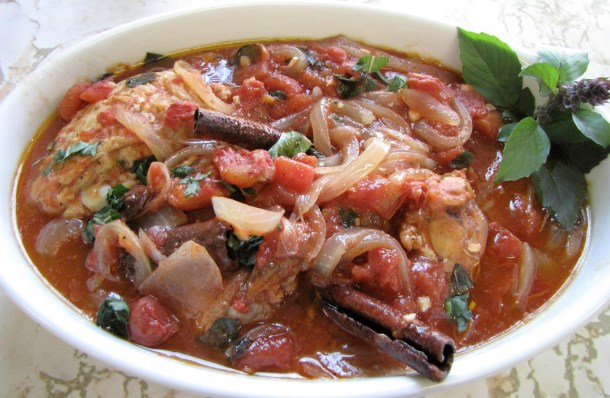
Cinnamon Basil Chicken

Cinnamon Basil Chicken Garnished With Cinnamon And Basil 

1 frying chicken, about 4 ½ pounds, cut into 8 pieces with the backbone

Kosher salt and freshly ground black pepper

2 tablespoons olive oil

1 large onion, halved and sliced from root end to top

2 cloves garlic, finely chopped

1 ½ tablespoons finely chopped fresh ginger

One (28-ounce) can diced tomatoes, drained of half the liquid

Three 3-inch cinnamon sticks, preferably “true” cinnamon

3 star anise pods

1 ½ cups torn  leaves cinnamon basil, or sweet basil,  gently  packed

Season all sides of the chicken with salt and pepper.  Heat the olive oil over medium-high heat in a large skillet with a tight-fitting lid.  When the pan is hot, put the chicken pieces in the pan, skin side down, and cook uncovered until the skin turns deep golden brown, at least 6 to 8 minutes.  Turn the chicken and cook another 2 to 3 minutes on the other side.  Take the chicken out of the pan and pile it on a platter.

Reduce the heat to medium and add the onion, garlic, and ginger to the pan.  Stir them around for 3 to 4 minutes, or until they soften and begin to brown.  Add the tomatoes, cinnamon sticks, star anise, and 1 teaspoon kosher salt.  Put the chicken back in the pan.  When the tomatoes come to a simmer, cover the pan, turn the heat to very low, and cook for about 50 minutes, or until there is little resistance when you pierce a thigh with the tip of a paring knife.  If the sauce seems watery, turn the heat to high and boil it uncovered until it thickens.  Scatter in the basil as you toss the chicken in the sauce with tongs.  Serve right away. 

Yield:  4 servings

Adapted from The Herbal Kitchen by Jerry Traunfeld

Linda

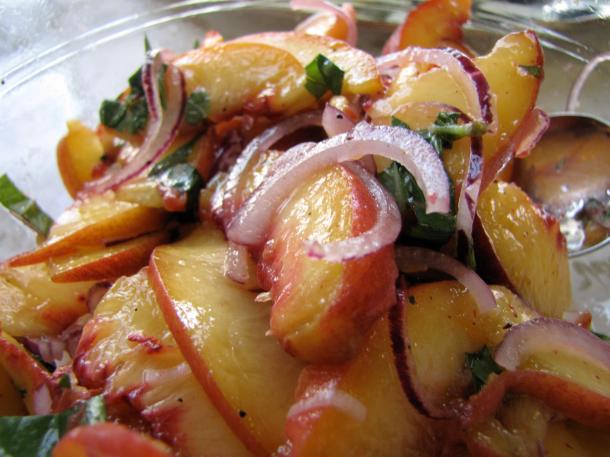
Peach And Red Onion Relish

Peach And Red Onion Relish 

1 tablespoon honey

1 tablespoon fresh lemon juice

1/8 teaspoon cayenne pepper

Coarse salt and ground pepper

¼ small red onion, very thinly sliced

2 ripe peaches, very thinly sliced

2 tablespoons chopped fresh cinnamon basil leaves 

In a small bowl of ice water soak onion for 10 minutes;  drain, blot dry and return to bowl.  Add peaches, honey, lemon juice and cayenne pepper.  Season with salt and pepper.    Let stand 15 minutes.  Toss with cinnamon basil.

Linda

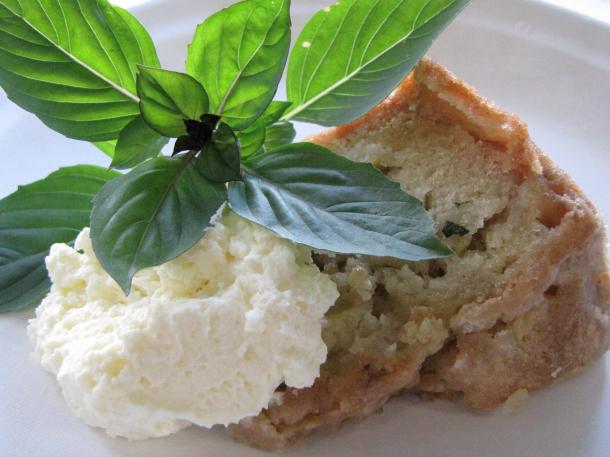
Apple Basil Cake

Apple Basil Cake With Cinnamon Spiked Whipped Cream And Basil Garnish

CAKE 

3 cups all-purpose flour

1 teaspoon baking soda

¾ teaspoon coarse salt

2 tablespoons (packed) minced cinnamon basil or sweet basil leaves

1 ¼ cups vegetable oil, preferably canola oil

1 ¾ cups granulated sugar

3 eggs

2 teaspoons vanilla extract

3 ½ cups unpeeled, coarsely chopped cooking apples, such as Granny Smiths

GLAZE 

3 tablespoons unsalted butter

3 tablespoons packed light brown sugar

3 tablespoons granulated sugar

3 tablespoons heavy cream

1 teaspoon vanilla extract

1.  Preheat oven to 325 degrees.  Grease a 10-inch removable-bottom tube pan.

2.  Sift together the flour, baking soda, and salt.  Whisk in basil leaves until thoroughly dispersed in the flour; set aside.  In a large bowl, beat together oil and sugar on low speed.  On medium speed, add eggs 1 at a time, beating well after each addition.  Add vanilla and increase speed to high; beat for 30 seconds.  On low speed, add flour mixture and beat just until blended.   Mixture is very dense.

3.  Fold in apples with a spatula; spread batter in prepared pan.  Bake for 1 hour and 15 minutes, until a toothpick inserted in the cake comes out clean.

4.  Just before cake is done, make glaze:  Over medium heat, melt the butter in a small saucepan and whisk in both sugars, cream, and vanilla.  Boil glaze for 1 minute.

5.  When the cake comes out of the oven, immediately pour the hot glaze over.  Let cake cool completely on a rack before removing from pan.  To remove from pan, run a knife around the edge to release it, then run a thin knife between cake and pan bottom; invert to release and invert again to place on platter, so glaze side is up.

Yield:  12 to 16 servings

This recipe is from “Desserts from an Herb Garden” by Sharon Kebschull Barrett.

Linda

Check Out Cinnamon Basil

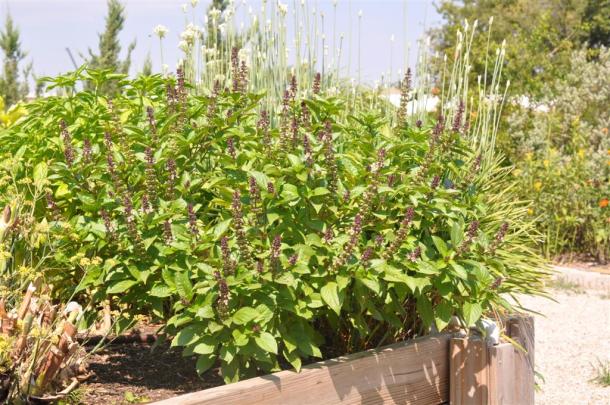
 Cinnamon Basil Growing In A Rasied Bed At The Demonstration Garden

Cinnamon basil is a cultivar of Ocimum basilicum (sweet basil).  It contains cinnamate, the same chemical that gives cinnamon its flavor, and has the strongest scent of cinnamon.

Cinnamon basil has reddish stems, lavender spiked flowers and small- to medium-sized serrated green leaves.  The leaves have a cinnamon-like taste and odor.  It can grow up to 3 feet tall and 3 feet wide.  Growing it in the garden may deter other pests that don’t like the smell of it.

If you’ve never grown or cooked with cinnamon basil, the following recipes might change your mind.  Intensely  fragrant, it can be used for baking, sauces, teas and as a “finisher” for many dishes.

Go ahead and give it a try.  The Cinnamon Basil Chicken recipe is so divinely aromatic while cooking  you might feel as though you’ve been transported to some foreign land – maybe the streets of Morocco or the Spice Markets of Istanbul.    You might encounter flavors you’ve never experienced before.   Toss it in your sliced summer peaches and red onion salad with  honey lemon vinaigrette for a real burst of seasonal flavor.  And, don’t forget to satisfy your sweet tooth with the wonderfully moist Apple-Basil Cake.   Whether sweet or savory, this delightful herb gets high marks for satisfying the senses!   

Linda

The “Mild” Habanero And The Eggplant

Never take your daughter with you to buy vegetable transplants. Molly seemed like a safe bet; this 24-year-old hasn’t cooed over anything but boyfriends and clothes since she turned 11. But show her the 4-inch veggies all waggling their cute little leaves and begging to come home with you, and don’t you know it, Molly’s like a preschooler with a batch of free puppies.  She wanted them all.

That’s how we ended up with The “Mild” Habanero and The Eggplant.

Eggplants And Habaneros On The Kitchen Counter

For the summer garden, we planted squash, cantaloupe, and watermelon seeds and transplants of tomatoes—plus the habanero and eggplant.  Now two months later, the cantaloupe seeds never sprouted, beetles decimated the squash and watermelon, and the tomatoes have decided that it’s too hot to do much of anything.

Of course, the habanero and eggplant have thrived.  

The tag on the habanero read “mild”—as compared to what? A ghost chili?  And you’ve never seen a more prolific pepper; at least 25 chilies in shades of green, yellow, and orange hang from its branches.  Perhaps one could blend up a concoction of chilies and vinegar strong enough to repel squirrels or wayward cats, but otherwise the peppers are too hot to use in anything.

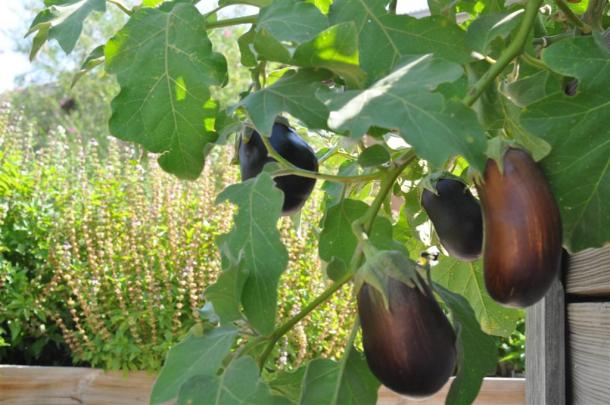
Eggplant growing in a raised bed at the Demonstration Garden in Dallas

The eggplant is now the size of a small shrub.  At least six of the most beautiful aubergine purple globes dot its sturdy branches.  Eggplants are much loved by cooks; the English and French call them aubergines.  Crayola even named a pink-purple-grey color crayon eggplant in 1998. 

In my kitchen, I have grilled, fried, stewed, stuffed, and rolled eggplant—all with the same conclusion.  I don’t like eggplant.  I tried, but no.

So, here we have it.  The stars of my August garden are inedible or underappreciated. Perhaps I could put a little vegetable stand out by the mailbox with an honor system jar for quarters.  Habaneros and Eggplant—Name Your Price…

Elizabeth

Dividing Iris At The Demonstration Garden

There are many paradoxes in gardening: bury something so it will live, divide to multiply, prune to bear more fruit.

We have a trove of blue Iris at the Demonstration Garden and it is time to divide them. Watch this video to learn the art of  satisfactory Iris division: 

 Our Iris  were purchased from the Iris Society of Dallas Public Sale. This year it is scheduled for September 15, 2012, from 9am to 1pm or until sold out at Northhaven Gardens.

Dig further into Iris information via the Dallas Morning News here.

Ann

Vegetable Lambs

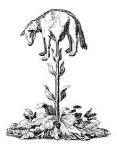
Plant Born Sheep, The Medieval Idea Of Cotton           

     Have you seen the Demonstration Garden’s flock of “vegetable lambs?”  Tended with loving care by Dallas County Master Gardener Jim and other DCMG volunteers, they thrive in the Garden’s raised beds.  Though we now know these “vegetable lambs” by their contemporary name, cotton, during the medieval period in Europe, cotton was an imported fiber and the actual plant that produced it was unknown.  So, noting its similarities to wool, people imagined that cotton must have been produced by plant-born sheep.  In 1350 John Mandeville, after a trip to Tartary, wrote: “There grew there (India) a wonderful tree which bore tiny lambs on the ends of its branches.  These branches were so pliable that they bent down to allow the lambs to feed when they are hungrie (sic).”   Later in 1791 Dr. De la Croix in his work Connubia Florum, Latino Carmine Demonstrata  wrote of the vegetable lamb:

  Upon a stalk is fixed a living brute,                       Early Understanding Of Cotton Plants

  A rooted plant bears quadruped for fruit.

  It is an animal that sleeps by day

  And wakes at night, though rooted in the ground,

  To feed on grass within its reach around.

     Today’s scientific classification of cotton is, of course, much different from the zoophyte (i.e. an animal that visually resembles a plant) classification of the medieval period.  The name of the genus derives from the Arabic word goz, which refers to a soft substance. 

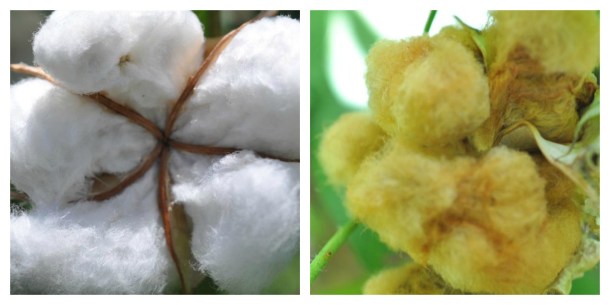
It is particularly interesting that cotton is in the Mallow family and is related to hibiscus.  This resemblance can be seen easily in cotton’s flowers.  Cultivated cotton is a perennial shrub.  However it is grown in our area as an annual.  Plants are around 3-5 feet tall with broad three to five lobed leaves.  The seeds are contained in capsules called a “boll.”  The many seeds found in a boll are surrounded by two types of cotton fiber.  The longer fiber can be spun into thread and ultimately cloth, while the much shorter fibers, called “linters,” are spun into low quality fiber, giving rise to the term “lint.”  Cotton requires a long growing period, full sun, moderate water and likes heavy soil.  If this sounds like a perfect plant for the Dallas area, it is—- and is why cotton fields used to be numerous throughout DallasCounty.  There are several different naturally occurring colors of cotton (white, brown, and green) and the DemonstrationGarden grows brown cotton and several different varieties of white cotton.

White Cotton And Brown Cotton Grown At The Demonstration Garden

     So the next time you visit the DemonstrationGarden, try standing by the cotton plants, closing your eyes, and just “Believe.”  If you listen closely, maybe you will hear the vegetable lambs say “baaaa.” 

       ***this is the first of several articles on cotton: the plant, its history, spinning and dyeing

Carolyn


Okra, An Olympic Hopeful For Dallas Gardens

This morning I woke up wanting to be like Gabby, the American gymnastics darling of the Summer Olympics.

I wanted to look like her, smile like her, have her discipline, WIN like Gabby!

My next thought was of my garden and what I needed to do out there in the early morning before it gets hot.  Before any more depressing thoughts of never winning an Olympic gold medal entered my head,I jumped out of bed and into my vegetable garden to coax my veggies into looking like Olympiads.

At this time of year, tomatoes are hanging on waiting for fall, cucumbers have stopped producing and the leaves look weathered, bell peppers and red peppers are stable but also wait for a drop in temperature. 

The super performers for Texas gardens in August  are okra, eggplant, and jalapeños. 

Maybe I am more like Gabby’s Olympic coach, Liang Chow. Okra will be my Olympic hopeful.

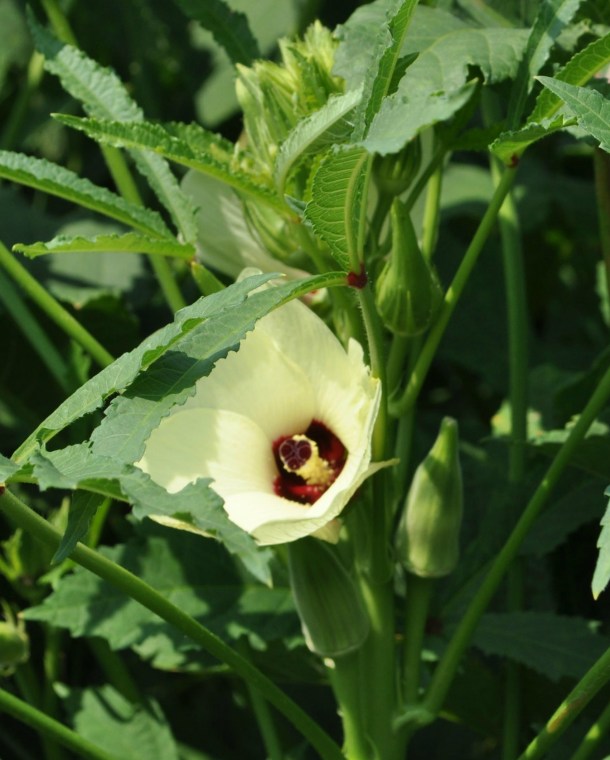
Okra Blossom and Okra Pods

 I will squirt the aphids off my okra with water, pick okra pods on time before they get too big and stringy tasting, and turn them into culinary delights that will cause even the pickiest of eaters to say, I LOVE OKRA!

Now I am imagining stands filled with fans, chanting we want okra, we love okra, and okra can win!

If you want to be a winner with okra remember these tips:

Planting Time: Don’t plant too early, the soil temperature needs to warm up and minimum average temperature should be above 65°. Plant seed in April for summer harvest and July15-August 25 for fall harvest.

Needs: Full Sun, adequate spacing, moderate water needs. Texas A&M recommends one inch of water weekly in the absence of rainfall for good production.

Harvest: pick the pods every day; they should be less 3-3 ½ inches in length. 

Varieties:  We have had great success with Clemson Spineless at the Demonstration Garden. Try Burgundy for the burgundy colored okra pods.  Other suggested varieties are Emerald, Louisiana Green Velvet, Annie Oakley (smaller stature-I like this one), Red Velvet and Beck’s Big.

Cooking:    Click here for a good Dallas Morning News okra recipe.

The burgundy varieties turn green when cooked and taste just like the green okra pods.  Okra blossoms are edible.

Ann

Basil Lime Shortbread

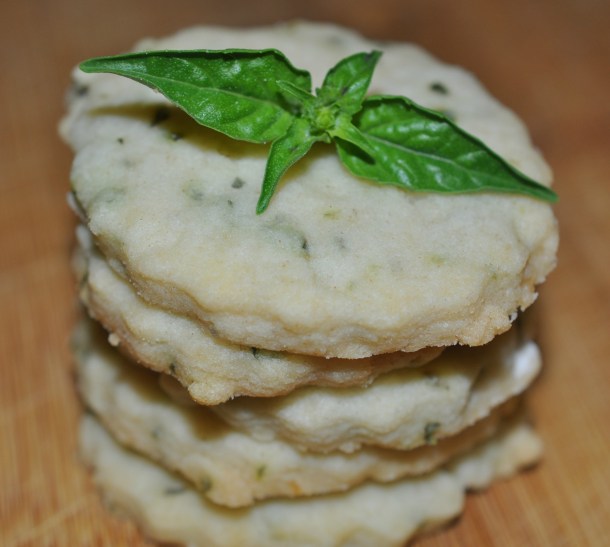
Basil Lime Shortbread With Basil Sprig

¾ cup unsalted butter

½ cup confectioner’s sugar

¼ teaspoon vanilla extract

¼ teaspoon salt

1 ½ cups all-purpose flour

¼ cup finely chopped fresh basil

2 tablespoons fresh lime zest

 1.  In a medium bowl and using an electric mixer at medium speed, cream the butter and confectioner’s sugar together until light and fluffy.  Beat in the vanilla extract and salt.  

2.  In a small bowl, toss together the flour, basil, and lime zest.  With the mixer at low speed,  add the flour mixture to the butter mixture, and mix until the dough just comes together and forms a ball.  Remove the dough from the bowl, wrap tightly with plastic wrap, and refrigerate for 2 hours. 

3.  Preheat oven to 350 degrees.  Line 2 baking sheets with parchment paper, and set aside. 

4.  On a lightly floured surface, roll the dough out to 1/8-inch thickness, and using a 2-inch round fluted cutter, cut cookies.  Place on prepared baking sheet, and bake for 8 to 10 minutes, or until edges begin to brown.  Cool on wire racks before serving. 

Yield:  24 cookies

Recipe from Victoria Bliss Magazine, March/April 2009

Linda