Keyhole Gardening

Keyhole gardening is considered an “African survival strategy” in a land of scarce resources and unforgiving climate.  According to reports from the BBC, 3 keyhole gardens can feed an African family of 10 for an entire year. 

A humanitarian aid organization in southern Africa developed this particular sustainable gardening method.  The design originates in permaculture which is a branch of ecological design & engineering that develops sustainable human settlements & self-maintained agricultural systems modeled from natural ecosystems. 

          A keyhole garden is the “ultimate raised-bed planter.” It consists of a circular shape w/ a 6 foot diameter & stands about waist-high.  A notched-in section like a pie-shaped wedge allows access to the plants.  It can be constructed from local recycled materials & incorporates a central composting basket into which food scraps/organic wastes are placed.  The garden is also watered through this basket.  It uses far less water than conventional gardens & recycles as it grows.  From a birds-eye view this garden reminds one of a keyhole.  
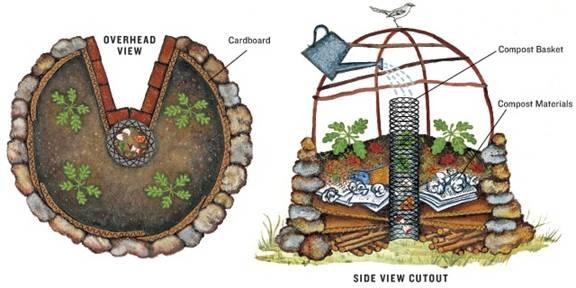
Keyhole Garden Bird's Eye View and Side View

 Keyhole gardening is an adaptable concept & almost any kind of raised bed of about a 6 foot diameter can be converted.  The basic idea is functionality & efficiency: producing the most nutritious organic produce in the least amount of space using minimal water.  Cattle water troughs, tractor & truck tires, old bathtubs, & boats are repurposed examples.

     This concept has been replicated by landscape architect Dr. Deb Tolman in partnership w/ ranchers Jim & Mary Lou Starnater.  Their property, located on the edge of the Hill Country in the  community of Clifton, Texas is similar to southern Africa, “scorching heat, thin layers of topsoil, & elusive rainfall that can make for a brutal summer.”
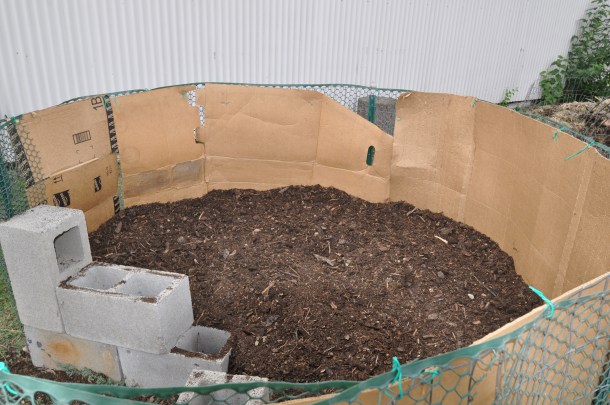
The Beginnings Of Our Keyhole Garden

     We constructed our version in the Composting area using reclaimed materials & a bit of ingenuity.  Kevin used heavy cord & a large screwdriver to scribe a 6 ft. diameter circle on the ground as our reference point.  He and  Roger set 4 ft. metal stakes to hold fence wire into the basic circular shape w/ an inset wedge to provide access (keyhole) to the garden.  Into the center went the temporary vent/self-watering stack (later we’ll construct an inner basket measuring 1 ft. diameter & 4 ft. in height).  
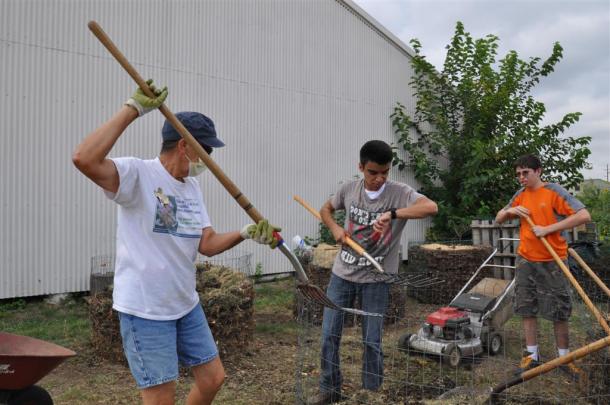
Harvesting Compost For The Keyhole Garden

  The students from Independence Life Preparatory School  lined the interior and base of the keyhole garden structure w/ cardboard & set up alternating layers, 3 in. deep, bottom to top, of brown & green compostable matter.  The inner stack will also be filled w/ alternating layers (kitchen scraps & other herbaceous matter) of green & brown.

Annette With Students from Independent Life Prepatory School

 Unlock your own Keyhole Garden

Follow these guidelines to get started: 

1. Measure a 6-ft. diameter circle to define the inside wall of your garden.

2. Notch the circle (like cutting a wedge of pie) so you can access the basket at the center.

3. Construct the exterior walls about 3 ft. high using rocks, metal, timbers or any material that can support the weight of wet soil.

4. Use wire mesh to create a tube about 1 ft. in diameter & about 4 ft. high. Stand the tube in the center of the circle.

5. Line the outer walls with cardboard & fill the garden area (but not the wire mesh tube in the center), with layers of compostable materials, wetting down as you go. Fill the last few inches with compost. The soil should slope from a high point at the top of the center basket downward to the edges of the garden.

6. Fill the center basket with alternating layers of compostable material, along with layers of kitchen scraps & herbaceous weeds that provide the plants with moisture & nutrients.

7. Water the center basket & the garden only when the plants will not survive without it. This forces the plants’ roots down toward the center basket.

8. Feed the garden by adding more kitchen scraps, lawn clippings, etc. to the center basket.

9. Consider arching framework of thin wires over the garden. During the hottest months, the wires can support a shade cloth, & in winter, plastic sheeting creates an instant greenhouse.

10. Enjoy the fruits & vegetables of your labor!

Sources: Texas Co-op Power, Feb. 2012, pp14-15 “Keyhole Gardening: Unlocking the secrets of drought-hardy gardens” by G. Elaine Acker; http://www.urbanoasisproject.org/; www.sendacow.org.uk (Send a Cow Charity, Africa).

Watch this inspirational video,  Keyhole Gardening in Africa.

Annette

Fall-What’s Not To Love?

What’s my favorite season? Easy peasy. FALL. Jacket wearing, college football cheering, leaf rustling, turkey roasting, Halloween mini-Snickers sneaking—Fall!

This lovely autumnal season is so much more than pulling up summer-scorched annuals and popping in mums for a few weeks.  At a time when northern gardeners are closing up shop for the winter, Texas gardeners have realized that the fall months may very well be the best time of the year to plant.

Think about it.  A Sweet Innocent Perennial you might plant in the spring is just being lined up for the furnace blast of summer from late May through August.  It’s hard to even survive—much less thrive–in temperatures in the 100s, no rainfall, and nighttime lows that hover in the 80s.  But if you’re a savvy gardener and plant that same Sweet Innocent in the fall, you’ve tucked it in when the future holds cooling temperatures and more frequent rain.  Voila.  Plant Success.

Most plants will put on a fall flush of growth and bloom in fall weather conditions.  Roses can be spectacular in the fall, often with blooms more vibrant than spring or summer.  Trim roses back now, fertilize, and give a deep soaking to promote bloom.

Raised Bed with carrots, radish seeds and trowel

If you’re planting a fall school garden with kids, it’s time to get busy.  If you want a warm season garden, plant bush beans and pinto beans by seed until September 15.  Be sure to baby your seeds; they need to be kept moist until they sprout and are established. 

Dallas County Master Gardeners Busy With Fall Gardening

Fall is Prime Time for cool season crops, those vegetables that love a nip in the air in November and December.  Plant beets, spinach, lettuce, and carrots by seed now through October 15.  Kids love transplants; they’re veggies in miniature.  Plant broccoli, Brussels sprouts, cabbage, and cauliflower transplants now through late-November.  Mustard greens, Swiss chard, spinach, parsley, leeks and kale transplants can be tucked in the garden from September 15 through the winter.  (Harvest your warmer season crops in late October, then plant cole transplants for a continued harvest.)

Spring flowering bulbs can be a fun thing to plant with kids.  Purchase your bulbs now when nurseries start stocking bulbs, but wait on planting them until soil temperatures cool significantly, for us in mid- to late-November.  Daffodils are probably your best bet with kids.  They are dependable, don’t require pre-chilling (like tulips), and some will naturalize.  The Southern Bulb Co. in Golden, Texas  is known for propagating old varieties of bulbs, often found in deserted homesteads. 

The best reason to garden in the fall is to enjoy it.  Your garden is filled with new blooms and growth.  Pests have taken a vacation with the cool temperatures.  So nibble a bit of early Halloween candy and enjoy the season.

Elizabeth

School In The Garden

A s summer fades away. here’s a look at some of our crops and more reasons to have school outside in our learning center at the Earth-Kind® WaterWise Demonstration Garden.

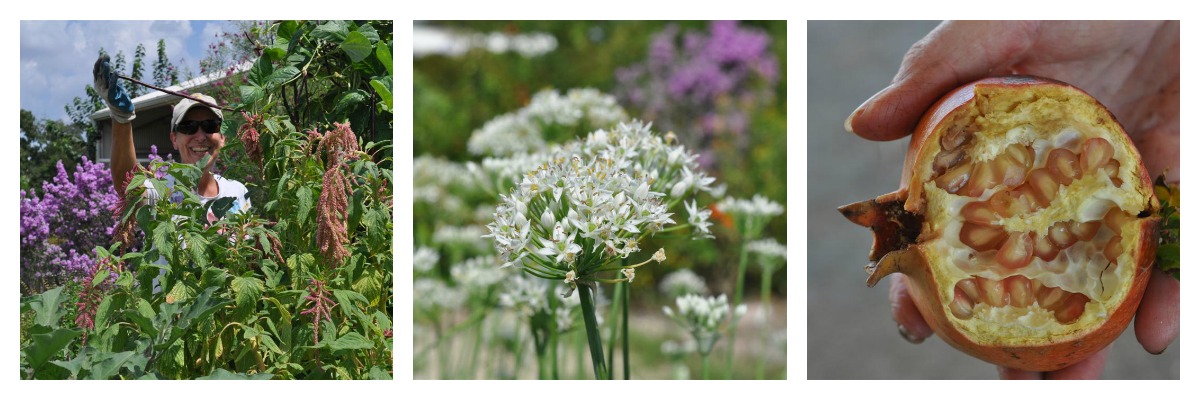
Chinese Red Yardlong Noodle Beans, Garlic Chives, Pomegranate

 Chinese Red Yardlong Noodle Beans and Amaranth Love Lies Bleeding

We are growing these two exotic edibles at the Demonstration Garden to learn more about them ourselves. In our first picture Cindy is stretching out the yardlong bean and the amaranth is blooming with cascading ropes of flowers in front of it.

 To find out how to cook the yardlong noodle beans read Garden Betty.  

Amaranth aka, Love Lies Bleeding, loves the heat and does not need much water. The leaves and seeds are highly nutritious.  Its creepy name refers to its use in the middle ages to stop bleeding.  A whole social studies unit could be written about Amaranth and the uses of it around the world today and historically.  Our garden setting would be the perfect place to teach this!

Garlic Chives  Plop the ornamental seeds heads into your salad along with the chopped up  stems or leave them so you can gather their seeds.

 Pomegranate  We grow the variety, ‘Wonderful’, and it started producing for us the summer after we planted it in 2009.  It will become a multi-trunked small to mid-size tree .  We have an orchard in the planning stages with  Pomegranate trees and other Dallas oriented fruit trees to be planted and more school lessons to be taught!

Ann

Cypress Vine

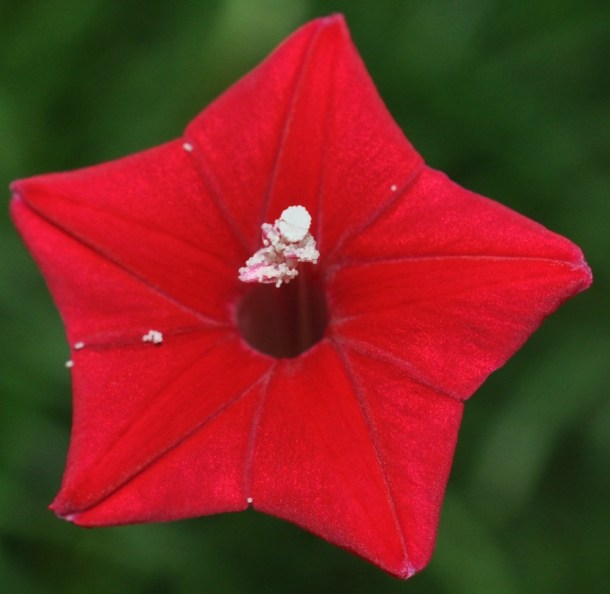
Cypress Vine Flower

When it comes to flowers, I like to get up close and personal.

I love to stare into them and what could be more rewarding than looking into the five point star of the cypress vine flower?  The bright red bloom also attracts hummingbirds who love to dive into the little white throat of its flower for nectar.

The fern like foliage also draws me to cypress vine or Ipomoea quamoclit.  It is bright green and buoyantly drapes around arbors, poles, columns, pergolas, or anything else you give it to climb. We have grown it in our Demonstration Garden on a trellis in a semi- shaded area.

Cypress Vine Draped At Ann's House With Althea In Background

This annual vine was grown in Virginia gardens in the eighteenth century.  Thomas Jefferson sent seeds to Monticello and it grows in their historic re-creation of Jefferson’s garden today.

Save the seeds of cypress vine when the pods become papery and you can hear the seeds rattle or just let them drop to the ground for a return of this welcome vine.

Ann

PS: Leave a comment if you are interested in a gift of cypress vine seeds from Dallas Garden Buzz.  We can mail  for planting next spring as long as our supply of seeds lasts!

Registration Now Open For Field Trips

 A very special experience awaits children visiting the Earth-Kind WaterWise Demonstration Garden on a field trip.  Children can pet friendly chickens, peek under leaves in the vegetable garden for growing produce, watch for hummingbirds and butterflies in the wildlife habitat, and learn how compost enriches our soil. 

Demonstration Garden Field Trip-Learning About Chickens

Teachers and parents are as enthusiastic about the field trip as their young friends: “The children absolutely loved the event…the volunteers were so excited about what they were sharing…and the excitement was contagious.”   

The Demonstration Garden gives teachers multiple opportunities to enrich their science curriculum.  The field trips are taught by Master Gardeners, gardening experts trained by the Dallas County AgriLife Extension Service. 

Is your class studying plant identification or wildlife? Would you be interested in having your students write poetry in the garden setting?   Or draw flowers and leaves to examine their structure? Perhaps figure out the area of a vegetable garden and determine the number of plants to include? We can tailor classes to fit your units of study, with a little notice. Literature, math, science, and the arts can be enhanced in a garden setting.

The field trips generally last about two hours.  Children rotate around stations in small groups with lots of individual attention. Restrooms, free parking, and picnic tables are available on site.

And the field trips are offered at little or no cost depending on the materials needed for your class.

Elizabeth

To schedule a field trip to the Demonstration Garden or ask questions about field trips, click here and for more specific information from Annette about field trips go to our Garden Field Trip page.

August Blooms In Dallas

The Earth-Kind® WaterWise Demonstration Garden is blooming even through August.

Fourteen out of twenty days in August have been over 100°.  To maximize our water usage, we have set up drip irrigation in all our beds and we water this garden and others  with rainwater harvested from our large shed with 5,000 square feet of metal roofing.  Usually we don’t get enough rain for our drip system in the latter part of summer and have to revert to city water, but last week we had about 4 inches of rain at the garden!  What didn’t go into our two 2500 gallon cisterns swished into our rain garden for more capture. 

Most of these pictures were taken from our newly planted Color Wheel garden.  Link back to the * July Bloom report so that you also know what was blooming in August in the rest of our gardens. Combine these plant lists to keep your garden flourishing through the summer.

Read the list of blooms clockwise from the  large, top left picture.

Flowers Blooming in August Dallas Gardens

1. Pink Gomphrena and Cuphea 2. Gomphrena Fireworks, Gomphrena globosa ‘Fireworks’ 3. Periwinkle-Cora Vinca blackberry, Catharanthus roseus 4. Hot Pink Moss Rose Portulaca olerancea ‘Samba Hot Pink’  5. Jewels of Opar, Talinum paniculatum 6. Moss Rose, Portulaca olerancea 7. Trailing Lantana, Lantana montevidensis 8. Yellow Zinnia

Flowers Blooming In Dallas August Gardens

1. White Lantana and white coneflower 2. Orange Zinnia 3. Mexican Petunia-Lavendar, Ruellia brittonia 4. Lafter, Buck Rose 5. Mexican Bush Sage, Salvia leucantha 6. Orange Lantana, Lantana horrida (camara) 7. Bell Flower,  Campanula rotundifolia  8. Gregg’s Mist Flower, Eupatorium greggii

Flowers For Dallas Summer Gardens

1. Salvia coccineas with  Cora Vinca 2. Pink gomphrena, Gomphreana globosa 3.                       4. Red Gomphrena, Gomphrena aageana ‘Strawberry Fields’ 5. Summer Poinsettia or Mexican Fire Plant, Euphorbia cyathophora 7. Sunflower, Helianthus annus

Flowers Blooming In August In Dallas

1. Mexican Honeysuckle, Justica spicigera 2. Pearlie Mae, Buck Rose 3. Onion Chives 4. Maggie 5. Althea, Hibiscus syriacus ‘Helene’ 6. Esperanza or Yellow Bells, Tecoma stans 7. Canna-dwarf-Tropical Series 8. Quietness, Buck Rose

*Refer to the July Blooms report . Only  Phlox #11,Autumn Sage #16, and Salvia guaranatica#21 are taking a break and not blooming in August.  All the rest on the July list are giving us that last bit of summer pleasure.

Ann

Cinnamon Basil Swirl Cake

Cinnamon Basil Cake Swirl Cake

CAKE

2 tablespoons minced cinnamon basil leaves

1 ½ cups all-purpose flour

1 teaspoon baking powder

1/8 teaspoon coarse salt

6 tablespoons unsalted butter, softened

¾ cup granulated sugar

2 eggs

2 teaspoons vanilla extract

1 cup sour cream

1 teaspoon baking soda 

SWIRL

1/3 cup granulated sugar

2 tablespoons (packed) light brown sugar

2 teaspoons ground cinnamon 

1.  Preheat oven to 350 degrees.  Grease a 10-inch springform pan. 

2.  In a small bowl, whisk together cinnamon basil leaves, flour, baking p0wder, and salt; set aside. 

3.  In a large bowl, beat butter and sugar on high speed until light and fluffy.  Beat in eggs, 1 at a time until fluffy and well blended.  Beat in vanilla. 

4.  In a small bowl, whisk together sour cream and baking soda until smooth.  With mixer on low speed, beat half the flour mixture into the butter mixture just until blended.  Beat in sour cream mixture, then remaining flour, beating just until blended.  Spread into prepared pan. 

5.  Make swirl:  In a small bowl, whisk together granulated sugar, brown sugar and cinnamon.  Sprinkle evenly over batter; swirl into batter with the tip of a knife, being careful not to touch the knife to base of the pan. 

6.  Bake cake for 40 to 45 minutes, until a toothpick inserted in the center comes out clean.  Cool completely (or nearly so) on a wire rack before removing pan side and slicing.  Serve warm or at room temperature. 

Yield:  8 to 12 servings

Linda

Cinnamon Basil Chicken

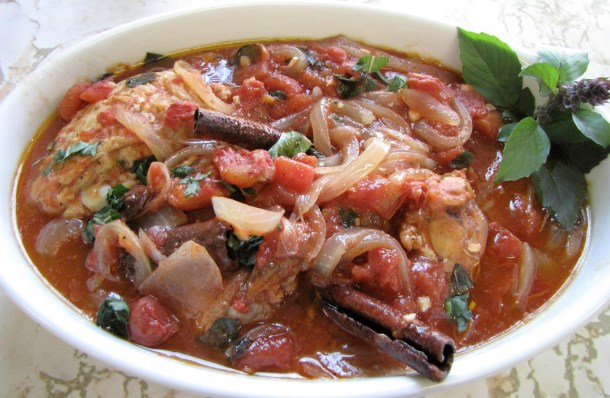
Cinnamon Basil Chicken Garnished With Cinnamon And Basil 

1 frying chicken, about 4 ½ pounds, cut into 8 pieces with the backbone

Kosher salt and freshly ground black pepper

2 tablespoons olive oil

1 large onion, halved and sliced from root end to top

2 cloves garlic, finely chopped

1 ½ tablespoons finely chopped fresh ginger

One (28-ounce) can diced tomatoes, drained of half the liquid

Three 3-inch cinnamon sticks, preferably “true” cinnamon

3 star anise pods

1 ½ cups torn  leaves cinnamon basil, or sweet basil,  gently  packed

Season all sides of the chicken with salt and pepper.  Heat the olive oil over medium-high heat in a large skillet with a tight-fitting lid.  When the pan is hot, put the chicken pieces in the pan, skin side down, and cook uncovered until the skin turns deep golden brown, at least 6 to 8 minutes.  Turn the chicken and cook another 2 to 3 minutes on the other side.  Take the chicken out of the pan and pile it on a platter.

Reduce the heat to medium and add the onion, garlic, and ginger to the pan.  Stir them around for 3 to 4 minutes, or until they soften and begin to brown.  Add the tomatoes, cinnamon sticks, star anise, and 1 teaspoon kosher salt.  Put the chicken back in the pan.  When the tomatoes come to a simmer, cover the pan, turn the heat to very low, and cook for about 50 minutes, or until there is little resistance when you pierce a thigh with the tip of a paring knife.  If the sauce seems watery, turn the heat to high and boil it uncovered until it thickens.  Scatter in the basil as you toss the chicken in the sauce with tongs.  Serve right away. 

Yield:  4 servings

Adapted from The Herbal Kitchen by Jerry Traunfeld

Linda

Peach And Red Onion Relish

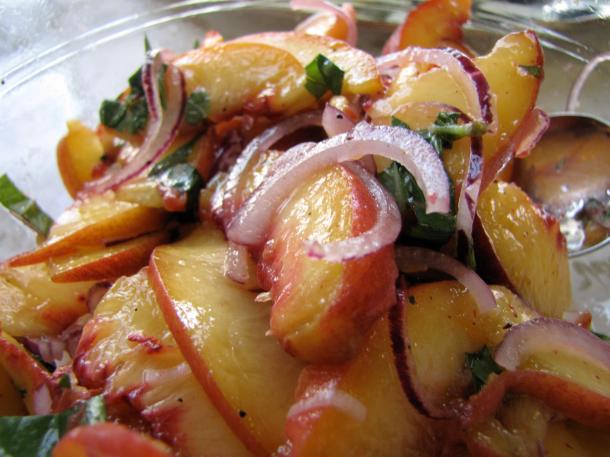
Peach And Red Onion Relish 

1 tablespoon honey

1 tablespoon fresh lemon juice

1/8 teaspoon cayenne pepper

Coarse salt and ground pepper

¼ small red onion, very thinly sliced

2 ripe peaches, very thinly sliced

2 tablespoons chopped fresh cinnamon basil leaves 

In a small bowl of ice water soak onion for 10 minutes;  drain, blot dry and return to bowl.  Add peaches, honey, lemon juice and cayenne pepper.  Season with salt and pepper.    Let stand 15 minutes.  Toss with cinnamon basil.

Linda

Apple Basil Cake

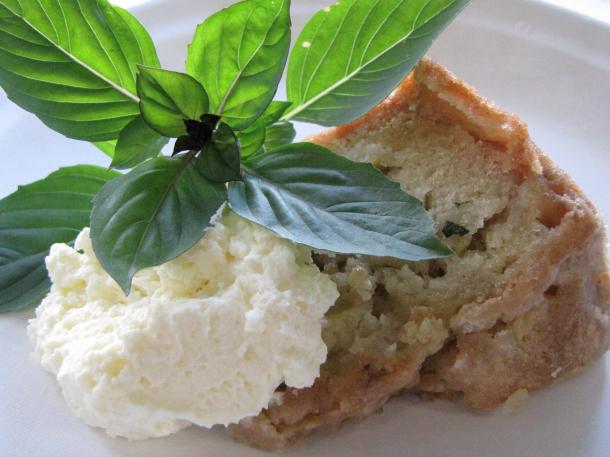
Apple Basil Cake With Cinnamon Spiked Whipped Cream And Basil Garnish

CAKE 

3 cups all-purpose flour

1 teaspoon baking soda

¾ teaspoon coarse salt

2 tablespoons (packed) minced cinnamon basil or sweet basil leaves

1 ¼ cups vegetable oil, preferably canola oil

1 ¾ cups granulated sugar

3 eggs

2 teaspoons vanilla extract

3 ½ cups unpeeled, coarsely chopped cooking apples, such as Granny Smiths

GLAZE 

3 tablespoons unsalted butter

3 tablespoons packed light brown sugar

3 tablespoons granulated sugar

3 tablespoons heavy cream

1 teaspoon vanilla extract

1.  Preheat oven to 325 degrees.  Grease a 10-inch removable-bottom tube pan.

2.  Sift together the flour, baking soda, and salt.  Whisk in basil leaves until thoroughly dispersed in the flour; set aside.  In a large bowl, beat together oil and sugar on low speed.  On medium speed, add eggs 1 at a time, beating well after each addition.  Add vanilla and increase speed to high; beat for 30 seconds.  On low speed, add flour mixture and beat just until blended.   Mixture is very dense.

3.  Fold in apples with a spatula; spread batter in prepared pan.  Bake for 1 hour and 15 minutes, until a toothpick inserted in the cake comes out clean.

4.  Just before cake is done, make glaze:  Over medium heat, melt the butter in a small saucepan and whisk in both sugars, cream, and vanilla.  Boil glaze for 1 minute.

5.  When the cake comes out of the oven, immediately pour the hot glaze over.  Let cake cool completely on a rack before removing from pan.  To remove from pan, run a knife around the edge to release it, then run a thin knife between cake and pan bottom; invert to release and invert again to place on platter, so glaze side is up.

Yield:  12 to 16 servings

This recipe is from “Desserts from an Herb Garden” by Sharon Kebschull Barrett.

Linda