Tag Archives: The Raincatcher’s Garden

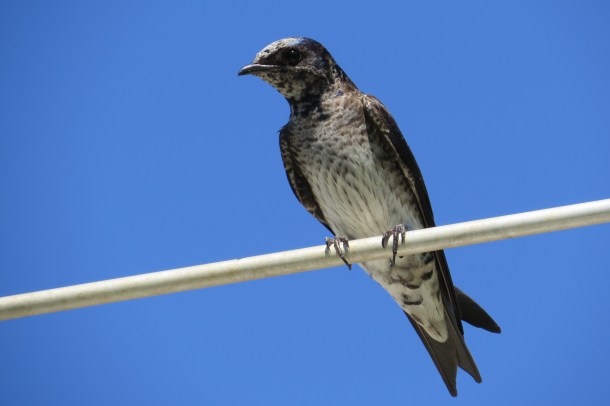
Purple Martins Have Arrived At The Raincatcher’s Garden

Deirdre starts this utube video saying “so these are the gourds where we’d really like to have a Purple Martin Colony.” She then explains the preparation and that we have been waiting two whole years for Purple Martins. No more waiting!

As of the beginning of May 2017, Purple Martins have landed at The Raincatcher’s Garden.

Purple Martin Close Up

Looking for friendly neighbors? Put up a Purple Martin house. It’s comparable to a miniature neighborhood in your backyard and Purple Martins chirp pleasantly and  perform aerial acrobatics to snap up flying insects.  Unfortunately, Mosquitoes only comprise as low as 3% of their diet.

At the end of the breeding season they gather in big flocks and make their way to South America.

Next year, we should see some of the same Purple Martins again!

Purple Martins At Home!

Video and Pictures by Starla Willis

If you are having trouble watching our Purple Martin Utube video, please click here.

Ann Lamb

When Words Fail

    Probably almost all of us have had those situations where mere words alone seem to fail us.   Occasionally it is in the happy times, such as an upcoming marriage or a new home, when there are too many well-wishes that one wants to say.  However it is often in the sad, gut-wrenching times when one feels at loss for words.  At these times for gardeners, the language of symbolic herbs and flowers may be of help.

Tussie-mussies (a.k.a. tussie mussy) are symbolic bouquets of flowers and herbs.  Though often associated with the Victorian era during which the language of flowers and herbs were codified and instructions for making tussie-mussies were found in books such as Godey’s Ladies Book, the actual history of the tussie-mussie goes back much further than Queen Victoria’s era.  In fact, due to the lack of hygiene and sanitation, the use of nosegays to mask odors has been traced to medieval times and can be found in several cultures such as Greece, Turkey, and the Aztecs of Central and South America.  Because the meanings of herbs and flowers were derived from various cultures, some herbs and flowers took on widely divergent meanings, sometimes even opposite meanings.  For example, according to an article in Mother Earth Living, the inclusion of basil in a tussie-mussie meant “best wishes” in Greece, “hatred” in Italy, and “sacred” in India.  However a few herbs and flowers have retained their same meaning throughout the world.  Rosemary is an herb that commonly means “remembrance.”

In compiling a vocabulary of symbolic herbs and flowers, most people start with lists of herbs and flowers and their meanings found in books such as Tussie-Mussies: The Victorian Art of Expressing Yourself in the Language of Flowers by Geraldine A. Laufer and The Illuminated Language of Flowers by Jean Marsh.  Though it helps to have a wide variety of herbs and flowers available, even a very small bouquet of mixed flowers can say “love.”  As opposed to a typical large bouquet, a tussie-mussie is normally just the size of a nosegay.  Tussie-mussies can be presented in a small vase or, if you really want to get fancy and be historically-correct, antique tussie-mussie holders can be found on Ebay. Just be sure to include a card that explains the meaning behind each herb or flower.

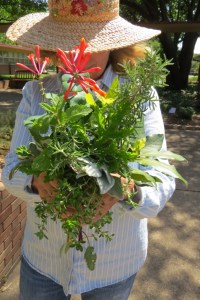
Flowers and herbs gathered for a tussie-mussie

Over the years I have made tussie-mussies for friends who have new jobs, weddings, and babies.  I have also found the language of flowers to be especially appropriate in those sad times, such as a bouquet that was given to a friend who was placed on hospice.  That tussie-mussie  (composed of geranium for friendship, Lamb’s Ear for kindness, thyme for courage, rosemary for remembrance, sage for wisdom, bay for peace, peppermint for warmth of feeling, honeysuckle for gentleness,  oak for strength, and, of course, flowers for love seemed to say it all.

Carolyn Bush

Picture by Starla Willis

Tussie- mussies by some of our school children here.

Have you ever seen a butterfly laying an egg?

Thanks to our own intrepid photographer, Starla, for capturing a rare picture of a butterfly laying an egg.

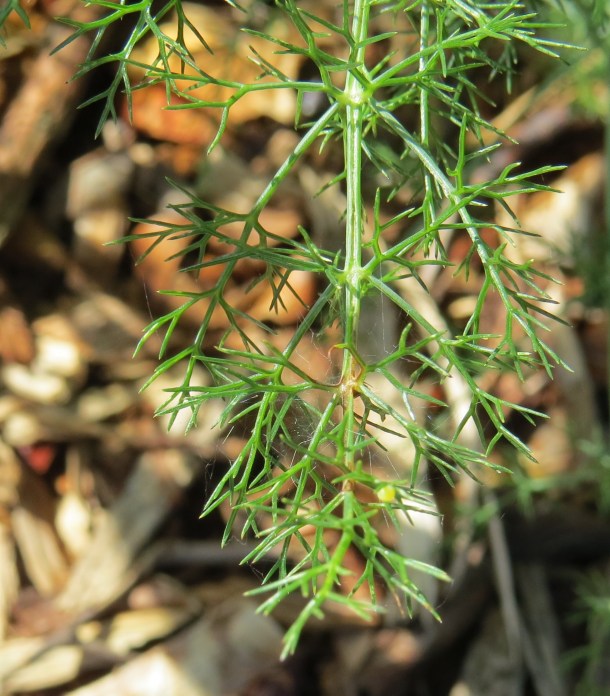
Black swallowtail butterfly laying an egg on fennel

And here’s the egg-

Look for the creamy yellow egg located on the lower right of the picture

*Eggs are laid singly on the host plants—usually on new foliage and occasionally on flowers. Development time is variable depending on temperature and host plant species, but generally the egg stage lasts four to nine days, the larval stage 10–30 days, and the pupal stage nine to 18 days.

Fascinating!

Ann Lamb

Picture by Starla Willis

*http://entnemdept.ufl.edu/creatures/bfly/bfly2/eastern_black_swallowtail.htm

Study up on our butterfly garden by looking at the right hand side of the front page of Dallas Garden Buzz under Raincatcher’s Resources for a list of hummingbird and butterfly plants or type butterfly in our search box for a host of articles on butterflies.


Arugula Has Its Day

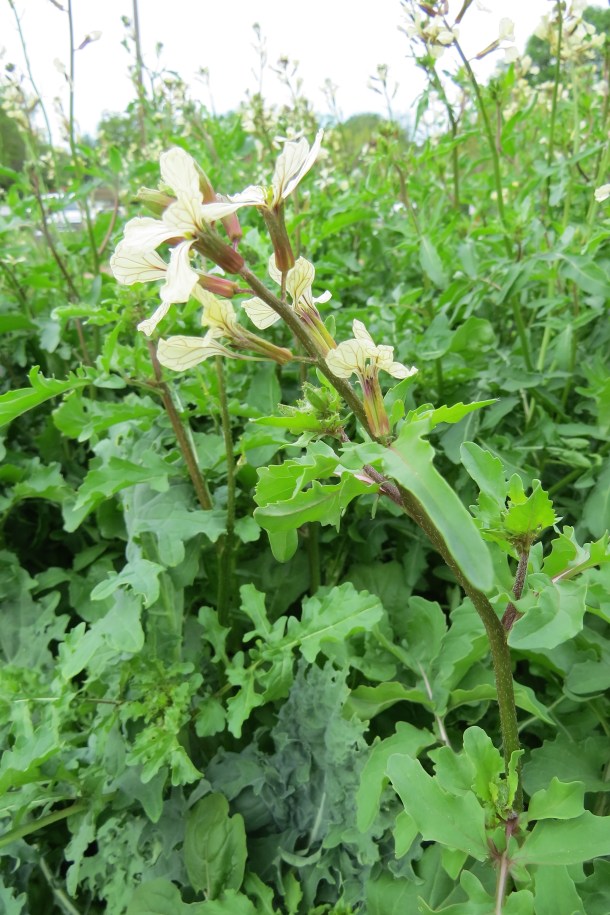
Tuesday at Raincatcher’s we noticed that the arugula was bolting. Lovely little white blossoms crowned the tops of all the arugula plants in our raised bed.  The bees couldn’t have been happier.

However, it also reminded us that the time had come for one final harvest. Carefully we clipped our way through the plants with bees buzzing all around us.  A very generous amount of arugula, at least 6 pots full, was harvested and shared with our volunteers.

Here is a delightful recipe for using fresh, peppery arugula brought in straight from the garden. A nice addition to the salad would be 1 bunch fresh roasted beets.  Be creative, arugula supports a variety of many different ingredients.


Arugula Growing at The Raincatcher’s Garden

Arugula Salad

Ingredients:

¼ cup sliced natural almonds

3 tablespoons olive oil

1 tablespoon minced shallot

1 tablespoon fresh lemon juice

1 ½ tablespoons red-wine vinegar

¼ teaspoon sugar

½ teaspoon salt

3 cups baby arugula (about 3 ounces)

3 or 4 radishes (thinly sliced)

Directions:

  1. Cook almonds in oil in a small skillet over moderate heat, stirring occasionally until pale golden. Cool almonds in oil, (nuts will get darker as they cool). Transfer almonds with a slotted spoon to a small bowl and season with salt.
  2. Stir together shallot, lemon juice, vinegar, sugar, salt and oil from almonds in a large bowl.
  3. Using a mandoline or very sharp knife, thinly slice radishes.
  4. Combine salad ingredients in a large bowl. Drizzle dressing over the top and toss well to coat the leaves.

Yield: 4 servings

Note: Freshly “pulled” radishes were added to the salad, as well.


Linda Alexander

Find out more about arugula here .

And here’s another way to use harvested arugula.

April Gardening, 2017

Making our raised beds even better!

Dallas County Master Gardeners at The Raincatcher’s Garden of Midway Hills

Upcoming Educational Events-Bring your friends and neighbors:

Saturday, April 8th , Spring Lawn Care by Stephen Hudkins and Jeff Raska at the Extension office, 10am until noon. Call the Master Gardener Help Desk for more information-214.904.3053.

Address: 10056 Marsh Ln Ste 101B, Dallas, TX 75229.

Saturday, April 15th, Updating the Home Landscape for Sun and Shade by Brad Sandy at Raincatcher’s, 10 until noon.

Address: 11001 Midway Road, Dallas, Texas, 75229. 

Ann Lamb

Picture by Starla Willis

Spring Is In The Air-Raised Bed Gardening

Good morning, Dallas Garden Buzz readers! If you are a subscriber and receiving emails of Dallas Garden Buzz posts, you can watch our informative videos by clicking on Dallas Garden Buzz at the top of your email. Pictures and videos are better if you go to our actual site rather than staying with the post in your inbox.

For those of you who have not become subscribers, please sign up to follow Dallas Garden Buzz by entering your email in the right hand column at the top of the page. We hope to have two posts a week during spring of 2017.

Recap of Jeff’s advice:

  • Top 12 inches of a raised bed should be a mixture of loamy soil amended with finished compost. We like homemade compost but it can also be purchased at garden centers by the bag or in bulk from companies who make it. Raised bed prepared mix by bag or bulk can also be purchased with compost already included.
  • Bottom portion of your raised bed could be hardwood mulch or even cut logs
  • 1/4 inch galvanized hardware cloth can be placed under the soil to deter unwanted critters from entering the bed by digging under it

What’s growing at The Raincatcher’s Garden of Midway Hills?

Garlic, potatoes, onions, spinach, leeks, radish, and mesculun were planted earlier.

Tomato varieties, Black Krim, Celebrity, Sun Gold, and Green Zebra have been planted. We were able to plant them in late February  because of our early spring weather.

Raincathcer’s will also be planting a Three Sisters vegetable bed, Ambroisa melon, okra (of course!) and peppers.

Ann Lamb

Thank you Jeff Raska, Dallas County Horticulture Program Assistant, Texas A&M AgriLife Extension Service.


Congratulations Again!

2016 Master Gardener Graduating Class

2016 Master Gardener Graduating Class

We salute the Dallas County Master Gardeners Class of 2016, who have already contributed 5002 total hours to Dallas County at a value of $118,000. 20 interns of that class have already each volunteered 100 hours or more! After a year filled with 72 hours of class time and at least 72 hours of volunteer work, 47 members of the Class of 2016 have graduated to become Certified Master Gardeners!

The Master Gardener Program is a volunteer development program offered by the Texas A&M AgriLife Extension Service, which is designed to increase the availability of horticultural information and improve the quality of life through horticultural projects. What really sets Master Gardeners apart from other home gardeners is their special training in horticulture. In exchange for their training, persons who become Master Gardeners contribute time as volunteers, working through their local Extension office to provide horticulture-related information to their communities. The Raincatcher’s Garden of Midway Hills is just one of many Master Gardener projects that enrich the community and provide opportunities for volunteers to continue learning and share their knowledge with the public.

We recently celebrated the graduation of these newly minted Master Gardeners with a ceremony and reception, where we served this gluten-free dessert. We received so many requests for the recipe that we thought we would share it with you all. We usually share garden-inspired recipes here, but you could say this is “gardener-inspired.” I make batch after batch of this at the holidays – it looks so pretty packaged in a cellophane bag tied with a ribbon. And it’s always nice to be able to offer something gluten-free for your guests that might have food sensitivities. Make this easy bark any time!

chocolate-bark

Festive Chocolate Bark

Ingredients

1 cup shelled salted pistachios (about 1/2 pound if you’re starting with nuts in the shell)

12 ounces semisweet chocolate (chocolate chips work fine)

8 ounces white chocolate

3/4 cup dried, sweetened cranberries

Directions

If using raw pistachios, sprinkle with salt and lightly toast the nuts on a baking sheet in a 350⁰ oven for about 10 minutes and allow to cool.

Melt the semisweet chocolate in a microwave-safe bowl, uncovered, on medium power for 2–3 minutes, stopping the microwave to stir once or twice. If using baking squares, chop them up to help the chocolate melt more uniformly. Remove from the microwave and stir until smooth. Melt the white chocolate separately following the same directions for 1–2 minutes, taking care not to overheat.

In a small bowl combine nuts and cranberries, then stir half of them into the semisweet chocolate. Using a spatula, spread the mixture to about a 1/2-inch thickness on a large cookie sheet. Drop the white chocolate by tablespoonfuls over the dark. With the tip of a butter knife, swirl the chocolates together to create a marbled effect. Sprinkle on the rest of the nuts and berries and lightly press them into the chocolate mixture.

Refrigerate the bark for about an hour or until firm, then break into pieces. Store the bark in an airtight container in the refrigerator for up to a month (I find it keeps for much longer). Makes about 1 3/4 pounds.

Enjoy!

Lisa Centala
Congratulations!


2016 Master Gardener Graduating Class

2016 Master Gardener Graduating Class

We salute the Dallas County Master Gardeners Class of 2016, who have already contributed 5002 total hours to Dallas County at a value of $118,000. 20 interns of that class have already each volunteered 100 hours or more! After a year filled with 72 hours of class time and at least 72 hours of volunteer work, 47 members of the Class of 2016 have graduated to become Certified Master Gardeners!

The Master Gardener Program is a volunteer development program offered by the Texas A&M AgriLife Extension Service, which is designed to increase the availability of horticultural information and improve the quality of life through horticultural projects. What really sets Master Gardeners apart from other home gardeners is their special training in horticulture. In exchange for their training, persons who become Master Gardeners contribute time as volunteers, working through their local Extension office to provide horticulture-related information to their communities. The Raincatcher’s Garden of Midway Hills is just one of many Master Gardener projects that enrich the community and provide opportunities for volunteers to continue learning and share their knowledge with the public.

We recently celebrated the graduation of these newly minted Master Gardeners with a ceremony and reception, where we served this gluten-free dessert. We received so many requests for the recipe that we thought we would share it with you all. We usually share garden-inspired recipes here, but you could say this is “gardener-inspired.” I make batch after batch of this at the holidays – it looks so pretty packaged in a cellophane bag tied with a ribbon. And it’s always nice to be able to offer something gluten-free for your guests that might have food sensitivities. Make this easy bark any time!

chocolate-bark

Festive Chocolate Bark

Ingredients

1 cup shelled salted pistachios (about 1/2 pound if you’re starting with nuts in the shell)

12 ounces semisweet chocolate (chocolate chips work fine)

8 ounces white chocolate

3/4 cup dried, sweetened cranberries

Directions

If using raw pistachios, sprinkle with salt and lightly toast the nuts on a baking sheet in a 350⁰ oven for about 10 minutes and allow to cool.

Melt the semisweet chocolate in a microwave-safe bowl, uncovered, on medium power for 2–3 minutes, stopping the microwave to stir once or twice. If using baking squares, chop them up to help the chocolate melt more uniformly. Remove from the microwave and stir until smooth. Melt the white chocolate separately following the same directions for 1–2 minutes, taking care not to overheat.

In a small bowl combine nuts and cranberries, then stir half of them into the semisweet chocolate. Using a spatula, spread the mixture to about a 1/2-inch thickness on a large cookie sheet. Drop the white chocolate by tablespoonfuls over the dark. With the tip of a butter knife, swirl the chocolates together to create a marbled effect. Sprinkle on the rest of the nuts and berries and lightly press them into the chocolate mixture.

Refrigerate the bark for about an hour or until firm, then break into pieces. Store the bark in an airtight container in the refrigerator for up to a month (I find it keeps for much longer). Makes about 1 3/4 pounds.

Enjoy!

Lisa Centala

Onion Planting at The Raincatcher’s Garden, 2017

It’s January and time to plant onion sets! Onion sets can be purchased at your local garden center. Sets are immature bulbs that were started from seed the previous year. The seed are sown closely so that they stay small and then pulled when they are about a half an inch round. Onion sets are inexpensive and contain about 75 onions. At Raincatcher’s we are planting Red Creole, Early White, and Super Sweet. Next week- Lancelot Leeks.

Dallas Garden Buzz is loaded with onion stories and recipes. Type onion in the search box to catch up on alliums!

Video by Starla Willis

Onion Planting by Dorothy Shockley

Ann Lamb

And did you know…

Thank you from The Raincatcher’s Garden of Midway Hills!

RAINCATCHER’S FUNDRAISER AT FISH CITY GRILL

Celebrate the new year with friends and family at Fish City Grill on Tuesday, January 10th and help the Raincatcher’s Garden.  The local gathering spot is known for Oyster Nachos, fresh seafood and a fun, casual atmosphere.

Fish City Grill supports local organizations through its First Tuesday Benefit.  Raincatcher’s will receive 15% of the day’s receipts, including take-out!

Fish City Grill is located on the southeast corner of Preston and Royal, near Central Market. Enjoy your Smokin’ Hot Shrimp and Fish Tacos from 11 am to 10 pm.

Address: 10720 Preston Road #1012
Dallas, Texas 75230
Phone: 214-891-9979