Why do gardeners keep going? Its hot—get up really early start to work to beat the heat—and find the mosquitos got up earlier.
Work hard on weeding feel successful–turn around–and find more weeds.
Wonderful to have so many flowers–until its obvious many flowers mean alot of deadheading.
Sometimes the problems pile up. It can be easy to forget the blessings gardening brings. Of course there is the functional fitness aspect–digging those weeds is actually a good thing. Fresh air and sunshine help the body and the mind.. Just being needed by the garden can be seen as a burden–but really its a blessing to be needed.
But remember another aspect of gardening that brings lasting joy. That is the way our plants and gardens connect us to others.
Some of our connections are to friends and family that we see regularly. Those who share successes –and some failures—and sometimes plants. Others are gone now but the plants they shared long ago ensure that they are not forgotten. Somehow they are not gone at all but with us still as we garden.
This was the first plant I ever had, well, a descendant, of course. I was about 6 years old. My mother and I were visiting one of her friends. She had Ghost plants in a huge iron kettle used by generations before to heat water over a fire and wash clothes. The plants spilling out of the kettle, now used as a flower pot, enchanted me.
So for sure–gardening is hard work somehow conditions never seem “just right” too hot too cold too dry too wet–it all happens. And we have to get out there anyway.
But don’t just work. Pause and take a step back every so often. Think about all the people and all the stories that surround your plants.
Then you will remember why you keep gardening. Remembering will lift you and bring joy to you even in difficult times.
This is Red Dragon. I was given a few stems in a glass of water by a friend and now it’s being shared.This unknown grass is a descendant of a small plant gathered by my mother near Lake Proctor.Raincatcher’s Garden used to be at Joe Field. I took some cutting of this pink turk’s cap before we left. They continue on!I found this rosemary in a trash pile. It isn’at a particularly good plant but it made me happy to find it and see it growing now years later.A neighbor came by and told me she enjoyed the zinnias in my yard and how much they took her back to her Mother’s garden.Growing a tree from seed reminds us that we can do a lot if we try.
Thank you plant sharing friends:
Jim has grown so many seeds for the plant sale. This is Pride of Barbados, one of his specialty plants. Hope it blooms soon but even if it doesn’t, I am reminded of Jim and all his work for the garden.Mark started these cuttings and generously shared. Be sure to notice Althea when you visit The Raincatcher’s Garden. It has been blooming all summer and thank Mark.
Susan Thornbury, Dallas County Master Gardener Class of 2008
There is something transformative about walking under an arbor. It is a marker for some kind of change, possibly an entrance to a new space, or a transition from one area to another— One thing for sure, is that an arbor sets the space apart. Arbors come in a variety of shapes, sizes, and materials. It’s difficult to understand all the work that goes into putting up an arbor–Only when you see it unfold before your very eyes will you fully see the scope of the project. Thanks to all who take the time, make the plans, and see it to its final position in the garden.
At Raincatcher’s we’ve been reworking an arbor that was first constructed in 2012 as an Eagle Scout Project at Joe Field, a previous Dallas County Master Gardeners site. changes came and we relocated in November of 2014 to Raincatcher’s Garden of Midway Hills. It was reassembled at the entrance to the North Field Pollinator Garden in 2015.
Arbor reassambled late 2015, notice the stark contrast between these 2 pictures. Our pollinator garden was just beginning.The 2015 pollinator friendly arbor with crossvine flurishing on the right and coral honeysuckle on the right.
This arbor served faithfully for several years, supporting multiple kinds of vines, such as passion vine (host plant for gulf fritillary butterfly), crossvine, coral honeysuckle and others added a touch of shade, some color, and best of all, the attraction of pollinators. In 2024(after about 12 years), the elements contributed to the deterioration of portion of the structure. Some of the original posts remained and were used in the new arbor.
Dallas County Master Gardeners and Raincatcher’s project specialists, Jon Maxwell (class of 2015 and Joe Labay (class of 2008) put a redo of this arbor on the to-do list. . Work began in January 2025 – first, devising a plan, then acquiring materials, and then came execution. This entailed many little things that made big differences, such as , measuring twice, or 3x if needed, so they cut once; leveling the wood and adjusting yet again. The original design was enhanced for functional and aesthetic purposes, the base was reinforced in concrete to better withstand the weather; more slats were added to the top, and the posts and beams leveled and adjusted numerous times.
Teamwork in action as speacialists measure and asemble the new arbor at Raincatcher’s.One more step in arbor reconstruction with the goal of enhancing our garden.Jon and Joe, our dedicated volunteers!
It was meticulously assembled after measuring, sanding, painting and placement. Finishing touches included grading the walkway, mulching, adding decomposed granite, placing stepping stones and adding a brick border to complete this garden work of Art. The project took about 5 months, partially due to only meeting once a week on Tuesday mornings. At times, other issues took precedence, or weather altered plans. It has been well worth the wait!
Interns assisted Jon and Joe with border and stone placement around entrance.Awaiting the finishing touches-decomposed granite, stepping stones and the brick border.Voila! French for Texan speak – here it is!
We at Raincatcher’s are grateful for the commitment and expertise of Jon and Joe to make this beautiful arbor a reality.
It is a statement piece that welcomes everyone to walk under it and into a pollinator paradise. Come and stroll through the garden and check it out! We have workers at the garden on Monday mornings and Tuesday mornings; pollinators are more frequent. See you soon!
Starla Willis, DCMG class 2011, Jon Maxwell, class 2015, and Joe Labay class of 2008
Constructive tips:
* Use the best quality materials you can afford. The better the materials, the longer it is likely to last. Cedar is a better choice than treated lumber. Treated lumber, especially the 4×4 posts tend to warp badly unless thoroughly dry, which are hard to find at the box stores. Cedar, while more expensive, will last longer and will not warp. If treated lumber is chosen based on cost, be sure to prime and stain it immediately upon installation.
* Using materials from the existing arbor may save on the costs, but not necessarily time.
* Plan on it taking longer than you expect —projects have a way of evolving.
Starla Willis, DCMG class of 2011, Jon Maxwell, class of 2015, and Joe LeBay class of 20
Meet the 2025 Pollinator of the year, the Hoary squash bee.
As much as I love bees, the squash bee has escaped my notice. Thankfully, pollinator.org has selected this bee as its 2025 pollinator of the year.
Honey bees are generalists while squash bees rely almost exclusively on squash and gourd pollen to feed their young. They are expert foragers on the squash blossoms of pumpkins, summer squash, winter squash, zucchini and gourds of the Cucurbita Family.
Squash bees are large and bulky like bumblebees, but are more similar to honeybees in their coloring. Compared to honeybees, they have rounder faces and longer antennae.
Sunrise is the best time to be in our Texas gardens and that’s when you might find a male squash bee darting from squash flower to squash flower in search of mates. The females are busy pollinating and build undergound tunnels to store squash pollen and nectar for their offspring.
Why do we need to focus on pollinators?
Our efforts make a difference, and pollinators need our support. I have read that one in three bites of food can be attributed to the work of our pollinators. There is a lack of interest in backyard biodiversity and planting to provide for pollinators. Miles of boxwood bushes and plastic lawns do nothing for bees or butterflies. Even flowers like periwinkles do not provide pollen, so we need to be more intentional and protective of pollinators and select and provide for them. Doug Tallamy reminds us” plants are not just for decoration, plants are vital ecological entities that do so many things.”
Start small, your backyard can become an oasis for you and our pollinators. If you need help, call a Master Gardener or visit our garden, The Raincatcher’s Garden, at 11001 Midway Road in Dallas. There are many good books and native plant lists available.
Ann Lamb, Dallas County Master Gardener Class of 2005
To learn more about honeybees, one of our favorite pollinators, buzz over these articles.
What a great plant larkspur is. Coming up from the seeds of last springs plants–living all winter as little fluffy greenery and suddenly growing tall and blooming before most other flowers.
Winter can be a challenge but finding the tiny larkspur seedlings and thinking of whats to come lifts the spirits. What a bonus that they honestly do not need a great deal of help from the gardener to grow and thrive.
As with most self seeding plants they come up where they wish to and may require some editing. If they are too crowded they won’t be their best so don’t hesitate to thin out the smaller ones. This will allow the remaining plants to grow tall. This adds structure to the spring garden. The color honestly goes with everything. Pink poppies–nigella–combined with the blues and purples of the larkspur–its a picture waiting to be painted–at least admired by you and anyone lucky enough to pass by.
Watch carefully larkspur is a magnet for native bumblebees. As we know bumblebees have been struggling. Seeing so many enjoying the larkspur makes growing them worthwhile in itself.
But wait–there is more!! When you grow larkspur you are growing a plant that has been grown by gardeners for hundreds of years. The Victorians were very fond of them–they were popular gift flowers.
In medieval times they were grown in monastery gardens. These gardens had to be useful not just beautiful.
Now–lets pause–important information will follow: all parts of larkspur are toxic. Do not consider internal use. But its great to know that people tried their best to help and use what they saw around them. Potions were made to treat a variety of problems including depression and anxiety. The seeds were used to make a solution to kill lice. That had to be a welcome relief as lice were a horribly common problem. In fact this use continued for a long time –soldiers used it during the revolutionary war..
The flowers can be used to make a dye and were used by the monks to make a blue ink.
So think of all those before you as you work in your garden–and remember you are a link in this long chain. Remember yes–but as always–there is more.You obviously must let the plants finish their blooming and go to seed–yes this can be a bit untidy but its essential. Lots of seeds will fall and they will lie in wait until next winter when the cycle starts again. But don’t let them all fall–gather some seeds.
Share some seeds with friends and neighbors–answer their questions about how to grow larkspur.
So the chain that links the plant and the gardener to the distant past will extend into the future–and you are and will be a link in that chain.
Larkspur and Poppies far better togetherLarkspur comes in white, this one has tinges of lavender look closelyThis one might be more lavender than whiteBe tolerant. A few larkspur in a vegetable bed is hardly a problem-in fact it is healthyNotice the variation in color, this one is very dark purple.This one is a bit lighter and blooms close to a tall verbena.Amazingly intricate flowersThe foliage is lovely itself- so delicate!A bumblebee, look close-they love larkspur.
Susan Thornbury, Dallas County Master Gardener Class of 2008
Carrots are not the easiest thing to grow in our part of the world. Our past efforts resulted in lower yields than we had hoped.
This year we tried something different. We placed burlap over the area we had just planted and sprinkled it once a day to keep it moist until the seeds had germinated.
We usually water other seeds by hand once a day until they germinate but that didn’t satisfy the carrots. Soaking the burlap daily provides the continuous moisture they need for a good germination rate.
There was a hard freeze during the germination period. We left the burlap in place and covered the area with frost cloth.
We were concerned that the seedlings would stick to the burlap when we removed it but that was not a problem.
The germination rate was excellent and after a few weeks we had many delicious carrots to share with the NDSM food pantry and visiting preschoolers. Next year we will confidently devote more space to carrots using this technique.
Harvesting, photo by Ruth Klein
Prepping for NDSM food pantry, photo by Beverly
Beverly Allen, Dallas County Master Gardener Class of 2018
We are enjoying the mild weather and it appears the vegetables are too. Last year was productive both in vegetables donated and new lessons learned. We came pretty close to doubling our yield from the previous year (from 966 to 1833).
The tatume squash was the star producer with 727 pounds donated to North Dallas Shared Ministries. We would have had more but the stink bugs cut the harvest short by a few weeks.
We left a large volunteer hybrid squash in place as a trap crop for squash vine borers. An infestation of stink bugs quickly followed the borers on this weakened plant and spread to the tatume despite our best efforts to control them. This led to the early demise of our tatume plants and many long sessions of spraying soapy water to rid the garden of stink bugs. We are grateful to the Master Gardener interns and new volunteers who kept working with us despite this challenging (and frankly, gross, infestation).
The best advice for controlling stink bugs in small gardens is to remove the eggs and nymphs as soon as they can be found. They can be brushed off into soapy water or vacuumed. We missed some early opportunities but ultimately were able to get it under control in time for fall vegetables.
Image of brown marmorated stink bug eggs and nymphs from stopbmsb.org
Learning to identify stink bug eggs and nymphsTatume squash harvest in JuneCrop loss in July
Beverly Allen, Dallas County Master Gardener class of 2018
Raincatcher’s Garden of Midway Hills 11001 Midway Rd, Dallas, TX 75229 Classroom 1, North Church Building 10-11 AM, Tuesday, February 4, 2025
Join us for a practical and informative class on maintaining your investment in your garden tools taught by Tim Allsup, an experienced and knowledgeable garden volunteer.
Rusted clippers? Dull loppers? Broken shovel handle? Tim can help you learn how to repair, restore and protect your tools in anticipation of spring garden tasks ahead.
To find the class, please enter the Midway Hills Christian Church campus from the south drive, follow the signs and park in the west parking lot. Enter the south building through the courtyard. The Community Hall is on your right.
Lisa Centala, Dallas County Master Gardener Class of 2010
Raincatchers’ Garden chose Obession Nandinas to co-exist with established Crepe Myrtles that have a darker leaf and white blooms. These two plants provide an attractive, easy to maintain small area within our garden, and provide a colorful treat for the eye throughout their growing season. Our plantings flank our shade pavilion located in the northwest corner of our north garden.
Glowing vibrant red in the spring and summer, Obsession™ Nandina is visually appealing, and it is also easy to grow, even for beginners. An upright, compact, dense grower, Obsession offers richer color than ordinary nandinas and is non-invasive.
With its vibrant foliage and compact form, Obsession Nandina adds texture and color to any landscape. It thrives in various growing conditions and adapts to full sun and partial shade. Whether you aim to create a colorful border, enhance a foundation planting, or beautify a patio or balcony, Obsession Nandina is up for the task. Best of all, Obsession Nandina is deer-resistant!
Ideal growing conditions for the Obsession Nandina shrub include well-drained soil and regular watering, especially during hot summer months, though you’ll find the water-wise Obsession to have low water needs once established.
This low-maintenance plant also doesn’t require frequent fertilizing, making it an excellent choice for those with busy schedules. If you wish, feed your Obsession Nandina once per year in early spring.
You can selectively prune to shape your nandina shrub prune in late winter or early spring according to your preference, but Obsession Nandina doesn’t require pruning to stay compact. When pruning, remove any dead or damaged branches, as well as any crossing or overcrowded stems.
Bloom/Feature Bright red new growth
Evergreen or Deciduous? Evergreen
Plant HardinessHardy to -10°F to 0°F
Key FeaturesDeer Resistant, Disease / Pest Resistance, Water-wise, Winter / Floweing Season
Fall Foliage Color None
UsesAccent, Container, Mass Planting, Slope
Water Needs Medium
FertilizeYearly in early spring
PruningNone Needed*
Planting Instructions
• Water before planting • Plant in location that receives partial sun to shade • Dig hole 2X the width of pot • Plant 1-2″ above ground soil level, backfill hole with soil • Water deeply to settle, then add more soil if needed • Mulch 1-2″ deep around plant, avoiding area closest to stem
*If pruning is desired for shape, remember to cut the offending branches at ground level, not from the crown of the plant.
Information above is from Southern Living Plant Collection.
Here we are in January–its cold and can be dark and gloomy. So how to appreciate it?
January is named for the great Roman God Janus. This God could look to the front and to the back–seeing both the past and the future–thats a lot right? But really his powers were far greater. Janus was a God of practical importance. When asked by mere mortals assistance could be given to turn dreams into reality. Janus had the power to help the followers to see and understand what actions were needed to recognize an abstract goal and take the necessary actions to make it real.
There seem to have been other powers but those seem quite enough for us to think about in this time of the year that can seem a bit bleak.
In fact it seems very possible that Janus was fond of gardening and was able to use the powers to make gardeners happier.
Well it is hard to say it was all a very long time ago now–but some things don’t change. We want things to be brighter and more cheerful. we know we can’t just wait for it to happen–its up to us–we are going to have to be inspired by ancient wisdom but we are the ones who must make it happen. OK lets turn the idea “make things brighter” into action to make it so. Remember–no just hoping for a good day–make it a good day!
Let’s decide on what to do:
Go and pick some of the lettuce and arugula in the garden make and enjoy a salad–delicious and healthy too.
Take a walk around the yard–Yes its cold but the hellebores are starting to bloom but you will never know unless you go out and look. Winter honeysuckle is covered in lovely white flowers a treat for people and bees but again it requires a good close look those flowers are beautiful but they are small.
Houseplants are right there for enjoyment. Don’t take them for granted and let them become just part of the furniture. Of course do the routine care but take the time to really look closely they will appreciate it and you will reap the benefits. Even the most common of the plants are amazing on close inspection.
Even January can be a wonderful time for gardeners. Lets learn from Janus and take action to make it so!
Enjoy every bloom of the Christmas Cactus!Eveyone including the bees can enjoy the pretty flowers of winter honey suckle. If you have orchids, apppreciate the amazing long lasting flowers.Growing lettuce just makes good sense. It is delicious and healthy.Arugula doesn’t give up and neither should you.Begonias are very easy to grow and not boring!Foliage plants are worth a careful look.What a treat; the Hellebores are starting to bloom.
Susan Thornbury, Dallas County Master Gardener Class of 2008
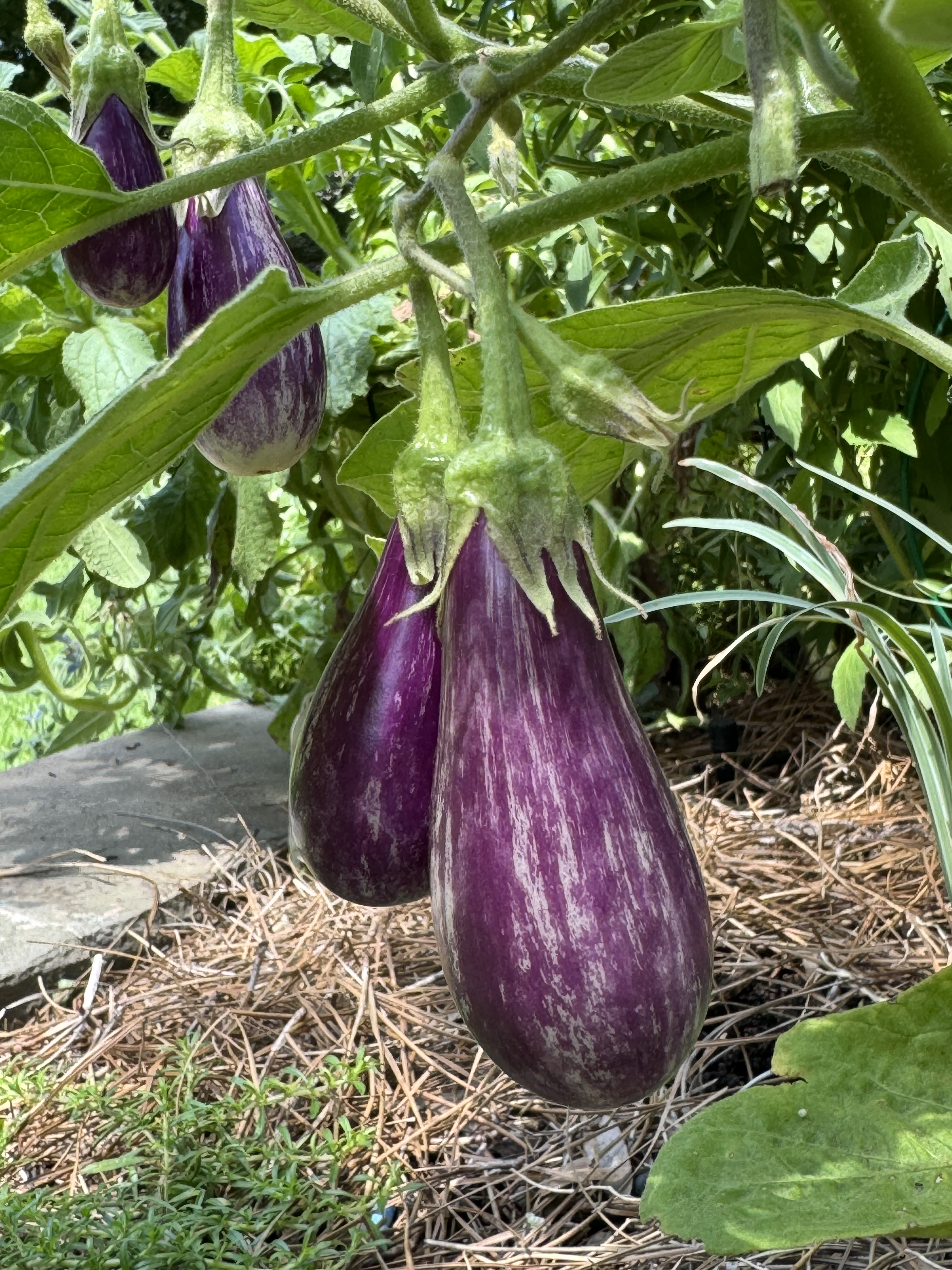
Does the familiar phrase ‘once upon a time’ bring back memories of your early childhood? Maybe it was when you heard the classic story of Little Red Riding Hood for the first time or were mesmerized when you saw Disney’s version of Snow White and the Seven Dwarfs. Throughout the years, fairy tales have given us wondrous characters in magical settings and left an indelible impression on young children throughout the world. But the fairy tale that has recently impressed me most is of a uniquely different variety. It is one that produces magically, ornamental plants for your garden. In this case, it is the adorable petite eggplant known as ‘Fairy Tale’.
Fairy Tale Eggplant
As you can see from the photo, it is a lovely mini eggplant, only 4 inches long, with stunning streaks of lavender and white. The plant itself grows to only 24” but produces tender-sweet fruits that are as beautiful as they are delicious. This variety can be grown in ground but, with its compact, dwarf size, is a just as suitable for container growing.
When it was time to harvest and enjoy, a quesadilla recipe was the perfect choice. Honey crisp apples gave it a sweet, tart taste while the smaller slices of savory fairy tale eggplant fit nicely on the tortilla. A handful of roughly chopped spinach along with some creamy Monterrey Jack cheese completed the combination of amazing flavors. Freshly made tortillas from Central Market held everything together while the quesadillas were baking in the oven.
A very unique feature of ‘Fairy Tale’ is the recognition it received in 2005 as an AAS* vegetable award winner. It was the first eggplant to win an AAS award since 1939. There is still time to grow ‘Fairy Tale’ in your garden so why not give it a try?
For transplants:
Pick a sunny site with rich, organic, well-draining soil. Eggplants require at least 6+ hours of direct sunlight per day. (Some sources advise not planting it in a plot where you grew tomatoes, peppers, potatoes or other eggplants the year before). Set transplants about 3 feet apart.
Mulch after planting.
Provide adequate water to produce the best-tasting eggplants. Fairy Tale eggplant enjoys deep, consistent watering throughout the growing season. Check often to be sure that Fairy Tale is receiving about 1-2 inches of water per week.
Harvest when fruits reach 2-4 inches in length for sweet, bitter-free enjoyment. Snip fruit with clean shears at their individual stems or in clusters. The skin should appear glossy (left side of photo), as dull skin can indicate overripe fruit (right side of photo). Harvest regularly to encourage new fruit production.
*All-America Selections winners are tested at trial grounds across North America. Each winner has superior qualities that distinguish it from similar varieties. ‘Fairy Tale’ was granted the prestigious AAS award by a nationwide panel of experts.
Linda Alexander,Dallas County Master Gardener Class of 2008