Tag Archives: Raincatcher’s Garden

DALLAS WATER UTILITIES 31st WATER WISE GARDEN TOUR OCTOBER 18, 2025 

October 14, 2025

Every fall, I look forward to one of my favorite  garden tours—The Water-wise Garden Tour hosted by Dallas Water Utilities and the city of Dallas.  There are several smaller organizations that participate, some giving lectures at the White Rock Pump Station (the traditional starting point of the tour). That’s where one picks up the map showing the location of the participating “winners” of this year’s tour.  I know in years past Dallas County Master Gardener’s Association has been both entrants and support staff. I’ve lost track of how many years Roger and I have wandered through Dallas, looking at peoples’ interpretation of what water-wise gardening entails.

Years ago, A&M Research Center on Coit Road had a program called Water University.  They had examples of homes with all sorts of saving water inside and outside the home.  We learned about Rainwater harvesting: how to build rain barrels for the home, rain gardens, etc.  All of which we demonstrated at our Joe Field location (thanks to County Commissioner M. Dickey).

When the county closed that location in 2014, we found a new home at Midway Hills Christian Church, located at 11101 Midway Road—thus our name “The Raincatcher’s Garden of Midway Hills.” This rain garden is located near the street on Midway Hills, next to the two cisterns that were put in place shortly after we started gardening there. This noncommercial rain garden would work in most home landscapes. It captures water from heavy rains and is also used to catch overflow from the cisterns.

2-2500 gallon water cisterns at The Raincatcher’s Garden

Although our garden is not on tour this year, feel free to visit us at 11101 Midway Road in Dallas, especially on Tuesday mornings when we are working in the garden. We love to share water saving tips.

Water Wise Garden Tour maps of the participating homes will be available at the White Rock Pump Station on Saturday and the information link can be found below.


Some yards or gardens use xeriscaping, while others have lush  lawns and gardens.  There are innovative uses of hardscaping. 

On the 18th, I am playing tourist to get more ideas about saving water and creating a beautiful yard at home.  I always find some new idea  to take home to try out.

Hope to see you on the tour.  Be sure to take notes or, better yet—pictures!

Cindy Bicking, Dallas County Master Gardener Class of 2006

Pictures by Starla Willis, Dallas County Master Gardener Class of 2011

Water Wise Tour Information

Growing Eggplant in Texas

October 11, 2025

The Raincatcher’s Garden vegetable gardening team has enjoyed growing several varieties of eggplant.

They have found them to be easy to grow as long as they remain vigilant about controlling the flea beetles with diatomaceous earth.

These long purple eggplants are called amazingly enough long purple eggplant.

Aswad eggplant pictured above is an Iraqi heirloom variety known for its mild sweet flavor.

Mark your 2026 calendar to start eggplant by seed February – mid-March. Transplants should be set out in mid-May through June.

While eggplant may not be your favorite vegetable, it’s nice to harvest something new after summer crops have withered in the heat. There are many varieties and ways to cook eggplant. Tonight, at our house we’ll have eggplant apple quesadillas; find the recipe here.

For more growing information: Easy Gardening-Eggplant

Ann Lamb, Dallas County Master Gardener Class of 2005 with Beverly Allen, Dallas County Master Gardener Class of 2018

Revisiting A Fairy Tale

October 9, 2025

Last summer, 2024, I grew Fairytale Eggplant for the first time. It produced adorable little tear-drop shaped eggplants for over three months. During that time, most of the harvest was used for Apple and Eggplant Quesadillas, a simply delicious treat. 

For 2025, a new recipe that we’ve enjoyed over the past few months is “Roasted Fairytale Eggplant Salad with Fresh Tomato”. Inchelium Red organic garlic had cured from my late spring/early summer crop, while fairytale eggplants, English cucumber and mint were growing in my garden and ready to use.

It’s now early October and my two Fairytale Eggplants are producing almost double the amount as last year. Here’s an example of what gets harvested every day.

Linda Alexander, Dallas County Master Gardener Class of 2008

Roasted Fairy Tale Eggplant Salad with Roasted Tomato

Summer Finale at the Saturday Farmer’s Market

September 12, 2025

This past Saturday, September 6th, marked the end of season schedule for St. Michael’s Farmer’s Market. Like many of our readers, I’ve been attending the Saturday market for years! Getting to meet so many of the vendors and following them each week has always been a delightful experience for me. 

People like The Baugh Family (now with two young children) drive in early from Wylie to bring an amazing assortment of east Texas vegetables, blueberries, blackberries and more. But it’s always those juicy, ripe peaches that create the long lines of anxious customers with everyone hoping there will be enough once it’s their turn. Wayne and his wife get up around 2:30am to harvest their magnificent bouquets of freshly cut flowers. Driving in to Dallas from Henderson is about 2 hours but these long-time flower farmers have us drooling over the rainbow of colorful blossoms that are bundled up and ready for purchase.

Master Gardener, Janet Smith class of 2008, became a regular this summer with her west Texas pecans. What a special treat! And new to the market was Honey Apple Farm in Canton, Texas. This small, family owned and operated farm produces a variety of artisan honeys. They are also passionate about strengthening the bee population by providing tips on planting a bee garden and going chemical free.

My end of season trip to the market on September 6th was bittersweet. While some of the vendors will return for a one-time only October appearance, we’ll have to wait until May 2026 for the weekly schedule to resume. Until then, I’m thankful for the bountiful blessings given to us by the farmers, flower growers, beekeepers and more whose hard work provided us with fresh, flavorful food this summer. I’ll be first in line to welcome them back next May.

Looking back through one of my herb cookbooks, I landed on a recipe that had been “tabbed” many years ago but never prepared. Things were about to change. Jerry Traunfeld wrote “The Herbal Kitchen” in 2005 as a handbook for incorporating fresh herbs, from his own herb garden, into everyday home meals. I would be using fresh tomatoes from the Saturday market to prepare his recipe for Tomato Bread. From my own garden, freshly picked basil and thyme along with cured garlic from late spring would supply most of the ingredients. 

Let me go on record as declaring that this new recipe exceeded my expectations.  And for those of you who already have your autumn tomato crop in the ground, please give this incredibly delicious dish a try. You might want to serve it as an accompaniment to salad, soup or with any grilled meats. I’ve made the recipe three times in the last month and shared it with family and friends. Everyone agreed that this is an exceptional way to enjoy fresh juicy tomatoes!

Start with chewy cubes of Italian-style bread drizzled with olive oil then topped with minced garlic and “torn” basil leaves. Finish with juicy, sliced tomatoes and a generous sprinkling of fresh thyme.

Tomato Bread Recipe here !

Linda Alexander, Dallas County Master Gardener Class of 2008


Growing Figs in Texas

September 6, 2025

Dig a hole through time and you will hit a fig tree’s roots. Figs are one of the oldest cultivated plants.

Figs are interesting little fruits but not in the traditional sense. The structure of the fig is a called a syconium, a fleshy sac lined with tiny flowers inside. When you eat a fig, you’re technically eating hundreds of tiny inverted flowers that bloomed inside the syconium.

  • The word “fig” comes from the Latin ficus
  • There are over 700 species of fig trees worldwide
  • Figs grown in the USA are self pollinating but in other countries pollination is provided by fig wasps which crawl into the fig, complete their mission and then die inside the fruit.
  • Figs conatin fiber, copper, potassium, maganese, vitamin K and other nutrients
  • Plant your fig tree in full sun in soil with good drainage, mulch regularly and monitor moisture needs

My experience with growing figs started with a fig tree propagated by Master Gardener, Jim Dempsey. It was planted in my backyard about 10 years ago. Every year I have looked up into my trees large, deeply lobed leaves longing for figs. The winter storm of 2021 nicknamed “Snowmagdeddon” caused the tree to die back and it would be several more years of waiting and hoping as it recuperated.

Finally this year my family tasted the fruit! About 12 pounds of figs were harvested from our Celeste fig tree. We let it grow to a height of over 20 feet. Rather than try to protect the tree from birds with a net or other artificial means, we let the birds eat the fruit in the branches way up high leaving the rest for us. There’s nothing like the taste of a fig eaten at peak ripeness from your own backyard tree.

Our Celeste Fig Tree, note the neighbor’s two story chimney for height comparison.

Another personal story: My son and wife and three little children moved to a new house last year. They have a “Texas Everbearing” fig tree. To my great delight, my grandchildren are eating figs from thier own tree. Imagine me walking into their kitchen and seeing figs on their high chair plates. Surely this is tender hearted beauty!

Ann Lamb, Dallas County Master Gardener Class of 2005


Extra figs were made into Fig Jam!

More Fig Facts here

Fig Fest

Overcoming The Summer Doldrums

August 30, 2025

Have you been feeling somewhat listless or despondent over the last few weeks? Are you experiencing a period of inactivity or lack of energy? If so, you are not alone. It may be that those summer doldrums have many of us in a wearisome summer slump!

We’ve all, no doubt, spoken those words many times over the years. However, for the first time, my curiosity motivated me to do a little investigating into the meaning of “doldrums”. Much to my surprise the doldrums are for real! In oceanographic terms, they are a part of the ocean near the equator abounding in calms and light shifting winds.

 In the early 19th century, the word doldrums came to be applied to certain tropical regions of the ocean marked by the absence of strong winds. Sailing vessels, depending on wind propulsion, struggled to make headway in these regions, leading to long, challenging journeys.

While the exact etymology of doldrums is not certain, it is believed to be related to the Old English dol, meaning “foolish” – a history it shares with our adjective dull.

Click here for a much more scientific and very fascinating explanation from NOAA

If you are like other gardeners waiting for the winds to “pick up”, here are a few refreshing ideas to help you navigate through the summertime blues! One of the most delightful ways to celebrate the hot, sticky last few weeks of summer is found in the herb garden. When I’m in search of a culinary treat, summer herbs seem to have the answer. Let’s look at a few of the heat-tolerant, dependable standouts that satisfy the craving.

Whatever your preference, vibrant flavors ranging from sweet and floral to savory and pungent can be found in herbs that persevere through the high heat and icky humidity of summer.

 Offering aromatic qualities from minty and citrusy to earthy and woodsy, consider these flavor profiles to suit your preference:

*Sweet and floral: basil, lavender and anise hyssop

*Citrusy: lemon verbena, lemon balm and French sorrel

*Minty: various mints (spearmint, ginger mint, peppermint, etc.), nepitella, oregano and thyme

*Earthy: sage, rosemary and thyme

*Pungent/Spicy: chives, papalo, French tarragon

Enjoy the simple pleasures of growing and harvesting summer herbs. Some of the most satisfying ways for using fresh herbs are found in sprinkling, scattering and tossing over fruits, salads, vegetables and desserts for a delectable finish. Other than a quick trip to the grill, bake free is the best way to savor the gifts of our summer gardens. Use freshly gathered herbs to elevate your food from tasty to irresistible!

Here are a few ideas for a cool ending to summer:

Grilled Peach and Blueberry Salad with Fresh Mint

Creamy Chilled Cantaloupe Soup Garnished with French Tarragon and Blue Borage Blossoms

Yellow Pear Tomato Salad with Red Rubin Basil, Nasturtium Blossoms, Basil Pesto and Mozzarella Pearls

Creamy Chilled Cantaloupe Soup with Ginger

Grilled Peach and Blueberry Salad

Linda Alexander, Dallas County Master Gardener Class of 2008

There is always something there to remind me.

August 28, 2025

Why do gardeners keep going?  Its hot—get up really early start to work to beat the heat—and find the mosquitos got up earlier.

Work hard on weeding feel successful–turn around–and find more weeds.

Wonderful to have so many flowers–until its obvious many flowers mean alot of deadheading.

Sometimes the problems pile up.  It can be easy to forget the blessings gardening brings.  Of course there is the functional fitness aspect–digging those weeds is actually a good thing.  Fresh air and sunshine help the body and the mind..  Just being needed by the garden can be seen as a burden–but really its a blessing to be needed.

But remember another aspect of gardening that brings lasting joy.  That is the way our plants and gardens connect us to others.

Some of our connections are to friends and family that we see regularly.  Those who share successes –and some failures—and sometimes plants.  Others are gone now but the plants they shared long ago ensure that they are not forgotten.  Somehow they are not gone at all but with us still as we garden. 

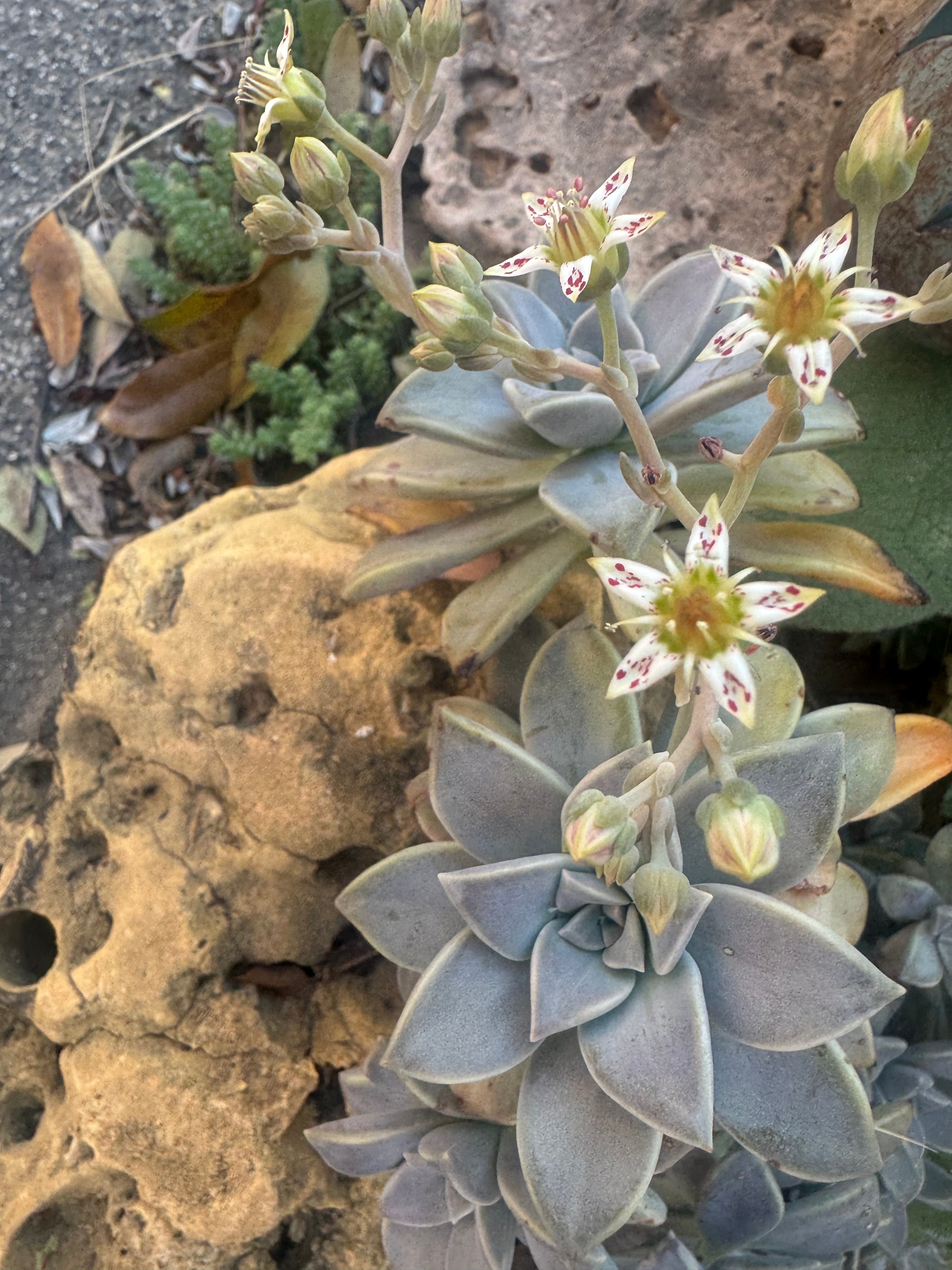
This was the first plant I ever had, well, a descendant, of course. I was about 6 years old. My mother and I were visiting one of her friends. She had Ghost plants in a huge iron kettle used by generations before to heat water over a fire and wash clothes. The plants spilling out of the kettle, now used as a flower pot, enchanted me.

So for sure–gardening is hard work somehow conditions never seem “just right”  too hot too cold too dry  too wet–it all happens.  And we have to get out there anyway.

But don’t just work.  Pause and take a step back every so often.  Think about all the people and all the stories that surround your plants.

Then you will remember why you keep gardening.  Remembering will lift you and bring joy to you even in difficult times.

Thank you plant sharing friends:

Jim has grown so many seeds for the plant sale. This is Pride of Barbados, one of his specialty plants. Hope it blooms soon but even if it doesn’t, I am reminded of Jim and all his work for the garden.
Mark started these cuttings and generously shared. Be sure to notice Althea when you visit The Raincatcher’s Garden. It has been blooming all summer and thank Mark.

Susan Thornbury, Dallas County Master Gardener Class of 2008

The Recreation of The Raincatcher’s Arbor

June 23, 2025

There is something transformative about walking under an arbor. It is a marker for some kind of change, possibly an entrance to a new space, or a transition from one area to another— One thing for sure, is that an arbor sets the space apart.  Arbors come in a variety of shapes, sizes, and materials. It’s difficult to understand all the work that goes into putting up an arbor–Only when you see it unfold before your very eyes will you fully see the scope of the project. Thanks to all who take the time, make the plans, and see it to its final position in the garden.

At Raincatcher’s we’ve been reworking an arbor that was first constructed in 2012 as an Eagle Scout Project at Joe Field, a previous Dallas County Master Gardeners site. changes came and we relocated in November of 2014 to Raincatcher’s Garden of Midway Hills. It was reassembled at the entrance to the North Field Pollinator Garden in 2015.

This arbor served faithfully for several years, supporting multiple kinds of vines, such as passion vine (host plant for gulf fritillary butterfly), crossvine, coral honeysuckle and others added a touch of shade, some color, and best of all, the attraction of pollinators.  In 2024(after about 12 years), the elements contributed to the deterioration of portion of the structure.  Some of the original posts remained and were used in the new arbor.  

 Dallas County Master Gardeners and Raincatcher’s project specialists, Jon Maxwell (class of 2015 and Joe Labay (class of 2008) put a redo of this arbor on the to-do list. . Work began in January 2025 – first, devising a plan, then acquiring materials, and then came execution.  This entailed many little things that made big differences, such as , measuring twice, or 3x if needed, so they cut once; leveling the wood and adjusting yet again. The original design was enhanced for functional and aesthetic purposes, the base was reinforced in concrete to better withstand the weather; more slats were added to the top, and the posts and beams leveled and adjusted numerous times.

It was meticulously assembled after measuring, sanding, painting and placement. Finishing touches included grading the walkway, mulching, adding decomposed granite, placing stepping stones and adding a brick border to complete this garden work of Art. The project took about 5 months, partially due to only meeting once a week on Tuesday mornings.  At times, other issues took precedence, or weather altered plans. It has been well worth the wait!

We at Raincatcher’s are grateful for the commitment and expertise of Jon and Joe to make this beautiful arbor a reality.  

It is a statement piece that welcomes everyone to walk under it and into a pollinator paradise. Come and stroll through the garden and check it out!  We have workers at the garden on Monday mornings and Tuesday mornings; pollinators are more frequent.  See you soon!  

Starla Willis, DCMG class 2011, Jon Maxwell, class 2015, and Joe Labay class of 2008

Constructive tips:

     * Use the best quality materials you can afford. The better the materials, the longer it is likely to last.  Cedar is a better choice than treated lumber. Treated lumber, especially the 4×4 posts tend to warp badly unless thoroughly dry, which are hard to find at the box stores. Cedar, while more expensive, will last longer and will not warp.  If treated lumber is chosen based on cost, be sure to prime and stain it immediately upon installation.

     *     Using materials from the existing arbor may save on the costs, but not necessarily time.            

    *       Plan on it taking longer than you expect —projects have a way of evolving. 

Starla Willis, DCMG class of 2011, Jon Maxwell, class of 2015, and Joe LeBay class of 20

Here’s our step by step decomposed granite walkway instructions.

Pollinator Week

June 22, 2025

Meet the 2025 Pollinator of the year, the Hoary squash bee.

As much as I love bees, the squash bee has escaped my notice. Thankfully, pollinator.org has selected this bee as its 2025 pollinator of the year.

Honey bees are generalists while squash bees rely almost exclusively on squash and gourd pollen to feed their young. They are expert foragers on the squash blossoms of pumpkins, summer squash, winter squash, zucchini and gourds of the Cucurbita Family.

Squash bees are large and bulky like bumblebees, but are more similar to honeybees in their coloring. Compared to honeybees, they have rounder faces and longer antennae.

Sunrise is the best time to be in our Texas gardens and that’s when you might find a male squash bee darting from squash flower to squash flower in search of mates. The females are busy pollinating and build undergound tunnels to store squash pollen and nectar for their offspring.

Why do we need to focus on pollinators?

Our efforts make a difference, and pollinators need our support. I have read that one in three bites of food can be attributed to the work of our pollinators. There is a lack of interest in backyard biodiversity and planting to provide for pollinators. Miles of boxwood bushes and plastic lawns do nothing for bees or butterflies. Even flowers like periwinkles do not provide pollen, so we need to be more intentional and protective of pollinators and select and provide for them. Doug Tallamy reminds us” plants are not just for decoration, plants are vital ecological entities that do so many things.”

Start small, your backyard can become an oasis for you and our pollinators. If you need help, call a Master Gardener or visit our garden, The Raincatcher’s Garden, at 11001 Midway Road in Dallas. There are many good books and native plant lists available.

Ann Lamb, Dallas County Master Gardener Class of 2005

To learn more about honeybees, one of our favorite pollinators, buzz over these articles.

What is Honey?

Communication in the world of bees, let’s dance

The Three Different Types of Honeybees

Telling the Bees

The Colors of Honey

LARKSPUR A BEAUTIFUL LIVING LINK TO THE PAST——AND TO THE FUTURE

May 3, 2025

What a great plant larkspur is.  Coming up from the seeds of last springs plants–living all winter as little fluffy greenery  and suddenly growing tall and blooming before most other flowers.

Winter can be a challenge  but finding the tiny larkspur seedlings and thinking of whats to come lifts the spirits.  What a bonus that they honestly do not need a great deal of help from the gardener to grow and thrive.

As with most self seeding plants they come up where they wish to and may require some editing.  If they are too crowded they won’t be their best so don’t hesitate to thin out the smaller ones.  This will allow the remaining plants to grow tall. This adds structure to the spring garden.  The color honestly goes with everything.  Pink poppies–nigella–combined with the blues and purples of the larkspur–its a picture waiting to be painted–at least admired by you and anyone lucky enough  to pass by.

Watch carefully larkspur is a magnet for native bumblebees.  As we know bumblebees have been struggling.  Seeing so many enjoying the larkspur makes growing them worthwhile in itself. 

But wait–there is more!!  When you grow larkspur you are growing a plant that has been grown by gardeners for hundreds of years.   The Victorians  were very fond of them–they were popular gift flowers.  

In medieval times they were grown in monastery gardens.  These gardens had to be useful not just beautiful. 

Now–lets pause–important information will follow:  all parts of larkspur are toxic.  Do not consider internal use.  But its great to know that people tried their best to help and use what they saw around them.  Potions were made to treat a variety of problems including depression and anxiety.  The seeds were used to make a solution to kill lice.  That had to be a welcome relief as lice were a horribly common problem.  In fact this use continued for a long time –soldiers used it during the revolutionary war.. 

The flowers can be used to make a dye and were used by the monks to make a blue ink.

So think of all those before you as you work in your garden–and remember you are a link in this long chain. Remember yes–but as always–there is more.You obviously must let the plants finish their blooming and go to seed–yes this can be a bit untidy but its essential.  Lots of seeds will fall and they will lie in wait until next winter when the cycle starts again.  But don’t let them all fall–gather some seeds.  

Share some seeds with friends and neighbors–answer their questions about how to grow larkspur.

So the chain that links the plant and the gardener to the distant past will extend into the future–and you are and will be a link in that chain.

Susan Thornbury, Dallas County Master Gardener Class of 2008