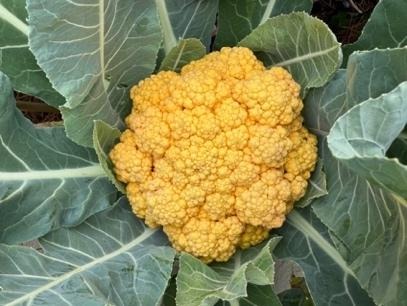
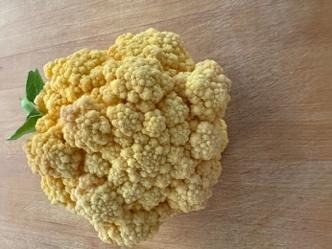
Here’s something that we hope will make you smile-a yellow cauliflower, named for its resemblance to the yellow-orange color of cheddar cheese. Developed for its appealing color, this cauliflower contains high levels of beta-carotene and is richer in Vitamin A than white varieties. From a flavor perspective, it offers a slightly sweeter, nuttier taste and retains its vibrant color even after cooking.
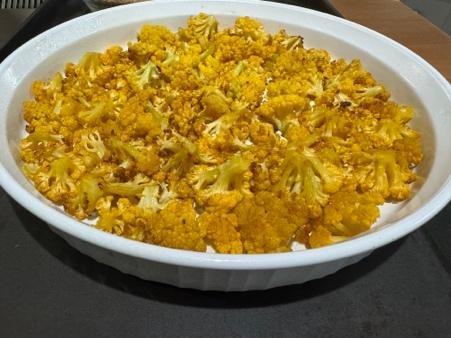
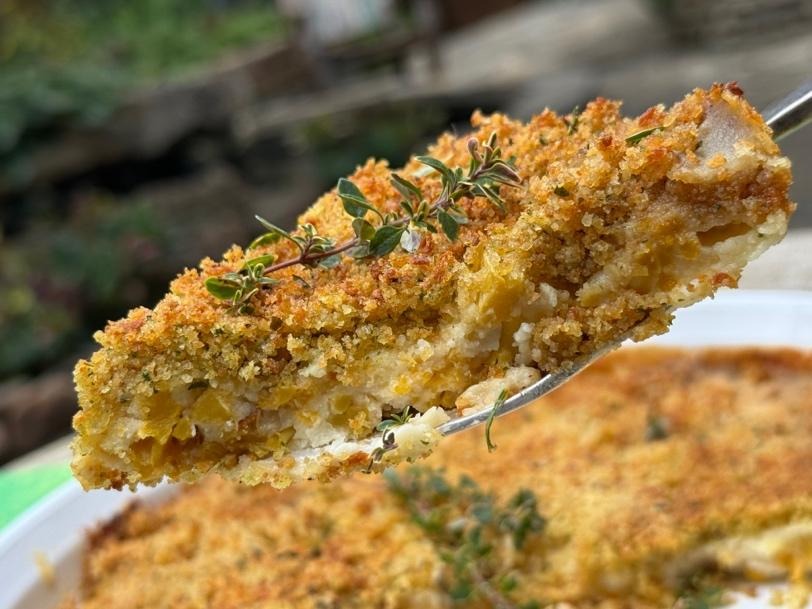
If you’re ready to elevate the taste of cauliflower and enjoy it as simple side or an elegant main dish, here’s a recipe that will deliver a palate pleasing experience.
Last summer, 2024, I grew Fairytale Eggplant for the first time. It produced adorable little tear-drop shaped eggplants for over three months. During that time, most of the harvest was used for Apple and Eggplant Quesadillas, a simply delicious treat.
For 2025, a new recipe that we’ve enjoyed over the past few months is “Roasted Fairytale Eggplant Salad with Fresh Tomato”. Inchelium Red organic garlic had cured from my late spring/early summer crop, while fairytale eggplants, English cucumber and mint were growing in my garden and ready to use.
It’s now early October and my two Fairytale Eggplants are producing almost double the amount as last year. Here’s an example of what gets harvested every day.
Fairy Tale EggplantEnglish Cucumber Spearmint
Linda Alexander, Dallas County Master Gardener Class of 2008
Here’s a hint – with its strong lemony scent and flavor, you’ll find many uses for it in the kitchen. You may have already guessed just by looking at the photo but, yes, the answer is Lemon Verbena (Aloysia triphylla). For over 30 years it has been my very favorite herb. I’ve used it countless times for breads, cakes, cookies, puddings, in savory dishes and beverages. From early spring when it emerges from the ground and sends up those first “shoots”, a fresh sprig goes into my daily glass of green tea. The ritual continues until at least November or whenever our first freeze of the season arrives.
Lemon Verbena Tea Garnished With Freshly Cut Lemon Verbena
Why should lemon verbena be growing in your garden? To start, lemon verbena is considered by some to be the queen of aromatic herbs, myself included. One whiff of its sweet lemony aroma explains why Southern ladies suffering from the “vapors” mopped their brows with a decoction made from its leaves. For this reason, it is sometimes called the Scarlett O’Hara herbs. Growing in our Zone 8 climate, you can expect lemon verbena to easily reach 4 to 5 feet in height when planted in full sun and in good garden soil. Consider placing it toward the back of your garden bed where it will become a nice informal shrub. Also, keep in mind that it tends to ramble off in different directions but can easily be trimmed to the shape you desire. Lemon verbena is a woody perennial that will start losing its slender, elongated leaves in late fall. If heavily mulched, it will survive a moderate winter. However, in the northern part of Texas, it may succumb to temperatures lower than 25° F. Over the years, I’ve lost at least five or more lemon verbena plants during a hard freeze. But once spring arrives, most local garden centers have it in stock. And, thankfully, it is a relatively quick growing plant.
Lemon Verbena Growing Gracefully in My Garden
Recently, I discovered a recipe in one of my 1995 herbal cookbooks that gave me a new appreciation for using lemon verbena with another well-loved herb, Anise Hyssop (Agastache foeniculum). In the summer section of ‘Today’s Herbal Kitchen’ published by the Memphis, Tennessee Herb Society, the recipe that caught my eye was Anise Hyssop Lemon Cake with Lemon Sauce.
Anise Hyssop is a pollinator-friendly plant whose blossoms are filled with honeybees
Reading through the short list of ingredients, I learned that anise hyssop was called for in the cake along with lemon verbena leaves in the sauce. Hooray! With both herbs growing in my summer garden, it was time to start baking.
Freshly snipped anise hyssop flowers ready to be chopped and mixed into the cake batter
Once out of the oven, and allowed to cool, it was time to slowly pour the luscious, warm lemon sauce over the top. I tried to imagine how the minty, licorice flavors of the cake would blend with the citrusy, floral taste of the sauce. Should I wait for my husband to come home from work before tasting? After carefully slicing the cake for the “photo shoot”, I yielded to temptation and willfully gave in to that first bite. It was a divine experience. My taste buds were rejoicing at the thought of this wonderfully harmonious combination. A new discovery is usually very satisfying and, in the case of anise hyssop and lemon verbena, I’ve determined that for as long as herbs are growing in my garden, these two “companions” will be there.
Have you been feeling somewhat listless or despondent over the last few weeks? Are you experiencing a period of inactivity or lack of energy? If so, you are not alone. It may be that those summer doldrums have many of us in a wearisome summer slump!
We’ve all, no doubt, spoken those words many times over the years. However, for the first time, my curiosity motivated me to do a little investigating into the meaning of “doldrums”. Much to my surprise the doldrums are for real! In oceanographic terms, they are a part of the ocean near the equator abounding in calms and light shifting winds.
In the early 19th century, the word doldrums came to be applied to certain tropical regions of the ocean marked by the absence of strong winds. Sailing vessels, depending on wind propulsion, struggled to make headway in these regions, leading to long, challenging journeys.
While the exact etymology of doldrums is not certain, it is believed to be related to the Old English dol, meaning “foolish” – a history it shares with our adjective dull.
Click here for a much more scientific and very fascinating explanation from NOAA
If you are like other gardeners waiting for the winds to “pick up”, here are a few refreshing ideas to help you navigate through the summertime blues! One of the most delightful ways to celebrate the hot, sticky last few weeks of summer is found in the herb garden. When I’m in search of a culinary treat, summer herbs seem to have the answer. Let’s look at a few of the heat-tolerant, dependable standouts that satisfy the craving.
Whatever your preference, vibrant flavors ranging from sweet and floral to savory and pungent can be found in herbs that persevere through the high heat and icky humidity of summer.
Offering aromatic qualities from minty and citrusy to earthy and woodsy, consider these flavor profiles to suit your preference:
*Sweet and floral: basil, lavender and anise hyssop
*Citrusy: lemon verbena, lemon balm and French sorrel
*Minty: various mints (spearmint, ginger mint, peppermint, etc.), nepitella, oregano and thyme
*Earthy: sage, rosemary and thyme
*Pungent/Spicy: chives, papalo, French tarragon
Enjoy the simple pleasures of growing and harvesting summer herbs. Some of the most satisfying ways for using fresh herbs are found in sprinkling, scattering and tossing over fruits, salads, vegetables and desserts for a delectable finish. Other than a quick trip to the grill, bake free is the best way to savor the gifts of our summer gardens. Use freshly gathered herbs to elevate your food from tasty to irresistible!
Here are a few ideas for a cool ending to summer:
Grilled Peach and Blueberry Salad with Fresh Mint
Peaches grilling in a nonstick grill panHoney infused balsamico used as a dressing for the saladGrilled Peach and Blueberry Salad
Creamy Chilled Cantaloupe Soup Garnished with French Tarragon and Blue Borage Blossoms
Ground sumac spice for cantaloupe soupCantaloupe growing in my August garden.Creamy chilled cantaloupe soup
Yellow Pear Tomato Salad with Red Rubin Basil, Nasturtium Blossoms, Basil Pesto and Mozzarella Pearls
Yellow pear tomatoes growing in my August gardenYellow Pear Tomato Salad with nasturtium blossoms
“Fresh peaches are nature’s candy”. From an unknown source, comes this quote that my husband embraces fully. It’s especially true at our house around late June to mid-July when those much-anticipated east Texas, Parker County and Hill Country peaches hit the local fruit stands and farmer’s markets. We’ve been known to buy several bushels during that time.
On a recent weekend trip to the deep piney woods of east Texas, we experienced an exceptionally flavorful peach event. Hosted by our dear friends, Sharon and Jason Romano, developers of a stunning place near Overton known as High Hill Resort Community, what could be more appropriate than to celebrate their annual peach-themed dinner extravaganza!
Bushels of peaches from local growers arrived at their doorstep a few days prior to the dinner. The restaurant’s chef had already created the menu so preparations for feeding 64 guests went immediately into action.
At 6:00pm diners were welcomed to their seats and the “peachy” feast began. Please enjoy reading through the menu and viewing photos of a masterfully curated “Philley Peach Dinner”. Congratulations to Executive Chef, Ryan Dove, and Sous Chef, Matt Frazier, for treating us to a truly memorable event!
And thanks to our friends for sending us back to Dallas with 2 bushels of those summer jewels from east Texas!
Here is a short list of several recipes we will be enjoying over the next few weeks:
Did you know that not all cukes are created equal? To simplify, there are two main types of cucumbers, American and English. Both can be used for pickling and slicing. This year I decided to try the English variety in my raised garden bed. Also, to save space, I used a trellis type support system for growing it vertically. That proved to be a very good decision.
13 inch long English cucumber ready to be harvested from my garden
After about two and a half months in the ground, my little cucumber transplant has covered the trellis and produced over a dozen cucumbers. English cucumbers generally grow thinner and straighter than their American counterparts and can grow in the range of 12 to 24 inches long. So far, I’ve been harvesting them at around 12 to 14 inches in length.
English cucumbers have a sweeter flavor and delicate skin that is less bitter than that of other cucumbers. Many sources say that English cucumbers tend to have very few seeds but, as you can see from the photo, mine had a generous amount.
Seeding an English cucumber with a serrated grapefruit spoon
Tips for growing:
*Plant in an area of the garden that receives a minimum 6 hours of sunshine daily.
*Prepare the soil by tilling well while adding aged compost to a depth of 6 inches.
*On average, cucumbers require: 1 inch of water per week in moderate conditions, twice per day when temperatures exceed 90°F.
*Add a 4-inch layer of organic mulch around base, but not touching the stem.
One of my favorite cucumber recipes is from a place in the Texas hill country where my husband and I, for over 35 years, always enjoyed having lunch. It was an absolutely charming restaurant in Fredericksburg known as ‘The Peach Tree Tea Room’. The Pedregon family opened their new venture in the fall of 1984. It brought in diners from all over the United States and internationally, as well. Sadly, it closed a few years ago leaving a void in the Fredericksburg culinary scene. Thankfully, over the years, I purchased all three of their wonderful cookbooks. The recipe I’m sharing is from their first cookbook, published in 1990. It is the recipe for ‘Chilled Creamy Cucumber Soup’.
Making the recipe over the weekend brought back cherished memories from those early days in Fredericksburg. It was especially rewarding to use three of the ingredients called for in the recipe from my garden; English cucumbers, parsley and garlic that was curing in my pantry.
Chilled Creamy Cucumber Soup Garnished with Freshly Chopped Parsley and Tomatoes
Hope you will be inspired to take a cool and refreshing break with ‘Chilled Creamy Cucumber Soup’. In the meantime, chill out with these tasty, sliced cucumber appetizers.
English cucumber slices topped with Herbed Cream Cheese, Salad Burnet and Borage Blossoms
And, just in case you were curious about the title…’Cool as a Cucumber’. I did a quick online search and learned something new. First, the inside of cucumbers are approximately 20 degrees cooler than the outside air. And the phrase ‘cool as a cucumber’ first appeared in a poem by the English author John Gay in 1732. It expresses the narrator’s angst regarding a woman with unreturned love! Today, that phrase is used to describe someone who tends to remain calm, assured and composed in any situation.
Linda Alexander, Dallas County Master Gardener Class of 2008
A recent Savannah Bee email was so inspiring to read that I immediately ordered three jars of what founder Ted Dennard described as “the happiest honey around”. Sourced from the beekeepers of Ukraine and Romania, it truly is “as sweet as a summer day.”
For more information about the women beekeepers who produce and distribute this remarkable sunflower honey, please follow the link to Savannah Bee. Their story is one of determination and perseverance in continuing the art of beekeeping for future generations.
Also, please revisit a blog article posted by Master Gardener Starla Willis in August of 2022. It features her summer trip to Ukraine where she captured an amazing photo of sunflower fields from her train ride across the country. She has cherished memories of that special experience.
For a quick breakfast treat, spread this yummy, crystallized honey onto a toasted English muffin.
Candied Sunflower Seed Snack
Only 5 ingredients from this to this!
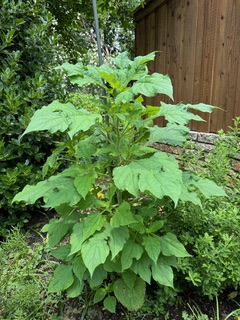
And this might be the summer to grow your own sunflowers for some additional honeybee activity in the garden. I’ve decided to try the big one: Mammoth Sunflower Helianthus annuusIt’s only been in the ground for one month, is already over 4 feet tall and filled with buds
*Note: For all products and references to Savannah Bee go to savannahbee.com
Linda Alexander, Dallas County Master Gardner Class of 2008
It’s as common in the garden and grocery isles as parsley but there seems to be a level of misunderstanding that needs addressing. First Coriander and Cilantro are the same plant. The confusion is found in the seeds. It is also sometimes referred to as Chinese parsley because of its long history of use in that cookery. To clarify, the name “coriander” comes from the Greek koris, meaning bug, in reference to the odor of the leaves. And who hasn’t heard the taste of cilantro described as having a “soapy” character?
Historically, coriander has been used for culinary and medicinal purposes for over 3,000 years. It is mentioned in Sanskrit texts, on Egyptian papyri and in Tales of the Arabian Nights.
In the Bible it is compared with manna. (Exodus 16:31 – “And the people of Israel called the bread manna. It was white like coriander seed and tasted like wafers made with honey.” NASB)
Coriander was brought by the Romans to Europe, where it now grows wild. In Mexico and throughout the Southwest you’ll find cilantro leaves used as a necessary flavoring ingredient in salsas, salads, soups, chicken and meat dishes.
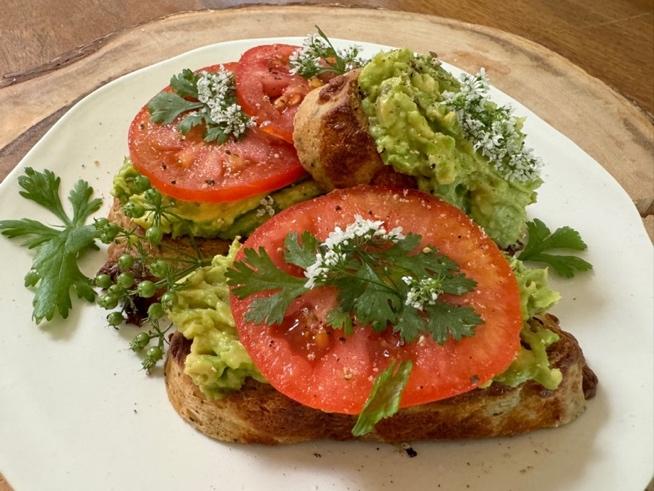
Today, coriander is grown primarily for the leaves, but chefs are discovering new ways of using the entire plant. Interestingly, for me, while working in the garden last week, a cilantro plant filled with lacey, petite white flowers caught my eye. After taking a few colorful photos, I couldn’t resist snipping a delicate umbel and popping it into my mouth. While the leaves of coriander/cilantro have a much more assertive personality, the flowers offered a milder, citrus-like taste that was cool and refreshing. It was an “ah-ha” moment for me. Never before had I considered using the delicate flowers in my cooking. I’m now convinced that a creative approach to using them will be enjoyed and appreciated. It is recommended cilantro flowers always be used fresh, never dried.
(Avocado Toast with Tomato Slices, Freshly Snipped Cilantro Flowers and a Splash of Apple Balsamic Vinegar)
(Asian Noodle Salad with Fresh Cilantro Flowers)
*Finally, here’s an easy way to simplify the confusion. When people speak of cilantro, they are referring to the stems, leaves and flowers of the plant. Coriander usually refers to dried seeds. All are edible so, please, enjoy using the entire the plant in your future cooking adventures.
Linda Alexander, Dallas County Master Gardener Class of 2008
Early last fall I planted a 4” pot of caraway in my raised garden bed. That little plant has now more than tripled in size.
Just a few days ago tiny white flowers appeared atop the feathery foliage. Blooming should continue until sometime during late spring or early summer when spent flowers yield those small, but wonderfully aromatic, hard brown seeds used in cuisines throughout the world.
If you’ve never grown caraway in your garden, follow along as we learn more about this carrot-like plant which is edible from root to shoot!
Caraway is a hardy herbaceous biennial requiring two seasons to complete its life cycle. The first year, bright green threadlike foliage resembling that of a carrot form a mound 1 to 3 feet high. Next comes the umbels of creamy white, delicate flowers that resemble Queen Anne’s Lace.
Once the flowers are spent, brown ribbed seeds appear. The familiar caraway seed is actually the fruit of the plant. It is recommended that seeds should be harvested about a month after they have blossomed. To accomplish this, clip off the seed heads and place in a paper bag to finish ripening.
While caraway seeds are most often associated with rye (or dark rye) breads there are a many other applications for using it. Some include: desserts and baked goods, liquors, stews, casseroles and as a flavoring for beef and pork dishes.
When the plant has produced seed, dig up the taproot and use as you would any other root vegetable.
Caraway is a pleasing plant to grow in your herb garden. The lovely little flowers attract beneficial insects, including honeybees.
For two different dinner options recently, we enjoyed caraway leaves straight from the garden in the following ways:
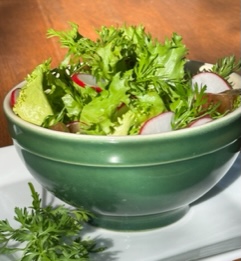
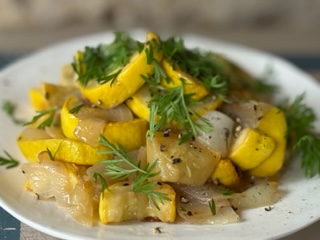
Tossed in a green salad along with radishes, tomatoes, and avocado slices Sauteed yellow squash and onions with a generous sprinkling of fresh caraway leaves for a flavorful lift
Linda Alexander, Dallas County Master Gardner Class of 2008
Walking in the garden early this morning just as sunlight was spreading its glowing rays, I stopped for a moment to gently caress the winter savory. Dew had fallen softly upon it, leaving the cascading branches with a shimmery presence. It seemed to be saying…” use me please”. And that is exactly what happened!
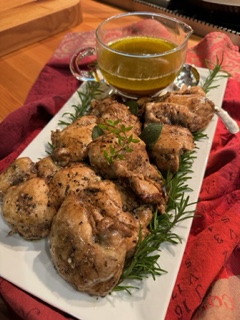
My husband and I love a cozy wintertime dinner by the fire. Thankfully, my winter herb garden had supplied me with the three ingredients needed to infuse the marinade for Balsamic Herb Baked Chicken Thighs: fresh rosemary sprigs, sage leaves and winter savory. This herb-garden inspired recipe delivered a pleasing amount of comfort and flavor for the perfect fireside meal.
Balsamic Herb Baked Chicken Thighs prepped and ready to bakeReady to serve!
Hopefully, you are growing a nice selection of herbs in your winter garden. If so, remember that they liked to be snipped, trimmed and used for culinary and decorative purposes in your home.
*For information about growing winter savory, click here.
*All herbs were harvested just before the cold front and freezing temperatures arrived. They were kept in a damp paper towel lined plastic baggie for two days.
Linda Alexander, Dallas County Master Gardener Class of 2008











 DALLAS GARDEN BUZZ