Music in shops–usually just more noise to be ignored—but then, just every now and again a line from a song provides a useful and welcome bit of advice. A helpful insight for the volunteer gardener.
It can happen that for this volunteer a sneaking feeling that all is not well–a creeping feeling of discontent appears and can grow and affect every hour in the garden. A feeling that the task is too big just too much. And the reward–where is it??? Why aren’t there more volunteers? Does anyone see what I am doing–much less care or appreciate it??
Sadly once this happens –if nothing changes–the next step can be a vanished volunteer.
What needs to change?
The basic situation isn’t going to change. Garden work can be hard and it can be repetitive. Weeds come back without fail. Treasured flowers and veg can seemingly fail for no apparent reason. Add in garden tours to be led, fundraisers, plant sales,and extra work days- all need volunteers and they seem to come around way too often.
So what to do. Everyone has heard it but now its time to believe it. The situation is the same–the response to it that’s different-it can change–a lot–and for the better.
Take a step back and think clearly don’t just react. Remember respond don’t react.
Maybe part of it is listening to a lot of talk of self care. One thing often mentioned is just saying no to requests for help. And of course no one can say yes to everything.
We must take time for ourselves and our own homes and gardens.
But don’t lose sight of the personal benefits of helping either. There are friendships and connections–yes we may have to work on them but its valuable work.
We all want our communities to be better–greener–safer for plants wildlife –and ourselves.
Plant sales and garden tours–well those aren’t just things to get through–they can make a difference. If just a few people learn about plants that will grow and provide help for the bees and butterflies–isn’t that valuable.. If people learn that insects are the foundation of life on earth and they can help protect them, that is your time well spent. If you help a child develop a love for living things not a fear–well what could be better–that is the highest form of self care.
Starla’s niece with cicadaLinda teaching the butterfly life cycleIntroduction to an insectStarla’s son long ago with butterfly
Can you save the earth? No you cannot–but can you make your part of the world a little better? Yes, you can and you make yourself a little better with the time and effort.
We can’t wait for all the others who should be there helping.. Those others that should be appreciating us more. Give them time!! But for now–
We ARE THE PEOPLE WE’VE BEEN WAITING FOR
Many hands make light workVolunteers planting a treeOn their knees, hard at workEnthusaiastic Raincatcher’s volunteers
Susan Thornbury, Dallas County Master Gardener Class of 2008
Join us at the garden, 11001 Midway Road, Dallas, Texas 75229 on the grounds of Midway Hills Christain Church. Our work days are Monday mornings and Tuesday mornings. This is a Dallas County Master Gardener approved project.
Here we are in January–its cold and can be dark and gloomy. So how to appreciate it?
January is named for the great Roman God Janus. This God could look to the front and to the back–seeing both the past and the future–thats a lot right? But really his powers were far greater. Janus was a God of practical importance. When asked by mere mortals assistance could be given to turn dreams into reality. Janus had the power to help the followers to see and understand what actions were needed to recognize an abstract goal and take the necessary actions to make it real.
There seem to have been other powers but those seem quite enough for us to think about in this time of the year that can seem a bit bleak.
In fact it seems very possible that Janus was fond of gardening and was able to use the powers to make gardeners happier.
Well it is hard to say it was all a very long time ago now–but some things don’t change. We want things to be brighter and more cheerful. we know we can’t just wait for it to happen–its up to us–we are going to have to be inspired by ancient wisdom but we are the ones who must make it happen. OK lets turn the idea “make things brighter” into action to make it so. Remember–no just hoping for a good day–make it a good day!
Let’s decide on what to do:
Go and pick some of the lettuce and arugula in the garden make and enjoy a salad–delicious and healthy too.
Take a walk around the yard–Yes its cold but the hellebores are starting to bloom but you will never know unless you go out and look. Winter honeysuckle is covered in lovely white flowers a treat for people and bees but again it requires a good close look those flowers are beautiful but they are small.
Houseplants are right there for enjoyment. Don’t take them for granted and let them become just part of the furniture. Of course do the routine care but take the time to really look closely they will appreciate it and you will reap the benefits. Even the most common of the plants are amazing on close inspection.
Even January can be a wonderful time for gardeners. Lets learn from Janus and take action to make it so!
Enjoy every bloom of the Christmas Cactus!Eveyone including the bees can enjoy the pretty flowers of winter honey suckle. If you have orchids, apppreciate the amazing long lasting flowers.Growing lettuce just makes good sense. It is delicious and healthy.Arugula doesn’t give up and neither should you.Begonias are very easy to grow and not boring!Foliage plants are worth a careful look.What a treat; the Hellebores are starting to bloom.
Susan Thornbury, Dallas County Master Gardener Class of 2008
If the key to life is simply living it.. The key to understanding may be simply realizing that wisdom is all around even in unlikely places. Our job is to realize wisdom when we find it—and then apply it .
For an example let’s think about these simple lines:
YOU GOT TO KNOW WHEN TO HOLD EM
YOU GOT TO KNOW WHEN TO FOLD EM
YOU GOT TO KNOW WHEN TO WALK AWAY
YOU GOT TO KNOW WHEN TO RUN
Few words but the ideas are wise and useful. No where more so than in the garden at this time of the year. We start with the first of course. And actually this idea was most important a little earlier in the year.
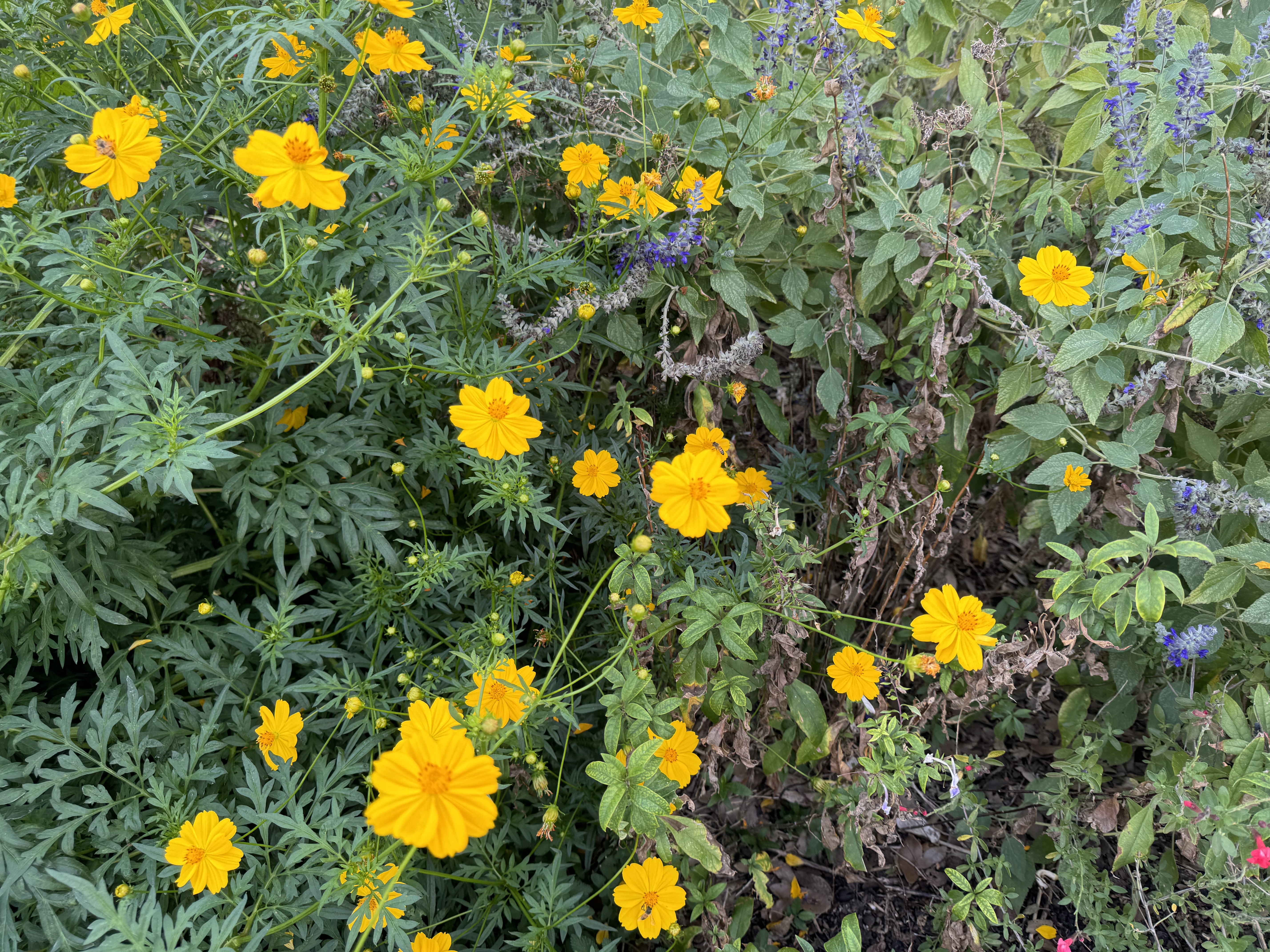
How was it so useful? well the yellow cosmos are a great example. All summer they grew and grew. No flowers at all. Some falling over due to the weight of stems and leaves. A passerby was heard to say ” I don’t know about those green leafy things they sure are big” Were they a terrible mistake? Are they ever going to bloom? Are they going to all fall over? Temptation grew to pull them all out. And then all at once they bust into huge numbers of lovely cheerful flowers. Butterflies and bees are just loving them. They even look great as cut flowers.
Yes!!! holding was the best choice for sure.
The big green leafy things that were bare all summer are blooming at last and they are amazing. Cosmos!
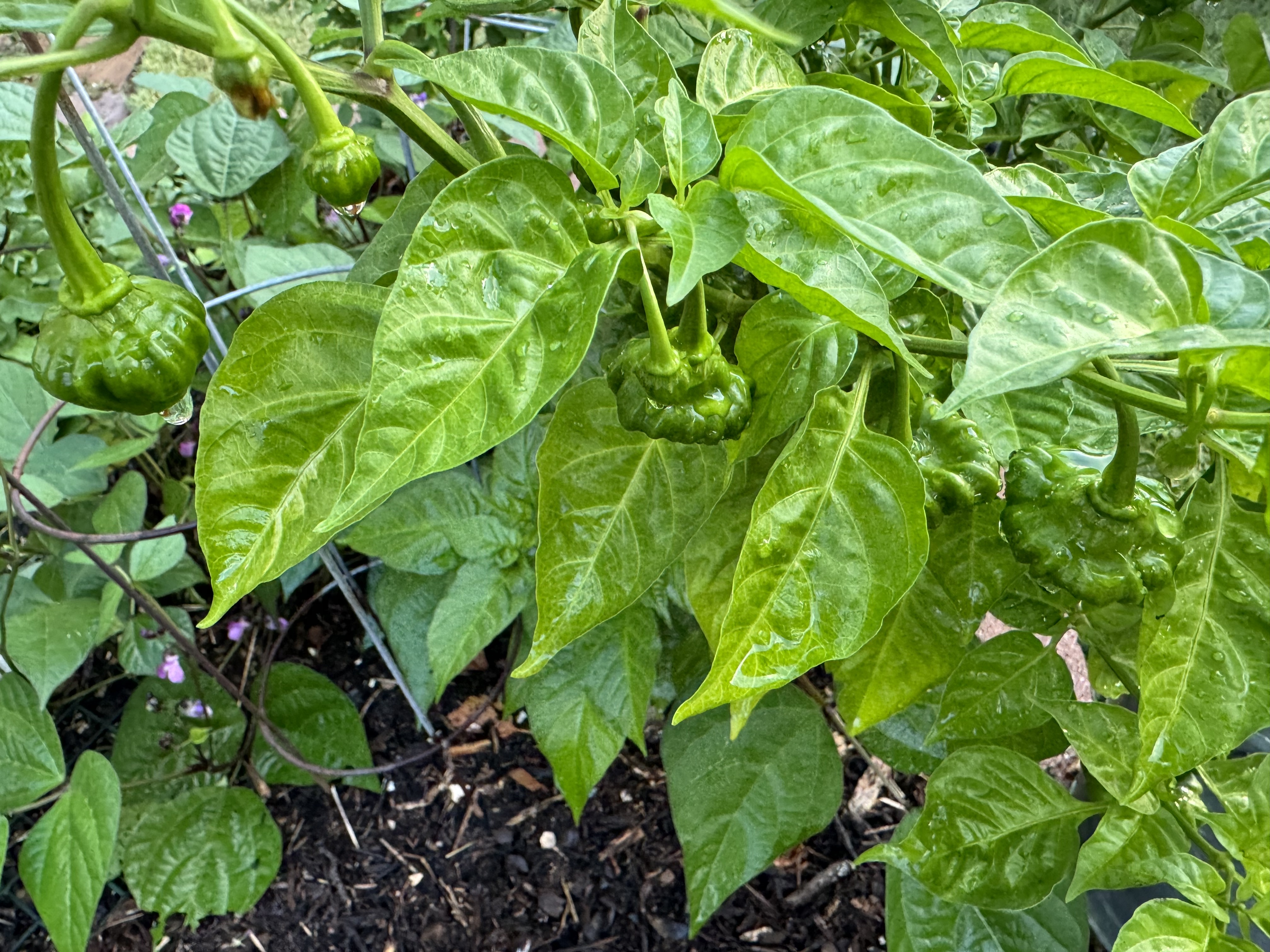
Aji dulce peppers –no peppers for months. All they were doing was taking up space and causing thoughts of “what on earth went wrong?” They were biding their time. Summer just didn’t suit. Just a small improvement in the weather–and blooms followed by lots and lots of little peppers. It was a temptation to give up–but it would have been a shame.
The Peppers finally realizing they have a job to do.
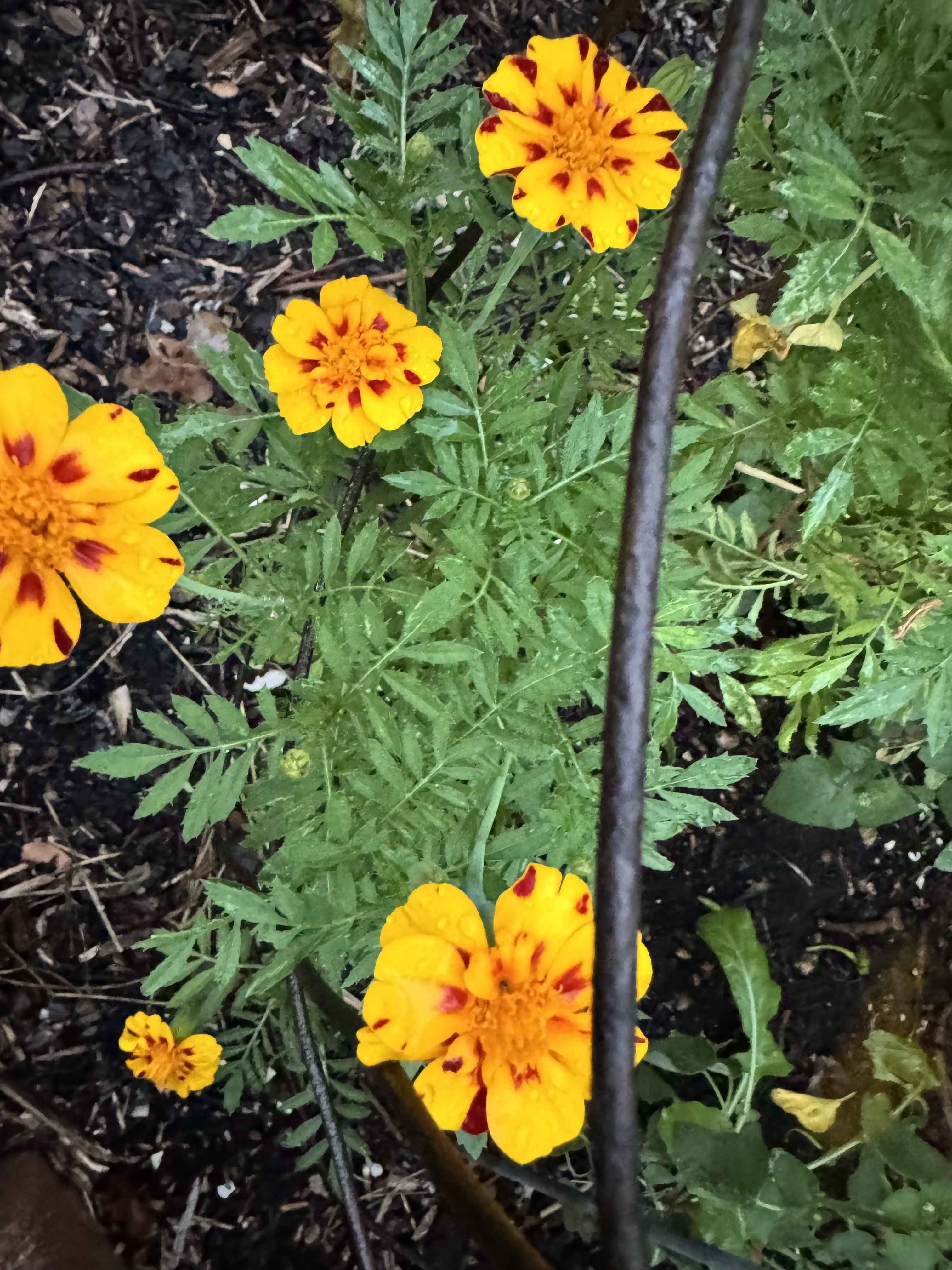
Marigolds–they also seemed to find the past few months not to their liking–the remaining tomatoes are happy maybe because the marigolds are happy.
The Marigolds were to keep the tomatoes company all summer. They are doing it now.
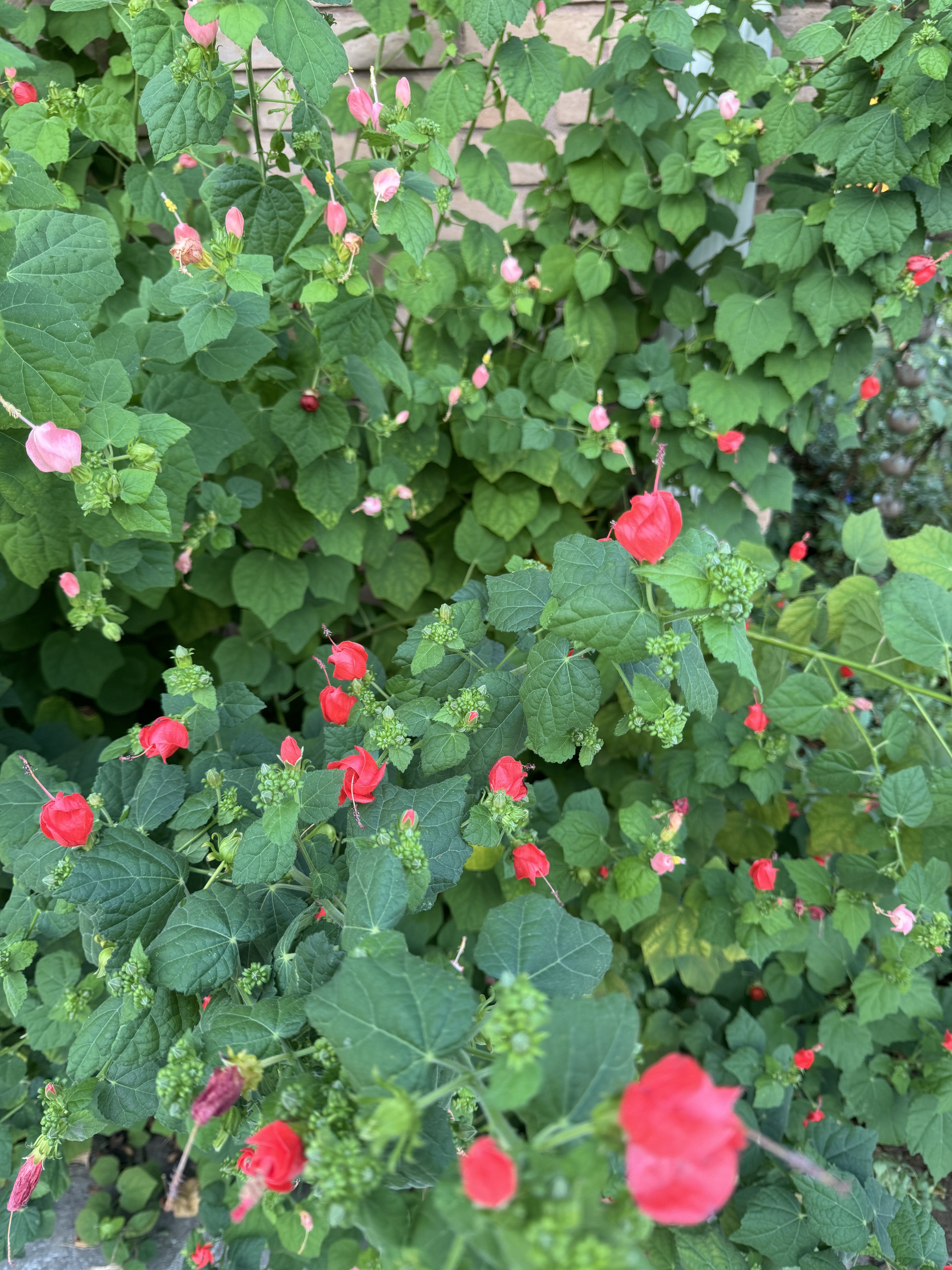
Turk’s cap–honestly it seemed to be asking to be cut to the ground–very few blooms and yet requiring constant pruning to keep it withing reasonable bounds–but–again a reward for avoiding extreme measures–countless flowers–and happy creatures.
Turk’s cap-all summer, some flowers but now covered in flowers.
Of course the facts are–that all doesn’t go as hoped.
The most obvious are annuals that have tried really hard but have now reached the end of the line. It is hard to do this when they aren’t quite done but face it–sad straggliy plants just distract from everything around them. Let them go its ok.
It’s time for an old friend to go. Sad but true.
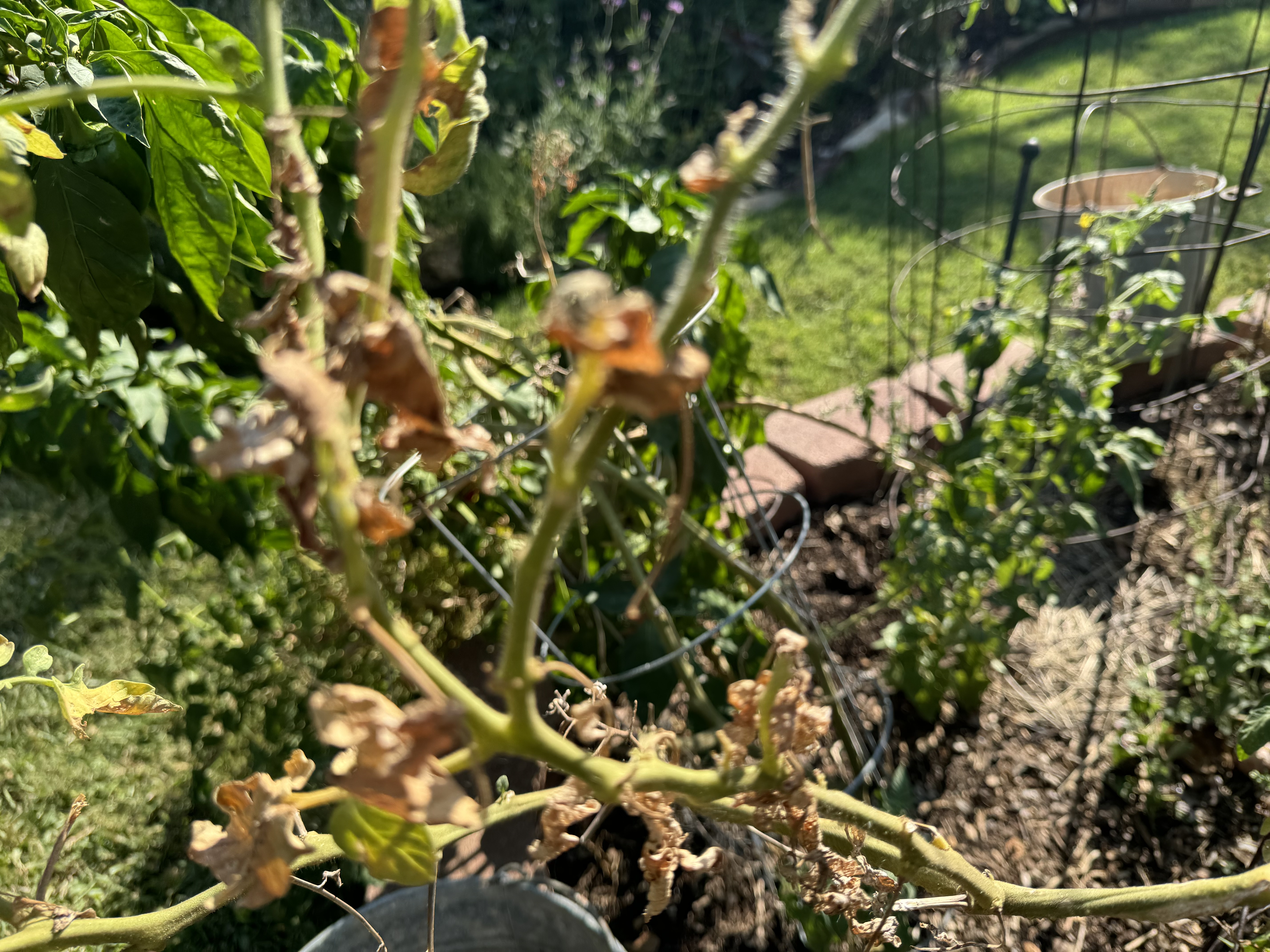
Same with vegetable plants. These plants work hard some can make it on into fall. But some just can’t. It is really best to get rid of them they can attract pests and diseases that are just doing what they do to eliminate the weak–but best to beat them to it.
This tomato in my garden just isn’t going to recover.
The really hard part of the fold ’em is facing that some of your efforts really were in vain. For some reason plants die. Sure try to figure out why. Was it lack of water–a common issue. Maybe over crowding? But sometimes its unknown. Pull them out anyway no use spending resources–including your time and energy on plants that just are not making it.
Perennial doesn’t mean live forever!
Those first two are pretty clear–but what about KNOW WHEN TO WALK AWAY?
Actually its an important one. This is the time of the year when plants have pretty well done what they are going to do. It can be so valuable to step back and away and look at the big picture. Could you do anything different ? Is it just that much too much? Or not quite enough? Walk away and take a good look and make some mental notes for next year.
Is it maybe just a little too much? Take a step back and look.
Can’t forget YOU GOT TO KNOW WHEN TO RUN. No it won’t be a big problem don’t worry. But do keep in mind that wasps and yellow jackets are very active at this time of the year. Of course they are part of nature and normally not an issue–but do look around they like to build nests in protected places–who doesn’t of course–but sadly when its right above the back door for example you may have to do what you would rather not. But be careful at times their temper can be kindly said to be “Uncertain” And i hope you don’t have to run–but—-.
YOU GOT TO KNOW WHEN TO HOLD EM
YOU GOT TO KNOW WHEN TO FOLD EM
YOU GOT TO KNOW WHEN TO WALK AWAAY
YOU GOT TO KNOW WHEN TO RUN.
Susan Thronbury, Dallas County Master Gardener Class of 2008
Fall is a good time to plant Hardy Hibiscus and Hydrangeas for spring and summer blooms.
Blissfully soaking rains in April ushered in the arrival of extraordinary May flowers. How refreshing to see these three stalwarts of the garden bursting with blossoms as they made their dramatic appearance in the landscape. New growth started to emerge on these three beauties sometime around early April. Continuing into May, they filled out with tender green leaves, buds and blossoms.
June’s gift to us was an explosion of color. The temptation to selectively snip and arrange them for indoor enjoyment was overwhelming. Restraint was needed but rather difficult to achieve.
Hibiscuses (Malvaceae)are in the Mallow family and, interestingly, also include such plants as okra, cotton and the old-fashioned hollyhock. My preference for dependable seasonal color is the tropical variety, which is considered an annual in our Zone 8 climate. Late winter is when I start planning the layout and design of my seasonal garden beds. Hibiscus is ALWAYS included. Who wouldn’t appreciate a flowering, seasonal plant that can go into the ground during the month of April and continue blooming until the first freeze? Another benefit: it’s the type of plant that manages itself well. During the growing season when glossy green leaves begin to turn yellow and die, they politely fall to ground. Blossoms that open for a few days, do likewise. They really are gardener friendly plants!
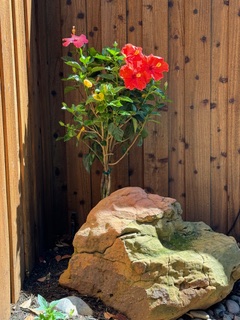
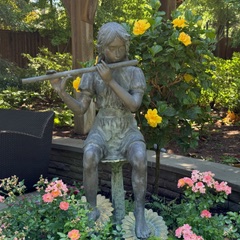
This year I’ve included tropical hibiscus in different shades of pink mixed in with existing limelight hydrangeas. They receive about 6 hours of morning to mid-day sun. And for a bit of whimsy, two hibiscus topiaries were added in areas that benefited from slightly more height. One is my favorite; it was placed behind my sunflower girl statue and features dreamy double yellow blossoms. The other is a sassy 4 foot tall, braided hibiscus topiary tree nestled in a corner bed. The multi-colored blossoms are a standout against our bronze colored fence.
Starting in late June our three hardy hibiscus plants began their seasonal show with those bodacious salad plate size flowers. These herbaceous perennials die to the ground in winter then around mid-April new growth signals their return to the garden.
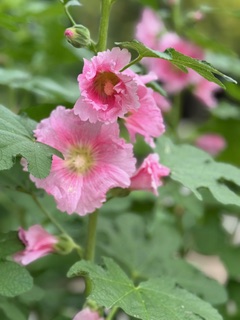
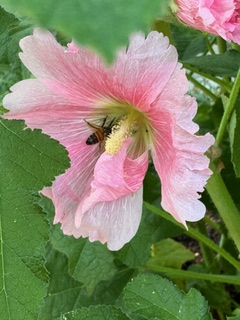
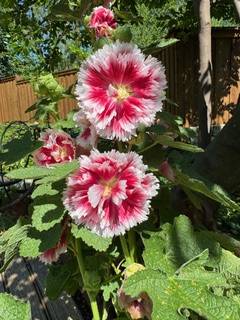
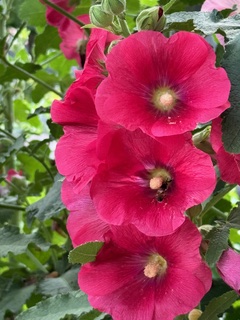
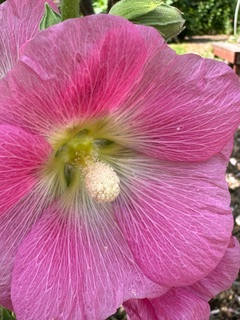
King Henry VIII Pink Hollyhocks with Honeybees Foraging for NectarPlanted 2023 in a location with morning sun and mid-afternoon shade‘Fiesta Time’ was added to my garden in May. Its fringed flowers are stunning
At Raincatcher’s Garden of Midway Hills, Master Gardener Susan Thornbury started seeds of a variety respectfully referred to as ‘Outhouse’. In days past, this treasured garden beauty was supposedly used as the perfect blocking for an unsightly outhouse while helping to mask the smell. Take a closer look at the multi-colored single blooms of white, pink, red and burgundy and you’ll see why it provided a pretty visual barrier.
Hydrangeas: When we moved into our home in May of 2006, oak leaf hydrangeas were already growing in a mostly shaded area of the garden. A few years later, they had overgrown the space and needed to be moved. A successful relocation to an area with filtered sun in the morning gave them more room to stretch their branches.
Since then, we’ve introduced a variety of hydrangeas to our garden beds:
*Big Leaf Hydrangea – Hydrangea macrophylla (Also, known as ‘mopheads’, these are the most common type of hydrangeas grown in home gardens and landscapes. Bloom time is usually late April through July. They are deciduous shrubs with large pom-pom heads of pink, purple or blue flowers. The flowers are greenish-white when young, picking up subtle shades of pink and brown as they age.
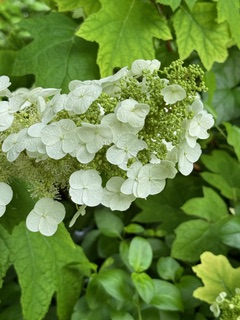
*Oakleaf Hydrangea – (Hydrangea quercifolia) Commonly referred to by its translation oak-leaved or oakleaf hydrangea, this variety offers year-round beauty with seasons of blooms, foliage and peeling bark. Blooms in spring and early summer. These beautiful plants were already growing when we moved to our home in 2006. Since then, I have searched for the compact, well-rounded deciduous hydrangea shrub known as ‘Ruby Slippers’. Finally, in mid-June, our local garden center received a shipment. I was first in line to purchase 3 plants. It was a special Father’s Day gift for my husband whose late mother was Rubye. He was thrilled! Oakleaf hydrangeas bloom on last year’s growth, so prune minimally after they bloom – not in early spring when new flower buds appear.
(This incredibly spectacular display of oakleaf hydrangeas is in the yard directly behind our house. It is the first thing that catches my eye when turning to leave our driveway. The photo on the left was taken in April when the plants were filled with those enormous white blossoms. Early to mid-summer they transitioned to lovely shades of deep pinkish/red. While the specific variety is unknown, something suggests to me that they could possibly be “Ruby Slippers’.)
*Panicle Hydrangea – (Hydrangea paniculata) This is one of the most cold hardy and heat tolerant of all species of hydrangea, thriving in Zones 3 through 9. Reaching 8’ + at maturity, there are now several dwarf varieties that stay under 5’ tall. For the strongest stems and the most abundant flowers, locate them in an area that receives 6+ hours of bright, direct morning sun then shaded during the hottest part of the day. We added ‘Limelight’ to our garden in 2022 and it has been a joy to watch them grow. Their huge, luxuriant conical flowers are mesmerizing. Bountiful blooms appearing in late May gradually turn from lime-green to creamy white in late summer followed by a rich deep pink which fades to beige as fall arrives.
*Of note, these hydrangeas are a recipient of the prestigious Award of Garden Merit of the Royal Horticultural Society and the Gold Medal Award of The Pennsylvania Horticultural Society.
Note: All photos were taken in the April – July time frame. The 100+ degree temperatures of the summer have left some plants struggling to endure the extreme heat. However, just as happened last year, the hardy hibiscuses, hollyhocks and hydrangeas will return next spring. The tropical hibiscus plants are going to be replaced with a new color palette in April of 2025.
Linda Alexander, Dallas County Master Gardener Class of 2008
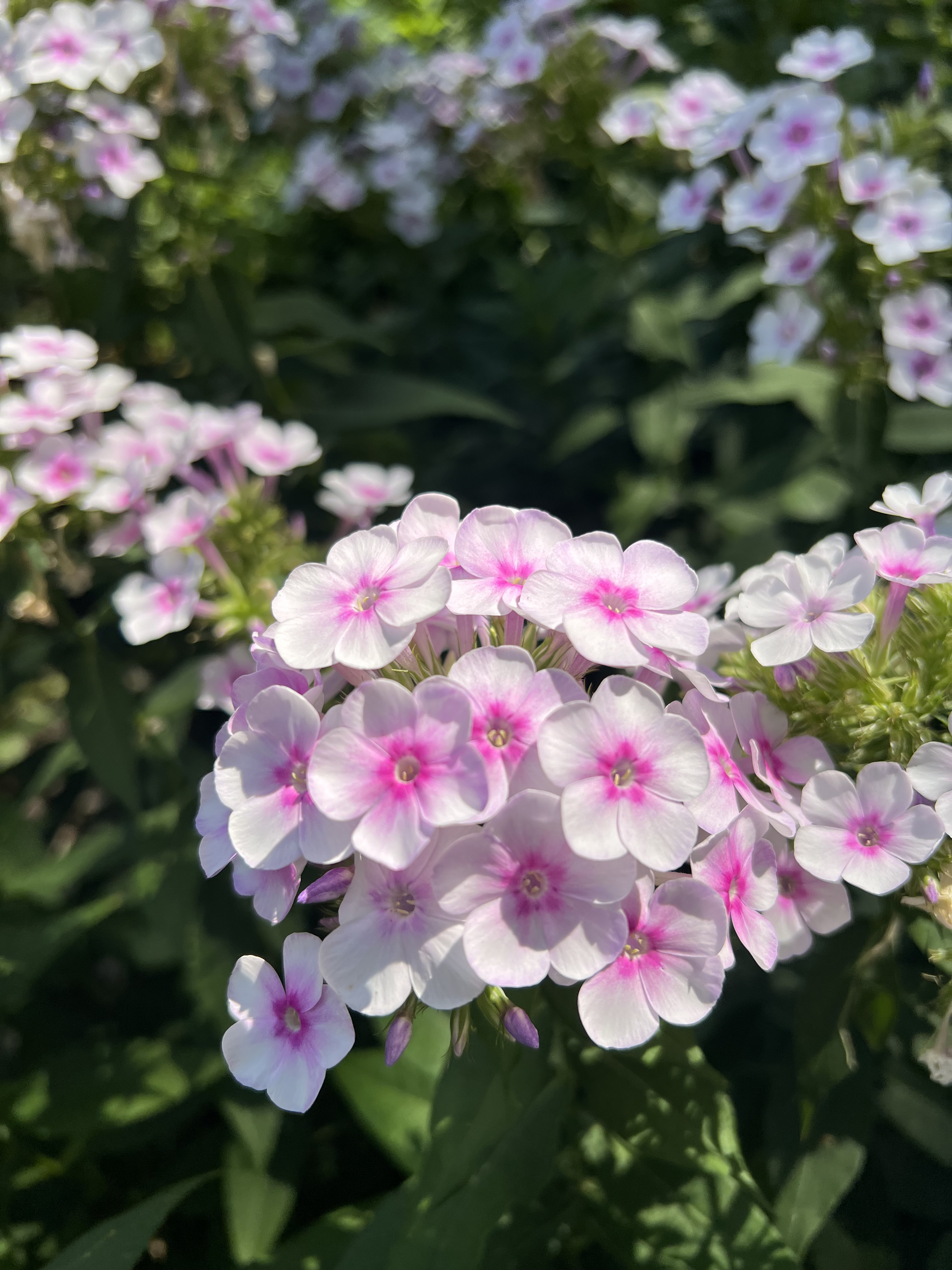
Everyone’s garden needs a leading lady. Have you considered Summer Phlox as yours? This tough, heat tolerant perennial makes a 3″ tall show stopping clump that lasts from early summer through fall. Texans make sure to select the Victoria Phlox shown above or the John Fanick cultivar. They have both been named to the Texas Superstar Program which means they will perform well in your garden and after all they probably grew at your grandmother’s homestead.
Phlox paniculata ‘Victoria’ at my house with boxwood and white Turk’s CapNeighbor’s PhloxPhlox along a garden path at Linda’sClose up, note the many tubular flowers forming a panicleRaincatcher’s Phlox ‘John Fanick’
Many things connect us to our gardens.We have had a busy spring at The Raincatcher’s Garden.
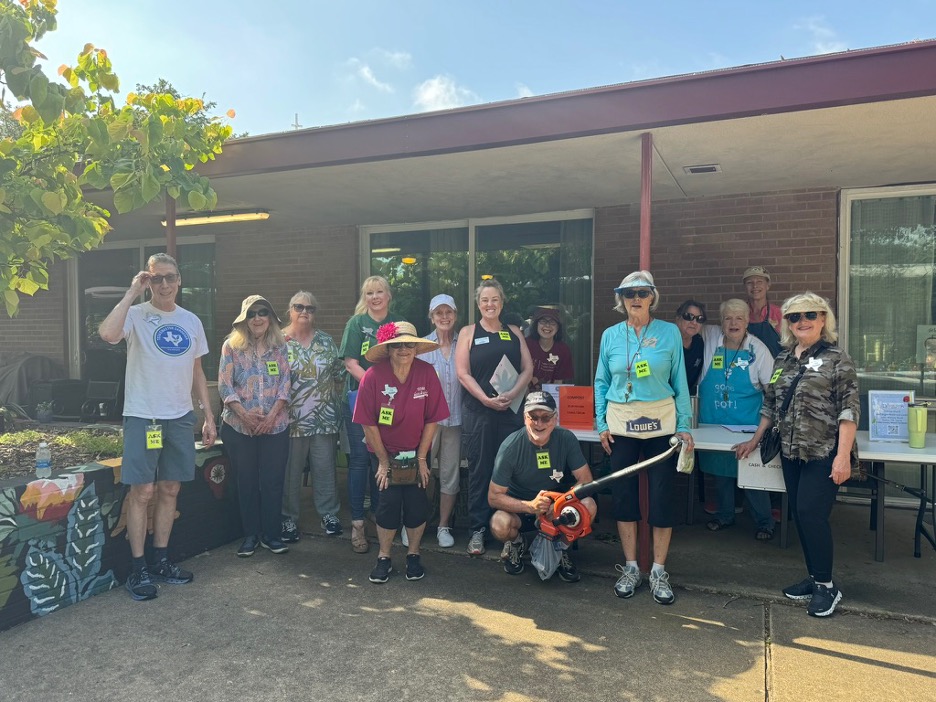
Garden chores become pleasure when we work together. Spring has consisted of weeding, seed collecting, watering and learning from each other and then sharing the fruit of that knowledge with all ages and also agencies that assist others
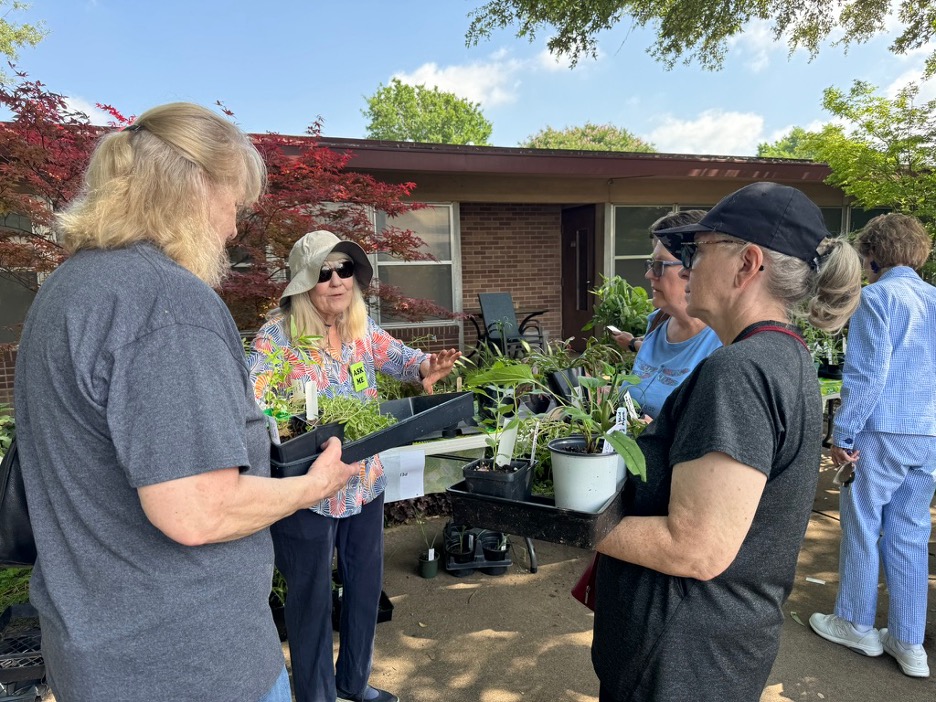
North Dallas Shared ministries received over 200 lbs of fresh vegetables to distribute from the Raincatcher’s Garden.Our compost crew hard at work. Combining efforts and resources for common goals. Here we are at our annual plant sale Jackie, Sue and Deborah at the Raincatcher’s Plant Sale
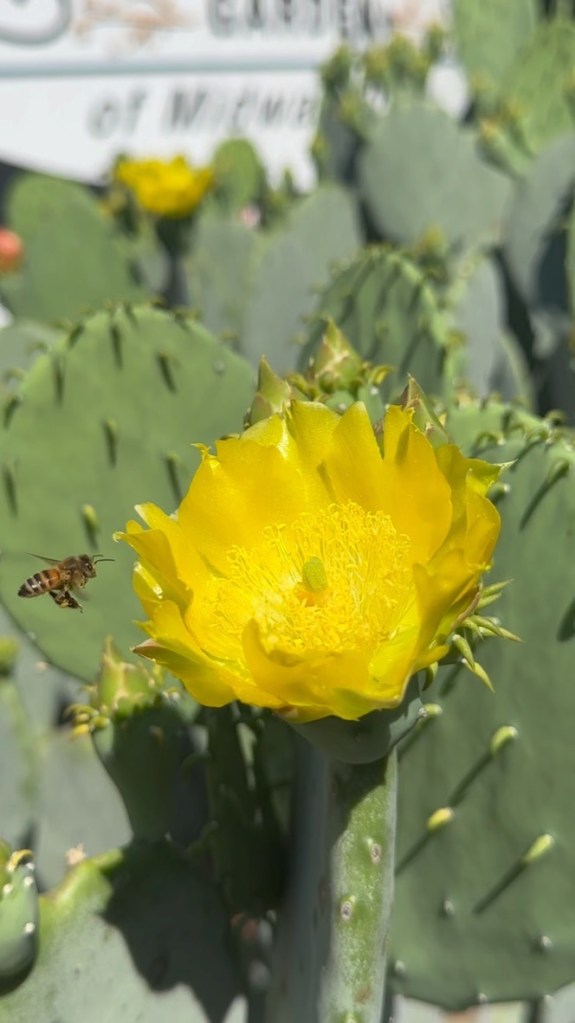
Nature unfolds before our very eyes. This honeybee is about to forage for nectar on a beautiful cactus flower at the Raincatcher’s Garden.
Garden love also includes sharing life, having fun, and learning through our garden work experiences.
Starla Willis, Dallas County Master Gardener Class of 2011
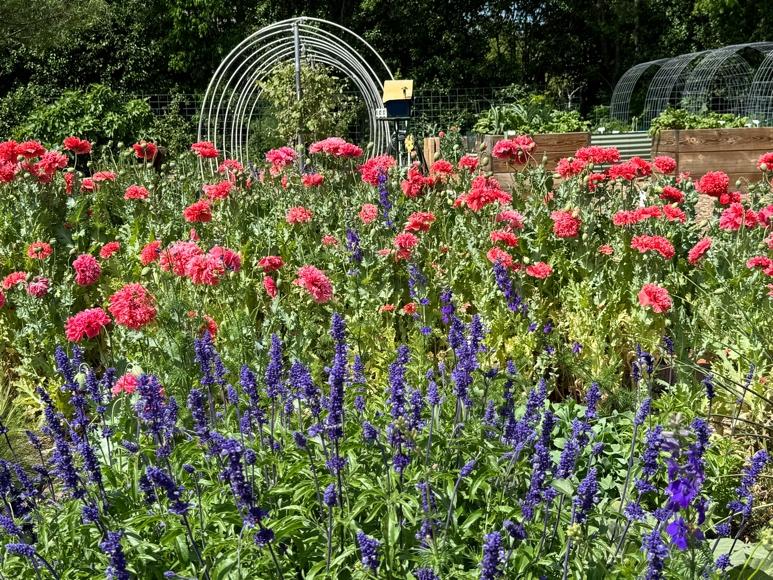
If you’ve been to Raincatcher’s Garden of Midway Hills anytime during the past two weeks, a seasonal spectacle may have caught your eye. Everywhere you look, from the Edible Landscape/Courtyard area extending out to the north garden, pathways are filled with the sight of spring blooming pink poppies.
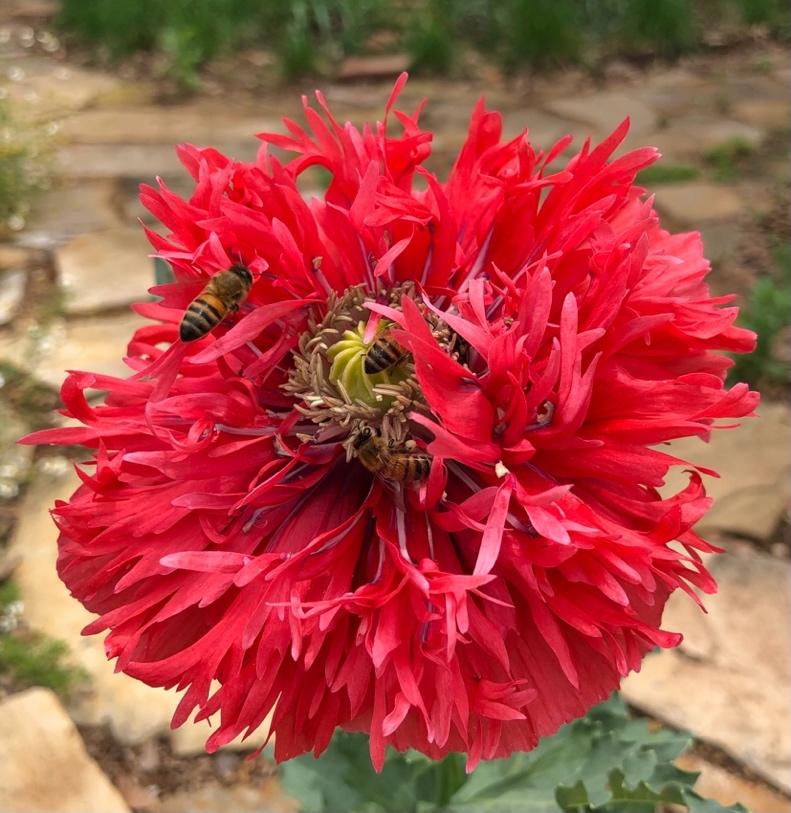
Move in a little closer and listen carefully for a soft humming sound. As you might have guessed, honeybees are busy at work foraging for pollen from the abundance of poppies that share these garden spaces with our herbs, vegetables and wildflowers.
Are you wondering…why are honeybees so attracted to poppies? As the late Robbin Thorp, native pollinator specialist for UC Davis in California so succinctly stated…” they’re not there for the nectar – they’re there for the pollen”.
Poppies should be considered as a quintessential plant for pollen production. And honeybees are one of the chief pollinating agents. A deeper dive into the world of poppies gives us some interesting information regarding pollen.
It is true that honeybees are attracted to poppies for pollen only. The reason why is that the inflorescences of all poppy species lack nectaries, thus no sugary nectar available to pollinators. Flowers, however, are packed with pollen-bearing anthers. Because pollen is the honeybee’s main source of protein, collecting it is a necessary task. Once collected, it is used for brood development and to feed the young larvae. And, fortunately for the bees, scientists have found that poppy pollen is remarkable clean, containing few fungi or mycotoxins.
Come visit our garden and take time to stroll the garden paths filled with poppies. Expect to be mesmerized by an eye-catching explosion of frills. Early morning and late afternoon seem to be the optimum time to experience the honeybees in action. Don’t be surprised to see as many as four or five honeybees foraging frenetically within a single flower.
(Raincatcher’s Garden of Midway Hills…Our “field of poppies!)
Linda Alexander, Dallas County Master Gardener Class of 2008
This is the time of the year when everyone wants something to change and improve advertisements that didn’t attract a bit of concern a while ago now seem tempting–the newest skin treatments that absolutely promise “younger brighter fresher” The poor child in the picture seems still a bit concerned but yet now doing better–well she should be concerned of course she is probably past Fourteen and knows its all downhill from here. Now if you want to buy thats fine after all it won’t hurt–although the price might be a real surprise and the bottle is so small and then there are two more things you absolutely must have if you really want “results” But we will go no further with this.
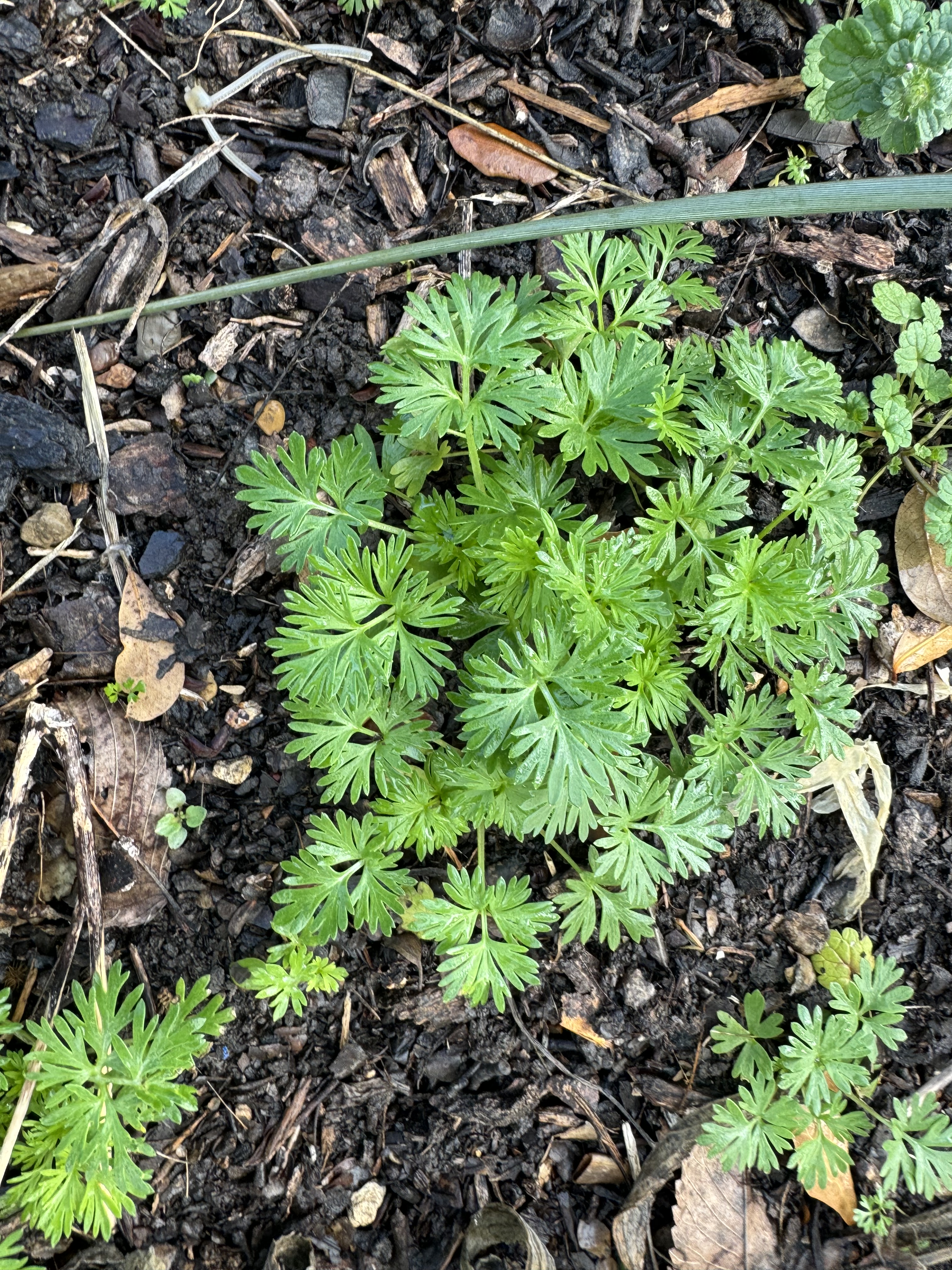
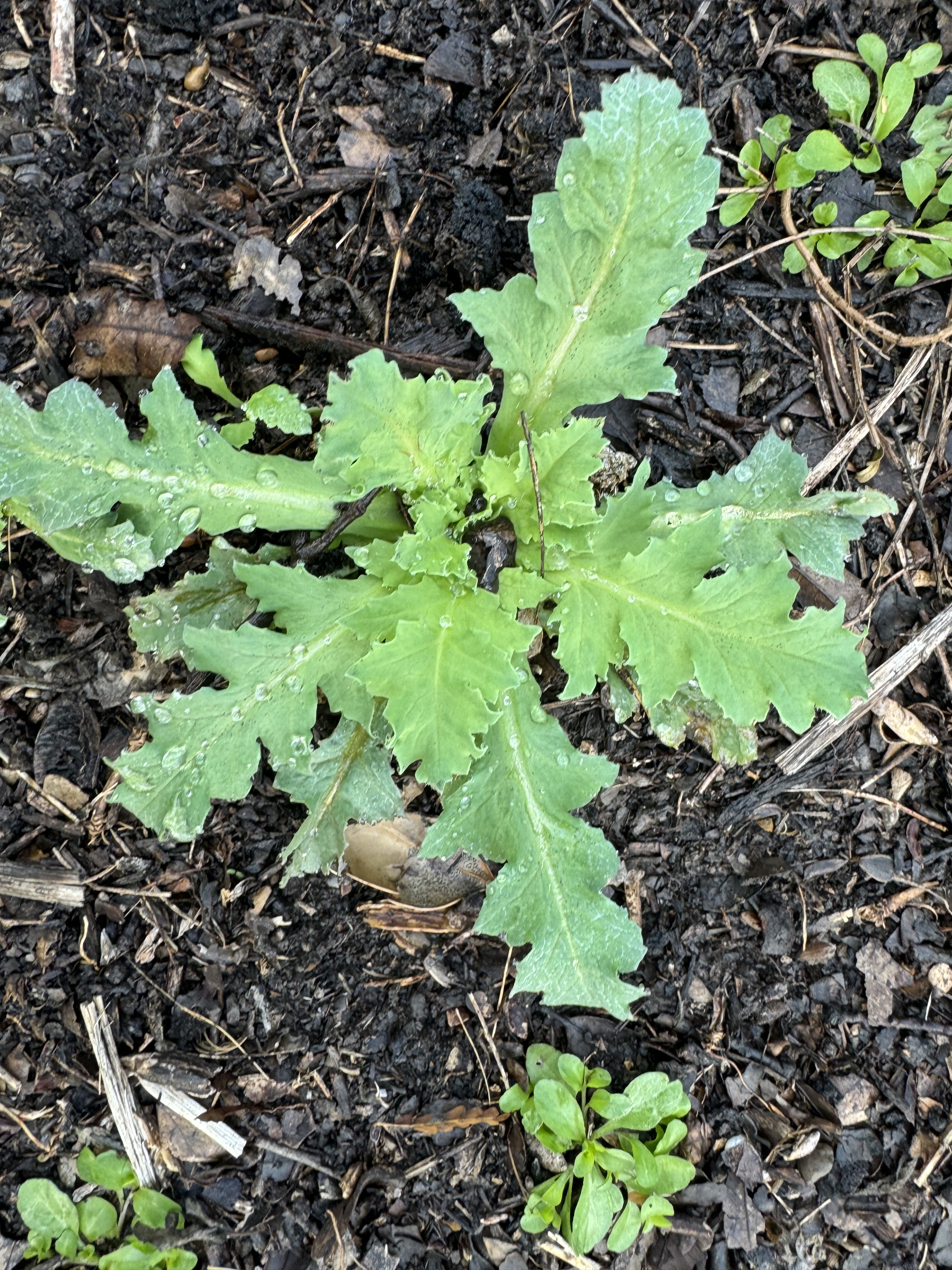
Baby Larkspur with maybe a weed-don’t worry about the weed.Baby poppy-same warning!Winter Honeysuckle does not give up.
No because YOUNG honestly is a state of mind more than anything and at this time of the year–well we may have to work at realizing that–and most importantly acting on our knowledge.
WE can’t let the season get us down. Its absolutely true that the leaves lying about have totally lost their charm –and how on earth did there get to be so many sticks and stalks everywhere. We have to look at things closely–after we clean up a bit of course. But take your time don’t be hasty, baby plants can be deceiving. The last thing you want to do is accidentally “weed” your precious spring flowers when in doubt don’t pull it up. Better to leave and weed than loose a poppy! Let your imagination take you to the blooms that will be here soon and you will be surprised at how much happier you will feel. Anticipating good things to come–well that is a receipt for real joy.
This is nothing but pure potential and hope!
Try to see bare patches as “Potential” not “Problems”. All the fresh seeds are here–stop and look . For some people this can be as much temptation as the five hundred dollar skin serum so do be careful. READ the labels and remember that if it says avoid heat you must avoid buying no matter how chilly and misty the day is right now. But maybe choose something new to try and go home and plant it–nothing worse than buying seeds and forgetting them–that doesn’t lead to happiness. But the choosing and preparing and planting–that can make a big difference for anyone. Feelings of accomplishment and planning for the future and feeling hopeful–well that makes anyone feel younger and fresher and its a feeling that lasts! Just the work in the fresh air helps so much even if you have to wrap up and use plastic shoes.
If it gets really cold take the time to protect your plants you will be glad you did–its work but it pays off and that makes us feel powerful. Just a little cover saved this lettuce.
If there are plants in the house don’t just pass them by they aren’t sofa cushions they really will respond to attention. water them and clean their leaves look for changes and growth–if you are fortunate even flowers–its the natural time for orchids to send up flower spikes–look carefully. Just noticing will brighten the whole day and who knows what tomorrow might bring .That is the key.
When we think about it–isn’t YOUNG really anticipating the future–the good exciting things to come? That feeling may get a little harder to come by sometimes but if we really notice our plants and gardens and care for them that feeling just seems to catch us and carry us forward–and that is FOREVER YOUNG.
Susan Thornbury, Dallas County Master Gardener Class of 2008


















 DALLAS GARDEN BUZZ