 Part of a poem by Emily Dickinson, a hero of the garden and the page, and my favorite poet.
This litle poem is big enough to cover the expanse of the meaning of the sky.
Ann
From The Complete Poems of Emily Dickinson | Written c. 1879
Part of a poem by Emily Dickinson, a hero of the garden and the page, and my favorite poet.
This litle poem is big enough to cover the expanse of the meaning of the sky.
Ann
From The Complete Poems of Emily Dickinson | Written c. 1879
Take a close up view of these easy flowering plants for a sunny, summer garden. Our Entry Garden is full of drought tolerant plants that fulfill the goal of being part of the non picky plant’s brigade. Hooray for the plants that do it all for you and request so little water in return!
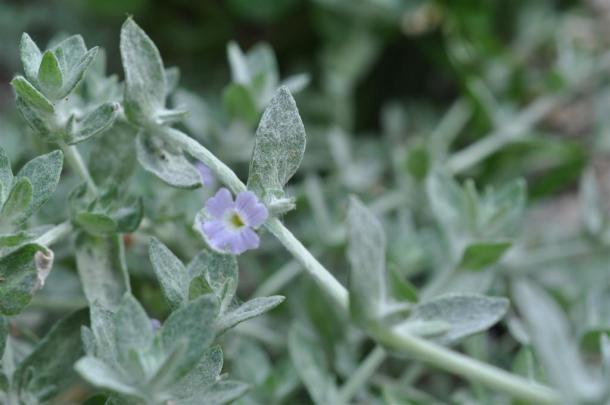
Woolly Stemodia– a dependable, ground hugging stalwart.
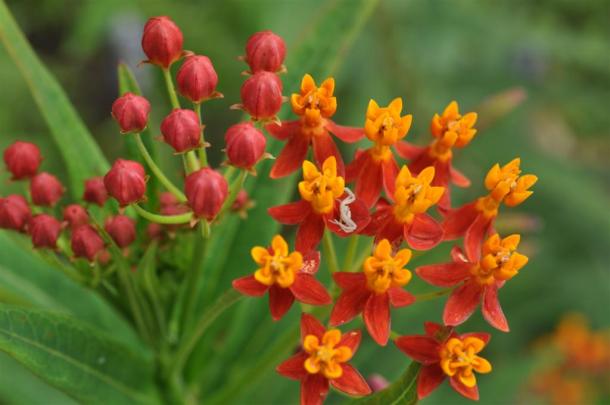
Butterfly Weed– a nectar source for butterflies.
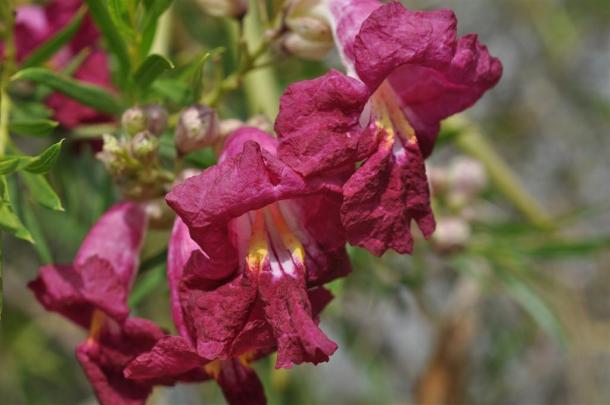
Desert Willow-seductive, trumpet-shaped blooms for hummingbirds.
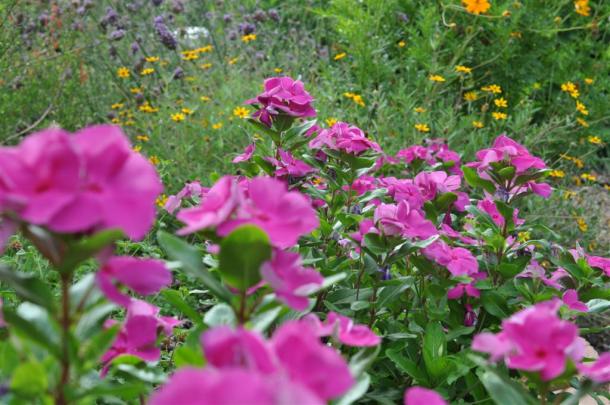
Periwinkles-the Cora variety is disease resistant, loves the heat and has a more uniform habit than other periwinkles. It looks great all season and into fall. Many colors to try!
Abeilia-foliage with a punch, this is the Frances Mason variety. The leaves turn from several colors of yellow to a coppery color in the fall.

Ann
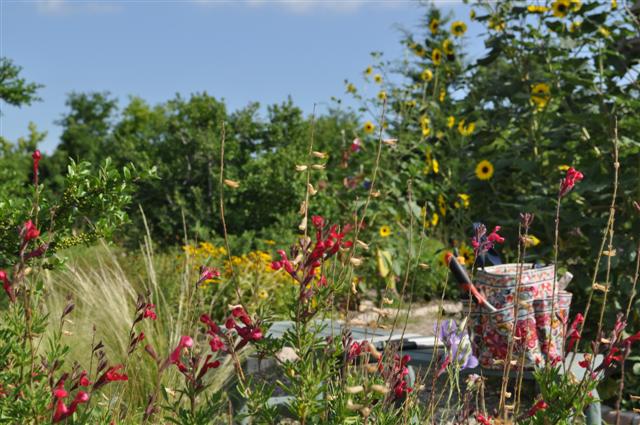
Salvia, Maximillian Sunflower, Black Eyed Susan,a branch of Yaupon Holly, Mexican Feather Grass
FALL GARDENS
Are Dallas gardeners just looking for any excuse to work in this heat? Listen to Common Sense here: the middle of July is reserved for racy spy novels, tall glasses of iced tea, and Spider Man movies. Settle onto that couch, look at the garden out the window, and move only to refill the pitcher of mojitos.
Obviously Jim, our Earth-Kind® and WaterWise Demonstration Garden vegetable guru, didn’t get that memo. By late June he already had diagrams, plans, flow charts, and supplies for the Fall Garden. He sprouted a frenzied list of freeze dates and vegetable maturation periods. He is more organized than Martha Stewart.

Trowel at the ready, the first veggies called up were tomatoes; their installation set for June 15 to July 25. Right on their heels are the Thanksgiving favorites: acorn and butternut squash for July 1 to August 1. Sugar pumpkins and cole transplants are set for July 15 to August 15. Green and yellow beans step up from August 1 to September 1. Spinach, carrots, lettuce and radishes go in from August 15 to September 10. And finally, mustard greens, beets, and turnips will be planted from August 25 to September 5.
Just makes you want to sweat.
Really, if you think about it, Texas is in denial about autumn. We really have extended summer through mid-October served up with a large dose of fall allergies.
I know this from personal delusion. Mike and I scheduled our wedding for October 1, thinking of cool breezes, rustling leaves, pumpkins, and mums. San Antonio weather sprung a record-breaking heat wave, and sweat rolled off the wedding party.
But what Dallas gardeners In The Know will tell you is that if you get off the couch, fill your compost pile with the scraggly spring tomato vines, and plant now in the summer heat, you can have a blockbuster fall harvest. Cooler autumn temperatures coax bumper crops of tomatoes and pumpkins. Come see Jim’s fall garden!
Elizabeth
You may have been searching for this vinaigrette recipe, like the bee in this picture is searching for pollen in the dahlia. This is the last of our recipes from the May menu in the “Farm to Table” write up. We will continue to give information about growing vegetables and using what you are growing in the future. Keep searching Dallas Garden Buzz!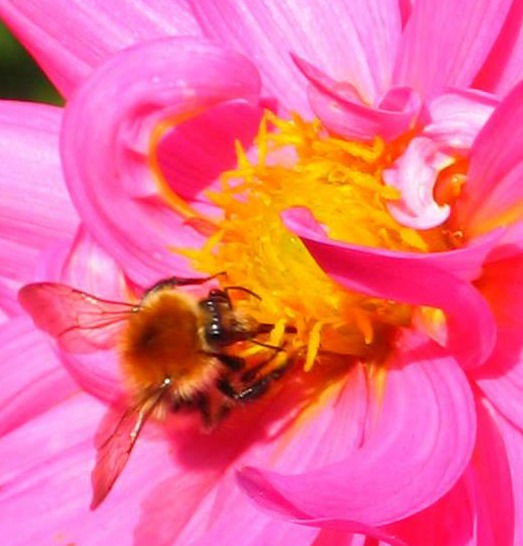
Ingredients:
¼ cup fresh lime juice
2 tablespoons honey
1 teaspoon Dijon mustard
½ teaspoon garlic powder
¼ teaspoon cumin
½ teaspoon kosher salt
½ teaspoon ground black pepper
¼ cup olive oil
¼ cup canola oil
Directions
3 Easy Ways to Mix the Dressing:
*In a blender. Add everything except the 2 oils to the blender and mix until combined. With the blender running, add the oils in a thin stream through the hole in the blender lid. Blend until well mixed.
*In a bowl. Whisk together everything except the 2 oils. Continue whisking while adding the oils in a thin stream. Keep whisking until well combined.
*In a jar. Add everything except the 2 oils to the jar. Cover and shake to combine. Add 2 oils and shake vigorously until well combined.
Serving Suggestions:
Toss dressing with your choice of salad greens. Use approximately 1 tablespoon of dressing per 2 cups of greens.
Drizzle dressing over sliced tomatoes or cucumbers.
Yield: About 1 cup
Linda
WHY PICKY PLANTS ARE LIKE MY CAT
My refrigerator is filled with open cans of cat food, one spoonful taken out, each encased neatly in a sandwich bag. Offerings to a sick—now well—cat. Each refused.

Adopted kittens should come with a warning label: once you offer the smelly, canned stuff, they’ll starve themselves before eating dry kibble. Charlie was perfectly chipper, although on the skinny side, before her yearly checkup and shots. Then, two days later, the dish with dry kibble was untouched.
A flurry of vet visits, calls, pokes, and blood tests, always with a flashing credit card, ensued. She still wouldn’t touch the dry kibble, but thought she might be able to bring herself to tuck into the $2.50 a can vet variety of Good Stuff.
She started again to eat and over a matter of days felt Much Better.
Then this morning with reasons known only to cats, the $2.50 Good Stuff didn’t look appetizing anymore. Only the cat food from the pet store would do–which we were out of.
But this is it. My final trip to the Pet Store for canned cat food. You black-and-white-adorable-shorthaired-domestic-tuxedo cat have got to again embrace Kibble. Food in a bowl, dump it in in the morning and have at it.
Which brings me to Picky Plants. I simply must stop this swooning at the plant nursery. Take me home, whispers a maidenhair fern. All I require is perfect soil and constant moisture.
Some very organized people have—and actually keep notes in—a garden journal. Mine would be filled with Did I Really Fall for That Again? plants.
Since working at the Earth-Kind®/WaterWise Demonstration Garden, my plant choices have gotten more savvy.
Need a splash of blue in my landscape? Look to Henry Duelberg or Indigo Spires Sage found in the Wildlife Habitat Garden.

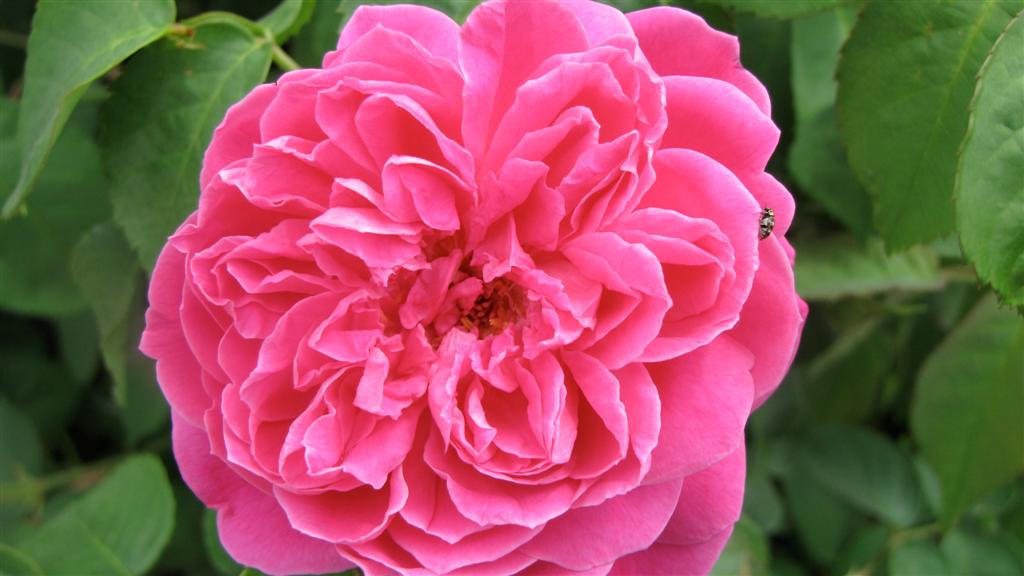
Or lovely roses that bloom profusely and rarely get blackspot? Belinda’s Dream, Maggie, Perle d’Or, or La Marne fill the Rose Trellis Garden.
Or a fun little fern that will love the dry shade under my huge red oak?
Wavy cloak fern is thriving in the Shade Garden.
The Demonstration Garden is a wonderful source of plant ideas. It’s filled with more than 70 trees, shrubs, perennials, annuals, and roses perfect for low-water yards in North Central Texas. Come visit us!
Elizabeth
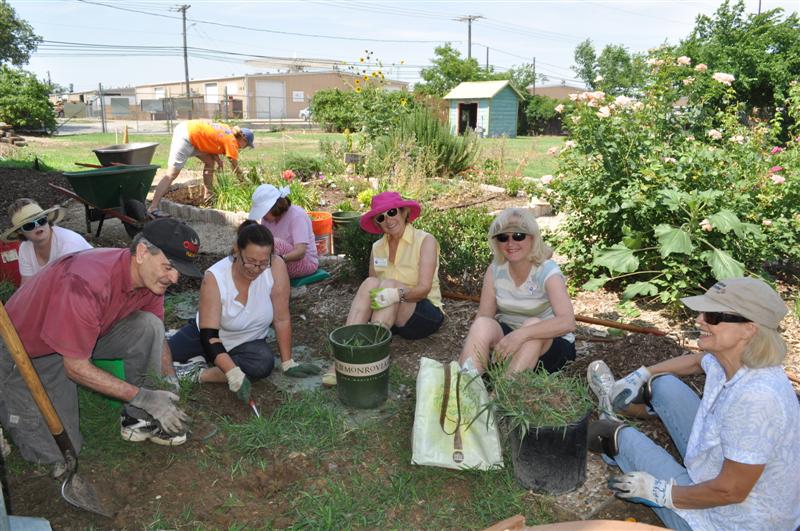
We are the Dallas County Master Gardeners at the Earth Kind® WaterWise Demonstration Garden on Joe Field Road. We hope you will get to know us and plan a visit to our gardens.
We love compost and work hard at it. Cindy, Sue, and Roger are adding green material to our compost bins. Believe me, our compost smells good. Roger is wearing the mask to reduce exposure to allergens. Come take a whiff-we promise!

Adding green material to the compost bins at the Demonstration Garden
Planting those onions mentioned in the “Farm to Table” menu.

Onion Planting in January 2012
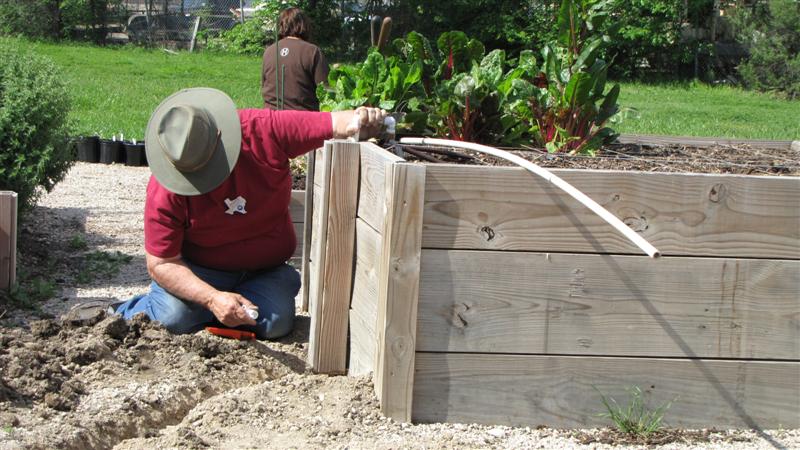
Jim adding drip irrigation to one of our raised beds. If he can’t do it, nobody can!
“Cares melt when you kneel in your garden!”
TOMATO TIPS
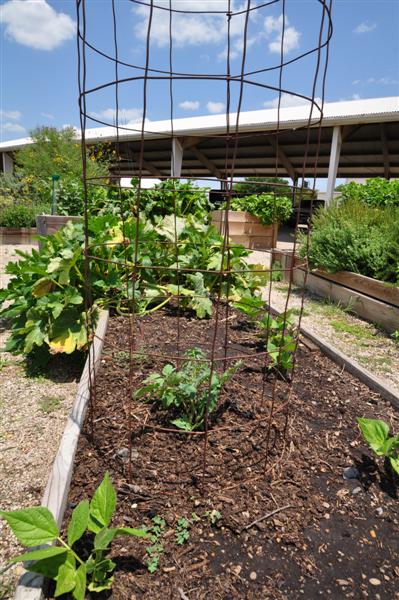
We plant tomatoes in the vegetable area of the Earth-Kind® Demonstration Garden.
Here are some tomato musts:
We don’t fertilize at the Demonstration Garden; if you want to feed your plants, use a slow release organic fertilizer.
If you have more tomatoes than you can give away, core them and freeze them whole in freezer storage bags for later use in sauces. Freezing preserves tomato flavor better than canning.
Elizabeth
Tomato Sauce from Fresh Tomatoes
Stir 4 minced garlic cloves and 3 tablespoons of olive oil together in a cold large skillet. Cook on medium heat for about 2 minutes until the garlic is sizzling and fragrant. Stir in 2 pounds of cored and peeled tomatoes, cut in ¾-inch chunks and ½ teaspoon of salt. Bring to a simmer and cook, stirring occasionally, until thick and chunky, about 15-20 minutes. Reduce heat if sauce starts to stick to bottom of pan. Remove from heat. Stir in ¼ cup chopped fresh basil with salt and pepper to taste.
TOMATO TALK

Thirty tomatoes ripen on the kitchen counter. Little red bottoms in the air, stem side down, they were picked when blushing, but not ready to slice. Now they deepen into that lovely rosy red of June gardens. A strainer full of cherry tomatoes drains in the sink.
A part of me wishes the tomato plants in my garden were as lovely as their offspring. Now, with our high temperatures, their yellowing leaves are hosts to masses of spider mites, a miniscule pest. Yes, we did spray the plants with fish emulsion—which is just what it sounds like—that is supposed to repel the insects. But we lost that battle.
And there’s the space issue. Or lack thereof. The unruly Sweet 100 Cherry tomato bush is about 8 feet tall by 4 feet wide and completely covers the well-behaved Celebrity tomato.
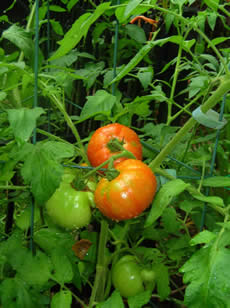
In the seed stage, tomatoes line up to be Determinate or Indeterminate. Determinate tomatoes agree to only grow to a certain height, have lots of large offspring, and bring them to graduation ALL AT THE SAME TIME.
Indeterminate tomatoes are the embarrassing relatives of the straight and narrow determinates. They have their own time table and in mid- June look like they haven’t had a shave or decent haircut in months.
Indeterminates grow as tall and as wide as water and fertilizer will take them, have zillions of cherry tomatoes, and ripen WHENEVER THEY WANT TO.

If that’s confusing—a little botany goes a long way—look at it this way:
A determinate Celebrity tomato would vote for Mitt.
An indeterminate Sweet 100 Cherry tomato would support Barack.
Elizabeth



 DALLAS GARDEN BUZZ