Eat Your Greens!

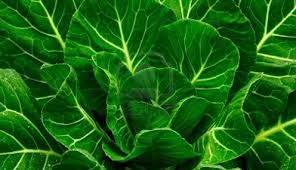
Collard GreensAfter my transplant from Connecticut to the Dallas area twenty-eight years ago, I’ve tip-toed around the Southern idea of cooked “greens”, but other than cooking kale occasionally never really developed an interest.  However, in a recent search for a non-dairy source of calcium for aging bones, I found that greens such as collards are a great source of this mineral as well as other complementary vitamins K and A.  Collards are one of the cruciferous vegetables in addition to the better known and more consumed broccoli, kale, and cabbage.  These greens have great cholesterol-lowering, anti-cancer, antioxidant, and anti-inflammatory benefits. 

Good for your heart, good for your bones, now how to make them good to eat!  I found a great cookbook called Greens Glorious Greens! by Johnna Albi and Catherine Walthers with great information, specific preparation and cooking directions, and great recipes for over thirty of these leafy greens—from arugula to wild greens such as chicory and dandelion.

These authors, as well as Whole Foods website, the world’s healthiest foods ,call collards a nutritional goldmine.  But one more obstacle before plunging into my exploration of greens—my Dallas-born husband who dislikes cooked greens.  So with a promise of corn muffins and BBQ chicken, I made the following recipe, which is adapted from Greens Glorious Greens! 

Collard Greens and Caramelized Onions 

12 ounces Collard greens (about 6-7 cups chopped)

1 Tablespoon extra virgin olive oil

1 large onion, thinly sliced

3 cloves garlic, minced

1-1/2 teaspoon agave nectar (or 2 tsp of sugar), for caramelizing the onions

salt to taste 

Chopped GreensWash collards, remove stalks, and cut leaves in half.  Stack 5 to 6 leaves together and slice into ¼ inch strips.  Set aside. 

In large, deep skillet (or cast-iron pan) heat olive oil, add onions, and sauté for 15 minutes.  Add agave (or sugar) to onion and continue to stir for 2 to 3 minute.  Add garlic and sauté for another 2-3 minutes. 

While the onions are cooking, bring 3 cups of water to a boil in a 12-inch skillet with a lid.  Add collards, cover, and cook at a good boil for 8 to 10 minutes, stirring occasionally.  The greens are bright green, but tender, when ready.  Drain in colander. 

Stir greens into onions and garlic.  Season with salt and cook for 2 to 3 minutes until heated through, Serves 3 to 4.

Adapted from Greens Glorious Greens, page 118. 

A great new vegetable recipe to add to my collection, and—yes—my husband did eat all his greens. 

Jean
Imagine A World…

“Imagine a world, in which all children grow up with a deep understanding of the  life all around them.  Where obesity is reduced through nature play. Where anti-depressants and pharmaceuticals are prescribed less and nature prescribed  more.  Where every school has a  natural play space. Where children learn of the joy of being in nature, before they experience its loss. Where they can lie on the grass on a hillside for hours and watch clouds become the faces of the future. Where every child and every adult has a human right to the connection to the natural world and  shares the responsbility for caring for it.”

Richard Low, author of Last Child in the Woods.

“Nature Deficit Disorder”

Happy New Year from

The Earth-Kind® WaterWise Demonstration Garden

 on Joe Field Road. 

We hope you will take steps in 2013 to cure Nature Deficit Order.

 Book a trip our garden!

Excerpts from the Great American Campout website and American Academy of Pediatrics: 

  • An “indoor childhood” hurts bodies & spirits.
  • Today’s kids are more likely to “tag” a friend on Facebook than outdoors in a game of “freeze tag.”
  • Kids today run from school to activities to sports w/ barely a minute to catch their breath.  Loss of free time can contribute to stress, anxiety, & depression in children. (American Academy of Pediatrics)
  • Studies show being outdoors is the perfect anecdote.  Time in green spaces reduces children’s tension levels & enhances their social interactions, helping them to feel more connected to self and others. 

Learning in the Garden 

Sources cited:

  • Growing Food LiFE Curriculum Series
  •  Botany on Your Plate (Univ. of CA & NGA)
  •  Math in the Garden (Univ. of CA & NGA)

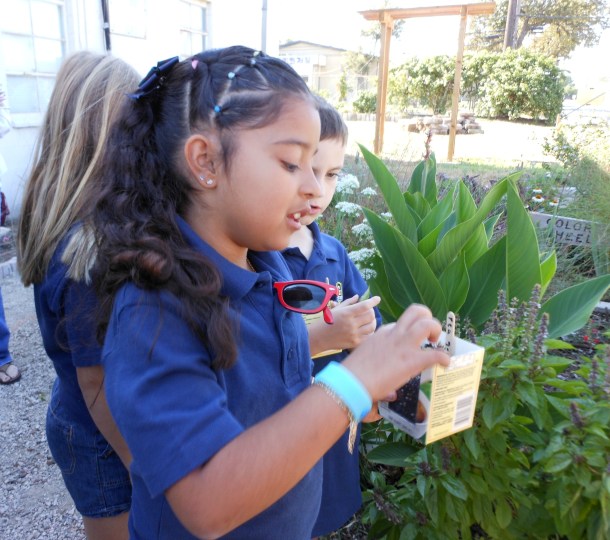
A Grace Academy Student Enjoying Learning and Nature At The Demonstration Garden

Using a garden helps teach the core concepts to diverse learners in an untraditional setting and grow into a relevant teaching tool. 

Simple truths about working w/ students in a garden setting: 

  • Students can better understand their environment by exploring it and hone their knowledge and skills while doing so.
  • An “outdoor learning center/classroom” creates a destination, a reason to outdoors.
  • Enhancing the outdoor learning center creates a schoolyard habitat: “If you build it, they will come.”
  • Students become stewards, stakeholders, creators by having a stake in planning and sustaining a school garden.
  • Gardening fosters teamwork, builds community, encourages sharing and understanding which in turn, creates decision-makers and problem-solvers.
  • Gardens are multi-sensory environments; students can use all of their senses to observe, predict, and understand how the world works.
  • Connections are created w/ the natural world & our region’s uniqueness.
  • Interdisciplinary learning is possible – connects Math, History, Language Arts (journaling, botanical names/Latin roots), Creative Arts, Social Sciences (bio-diversity and interdependence in plant and animal communities as in human communities), Life Sciences (nutrition, healthy choices, life skills). 

A garden setting is ripe for inquiry learning, doing & thinking rather than learning a set of predetermined facts by rote.  Einstein said the most important thing is to never stop asking questions.  Knowing how to find answers to those questions is every bit as important as knowing the answers.  

Since the early 1970s, research on how students learn Science stressed the importance of starting instruction based upon student perceptions & experiences.  In other words, you start w/ what they know or perceive to know and make meaningful connections between new knowledge and existing knowledge.  What teachers need to remember is children build their ideas over many years of explorations.  They tend to hold onto these ideas/beliefs tenaciously.  Time and countless repetitions (in large groups, small groups, or individually) are needed for them to examine new evidence, new explanations and new ideas and draw meaningful connections w/ their preexisting knowledge.  For new concepts to take root, they must make sense and fit into the students’ experiences that have been created outside the classroom. 

Unfortunately, Science is taught by “rote learning.”  No consideration is given to what science ideas students might bring to the classroom.  To cultivate meaningful learning of real world concepts, we need to draw upon their experiences, whether the experiences are misconceptions or incomplete learning, & connect the content currently being taught to their world. 

Science in the Garden can encompass the following concepts:

Humans rely upon a world of complex systems – the Earth, its ecosystems, its food systems.  Human activities impact our natural world for better or worse.  In a garden, students can grow food while maintaining a living lab.  They can investigate & monitor weather changes & the impact on a garden ecosystem.  Or, they might study decomposition, observe life cycles (seed to food, egg to butterfly), or see how matter and energy flow through ecosystems (the process of food production and the release of energy). 

Math in the Garden: allows students to hone their mathematics knowledge and skills to carry out investigations in the garden environment.  This is an untapped source of patterns, comparisons, problem-solving, measurement, number operations, Algebra, Geometry, and data analysis. 

At the base of all of this is Journaling, keeping an account of the natural world around you. Your Journal will be a guide, developed over a period of time, of noticing and noting changes, monthly and seasonally, of life cycle events.

Annette

Creamy Polenta With Sage and Roasted Wild Mushrooms

Sage In Snow

On a crisp, cold night this dish will really warm you up.

Polenta:

  • 1 3/4 cups water
  • 1 3/4 cups chicken broth
  • 1 teaspoon minced garlic
  • 3/4 cup polenta
  • 2/3 cup creme frache or sour cream
  • 1 ounce Monterey jack cheese shredded, (1/4 cup)
  • 1 ounce Parmesan cheese, freshly grated (1/4 cup)
  • 3 Tablespoons unsalted butter, melted
  • 1/4 teaspoon salt
  • 1/4 teaspoon freshly grated pepper
  • Roasted Wild Mushrooms

Preheat oven to 350 degrees. Bring water, broth, and garlic to a boil in a large oven proof saucepan over medium high heat.  Slowly mix in polenta.  Reduce heat to medium.  Cook 5 minutes, stirring constantly.  cover and place in oven.  Bake until thick, but still creamy, stirring occasionally, about 45 minutes. (add more water if mixture appears dry.)

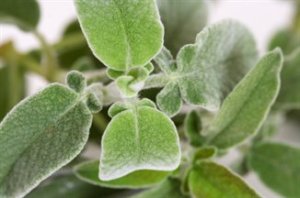
Sage Leaves

Sage:  

  • 1/2 cup extra virgin olive oil
  • 1/3 cup fresh sage leaves
  • salt

Heat oil in a small skillet over medium high heat.  Add sage leaves. Fry until crisp, about 10 seconds.  Drain on paper towels. Season with salt. Set aside.

Combine polenta, creme fraiche, Monterey Jack, Parmesan, butter, salt, and pepper. Spoon polenta onto serving plates.  Top with roasted wild mushrooms. Garnish with sage leaves. Seve Immediately.

Roasted Wild Mushrooms:

  • 8 gloves garlic, thinly sliced
  • 3 tablespoons olive oil
  • 3 tablespoons balsamic or red wine vinegar
  • 3 sprigs fresh rosemary chopped
  • 3 sprigs fresh thyme, chopped
  • 1 pound large fresh wild mushrooms (shitake, oyster, or cremini)
  • 1/4 teaspoon salt
  • 1/8 teaspoon freshly ground pepper

Creamy Polenta With Sage

Preheat oven to 425 degrees. Line 2 baking sheets with foil. combine garlic, olive oil, vinegar, rosemary, and thyme in a large bowl. Add mushrooms and toss to coat.  Season with salt and pepper. Arrange mushrooms in a single layer on prepared baking sheets.  Roast until mushrooms are tender and slightly crisp on edges, about 25 minutes.  Serve immediately.

Linda

Merry Christmas From the Demonstration Garden on Joe Field Road

Merry Christmas From The Demonstration Garden

T’was the weekend before Christmas, and all through the yard,
Not a gift was being given, not even a card
The tools were all hung, in the garage with care,
With hopes that St. Nicholas soon would repair.
The shovel with blade all rusty and cracked,
The pitchfork still shiny, but handle it lacked.
When out on my lawn, (its brown and abused)
I could see poor old Santa, looking confused.
No list had been left for Santa to see,
No gardening gifts were under the tree.
But wait there’s still time, it’s not Christmas yet,
And gardening gifts are the quickest to get.
You can forget the silk tie, the fluffy new sweater;
Give something to make the garden grow better.
If she wants a gift shiny, then don’t be a fool,
It’s not a dumb diamond, but a sparkling new tool.
If fragrance is listed you can forget French perfume,
It’s a pile of manure that’ll make gardeners swoon.
Give night crawlers, not nightgowns, a hose that sprays water.
(Anything for the kitchen is not worth the bother.)
Give a great gift that can dig in the dirt,
It’s better than any designer-brand shirt.
Now look quick at Santa, this guy’s not so dumb,
Under his glove, he hides a green thumb.
His knees are so dirty, his back how it aches,
His boots stomp on slugs, (he gives them no breaks).
The guy works only winter, you can surely see why,
For the rest of the year it’s as easy as pie.
He has elves plant through spring, pull weeds in the summer,
In fall they all harvest, but winter’s a bummer
And so Christmas gives Santa a part-time employment,
‘Till spring when the blooms are his real enjoyment.
So ask the big guy for garden gifts this year,
Seeds, plants and tools, Santa holds them all dear.
You see, malls may be crowded, vendors hawking their wares,
But visit a nursery; stress-free shopping is there.
Now Santa’s flown off, to the nursery he goes,
And his voice fills the night with a loud Hoe! Hoe! Hoe!
Reprinted from Rhode’s Newsletter with permission.

Compost

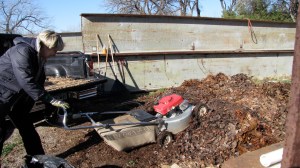
Cindy With Mulching MowerCompost is recycled organic material.  Grass clippings, leaves and plant refuse, things  that used to be thrown into the landfill, are converted with the help of microbes, molds and insects into food for our garden.

WHAT DO YOU NEED TO MAKE COMPOST?

(4 components + tools)

 NITROGEN – GREEN – Grass clippings, Fruit & Vegetable Scraps, Coffee Grounds

CARBON – BROWN – Dried leaves, dried plants, shredded paper, wood chips (also known as mulch)

MOISTURE – BLUE – Water, leftover juices from drinks, pickle juice, jams, jelly, any liquid containing sugar

 OXYGEN – WHITE – Air/circulation

HOW DOES IT BECOME COMPOST?

Mix the above 4 ingredients and let nature take over.    All around us are small animals called MICROBES.  Like any animal, they like to eat.  Feed them and they multiply.  Their food is the materials we mixed together (green, brown) with the water.  The air/oxygen allows them to live. 

HOW SHOULD A COMPOST PILE LOOK?

Compost bins/piles can be as simple as a pile on the ground or as elaborate and a hand or machine cranked barrel.  MASS is more important in composting than its container. The deeper and wider the pile, the faster it will compost.  Good dimensions are 3’ deep and 3-4’ in diameter.  Piles can be square, rectangular, or round. 

Round Compost Bin The outside edge (as much as 12” can dry out fairly quickly so I prefer the round style—acts like an insulator.  The interior stays moist and heats up with microbial activity.  When the pile is turned, the dry outer material is stirred into the moist interior and helps to aerate the pile. Depending on your available space, it is nice to have more than one container so you can move the compost when turning it.  Three containers allow you to have compost at different stages of maturation; new, in-process, finished. 
WHAT IS COMPOST GOOD FOR?

1)             Feeding plants and soil animals (worms, insects, microbes)

2)            Rebuilding the soil by improving its friability  and fertility

3)            Improving the ability of the soil to absorb moisture, avoiding excess runoff and erosion

4)            Keeping organic materials out of our landfills

What we had to get from outside sources when we first began our garden, we are now able to produce in our COMPOST area.  Not only do we feed our many garden areas, but are also able to furnish our fellow gardeners with food for their gardens.

Cindy

West Dallas Community School Visits Our Garden

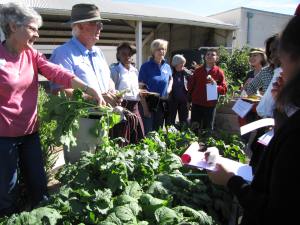
School Gardening With Jim, Abbe, Jan, LindaFifth grade students from  West Dallas learn about root crops from Jim and Abbe.  Did you know that the turnip or white turnip is a member of the parsley family, Brassica rapa var. rapa?  It is a root vegetable known for its bulbous tap root which is high in vitamin C and grown as a food crop for both humans and livestock.  Turnips are easy and quick to grow (35-70 days) and can be eaten raw (roots) or cooked (roots and leaves).  Turnips like well-tilled soil and constant water.  Both of these conditions are provided in our raised organic beds via our home-made compost and drip irrigation system.

The Interesting Story Of Cotton As Told By Dallas County Master Gardener, CarolynCarolyn demonstrates the technique of hand-spinning cotton thread to the fifth grade students .  Did you know that cotton is the most important non-food crop in the world?  Cotton has been spun, woven & dyed since prehistoric times.  Today, industrial uses for cotton are just as important as the cloth that originally was woven.  These products vary widely from cloth-based such as diapers, bandages, and paper to cosmetics, soap and oils; dynamite and plastics; and that sidewalk scourge, chewing gum (cellulose).  There are 39 different species of the genus Gossypium, 4 of which were commercially grown since all cotton was domesticated in antiquity.  The variety G. hirsutum became known as “upland cotton” and comprises 90% of the world’s cotton crop.
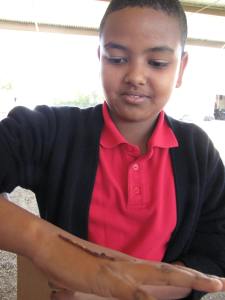
A Student's Introduction To VermicultureA 5th grade student  from West Dallas Community School gets up close & personal with a “red wiggler” worm.  During our Vermi-composting lesson, he & his classmates learned that this little ‘Eisenia fetida’ is one of approximately 2700 different kinds of worms of a large variety of species.  Did you know that “red wigglers” (aka brown-nose or red worms) work best in container/bin composting.  That’s because they are non-burrowing and move horizontally through the soil.

Annette, pictures by Starla

“Nature Is My Life”

Journaling is an integral component of the educational program offered by the Demonstration Garden.  Our Nature Journals, made from recycled materials are constructed by our student visitors and  personalized to reflect their connections with the garden.   A 5th grader from West Dallas Community School proudly proclaims, “Nature is My Life.”  Her journal became her memory book of observations, descriptions, illustrationsand  connections; a special way of carrying a piece of the garden home with her.
Annette and picture by Starla

Why Keep A Nature Journal?

   West Dallas Community School Student Journaling During A Recent Field Trip

  Marcel Proust once wrote, “The real voyage of discovery consists not in seeking new lands but in seeing with new eyes.”  A garden journal can be the “new eyes” for the novice as well as the seasoned gardener. 

     Formal or casual, a journal is a reference tool.  It can be used in myriad ways and function as: a means for planning and reflecting, as a memory book, showcase or diary, an informational text, or even created as a web blog.  In My Texas Garden, a Gardener’s Journal, Dale Groom writes that you can use a journal to track the evolution of the garden as well as the gardener.  Through diligent record-keeping, you can track your garden’s growth and your personal growth as a gardener:  successes and failures, preferences in plants and seasons, the impact of the weather, environmental conditions in your garden.

     In its most basic form, a garden journal tracks daily or weekly observations, the weather that day, what’s been planted and/or transplanted, any other garden notes.  Make notes for planting dates for seeds and plants, planting information (spacing, germination, thinning, blooming and harvest dates), suppliers and sources, and cost information for seeds and plants, fertilizing dates and types, soil conditions and types, light and exposure, pests and diseases/problems and solutions, weather information (rainfall, temperatures, frost dates), wildlife observations. 

     A garden plan drawn on graph paper with ¼ inch grids uses a 1inch=4 feet proportion.  Include photos from different times of day and seasons, sketches and diagrams.  All of these are important for the garden in its present state as well as for future plans.  

Annette

Lakota Squash, An Heirloom Vegetable For Fall Gardens

Lakota Squash Planted In  Early August

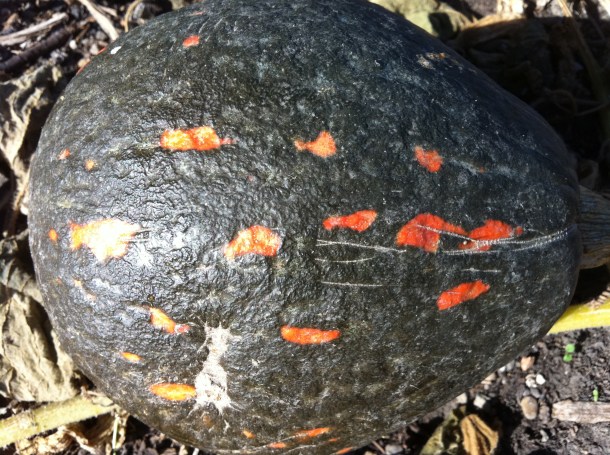
Lakota squash is one of the winter storage types of squash. It’s a medium sized,  pear-shaped squash, weighing an average of about seven pounds. The outer shell is hard with interior flesh a golden yellow. The flavor is nutty and sweet. The Lakota squash derives its name from the Lakota Tribe of the Sioux Indians who prized this hardy winter squash for cooking and baking.   We like to think we are continuing their history by growing it at The Demonstration Garden. 

Store Lakota squash in a cool, dry place for up to three months or more after picking them. Since this is our first time to grow this heirloom vegetable, we may try one of these cooking ideas from Chef Kyle Shadix :

• Purée in food processor with light coconut milk, curry, and freshly minced and sautéed ginger and garlic.
• Add brown sugar, vanilla extract, and toasted walnuts.
• Add maple syrup and toasted almonds.
• Serve mashed with salt and pepper and a touch of real butter.
• Mix with prepared pesto and sprinkle with Parmesan or Pecorino Romano cheese.

Because Lakota Squash is an heirloom variety not a hybrid, the seeds will produce offspring like the parent. Next year we can share the seed and all get a little taste of Sioux history!

Ann