Take Me Away

August 5, 2023

Butchart Gardens

If you haven’t high tailed it out of Dallas for a lazy vacation at the beach or cool, comfortable nights in the mountains then, like me, you’ve accepted the undeniable fact that our sweltering summer heat and humidity is overstaying it seasonal appearance. With daytime temperatures hovering in the 100+ degree range, it’s a miserable time to be outdoors. What’s a garden lover to do!

I’m dreaming about a place that my husband and I have visited several times over the years and wishing, somehow, we could be transported there now. Until that happens, let’s spend a few minutes enjoying the remarkable scenery of a global beauty. Our photographic journey will reward us visually as we visit the world-famous Butchart Gardens. Located near Victoria on Vancouver Island in Brentwood Bay, British Columbia, Canada, the gardens were designated a National Historic Site of Canada in 2004.

Robert Pim Butchart (1856-1943) began manufacturing Portland cement in 1888 near his birthplace of Owen Sound, Ontario, Canada. He and his wife Jennie Butchart (1866 – 1950) came to the west coast of Canada because of rich limestone deposits necessary for cement production. In 1904, they established their home near his quarry on Tod Inlet at the base of the Saanich Peninsula on Vancouver Island.

Fast forward to 1909 when the limestone quarry was exhausted, Jenny set about turning it into the Sunken Garden, which was completed in 1921. Over the next few years, other areas were converted into themed gardens. In 1939, the Butchart’s gave the Gardens to their grandson Ian Ross (1918-1997) on his 21st birthday. Ross was involved in the operation and promotion of the gardens until his death 58 years later. And today, ownership of the The Gardens remains within the Butchart family. 

Visiting this 119-year-old internationally renowned 55-acre floral display is a breath-taking experience.  The gardens provide dramatic floral displays in a variety of garden settings and styles. Starting with The Sunken Garden (the original quarry) to The Rose Garden with over 2,500 roses filling the air with their fragrance, you’ll feel as if you’re walking through a fairytale.

*The Butchart Gardens are open daily. Closed Christmas Day.

Linda Alexander, Dallas County Master Gardener Class of 2008

Love-Ache

July 28, 2023

Are you familiar with an herb whose origin and history can be traced back to medieval times in the Liguria region of northwest Italy? If not, you might want to learn more about Lovage (Levisticum officinale). The name lovage is from “love-ache”, ache being a medieval name for parsley. Lovage is used in many recipes calling for parsley or celery. With its glossy, deep-green leaves that are cut and divided and having a pungent celery taste, some consider it to be the ultimate celery herb.

While not as well known in the United States, lovage has been long cultivated in Europe. Queen Vitoria always carried some candied lovage seeds to satisfy her sweet tooth. Charlemagne, King of Franks, was said to have liked lovage so much that he ordered it grown in all of the gardens on his estate. Over the years, chefs have discovered that cooking with lovage has its benefits. All parts of the plant are usable, from leaves as an herb, the roots as a vegetable and the seeds as an aromatic spice. Even the hollow stems can serve as a straw substitute when sipping a favorite beverage.

A glass of pink drink with a straw

Description automatically generated with low confidence

(Pink Lemonade with a lovage straw)

Lovage will reach two to three feet, even as high as 6 feet, with a spread of about two feet. Rounded umbels or flat clusters of small yellow-green flowers up to four inches across appear mid- to late summer. Flowers are followed by brown, ridged, crescent-shaped seeds that are about ¼ inch long. Harvest the tender, young leaves at any time and use them in soups, stews and salads. Or, during an early morning stroll, enjoy nibbling on them straight from the garden. Seeds can be used crushed or whole, sprinkled over meat and salads or added to liqueurs, cordials, bread and pastries.

In our Zone 8 climate lovage performs best when planted in a location with partial sun, preferably morning sun. It is easy to grow in any well-drained soil with plenty of compost. Plant from containers in the spring while the weather is still cool. Start from seed in the winter. Divide plants in spring or fall, making sure that each division has some new buds. Though lovage is considered an herbaceous perennial, it sometimes succumbs to summers in the south. Plants die back to the ground in winter, but regrow from the roots in spring.

A picture containing food, dish, indoor, bowl

Description automatically generated
White Chicken Chili topped with Lovage and Parsley Mixture

Linda Alexander, Dallas County Master Gardener Class of 2008

Lovage and Parsley recipe here

Honeycomb Construction…The Building Block of the Hive

July 20, 2023

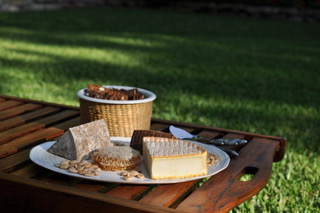
In 2016, a wonderful new cookbook was published by the Dallas County Master
Gardener Association. The title was ‘A Year on the Plate’. One of the cookbook
committees’ favorite photographs was taken late in the afternoon with long
shadows stretching across the yard as sunlight drifted slowly behind the trees.
The dish to be photographed was from the honey section of the book. It was a
charcuterie board featuring an assortment of salty cheeses and nuts with a lovely
round honeycomb serving as the main attraction. Looking through several
options, we were thrilled with the dreamy look of one particular photograph that
captured the essence of our star ingredient.

Since that day over seven years ago every imaginable type of charcuterie board
has been created. And, as you might have guessed, each one is almost always
designed around a honeycomb. Carefully cut and oozing with sweet honey, it is a
magical gift of nature that comes from honeybees.
During the months of July and August, we’ll take a look inside the hive to discover
some of the most amazing facts about honeycomb construction and why it is
considered to be the building block of the hive.

What is honeycomb?
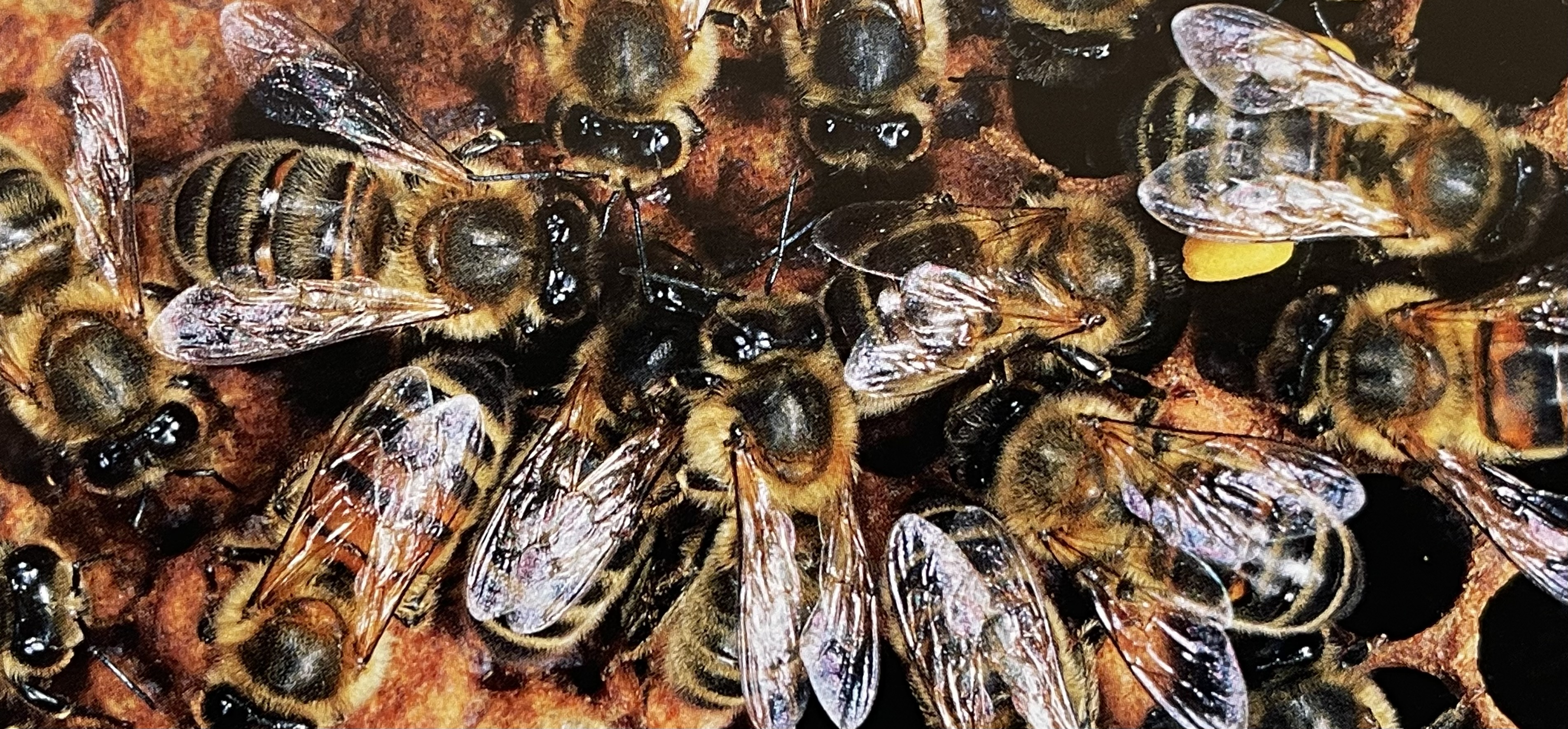
Honeycomb is a cluster of repeating hexagonal beeswax cells made by honeybees
and used for raising brood and storing honey and pollen. Honeycombs store
honey because honey is valuable to bees. It feeds their young and sustains the
hive.

Why are honeycombs constructed using the hexagonal shape?
First consider spheres, pentagons and octagons. All of these produce gaps. Bees
are efficient creatures so anything with gaps isn’t the answer. As it turns out,
there are only three geometrical figures with equal sides that can fit together on a
flat surface without leaving gaps: equilateral triangles, squares and hexagons. So,
which one is best?
It’s a very old question and one that a Roman soldier/scholar/writer named
Marcus Terentius Varro proposed an answer to in 36 B.C. Ever since then, Varro’s
answer has been referred to as “The Honeybee Conjecture”. Simply stated, he
thought that a honeycomb built of hexagons could hold more honey and, maybe,
hexagons require less building wax. Why is the issue of wax important?
It takes thousands and thousands of bee hours, tens of thousands of flights back
and forth to the foraging source to gather nectar from countless flowers just to
start the process of building a honeycomb. Is it, therefore, reasonable to assume
that bees want a tight, secure structure that is as simple to build as possible?

As was eventually determined, compactness matters. The more compact your
structure, the less wax needed to construct the honeycomb. Wax is a precious
material. A honeybee must consume about eight ounces of honey to produce a
single ounce of wax. It is an accepted fact that the hexagon shape uses the least
amount of wax.
Additionally, years and years of research have demonstrated that honeybees use
the shape of their bodies as rulers to build each cell exactly the same. Even
Charles Darwin himself once wrote, the honeycomb is a masterpiece of
engineering. It is “absolutely perfect in economizing labor and wax.”

Linda Alexander, Dallas County Master Gardener Class of 2008

Celebrating National Ice Cream Day and Blueberry Honeycomb No-churn Ice cream

July 16, 2023

July is National Ice Cream Month and July 16th is National Ice Cream Day. Thomas Jefferson is credited with the first ice cream recipe, read the cold, hard facts here.

If you love homemade ice cream on a sizzling hot summer day, Blueberry Honeycomb No-Churn Ice Cream is a super easy treat that will take you into dreamland!

Blueberry Honeycomb No-Churn Ice Cream Recipe

Linda Alexander, Dallas County Master Gardener Class of 2008
More on the buzz coming soon: Our next honey blog will the about the construction of honeycomb.

HONESTY—IN THE GARDEN

Every so often one reads something that Is just so honest and truthful that its almost a shock.  That recently happened.

For some reason an interview with a tourist information official from Nebraska seemed to jump off the page.  He said—“To be honest it’s not for everyone”.  Oh my thatis a wonderful thing.  One expects technicolor sunsets—incredibly happy couples eating amazing food laughing children at the theme park—but not this time—“To be honest its not for everyone”

That should make anyone want to head for Nebraska—now.  Because you would know what to expect—a perfectly nice place where you might  have to make an effort to have a great time.

And then it seemed the absolutely perfect motto for the Pollinator garden at Raincatchers.

It’s a wonderful area but people who work there—well they have to work at it.  The butterflies and bees and birds—obviously appreciate it but they keep quiet—no rounds of applause or words of thanks.

Often it is said that native and adapted plants are “low maintenance –but work is required and it is repetitive –deadheading trimming weeding—necessary but it can be hard too and somehow—never quite “finished” And without a doubt not at all glamorous.

So—it’s clear now right??  Come and work in the pollinator area you get to see insects and  birds and lovely plants—yes it is work and it might not be spectacular—but isn’t that the whole point of a garden.

It’s a wonderful experience but you have to work at it.  It may not be for everyone —-but—maybe its for you!!  You will always be welcome!  And just like Nebraska—the rewards are there with just a little effort!

Susan Thornbury, Dallas County Master Gardener Class of 2008

During the hot summer days, we work early at Raincatcher’s. Monday morning and Tuesdays you will find Master Gardeners in the garden early-even before 8am.

Comic Relief from our Cantaloupe Patch

It’s day five of our cantaloupe witness protection program and no losses yet. We were finding many half eaten green cantaloupes around the garden before deploying this improvised metal cage plus mesh bag system. 

Beverly Allen, Dallas County Master Gardener Class of 2018

Garden Gifts, Exploring the artistry of seasonal flora

Beginning this month, dallasgardenbuzz.com will introduce a new idea which allows the natural world to speak to us as seasons change and our gardens evolve. Once each month, we hope to share with our readers the joy of using seasonal gifts from the garden in floral displays, arrangements and more. 

Look for fresh and innovative ways of gathering unusual combinations of flowers, herbs, branches and other natural ingredients to display in your home.  Let creations from your garden bring happiness to a friend, neighbor or family member. Embrace a mindset of filling your life with beautiful gifts from the garden every month of the year. 

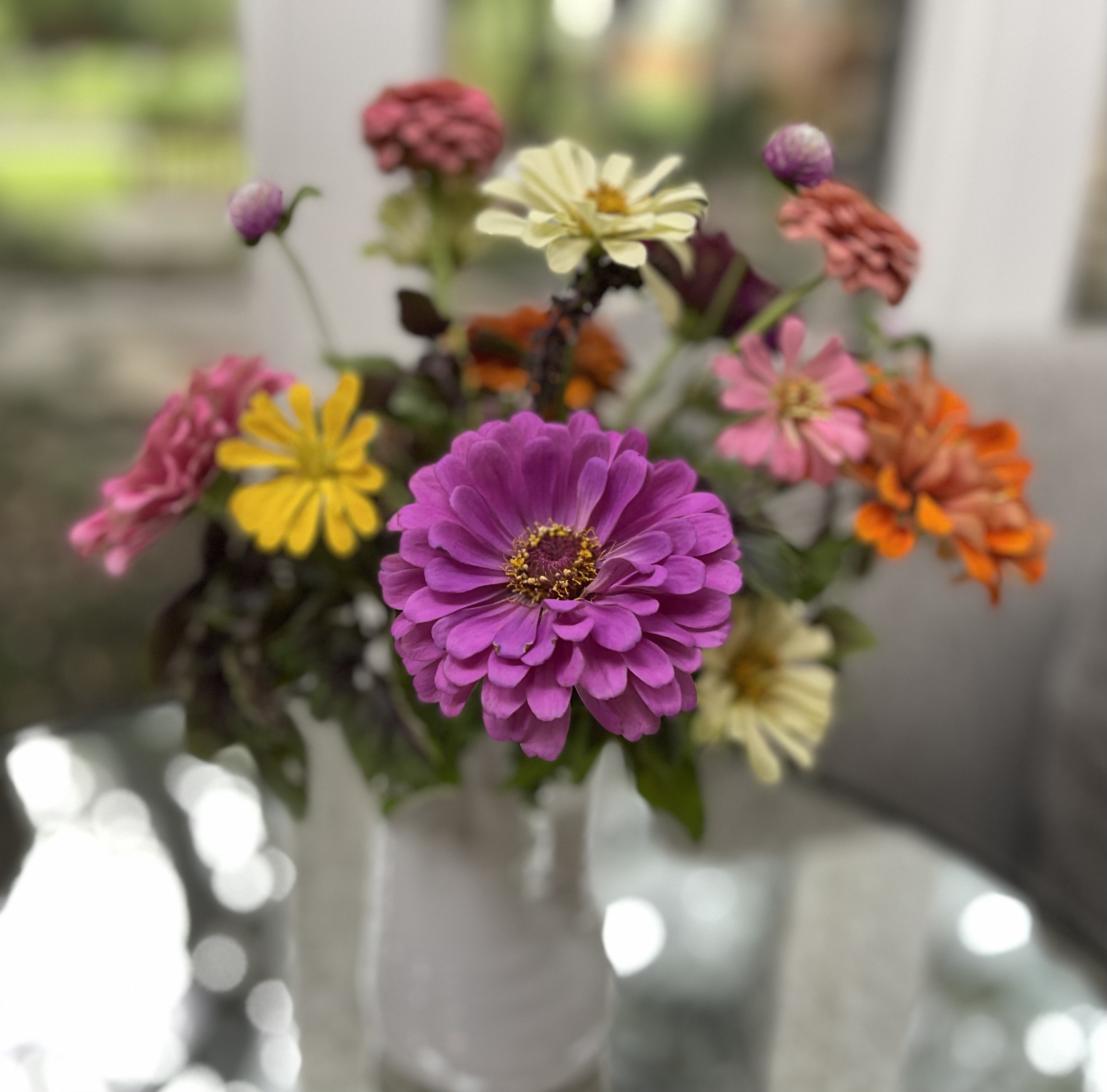
To start, we’ll begin with a quintessential summer flower – zinnias! Offering one of the most colorful palates found in the garden, zinnias bold and bright blooms range from white to orange, pink, yellow, purple and red. We’ve chosen to combine our blooms with another plant that is thriving in the Dallas heat – basil.

With dozens of varieties to consider, two types currently growing in the garden were the perfect complement to our monthly arrangement. Basil ‘Wild Magic’ is a robust grower with purple/violet flowers and dark green leaves with purple margins. For leaves with an even deeper purple presence, ‘Red Rubin’ also adds an aromatic touch to arrangements.

If a compact, tight arrangement seems a little too crowded, consider going in a different direction. Give each zinnia  space to breath while making its own individual statement. A flower show judge might suggest that a more open design reflects the natural habit of flowers growing in the garden. In this type of arrangement, there’s plenty of room for “a butterfly to move from bloom to bloom”.

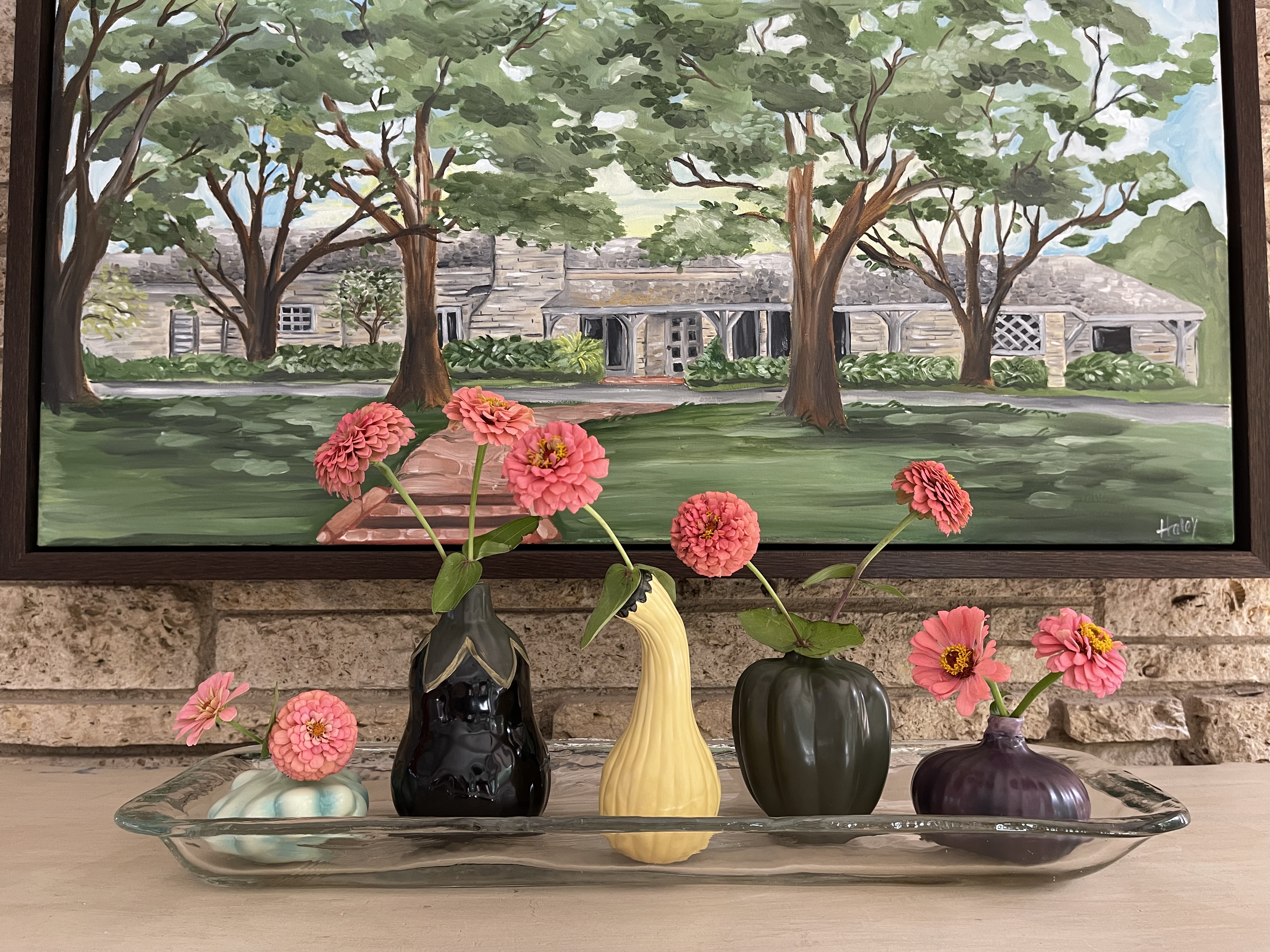
And finally, for a moment of simplicity, use individual blooms as illustrated in this arrangement. A collection of vintage ceramic vegetable vases sitting under an oil painting of our house needs only a delicate touch to enhance its beauty. The soft tones of puffy little salmon zinnias are the right choice!

Our promise to you is that all of our displays will feature botanical material growing in the home garden. In other words, these are not flower shop creations. We want you to be inspired and encouraged to appreciate the simple elegance of using gifts from your garden to bring a touch of beauty and charm to everyday life.

Linda Alexander, Dallas County Master Gardener Class of 2008

Stay Tuned for Honeycomb Facts and Recipes

During the months of July and August, our venture into the world of bees will explore what is
often described as an engineering marvel…The Honeycomb. To better understand the
importance of the honeycomb, we’ll answer several basic questions:

  1. Why do honeycombs look the way they do?
  2. Why the hexagon design?
  3. What does it do for the colony?

Until then, here’s a little something to whet your appetite for honeycomb.

Last year a New York based ice cream company opened a shop in Texas. Van Leeuwan Ice Cream entered the Dallas market with shops located on McKinney Ave and at the Lover’s Lane/Inwood intersection. It can also be found at places like Central Market, Tom Thumb and Walmart. Just a few weeks ago, while shopping for ice cream at Central Market, this is what caught my eye.

 Yes indeed, an authentic and absolutely delicious Van Leeuwan Honeycomb ice cream. My husband and I consumed it that night. On a return trip to purchase more, Central Market was sold out. But the good news is that Van Leeuwan’s store front shop on Lover’s Lane keeps a consistent supply of all their brands. 


A bowl of ice cream and a piece of honeycomb

Description automatically generated with medium confidence

A plate of ice cream and honey

Description automatically generated with low confidence


Visit dallasgardenbuzz.com in July and August for some wonderful honeycomb recipes along with fun ideas for using it this summer.

Linda Alexander, Dallas County Master Gardener Class of 2008
Tomatoes, I Owe You an Apology

Tomatoes, I owe you an apology.  All is forgiven.  We had some rain and a mild beginning to the summer. You behaved reasonably under those circumstances and gave us an abundance of delicious fruit.  I’m sorry for all the negative things I’ve said about you.  I have called you names. I have described you as difficult. I have suggested to beginning gardeners that they avoid you and try peppers instead. 

Our biggest problem with you this year was that certain bushy tailed scoundrels found you irresistible even when you were green. That was not your fault.  Never fear, we are planning our squirrel defense strategies for next year.  

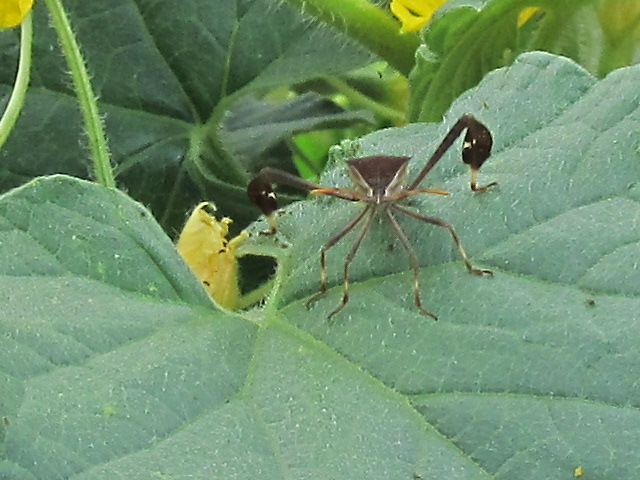
Now our high temperatures are in the triple digits and you have developed blight and begun providing food and shelter to stink bugs.  You held out as long as could be expected and for this I thank you. 

Diane, our photographer friend, snapped this picture of a stink bug. Notice its fierce mustachioed look. It has already begun assaulting our tomatoes.

Tomatoes, despite the pain of previous seasons, I am grateful for what I have learned from you-mostly patience.

Beverly Allen, Dallas County Master Gardener, Class of 2018

Tomatoes are the Jerkiest Plants

Tomatoes Will Break Your Heart

Squirrel photo by Don Heaberlin and stink bug photo by Diane Washam

Communication in the World of Bees…” Let’s Dance!”

As humans, we live in an information age where advancing technology continues
to take us to new horizons. Amazingly, for as long as honeybees have been on the
planet, their highly effective way of communicating has remained the same.
Survival in the world of honeybees is dependent upon good communication. Let’s
look at how the concept of ‘moving in the right direction’ plays a major role in the
process.
An Australian zoologist named Karl van Frisch (1886-1982) measured aspects of
honeybees’ dances by artificially manipulating forage sources. He described two
types: the round dance and the waggle (or figure-eight) dance. Scout bees
returning from foraging flights immediately attract the attention of other bees
which huddle close to monitor the scout’s movements in the darkness.
A short Q & A will provide a better understanding of these astonishing dances and
how bees use them to share precise information with the hive.
Why do bees dance?
To communicate the location of food. Foraging is a highly organized operation.
When a forager bee finds a particularly good source of nectar, she returns to the
hive and directs others to the source. Specific instructions for the location are
communicated through the patterns of the dance.
How do bees learn to dance?
Bees need “tutors”. In order to learn the dances correctly, they must follow other
experienced dancers. The concept of social learning ultimately shapes honeybee signaling giving them the ability to use a complex form of spatial referential
communication.
What is learned from the dances?
In a strangely mysterious way, dancing communicates the direction, distance and
quality of a resource to nestmates by encoding celestial cues, retinal optic flow
and relative food value into motion and sound within the nest. If you thought it
was just a colony of bees buzzing around in the hive, it is scientific fact that these
curious movements (bee language) are used to manage the work of the hive.
“Busy as a bee” is truly something to be admired.
How is the waggle dance explained?
Outgoing forager bees gather in a specific part of the hive to watch returning
foragers perform the dance. The dancer walks across the comb in the pattern of a
figure eight, waggling her abdomen back and forth as she moves through the
straight portion of the pattern. The direction she faces while waggling charts an
angle in relation to the sun. Other foragers use this information to help navigate
their way to the source. The more she waggles, the better the foraging in this
area. Also, the longer the dance, the farther the distance from the hive.

A drawing of bees on a grid

Description automatically generated with low confidence

What determines how much the scouter bee moves her abdomen?
The fervor with which she vibrates her abdomen during the dance, the greater
the richness of the forage source.

Linda Alexander, Dallas County Master Gardener Class of 2008