Carrots are not the easiest thing to grow in our part of the world. Our past efforts resulted in lower yields than we had hoped.
This year we tried something different. We placed burlap over the area we had just planted and sprinkled it once a day to keep it moist until the seeds had germinated.
We usually water other seeds by hand once a day until they germinate but that didn’t satisfy the carrots. Soaking the burlap daily provides the continuous moisture they need for a good germination rate.
There was a hard freeze during the germination period. We left the burlap in place and covered the area with frost cloth.
We were concerned that the seedlings would stick to the burlap when we removed it but that was not a problem.
The germination rate was excellent and after a few weeks we had many delicious carrots to share with the NDSM food pantry and visiting preschoolers. Next year we will confidently devote more space to carrots using this technique.
Harvesting, photo by Ruth Klein
Prepping for NDSM food pantry, photo by Beverly
Beverly Allen, Dallas County Master Gardener Class of 2018
We are enjoying the mild weather and it appears the vegetables are too. Last year was productive both in vegetables donated and new lessons learned. We came pretty close to doubling our yield from the previous year (from 966 to 1833).
The tatume squash was the star producer with 727 pounds donated to North Dallas Shared Ministries. We would have had more but the stink bugs cut the harvest short by a few weeks.
We left a large volunteer hybrid squash in place as a trap crop for squash vine borers. An infestation of stink bugs quickly followed the borers on this weakened plant and spread to the tatume despite our best efforts to control them. This led to the early demise of our tatume plants and many long sessions of spraying soapy water to rid the garden of stink bugs. We are grateful to the Master Gardener interns and new volunteers who kept working with us despite this challenging (and frankly, gross, infestation).
The best advice for controlling stink bugs in small gardens is to remove the eggs and nymphs as soon as they can be found. They can be brushed off into soapy water or vacuumed. We missed some early opportunities but ultimately were able to get it under control in time for fall vegetables.
Image of brown marmorated stink bug eggs and nymphs from stopbmsb.org
Learning to identify stink bug eggs and nymphsTatume squash harvest in JuneCrop loss in July
Beverly Allen, Dallas County Master Gardener class of 2018
Raincatcher’s Garden of Midway Hills 11001 Midway Rd, Dallas, TX 75229 Classroom 1, North Church Building 10-11 AM, Tuesday, February 4, 2025
Join us for a practical and informative class on maintaining your investment in your garden tools taught by Tim Allsup, an experienced and knowledgeable garden volunteer.
Rusted clippers? Dull loppers? Broken shovel handle? Tim can help you learn how to repair, restore and protect your tools in anticipation of spring garden tasks ahead.
To find the class, please enter the Midway Hills Christian Church campus from the south drive, follow the signs and park in the west parking lot. Enter the south building through the courtyard. The Community Hall is on your right.
Lisa Centala, Dallas County Master Gardener Class of 2010
Raincatchers’ Garden chose Obession Nandinas to co-exist with established Crepe Myrtles that have a darker leaf and white blooms. These two plants provide an attractive, easy to maintain small area within our garden, and provide a colorful treat for the eye throughout their growing season. Our plantings flank our shade pavilion located in the northwest corner of our north garden.
Glowing vibrant red in the spring and summer, Obsession™ Nandina is visually appealing, and it is also easy to grow, even for beginners. An upright, compact, dense grower, Obsession offers richer color than ordinary nandinas and is non-invasive.
With its vibrant foliage and compact form, Obsession Nandina adds texture and color to any landscape. It thrives in various growing conditions and adapts to full sun and partial shade. Whether you aim to create a colorful border, enhance a foundation planting, or beautify a patio or balcony, Obsession Nandina is up for the task. Best of all, Obsession Nandina is deer-resistant!
Ideal growing conditions for the Obsession Nandina shrub include well-drained soil and regular watering, especially during hot summer months, though you’ll find the water-wise Obsession to have low water needs once established.
This low-maintenance plant also doesn’t require frequent fertilizing, making it an excellent choice for those with busy schedules. If you wish, feed your Obsession Nandina once per year in early spring.
You can selectively prune to shape your nandina shrub prune in late winter or early spring according to your preference, but Obsession Nandina doesn’t require pruning to stay compact. When pruning, remove any dead or damaged branches, as well as any crossing or overcrowded stems.
Bloom/Feature Bright red new growth
Evergreen or Deciduous? Evergreen
Plant HardinessHardy to -10°F to 0°F
Key FeaturesDeer Resistant, Disease / Pest Resistance, Water-wise, Winter / Floweing Season
Fall Foliage Color None
UsesAccent, Container, Mass Planting, Slope
Water Needs Medium
FertilizeYearly in early spring
PruningNone Needed*
Planting Instructions
• Water before planting • Plant in location that receives partial sun to shade • Dig hole 2X the width of pot • Plant 1-2″ above ground soil level, backfill hole with soil • Water deeply to settle, then add more soil if needed • Mulch 1-2″ deep around plant, avoiding area closest to stem
*If pruning is desired for shape, remember to cut the offending branches at ground level, not from the crown of the plant.
Information above is from Southern Living Plant Collection.
Here we are in January–its cold and can be dark and gloomy. So how to appreciate it?
January is named for the great Roman God Janus. This God could look to the front and to the back–seeing both the past and the future–thats a lot right? But really his powers were far greater. Janus was a God of practical importance. When asked by mere mortals assistance could be given to turn dreams into reality. Janus had the power to help the followers to see and understand what actions were needed to recognize an abstract goal and take the necessary actions to make it real.
There seem to have been other powers but those seem quite enough for us to think about in this time of the year that can seem a bit bleak.
In fact it seems very possible that Janus was fond of gardening and was able to use the powers to make gardeners happier.
Well it is hard to say it was all a very long time ago now–but some things don’t change. We want things to be brighter and more cheerful. we know we can’t just wait for it to happen–its up to us–we are going to have to be inspired by ancient wisdom but we are the ones who must make it happen. OK lets turn the idea “make things brighter” into action to make it so. Remember–no just hoping for a good day–make it a good day!
Let’s decide on what to do:
Go and pick some of the lettuce and arugula in the garden make and enjoy a salad–delicious and healthy too.
Take a walk around the yard–Yes its cold but the hellebores are starting to bloom but you will never know unless you go out and look. Winter honeysuckle is covered in lovely white flowers a treat for people and bees but again it requires a good close look those flowers are beautiful but they are small.
Houseplants are right there for enjoyment. Don’t take them for granted and let them become just part of the furniture. Of course do the routine care but take the time to really look closely they will appreciate it and you will reap the benefits. Even the most common of the plants are amazing on close inspection.
Even January can be a wonderful time for gardeners. Lets learn from Janus and take action to make it so!
Enjoy every bloom of the Christmas Cactus!Eveyone including the bees can enjoy the pretty flowers of winter honey suckle. If you have orchids, apppreciate the amazing long lasting flowers.Growing lettuce just makes good sense. It is delicious and healthy.Arugula doesn’t give up and neither should you.Begonias are very easy to grow and not boring!Foliage plants are worth a careful look.What a treat; the Hellebores are starting to bloom.
Susan Thornbury, Dallas County Master Gardener Class of 2008
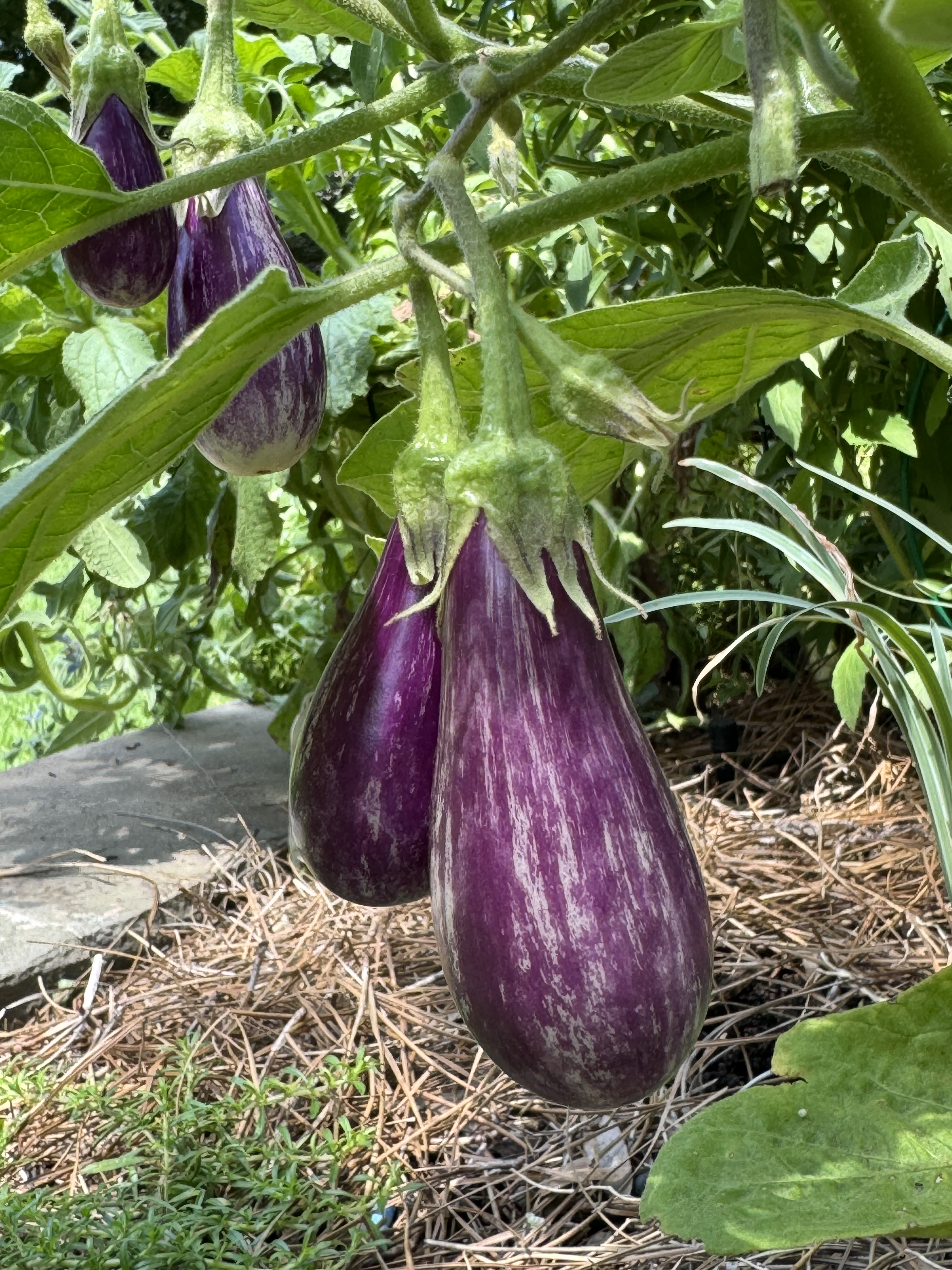
Does the familiar phrase ‘once upon a time’ bring back memories of your early childhood? Maybe it was when you heard the classic story of Little Red Riding Hood for the first time or were mesmerized when you saw Disney’s version of Snow White and the Seven Dwarfs. Throughout the years, fairy tales have given us wondrous characters in magical settings and left an indelible impression on young children throughout the world. But the fairy tale that has recently impressed me most is of a uniquely different variety. It is one that produces magically, ornamental plants for your garden. In this case, it is the adorable petite eggplant known as ‘Fairy Tale’.
Fairy Tale Eggplant
As you can see from the photo, it is a lovely mini eggplant, only 4 inches long, with stunning streaks of lavender and white. The plant itself grows to only 24” but produces tender-sweet fruits that are as beautiful as they are delicious. This variety can be grown in ground but, with its compact, dwarf size, is a just as suitable for container growing.
When it was time to harvest and enjoy, a quesadilla recipe was the perfect choice. Honey crisp apples gave it a sweet, tart taste while the smaller slices of savory fairy tale eggplant fit nicely on the tortilla. A handful of roughly chopped spinach along with some creamy Monterrey Jack cheese completed the combination of amazing flavors. Freshly made tortillas from Central Market held everything together while the quesadillas were baking in the oven.
A very unique feature of ‘Fairy Tale’ is the recognition it received in 2005 as an AAS* vegetable award winner. It was the first eggplant to win an AAS award since 1939. There is still time to grow ‘Fairy Tale’ in your garden so why not give it a try?
For transplants:
Pick a sunny site with rich, organic, well-draining soil. Eggplants require at least 6+ hours of direct sunlight per day. (Some sources advise not planting it in a plot where you grew tomatoes, peppers, potatoes or other eggplants the year before). Set transplants about 3 feet apart.
Mulch after planting.
Provide adequate water to produce the best-tasting eggplants. Fairy Tale eggplant enjoys deep, consistent watering throughout the growing season. Check often to be sure that Fairy Tale is receiving about 1-2 inches of water per week.
Harvest when fruits reach 2-4 inches in length for sweet, bitter-free enjoyment. Snip fruit with clean shears at their individual stems or in clusters. The skin should appear glossy (left side of photo), as dull skin can indicate overripe fruit (right side of photo). Harvest regularly to encourage new fruit production.
*All-America Selections winners are tested at trial grounds across North America. Each winner has superior qualities that distinguish it from similar varieties. ‘Fairy Tale’ was granted the prestigious AAS award by a nationwide panel of experts.
Linda Alexander,Dallas County Master Gardener Class of 2008
Oh, I so enjoy the colors and flowers that bloom during the early summer and one that I’m enjoying of late is bee balm. Its magenta flowers atop a tall stalk are a feast for pollinators. In the wildflower area of Raincatchers, a purple rocket-like plant is putting on a show – Bee balm? It looks nothing like the other, but I recall it being bee balm too. Can it be? And then there’s Lemon Balm with its bushy habit and ability to travel readily. Looks like it’s time to clear up this mystery—
Upon further investigation, these similar names create a climate for confusion Bee balm, Lemon Balm, and Lemon Bee Balm -the looks of the plants are distinctively different but all are related to the mint family.
eBee balm, also called Wild bergamot, has several varieties – some perennial and others annual. Monarda is a genus of flowering, plants from the mint family. Lamiaceae didyma or fistulosa (zones 4-9) are perennials. Its cheery pink flowers are located near the Edible landscape greenhouse and stands 24-48 inches tall, and can spread 24 -36 inches. It blooms late spring into summer in full to part sun in well prepared beds with good drainage. Bee balm has magenta, pink, purple, red or white flowers that are 2-3-inch across with slender tubes looking flowers on a tall stalk.
Bee Balm
If your garden needs a smaller specimen, pinch the stalks in early spring, or purchase a shorter variety. Deadheading and cutting makes way for more flower production. Cut the stalks close to the ground in late fall and they will return in the spring. Powdery mildew might make an appearance if it’s a wet spring, but it won’t harm the plant.
II was purchased at the DCMG Plant Sale at Fair Park and then a dear friend gifted some she started from seeds (Northaven Gardens). It spreads some, but not difficult to control. The bees, Butterflies and hummingbirds are delighted. Mark and Cynthia Jones captured this picture of a moth (white lined sphinx moth I think) feasting on the variety Peter’s Purple.
Lemon BEE Balm (Monarda citriodora) is a herbaceous annual of the mint family, native to Central, southern America and Mexico and is commonly found in pastures and prairies. It will thrive in full sun, and in poor, rocky, or sandy soils. Can you see where this gets confusing? It Blooms in late Spring early summer about the same time as the Bee balm is blooming. This was found in our wildflower area at the garden along with blanket flower, long after the bluebonnets, Indian paint brush, and Engelmann daisies have said their adieus (goodbyes) To confuse even more, Lemon Bee balm is also known as purple horsemint or lemon mint. It has lemon scented spiky clusters of varying shades of lavender. You can find this in seed packets and often in wildflower mixes.
Lemon Bee Balm
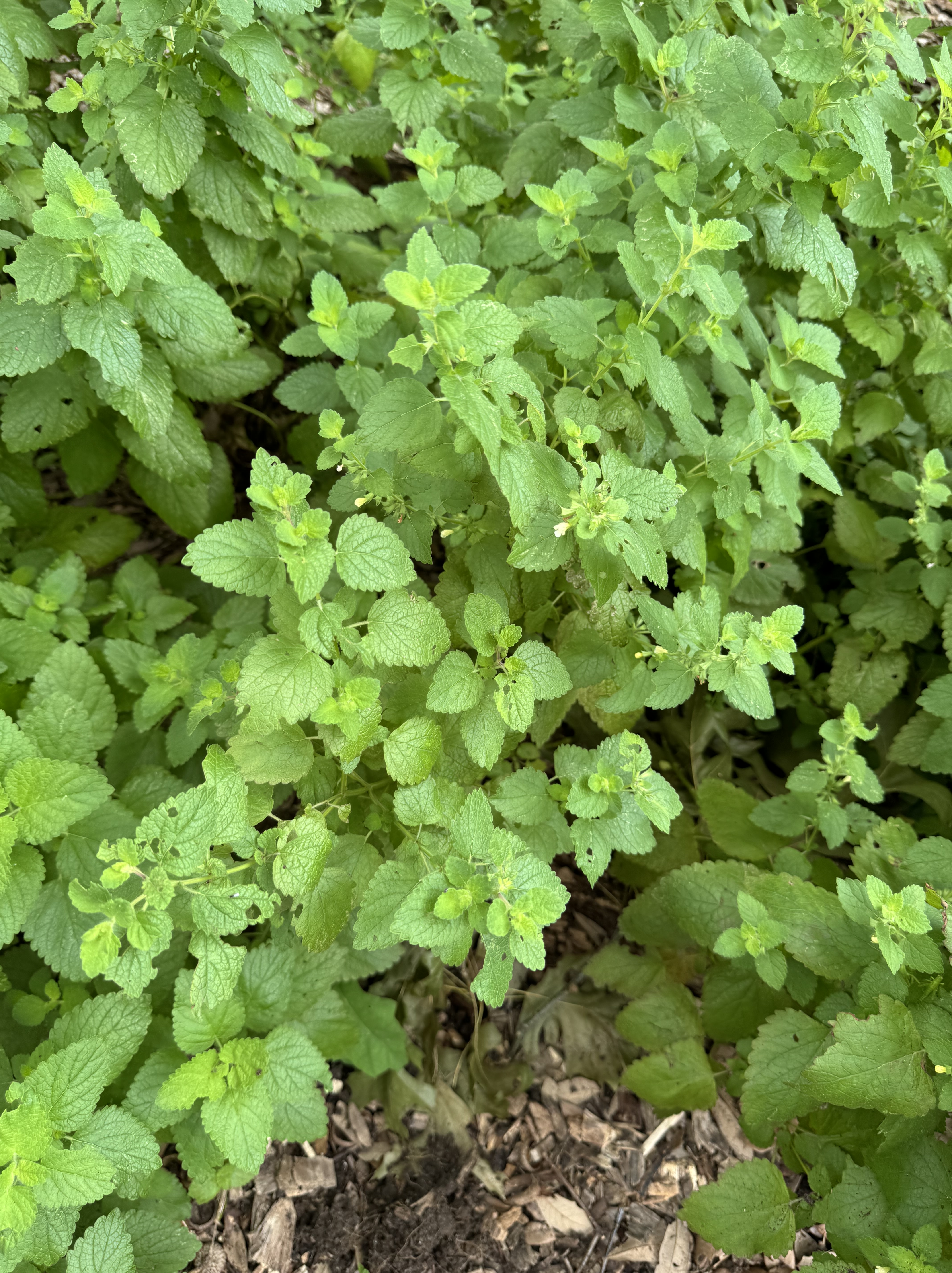
Lastly there is Lemon Balm, another member of the mint family, (Melissa officinalis). Native to Europe, It can be found in many places, but most recently has been thinned from the Hügelkultur in the Edible landscape. It grows in a clump, with wrinkled leaves that have a scent of Lemon. The flower is an insignificant spiky pale-yellow cluster. This herb is said to produce calming effects. It seeds and spreads readily and can get 3 feet by 2 feet. It consistently returns in the garden. It can be obtained in the herb section of garden centers or possibly a garden friend would gift you a start.
Lemon Balm
Now that that mystery is put to rest, figure out a way to use one or all of these beauties in your landscape.
Starla Willis, Dallas County Master Gardener Class of 2011
Video of sphinx moth, courtesy of Mark and Cynthia Jones, Dallas County Master Gardeners Class of 2013
If you’ve been to Raincatcher’s Garden of Midway Hills anytime during the past two weeks, a seasonal spectacle may have caught your eye. Everywhere you look, from the Edible Landscape/Courtyard area extending out to the north garden, pathways are filled with the sight of spring blooming pink poppies.
Move in a little closer and listen carefully for a soft humming sound. As you might have guessed, honeybees are busy at work foraging for pollen from the abundance of poppies that share these garden spaces with our herbs, vegetables and wildflowers.
Are you wondering…why are honeybees so attracted to poppies? As the late Robbin Thorp, native pollinator specialist for UC Davis in California so succinctly stated…” they’re not there for the nectar – they’re there for the pollen”.
Poppies should be considered as a quintessential plant for pollen production. And honeybees are one of the chief pollinating agents. A deeper dive into the world of poppies gives us some interesting information regarding pollen.
It is true that honeybees are attracted to poppies for pollen only. The reason why is that the inflorescences of all poppy species lack nectaries, thus no sugary nectar available to pollinators. Flowers, however, are packed with pollen-bearing anthers. Because pollen is the honeybee’s main source of protein, collecting it is a necessary task. Once collected, it is used for brood development and to feed the young larvae. And, fortunately for the bees, scientists have found that poppy pollen is remarkable clean, containing few fungi or mycotoxins.
Come visit our garden and take time to stroll the garden paths filled with poppies. Expect to be mesmerized by an eye-catching explosion of frills. Early morning and late afternoon seem to be the optimum time to experience the honeybees in action. Don’t be surprised to see as many as four or five honeybees foraging frenetically within a single flower.
(Raincatcher’s Garden of Midway Hills…Our “field of poppies!)
Linda Alexander, Dallas County Master Gardener Class of 2008
The kiosk in the north garden at Raincatcher’s Garden has been somewhat ignored over the years. We felt it would be a good opportunity to give people visiting the garden some useful information about events happening at the garden, as well as plant details. It was time that the kiosk served some purpose!!! The first poster that was added to the kiosk was information about our blog, Dallas Garden Buzz. Hopefully, visitors to the garden will use the QR code and find a wealth of plant information, beautiful garden photos and great recipes. Another flyer was added to announce our annual plant sale coming up on Tuesday, May 7, 2024
One of our main missions as Master Gardeners is to be a resource for gardening knowledge to the community. We will be using the kiosk to do this by posting a monthly plant information sheet featuring one of the plants in the garden. Not only will visitors be able to read the plant information but they will also be able to stroll through the garden trying to locate the plant on the flyer.
Below is the first “Plant of the Month” information sheet that is currently posted in the kiosk. Hopefully, this will be the first of many!!!
Chinese Ground Orchard
The Chinese Ground Orchid is a perennial bulb in the orchid family that grows to a height of 1 – 1½ foot with a 1 foot spread. It is a shade plant that does well in morning sun and afternoon shade but it will also grow in full shade. The blooms last for about 6 weeks and the foliage looks like a palm tree seedling when not in bloom. This tropical plant does well as a ground cover or growing under a tree and is a good choice for a container in colder climates. The Chinese Ground Orchid spreads by rhizomes and is easily propagated by divisions. This beautiful plant is blooming in the courtyard now.
Jackie James, Dallas County Master Gardener Class of 1993
Starla and I will be speaking at the Dallas Arboretum during Dallas Blooms at 11am on Friday, March 1st. We will be coordinating with the Dallas Blooms theme-A picture’s worth a thousand words, showing pictures of our recent trip to America’s Garden Capitol and giving photography tips.
Click here for information about our talk as part of the series: Learn to Grow Horticultural Presentations. Many other classes will be available by other Dallas County Master Gardeners. Check the calendar!
No charge except your admission to the Arboretum.
The DCMGA Japanese Maple Sale Begins March 6
Once again, we are offering a large selection of Japanese Maples from Metro Maples for purchase with all proceeds going to DCMGA. If you were disappointed because you missed out buying one of these lovely trees in the October sale, be sure to get online early to make your selections. The SignUpGenius for ordering and purchasing maples will go live March 6 at 8 AM. At that time, you can order and pay for your selection(s). One-gallon trees are $35.00 (including tax) Two-gallon trees are $46.00 (including tax) The SignUpGenius will close at 5 PM on March 13, or earlier if all trees are sold. Our inventory of trees sold out within hours last October. Please bring your confirmation to the pickup on Saturday, March 23 between 10 AM and 1 PM at Raincatcher’s Garden.
SAVE THE DATE: Raincatcher’s Garden Annual Plant Sale
Midway Hills Christian Church
11001 Midway Road
Dallas, Texas 75229
Tuesday, May 7th 2024
10 AM – 3 PM
We will have annuals, perennials, herbs, peppers, succulents, shrubs, trees, groundcover, bulbs, houseplants, decorative pots, yard art, etc.
All proceeds from this sale go to Dallas County Master Gardener Projects.
Ann Lamb, Dallas County Master Gardener Class of 2005