Tag Archives: Dallas County Master Gardeners

Tagging Monarchs at Raincatcher’s

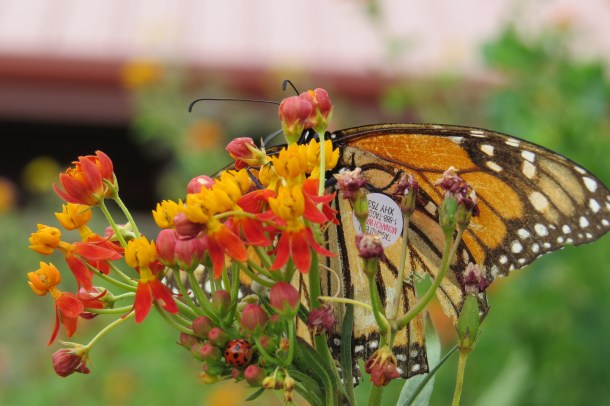
Monarch Butterfly Sipping Milkweed, Note the Tag

With a woosh of her net, Master Naturalist, Ellen Guiling, has captured another Monarch butterfly to be tagged and then sent on its migratory journey.

As per the Monarch Watch website: tagging information helps answer questions about the geographic origins of monarchs, the timing and pace of the migration, mortality during migration, the effects of wind and weather, and changes in geographic distribution of monarchs. Each year the information is collected and can be viewed at www.monarchwatch.org.

You may remember Starla found a tagged Monarch from Kansas who visited our garden in 2015.

We have many butterflies visiting The Raincatcher’s Garden and the reason goes back to the careful planning and planting of host and nectar plants for many different types of butterflies. Review the butterfly plant list in our Raincatcher’s Resources on the right of our front page and enjoy the delights of your own butterfly garden.

Ann Lamb

Pictures and video by Starla Willis


Chinese Long Beans—Green Beans for Summer—Even Here

Have you ever read or been told that green beans will produce all summer?  This is advice that must be met with a kind smile.  Bless their hearts, it’s totally untrue.   Obviously cannot be blamed for this mistake, they are just not from around here.  Anyone who gardens in North Texas knows green beans will not make it in summer’s heat.

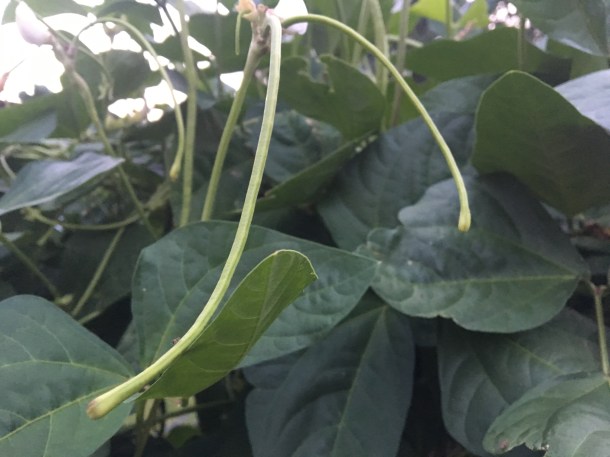
Does that mean no more fresh beans? No, not if you plant Chinese long beans.  This delicious vegetable goes by many names: snake bean, yard long bean even asparagus bean.  A red variety called red noodle is also available.  Properly they are called Vigna Unguiculata.  As its “real name” makes clear, they are actually related to cowpeas or blackeyed peas and not ordinary garden green beans.  The important point is they grow in the heat of summer, in fact they require heat to do well.  Which wouldn’t matter if they didn’t taste good, but they do with flavor much like green beans and a touch of blacked pea.

Are you convinced? Plant the seeds as directed on the package.  It is essential to provide a sturdy support as these are vines not bushes.  Large tomato cages work well. The vines would probably like something ten feet tall to grown on but vines don’t always get what they want.  Compromise is key between you and the vines.  Give the vines plenty of room so  they can grow up and over supports but keep them within bounds so you can  pick the beans. Remember the vines will try to grab any innocent plant that gets in their way; be alert.

Trellised Vines of the Chinese Long Bean

Garden soil with compost is ideal.  Apply organic fertilizer when planting. As with any rapidly growing plant, regular watering is essential.

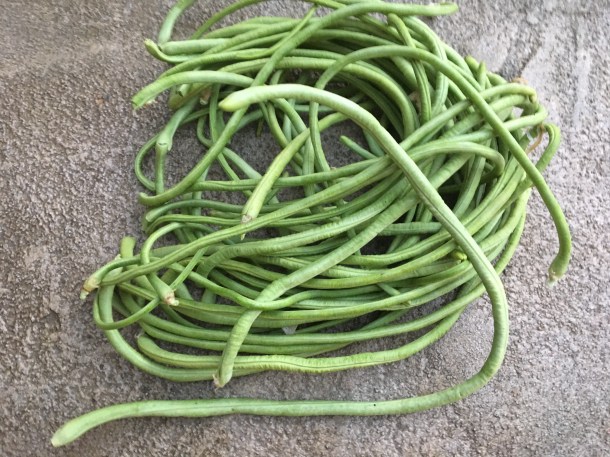
Once the production starts, check the vines every day. The beans grow amazingly fast and will need regular picking, pick them about twelve inches long  while they are still firm and dark green.

Chinese Long Beans, Ready to Eat!

When they are picked like this they are even good raw in salad. They are delicious prepared in many ways: simmered as green beans would be or fried as they are in many traditional Chinese recipes.

Try them and you will see for yourself!!

Susan Thornbury

Killing Nutgrass

If ever there was a villain in the garden, nutgrass would be the culprit.

It is one of the most hated weeds and very aggressive, robbing desirable plants of water and nutrition.   Nutgrass rankles my sister  so much she tells me she can see it out of the corner of her eye as she walks through her garden. Then, like any good gardener she attacks it and tries to dig up the whole plant along with the rhizomes and the tubers (also called nuts). Any tubers left behind will generate a whole new set of weeds.

Though it looks like grass, the plant is actually a sedge. The  varieties most often seen are  Cyperus esculentus (yellow nutsedge) and Cyperus rotundus (purple nutsedge).  Even our own garden has an unwanted plot of purple nutsedge in the Edible Garden area.

What should we do about this problem intruder? How can we kill nutgrass organically in a large garden area? *Kim Kirkhart has had success with her variation of the  loose landscape fabric method taught by Skip Richter, Texas AgriLife Extension  Agent for Harris County.

What’s  needed:

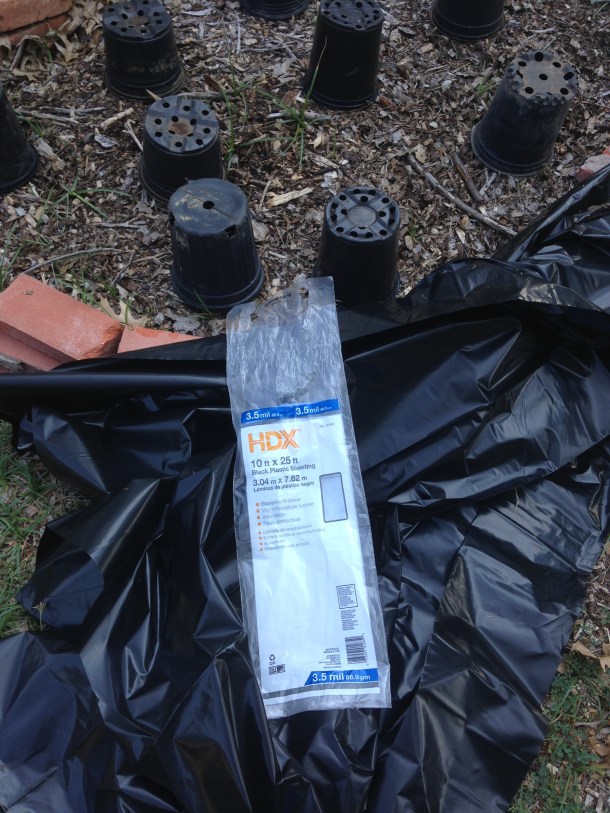
  • Heavy black plastic
  •  Plastic pots
  • Bricks or rocks to hold plastic in place
  • Time-this method takes several months  up to a  year

Recycled Plastic Pots

Begin by setting plastic pots in the garden area. The pots have a dual purpose. They  hold up the black tarp and also spot kill nutgrass. 3 or 4 pots are stacked together (turning them each to cover their holes).

As you can see, not all the nutgrass is under pots.  Don’t worry though, those invaders will die under the tarp, without light.

Heavy Black Plastic

Next lay the black plastic over the whole garden area on top of the pots. The pots keep the plastic elevated so emerging nutgrass shoots can not puncture through the plastic and let light in. Overlap the seams of the plastic to keep the light out.

Bricks hold the plastic in place, remember to keep the plastic lifted.

Carefully place bricks or rocks around edge of plastic and wait for the nutgrass to die.

This organic way of killing nutgrass requires patience. We started this process July 26 and plan to take off the plastic in October in time for fall gardening. We will let you know the results of our test!

Pictures  by *Kim Kirkhart, DCMGA class of 2006

Ann Lamb

Click here for Skip Richter’s article, Weed Wars.  We have used the expert advice in this article for our method of killing nutgrass organically.

August 2017 at Raincatcher’s

We appreciate and enjoy our new shade structure!

Our rain garden flourishes with purpose and beauty.

Our volunteers are busy with projects like staining vegetable beds.

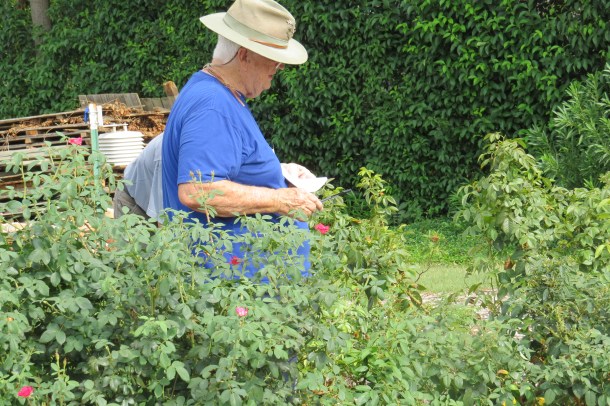
Our roses are carefully monitored in Rose Rosette Trials.

Please visit us at The Raincatcher’s Garden. We are at work Tuesday mornings and also have several upcoming education events open to the public. Drop a comment if you would like more information or call the Master Gardener Help Desk 214 904 3053.

Ann Lamb

Pictures by Starla Willis

Hurricane Harvey 2017

Our hearts are with our fellow Texans under duress because of Hurricane Harvey.

Here are two posts about the area:

Hummer Festival

The Big Tree

Ann Lamb


Made For The Shade

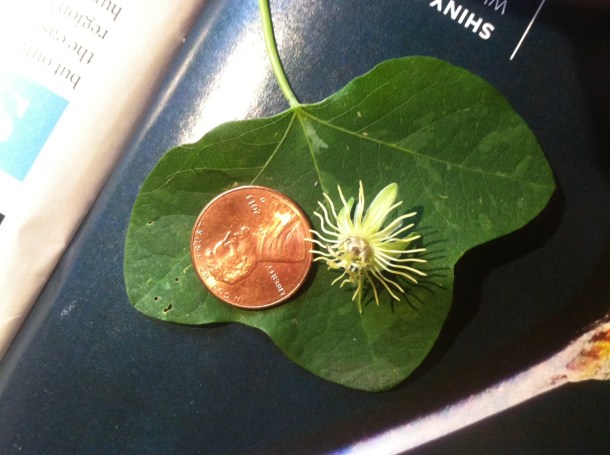
Have you always wanted to grow a passion vine but have too much shade to grow the showy purple Passiflora incarnata?  Or perhaps you have a butterfly garden and are interested in providing one of the host plants for Gulf Fritillary, Julia and Zebra Longwing butterflies?  Well, if you don’t mind having a Lilliputian passion flower that is only about an inch in diameter, then Passiflora lutea is for you.

Passiflora lutea is also known as yellow passionflower, though the color of the flowers may range from chartreuse to off-white.  It is a native plant in Texas that blooms from May through September. In Dallas it is considered a perennial herbaceous climbing or trailing vine that can reach 15 feet in height.  Here it will loose its wide shallowly-lobed leaves in the winter but it comes back reliably in the spring.   The fall leaf color is a shade of yellow. Though considered somewhat drought tolerant once established, P. lutea prefers moist, rich soil.  Its flowers are followed by small black berries, which some say are edible but not very tasty.


Tiny Yellow Passionflower and Leaf From Carolyn’s Garden

I have P. lutea growing wild in my shady yard near White Rock Lake.  If I don’t keep an eye on it, the vines can grow rampantly in some spots.  However they are very easy to pull off from wherever they are growing.  I also have one pot of purple Passiflora incarnata and have noticed that the Gulf Fritillary butterfles tend to prefer to lay their eggs on P. incarnata rather than P. lutea.  However, one of my neighbors had P. lutea growing in her yard and had many caterpillars feeding on it.

One of the historic uses for the berries has been to make ink.  A recommended recipe is:  ½ cup of P. lutea berries, ½ tsp. salt, and ½ tsp. vinegar.  Crush the berries, and then strain the liquid through a fine sieve.  Then add the salt and vinegar.  Though this ink is not archival, the deep purple-black color is pretty

Yellow passionflower  is not often found in most garden centers. However,  Roseann Ferguson says that the annual plant sale at Texas Discovery Gardens will carry it.  The dates for this year’s fall sale are September 15-16 with the member-only sale taking place on the 15.  Many of their unusual plants sell out quickly, so get there early and consider becoming a member.  Further information about the plants that will be for sale will be posted on Texas Discovery Garden’s website (www.txdg.org) closer to the date of the sale.

Carolyn Bush


August Color in the Garden

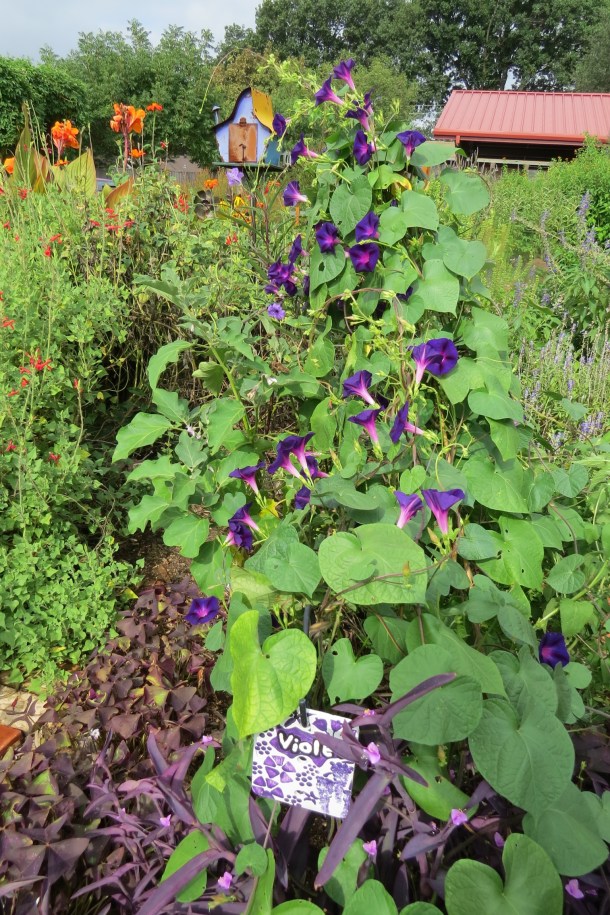
Starla said, “my favorite color this week is violet.”

Thank you, Starla, we like it and welcome back!

Ann Lamb

Click here for other August photos

Send us your comments about the eclipse! We are interested!

Tomatoes For Dessert!

Green Tomato Brown Betty

Green Tomato Brown Betty

Ingredients:

2 cups crumbs (graham cracker, whole wheat cracker or cookie crumbs)

1 stick unsalted butter, melted

3 pounds (approximately 3½ cups) unripe green tomatoes, thinly sliced

¾ cup raisins

Juice of 1 lemon

1¼ cups light brown sugar

1 tablespoon cinnamon

1 teaspoon ground allspice

½ cup apple juice

Directions:

  1. Preheat the oven to 350˚.
  2. In a small bowl, combine the crumbs and melted butter. Set aside. In a medium bowl, mix the tomatoes, raisins, lemon juice, sugar and spices together.
  3. Butter a 2-quart baking dish. Spread a third of the crumb mixture evenly over the bottom. Spread half of the tomato mixture on top of the crumbs. Sprinkle with half the apple juice. Cover with another third of the crumb mixture, followed by the remaining tomatoes. Sprinkle with the rest of the apple juice. Finish by covering the tomatoes with the remaining crumb mixture.
  4. Cover and bake for approximately 45 minutes or until the tomatoes are soft. Remove the cover. Raise the heat to 400˚ and bake for another 10 minutes or until browned on top. Serve warm with a scoop of vanilla ice cream.

Serves 8

Adapted from TOMATOES: A Country Garden Cookbook by Jesse Cool


Tomato Ginger Upside-Down Cake

Ingredients:

1 stick unsalted butter, melted

1 tablespoon grated fresh ginger

6 tablespoons light brown sugar

2 to 3 ripe tomatoes (or enough to cover the bottom of the pan as you would a pineapple upside-down cake), skinned, seeded and sliced ¼ inch thick

1 stick unsalted butter, softened

1½ cups brown sugar

½ cup molasses

2½ cups unbleached white flour

2 teaspoons baking powder

1 tablespoon ground ginger

½ teaspoon ground cloves

1 cup buttermilk

Directions:

  1. Preheat the oven to 350˚.
  2. Combine the melted butter with the ginger and sugar and spread evenly on the bottom of a parchment paper-lined 10×14-inch pan. Cover with tomato slices.
  3. In a mixer, cream the butter with the brown sugar and molasses. In another bowl, sift together the flour, baking powder and spices. Add the flour mixture alternately with the buttermilk to the creamed butter and sugar. Pour batter over tomatoes in baking pan.
  4. Bake for approximately 40 minutes or until a toothpick comes out clean when testing the center of the cake. Remove from the oven, loosen outer edges with a knife and invert onto a platter larger than the baking pan. Let stand at least 5 minutes before trying to remove the pan. Carefully peel back the parchment paper. Serve warm with whipped cream or vanilla ice cream.

Serves 8 or more

Adapted from TOMATOES, A Country Garden Cookbook by Jesse Cool

Recipes and Picture by Linda Alexander

Editing-Lisa Centala

Tomato Sampler Lunch Recipes From August 1, 2017

Cream of Tomato Soup with Parsley Croutons

Cream of Roasted Tomato Soup with Parsley Croutons

Ingredients:

2 pounds large, ripe tomatoes

Olive oil to coat tomatoes

8 shallots

1 small carrot

1 small fennel bulb

3 tablespoons unsalted butter

2 cups chicken or vegetable stock

5 to 6 sprigs fresh tarragon

5 to 6 sprigs fresh parsley

Salt and freshly ground black pepper, to taste

1 cup heavy cream (optional)

Parsley Croutons:

12 thin slices baguette

Olive oil to generously coat both sides of each piece of baguette

3 cloves garlic, cut in half

½ cup Teleme cheese, grated (or use your favorite semi-soft cheese, such as Brie, Havarti, Monterrey Jack or Port Salut)

¼ cup chopped fresh parsley

Directions:

  1. Preheat the oven to 425˚. Cut tomatoes in half, seed them and coat with olive oil. Place tomatoes on a foil lined cookie sheet and bake for 30 minutes, turning every 10 minutes, until the skins begin to darken and blister. Remove from oven and let cool. Remove the skins and reserve the pulp and all the juices.
  2. Coarsely chop the shallots, carrot and fennel. Melt butter in a medium saucepan over medium heat and sauté chopped vegetables until they are very soft. Stir occasionally to prevent sticking. Add the stock and herbs and simmer over low heat for 30 minutes. Add the tomato pulp and reserved tomato juices. Remove the herb sprigs. Puree the soup or run the pulp through a food mill or fine sieve for a smoother soup. Season with salt and pepper and extra herbs, if desired. Keep warm over low heat.
  3. Lower the oven to 400˚. To make the parsley croutons, brush both sides of baguette slices with olive oil and place on a baking sheet. Rub one side of baguette with garlic. Sprinkle with cheese and parsley and bake until brown.
  4. Add the cream to the soup if desired and heat until warm. Ladle soup into warm bowls and float 3 parsley croutons on top of each.

Serves 4

Adapted from TOMATOES, A Country Garden Cookbook by Jesse Cool


Summer Cherry Tomato Dressing

Summer Cherry Tomato Dressing

Ingredients:

8 ounces small cherry or other tiny tomatoes, halved or quartered, depending on size

3 tablespoons extra-virgin olive oil

2 tablespoons drained, oil-packed sundried tomatoes, thinly sliced

1 tablespoon fresh basil leaves, thinly sliced

2 teaspoons drained capers, coarsely chopped

2 teaspoons sherry vinegar

2 teaspoons fresh orange juice

½ teaspoon minced fresh garlic

¼ teaspoon Kosher salt

Directions:

  1. Combine all of the ingredients in a small bowl and stir gently to combine. Let sit for 10 to 15 minutes (or up to 30 minutes) to let the flavors mingle and to let the tomatoes marinate some. Stir gently before serving over fresh green salad. May also be refrigerated overnight.

Yield: About 1 ¼ cups

Adapted from Edible Dallas and Fort Worth, Summer 2010
Curried Tomato Pickles

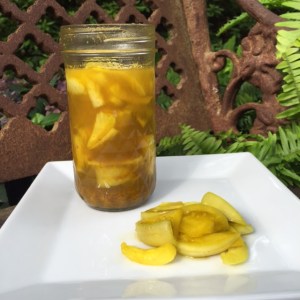
Curried Pickled Tomatoes

Ingredients:

2 pounds unripe green tomatoes

2 medium yellow onions

4 to 5 fresh whole red chili peppers

3 to 4 cups seasoned rice wine vinegar

3 bay leaves

3 cloves garlic

1 teaspoon whole allspice

2 tablespoons curry powder

1 tablespoon whole cumin

Directions:

  1. Sterilize 4 or 5 pint-sized jars by boiling in hot water or running them through the dishwasher without detergent.
  2. Cut tomatoes into wedges. Cut the onions into wedges approximately the same size as the tomatoes. Alternate layers of the onions and the tomatoes in the sterilized jars. Place 1 chili pepper in each jar.
  3. In a large, nonreactive pot, bring all the remaining ingredients to a boil for 5 minutes. Strain and pour evenly over the onions and tomatoes. Let cool.
  4. Add enough liquid to the jars to completely cover the vegetables and reach within ½ inch of the top of the jar. Add more vinegar if more liquid is needed. Cover with the lids and store in the refrigerator. Give them a minimum of a few days before eating. Good for at least 2 months in the refrigerator.

Makes 4 to 5 pints

Adapted from TOMATOES: A Country Garden Cookbook by Jesse Cool

Heirloom Tomato and Fresh Peach Salad

Heirloom Tomato and Fresh Peach Salad over Whipped Burrata Cheese 

Ingredients:

2 heirloom tomatoes, cut into wedges

4 yellow pear tomatoes, cut in half

2 ripe peaches, sliced

2 watermelon radishes, thinly sliced on a mandoline

12 zucchini spirals, thinly sliced longwise on a mandoline

2 tablespoons pine nuts, lightly toasted

16 ounces Burrata cheese (may substitute fresh mozzarella and cream for thinning) 

Directions:

1. Whip Burrata cheese in a food processor until creamy and spreadable.

2. Spread equal amounts of the cheese onto four salad plates, forming a circle.

3. Arrange an even number of tomato wedges, peach slices, radish slices and zucchini spirals on top of the cheese.

4. Sprinkle the pine nuts evenly over each of the four plates. 

Serves 4

Tomato Tart

Ingredients:

1 unbaked 10-inch pie crust (boxed, refrigerated type preferred)

Pinch ground nutmeg

1½ pounds Roma tomatoes, thickly sliced

1 rib celery, coarsely chopped

1 carrot, peeled and coarsely chopped

1 medium red onion, coarsely chopped

1 clove garlic, minced

¼ cup Italian parsley, coarsely chopped and firmly packed

2 tablespoons olive oil

2 tablespoons unsalted butter, melted

Salt

Freshly ground pepper

1 tablespoon minced fresh basil

4 large eggs, lightly beaten

2 ounces Parmesan cheese, freshly grated (½ cup)

1 large tomato, seeded and thinly sliced

Fresh basil leaves to garnish

Freshly grated Parmesan cheese to garnish

Directions:

  1. Unroll pie crust and roll out slightly to fit into and up the sides of a 10” tart pan. Gently press into place. Dust with nutmeg and prick bottom with a fork. Place aluminum foil with pie weights or dried beans over pastry. Chill 30 minutes in refrigerator or place in freezer for 10 minutes. Preheat oven to 425˚. Bake 10 to 15 minutes. Remove foil and weights. Continue cooking until crust is golden and dry in the center, about 5 minutes. Remove from oven and cool at least 15 minutes.
  2. Place Roma tomatoes, celery, carrot, onion, garlic, and parsley in a large skillet. Drizzle olive oil over top. Cover and cook over medium-low heat for 1 hour, stirring occasionally to prevent sticking on the bottom. Transfer mixture to a food processor and process until finely chopped. Add butter. Process to combine. Season with salt and pepper. Transfer tomato mixture to a medium saucepan or back into the skillet. Cook over medium heat until thickened, about 15 minutes. Transfer to a bowl and stir in basil. Set aside and allow to cool completely.
  3. Preheat oven to 350˚. Add eggs and Parmesan to cooled tomato mixture. Pour tomato mixture into tart crust. Arrange tomato slices over filling. Bake 20 minutes or until golden brown and filling is firm in the center. Cool 12 to 15 minutes before slicing. Garnish slices with basil and Parmesan.

Serves 8

Adapted from Stop and Smell the Rosemary by Junior League of Houston

Recipes and Pictures by Linda Alexander

Editing by Lisa Centala

More Tomato Recipes Tomorrow!
 

The Science Of Decay

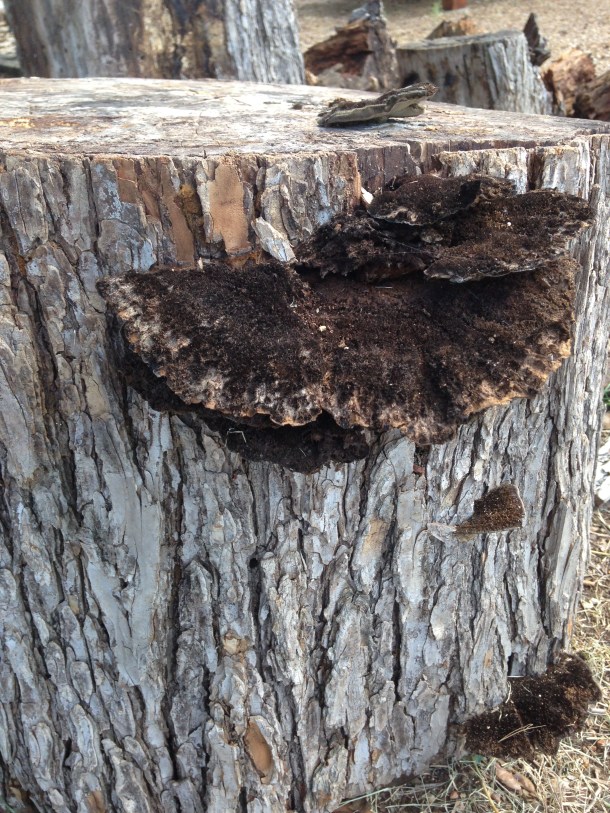
What am I ?


It appears that the latest visitor to the edible landscape garden is a Brown Shelf Fungus. It was found on one of the logs that has been used as a garden seat. Fungi are many-celled filamentous or singlecelled primitive plants. They lack chlorophyll and must live on decaying plants to get carbohydrates.

The Brown Fungus produces hydrogen peroxide to decompose the cellulose in the wood. Since the hydrogen peroxide (H2O2) is a small molecule, it can move rapidly through the wood. This will mean that the decomposition will not be just surrounding the area of the hyphae or filaments of the fungus. The log will eventually decay and become part of the surrounding soil. 

Mark Jones

Picture by Kim Kirkhart