My Jewels of Opar is in a mostly shady area. Next spring, as new plants emerge, they will be relocated to a place in my garden that receives full sun until late afternoon.
In May of 2021, we shared an article with our readers about Jewels of Opar, a lovely plant that is both edible and ornamental. Click here for the original article which includes helpful growing information.
This time, we’ve chosen to “drop in” for a quick autumn visit showcasing this adorable little beaded wonder in full bloom. You may remember that Jewels of Opar, sometimes referred to as Pink Baby-Breath, produces wands of tiny, pink star-shaped flowers followed by jewel-like fruits in shades of pink and orangish red.
Enjoy this photo of a simple arrangement filled with Roselle Hibiscus leaves gracefully surrounding Jewels of Opar in its colorful autumn wardrobe!
Linda Alexander, Dallas County Master Gardener Class of 2008
Here’s a hint – with its strong lemony scent and flavor, you’ll find many uses for it in the kitchen. You may have already guessed just by looking at the photo but, yes, the answer is Lemon Verbena (Aloysia triphylla). For over 30 years it has been my very favorite herb. I’ve used it countless times for breads, cakes, cookies, puddings, in savory dishes and beverages. From early spring when it emerges from the ground and sends up those first “shoots”, a fresh sprig goes into my daily glass of green tea. The ritual continues until at least November or whenever our first freeze of the season arrives.
Lemon Verbena Tea Garnished With Freshly Cut Lemon Verbena
Why should lemon verbena be growing in your garden? To start, lemon verbena is considered by some to be the queen of aromatic herbs, myself included. One whiff of its sweet lemony aroma explains why Southern ladies suffering from the “vapors” mopped their brows with a decoction made from its leaves. For this reason, it is sometimes called the Scarlett O’Hara herbs. Growing in our Zone 8 climate, you can expect lemon verbena to easily reach 4 to 5 feet in height when planted in full sun and in good garden soil. Consider placing it toward the back of your garden bed where it will become a nice informal shrub. Also, keep in mind that it tends to ramble off in different directions but can easily be trimmed to the shape you desire. Lemon verbena is a woody perennial that will start losing its slender, elongated leaves in late fall. If heavily mulched, it will survive a moderate winter. However, in the northern part of Texas, it may succumb to temperatures lower than 25° F. Over the years, I’ve lost at least five or more lemon verbena plants during a hard freeze. But once spring arrives, most local garden centers have it in stock. And, thankfully, it is a relatively quick growing plant.
Lemon Verbena Growing Gracefully in My Garden
Recently, I discovered a recipe in one of my 1995 herbal cookbooks that gave me a new appreciation for using lemon verbena with another well-loved herb, Anise Hyssop (Agastache foeniculum). In the summer section of ‘Today’s Herbal Kitchen’ published by the Memphis, Tennessee Herb Society, the recipe that caught my eye was Anise Hyssop Lemon Cake with Lemon Sauce.
Anise Hyssop is a pollinator-friendly plant whose blossoms are filled with honeybees
Reading through the short list of ingredients, I learned that anise hyssop was called for in the cake along with lemon verbena leaves in the sauce. Hooray! With both herbs growing in my summer garden, it was time to start baking.
Freshly snipped anise hyssop flowers ready to be chopped and mixed into the cake batter
Once out of the oven, and allowed to cool, it was time to slowly pour the luscious, warm lemon sauce over the top. I tried to imagine how the minty, licorice flavors of the cake would blend with the citrusy, floral taste of the sauce. Should I wait for my husband to come home from work before tasting? After carefully slicing the cake for the “photo shoot”, I yielded to temptation and willfully gave in to that first bite. It was a divine experience. My taste buds were rejoicing at the thought of this wonderfully harmonious combination. A new discovery is usually very satisfying and, in the case of anise hyssop and lemon verbena, I’ve determined that for as long as herbs are growing in my garden, these two “companions” will be there.
Dig a hole through time and you will hit a fig tree’s roots. Figs are one of the oldest cultivated plants.
Figs are interesting little fruits but not in the traditional sense. The structure of the fig is a called a syconium, a fleshy sac lined with tiny flowers inside. When you eat a fig, you’re technically eating hundreds of tiny inverted flowers that bloomed inside the syconium.
The word “fig” comes from the Latin ficus
There are over 700 species of fig trees worldwide
Figs grown in the USA are self pollinating but in other countries pollination is provided by fig wasps which crawl into the fig, complete their mission and then die inside the fruit.
Figs conatin fiber, copper, potassium, maganese, vitamin K and other nutrients
Plant your fig tree in full sun in soil with good drainage, mulch regularly and monitor moisture needs
My experience with growing figs started with a fig tree propagated by Master Gardener, Jim Dempsey. It was planted in my backyard about 10 years ago. Every year I have looked up into my trees large, deeply lobed leaves longing for figs. The winter storm of 2021 nicknamed “Snowmagdeddon” caused the tree to die back and it would be several more years of waiting and hoping as it recuperated.
Finally this year my family tasted the fruit! About 12 pounds of figs were harvested from our Celeste fig tree. We let it grow to a height of over 20 feet. Rather than try to protect the tree from birds with a net or other artificial means, we let the birds eat the fruit in the branches way up high leaving the rest for us. There’s nothing like the taste of a fig eaten at peak ripeness from your own backyard tree.
Our Celeste Fig Tree, note the neighbor’s two story chimney for height comparison.
Another personal story: My son and wife and three little children moved to a new house last year. They have a “Texas Everbearing” fig tree. To my great delight, my grandchildren are eating figs from thier own tree. Imagine me walking into their kitchen and seeing figs on their high chair plates. Surely this is tender hearted beauty!
Ann Lamb, Dallas County Master Gardener Class of 2005
Why do gardeners keep going? Its hot—get up really early start to work to beat the heat—and find the mosquitos got up earlier.
Work hard on weeding feel successful–turn around–and find more weeds.
Wonderful to have so many flowers–until its obvious many flowers mean alot of deadheading.
Sometimes the problems pile up. It can be easy to forget the blessings gardening brings. Of course there is the functional fitness aspect–digging those weeds is actually a good thing. Fresh air and sunshine help the body and the mind.. Just being needed by the garden can be seen as a burden–but really its a blessing to be needed.
But remember another aspect of gardening that brings lasting joy. That is the way our plants and gardens connect us to others.
Some of our connections are to friends and family that we see regularly. Those who share successes –and some failures—and sometimes plants. Others are gone now but the plants they shared long ago ensure that they are not forgotten. Somehow they are not gone at all but with us still as we garden.
This was the first plant I ever had, well, a descendant, of course. I was about 6 years old. My mother and I were visiting one of her friends. She had Ghost plants in a huge iron kettle used by generations before to heat water over a fire and wash clothes. The plants spilling out of the kettle, now used as a flower pot, enchanted me.
So for sure–gardening is hard work somehow conditions never seem “just right” too hot too cold too dry too wet–it all happens. And we have to get out there anyway.
But don’t just work. Pause and take a step back every so often. Think about all the people and all the stories that surround your plants.
Then you will remember why you keep gardening. Remembering will lift you and bring joy to you even in difficult times.
This is Red Dragon. I was given a few stems in a glass of water by a friend and now it’s being shared.This unknown grass is a descendant of a small plant gathered by my mother near Lake Proctor.Raincatcher’s Garden used to be at Joe Field. I took some cutting of this pink turk’s cap before we left. They continue on!I found this rosemary in a trash pile. It isn’at a particularly good plant but it made me happy to find it and see it growing now years later.A neighbor came by and told me she enjoyed the zinnias in my yard and how much they took her back to her Mother’s garden.Growing a tree from seed reminds us that we can do a lot if we try.
Thank you plant sharing friends:
Jim has grown so many seeds for the plant sale. This is Pride of Barbados, one of his specialty plants. Hope it blooms soon but even if it doesn’t, I am reminded of Jim and all his work for the garden.Mark started these cuttings and generously shared. Be sure to notice Althea when you visit The Raincatcher’s Garden. It has been blooming all summer and thank Mark.
Susan Thornbury, Dallas County Master Gardener Class of 2008
Passion vine has been tumbling over my mailbox for years. This summer I experienced the life cycle of the gulf fritillary from egg to caterpillar to chrysalis to butterfly.
This fascinating journey captivated me for weeks. On July 25th, caterpillars were covering the leaves and blooms of the passion vine. They looked menacing with their reddish-brown spiked bodies.
But there was one who was unlike the others – It had spikes, but had a white milky covering, and it was hanging in a definite “J” shape from my recently-bloomed color guard yucca stalk.
Excited, I ran to get my phone for a time lapse video, but the location and time that it would take to capture, encouraged a different approach. Pictures were snapped before running errands. Alas, upon returning the caterpillar had created the chrysalis and was unassumingly hanging on part of the stalk right at eye level. Had the caterpillar not been seen, it would have been difficult to recognize the chrysalis, as it looked like the material of the spent stalk. It was unnoticeable, unless it was seen in progress. Upon closer examination, the caterpillar shape was recognizable, and the lower portion was where wings formed.
Every morning began with observations – here are some of them:
1. Check on the chrysalis – no real change for about a week – information suggested that it would remain 5-8 days before emerging. Search for more.
2. Look for caterpillars– spiky, reddish brown color, they came in all sizes from very small to about 1 -2 inches long. They were in every part of the passion vine — plain sight, under the leaves, on the stems, and even in the flowers, but were voracious eaters.
3. Observe the native passion vine being ravaged by the very hungry caterpillars. -As a host plant, its lush vegetation, quicky changed to a sickly mass of stems, stripped leaves and decimated flowers. Nothing to do but watch, the plant would soon regrow.
4. Watch gulf fritillary butterflies deposit eggs on the leaves, quickly flitting away to find another spot to do it again.
5. Cringe as Wasps swoop in and sting vulnerable caterpillars. It was disheartening to view but realized that this is part of the natural process.
The observations of the chrysalis were routine until Saturday morning, August 2nd; – there was a gulf fritillary butterfly with his legs clinging to the chrysalis from which he had just emerged. Not moving much, just drying his wings and hanging out. After a few minutes it began to slowly fly to another stalk, then paused–It’s hard work coming out! After several minutes, there was more movement, brief flights, and then it disappeared into the flurry of other butterflies. The short-lived journey of this Gulf fritillary began (14-24 days).
During my daily walk around, it was noted that two eggs were deposited on the painted wood of my mailbox. The contrasting pale yellow color made it easy to observe. With a magnifying glass and ruler in hand., I peered closer at the eggs. For over a week the tiny egg remained unchanged, but then the color turned to a reddish-brown, becoming the smallest of caterpillars (3 mm) in search of passion vine to devour. They didn’t have far to travel as the native passion vine encircled the mailbox.
Eggs!Tiny caterpillar that emerged with Starla’s manicured nail for perspective.
Checking on the cats became a morning pattern, and I was not disappointed when stumbling on another gulf fritillary emerging. This one was located on a coneflower stem. The wings were still droopy indicating that it had very recently exited the chrysalis and needed to dry. As I watched, another gulf fritillary came, flitted his wings slowly and covered him as he hung to the chrysalis. This behavior mesmerized me. Was it protecting him while his wings were drying out? After a short while, maybe 10-15 minutes, they were in flight and yet another chrysalis was abandoned.
There’s so much I don’t know about this process but seeing it up close and personal reminded me that the wonder of God’s creation is incredibly complex and so beautiful. With our busy schedules this is a good reminder to take time to enjoy nature that is all around and let that inspire and encourage us.
Starla Willis, Dallas County Master Gardener Class of 2011
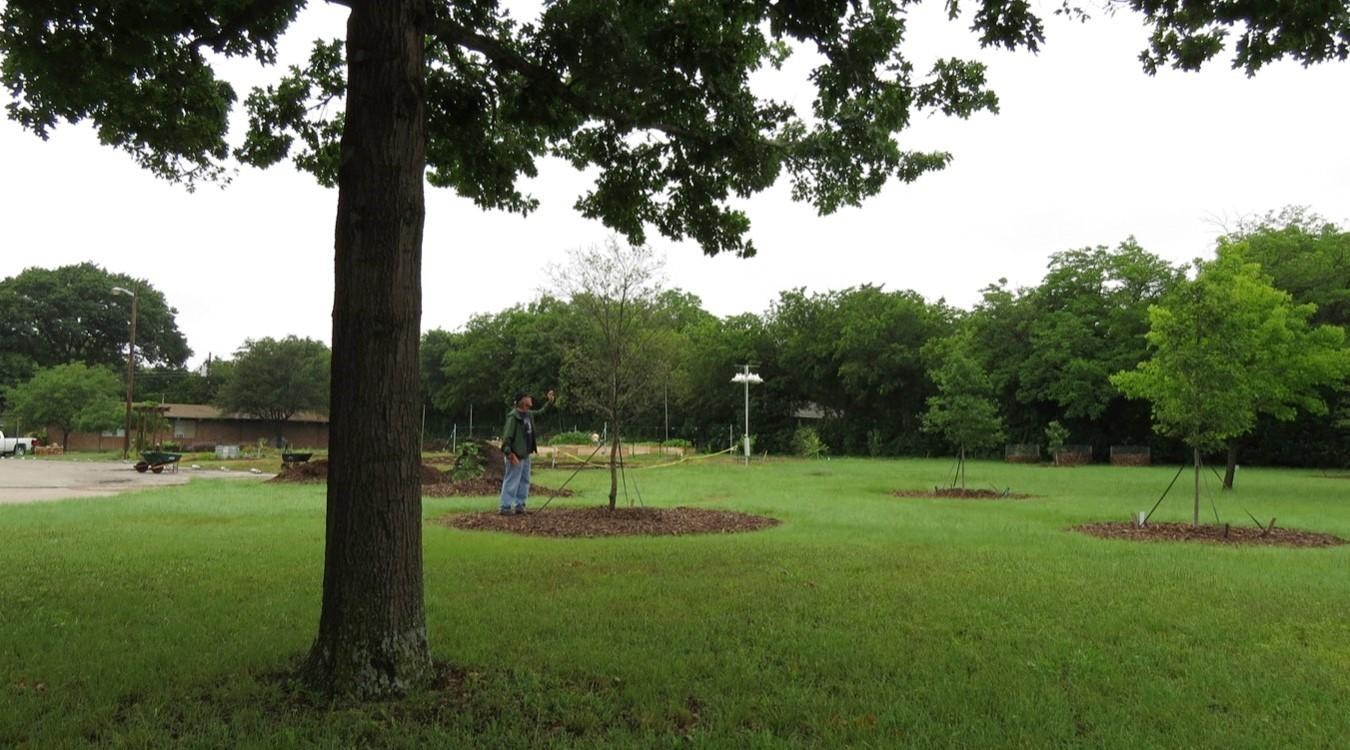
“Fresh peaches are nature’s candy”. From an unknown source, comes this quote that my husband embraces fully. It’s especially true at our house around late June to mid-July when those much-anticipated east Texas, Parker County and Hill Country peaches hit the local fruit stands and farmer’s markets. We’ve been known to buy several bushels during that time.
On a recent weekend trip to the deep piney woods of east Texas, we experienced an exceptionally flavorful peach event. Hosted by our dear friends, Sharon and Jason Romano, developers of a stunning place near Overton known as High Hill Resort Community, what could be more appropriate than to celebrate their annual peach-themed dinner extravaganza!
Bushels of peaches from local growers arrived at their doorstep a few days prior to the dinner. The restaurant’s chef had already created the menu so preparations for feeding 64 guests went immediately into action.
At 6:00pm diners were welcomed to their seats and the “peachy” feast began. Please enjoy reading through the menu and viewing photos of a masterfully curated “Philley Peach Dinner”. Congratulations to Executive Chef, Ryan Dove, and Sous Chef, Matt Frazier, for treating us to a truly memorable event!
And thanks to our friends for sending us back to Dallas with 2 bushels of those summer jewels from east Texas!
Here is a short list of several recipes we will be enjoying over the next few weeks:
Surprise Lily-The interesting thing about the name of this lily is that I was the one met with a surprise – in my own back yard!
Just a few days ago, with the temperature hovering around 93 degrees, I decided to run the sprinkler system in my raised edible bed. It was a hot afternoon and overspray from the system felt good hitting me in the face, so I sat down on a bench and waited for it to complete the cycle. Interestingly, something in the blue blooming salvia bed just to my right side kept catching my eye. Curious to figure out “why” a single, and very lovely, pale pink flower was peeking out at me, I got up, walked a few steps and stared in amazement.
Gently pushing back some of the ‘black and blue’ salvias that had been growing in that spot for over 5 years, was the most unexpected sight. Droplets from the sprinkler that had just watered that area were gracefully clinging to the petals and seemed to be inviting me to come closer and take a look. What was this mysterious plant that I had never even noticed in the 19 years we’ve lived here?
After taking a few photos with my iPhone and then doing a quick plant search, the answer was revealed to me. I was pleased to learn that the botanical name Lycoris, is from plants in the Amaryllis family. Some of their common names, however (resurrection flower, surprise lily and magic lily) refer to the trumpet-shaped blooms that resemble lilies. Also known as ‘naked ladies’ for the absence of leaves, these striking lilies start blooming around the end of July. She almost looked like a flamingo standing stiff-legged in my garden bed. I wanted to learn more about her!
Lycoris includes around 20 different species found in China, Japan and a few other Asian countries. However, the tall, pink flowered Lycoris x squamigera is the most common in American gardens. If you are interested in growing this lovely, delicate pink lady, here are a few tips to get started:
*The surprise lily is a perennial bulb in the Amaryllis family and is the hardiest of all the plants in the Lycoris species.
*Bulbs are about 3 inches in diameter with long necks that can persist for many years once established.
*Lycoris prefer full sun to partial shade.
*When planting, bury bulbs to a depth of 8 to 12 inches, spacing them 6 inches apart.
*They grow best in well-drained, fertile soils.
*Foliage emerges in late winter to early spring. Silvery gray greenish strap-like leaves measure 12 inches long and 1 inch wide. They grow in clumps.
*Foliage dies away in late spring followed by the late summer “surprise” lily that emerges like magic and produces 5-7 four-inch pale pink trumpet-like blooms atop the 2-foot tall stalks.
*Butterflies and hummingbirds are attracted to the fragrant flowers.
Now that I’ve had the pleasure of meeting this remarkable lady, I’ll be especially watchful next spring while awaiting her return!
Linda Alexander, Dallas County Master Gardener Class of 2008
The famous words refer of course not to a person but to the V8 Ford. Just out for a bit of fast driving–those were different days–gas was so cheap and all and the roads less crowded. But now the lesson. The Ford going as fast as it can is passed by Madeline in a Coupe deVille!!
Let’s leave it there for a bit.We need to get back to gardening
In your work at the Master Gardener projects do you get the feeling you must work hard non stop. Do you feel like you couldn’t possibly enter hours for volunteering which weren’t totally filled with your hard best effort?
Lisa collecting seedsVolunteer hard at work in The Raincatcher’s Vegetable GardenJoe and Jon constructing the Raincatcher’s pergola
Do you ever feel that no matter how hard you are working its not quite good enough and maybe others are working harder–or better?
Do you ever feel that even though you do feel you are working hard that what still needs doing seems endless?
Master Gardeners hard at work, tending to the compost.Dedication, hard work and nurturing!Garden labor makes a difference.
Is there ever a feeling of discouragement that creeps in before you even start to work ?
Sometimes we need to take a step back and do a little thinking.
We all need to find fun and joy in your garden work or honestly what is the point?
We need to work hard–yes! But we also need to take little breaks. Sure we need to rest or backs–and knees –and hips–we could go on and on. But also to rest our minds and spirits. We need to take time to connect with our friends–and maybe make some new ones. We need to look around and forget about the weeds for a few minutes and see the beauty and the good things.
Alot needs doing–it does but chances are those things aren’t going anywhere–take time to think about what has been done. Realize and appreciate that our work makes a difference to the garden–to others–and to ourselves.
The physical breaks are essential. The mental ones are too.
Sharing the joy of new plants.Lunchtime at the garden!Master Gardeners taking a well deserved break!
Without breaks–without connection to others–without appreciate and joy the whole point of gardening is lost.
With these breaks we can keep going while avoiding unnecessary injury or worse yet–burnout.
We all know people that it has happened to. Let’s not let it happen to us
Naturally we must end by going back to the V8 Ford.
Remember what happened–a little break–a little water–and ” she caught Madeline at the top of the hill”
Now we cant go too far with this lesson.
Madeline sounds like a bad girl who isn’t going to change so the catching may be a waste–all the Ford’s hard work too.
But we can change we can take time to rest-recharge–rethink-and keep the joy in gardening and in our lives.
Susan Thornbury, Dallas County Master Gardener Class of 2008
It happens every season. Our gardens give us a show-stopping presentation and then, poof, it’s over! So, what’s a good way to prepare for the transition? My advice, let the garden inspire you.
How about an artful arrangement of garden gifts for a dinner party buffet centerpiece?
A simple white ceramic pitcher was the perfect vessel for displaying the following “end of season” blossoms and greenery. Once completed, it had become a tapestry of seasonal beauty.
Cilantro in its “bolting” stage, curly and flat-leaf parsley, radish leaves, beet leaves, cornflower (bachelor’s buttons) and lots of blooming oregano stems for “filler”. A sprinkling of German Chamomile lightened the look. Guests were mesmerized by the natural beauty that a “fresh from the garden” look offered. Some couldn’t resist sampling a few sprigs!
A few days following our buffet dinner, the delightful arrangement was carried outside to be composted. As one master gardener remarked, “this is liquid gold for the compost bin!” I agree!
Linda Alexander, Dallas County Master Gardener Class of 2008
Location: The Raincatcher’s Garden at Midway Hills Christian Church,11001 Midway Road, Dallas, Texas 75229
Thursday, May 1st, 2025
10 AM – 3 PM
Great selection of annuals, perennials, herbs and veggies, succulents and sedums, tropicals and house plants, shrubs and trees, groundcovers, bulbs and irises grown by the intrepid Raincatchers volunteers.
All proceeds go to Dallas County Master Gardener projects.