Raincatcher’s Pansy and Plant Sale 2024 Raincatcher’s Garden of Midway Hills is offering fall annuals for your fall and winter landscape color. Pansies and violas are $21/flat of 18 4″ pots, which includes tax. The sale begins at 6 AM on Wednesday, 10/16, and ends on Sunday, 10/27, at midnight. Flats will be delivered to the garden on Thursday, 11/7, and will be available to be picked up from 10 AM until 2 PM or by appointment.
Summer’s official calendar date began on Sunday, June 21, 2024. The high that day was 95 degrees F. It was only the beginning of a miserably hot, humid summer. But now, exactly three months later, we have been rescued from the blast of heat that seemed to overstay its welcome. Once again, according to the calendar date of September 22, 2024, we have almost made it to the end of summer and will finally have some relief.
For all the bloomers and plant warriors that never gave up the fight, we celebrate you for gifting us with those bold and long lasting splashes of summer color. Our gardens were decorated with your presence. Throughout the months of June, July, August and September, early morning trips to the garden gave us a plentiful supply of dainty blossoms and gorgeous flowers, amazing vegetables and tasty culinary herbs.
Freshly harvested and carefully snipped, you filled our vases with stunning natural beauty. Charcuterie boards and chilled summer soups garnished with tiny treasures from the garden created an irresistible “feast for the eyes”. Your perseverance was remarkable. Thank you for giving us a summer filled with stunning landscapes, spectacular flowers, and fresh, flavorful edibles. Most of all we our honored that you leave us with the everlasting promise of returning next year!
*All photos in the attached video were taken from June 21, 2024, through September 18, 2024.
Linda Alexander, Dallas County Master Gardener Class of 2008
The Dallas County Master Gardener Association Japanese Maple Sale opens October 9 Once again, we are offering a large selection of Japanese Maples from Metro Maples for purchase with all proceeds going to DCMGA. These are very small young trees that will do well in a container until you find a place for them in your garden; in fact, many of them would be perfectly happy in containers for several years, although you can certainly plant them directly in the ground. If your interests lean toward the unusual and rare, we have several varieties that qualify including the dwarf Kotohime, Beni hagoromo, Chiri hime, Nuresagi and Ogon Sarasa. Get online early to make your selections. The SignUpGenius website for ordering and purchasing maples will go live October 9 at 8 a.m. At that time, you can order and pay for your selection(s).
One-gallon trees are $35.00 (including tax) Two-gallon trees are $46.00 (including tax)
The SignUpGenius will close at 5 p.m. on October 16, or earlier if all trees are sold. This fall we have 20% more trees for sale, but don’t procrastinate because our inventory of trees has sold out within hours in the past. Please bring your confirmation to the pickup on Saturday, October 26 between 10 a.m. and 1 p.m. at 3015 Randy Ln., Farmers Branch (note: this is a new pick-up location.)
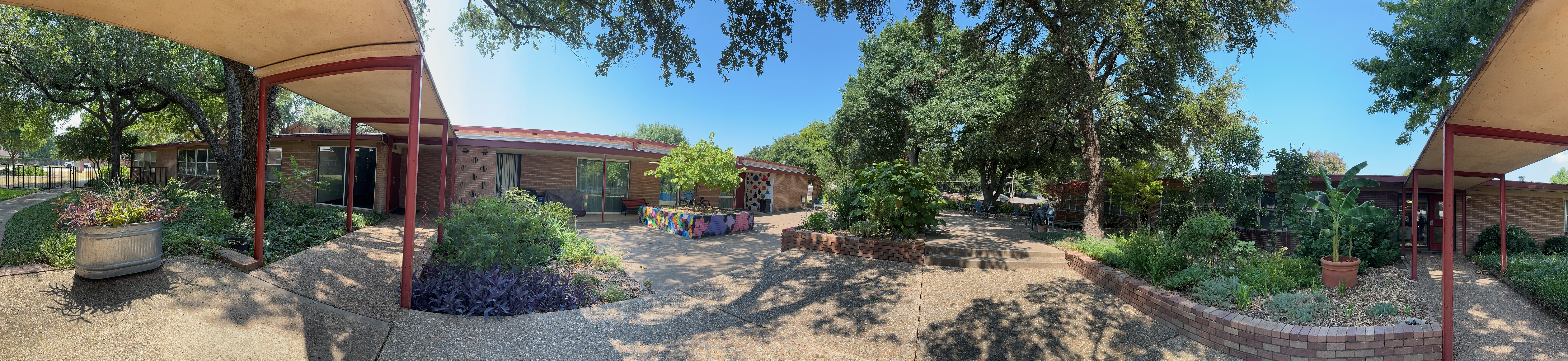
Panoramtic View of the Courtyard, Raincatcher’s Garden
Our garden has survived and even thrived this summer. The Raincatcher’s Garden was built using the 7 principles of Water Wise Landscaping:
Planning and design
Appropriate plant selection
Practical turf areas
Soil improvement
Efficient irrigation
Use of mulches
Appropriate maintenance
With fall temperatures giving us a respite, maybe you are looking for plants and practices that will endure our hot Texas summers. Take a look below at what worked for us and as always we would love to have you come for a vsit.
Rainctcher’s Prolific Vegetable GardenDesert Willow with attached polinatorFlame Acanthus for the HummingbirdsOkraTexas Sage, Leucophyllum frutescens, also known as the barometer bush-it blooms in periods of high humidity or rainGarden made Compost for Sale!A Crinum in bloom!Gardeners behind EsperanzaMexican Bird of Paradise, Caesalpinia pulcherrimaPentasA View of the Edible LandscapeZipper Spider-we think!Raincathcher’s Rain Garden with Rain Cisterns in BackgroundEvergreen Wisteria-we have a blog about this plant
Ann Lamb, pictures by Starla Willis- class of 2005 and 2008
Master Gardeners are really gracious about sharing plants! Have you ever, at some point in your garden journey, heard about a particular plant but couldn’t seem to find it? Or have you visited a friend’s garden and then dreamed about creating a similar look? Consider this, your greatest resource might be a master gardener!
At the Raincatcher’s Garden plant sale this past May, I just happened to mention something about a certain plant that would be a nice addition to my garden. Finding it had been problematic. Fortunately, another master gardener overheard my comments and spoke up. Master Gardener Linda Seidel smiled and told me that she had an abundance of it in her garden. And, at that very moment, she offered to make a quick trip to her house, dig some up and bring it back to me.
These are the three plants Linda Seidel shared with me that day
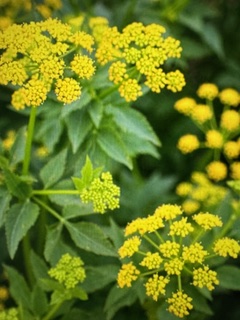
You may be wondering, why all the fuss about a plant? Well, it was the plant’s name that first piqued my interest a few years ago. If your last name was Alexander, wouldn’t you want the wildflower Golden Alexander growing in your garden, as well? Even the description sounds enticing – “a tough native that lights up the spring garden with its bright yellow flowers that attract pollinators.”
They were planted in an area of my garden that receives morning to mid-day sun and afternoon dappled shade. And then, a few months later, something unfortunate happened. Our weekly yard crew had a new person working with them. His job was to help with pulling weeds. And, as you’ve probably guessed by now, he unknowingly pulled up all three of my carefully managed Golden Alexander plants. The crew was already on their way to the next job before I even noticed.
Disappointed and somewhat embarrassed by the mistake, I sent a text to Linda explaining the situation. She assured me that it would be no problem to replace them. I was so relieved at her response and can happily say that I am now the proud owner of three new plants. As you can see from the photo, they have been planted, labeled and identified. Yard guys, beware, these plants are not to be removed!
Here is one of the three plants in the ground, labeled and temporarily protected!
Golden Alexander is an herbaceous, short-lived perennial in the carrot family. It has a yellow flat top cluster flower, similar to the lacy, umbrella-shaped flowers on dill, wild parsnip and Queen Anne’s Lace. The flowers are attractive to a variety of butterflies, native bees, bumble bees and honeybees. It serves as the primary larval host for the Black Swallowtail Butterfly.
General Information
Botanical Name – Zizia aurea
Common Name – Golden Alexanders
Family – Apiaceae
USDA Zone – 3 thru 8
Light Requirement – Full Sun to Part Shade
Height and Spread – 1.5-3ft x 1.5-2ft
Flower Color – Yellow
Soil Type – Loamy, clay
Bloom Time – April – June
Linda Seidel shares growing information below:
“Everyone needs a Golden Alexander,” a volunteer told me at a Native Plant Society of Texas plant sale. I’d never heard of the plant, but if everyone needs one, I’ll take one. I planted it near the top of my hillside pollinator garden where it would get morning sun and dappled shade of a crabapple tree in the afternoon. It does fine in my mostly clay soil which drains well on the hillside. It doesn’t seem to need fertilizer. It gets watered twice a week along with the rest of the garden. I would not say it is a drought tolerant plant, but even with our super-hot summer days the foliage has not burned since it is shaded in the afternoon. It provides a lovely dark green, soft textured background in the garden. Pollinators love the yellow flower clusters. Birds love the seeds. And speaking of seeds, Golden Alexander spreads its seeds prolifically. If you don’t want lots of little Golden Alexanders next spring, spend some time deadheading, before the seed heads have a chance to pop open. I now know why the plant sale volunteer told me I only needed one Golden Alexander!
Next May at the 2025 Raincatcher’s Garden Plant Sale, we plan to have Golden Alexander plants potted and ready for purchase. Come take a look!
Linda Alexander, Dallas County Master Gardener Class of 2008
Honestly, I’ve had a change of heart. But it didn’t happen suddenly. I must admit that, until a few months ago, an unknown plant with the characteristics of a weed was taking over strategic areas of my garden and had to go. I began yanking and pulling it up with ‘wild abandon’. And then I paused for a moment, allowing my curiosity time to reconsider. Thankfully, the plant finder app on my iPhone came to the rescue. The answer appeared quickly and offered helpful information. What I assumed to be just another noxious weed, was instead an herbaceous plant in the dayflower family. You may know it as Widow’s Tears, White-mouth Dayflower or Asiatic Dayflower. It gets its name because the tiny one-inch blooms last for only one day.
After reading more about the dayflowers growing in my garden, I was then redirected to an exceptionally moving YouTube video made by a lady in Israel. It was so beautifully done that my heart began to melt while watching the history of dayflower unfold on my computer screen. Common dayflower sprawls along the ground like a vine, often rooting at the nodes. Flowers emerge from a boat like sheath, one at a time. They are composed of 3 petals: 2 larger mouse- eared shaped blue petals above and a small curling white petal tucked beneath. Bloom time is generally May-October. If you have an adventurous spirit and feel inclined to experience something new, the stems, flowers, leaves and seeds of dayflower are all edible. Remember to harvest the tiny blue flowers early in the morning when they are fully open. Use them as a garnish for cheese and for an added splash of color in salads. My choice for the first ‘taste’ was to place the flowers atop a bowl of yogurt and fresh peaches. A light dusting of cinnamon sugar was the perfect finale.
Interesting facts about Dayflower:
*As one of the few flowers with a true blue bloom, the dayflower symbolizes reliability, steadfastness and trustworthiness. *Carl Linnaeus, the Swedish botanist, named the genus for three Dutch botanists, the Commelijn brothers. Linnaeus believed the unequal petals of the dayflower nicely represented the talents of the three brothers. *An exquisite Japanese woodblock print by Katsushika Hokusai, from the Edo Period, about 1800-05, gives credit to a distinctive blue dye created from the petals of the dayflower. The blue-gray color at the top of the tallest wave was identified as dayflower blue. For a fascinating in-depth look into the world of blue flowers, go to Science Friday and read the article entitled “How The Humble Asiatic Dayflower Revealed Clues To Blue Hues”. (Written by Lauren J. Young,on September 9, 2021).
Linda Alexander, Dallas County Master Gardener Class of 2008
It may sound like the title of a new song, but this dazzler of an eggplant has started coming on strong in my summer garden. Over a half dozen online sources describe Summer Emerald as “living up to its reputation as one of the best-tasting eggplants–firm texture, few seeds, sweet and tasty flesh–perfect for broiling or grilling.” My one little transplant was purchased a few months ago at a local garden center. At the time, I really wasn’t familiar with this variety but was intrigued by the name. Isn’t that a good reason to try something new?
Eggplant ‘Summer Emerald’ growing in my raised bed
Once those petite little fruits (1” x 8”), with lime-green skin that is never bitter, started making their debut in my garden, I was impressed and ready to crank up the grill. A simple lengthwise cut down the center followed by a light brushing of olive oil was all the preparation needed. As suggested, It only took a few minutes for these dainty little eggplants to cook. We enjoyed our perfectly grilled eggplants alongside a light summer salad. Finally, I must confess that I had never tasted a lime green, grilled eggplant before, but it was so incredibly delicious that the grill will be fired up again for this one!
‘Summer Emerald’ Eggplant harvested from my garden
Left, ‘Summer Emerald’ eggplant cut down the center and ready to be prepped, Right, brushed with Texas Hill Country Blood Orange Olive Oil, Bottom Grilled in Stove Top Skillet
Perfectly grilled eggplant garnished with freshly clipped lemon thyme, a light dusting of cracked black pepper and a sprinkling of fine gray sea salt
Lemon Thyme in my raised bed
Linda Alexander, Dallas County Master Gardener Class of 2008
Don’t give up, Susan Thornbury has some words of inspiration and an action plan for us during these hot days of summer.
August 15, 2024
Memory is strange. Most thoughts and memories are unhelpful. So much so that often a deep breath and a reminder that they are just thoughts and memories and not reality seems to be indicated. But then when least expected a flash of amazingly helpful inspiration!!
After listening to a weather forecast –given after the meteorologist offers an apology for what will be coming–and then stepping out to look at the garden already in a negative frame of mind and naturally seeing trouble everywhere—a song came –the words very loud and clear: “I”M GOING TO STAND MY GROUND YOU KNOW I WON’T BACK DOWN I’M GOING TO STAND MY GROUND”
Now don’t rush to judgement on that song–in this case it was crystal clear what the meaning was–it was aimed at gardeners!!
Not those in “other places” Places where the nights are cool it rains at least once a week and where things “just seem to grow” Oh no, they don’t get a song–it was not meant for them.
It was meant for gardeners here–it was meant for US!!
It is just such a temptation to give up–Its so hot and yet weeds are thriving–the list of “NOT FAIR” is a long one
But not for us to dwell on that: WE WILL NOT BACK DOWN WE WILL STAND OUR GROUND”
We can’t just think about it though–a plan is needed!
Each plan must suit the planner of course but–there are some important point that might be universal.
First give serious thought to becoming a morning person–if you start at 7AM –its not so bad and you can get a lot done in an hour or two. If this is not your usual habit–well just tell yourself–when November comes you can sleep late!!
Second set priorities. Take a good look and decide what must be done now some things can and should wait until later. One thing is usually deadheading.. The poor plants are stressed they don’t need to be trying to set seeds or supporting yellowing leaves. When you tidy them up they are really helped–and you get some encouragement–things are looking better already.
Third don’t give up on weeding. Weeds are cleaver plants and they can grab water and use it to set their seeds faster than one can believe–so don’t let them–you sure don’t need more weeds and your plants need all the water they can get.
Healthy and happy mulberry weeds edited out of the garden-they thought they were safe hiding in the salvia
Fourth–look for what is working. Which plants are showing a fighting spirit and a will to live they must be encouraged and rewarded–as they are encouraging and rewarding you.
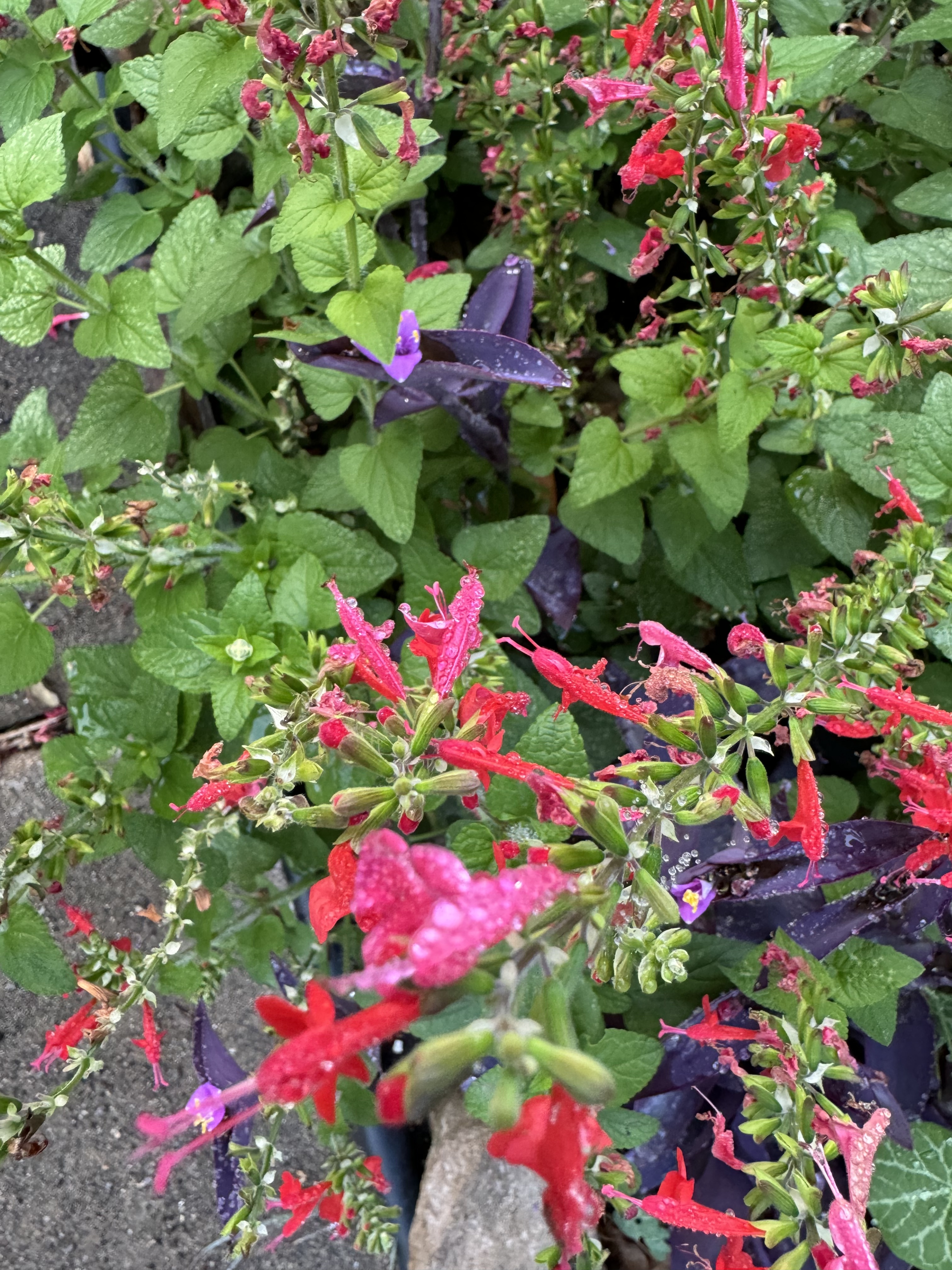
Turk’s Cap loves summerCenzio is ok with heat, even seems to like itRosemary is not complainingYard pointsetta and white veined piple vine are okay with heat but do like shadeSalvia coccinea keeps going when the going gets tough
But of course you must also face what isn’t working–Bite the bullet–remove dying plants there is just no use in trying to care for them and waste precious water on them–make a mental note to avoid them in the future.
Last–congratulate yourself!! you deserve it YOU STOOD YOUR GROUND NO YOU DIDN’T BACK DOWN YOU STOOD YOUR GROUND!!!
Susan Thornbury, Dallas County Master Gardener Class of 2008
Returning from a 5-day trip to Park City, Utah last week, my husband and I weren’t too happy about the Dallas forecast. Discouragement at having to return during the height of summer heat left us agonizing over the cool, crisp air that had filled our time in the mountains.
Upon arrival at the Salt Lake City airport, our wonderful Dallas friends greeted us and immediately suggested a leisurely lunch at The Grand America Hotel near downtown. As promised, lunch on the patio of the Garden Café was a welcoming introduction to our incredible stay. Shortly after lunch, we made our way out to the hotel’s world class gardens which were beautifully dressed in their finest summer attire. A spectacular display of brilliant and colorful blooms filled every inch of garden space. The natural beauty of flowers and plants so artistically arranged was mesmerizing.
Following a relaxing pause as we strolled through the gardens, a short 30 minute drive took us to our final destination, Park City, Utah. At just over 7,500 feet above sea level, this little Wasatch Mountain town is filled with stunning panoramic views. (This was our 8th consecutive summer to spend time with our friends who enjoy renting a condominium in Park City each year for their summer escape from the blast of Texas heat).
Early the first morning, our hosts took us to a roadside market stand that they hoped would have fresh peaches. Unlike Texas, Utah peaches were just beginning to ripen and become available for purchase along with tables of juicy, red tomatoes and freshly picked summer corn.
Driving around town, individual yards, city parks and medians throughout the Park City landscape were in full bloom. Zinnias, marigolds, cannas, petunias, geraniums, blue salvia, hollyhocks and goldenrod offered a sprinkling of confetti-like color for everyone to enjoy.
August temperatures in the area hovered around the mid 50’s at night with daytime highs in the upper 80’s with the absence of humidity! Plants and humans alike were soaking up the dreamy climate and the refreshing mountain air. Spending time outdoors couldn’t be more enjoyable in this kind of environment. Hope you will take time to enjoy a visual feast of our mountaintop adventure. Wish we were still there but our invitation to come back in 2025 has already been accepted!
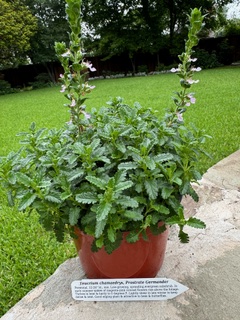
If you’re contemplating a substitute for boxwood, consider these words from Cyrus Hyde, the late garden herb folklorist and founder of Well-Sweep Herb Farm in New Jersey. He referred to germander as “poor man’s box”. Why then, has it not received more recognition in the world of herbs?
Even our first president, George Washington was such an admirer of germander that it was planted at his Mount Vernon, Virginia estate. But sadly, it seems to have faded from view until recently when garden centers began featuring lesser known herbs alongside the more desirable customer favorites. Thankfully, it was a wise decision with germander finding its place as a decorative evergreen border plant and as a substitute for boxwood in the beloved knot-garden design.
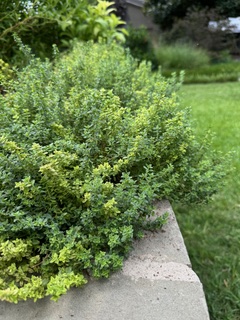
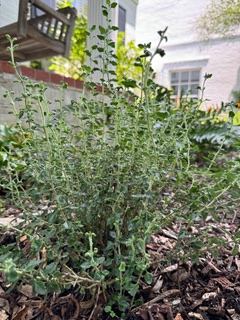
Germander ‘Upright’ surrounding the children’s statue in the Edible Landscape at Raincatcher’s GardenGermander ready to be planted at Linda’sGermander thriving in MG’s Patty Brewer’s Garden.
Germander is a Mediterranean native in the mint family (Lamiaceae) with small, dark green scalloped leaves and a mild garlic-spice aroma. It is a hardy perennial and evergreen, keeping its tidy appearance throughout the year. In early summer whorls of purple-pink flowers appear. Bees are attracted to the tiny flowers.
Grow it:
*Space plants 2 feet apart and at least 3 feet away from companion plants.
*Germander prefers full to partial sun and well-drained soils.
*Follow a regular watering schedule to establish, then cut back to maintain health.
*Fertilize lightly with an all-purpose organic fertilizer once or twice a year.
*Pruning right after bloom will help to renew the plants faster.
Germander with single stem gerbera daisies gently nestled in the glossy green foliage
Linda Alexander, Dallas County Master Gardener Class of 2008

















 DALLAS GARDEN BUZZ