This season of the year we are often asked to express what we are thankful for, of which there are many things; however, recently I have been reminded of how thankful I am to have a garden to tend, a group to garden with and organizations and friends who support these garden endeavors.
Several weeks ago when there was an impending freeze, I made my way to capture what I expected to be a transition in the looks of our colorful and vibrant landscape to a somewhat muted look. Upon arrival, the brisk fall air welcomed , the pink shades of the muhly grass glistened in the bright morning sunlight – flowers were continuing to burst forth with blooms, and vegetables continued to produce fruit.
As I wandered through the pathways, soaking up the beauty, my memories were not just of the plant material, but the people who have made this garden special to me. Raincatcher’s garden of Midway Hills was begun in November, of 2014. We moved locations that Fall –and began anew. The courtyard plantings have been transformed, a rain garden was added, and the old playground has become home to our Edible Landscape and greenhouse. The most dramatic change has been in the North Field. It went from an acre of land, to a vibrant workspace with vegetable beds, trees, orchards, color wheel, compost area, wildlife habitat and a covered meeting area.
We are truly thankful for the opportunity to garden on the grounds of Midway Hills Christian Church, and for the many hands that make this Dallas County Master Garden project one that educates the residents of this area, but also gives back to the community.
We are grateful; We are thankful. And we are blessed. Thanks for following us on our journey!
OH yes, BTW, we are still awaiting our first significant freeze, so come by the garden and enjoy the beauty of whatever season you find yourself when you are here.
Starla Willis, Dallas County Master Gardener Class of 2011
In just a few weeks our year-long journey into the world of bees will come to an end. Until then, let’s explore, unarguably, the best part of experiencing honey.
In April of 2014, Joe Field (our location prior to relocating and becoming Raincatcher’s Garden on Midway Road) master gardener volunteers hosted a honey-tasting event along with a fabulous honey-themed lunch. A local beekeeper was our featured speaker. To this day, it has been one of our most successful educational programs. Not only did we learn the ‘proper’ way to taste honey, but the menu was created with those complimentary flavors in mind.
(For a quick glimpse of the menu and other photos from the event, go to the following link)
Our instructor that day shared with us that the composition of honey depends largely on which flowers are visited by the bees when collecting nectar. We should also not forget that plants produce nectar in order to attract pollinators such as honeybees, wasps, moths and bats. Another important fact is that the nectar of each plant species has a different combination of sugar and odor. Together, with the flower’s shape, design and color, this helps to guide the bee from one flower to another of the same kind.
Additionally, it was beneficial to learn that honey’s color, flavor and aroma all derive from the plants pigments and other materials secreted in the nectar. This is what makes honey from each floral source unique. Last month we shared examples of local fall blooming pollinator-friendly plants. Some of the flavor profile descriptions of those flowers can help us to imagine the taste of that particular honey.
Color and Flavor Aster: Water-white to light amber. Spicy overtones, firm, chewy texture. Borage: Pale yellow or water white. Herbal and floral bouquet with hints of cucumber and orange pekoe tea. Sugary aftertaste. Goldenrod: Brilliant amber to a warm golden yellow. Bright, sharp, floral-like flavor with hints of fresh straw. Spicy aftertaste.
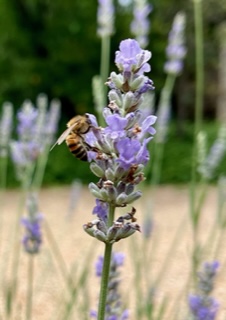
And a few others: Lavender: Light amber. Strong camphor-perfumed taste with sweet tobacco notes. Thyme: Carmel to dark, golden amber or darker. Aromatic, floral, lemony, minty and strikingly sweet.
Honeybees gathering nectar from Lavender blossomsHoneybees gathering nectar from thyme blossoms
Here is a quick overview of how we learned to taste honey. *Tasting honey is an exercise in comparing and contrasting flavors.
*Our taste buds can distinguish between five flavor sensations: sweet, sour/tart, salty, bitter and umami, which is a savory taste. The taste buds for each flavor are located at different areas on the tongue. This is the reason why it is recommended that you move the honey around your mouth as you taste it. Tasting more than one honey at a time gives you a reference point for comparing “tasting notes”.
*Begin with the lightest in color, moving on to medium ambers and then finishing with the darkest. Light-colored honeys typically have a mild flavor, while dark-colored honeys are usually stronger in flavor.
*Take a sip of water in between each sample to clear your palate. Also, a crusty piece of bread and a variety of cheeses can complement the tasting experience.
*To keep it simple and less confusing, start with about five to six different types of honey.
*Start by drizzling a sample of honey onto your tongue and let it melt for a few seconds.
*Spread it around your mouth and consider several questions:
Is it woody, floral, full, light, crisp, buttery, well balanced? Does it have a long finish or an abrupt end? Do you like it or find it unpleasant?
Finally, there is no right or wrong as we each have our own individual taste preferences and predisposition to flavors. Embrace the process of learning how to appreciate honey and celebrate the opportunity to discover the flavors you find the most enjoyable!
FYI…I was intrigued about Goldenrod honey and decided to try to find a source that sells it. That led me to Bee Friends Farm in Michigan. My two 12 oz. bottles should arrive within a few days! Look for an update about the flavor and taste in our December article.
Linda Alexander, Dallas County Master Gardener Class of 2008
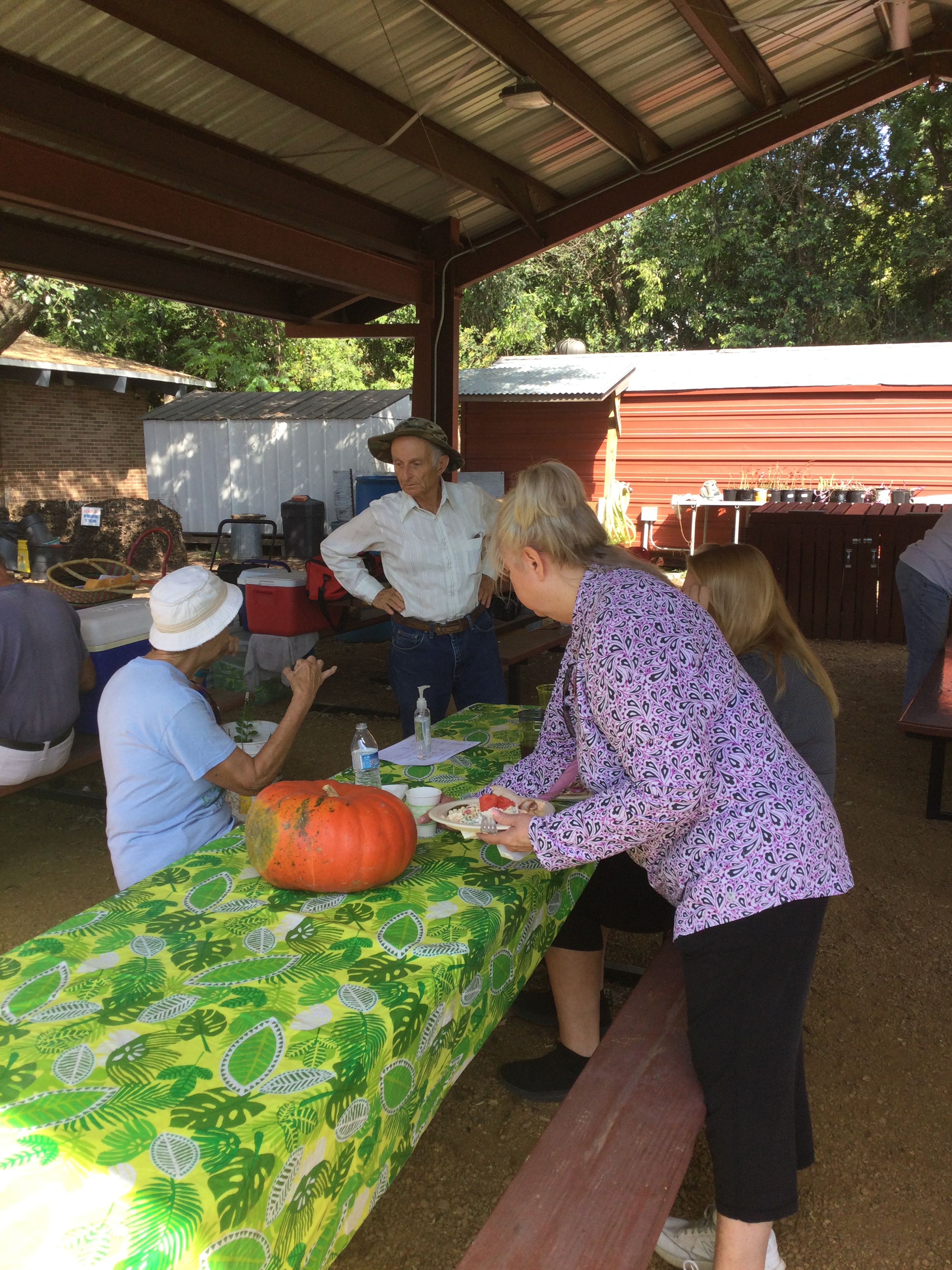
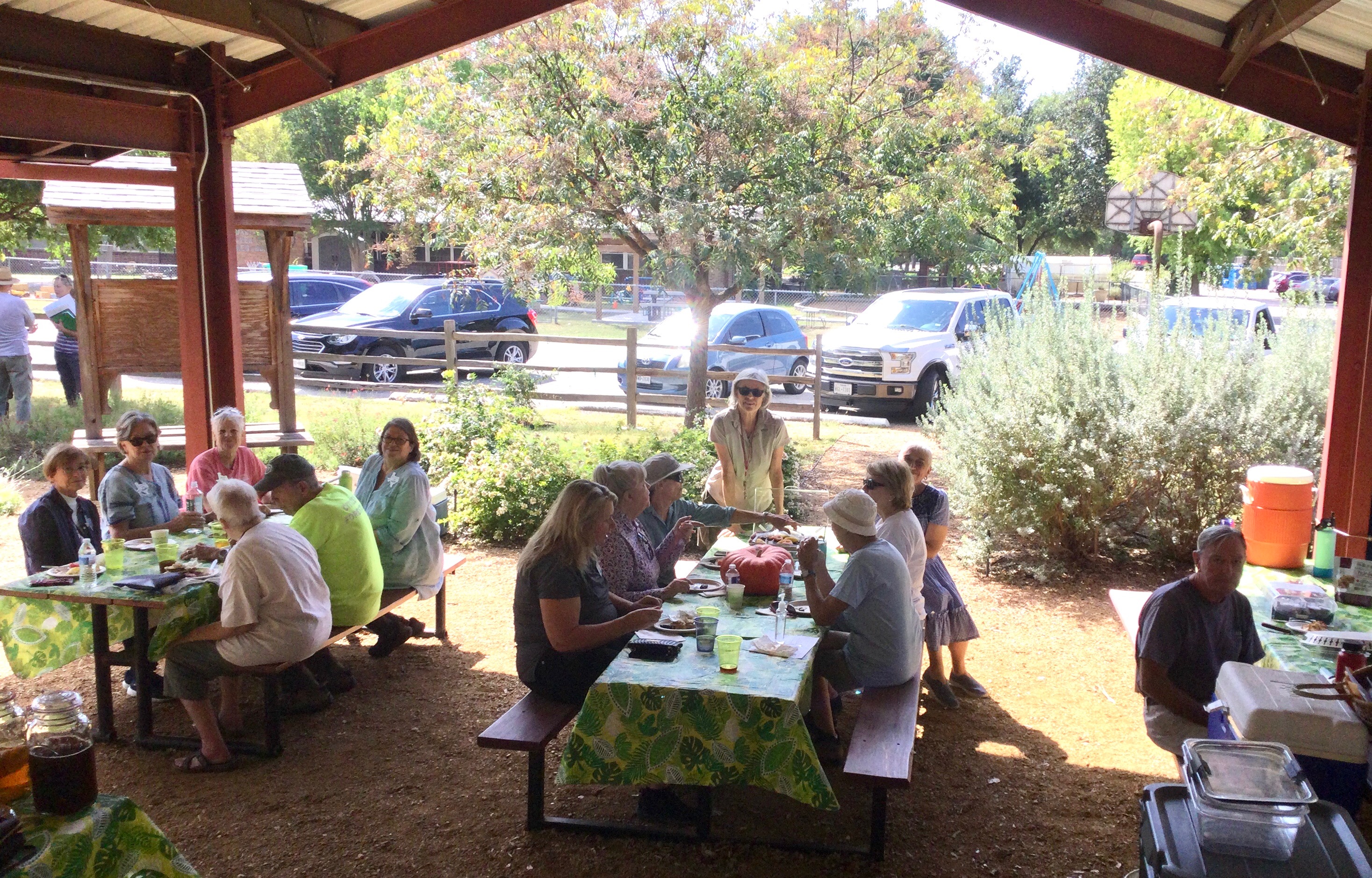
After an especially punishing summer, it was refreshing for Raincatcher’s volunteers to pause and reconnect.
The garden budget including planned improvements was presented by Lisa.Raincatcher’s volunteers gathered for lunch to celebrate fall gardening!
Many of us think fall is the best gardening season of the year. In the north garden we are harvesting okra, peppers, eggplant, long beans, and zucchini as well as preparing space for our new greenhouse.
Don Heaberlin, Beverly Allen and Ann Lamb, Dallas County Master Gardeners compiled this article.
Raincatcher’s pansy sale is November 8th, more information is coming.
Dallas Arboretum class with Starla and Roseann in center surrounded by more Master Gardeners.
Even though our weather screams sweltering summer, the availability of pumpkin spice aroma is already permeating our neighborhoods. I hear you can get the flavored fall drink now. That must mean that Fall is around the corner, and then comes Halloween, pumpkins, Thanksgiving, and cooler weather (hopefully not in that order)!
Let’s talk pumpkins for a minute – they are a staple of fall decorating, carving for Halloween, cooking for Thanksgiving and Decorations to last through the Holidays. The Arboretum has its campus covered with about 100,000 pumpkins and gourds in all shapes and sizes from a farm in Floydada, Texas(near Lubbock) for its Fall Festival. The “stars” of Fall have not yet arrived but are soon to show.
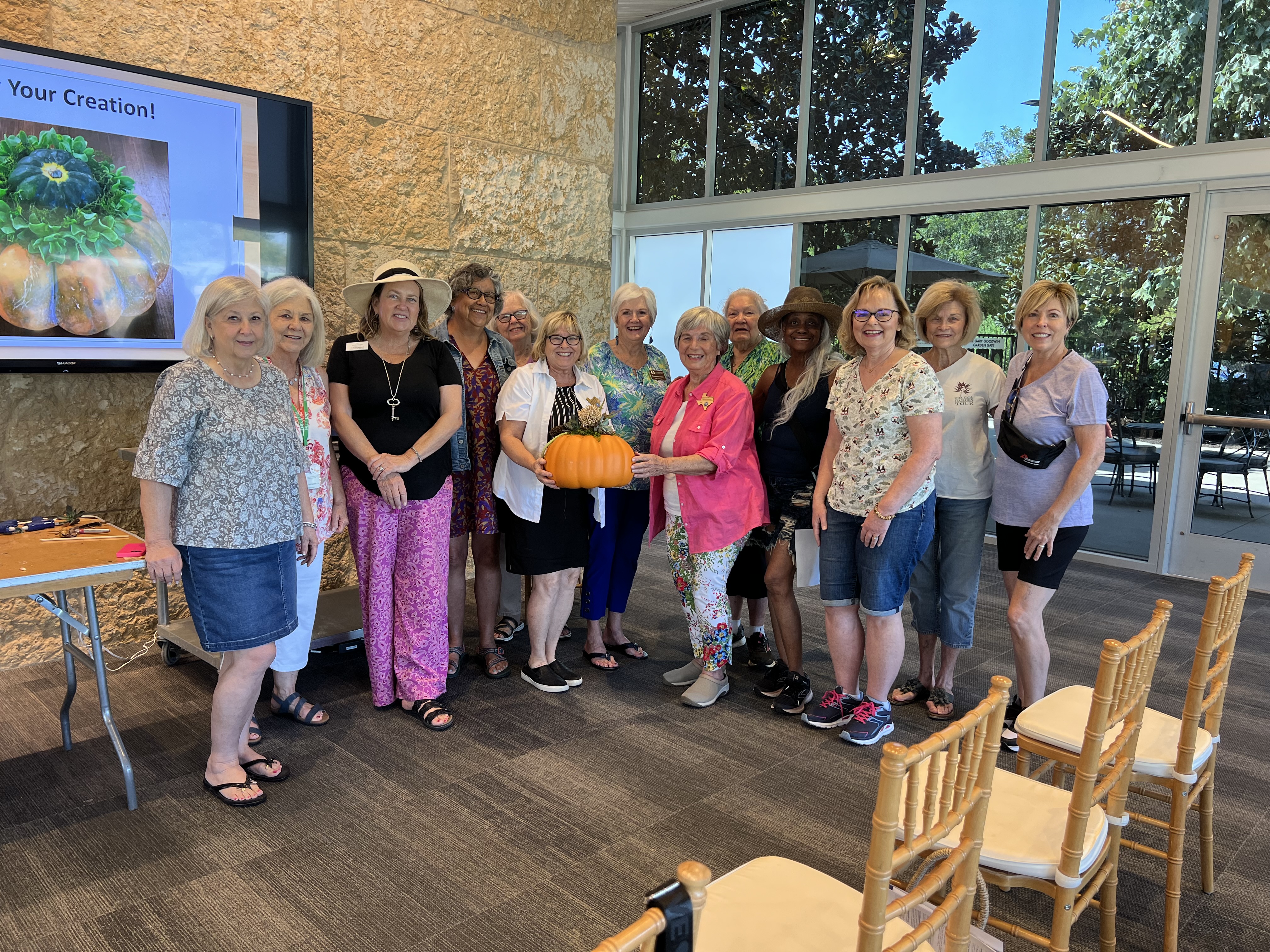
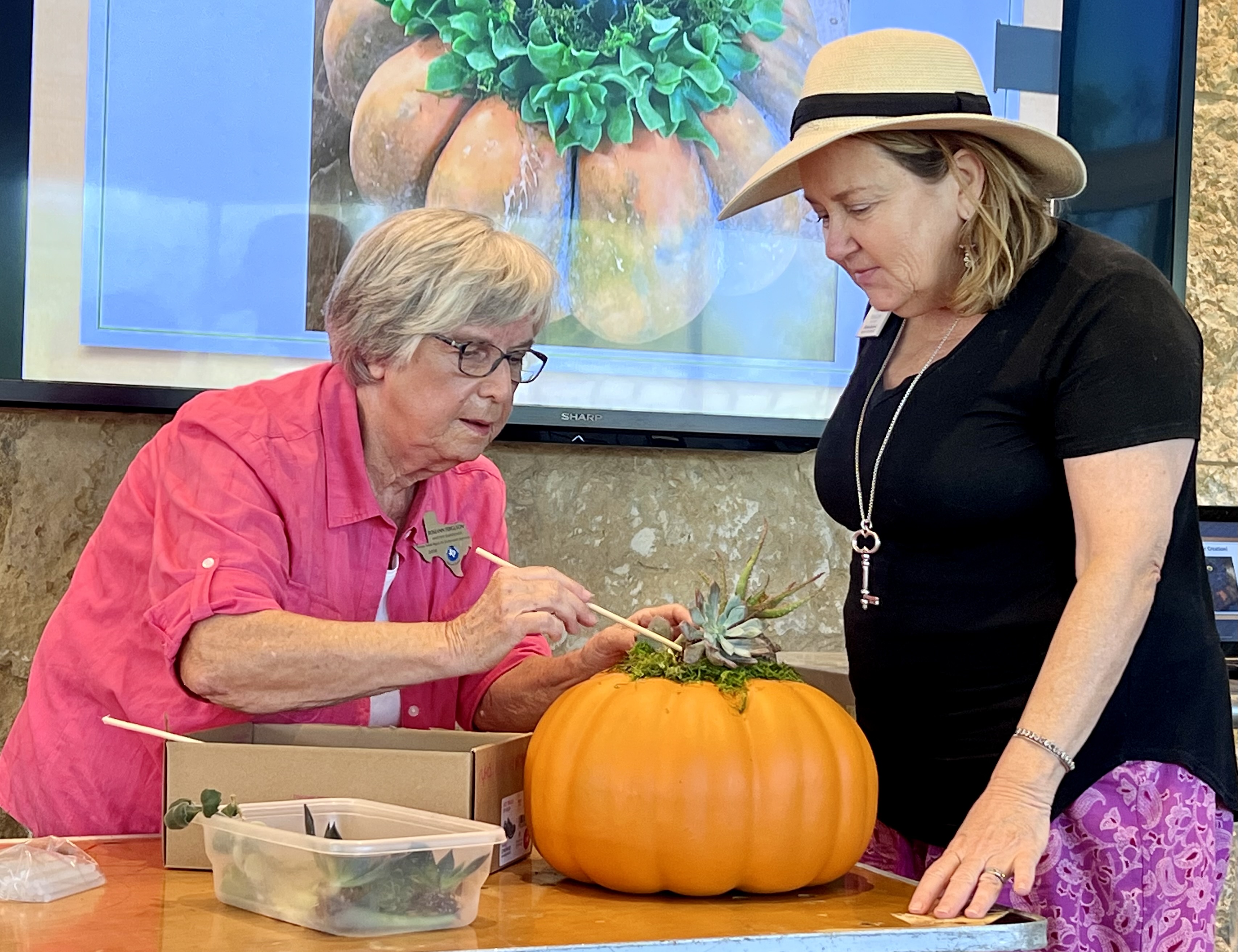
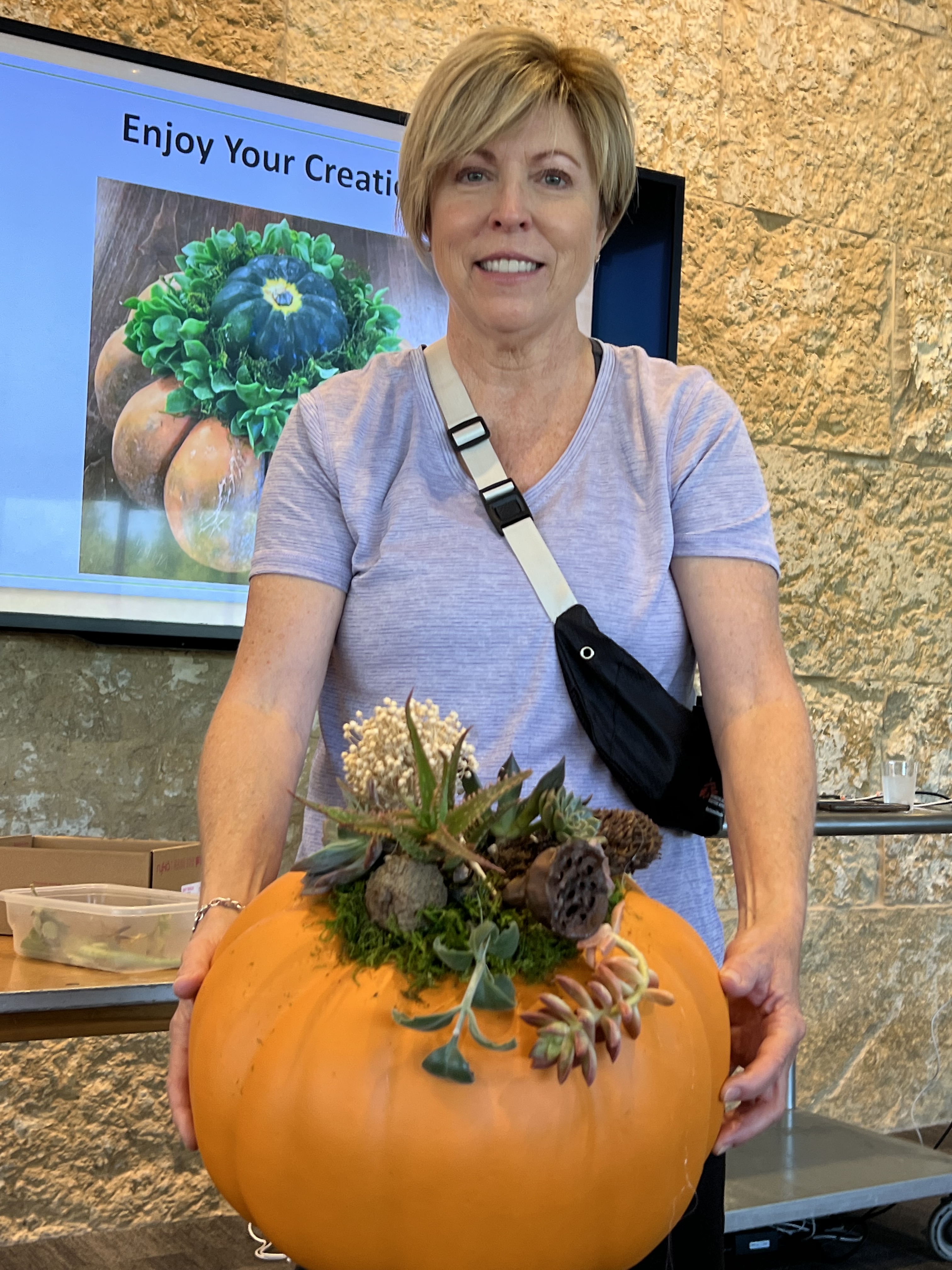
A Tasteful Place at the Dallas Arboretum hosts “Learn to Grow” presentations on most Fridays from 11:00am -12 noon. These talks are informative, inspirational, and interesting. Roseanne Ferguson, DCMG class 0f 2008 shared a demonstration to all ages on how to make “Pumpkins with Pizzazz”, which is creating a unique decoration with succulents and other materials that symbolizes fall and lasts for months.
Roseann demonstrating how to decoarate a pumpkin.Pumpkins in processThe finished project
All sizes and shapes are available for this project, but some guidelines need to be followed:
A pumpkin with at flat top will be easier to work with and provide more surface for succulents.
The variety Cinderella is a good choice. Smaller pumpkins can also be used.
Keep the pumpkin whole – any puncture will cause it to decay quickly. Clean it before you start.
Cut a template out of posterboard or cardboard of the top surface where you will be adding succulents- so that the adhesive will only be on the area where you are working.
Assemble an assortment of succulents, moss, other nature materials, to use along with spray adhesives, a glue gun, some clippers for stems and a chop stick to work with the hot glue, but don’t stick it in the pumpkin!
Arrange and glue down the above items till you have the arrangement you desire.
The succulents may need to be misted when they look droopy, but not often. Keep it in a bright light, but not direct sun – not all succulents can handle our sun rays even in the Fall.
Check out your local libraries, garden clubs for opportunities to either see a demonstration, or to participate in making these decorations for your Fall décor. The costs will vary, but it’s a lot of fun!
Starla Willis, Dallas County Master Gardener Class of 2008
I am reposting this on the last day of September because we had a few technical difficulties with our video last week. If you love basil or basil in a flower arrangement, you will eat this up! So please watch.
Something in the air feels refreshing and hopeful. Summer heat is beginning to drift away as cooler nights carry us into autumn’s blissful welcome. Have you felt the delicate whisper of magic moving through the trees as leaves are beginning to reveal their fall color palette?
Our landscapes seem grateful for the transition to rainy days filled with a nourishing gift from the heavens. Plants that were scorched and spent from the blistering heat of summer have lifted their heads in gratitude for the cool breezes of our beloved fall weather. Spending time outdoors is, once again, a delightful and long-awaited experience. Autumn is the season to embrace soothing moments of tranquility in the garden!
Plentiful is one of many ways to describe the variety of botanical options available to us over the next few months. For September, our featured plants are the following: Basil is brimming with a colorful, rich display of foliage that will be used in various ways; some for filling in open spaces of fragrant arrangements, others for making tasty pesto for the freezer. Turk’s Cap survived the summer and is now ending its seasonal performance while the strong stems and slightly rough leaves of Lemon Verbena plodded through the heat of summer with steadfast determination.
In April, my raised stone garden bed was planted with a half dozen, or more, different types of basil. They continued to grow lush and beautiful with blossoms appearing as summer progressed. It was a happy place for bees and butterflies to visit daily. Several varieties I especially enjoyed were:
Balsamic Blooms: Vigorous grower with bright green leaves and deep, purple blooms appearing simultaneously. Both leaves and flowers are edible. Wonderful for pesto, garnishes and more.
Cinnamon Basil: Once again, volunteer plants from last year’s seeds filled one side of our gravel driveway with their showy presence. Their aromatic cinnamon fragrance is a treat for the senses when used for indoor arrangements. But I couldn’t resist making several Cinnamon Basil Cakes to share with friends!
Basil, ‘Magic Mountain’: A strong contender for its ornamental value, this plant displays large, deeply colored flowers all summer long. The purple-hued dark green leaves are showy in floral arrangements as well as adding flavor to pesto, sauces, salads and meat dishes.
A few additional observations from my garden:
*Favorite basil for the honeybees: ‘Magic Mountain’ was like a bee magnet throughout the entire summer, especially during the early morning and late afternoon hours. Hundreds of foraging bees buzzed around the blossoms drinking in the nectar. They weren’t even bothered by my camera lens just inches away from the activity.
*Best basil for using in an arrangement: ‘Red Rubin’ proved to be a prolific grower with its coppery, purple leaves and small pink flowers. It offers an interesting branching structure that serves any arrangement well. Next spring, I’ll be using it throughoutmy garden.
*Basil with the most dramatic appearance: ‘Balsamic Blooms’ There’s a good reason why this variety received the Texas Superstar rating. Brilliant, green leaves embracing tightly formed purple blossoms make a striking appearance in the garden.
Turk’s Cap survived the summer heat and is now giving us a final showing. This perennial dies to the ground in winter but emerges in early spring. It’s another great native plant for Texas landscapes attracting bees, butterflies and hummingbirds. Growing up to six feet tall, use it as a background plant alongside other natives suited for a natural growth environment.
Lemon Verbena is my perennial herb of choice and one that I feel saddened to bid farewell to when our first freeze arrives. It was over thirty years ago that lemon verbena captured my attention. During that time, I’ve made countless loaves of lemon verbena bread to share with family and friends who gratefully extend their appreciation. And, of course, every morning from April until November a fresh sprig of lemon verbena garnishes my oversized glass of green tea.
September gently sweeps us out of summer and into the refreshing music of Autumn. Let’s embrace the melody!
Linda Alexander, Dallas County Master Gardener Class of 2008
Dining locally at Suze restaurant for dinner is something my husband and I enjoy doing a few times a month. So, for my birthday just a few weeks ago, it was my first choice. As always, the appetizers and entrées were superb, but it was the dessert that left us swooning.
Gilbert Garza, our dear friend and chef-owner, said he would be bringing out an “off the menu” dessert for us. He mentioned that one of the ingredients was only seasonally available and in his words, “difficult to get my hands on”. But, as luck would have it, that special ingredient had been delivered to the restaurant earlier in the day.
As we leisurely finished the main course, Gilbert appeared with a bowl of something so intriguing it required an explanation. As told to us by Gilbert, once a year he puts in a request for a very hard to obtain plum from California known as Green Gage Plum. His dessert presentation was an artfully designed bowl of caramelized Green Gage plums warmed and served with house made vanilla gelato, crushed almond tuille and crème anglaise. Freshly harvested spearmint with a splash of balsamic was the final touch. It was a perfectly delicious, light and refreshing birthday treat!
Curious as to the unusually sweet taste of the rather small green plums, we did an internet search later that evening to learn more. The story behind Green Gage plums was fascinating.
‘Green Gage’ Plum (Prunus domestica) produces fruit that is sublimely sweet. They are a naturally occurring hybrid of the European plum, Prunus domestica and P. insititia, a species that includes Damsons and Mirabelles. Possibly, first grown in Iran in ancient times, the plums were spread to early civilizations along the Silk Road. In the 16th century they were planted in the royal gardens of Francis I in France.
Green Gage plums were brought to England by Sir William Gage in the 18th century. The story is told that Gage purchased a tree from Paris and planted it in his home garden. Having lost the label that identified the tree, Gage eventually renamed the tree after himself. Green Gage plums then spread throughout Europe, Asia, New Zealand and Australia.
On March 31, 1773, Thomas Jefferson recorded sending slips of the tree to Monticello. In 1783, he planted twenty-one of these trees in the South Orchard. Records from Monticello show that Green Gage Plum was the most intensively documented variety of fruit that Jefferson grew at Monticello.
In describing the look, texture and taste of Green Gage plums, we found the following information helpful. Green Gage plums are small, averaging 2 to 4 centimeters in diameter with a round, ovate to oval shape, curved shoulders and a slightly flattened base. The plum’s skin is smooth, taut, and thin, ranging in color with variegated hues of green and yellow to gold. Beneath the surface, the flesh is dense, finely textured and succulent, displaying yellow-green hues with a translucent quality.
After finishing every tiny morsel of our dessert, Gilbert brought out a few Green Gage plums for us to sample. We agreed with the vivid description from Specialty Produce…” Greengage plums have a sweet, honeyed and syrup-like flesh with a balanced and ambrosial flavor composed of dried apricot, ripe mango and citrus marmalade nuances.”
Don’t be misled by their green-colored appearance, which is often associated with unripe, sour flavors. What we experienced was an exceptionally sweet tasting plums, both enjoyable and suitable for eating fresh!
An update on our plum journey: The next morning, we ordered two Green Gage plum trees from plantmegreen.com. They arrived last week and are now at home in our Texas garden.
Growing Information
Green Gage Plums can be grown in USDA zones 5 through 9. They thrive in regions with sunny, hot summers combined with cool nights. We followed the planting instructions and placed them in a sheltered, sunny area of our garden with well-draining, fertile soil. We are hoping that the trees will be ready for a bountiful plum harvest by summer to late fall of 2024.
Linda Alexander, Dallas County Master Gardener Class of 2008
What’s happening at Raincatcher’s Garden: We are harvesting okra, peppers, eggplant, black-eyed peas, and long beans. Radish seeds are being planted anywhere there is unused growing space.
Something in the air feels refreshing and hopeful. Summer heat is beginning to drift away as cooler nights carry us into autumn’s blissful welcome. Have you felt the delicate whisper of magic moving through the trees as leaves are beginning to reveal their fall color palette?
Our landscapes seem grateful for the transition to rainy days filled with a nourishing gift from the heavens. Plants that were scorched and spent from the blistering heat of summer have lifted their heads in gratitude for the cool breezes of our beloved fall weather. Spending time outdoors is, once again, a delightful and long-awaited experience. Autumn is the season to embrace soothing moments of tranquility in the garden!
Plentiful is one of many ways to describe the variety of botanical options available to us over the next few months. For September, our featured plants are the following: Basil is brimming with a colorful, rich display of foliage that will be used in various ways; some for filling in open spaces of fragrant arrangements, others for making tasty pesto for the freezer. Turk’s Cap survived the summer and is now ending its seasonal performance while the strong stems and slightly rough leaves of Lemon Verbena plodded through the heat of summer with steadfast determination.
In April, my raised stone garden bed was planted with a half dozen, or more, different types of basil. They continued to grow lush and beautiful with blossoms appearing as summer progressed. It was a happy place for bees and butterflies to visit daily. Several varieties I especially enjoyed were:
Balsamic Blooms: Vigorous grower with bright green leaves and deep, purple blooms appearing simultaneously. Both leaves and flowers are edible. Wonderful for pesto, garnishes and more.
Cinnamon Basil: Once again, volunteer plants from last year’s seeds filled one side of our gravel driveway with their showy presence. Their aromatic cinnamon fragrance is a treat for the senses when used for indoor arrangements. But I couldn’t resist making several Cinnamon Basil Cakes to share with friends!
Basil, ‘Magic Mountain’: A strong contender for its ornamental value, this plant displays large, deeply colored flowers all summer long. The purple-hued dark green leaves are showy in floral arrangements as well as adding flavor to pesto, sauces, salads and meat dishes.
A few additional observations from my garden:
*Favorite basil for the honeybees: ‘Magic Mountain’ was like a bee magnet throughout the entire summer, especially during the early morning and late afternoon hours. Hundreds of foraging bees buzzed around the blossoms drinking in the nectar. They weren’t even bothered by my camera lens just inches away from the activity.
*Best basil for using in an arrangement: ‘Red Rubin’ proved to be a prolific grower with its coppery, purple leaves and small pink flowers. It offers an interesting branching structure that serves any arrangement well. Next spring, I’ll be using it throughoutmy garden.
*Basil with the most dramatic appearance: ‘Balsamic Blooms’ There’s a good reason why this variety received the Texas Superstar rating. Brilliant, green leaves embracing tightly formed purple blossoms make a striking appearance in the garden.
Turk’s Cap survived the summer heat and is now giving us a final showing. This perennial dies to the ground in winter but emerges in early spring. It’s another great native plant for Texas landscapes attracting bees, butterflies and hummingbirds. Growing up to six feet tall, use it as a background plant alongside other natives suited for a natural growth environment.
Lemon Verbena is my perennial herb of choice and one that I feel saddened to bid farewell to when our first freeze arrives. It was over thirty years ago that lemon verbena captured my attention. During that time, I’ve made countless loaves of lemon verbena bread to share with family and friends who gratefully extend their appreciation. And, of course, every morning from April until November a fresh sprig of lemon verbena garnishes my oversized glass of green tea.
September gently sweeps us out of summer and into the refreshing music of Autumn. Let’s embrace the melody!
Linda Alexander, Dallas County Master Gardener Class of 2008
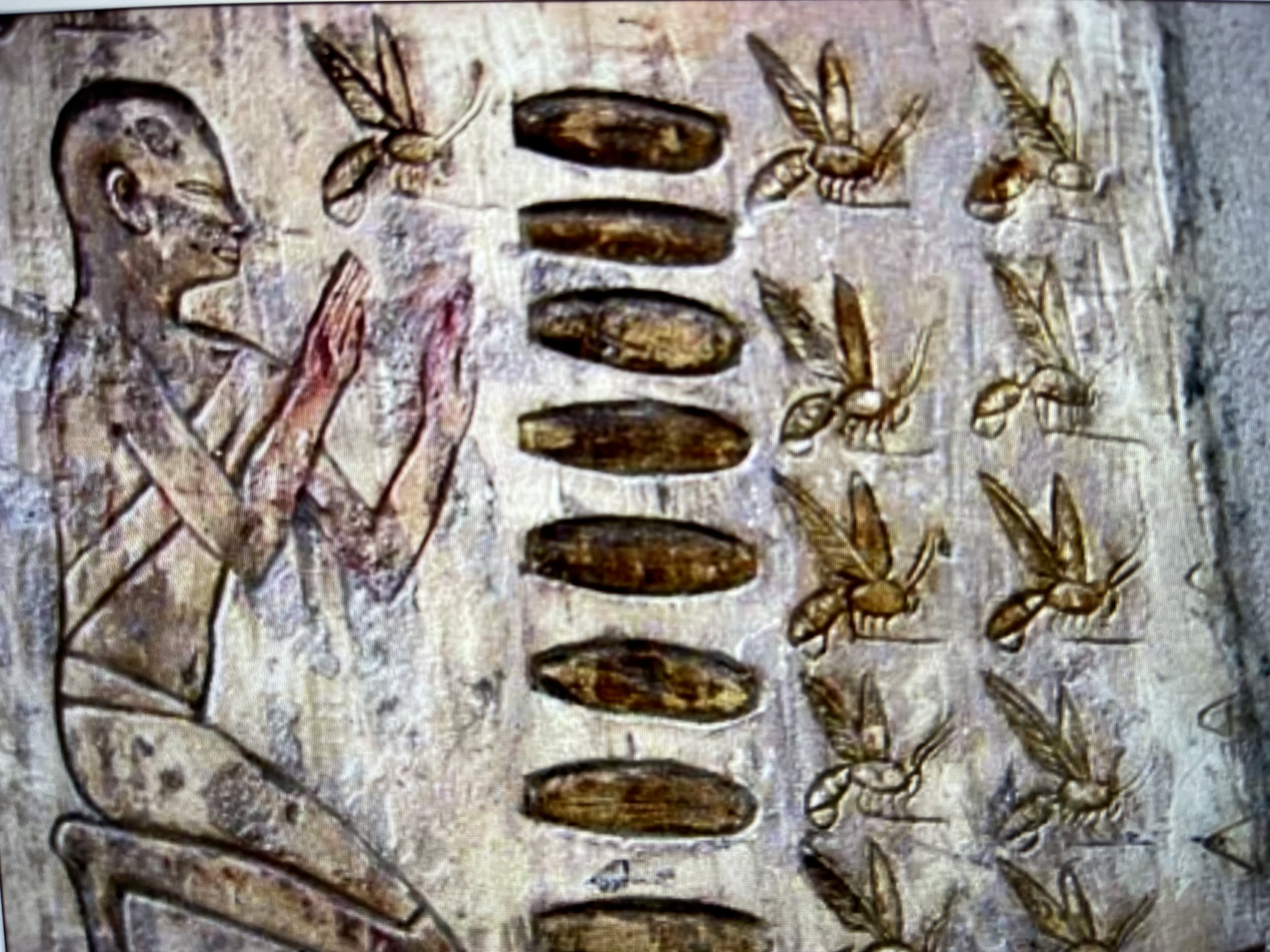
Almost every country on the planet has a story about the relationship between humans and their bees. Let’s cruise through some of the more entertaining facts pertaining to one of the most fascinating insects in the world. Consider how the flowing sweetness of honey has, since ancient times, given us eloquent phrases associated with “honeyed words”. Even bee behavior has been identified with our own in phrases such as a dominate female being referred to as a “queen bee”, or when hard at work it might imply that we are “as busy as a bee”. Such symbolism has its roots in ancient cultures of the world.
Bees in Mythology *San (Bushman) of southern Africa left prehistoric spiritual rock drawings of bees and their nests suggesting that bees had a special importance in the Stone Age. *Prehistoric cave drawings in La Cueva de la Arana in eastern Spain show images of how early humans plundered wild bees’ nests for honey.
*The Myceneans, an indigenous Greek civilization dating back to the 16 th century BC, used images of bees on their beehive shaped tombs. *Ancient Mayas of Mesoamerica kept native stingless bees and celebrated the bee god, Ah Mucan Cab, by downing honey and balche, an alcoholic honey drink. *In 1653, construction workers near the church of Saint-Brice in Tournai discovered over 300 beautiful gold and garnet cloisonne bees in the tomb of Childeric (440-482), king of the Franks. Sadly, in 1831, thieves broke into the library of the Bibliotheque nationale de France, where they were stored, stealing hundreds of pounds of gold artifacts, including Childeric’s treasure. A significant portion was melted down, leaving only two little bees in existence today.
The story of Childeric’s bees made such a strong impression on Napoleon Bonaparte that, ultimately, the bee became the new emblem of the French Empire. Even more specifically, the bee came to represent Napoleon intimately, serving as his personal emblem. He was given the nickname, the Bee. Shortly afterwards, Napoleon’s friend and miniature portraitist, Jean-Baptiste Isabey, took to the task of redesigning Childeric’s bees. His resulting design was immensely handsome. Soon enough it became suitable for fashionable wear, and would come to dominate the interiors, decorative art, fashion and material culture of the Napoleonic court. Even today, the bee emblem is used on French glassware, cutlery, linens, upholstery fabric and cosmetics.
Globally, we continue to celebrate the influence of the honeybee found in themed fabrics, jewelry, paper goods, decorative items and so much more. Looking back across time, it is an enduring reminder of the indelible mark bees have left on mankind. Enjoy these timeless images of the impact honeybees and their beloved honey have in our world today!
September’s featured honey recipe transitions us from a cherished summer fruit…peaches…to some time-honored autumn favorites…pecans and sweet potatoes. Feast on a stack of these warm and lightly spiced pancakes and you’ll be swooning with joy. Just don’t forget the maple syrup!
Sweet Potato Pancakes with Spiced Pecans and Fresh Peach Butter, recipe below
Linda Alexander, Dallas County Master Gardener Class of 2008
Make plans to join us on Saturday, October 14, for a unique day-long educational event sponsored by the Dallas County Master Gardener Association and Dallas College featuring well-known horticulturalists Felder Rushing and Callie Works-Leary. The $20 cost of registration includes lunch. To review the schedule of presentations, to read more about our speakers, and to register, visit dallascountymastergardeners.com. All who love gardening are welcome to attend!
Old sayings are so often true and in the garden this summer, there is no doubt at all.
No way, is this post full of cheer, the summer is miserable for gardeners and plants alike. But as always we can learn a lot and really we have to. Like it or not gardens are just essential for birds and lizards and insects of all sorts. They count on plants for their very life—and what would a gardener be—without a garden —so what to do?
Don’t forget about grasses. This is seep muley, not dramatic but looks good in a quiet way.Common Mullein has lots of bad habits but don’t overlook all the good ones.
Observation comes to the rescue and brings a bit of joy and hope. Some plants are holding on—and even blooming—if not right this minute they are planning to—soon. These are the plants we must remember, be sure to plant again for the next summer—which we sincerely hope will be more pleasant but –we can’t count on it.
Mealey blue sage is a self seeder, sometimes too much, but tries hard and what lovely color in hard times.When plants self seed, they find what works for them and are often far healthier than the ones planted by us.
Some of these plants are not the most spectacular but they are lovely in their own right and most important provide essential nutrition for the little lives counting on the garden. Fennel is a host plant for black swallowtails, plus we can enjoy using fennel and it is still alive.
Carry on watering mulching deadheading and trimming—it honestly isn’t so bad early in the morning. But don’t stop there. Take pictures make notes do what it takes to keep the plants that are surviving and even succeeding in your garden in your mind. That way there will be less wasted work and money next year. Sadly of course remember also what failed miserably. When the going gets tough—some plants just give up. More than likely not their fault at all they just were never intended for this weather. Best to face it and remember it clearly.
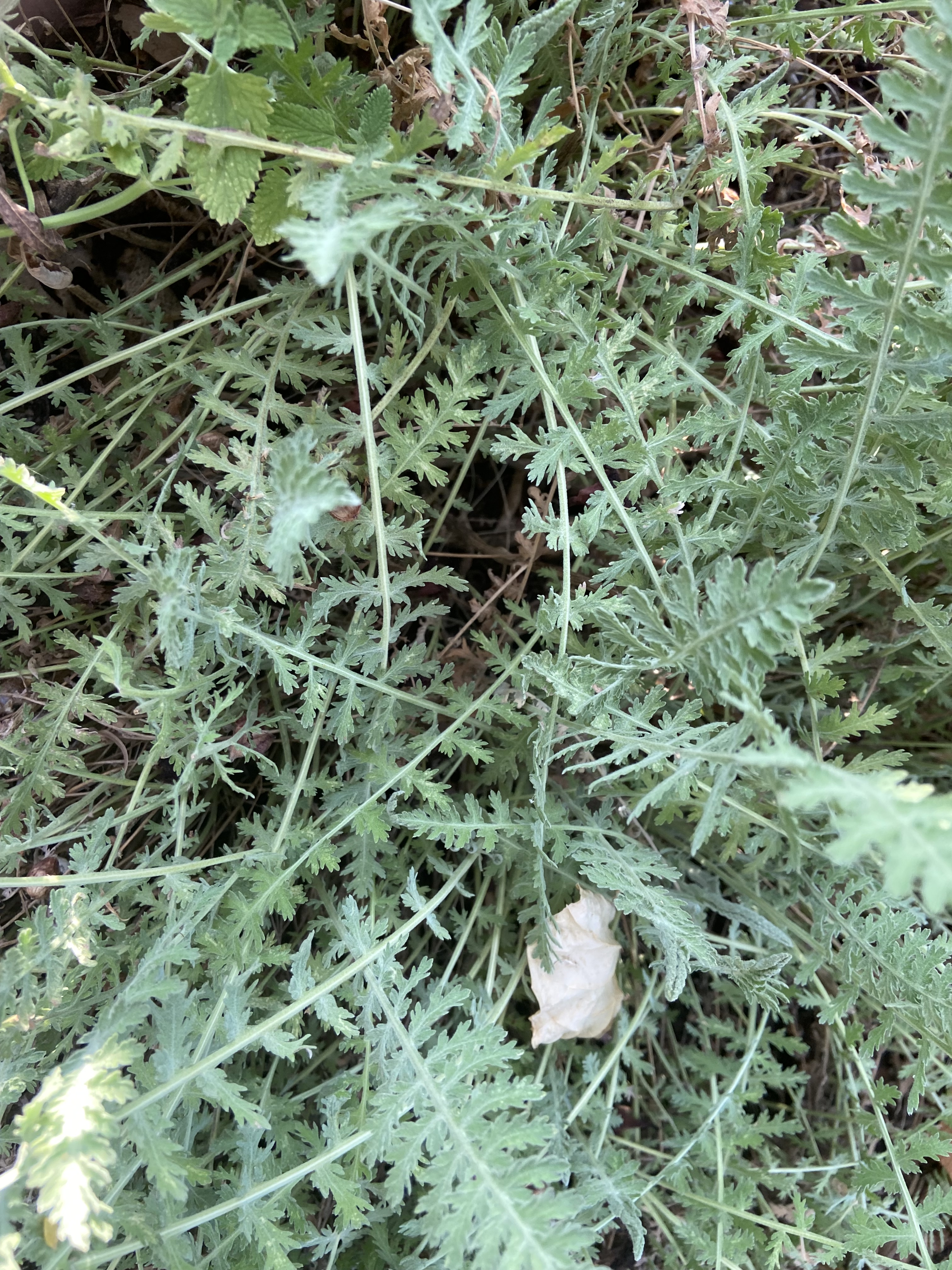
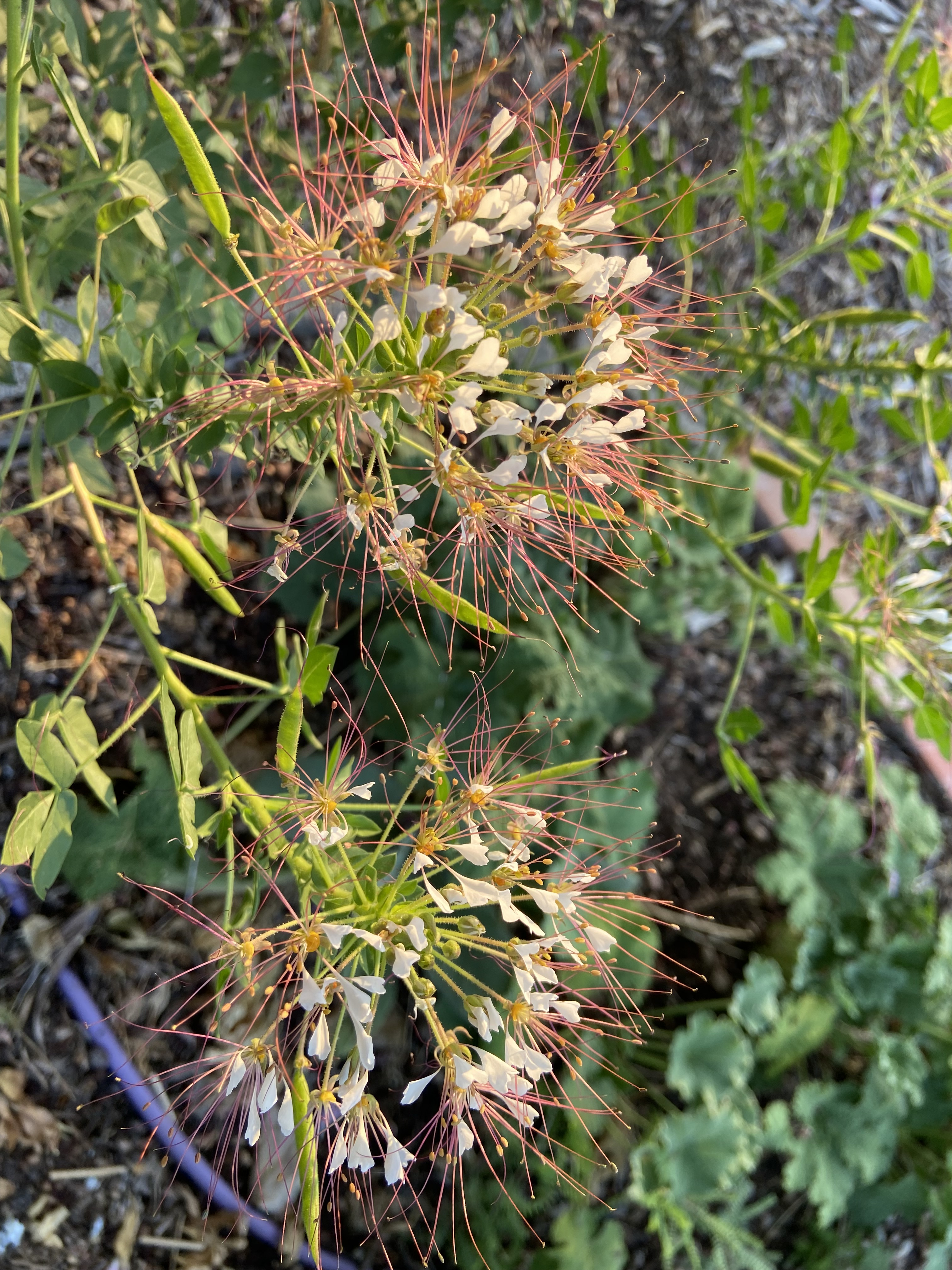
Yarrow, not blooming, but healthy and will bloom again when the time is right.Candelstick trees seend themselves then send down roots before they grow tall. This is a great plant for dealing with adverse conditions.Amaranth has a long history of living in hot places.Clammy weed doesn’t give up. This plant is in a little shade which helps.Tithonia requires upkeep but it’s worth it for flowers in serious heat.
Hope isn’t the best strategy for the summer garden –at least around here. Look at what works in your garden and in gardens you visit, Raincatcher’s welcomes visitors any time. Tuesday mornings there will be gardeners available to answer questions. You might even enjoy summer gardening!
Make experience; even of this dreadful summer—count for knowledge of what works—and what doesn’t. That will make us all better gardeners!
Susan Thornbury, Dallas County Master Gardener Class of 2008