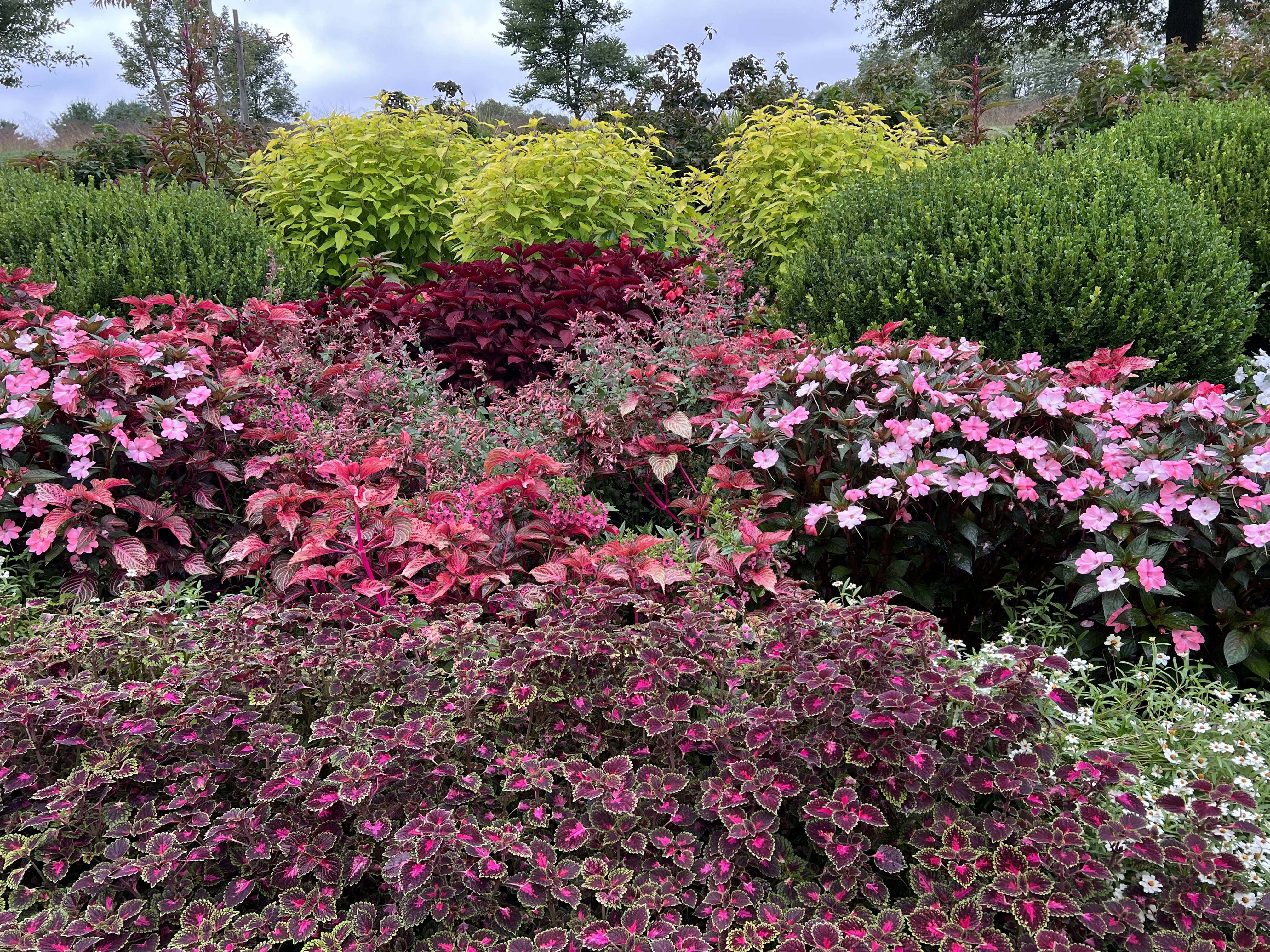
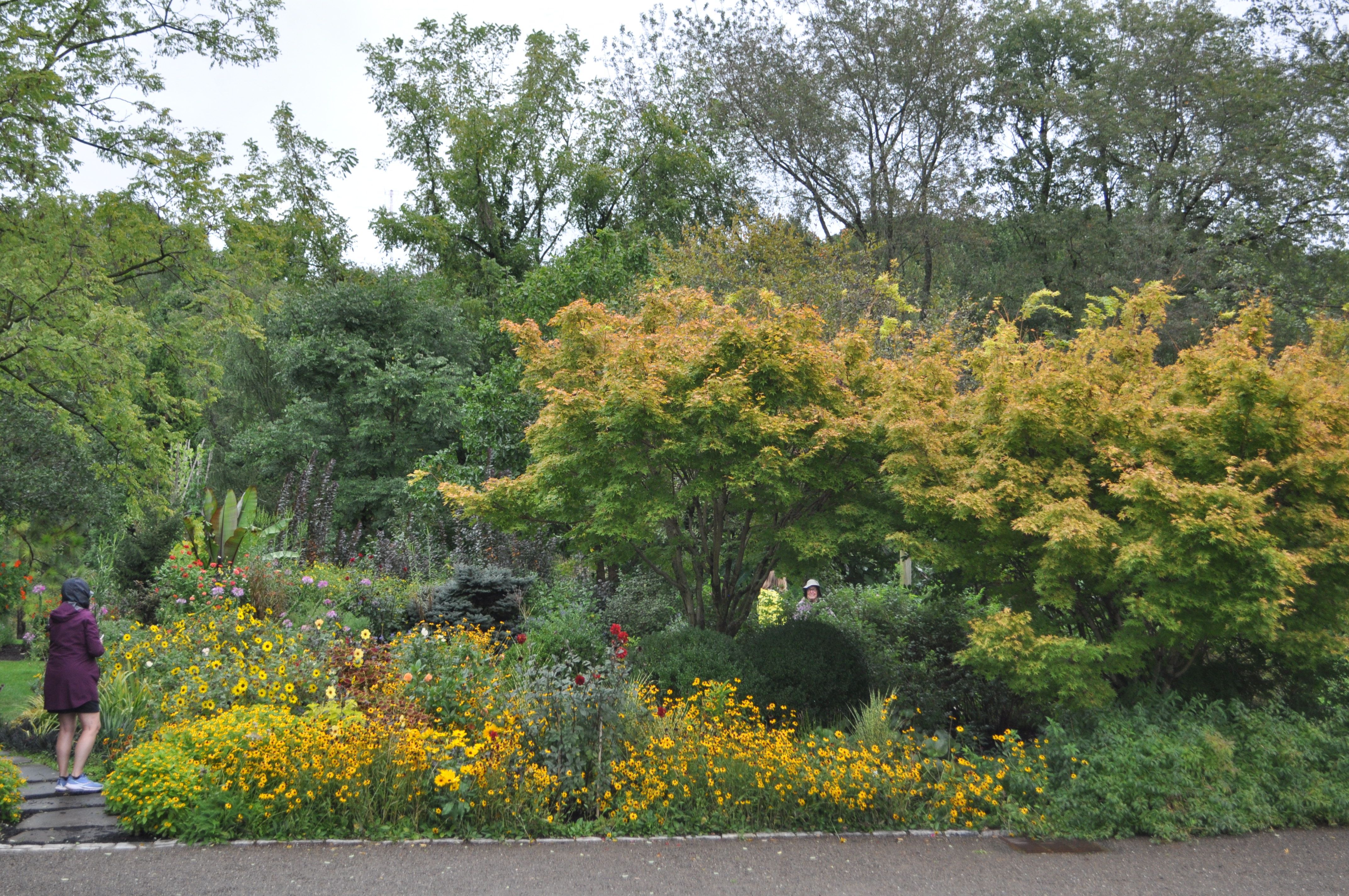
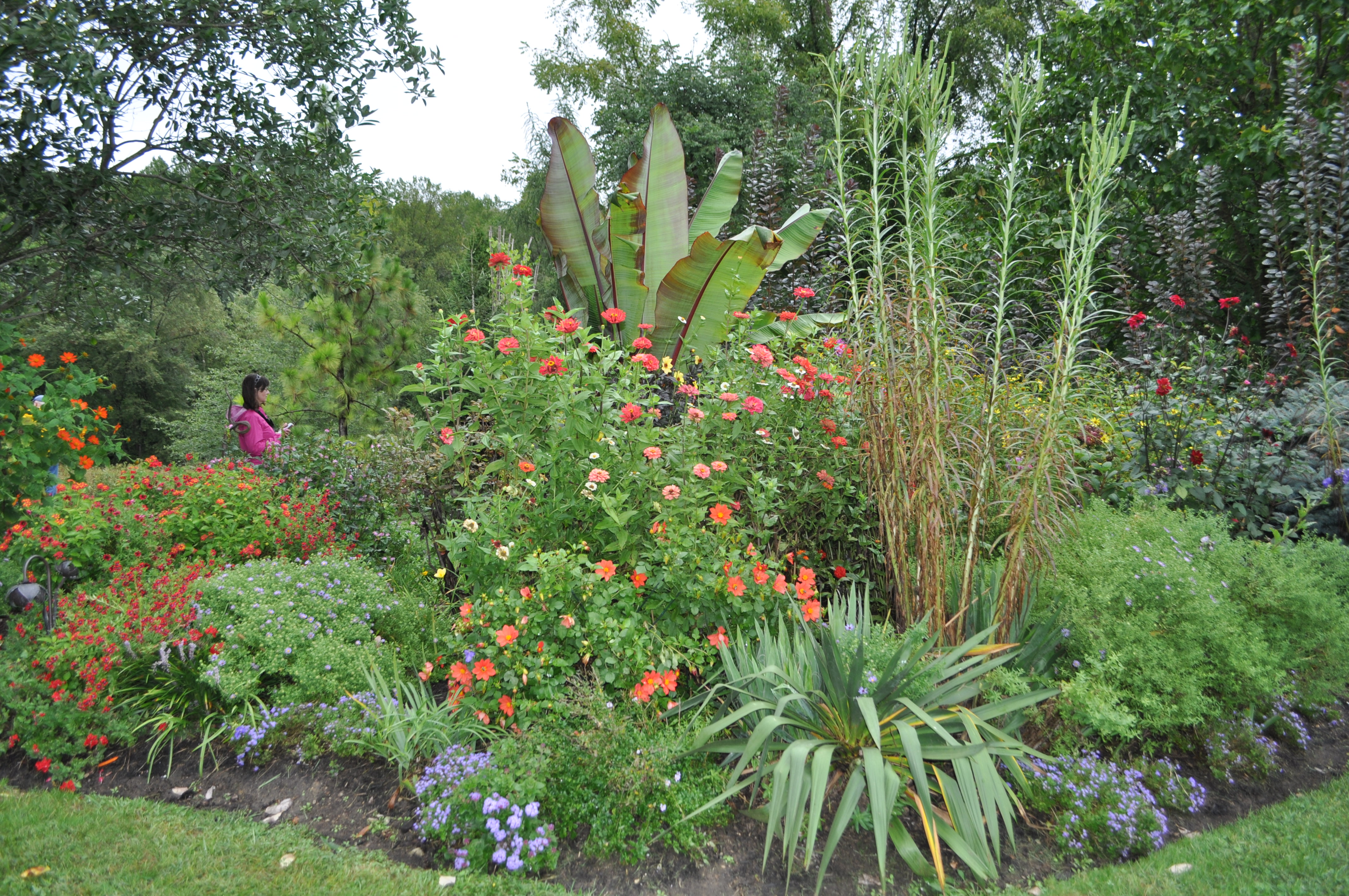
Plow back with me in time to The Garden Blogger’s Fling in September, a few months ago. Owl Creek Farm in West Chester, Pennsylvania was a favorite. There were no ancient walls, limestone paths or turrets as backdrops but the design elements leaned towards English garden theory. Stepping into this garden, fed my plant lusting eyes but also my heart. I hope you will enjoy a look at Owl Creek Farm.
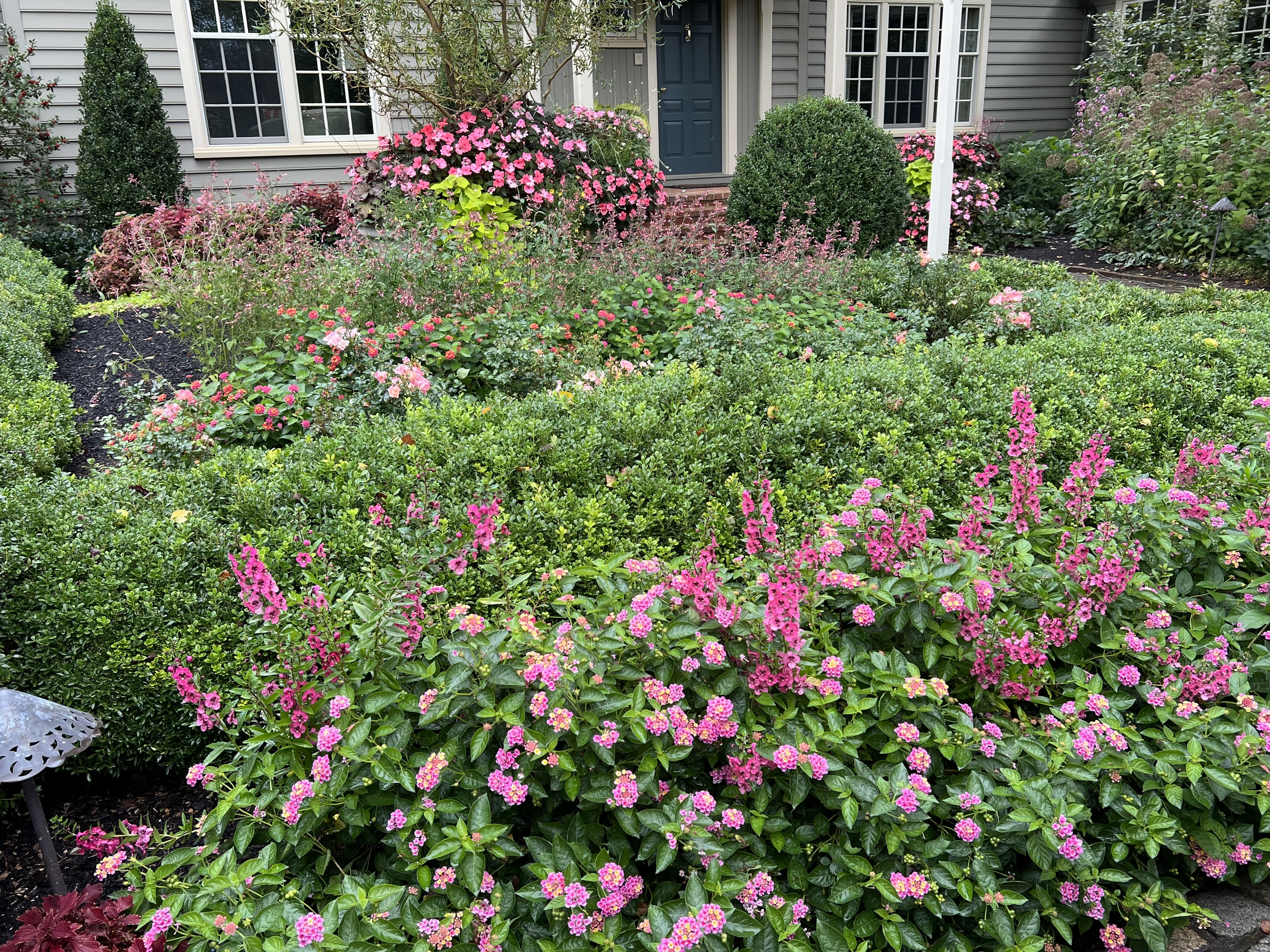
Lush plantings such as these pink borders in the two photos above with several kinds of Coleus, Impatiens, Angelonia, and Lantana. Texans could borrow this scheme.Color Themed Gardens, yellow reigns here!Plant Diversity-yuccas, orange zinnia and dahlia with a banana as an exclamation.Perfectly Planned Borders, love the textural contrast-coneflower, anemones, a grass I can’t name, allium seed heads in the front, weeping redbud, Cercis canadensis anchoring the back.
Trellis– such as these three, an essential English garden element
Exuberant Pots, Phormium, Coleus, a bit of Lantana, Cuphea at it’s feet and blue salvia
Ann Lamb, Dallas County Master Gardener, Class of 2005
October ushered us into the colorful changes of fall. And then, November arrived with waves of crimson, yellow and orange. Mary Ann Evans, known by her pen name, George Eliot, gave us these endearing words from a letter written to Miss Lewis, October 1, 1841…
“Delicious autumn! My very soul is wedded to it, and if I were a bird I would fly about the earth seeking the successive autumns.”
How eloquently her words capture the essence of autumn in this beautiful quote. Hopefully, you have taken notice of trees bursting with color, fall foliage ablaze with seasonal splendor and tables graced with a harvest of plenty. As the gathering of family and friends begins, let’s celebrate the abundance of blessings found in the natural world.
Japanese Maples: For the past few years, the Dallas County Master Gardener Association has hosted a fundraiser featuring countless varieties of Japanese maples. Trees are usually “sold out” within hours. This speaks to the popularity of Japanese maples found in landscapes throughout Dallas County and beyond. Everyone seems to have a favorite but for many homeowners, the options typically include several types.
When we purchased our seventy-five-year-old house in 2006, previous owners (six total) had planted Japanese maples in various locations on the property. One maple, in particular, struggled to survive the below freezing temperatures of 2021, 2022 and 2023. As you can see from the photo, we chose to give it time to recover. After consulting with several arborists, the stately 30+ year-old tree is continuing to fight its way back. Still requiring some special attention, our tree is determined to overcome the odds. Its canopy provides wonderful afternoon shade in an area where we gather by the pool during the heat of the day.
Over the years we’ve added several dwarf Japanese maples and our new favorite variety, coral bark. It is a beautiful small tree with red-coral bark on its young branches with color that intensifies in the winter.
You’ll find them growing somewhere in most yards, especially on older properties. Overlooked, undervalued, neglected and dismissed, why have they lost favor in the landscaping world? It’s time to revisit a plant with so much to offer but rarely considered for its dramatic effect. More commonly known as heavenly bamboo or sacred bamboo, we know it as Nandina Domestica.
Nandina is native to China, cultivated significantly in Japan, then intentionally introduced to the United States as an ornamental in 1804 for its year-round interest and beauty. As a native Texan who spent my K-College years in southeastern Oklahoma, l am very familiar with nandina. It was growing in yards throughout my small hometown of Durant. However, from what I remember, nandina shrubs were typically used as background plants and located where they didn’t offer much more than a lame effort for “filling in”.
Over the years it has proven to be a very reliable asset for homeowners. Especially desirable for its dependability in extreme temperatures and striking seasonal foliage, it ranks high on the performance scale. Landscapers seem to be taking a fresh, new approach to using it in more creative and eye-catching ways, even with modern architecture. Hopefully this trend will continue with nandina giving us the “heavenly” mention it deserves!
Follow these recommendations when considering nandina for your landscape:
*Nandina is still considered invasive in some areas so choose wisely.
*Two sterile cultivars that might be a better option are ‘Firepower’ and ‘Blush Pink’.
*Nandina should not be sheared as it destroys the natural beauty of the plant. When nandina becomes too large, irregular in shape or leggy, carefully prune using the one-third rule.
*Nandina thrives in USDA zones 6 to 9 and grows best in full sun or partial shade. Choose from the numerous cultivars available in most garden centers. ‘Firepower’, Gulfstream’, ‘Obsession’ and ‘Sienna Sunrise’ are strong recommendations.
We’ve just added three new ‘Obsession’ nandinas to a south facing area in our backyard. They are already starting to show those brilliant shades of red in their leaves.
November’s ever-changing tapestry is filled with botanical color. Take a few moments to experience some especially magnificent images of autumn’s brilliance. It may not be Vermont but our local landscapes really know how to take center stage!
Linda Alexander, Dallas County Master Gardener Class of 2008
This season of the year we are often asked to express what we are thankful for, of which there are many things; however, recently I have been reminded of how thankful I am to have a garden to tend, a group to garden with and organizations and friends who support these garden endeavors.
Several weeks ago when there was an impending freeze, I made my way to capture what I expected to be a transition in the looks of our colorful and vibrant landscape to a somewhat muted look. Upon arrival, the brisk fall air welcomed , the pink shades of the muhly grass glistened in the bright morning sunlight – flowers were continuing to burst forth with blooms, and vegetables continued to produce fruit.
As I wandered through the pathways, soaking up the beauty, my memories were not just of the plant material, but the people who have made this garden special to me. Raincatcher’s garden of Midway Hills was begun in November, of 2014. We moved locations that Fall –and began anew. The courtyard plantings have been transformed, a rain garden was added, and the old playground has become home to our Edible Landscape and greenhouse. The most dramatic change has been in the North Field. It went from an acre of land, to a vibrant workspace with vegetable beds, trees, orchards, color wheel, compost area, wildlife habitat and a covered meeting area.
We are truly thankful for the opportunity to garden on the grounds of Midway Hills Christian Church, and for the many hands that make this Dallas County Master Garden project one that educates the residents of this area, but also gives back to the community.
We are grateful; We are thankful. And we are blessed. Thanks for following us on our journey!
OH yes, BTW, we are still awaiting our first significant freeze, so come by the garden and enjoy the beauty of whatever season you find yourself when you are here.
Starla Willis, Dallas County Master Gardener Class of 2011
In just a few weeks our year-long journey into the world of bees will come to an end. Until then, let’s explore, unarguably, the best part of experiencing honey.
In April of 2014, Joe Field (our location prior to relocating and becoming Raincatcher’s Garden on Midway Road) master gardener volunteers hosted a honey-tasting event along with a fabulous honey-themed lunch. A local beekeeper was our featured speaker. To this day, it has been one of our most successful educational programs. Not only did we learn the ‘proper’ way to taste honey, but the menu was created with those complimentary flavors in mind.
(For a quick glimpse of the menu and other photos from the event, go to the following link)
Our instructor that day shared with us that the composition of honey depends largely on which flowers are visited by the bees when collecting nectar. We should also not forget that plants produce nectar in order to attract pollinators such as honeybees, wasps, moths and bats. Another important fact is that the nectar of each plant species has a different combination of sugar and odor. Together, with the flower’s shape, design and color, this helps to guide the bee from one flower to another of the same kind.
Additionally, it was beneficial to learn that honey’s color, flavor and aroma all derive from the plants pigments and other materials secreted in the nectar. This is what makes honey from each floral source unique. Last month we shared examples of local fall blooming pollinator-friendly plants. Some of the flavor profile descriptions of those flowers can help us to imagine the taste of that particular honey.
Color and Flavor Aster: Water-white to light amber. Spicy overtones, firm, chewy texture. Borage: Pale yellow or water white. Herbal and floral bouquet with hints of cucumber and orange pekoe tea. Sugary aftertaste. Goldenrod: Brilliant amber to a warm golden yellow. Bright, sharp, floral-like flavor with hints of fresh straw. Spicy aftertaste.
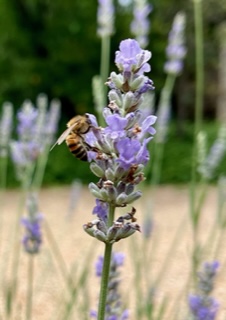
And a few others: Lavender: Light amber. Strong camphor-perfumed taste with sweet tobacco notes. Thyme: Carmel to dark, golden amber or darker. Aromatic, floral, lemony, minty and strikingly sweet.
Honeybees gathering nectar from Lavender blossomsHoneybees gathering nectar from thyme blossoms
Here is a quick overview of how we learned to taste honey. *Tasting honey is an exercise in comparing and contrasting flavors.
*Our taste buds can distinguish between five flavor sensations: sweet, sour/tart, salty, bitter and umami, which is a savory taste. The taste buds for each flavor are located at different areas on the tongue. This is the reason why it is recommended that you move the honey around your mouth as you taste it. Tasting more than one honey at a time gives you a reference point for comparing “tasting notes”.
*Begin with the lightest in color, moving on to medium ambers and then finishing with the darkest. Light-colored honeys typically have a mild flavor, while dark-colored honeys are usually stronger in flavor.
*Take a sip of water in between each sample to clear your palate. Also, a crusty piece of bread and a variety of cheeses can complement the tasting experience.
*To keep it simple and less confusing, start with about five to six different types of honey.
*Start by drizzling a sample of honey onto your tongue and let it melt for a few seconds.
*Spread it around your mouth and consider several questions:
Is it woody, floral, full, light, crisp, buttery, well balanced? Does it have a long finish or an abrupt end? Do you like it or find it unpleasant?
Finally, there is no right or wrong as we each have our own individual taste preferences and predisposition to flavors. Embrace the process of learning how to appreciate honey and celebrate the opportunity to discover the flavors you find the most enjoyable!
FYI…I was intrigued about Goldenrod honey and decided to try to find a source that sells it. That led me to Bee Friends Farm in Michigan. My two 12 oz. bottles should arrive within a few days! Look for an update about the flavor and taste in our December article.
Linda Alexander, Dallas County Master Gardener Class of 2008
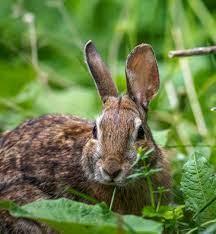
My history with wildlife eating my flowers is a long one. I once watched a wild turkey peck away at my johnny jump ups. Here in Dallas County, we are much more likely to encounter bunnies. Those little bundles of fluff that look so cute on a neighbor’s lawn may find your new pansies and their friends to be very attractive. Unfortunately, they may not limit themselves to enjoying only with their eyes and might proceed to dine on your new plants.
How to keep plants from being nibbled by rabbits is a challenge faced in most gardens sooner or later. A quick tour of the internet reveals many techniques that are reported to be successful for some gardeners but finding actual studies is another matter entirely.
Regardless of the source of the data, there are two primary techniques for saving your plants and they are like the ways we protect our skin from mosquitoes. We either exclude or we repel the pest. Shooing them away just isn’t effective. Like mosquitoes, most rabbits will return for a meal.
Fencing can be one of the most successful options. The addition of a chicken wire or hardware cloth fence 2-3 feet tall and buried 6 inches underground can keep a section of your garden off the menu. Wire cages can be constructed or purchased to protect your kales or chards. Planting in large, tall pots can keep your plant safer on your porch or patio.
Repellants can be purchased or made at home, and work via odor or taste. All will require repeated applications, especially after rain. Odors that rabbits avoid are associated with predators or spoiled, pungent foods. Blood meal is a commonly used odor deterrent and has the advantage of containing nitrogen. One reported downside is that it may attract other predators, leading to the trusty family dog to roll over your pansies. On the plus side, the presence of a dog may scare away rabbits.
Most rabbits dislike the taste of hot peppers, and capsaicin is included in many commercial products. Please read and follow the directions, as some products are not designed for or safe to use with edible plants. If you decide to surf the web for a home-grown repellant, do not use moth balls in your yard. This dangerous advice continues to haunt the internet. Regulated by the EPA, it is illegal, toxic, and counterproductive to use mothballs as deterrent for mammals in your garden. Using garlic spray or a sprinkle of red pepper might just work for you. It all depends on the rabbit and just how hungry it might be.
Whether we are dealing with wildlife that nibbles us or our gardens, what works for one person may not be appropriate for another. One deterrent I read about mentioned encouraging the presence of predators. I doubt the addition of a coyote here would be acceptable. I have found that my new fence seems to keep all the bunnies in the front yard… or is it the feral cat that now enjoys the safety of the back garden? Just like mosquitos, wildlife will find a way around our plans.
Mary Freede, Dallas County Master Gardener Class of 2005
After what seemed like the summer that would not die, the trees begin to show color, we get rain and an early frost… it is time to plant pansies, violas and their friends for color that will carry us into spring.
Members of Violaceae family, pansies and violas can be traced back to their wild relatives in 4th Century Europe. These sweet flowers have long been associated with love and thoughtfulness. As plant cousins, all pansies are violas but not all violas are pansies. In general (and perhaps easier to remember) pansies tend to have larger but fewer blooms, while violas have more but smaller blooms.
Appearing quite delicate, they are surprisingly sturdy and are extensively used as bedding plants across Dallas County. Because they do not like intense heat, we plant them when cooler weather finally sets in, knowing they will fade away when our weather once again heats up. Autumn planting is designed to allow pansy and viola roots to develop before the weather turns especially cold.
Plant these cousins in rich well drained soil in a sunny spot, for best blooming. Place plants 6-10 inches apart in beds or add them to pots with drainage holes. That spot under your deciduous tree might be perfectly bright this winter, or perhaps you have pots with annuals that are ready for something new.
Grown for instant color, pansies were fed heavily in the greenhouse, so don’t starve them when you get them home. If you haven’t already added organic matter to your beds, plan to add a good well-balanced fertilizer, with light monthly feedings for both beds and pots. You may find a time release product works better for you.
Mulch after planting, leaving a gap around the plant stem. That few inches of mulch will help keep moisture and temperatures moderated. Water your new transplants in well and plan to keep them moist but not soggy. Let the soil dry out only slightly between waterings.
All varieties can handle light frost. Some varieties will reportedly survive single digit temps IF they have have a chance to develop a good root system and are planted in an ideal microclimate, but you will have to wait for new flowers to grow from the center.
That crucial time needed for pansies to get rooted in can be just too short here in Dallas. This year was no exception! Rather than risking the loss of their lovely color, water your plants well when temperatures are expected to drop to 20 or below. Move containers to protected areas if possible and cover your pansies with frost cloth. Sheets and blankets can work but avoid plastic.
Pansies and violas aren’t our only options for winter gardening. It is no accident that this year our pansy sale includes alyssum, kale, mustard, and bright lights chard. They all play nicely together and have similar needs.
Ornamental kale is a frilly leaved member of the Brassica family that have been developed for their looks, rather than for their flavor. Looking like extremely large rose blossoms, they need cooler weather to fully develop their color variations. If we encounter a dry spell they will need water and plan on adding a good, high nitrogen fertilizer in December.
Swiss chard has been called beets without roots and was one of the first vegetables to be sold as an ornamental. Bright Lights is the 1998 All American selection that can add gold, red, yellow and orange stalks and veins to containers and borders…and it is edible! This could be just the “thriller” your containers want this winter.
Red Giant Mustard is another lovely and edible plant that brings maroon leaves with bright green ribs and what is called a “zesty” bite. These leaves will play nicely with kales and pansies.
Last but certainly not consider alyssum in shades of white and purple. The Crystal Clear white and purple alyssum are historically a cool season annual here, fading when our heat returns. The newer White Stream is a 2013 Texas Superstar plant bred to survive into summer and does not tolerate freezing. Both varieties form sweet smelling mats and can fill in between other plants or stand on their own in a pot.
Surely you have a spot for one or more of these in your winter garden? And if you purchased some of these plants from our sale, our hearfelt thanks will surely boost your winter garden to beauty.
Mary Freede, Dallas County Master Gardener Class of 2005
PIck up is Wednesday, November 8th from 10-2 under the shade pavilion on the North side of the garden.
For the past few weeks, I’ve been spending countless hours in the garden. It didn’t take long to notice the increased level of honeybee activity occurring from early morning until evening. The bees are everywhere during daylight hours and seem to be buzzing around the flowers with a frenzy in their movements. It is truly fascinating to watch.
Why, I wondered, is fall such a busy time for the bees? One interesting explanation that I stumbled across was that honeybees have switched from needing protein to feed their young to craving carbohydrates before they die later in the season. Seems rather sad but, as we know, the lifespan of a honeybee is relatively short – a few weeks to maybe six months, at the most.
I also discovered that as long as the weather is mild, honeybees will continue to forage throughout the autumn months. During this time, worker bees spend many hours collecting enough nectar (carbohydrates) and pollen (protein) to feed and maintain the colony throughout the winter. Keeping the hive alive during the winter months is a priority. In order for this to happen, worker bees will need to be especially vigorous and healthy.
(NOTE: In the summer months a hive can have about 60,000 bees, but only about 10,000 bees are needed to ensure a colony survives the cold winter weather. As honeybees start preparing for winter, most drones (male honeybees) are evicted from the hive. Since drones have one purpose only – to mate with a queen – when their work is over, out they go.)
As the days grow shorter and colder, the remaining honeybees will form what is referred to as a “winter cluster”. The queen and her brood are kept at the center of this globe-like cluster while worker bees shiver or vibrate their wing muscles, generating enough heat to keep the hive warm in even very cold temperatures. On mild winter days, as we often experience in Zone 8, bees will come out of the hive to dispose of waste products, clean the hive and forage.
However, since there aren’t many options for foraging in the middle of winter, fall nectar and pollen gathering is critical to the hive’s continued survival. We can play an important role in supporting the honeybees during this time by taking a few steps to help them in their work.
*Plant late blooming plants that provide the nectar and pollen bees need. Some examples include fall asters, borage, calendula, frostweed, goldenrod, hibiscus, pentas, salvia and zinnias. We have pictures of most of these pollinator plants above.
*Plan to leave your basil plants in the ground until the first “cold snap” or freeze. I’ve noticed more honeybees on my fall basil plants than anything else in the garden.
*Provide a fresh water source (shallow container) and add some pebbles or twigs for the bees to land on while drinking.
Black Sage Honey, (Salvia mellifera)
Sometime around the middle of September, while visiting our youngest son and his family, we started a conversation about the different flavors of honey. He wanted to know if I had ever heard of Black Sage Honey. My answer was “yes”, but I had never tasted it. Immediately, he brought out a jar, opened it and, together, we all sampled a delicious, peppery honey that was truly unique.
Later that evening, I did an online search to learn more about “black sage”. Here is a brief summary of what I learned about this amazing plant from Specialty Produce.
“Black Sage is a powerfully fragrant, woody shrub that quickly grows to an average of one meter in height and width. More mature plants can reach up to 1.8 meters. The plant has tiny hairs coating the stems and leaves in a sliver-green fuzz, and flowers that range from white to pale blue or lavender grow in spherical clusters known as whorls, along the square stems. The small, oval, dark-green pebbled leaves can look almost black from a distance, especially during dry conditions, and the stem and whorls harden and turn black at the end of the season – all characteristics believed to have influenced the plant’s name. Black Sage leaves produce a strong, herbal, sometimes minty scent and offer a mildly astringent, herbaceous flavor.”
After learning that black sage is recommended for USDA Zones 8-10, I began searching for a grower. Mountain Valley Growers in Squaw Valley, California had the plants in stock, so my order was quickly placed. I purchased a total of three plants. They arrived on October 20th and, after acclimating for a few days, were put into the ground this week.
New planting of Black Sage. It will receive about six hours of sun followed by dappled shade in the late afternoon.
And finally, what’s all the “buzz” about Black Sage Honey? Black sage is native to Southern California and Northern Mexico. It flowers only about every three years. That translates to a very rare honey that is made only about four seasons per decade! Thankfully, I was able to find a jar from Savannah Bee Company and am happy to share this simple recipe with everyone. My recommendation is to experience the wild and earthy taste on its own then decide how you would best enjoy using it. Drizzled over brie cheese and fresh fall figs is my first choice!
From Mexican Mint Marigold and Pineapple Sage to the tall and stately Frostweed filled with clusters of white blossoms, stunning displays of seasonal color fill our gardens with enchanting beauty. Come along, as we find inspiration in the richness of autumn-hued leaves, pumpkins and an array of natural elements.
Mexican Mint Marigold (Tagetes lucida) seems to stay under the radar for most of the April to September growing season. And then, something magical happens in October. Clusters of golden-yellow half-inch flowers begin to appear in early fall attracting migrating butterflies and other pollinators. Considered by many as the Texas substitute for French tarragon, it tolerates the hot, humid climate we experience most summers.
Pineapple Sage (Salvia elegans) is an herbaceous herb used for both culinary and ornamental purposes. The yellow-green, fuzzy leaves have a tropical, pineapple- like aroma, especially when crushed. Late in the season, the plant will sprout long clustered spikes of tubular scarlet-red flowers about an inch long. While the vibrant red flowers are popular in flower arrangements, they also attract butterflies and hummingbirds to the garden just in time for their fall migration. Both the leaves and flowers offer a slightly bitter-sweet citrus and mint flavor that is delightful to experience.
Frostweed (Verbesina virginica) In the fall of 2008, I was completing the three- month program to become a Dallas County Master Gardener. During one of the last few weeks, we were told about a special treat. As tradition would have it, master gardeners from previous classes would be hosting a “plant give-away” to offer their congratulations to us for completing the program. We could choose three or four plants to take home following class that day.
For some peculiar reason, I chose a plant unknown to me but with an interesting name. Another master gardener casually mentioned that it needed plenty of room to grow in my garden. That strange plant with a funny name was Frostweed! The next day it was planted in an uncrowded back area of my garden.
Fast forward to this week, and you can see that my tiny 4” pot from 2008 has continued to grow prolifically and now covers an area over five feet in diameter. I didn’t know it at the time but have since learned that Frostweed is a critical nectar source for monarchs. Clusters of white flowers that appear starting in late August and lasting until November are a welcome sight for Monarch butterflies during their fall migration. It is one of the few plants with autumn flowers consistently in bloom during that time. In addition to monarchs and other pollinators, our Frostweed is visited daily by hundreds of honeybees. In winter, prepare to be stunned by Frostweed’s unusual behavior. When a freeze occurs, the stems will burst and make beautiful ice formations at the base of the plants. Generically referred to as “frost flowers, it is truly a winter garden phenomenon. My granddaughter got to experience the thin and delicate icy ribbons a few years ago and was so mesmerized that her sweet little hands could not stop touching them as she giggled with delight. Give this unique and impressive Texas native a try. In closing, please enjoy a brief video showcasing the magical gifts of autumn as we celebrate this wondrous time of year!
Linda Alexander, Dallas County Master Gardener Class of 2008
In case you missed September’s flora feature and movie, click here.
Raincatcher’s Garden of Midway Hills is pleased to offer pansies and violas at a fantastic price for your fall and winter landscape color. “What’s the difference?,” you might ask. Pansy blooms are larger than viola blooms, but violas are reported to have more blooms per plant and be somewhat more cold-tolerant. We also have alyssum this year – so pretty in container plantings – as well as ornamental kales, Swiss chard and mustard.
Please be aware that all orders are subject to availability at the nursery.
Pansies and violas are sold by the flat of 18 4″ pots. Each flat is $20 inclusive of tax. Alyssum is $22/flat. Please order with care – chard, kale and mustard plants are priced according to the quantity and size of the pot. Sale ends Sunday, 11/5, at 6pm.
All orders must be prepaid, either through Signup Genius using your credit or debit card (fast and easy), or through Zelle to DCMGA at treasurer@dallasmga.com. Zelle payments should be made no later than 11/5 please.
All pansies and plants will be staged at Raincatcher’s for you to pick up from the west parking lot on the campus of Midway Hills Christian Church, 11001 Midway Road, Dallas, TX. We will offer delivery in the Dallas area within about 5 miles of the garden for large orders of 12 flats or more. If you live farther away and would like a delivery, we’ll work with you to charge a fair price in the neighborhood of $10 or so. You may pick up your order on Wednesday, 11/8, from 10am until 2pm. Volunteers will be available to help pull and load your order.
This sale is open to the public, so please tell your friends, family, social media and Nextdoor.com contacts!
Thank you for your support! Funds raised support Raincatcher’s Garden of Midway Hills, a Dallas County Master Gardener Research, Education and Demonstration project.
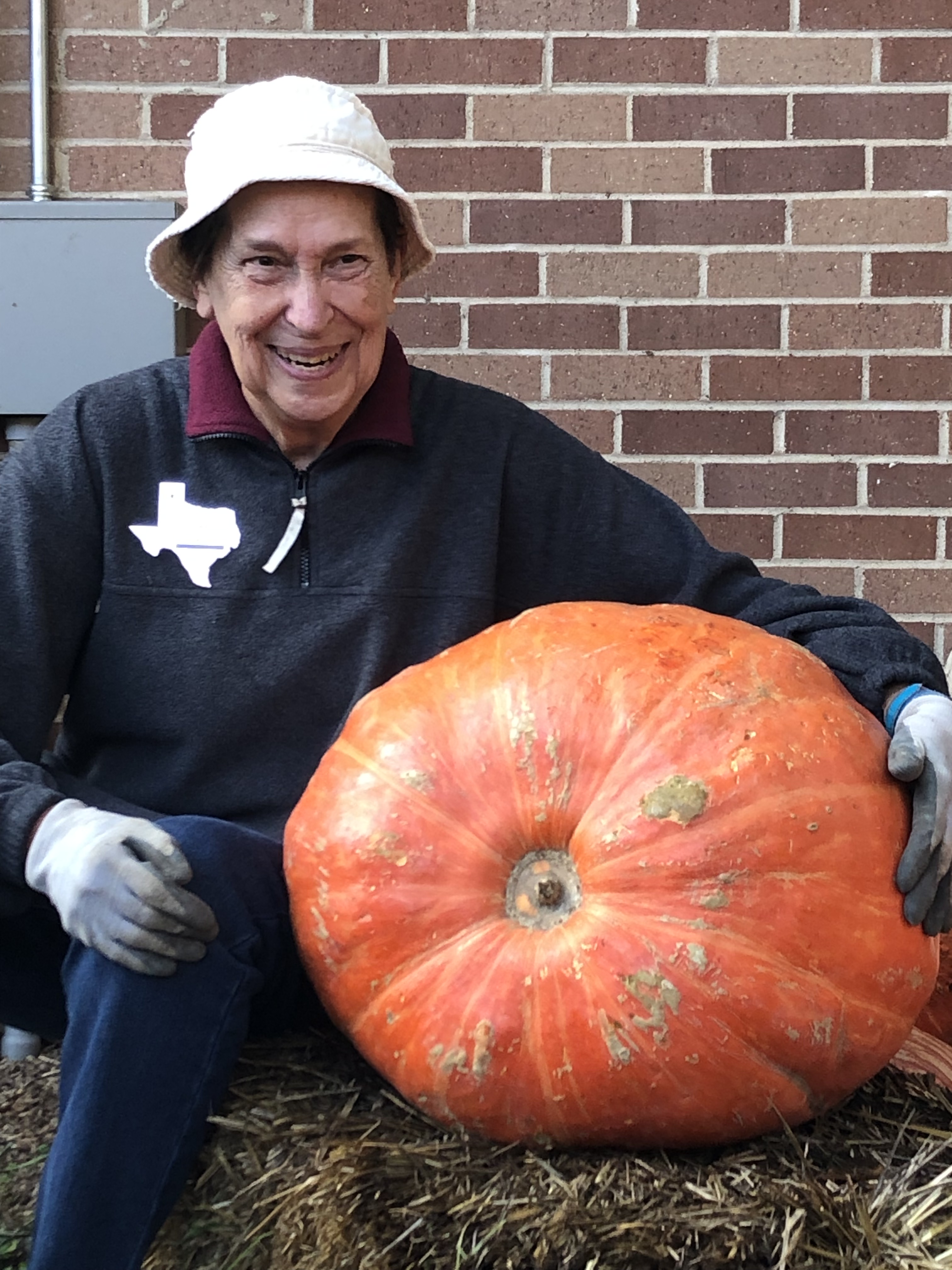
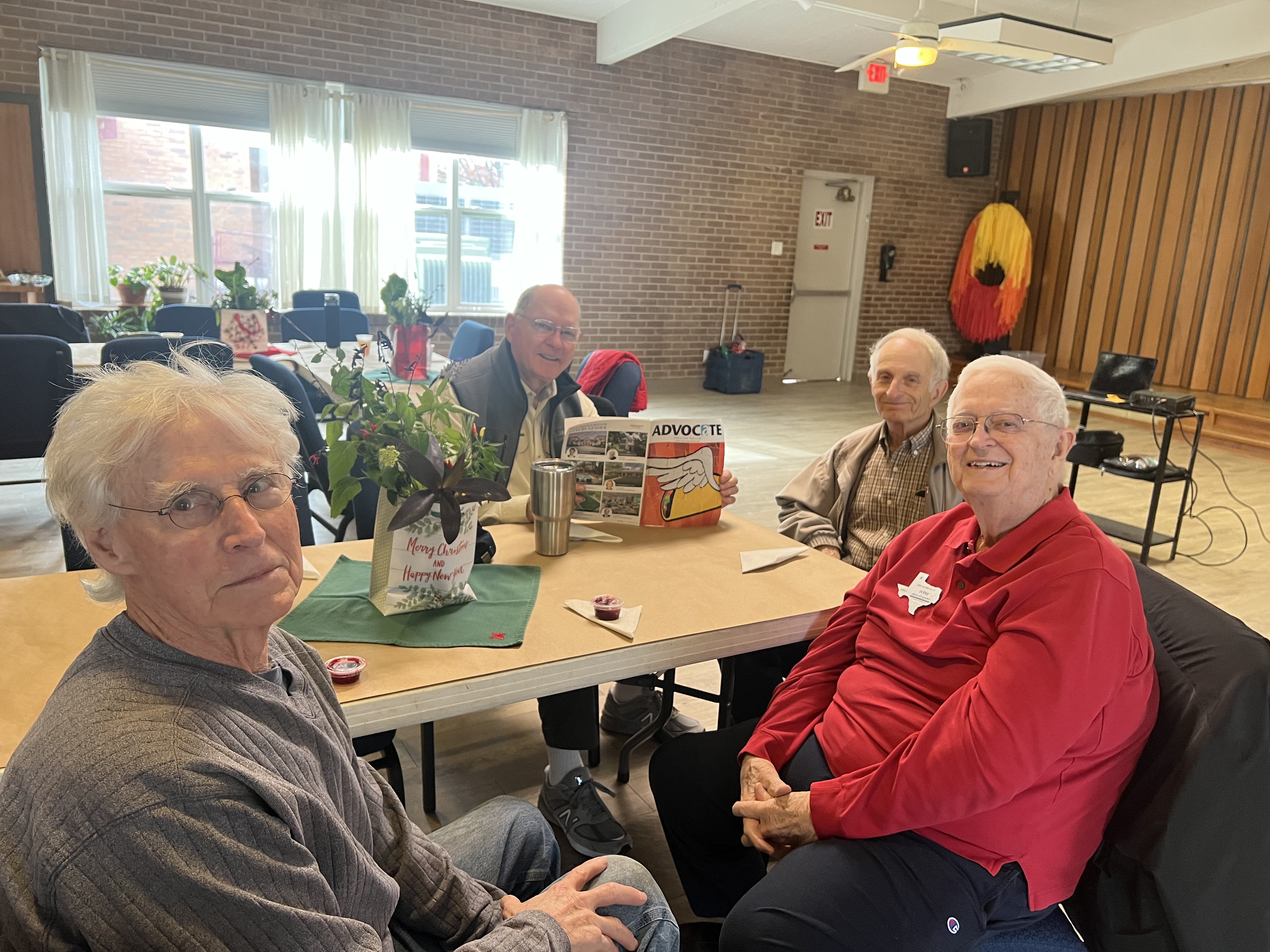
After an especially punishing summer, it was refreshing for Raincatcher’s volunteers to pause and reconnect.
The garden budget including planned improvements was presented by Lisa.Raincatcher’s volunteers gathered for lunch to celebrate fall gardening!
Many of us think fall is the best gardening season of the year. In the north garden we are harvesting okra, peppers, eggplant, long beans, and zucchini as well as preparing space for our new greenhouse.
Don Heaberlin, Beverly Allen and Ann Lamb, Dallas County Master Gardeners compiled this article.
Raincatcher’s pansy sale is November 8th, more information is coming.