Daffodil, Jonquil, Narcissus


What’s in a name? That which we call a rose by any other name would smell as sweet.

–Shakespeare’s Romeo and Juliet

     Picture the flower: daffodil, jonquil, narcissus.  If you are like most people, probably a particular flower comes to mind.  However depending in which part of the country you grew up or lived, or even your age, the specific flowers associated with each of these terms may be different.  This confusion, when using common names for plants, is why botanists classify plants using their Latin or scientific names.

So what exactly is the difference between a daffodil, a narcissus, and a jonquil?  The simple answer, according to University of Illinois   Extension specialist Jennifer Schultz Nelson,  “is nothing, or “it depends.”  All three terms are used as common names in many cases and used incorrectly.  Narcissus is technically the only correct scientific name identifying the genus of this group of plants.  It is not a common name, though some use it as such.  Daffodil is typically used as a collective name for all these plants, but is more often used to describe the larger flowered types.  Jonquil is a name sometimes used for this group as well, but actually only applies to a very small subgroup, Narcissus jonquilla and related hybrids, which typically have several small, fragrant flowers on each stem with flat petals.  The foliage is very narrow and reed-like, according to the American Daffodil Society (ADS).”

 
Daffodil 'Unsurpassable'

Daffodil ‘Unsurpassable’

The American Daffodil Society (ADS) designates 13 divisions of daffodils with, depending on which botanist is asked, over 40 to 200 different daffodil species, subspecies and varieties of species and over 25,000 registered cultivars or named hybrids.  Daffodils are members of the Amaryllis family, of the genus Narcissus.  Narcissus is derived from the Greek word narke, meaning numbness or stupor.   Perhaps the name was given because in Greek mythology Narcissus was a young man so enamored of himself that he stared at his reflection in a pool of water until he eventually drowned as he tried to embrace himself.  Supposedly flowers grew up around the site.  Or the name Narcissus may refer to the flower’s intoxicating fragrance, or because all parts of the daffodil are poisonous.  In fact, not only animals but even humans who have occasionally mistaken a daffodil bulb for an onion, have become ill upon eating the bulb.  There is even a contact dermatitis called “daffodil picker’s rash” which can occur upon repeated handling of the stems.
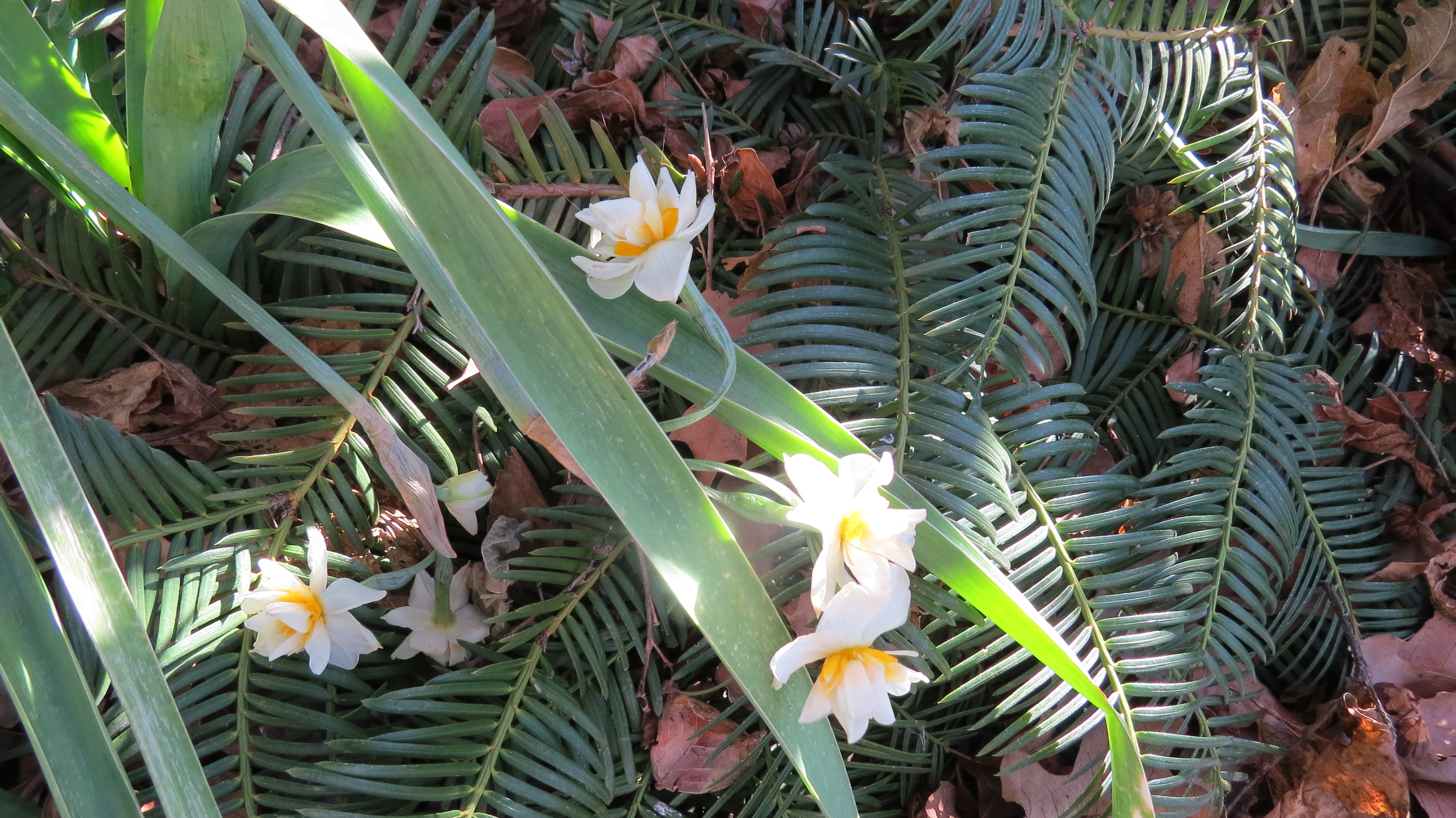
Above: Narcissus tazetta Double Roman peeking our thru leaves of our yew at The Demonstration Garden

Above: Narcissus tazetta Double Roman peeking our thru leaves of our yew at The Demonstration Garden

Daffodils found growing wild in Texas around old homesteads or cemeteries were probably brought over here from Europe by early settlers, according to Dr. Jerry Parsons, retired AgriLife Extension Horticulturist. Daffodils will grow best in a well drained area in full sun though they can naturalize in part shade under deciduous trees.  The bulbs should be planted and divided in the fall or late summer.   It is extremely important that the foliage be allowed to grow, mature and ripen naturally.  According to Dr. Parsons, it should never be cut off or “tied in cute little knots.”  It is the foliage that stores up the food reserves for the next year’s blooms and new bulbs.  In a flower bed, the withering foliage can be disguised by other plants.

Narcissus tazetta '‘Grand Primo’', a bulb that will naturalize in Texas

Narcissus tazetta ‘‘Grand Primo’’, a bulb that will naturalize in Texas

To naturalize daffodils in Texas, it is important to plant the correct varieties.  In general, according to Dr. Parsons, Southern grown stock is genetically superior in vigor to the commercial Dutch forms.  His article on daffodils in Plant Answers lists some of his favorite varieties.  Another excellent source for bulbs of all kinds collected from Texas and neighboring states is The Southern Bulb Company www.southernbulbs.com.  The owner, Chris Wiesinger, collects heirloom and sometimes rare bulbs that will perform very well for the warm-weather gardener.  Many of the daffodils and bulbs planted at the DemonstrationGarden have come from his stock.

So, whether you call them daffodil, narcissus or jonquil,

now is the time to enjoy these delightful flowers.

Carolyn

Picture of ‘Double Roman’ and ‘Grand Primo’ by Starla

Daffodil ‘Unsurpassable’: DaffSeek, American Daffodil Society, Inc., Unsurpassable retrieved on Mar 6, 2014’, available at www.daffseek.org

Take in all things Daffodil at The Annual Texas Daffodil Society Show  this weekend at the Dallas Arboretum.

Companion Plants and Plantings

Onions and potatoes…not only do they taste great together – they grow great together!  A few weeks ago, we planted our onions (yellow 1015, otherwise known as Texas Sweet) and potatoes (red LaSoda) in one of our raised beds.  We planted the onions from seedlings, and prepared seed potatoes.

Above: Calloused Potatoes, ready to plant

Above: Calloused Potatoes, ready to plant

To prepare the potatoes, they were quartered – making sure there were a couple of eyes in each section, dipped in sulfur powder (you may know it as the stuff you sprinkle on yourself to keep chiggers at bay), and then left in a cool, dry, dark place to callous over.   By callousing over the cut parts of the potatoes, excess moisture evaporates and the chance of mold growing underground where the potato was cut is reduced. Usually, 7-10 days is sufficient for callousing.

Since the onions didn’t require any special work, they got planted a couple of weeks earlier, at the top of two rows we’d made in the bed.  They were planted about an inch deep, and roughly four inches apart from one another.  These are bulb onions, so we wanted to make sure there’d be plenty of room for them to grow nice and big.  The potatoes, once they were ready, got planted in the furrow made between the two rows of onions, cut side down (eyes up), about four inches deep and roughly six inches apart.  Six inches may seem a little close, but our goal was to plant all our sets, and that’s how the spacing worked out in our raised bed.

Above: Sue and Christina planting our potatoes inside rows of onions

Above: Sue and Christina planting our potatoes inside rows of onions

So why plant these two together?  It goes like this:  as the onion grows, to help facilitate bulb production, we’ll start removing some of the soil off of the tops of the bulbs.  Meanwhile, the potato plant grows upwards, but the potato is formed off of the part of the stem that is underground.  So as the potato grows upwards, we’ll use the soil we’re removing off of the onion to help bury the potato plant stem so there’s more stem to swell into more potatoes!  Pretty nifty, eh?

Finally, at the end of the bed we have a boxlike structure made of wood.  There, we’re experimenting with growing the potatoes really tall – covering the stems with compost as the plant grows upwards.  We’ve planted five potato pieces in there – one in each corner, and one in the middle – and our drip line extends into the box area.  As the plants grow up and we add more compost, we’ll lift the drip line (we’ve left a little play in there) so it stays near the top of the soil.

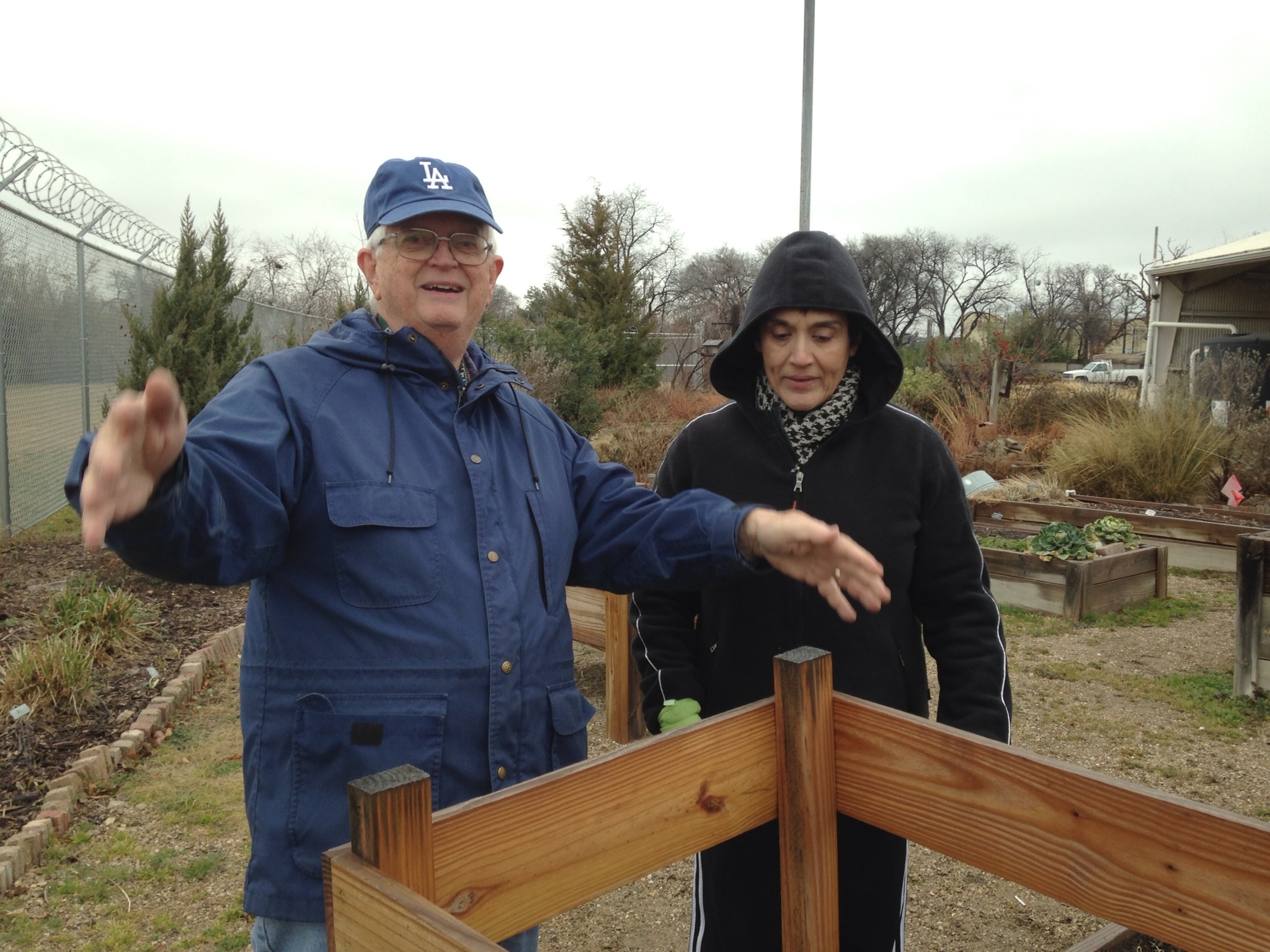
Above: Jim explaining the potato growing process

Above: Jim explaining the potato growing process

It’ll be a few months before we can harvest the roots and tubers of our labors, but it’s good to keep in mind that if you plant a short-day/spring/sweet onion, it’s not considered a storage onion.  If cured properly, it may last a couple of months, but the high sugar content works against long storage.  So it’s best to cook ’em up and eat ’em quick!

Lila Rose

More about our Potatoes: One Potato, Two Potato, Hopefully More, A Better Mouse Trap, and Vegetable Planting in January and more about Onions: The Lowly Onion.

WELCOME TO DALLAS GARDEN BUZZ

Gardening in North Central Texas is enough to make you throw away your trowel.  Our summers are hot enough for a blast furnace.  Our winter chill can freeze pipes and coat trees with ice.  We’re pummeled with spring storms and hail, but when we most need the rain, not a cloud is on the horizon.  Dallas’ unforgiving black clay forms clods hard as rocks and is so alkaline, its pH is off the chart.

DALLAS GARDEN BUZZ shares our journey through the triumphs and missteps of gardening in our North Texas heat, clay soil, limited water, and high alkalinity.  In the world of gardening, there is always a story to be told and sage advice to share.  As we dig, trim, harvest, and cook, we’ll give you the best information we can gather from our “hands on” work in  The Raincatcher’s Garden of Midway Hills, a Research, Education and Demonstration garden at 11001 Midway Road in Dallas.

DALLAS GARDEN BUZZ is written by Dallas County Master Gardeners, volunteers trained by the Texas A&M AgriLife Extension Service.

dcmga_logo_20160109-jpg-2017 agrilife_logo_9-12-jpg-2017

Hearts and Roses Luncheon Desserts

Red Velvet Cake

Hearts and Roses Lunch-Red Velvet Cake

Ingredients:

½ cup butter, softened

1 ½ cups sugar

1 tablespoon white vinegar

1 teaspoon vanilla extract

3 large eggs

1 (1-ounce) bottle liquid red food coloring

2 ½ cups all-purpose flour

2 tablespoons cocoa

1 teaspoon baking soda

½ teaspoon salt

1 cup buttermilk

Cream Cheese Frosting

Directions:

1.  Beat butter at medium speed with an electric mixer until creamy; gradually add sugar, vinegar, and vanilla, beating well.  Add eggs, 1 at a time, beating until blended after each addition.  Add food coloring, beating until combined.

2.  Combine flour and next 3 ingredients; add to butter mixture alternately with buttermilk, beginning and ending with flour mixture.  Beat at low speed until blended after each addition.  Pour into 2 greased and floured 9-inch cake pans.

3.  Bake at 350 degrees F for 20 to 25 minutes or until a wooden pick inserted in center comes out clean.  Cool in pans on wire racks 5 minutes; remove from pans, and cool on wire racks.

4.  Spread Cream Cheese Frosting between layers and on top and sides of cake.

Yield: 1 (2-layer) cake

Cream Cheese Frosting

Ingredients:

1 (8-ounce) package cream cheese, softened

½ cup butter

1 (16-ounce) package powdered sugar

1 ½ teaspoons vanilla extract

1 cup chopped pecans

Directions:

1.  Beat cream cheese and butter until creamy; gradually add sugar and vanilla, beating well.  Stir in pecans.

Yield:  3 cups

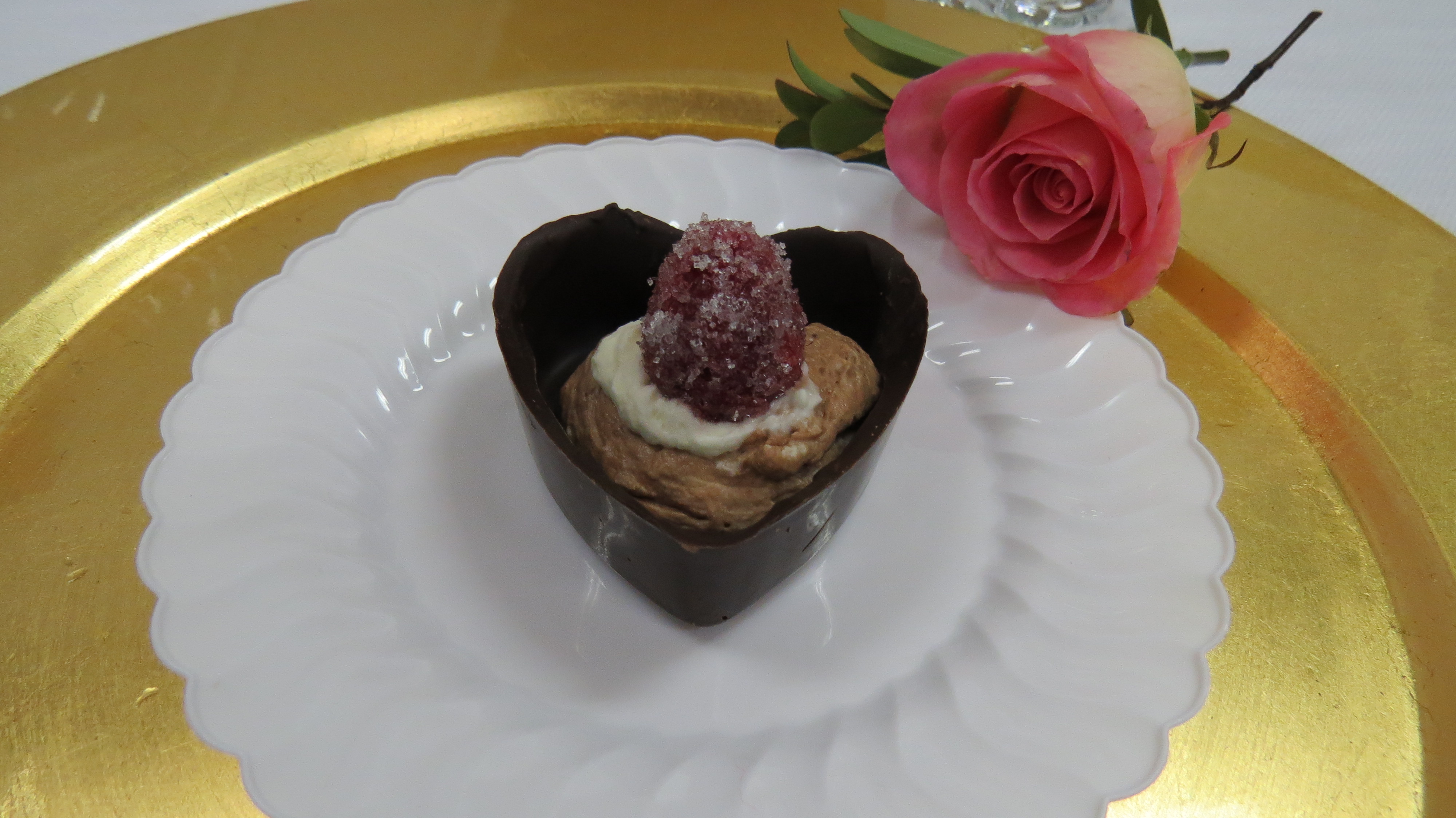
Creamy Chocolate Mousse

Hearts and Roses Lunch Dessert


Ingredients:

3 eggs, separated

1 ½ teaspoons vanilla extract

½ teaspoon almond extract

4 (1-ounce) squares semisweet chocolate, melted and cooled slightly

½ teaspoon cream of tartar

½ cup sugar

1 cup whipping cream

Directions:

1.  Beat egg yolks lightly; add flavorings and chocolate to egg yolks, stirring well.

2.  Beat egg whites (at room temperature) and cream of tartar at high speed of an electric mixer until frothy.  Gradually add sugar, 1 tablespoon at a time, beating until stiff peaks form and sugar dissolves (2 to 4 minutes).  Stir about one-fourth of meringue into chocolate mixture; fold remaining meringue into chocolate mixture.

3.  Beat whipping cream at medium speed of an electric mixer until soft peaks form; fold cream into chocolate mixture.  Cover and chill at least 2 hours.

Yield:  5 cups.

How to Make Sugared Raspberries

Ingredients:

1 cup of raspberries (or other whole, small summer fruit such as blueberries, small strawberries or blackberries)

1 egg white

½ cup sanding sugar

Directions:

1.  Select the firmest, plumpest raspberries to work with.  This will help the final berries retain their shape and they’ll be less likely to turn into a juicy, sugar puddle.

2.  Lightly paint egg white onto entire outer surface of raspberry (using a small pastry brush).  Make sure to get the base and the top of the berry completely covered.  Dipping the fruit into the egg white is not recommended; it becomes messy and doesn’t turn out as well.

3.  Pour about ½ cup sanding sugar onto a plate to use for sugaring.

4.  Place fruit on plate and sprinkle with sugar.  Gently rolling the raspberry in sugar works too.  Be careful not to squeeze or push too hard, breaking the berry.

5.  Coat the raspberry in sugar as evenly as possible.

6.  Dry sugared raspberries on a parchment-lined baking tray for 4 to 8 hours, resting the fruits in a cool, dry place.  Humidity will affect this process, so if your home is very humid, you may want to try this recipe at a different time.

7.  Enjoy just a few berries as a garnish to any dessert (they are very sweet and strong!)

Serving suggestions for sugared raspberries:  Use as a topping for creamy chocolate mousse, angel food cake smeared with lemon curd, or gingerbread topped with whipped cream and a pretty sugared raspberry sitting on the top.  Or, how about a delicious piece of homemade pound cake topped with a combination of sugared berries?  Yummy!

Linda

Strawberry Spinach Salad

Spinach and Strawberry Salad

Ingredients:

1 to 2 pints strawberries, sliced

1/3 cup slivered almonds, lightly toasted

2 (5-ounce) bags fresh baby spinach, rinsed

¼ cup vinegar

½ cup vegetable oil

½ cup sugar

2 tablespoons sesame seeds

1 tablespoon poppy seeds

1 ½ teaspoons finely chopped onion

¼ teaspoon each Worcestershire sauce

¼ teaspoon paprika

Directions:

1.  Toss the strawberries, almonds and spinach in a large bowl.

2.  Whisk the remaining ingredients in a bowl until blended.

3.  Add to the salad and toss to mix.

Yield:  8 servings

Linda

AND THE WINNERS OF OUR VALENTINE TRIVIA QUIZ:

Dallas County Master Gardeners, Eric and Jane, the winners!

Dallas County Master Gardeners, Eric and Jane, the winners!

Hearts and Roses Luncheon Recipes

On February 11th winter’s chill may have been all around us, but we were warmed up with a “good- for your- heart and soul” menu today at the Demonstration Garden.   Our very capable group of volunteers prepared and served this lovely menu for the “Hearts and Roses” Luncheon.  As we reminisced about childhood memories, comfort food in all its glory transported each of us to a happy place.  It was a delightful gathering.

Hearts and Roses Luncheon-Dallas County Master Gardeners

Baby, when it’s cold outside – get in the kitchen and start cooking!


Old-Fashioned Chicken and Dumplings

Just close your eyes and savor the memory of this heart-warming treat

Just close your eyes and savor the memory of this heart-warming treat

Sometimes referred to as “country dumplings”, a bowl of this warms both tummy and soul.


Ingredients:

1 (3- to 3 ½ -pound) broiler- fryer

2 quarts water

2 stalks celery, cut into pieces

2 teaspoons salt

½ teaspoon pepper

1 stick butter

2 cups all-purpose flour

2 teaspoons baking powder

½ to ¾ teaspoon salt

¼ cup butter, softened

¾ cup buttermilk

Directions:

1.  Place chicken in a Dutch oven; add water, celery and 1 teaspoon salt.  Bring to boil; cover, reduce heat, and simmer 1 hour or until tender.  Remove chicken from broth, and cool.  Discard celery.

2.  Bone chicken, and cut meat into bite-size pieces; set aside.

3.  Bring broth to a boil; add butter and pepper.

4.  Combine flour, baking powder and ½ teaspoon salt; cut in butter until mixture resembles coarse meal.  Add buttermilk, stirring with a fork until dry ingredients are moistened.  Turn dough out onto a well-floured surface, and knead lightly 4 or 5 times.

5.  Pat dough to ½-inch thickness.  Pinch off dough in 1 ½ -inch pieces, and drop into boiling broth.  Reduce heat to medium-low, and cook about 8 to 10 minutes, stirring

occasionally.  Stir in chicken and serve.

Yield: 4 to 6 servings

Linda

Tomorrow the remainder of the Hearts and Roses Luncheon Recipes will be launched. Check back with us tomorrow.


Perfecting the Pond

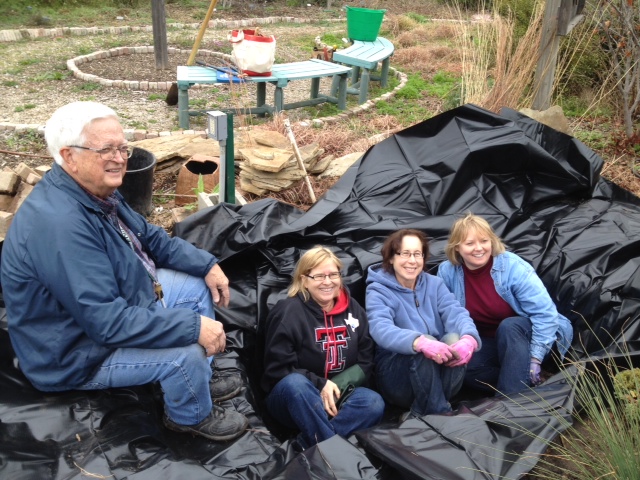
Like mud? Try enlarging the pond in the wildlife area of the Demonstration Garden on a cool Tuesday morning.  The dirt—well mud—was flying as Jim, Michelle, Sue and friends dug out the pond and added six-inch shelves for bog plants.  After adding a thick new liner, the pond is perfect for a picture for DALLAS GARDEN BUZZ! Gardeners arranged flagstones around the pond edge to hold the liner, filled the pond with water and returned aquatic plants, and installed a new pump with a fountain head.  Whew! As Jim commented, that’s a lot of work!

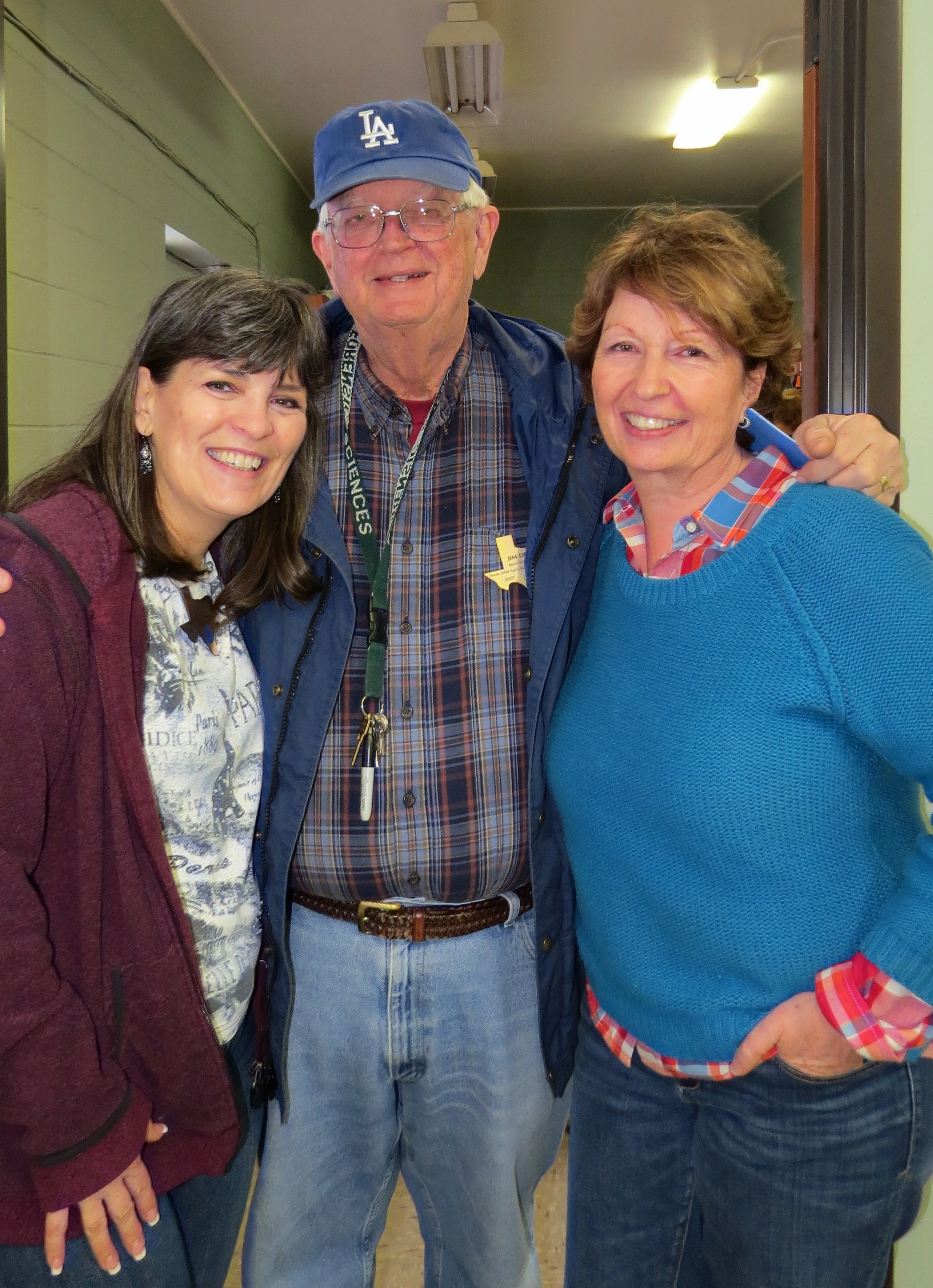
Dallas County Master Gardeners: Jim, Starla, Sue, and Michele  Taking A Rest After Digging the Pond

Dallas County Master Gardeners: Jim, Starla, Sue, and Michele
Taking A Rest After Digging the Pond

Vegetable updates: Radishes and lettuce planted last week are up and growing; carrots are taking their time to sprout.  Onions and leeks planted a few weeks ago are doing well; the spring potatoes have not made an appearance yet.

Master Gardeners also worked to trim back roses and grass, pull weeds, and start rose cuttings for the May plant sale.   We had a great turnout (welcome interns!) and good productive workday in the Demonstration Garden.

Elizabeth

Celebrating Ann

February birthday gardeners Kim Kirkhart and Jim Dempsey celebrate with Ann Lamb

February birthday gardeners Kim Kirkhart and Jim Dempsey celebrate with Ann Lamb

It is so fitting that one of the sweetest people we know has a birthday days removed from Valentine’s Day. The Joe Field gardeners celebrated Ann Lamb and her 60th birthday this month and thanked her for her years at the helm of the Demonstration Garden on Joe Field Road. Gardeners enjoyed Austin Cheese and Vegetarian Potato Soups; Chicken Pineapple Pecan, Mango Chutney Tuna Fish and Cucumber Tea Sandwiches, and Beatty’s Chocolate Cake for the birthday lunch. Volunteers gave Ann a sterling silver ornament decorated with roses as a gift of appreciation for her dedication to the garden. Happy Birthday, sweet friend, who inspires us in life and in the garden!

Elizabeth

Two Recipes Using Nasturtiums

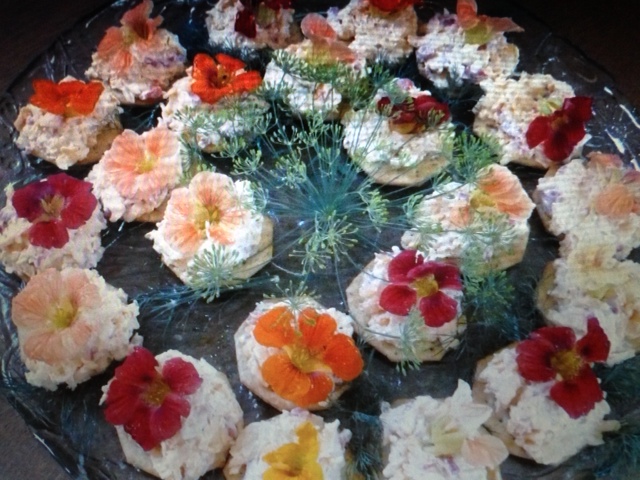
Nasturuims as garnish

Herbed Cream Cheese Appetizer

Ingredients:

1 (8-ounce) package cream cheese, softened

2 Tablespoons chopped fresh basil

2 Tablespoons chopped fresh cilantro

2 Tablespoons chopped fresh tarragon

3-4 cloves minced fresh garlic

Directions:

1.  Mix herbs with cream cheese by hand until blended.

2.  Spread mixture over your favorite crackers.

3.  Garnish each cracker with a nasturtium blossom.

Alternately:  Core a zucchini.  Fill center with cream cheese mixture.  Slice and serve on a cracker.  Garnish with a nasturtium blossom.

Nasturtium Mayonnaise

This recipe is the perfect compliment to chilled summer salmon, or any fish, fresh off the grill.  Also makes a great spread for tea sandwiches, or any sandwich needing some zip.

 Ingredients:

1 cup mayonnaise

¼ teaspoon finely minced garlic

2 teaspoons coarsely chopped capers

1/3 teaspoon grated lemon peel

2 teaspoons chopped nasturtium leaves

Directions:

Combine all ingredients.  Keep chilled until ready to use.

Nasturtium, Tropaeolum majus

It is said that Monet was rather fond of them and planted them in the border of the pathway that led to the front door of his home in Giverny.  With enchanting names like “Empress of India”, “Whirlybird”, “Alaska”, “Peach Melba” and “Butter Cream”, no wonder Nasturtiums are so welcomed in the garden.   They just seem to add a touch of old-fashioned charm.

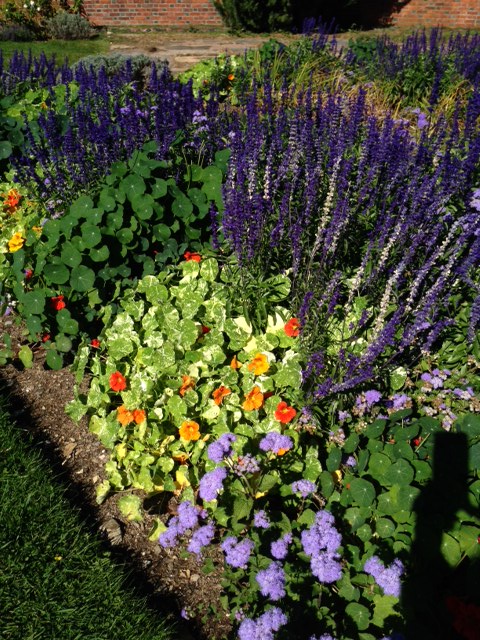
Above: Beautiful fall nasturtiums at Shelburne Farm in Vermont

Above: Beautiful fall nasturtiums at Shelburne Farm in Vermont

Nothing signals spring’s arrival more dramatically than the first bunch of jeweled toned nasturtiums perched on the shelf at your local garden center. If you are looking for decorative, even water lily pad- like foliage, with a wave of brightly-colored blossoms that are tasty to boot, then head for the nasturtiums.  You may be familiar with the varieties that have deep green leaves, but there are now a number of variegated, almost speckled ones, as well.

Above: Lily pads in the garden? No, more fall Nasturtiums from Vermont!

Above: Lily pads in the garden?
No, more fall Nasturtiums from Vermont!

Ideally, nasturtiums like to be in full sun, with moist, well drained soil. However, most varieties can survive when grown in partial sun. These carefree little dazzlers don’t seem to be bothered much by snails, other insects or diseases.  Enjoy them from March until sometime around late June when they succumb to our extreme Texas heat.

You’ll typically find two different kinds of nasturtiums: dwarf bush type and trailing.  The dwarf types are much more commonly available, and are useful as 10- to 12-inch tall colorful borders and for mass plantings.  The trailing variety will cascade dramatically down walls or hanging baskets.  Nasturtiums make a lovely addition to the herb garden with a multitude of culinary benefits.

There is nothing more intriguing than the tissue paper like profusion of blossoms that nasturtiums produce.   Although the blossoms appear delicate, they are actually very durable and make for vibrant and long-lasting garnishes.  Use the blossoms either whole or chopped to decorate creamy soups, salads, butters, cakes and platters.  Their sweet, peppery taste (both in the leaves and in the flowers) adds to the enjoyment.

Above: Organic nasturtium blossoms bundled  up and for sale at the Aspen, Colorado Summer market

Above: Organic nasturtium blossoms bundled up and for sale at the Aspen, Colorado Summer market

Nasturtiums are natives to the cool highlands of mountains extending from Mexico to central Argentina and Chile. The conquistadors brought these brightly colored plants back to Spain in the 1500’s. The Indians of Peru used the leaves as a tea to treat coughs, colds and the flu, as well as menstrual and respiratory difficulties.   Being high in vitamin C, nasturtiums act as a natural antibiotic, once used topically as a poultice for minor cuts and scratches.


Take advantage of the many decorative ways to use nasturtium flowers for your next gathering.  However, don’t be surprised; some people will turn up their noses to a beautiful flower sitting atop a cracker spread with herb-flavored cream cheese.  Others will fully embrace the opportunity to sample such a tasty little gem.  If we could only extend our growing season nasturtiums might grace our tables more often.  Oh, dreaded Texas summers, why do you leave us so little time to enjoy this beloved plant?

Linda

Tip: Texas AgriLife Extension Service recommends planting nasturtium seeds about the time of the average last frost. They are usually planted where they can be allowed to mature, since young seedlings can be difficult to transplant.