Tag Archives: outdoor learning

Fall-What’s Not To Love?

What’s my favorite season? Easy peasy. FALL. Jacket wearing, college football cheering, leaf rustling, turkey roasting, Halloween mini-Snickers sneaking—Fall!

This lovely autumnal season is so much more than pulling up summer-scorched annuals and popping in mums for a few weeks.  At a time when northern gardeners are closing up shop for the winter, Texas gardeners have realized that the fall months may very well be the best time of the year to plant.

Think about it.  A Sweet Innocent Perennial you might plant in the spring is just being lined up for the furnace blast of summer from late May through August.  It’s hard to even survive—much less thrive–in temperatures in the 100s, no rainfall, and nighttime lows that hover in the 80s.  But if you’re a savvy gardener and plant that same Sweet Innocent in the fall, you’ve tucked it in when the future holds cooling temperatures and more frequent rain.  Voila.  Plant Success.

Most plants will put on a fall flush of growth and bloom in fall weather conditions.  Roses can be spectacular in the fall, often with blooms more vibrant than spring or summer.  Trim roses back now, fertilize, and give a deep soaking to promote bloom.

Raised Bed with carrots, radish seeds and trowel

If you’re planting a fall school garden with kids, it’s time to get busy.  If you want a warm season garden, plant bush beans and pinto beans by seed until September 15.  Be sure to baby your seeds; they need to be kept moist until they sprout and are established. 

Dallas County Master Gardeners Busy With Fall Gardening

Fall is Prime Time for cool season crops, those vegetables that love a nip in the air in November and December.  Plant beets, spinach, lettuce, and carrots by seed now through October 15.  Kids love transplants; they’re veggies in miniature.  Plant broccoli, Brussels sprouts, cabbage, and cauliflower transplants now through late-November.  Mustard greens, Swiss chard, spinach, parsley, leeks and kale transplants can be tucked in the garden from September 15 through the winter.  (Harvest your warmer season crops in late October, then plant cole transplants for a continued harvest.)

Spring flowering bulbs can be a fun thing to plant with kids.  Purchase your bulbs now when nurseries start stocking bulbs, but wait on planting them until soil temperatures cool significantly, for us in mid- to late-November.  Daffodils are probably your best bet with kids.  They are dependable, don’t require pre-chilling (like tulips), and some will naturalize.  The Southern Bulb Co. in Golden, Texas  is known for propagating old varieties of bulbs, often found in deserted homesteads. 

The best reason to garden in the fall is to enjoy it.  Your garden is filled with new blooms and growth.  Pests have taken a vacation with the cool temperatures.  So nibble a bit of early Halloween candy and enjoy the season.

Elizabeth
School In The Garden

A s summer fades away. here’s a look at some of our crops and more reasons to have school outside in our learning center at the Earth-Kind® WaterWise Demonstration Garden.

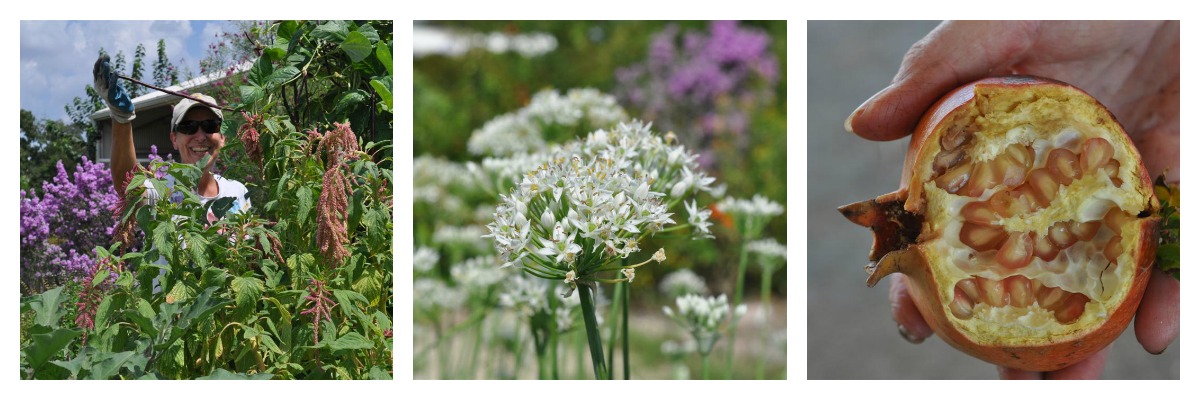
Chinese Red Yardlong Noodle Beans, Garlic Chives, Pomegranate

 Chinese Red Yardlong Noodle Beans and Amaranth Love Lies Bleeding

We are growing these two exotic edibles at the Demonstration Garden to learn more about them ourselves. In our first picture Cindy is stretching out the yardlong bean and the amaranth is blooming with cascading ropes of flowers in front of it.

 To find out how to cook the yardlong noodle beans read Garden Betty.  

Amaranth aka, Love Lies Bleeding, loves the heat and does not need much water. The leaves and seeds are highly nutritious.  Its creepy name refers to its use in the middle ages to stop bleeding.  A whole social studies unit could be written about Amaranth and the uses of it around the world today and historically.  Our garden setting would be the perfect place to teach this!

Garlic Chives  Plop the ornamental seeds heads into your salad along with the chopped up  stems or leave them so you can gather their seeds.

 Pomegranate  We grow the variety, ‘Wonderful’, and it started producing for us the summer after we planted it in 2009.  It will become a multi-trunked small to mid-size tree .  We have an orchard in the planning stages with  Pomegranate trees and other Dallas oriented fruit trees to be planted and more school lessons to be taught!

Ann

Registration Now Open For Field Trips

 A very special experience awaits children visiting the Earth-Kind WaterWise Demonstration Garden on a field trip.  Children can pet friendly chickens, peek under leaves in the vegetable garden for growing produce, watch for hummingbirds and butterflies in the wildlife habitat, and learn how compost enriches our soil. 

Demonstration Garden Field Trip-Learning About Chickens

Teachers and parents are as enthusiastic about the field trip as their young friends: “The children absolutely loved the event…the volunteers were so excited about what they were sharing…and the excitement was contagious.”   

The Demonstration Garden gives teachers multiple opportunities to enrich their science curriculum.  The field trips are taught by Master Gardeners, gardening experts trained by the Dallas County AgriLife Extension Service. 

Is your class studying plant identification or wildlife? Would you be interested in having your students write poetry in the garden setting?   Or draw flowers and leaves to examine their structure? Perhaps figure out the area of a vegetable garden and determine the number of plants to include? We can tailor classes to fit your units of study, with a little notice. Literature, math, science, and the arts can be enhanced in a garden setting.

The field trips generally last about two hours.  Children rotate around stations in small groups with lots of individual attention. Restrooms, free parking, and picnic tables are available on site.

And the field trips are offered at little or no cost depending on the materials needed for your class.

Elizabeth

To schedule a field trip to the Demonstration Garden or ask questions about field trips, click here and for more specific information from Annette about field trips go to our Garden Field Trip page.

Vegetable Lambs

Plant Born Sheep, The Medieval Idea Of Cotton           

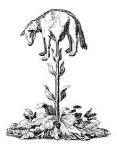
     Have you seen the Demonstration Garden’s flock of “vegetable lambs?”  Tended with loving care by Dallas County Master Gardener Jim and other DCMG volunteers, they thrive in the Garden’s raised beds.  Though we now know these “vegetable lambs” by their contemporary name, cotton, during the medieval period in Europe, cotton was an imported fiber and the actual plant that produced it was unknown.  So, noting its similarities to wool, people imagined that cotton must have been produced by plant-born sheep.  In 1350 John Mandeville, after a trip to Tartary, wrote: “There grew there (India) a wonderful tree which bore tiny lambs on the ends of its branches.  These branches were so pliable that they bent down to allow the lambs to feed when they are hungrie (sic).”   Later in 1791 Dr. De la Croix in his work Connubia Florum, Latino Carmine Demonstrata  wrote of the vegetable lamb:

  Upon a stalk is fixed a living brute,                       Early Understanding Of Cotton Plants

  A rooted plant bears quadruped for fruit.

  It is an animal that sleeps by day

  And wakes at night, though rooted in the ground,

  To feed on grass within its reach around.

     Today’s scientific classification of cotton is, of course, much different from the zoophyte (i.e. an animal that visually resembles a plant) classification of the medieval period.  The name of the genus derives from the Arabic word goz, which refers to a soft substance. 

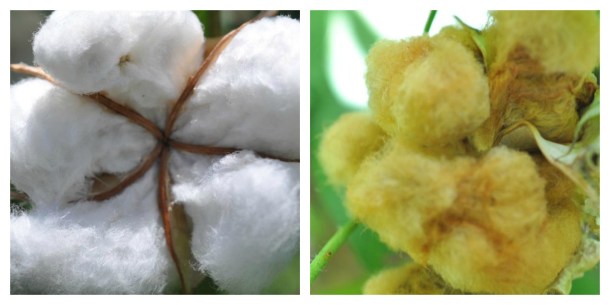
It is particularly interesting that cotton is in the Mallow family and is related to hibiscus.  This resemblance can be seen easily in cotton’s flowers.  Cultivated cotton is a perennial shrub.  However it is grown in our area as an annual.  Plants are around 3-5 feet tall with broad three to five lobed leaves.  The seeds are contained in capsules called a “boll.”  The many seeds found in a boll are surrounded by two types of cotton fiber.  The longer fiber can be spun into thread and ultimately cloth, while the much shorter fibers, called “linters,” are spun into low quality fiber, giving rise to the term “lint.”  Cotton requires a long growing period, full sun, moderate water and likes heavy soil.  If this sounds like a perfect plant for the Dallas area, it is—- and is why cotton fields used to be numerous throughout DallasCounty.  There are several different naturally occurring colors of cotton (white, brown, and green) and the DemonstrationGarden grows brown cotton and several different varieties of white cotton.

White Cotton And Brown Cotton Grown At The Demonstration Garden

     So the next time you visit the DemonstrationGarden, try standing by the cotton plants, closing your eyes, and just “Believe.”  If you listen closely, maybe you will hear the vegetable lambs say “baaaa.” 

       ***this is the first of several articles on cotton: the plant, its history, spinning and dyeing

Carolyn


Our New Blog

 Looking Down the Path to our Garden


Hello,  and welcome to the new blog for the Earth Kind® WaterWise Demonstration Garden on Joe Field Road. We have changed our name, but not our mission.  You may have known us formerly as the Bloomin’ Blog on Joe Field Road, we can now be found as dallasgardenbuzz.com.  You can help us by subscribing to our blog and passing our name along to others.

Though we are changing our web address to dallasgardenbuzz.com, you will find the same gardening advice and love of gardening. Our physical address has not changed. The  Earth Kind® Water Wise Demonstration Garden is located at 2311 Joe Field Road, Dallas, Texas 75229 in the heart of the Northwest industrial  area of Dallas near Royal Lane and Stemmons Freeway.

Drop in on a Tuesday morning or contact us for an appointment.  Even better, bring a group for a field trip to our gardens.  We would love for you to see our gardens.