Tag Archives: herbs

My Favorite Herb…And a Good Companion

September 18, 2025

Here’s a hint – with its strong lemony scent and flavor, you’ll find many uses for it in the kitchen. You may have already guessed just by looking at the photo but, yes, the answer is Lemon Verbena (Aloysia triphylla). For over 30 years it has been my very favorite herb. I’ve used it countless times for breads, cakes, cookies, puddings, in savory dishes and beverages. From early spring when it emerges from the ground and sends up those first “shoots”, a fresh sprig goes into my daily glass of green tea. The ritual continues until at least November or whenever our first freeze of the season arrives.

Lemon Verbena Tea Garnished With Freshly Cut Lemon Verbena

Why should lemon verbena be growing in your garden? To start, lemon verbena is considered by some to be the queen of aromatic herbs, myself included. One whiff of its sweet lemony aroma explains why Southern ladies suffering from the “vapors” mopped their brows with a decoction made from its leaves. For this reason, it is sometimes called the Scarlett O’Hara herbs. Growing in our Zone 8 climate, you can expect lemon verbena to easily reach 4 to 5 feet in height when planted in full sun and in good garden soil. Consider placing it toward the back of your garden bed where it will become a nice informal shrub. Also, keep in mind that it tends to ramble off in different directions but can easily be trimmed to the shape you desire. Lemon verbena is a woody perennial that will start losing its slender, elongated leaves in late fall. If heavily mulched, it will survive a moderate winter. However, in the northern part of Texas, it may succumb to temperatures lower than 25° F. Over the years, I’ve lost at least five or more lemon verbena plants during a hard freeze. But once spring arrives, most local garden centers have it in stock. And, thankfully, it is a relatively quick growing plant.

Lemon Verbena Growing Gracefully in My Garden

Recently, I discovered a recipe in one of my 1995 herbal cookbooks that gave me a new appreciation for using lemon verbena with another well-loved herb, Anise Hyssop (Agastache foeniculum). In the summer section of ‘Today’s Herbal Kitchen’ published by the Memphis, Tennessee Herb Society, the recipe that caught my eye was Anise Hyssop Lemon Cake with Lemon Sauce.

Anise Hyssop is a pollinator-friendly plant whose blossoms are filled with honeybees

Reading through the short list of ingredients, I learned that anise hyssop was called for in the cake along with lemon verbena leaves in the sauce. Hooray! With both herbs growing in my summer garden, it was time to start baking.

Freshly snipped anise hyssop flowers ready to be chopped and mixed into the cake batter

Once out of the oven, and allowed to cool, it was time to slowly pour the luscious, warm lemon sauce over the top. I tried to imagine how the minty, licorice flavors of the cake would blend with the citrusy, floral taste of the sauce. Should I wait for my husband to come home from work before tasting? After carefully slicing the cake for the “photo shoot”, I yielded to temptation and willfully gave in to that first bite. It was a divine experience. My taste buds were rejoicing at the thought of this wonderfully harmonious combination. A new discovery is usually very satisfying and, in the case of anise hyssop and lemon verbena, I’ve determined that for as long as herbs are growing in my garden, these two “companions” will be there.

Anise Hyssop Lemon Cake with Lemon Verbena Sauce

Linda Alexander, Dallas County Master Gardener Class of 2008

Bee Balm vs. Lemon Bee Balm vs. Lemon Balm

 Oh, I so enjoy the colors and flowers that bloom during the early summer and one that I’m enjoying of late is bee balm.  Its magenta flowers atop a tall stalk are a feast for pollinators. In the wildflower area of Raincatchers, a purple rocket-like plant is putting on a show – Bee balm?   It looks nothing like the other, but I recall it being bee balm too. Can it be?  And then there’s Lemon Balm with its bushy habit and ability to travel readily.  Looks like it’s time to clear up this mystery— 

Upon further investigation, these similar names create a climate for confusion Bee balm, Lemon Balm, and Lemon Bee Balm -the looks of the plants are distinctively different but all are related to the mint family.   

eBee balm, also called Wild bergamot, has several varieties – some perennial and others annual. Monarda is a genus of flowering, plants from the mint family. Lamiaceae didyma or fistulosa (zones 4-9) are perennials.   Its cheery pink flowers are located near the Edible landscape greenhouse and stands 24-48 inches tall, and can spread 24 -36 inches.  It blooms late spring into summer in full to part sun in well prepared beds with good drainage. Bee balm has magenta, pink, purple, red or white flowers that are 2-3-inch across with slender tubes looking flowers on a tall stalk. 

Bee Balm

If your garden needs a smaller specimen, pinch the stalks in early spring, or purchase a shorter variety. Deadheading and cutting makes way for more flower production.  Cut the stalks close to the ground in late fall and they will return in the spring. Powdery mildew might make an appearance if it’s a wet spring, but it won’t harm the plant.  

II was purchased at the DCMG Plant Sale at Fair Park and then a dear friend gifted some she started from seeds (Northaven Gardens).  It spreads some, but not difficult to control.  The bees, Butterflies and hummingbirds are delighted.  Mark and Cynthia Jones captured this picture of a moth (white lined sphinx moth I think) feasting on  the variety Peter’s Purple. 

Lemon BEE Balm (Monarda citriodora) is a herbaceous annual of the mint family, native to Central, southern America and Mexico and is commonly found in pastures and prairies.  It will thrive in full sun, and in poor, rocky, or sandy soils. Can you see where this gets confusing?  It Blooms in late Spring early summer about the same time as the Bee balm is blooming.   This was found in our wildflower area at the garden along with blanket flower, long after the bluebonnets, Indian paint brush, and Engelmann daisies have said their adieus (goodbyes) To confuse even more, Lemon Bee balm is also known as purple horsemint or lemon mint.  It has lemon scented spiky clusters of varying shades of lavender.  You can find this in seed packets and often in wildflower mixes.  

Lemon Bee Balm

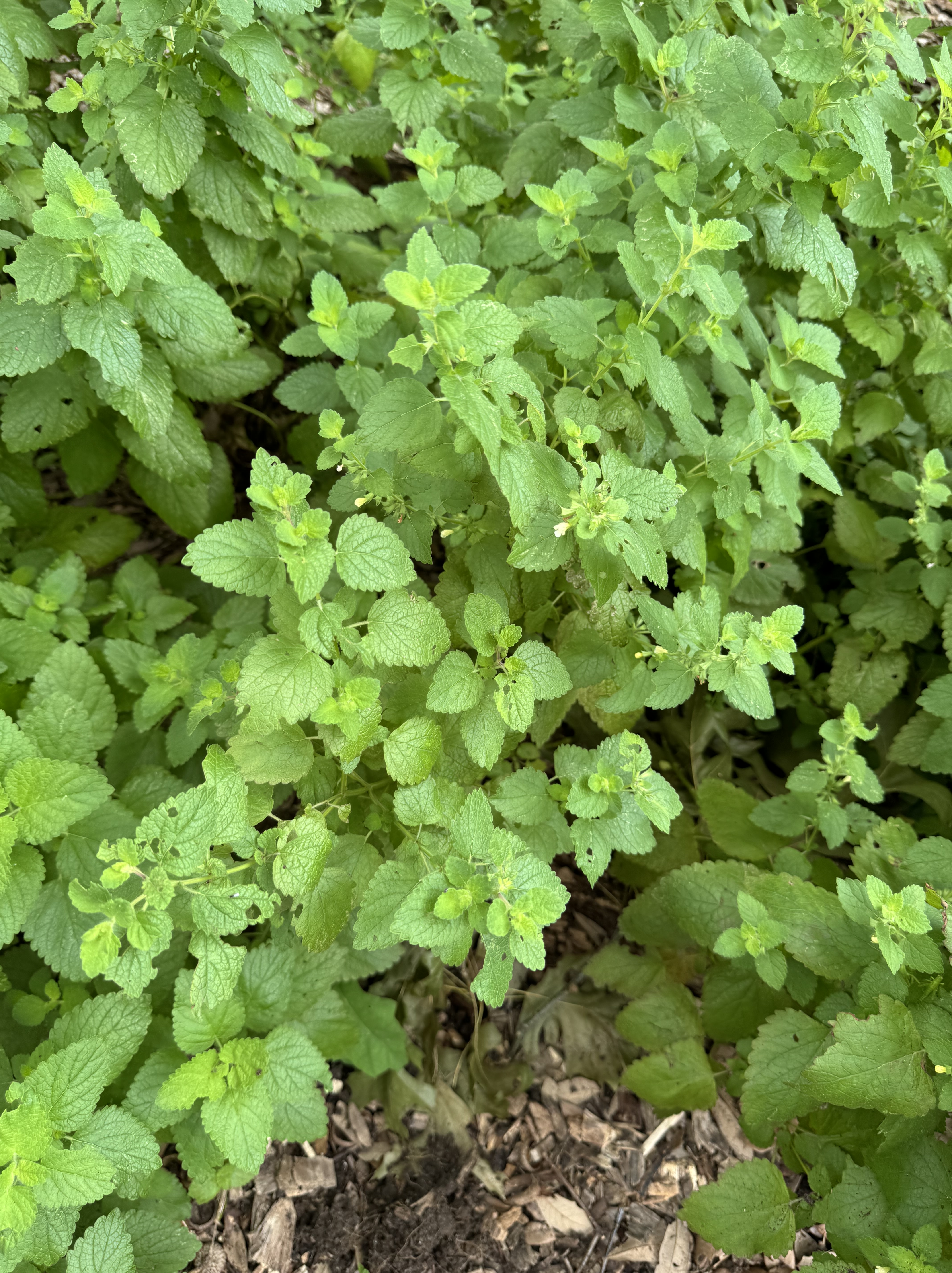
Lastly there is Lemon Balm, another member of the mint family, (Melissa officinalis). Native to Europe, It can be found in many places, but most recently has been thinned from the Hügelkultur in the Edible landscape.  It grows in a clump, with wrinkled  leaves that have a scent of Lemon. The flower is an insignificant spiky pale-yellow cluster.  This herb is said to produce calming effects.   It seeds and spreads readily and can get 3 feet by 2 feet.   It consistently returns in the garden. It can be obtained in the herb section of  garden centers or possibly a garden friend would gift you a start.  

Lemon Balm

Now that that mystery is put to rest,  figure out a way to use one or all of  these beauties in your landscape.   

Starla Willis, Dallas County Master Gardener Class of 2011

Video of sphinx moth, courtesy of Mark and Cynthia Jones, Dallas County Master Gardeners Class of 2013

Winter Savory Is Welcome In This Flavorful Wintertime Dish

January 20, 2024

A plant growing on a stone wall

Description automatically generated
Winter Savory growing in the garden

Walking in the garden early this morning just as sunlight was spreading its glowing rays, I stopped for a moment to gently caress the winter savory. Dew had fallen softly upon it, leaving the cascading branches with a shimmery presence. It seemed to be saying…” use me please”. And that is exactly what happened!

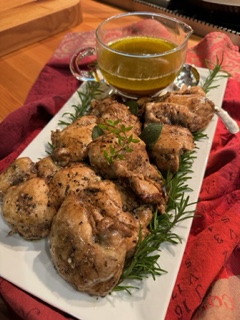
My husband and I love a cozy wintertime dinner by the fire. Thankfully, my winter herb garden had supplied me with the three ingredients needed to infuse the marinade for Balsamic Herb Baked Chicken Thighs: fresh rosemary sprigs, sage leaves and winter savory. This herb-garden inspired recipe delivered a pleasing amount of comfort and flavor for the perfect fireside meal.

Hopefully, you are growing a nice selection of herbs in your winter garden. If so, remember that they liked to be snipped, trimmed and used for culinary and decorative purposes in your home.

*For information about growing winter savory, click here. 

*All herbs were harvested just before the cold front and freezing temperatures arrived. They were kept in a damp paper towel lined plastic baggie for two days.

Linda Alexander, Dallas County Master Gardener Class of 2008

Gifts From the December Garden

December 20, 2023

A red ball on a statue

Description automatically generated

The chill of winter, though not officially here according to the calendar, has arrived. Trees are now displaying their bare branches as each day swirling, gusty winds bring colorful autumn leaves to the ground. From the stately red oaks and maples to the stunning brilliance of Chinese Pistache, yard crews are struggling to keep up with the piles and piles of leaves covering grassy lawns and flower beds. 

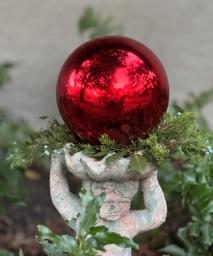
What remains is winter’s gift to our yards and woodlands…the mighty evergreens. My Christmas decorating theme was simplified significantly this year as I took time to pause and contemplate this marvel of nature.  Suddenly, I was caught completely by surprise upon discovering a towering tree growing along the back side of our neighbor’s fence. After 17 ½ years of driving past their property to enter our back gate, a large evergreen tree bursting with clusters of small blue berries caught my eye. I had never even noticed this tree until two weeks ago. Unsure of its name, a quick plant search on my iPhone gave me the correct answer. It was a JUNIPER. 

From that moment of discovery, I was smitten with the dreamy blue color of berries drooping from needle-like leaves with a delicate and aromatic pine scent. Thoughts of decorating my home with the greenery of winter were filling my head. And then a beloved old Christmas carol seemed to speak the words I needed to hear. My decorating theme for Christmas 2023 would be…” Let Heaven and Nature Sing”.

My sweet neighbor was so accommodating by giving me permission to ‘harvest’ as much as I wanted from her Juniper tree. That was the beginning of a foraging-type mission for evergreen material in our yard and along the alley ways and streets behind us. My goal was to respectfully select, then carefully cut, branches that would complement my decorating theme. 

The joy of using freshly cut evergreen branches for Christmas decor is their aromatic gift and profound color. Our home not only has the feel of a nature-inspired Christmas, but the air is filled with a calming heavenly scent, as well. 

Please enjoy a sampling of nature’s gifts in this short video featuring the evergreens used to adorn our home as we proudly proclaim…” Joy to the World!”

*Evergreens, and herbs, used from our yard (and a kind neighbor) are: Magnolia, Boxwood, Burford, Foster, Nellie R. Stevens, Savannah and Yaupon Hollies, Junipers, Cedar Trees, Japanese Plum Yew, Lavender, Rosemary, Thyme, Winter Savory and traditional English Ivy.

Linda Alexander, Dallas County Master Gardener Class of 2008