A Very Good Day at the Garden

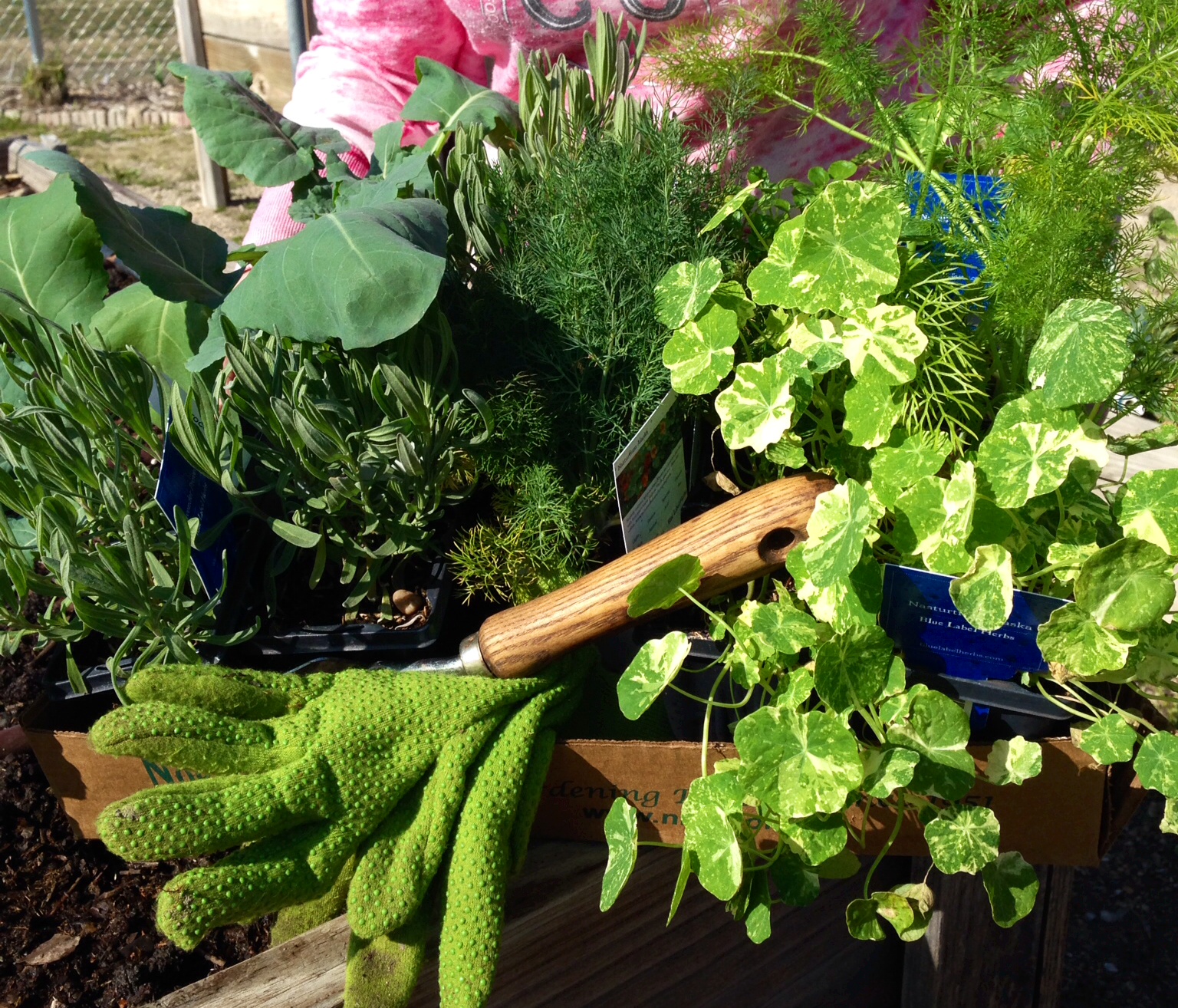
Above: Nasturtiums, Watercress, Lavender, Fennel, and Broccoli

Above: Nasturtiums, Watercress, Lavender, Fennel, and Broccoli

Thought I might give you a report .  We had a pretty day at the garden and we got a lot accomplished:

1)  roses trimmed

2)  planted radishes, carrots, lettuce, and beets

3)  cleaned up the herb beds and planted

4)  weeded

5)  removed most of the brown material in the RainCatcher Garden

6)  cleaned up the Color wheel

7)  trimmed asparagus

8)  worked the compost bins

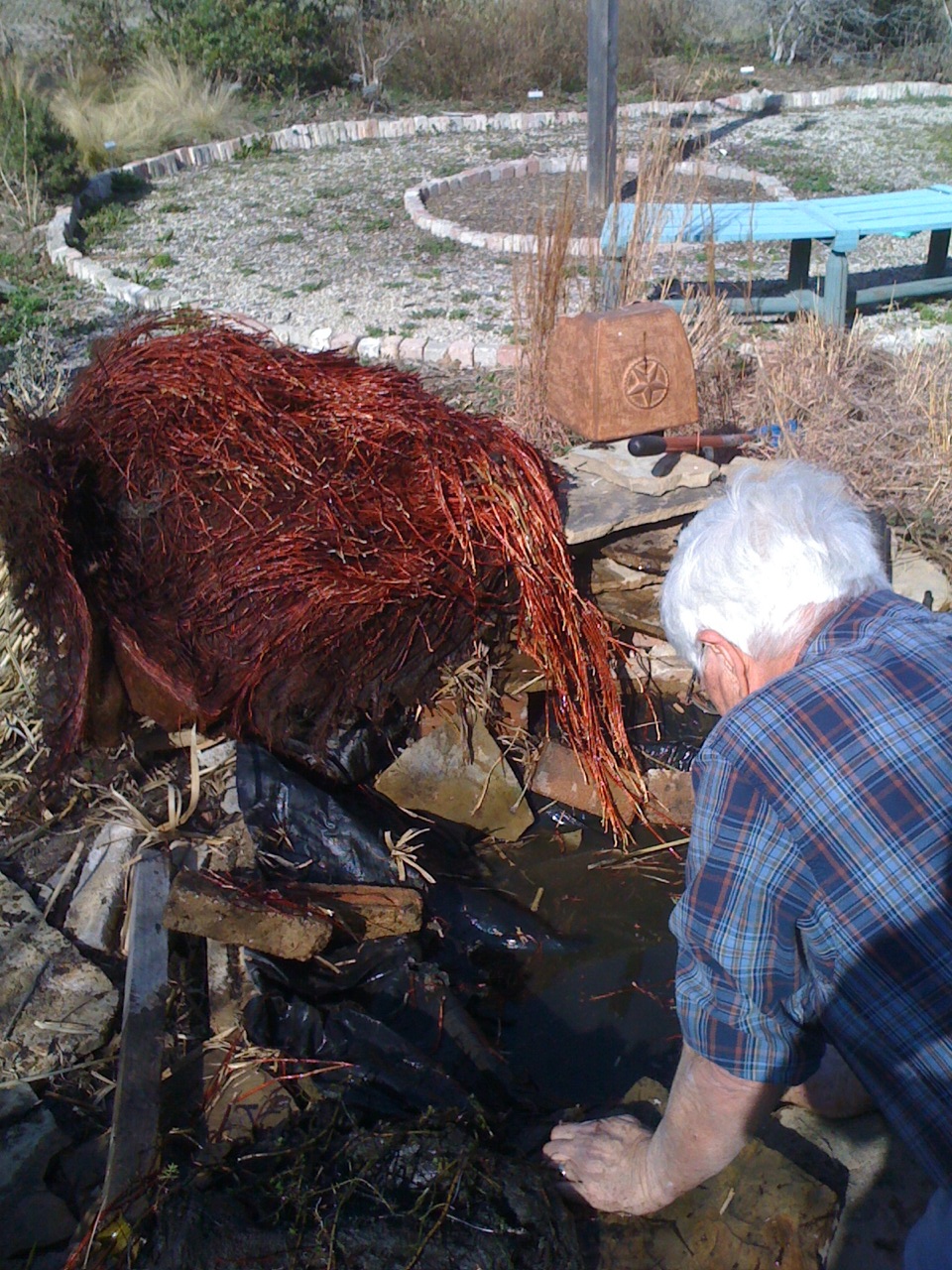
9)  removed the ‘umbrella’ plant from pond – BIG job

10) divided and planted most of the huge papyrus plant

11) removed water lily pots, bailed nasty water from the pond and remove the damaged pond line

12) will dig pond deeper, but not bigger and will decide what type of liner to use

We had a very good day.

Above: Cleaning out the Pond, Red Roots Belong to our Papyrus to be Divided

Above: Cleaning out the Pond, Red Roots Belong to our Papyrus to be Divided

Jim

Pictures by Kim and Michele

For more about our pond click here.

Tomorrow: More about that lovely little plant in the box at the top of the page-Nasturtium.

Rose pruning….

It takes a fearless person to prune a rose.  Brandishing its protective thorns, the row of leafless bushes awaits us like the vicious magical Whomping Willow in the Harry Potter series, ready to throw us to the winds.

Armed with loppers, protected with elbow skimming rose gloves—the closest I’ll ever come to Mia Farrow’s favorite length—we faced the prickly branches.

Where to start thinning? Like a yoga chant, the rules started running through one’s subconscious: thinner than a pencil, rubbing, main canes…

Gradually the spindly support of last year’s blooms was cast aside, a faint memory of last May’s flush of happy blossoms.  Old rubbed canes fell to stronger green upstarts.

Eventually, a bare skeleton emerged from the entanglements, a garden star ready for its next act: its primadonna performance in the dance called Spring.

Elizabeth

Brush up on rose pruning tips here with Mariana Greene of the Dallas Morning News.

Hearts and Roses Luncheon and Lecture

Click. Click. “Oh, look at that one!”  Click. Click. “Oh, wow!” Click. Cli—Wait is this the Olympic games in Sochi?

No, it’s a bunch of lucky gardeners falling in love with roses.  Well, the first couple of rose pictures had rose expert Vicki Agee a little perturbed; seems her vibrant red roses were coming up blue on the power point.  Jim sprinkled a little fairy dust on the computer cable, and voila! The rose colors were correct, and the audience was entranced.   Vicki, who is also a Dallas County Master Gardener, spoke Tuesday at the Hearts and Roses luncheon held at the Demonstration Garden.

Above: Hearts and Roses Lunch and Lecture, 2-11-54

Above: Hearts and Roses Lunch and Lecture, 2-11-54

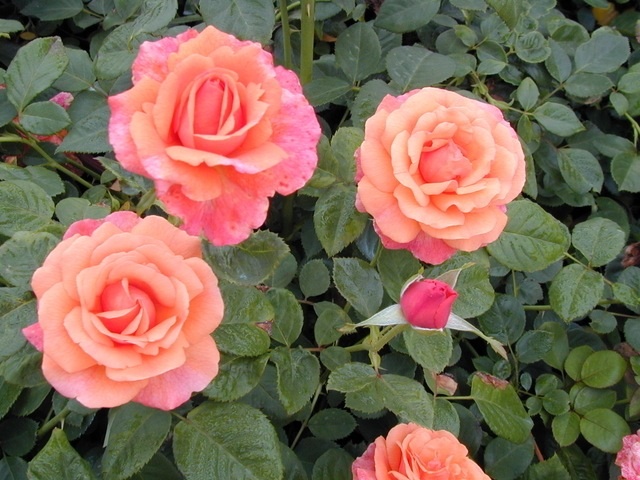
The rose world has changed dramatically, Vicki told us.  Breeders are adding many lovely, disease resistant, fragrant roses for the home market.   Look for shrub roses like floribundas and grandifloras, Vicki suggests. She recommended ‘Easy Does It,’ ‘Walking on Sunshine,’ ‘Pretty Lady,’ and ‘Lion’s Fairy Tale.’  Does anything smell better than a rose? For especially fragrant roses, choose ‘Francis Meilland,’  hot pink ‘Beverly,’ pink ‘McCartney,’ or pink ‘Deelish.’

'Easy Does It'

‘Easy Does It’

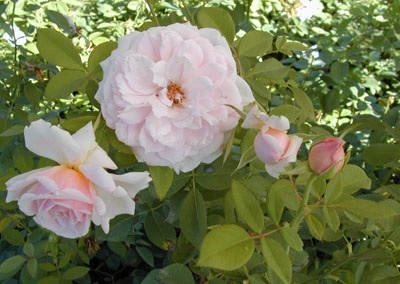
She also loves an old favorite Buck rose named ‘Quietness;’ its pale pink blooms mask its tough resistance to black spot.  Easy Elegance roses, Austin roses, Flower Carpet roses, and old favorites like ‘Mr. Lincoln’: the beautiful varieties made my head spin.  I wanted one of each.

'Quietness' Rose, a Dr. Griffith Buck Rose

‘Quietness’ Rose, a Dr. Griffith Buck Rose

Vicki also knows how to take care of her roses.  For fungal diseases like black spot use Neem oil for your first spray of the season.  Then spray spring and fall with a product like Banner Max or Honor Guard that contains Propiconazole.  Once temperatures reach into the 90s, stop spraying until fall.

Vicki suggests using Spinosad for thrips, because stronger sprays will also kill beneficial insects and butterflies.  Use a miticide like Floramite, Forbid or Avid for spider mites.  Pyrethrum takes care of cucumber beetles.  Fertilize with Texas T in the spring, and once roses have leafed out, use seaweed fertilizer every 2-3 weeks.  After late summer pruning, foliar feed your roses through October for maximum bloom.

An online bouquet of roses goes to Vicki for her wonderful talk and tips on a frosty February morning.  I know I wasn’t the only gardener who found new favorites to add to their flowerbeds.

Elizabeth

Picture of lecture by Starla

Our thanks to Chamblee’s Roses for permission to print from their website.  Click here for Chamblee’s Roses.

If You Feed Them, They Will Come

Though the Demonstration Garden doesn’t consistently put out food in our bird feeder since DCMG volunteers are not present at the Garden every day, within a very short time after the Garden’s feeder was filled, Starla, our talented Garden Buzz photographer, captured these pictures of Red-winged Blackbirds, Sparrows, and Brown-headed Cowbirds, feasting on the seeds.

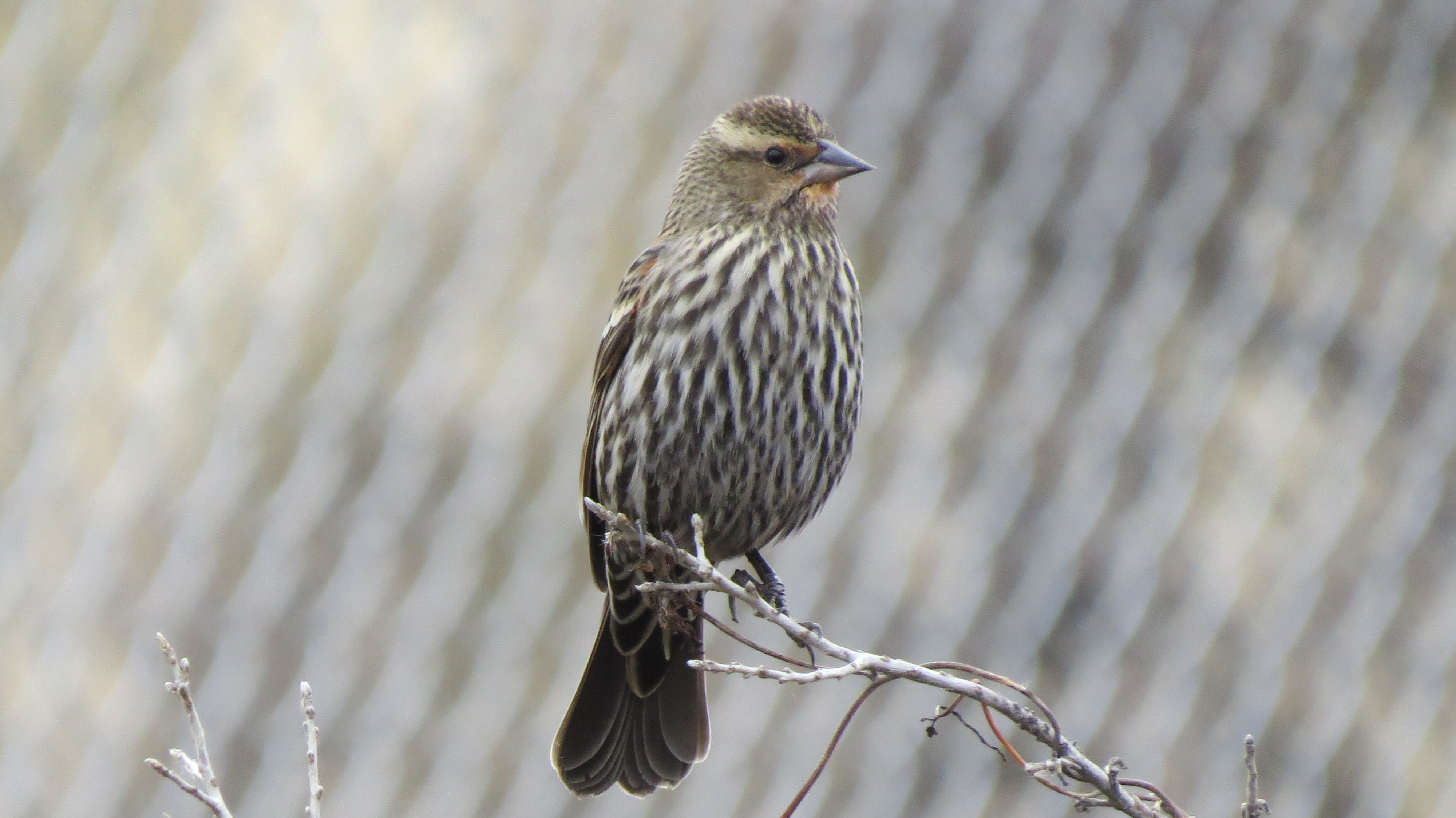
Red-winged Blackbirds are some of the most abundant birds in North America. The Red-winged’s count was estimated at 190 million in the mid-1970s. The male Red-winged Blackbird proudly displays his distinctive red shoulder patches, or “epaulets” when flying or displaying.  When resting, the black male shows a yellow wing bar.  The female Red-winged Blackbird is much drabber and has a streaked feather pattern.  Blackbirds are omnivorous and will eat both seeds and insects.  Though they tend to build their nests in fresh and saltwater marshes, in winter they can be found in fields and pastures.

Above: Female Redwing Blackbird at our Feeder

Above: Female Redwing Blackbird at our Feeder

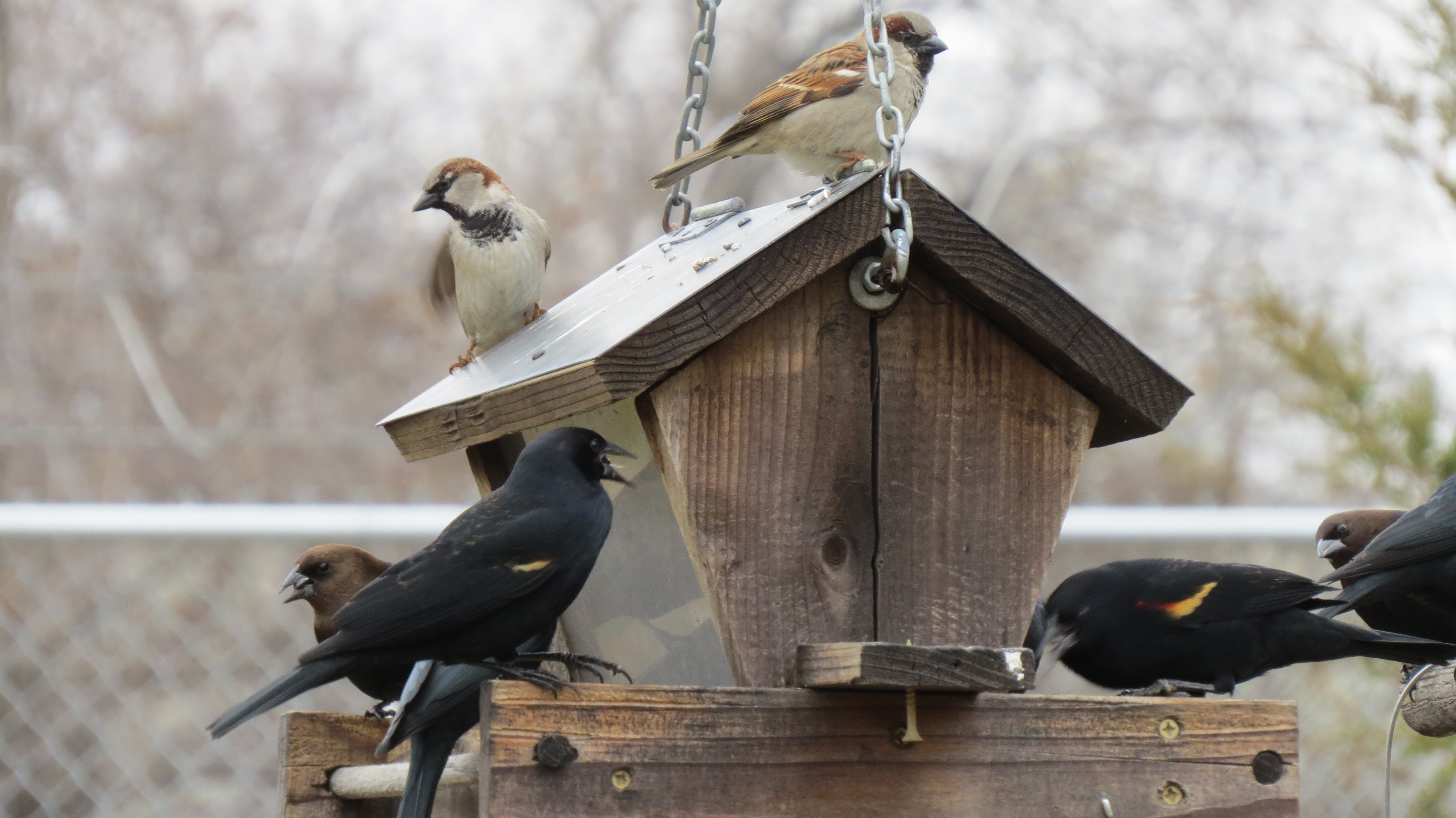
Brown-headed Cowbirds are a species of blackbirds often found among flocks of Blackbirds and Starlings feeding on the ground.  They can be recognized by their shorter tail and thicker neck than most blackbirds.  They also have a rich brown head that sometimes looks black in poor lighting.  Females do not build nests but instead lay their eggs, sometimes as many as three dozen a year, in the nests of other birds, These foster parents will raise the cowbird chicks as their own.  However this is often at the expense of some of the parent’s natural chicks.

Above: Blackbirds, Brown Headed Cowbird, and Sparrows at The Demonstration Garden Feeder

Above: Blackbirds, Brown Headed Cowbird, and Sparrows at The Demonstration Garden Feeder

Sparrows, of course, are the most familiar of all wild birds.  They have adapted easily to the urban environment and are found throughout all of North America.  They too are omnivorous and will eat both insects and seeds.   At backyard feeders, they especially like to eat millet, corn and sunflower seeds, all of which are often found in seed mixtures.

If you are interested in learning more about birds and identifying the birds you might find at your feeder, there are many sites on the internet (the Cornell Lab of Ornithology is one) www.allaboutbirds.org that can be used as field guides for identification and behavior.  Some sites, such as the Cornell website, even have audio recordings of bird calls so you can identify a bird just by its sound.   In winter, though birds have throughout the ages managed to survive without supplemental feed from humans, as Starla said about the number of birds that quickly came to the Garden’s feeder:  “They were super appreciative of the feast.”

Carolyn

Pictures by Starla

Winter Honeysuckle

It’s nice to have something blooming in February and it’s nice to have friends like Texas Discovery Garden.

We had all gathered around our Winter honeysuckle to inhale its lovely scent and had questions about this plant.

Winter Honeysuckle Blooming Late January through February at the Demonstration Garden on Joe Field Road

Winter Honeysuckle Blooming Late January through February at the Demonstration Garden on Joe Field Road

Roger, featured in another of our posts, answered:

Ann,

Roseann had forwarded me your e-mail yesterday and I hadn’t realized until then that ours too is in bloom now!  I had gone out to check on it and never got back to respond.

As you already know it’s a non-native (E. China)so might be discouraged by some purists for planting.  Although it is listed as “invasive” by some sources, most gardeners would disagree, as it doesn’t produce many berries and only suckers for a short distance from the bush.  Perhaps in the moist woods of eastern U.S. it might escape cultivation, but doubtful here in our fairly dry habitat.  Probably it has received a bad rap from its many relatives – like the highly invasive Japanese Honeysuckle which is a VINE or Amur Honeysuckle, a bush that used to be fairly invasive in this area.

Anyone that would rather not try it, might try the native White Honeysuckle (Lonicera alba) that has very similar leaves and not quite so bush-like.  I’m not sure of its bloom time, but it probably doesn’t produce the profusion of strong scented flowers this early in the season like the Winter (or Fragrant) Honeysuckle.

As a landscape plant, it apparently is not picky as to soil type and is relatively drought tolerant.  It does have some other distinct benefits for a North Texas landscape.  The flowers this early in the season do provide a rare nectar source for bees and butterflies that venture out on warm days during the winter months (Question Marks, Goatweeds, and Mourning Cloaks are local butterflies that overwinter here as adults).  It is supposed to be an excellent bird attracting bush according to some sources for the berries.  But since ours rarely fruits, it is often the flowers that attract the birds!  They apparently eat the flowers for the nectar and spit out the petals.  One interesting comment I read is that it is sometimes referred to as “Pouting Flower” as the paired flowers face in opposite directions!

Thanks for asking about this!  I needed to write something for my weekly “In The Garden…” part of TDG’s blog, so I’ll just copy what I wrote to you!  Naturally, Roger

Roger Sanderson
Director of Horticulture

Texas Discovery Gardens
at Fair Park
3601 Martin Luther King Jr Blvd
Dallas, Texas 75210
P.O. Box 152537
Dallas, Texas 75315
P (214) 428-7476 ext. 210
F (214) 428-5338

RSanderson@TexasDiscoveryGardens.org
The butterflies are back!

Picture by Starla

Variegated Maiden Grass – Miscanthus sinensis ‘Morning Light’

Take a look with us at one of our beautiful ornamental grasses, Miscanthus sinensis, “Morning Light’.

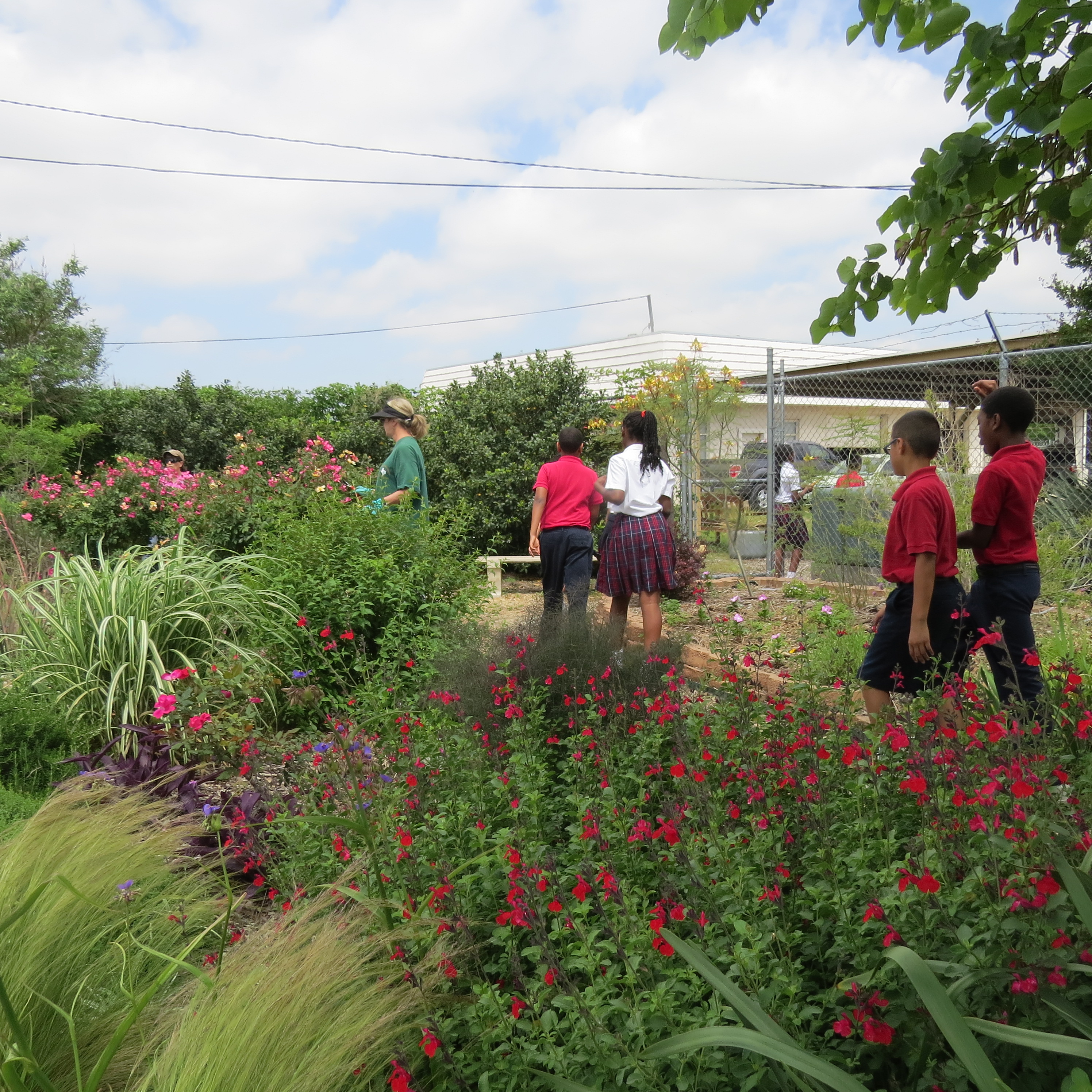
Above: Mutablis Rose, Miscanthus, Mexican Feather Grass,and Salvii gregii in our spring garden.  Don't you like the way the children's uniforms compliment the garden colors?

Above: Mutablis Rose, Miscanthus, Mexican Feather Grass,and Salvii gregii in our spring garden. Don’t you like the way the children’s uniforms compliment the garden colors?

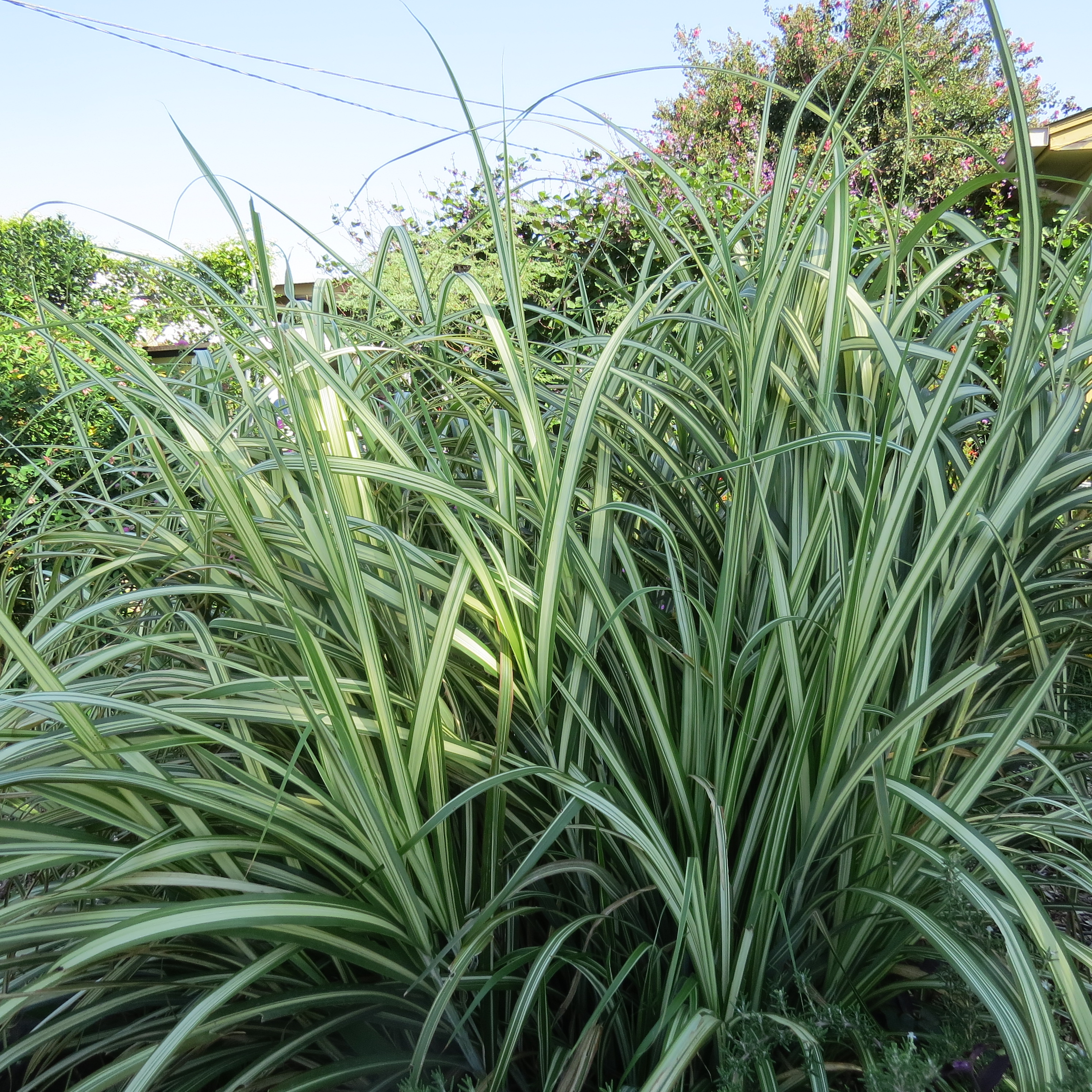
In the summer its variegated leaves glisten.

Above: Summer time view of Miscanthus Morning Light

Above: Summer time view of Miscanthus Morning Light

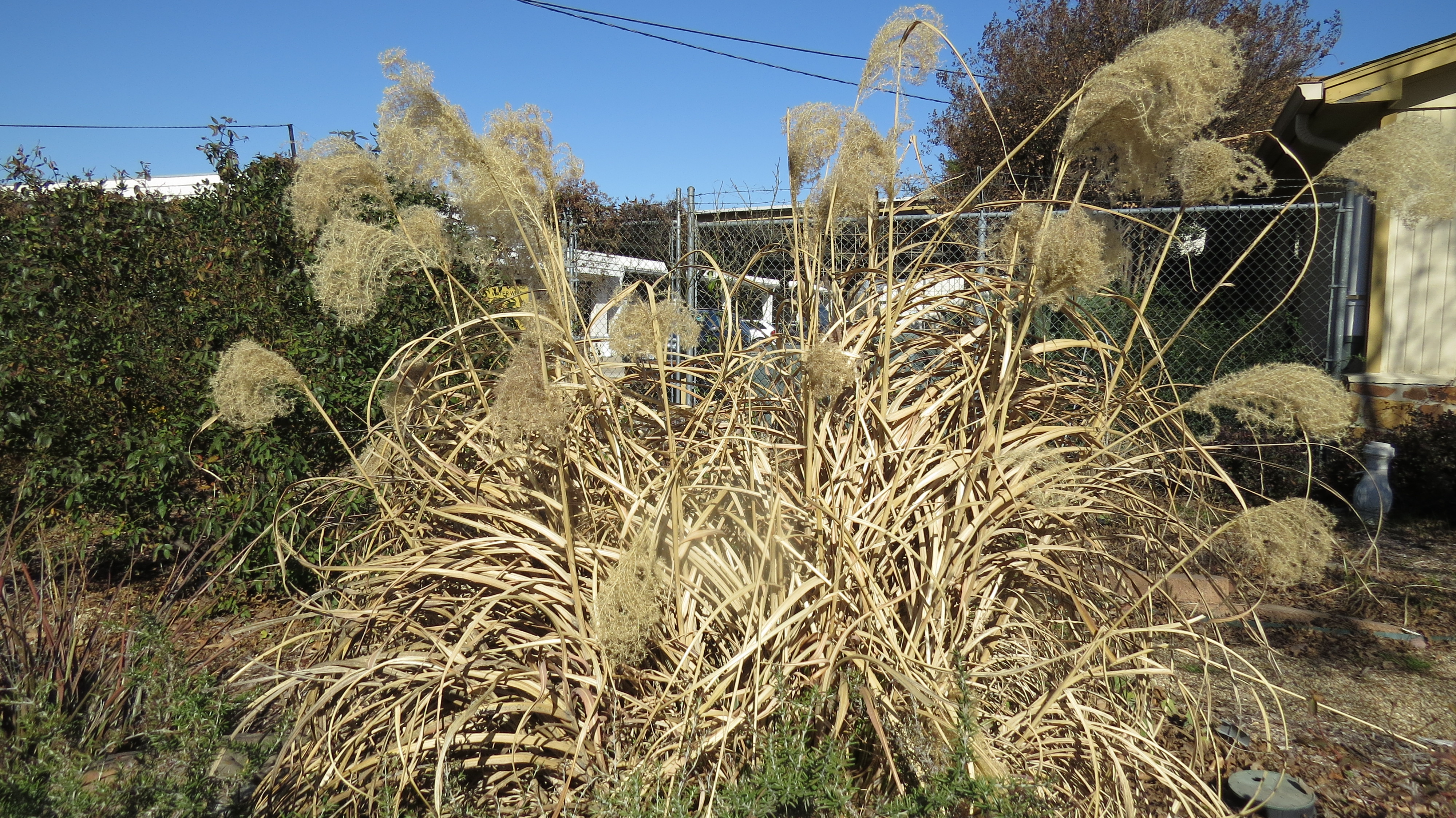
In the Winter the grass turns brown and brightens the sky with its tawny panicles.

Above: Winter Version of Miscanthus

Above: Winter Version of Miscanthus

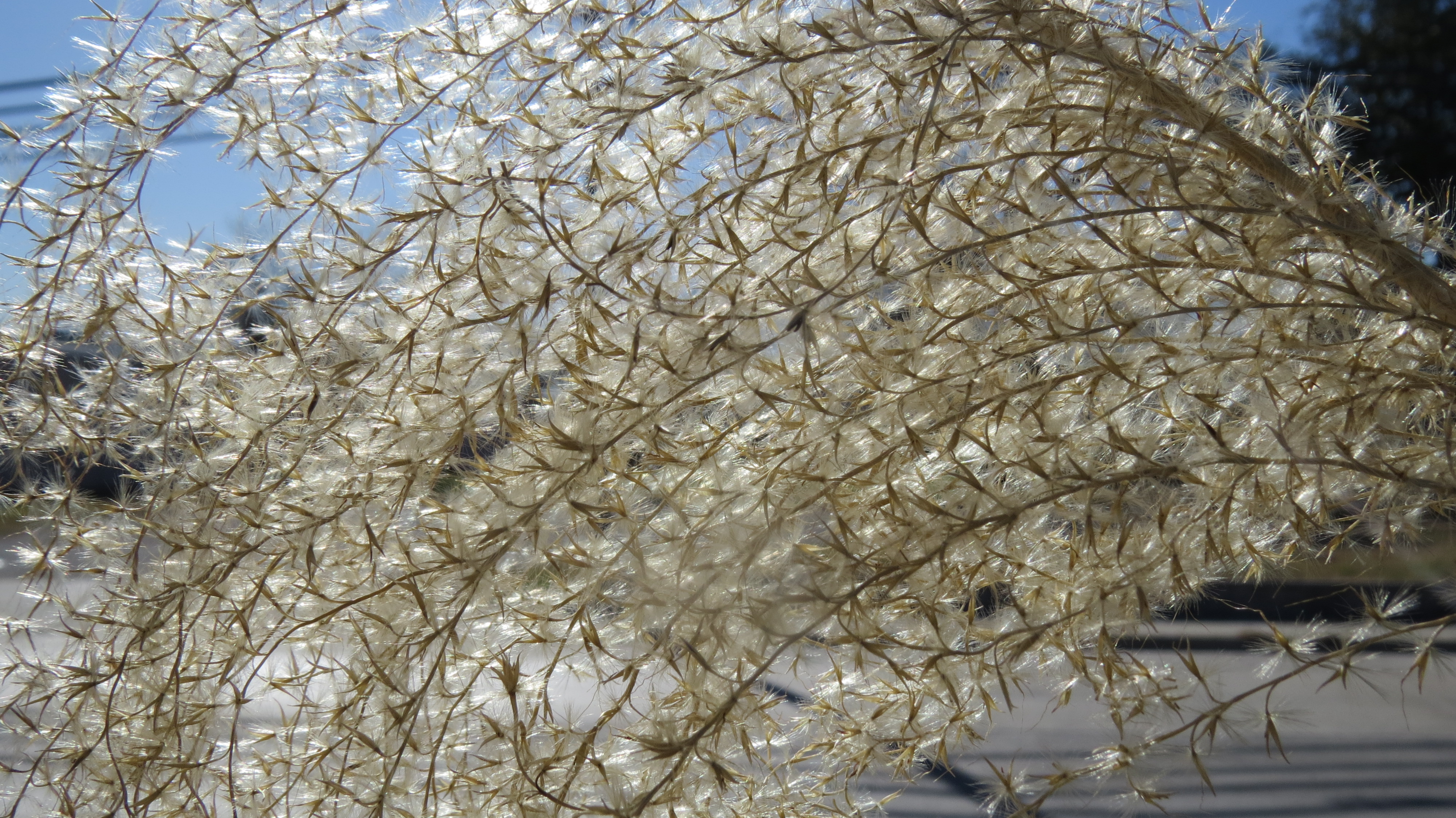
The panicles glow in morning light.

Above: Wintery Miscanthus Panicles

Above: Wintery Miscanthus Panicles

Alas, there is a season for everything and even grasses must be sheared.

To learn more about a new grass pruning method click here.

And don’t grow weary, Morning Light will come again.

Ann

Pictures by Starla

The Lowly Onion

Because of their circle within a circle anatomy, the Egyptians considered them to be the symbol of eternal life, and they buried them along with their dead.  The Greeks, on the other hand, used them to increase the strength and endurance of their athletes before the Olympic Games.  Throughout the ages they have served as food and medicine for both the poor and wealthy.  What is this ancient vegetable?  The lowly onion, of course.

Above: Dallas County Master Gardeners-Cindy, Tim, and Linda with our onions harvested in 2013

Above: Dallas County Master Gardeners-Cindy, Tim, and Linda with our onions harvested in 2013

Onions (Allium cepa or bulb onions) are thought to have first originated in Central Asia or perhaps Iran and Pakistan at least 5000 years ago.  Our earliest ancestors probably ate wild onions and gradually started cultivating and domesticating them since onions are portable, easy to grow, prevent thirst, and could be dried for times when food was scarce.  To the Romans, the onions’ medicinal qualities included to cure vision, induce sleep, and heal mouth sores, dog bites, toothaches, dysentery, and lumbago.  In the Middle Ages their antiseptic qualities were thought to cure snake bites, alleviate headaches and prevent hair loss.  In North America, despite the abundance of wild onions consumed by Native Americans, the Pilgrims in 1648 planted bulb onions as soon as the ground could be cleared.

Today it is estimated that the per capita consumption of onions in the United States is over 20 pounds a year.  The onion is also the official state vegetable of Texas.    If you want to grow onions in North Texas, Jan. 1-Feb. 15 is the time to plant them.  Onion varieties are generally divided into three major categories:  long day, short day and intermediate day onions.  Dixondale Onion Farm in Carrizo Springs, TX, stresses that when selecting onion varieties “the size of the onion bulb is dependent upon the number and size of the green leaves or tops at the time of bulbing.  For each leaf, there will be a ring of onion.  The larger the leaf, the larger the ring will be when the carbohydrates from the leaves are transferred to the rings of the bulb.  The triggering of this transfer or bulbing is dependent upon day length and temperature and not the size or age of the plants.  When selecting your onion varieties, remember that the further north you are, the more hours of daylight you have during the summer.”  The onions that can be grown in Dallas County are those varieties found in the short day and intermediate day category.  This, unfortunately, eliminates some of the “specialty” onions found in some seed catalogues; however there are still white, red and yellow onions that do well in here.  Most garden centers carry onion slips that are selected for our area or go to the Aggie-Horticulture website  to see a list of recommended varieties.

Onions prefer a loose, well drained soil and should be planted 4-6 weeks before the last spring freeze.  To grow larger onions, they can be fertilized with a synthetic or organic fertilizer that has a larger middle number, such as 10-20-10 when they are first planted.  After the original planting, they can be fertilized with ammonium fertilizer (21-0-0) in alkaline soils or calcium nitrate (15.5-0-0) in acidic soils about every 2-3 weeks, if desired.  Stop fertilizing once the onions start to bulb.

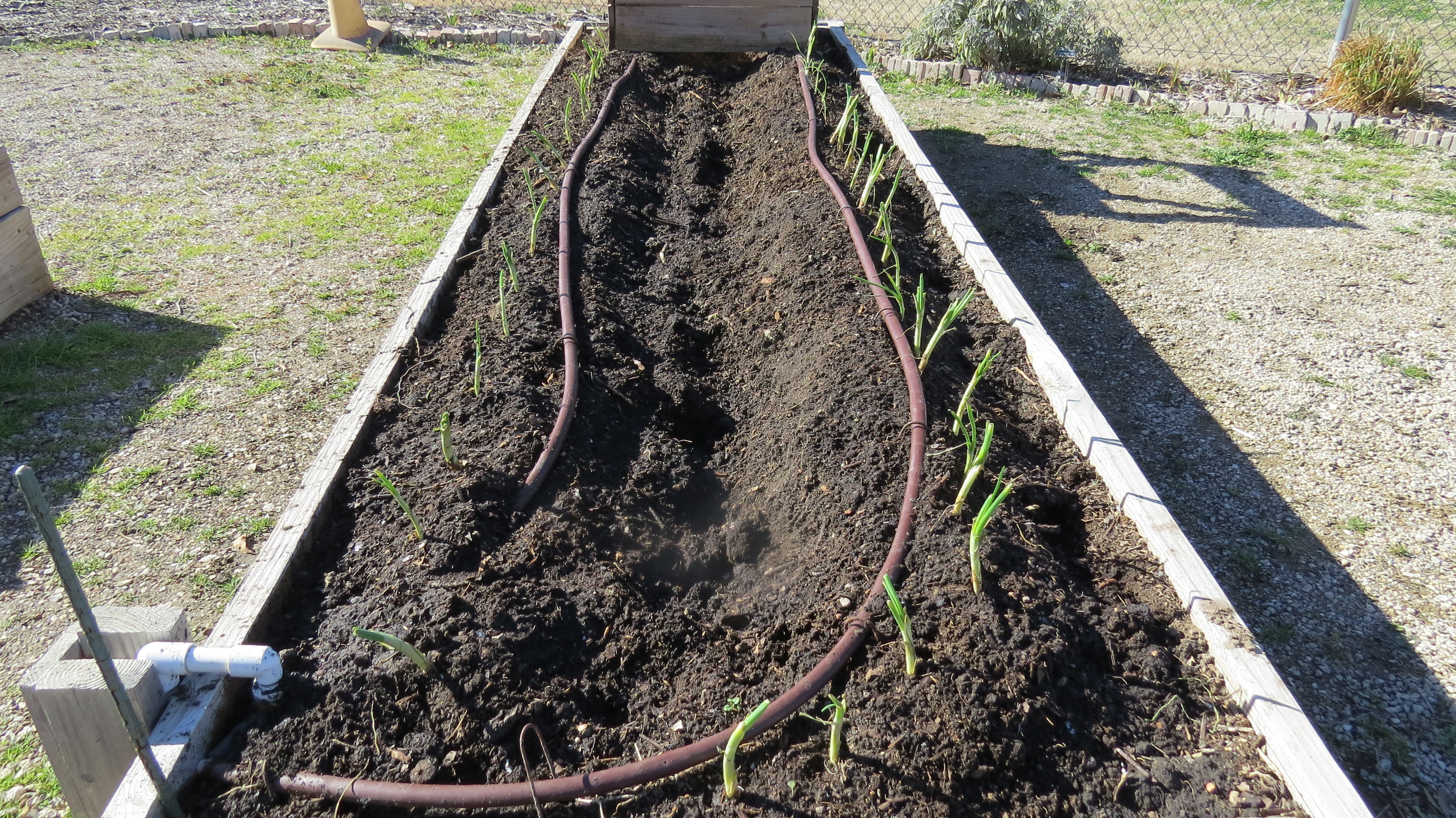
Above: Onions planted at The Demonstration Garden on Joe Field Road in 2014.

Above: Onions planted at The Demonstration Garden on Joe Field Road in 2014.

Plant the onions slips one inch deep and no deeper as their ability to form a bulb will be compromised.  Onions grown to maturity should be planted about 4 inches apart; however, if green onions are desired, the onion slips can be planted about 2 inches apart and every other one pulled for green onions.  Water thoroughly and regularly until the tops turn brown or yellow and fall over, then cut back on water.  At this point a fully mature onion should have about 13 leaves.

When they are harvested, dry them thoroughly for several days to avoid problems with rot.  The entire neck (where the onion meets the bulb) should be dry and not “slip.”  Once the onions are dry, clip the roots and clip the top to 1 inch.  Store them in a cool, dry, well-ventilated location if not consumed right away.  Any onion that shows signs of rot should be removed immediately.  In general, according to Dixondale, sweeter tasting onions do not store as long as the more pungent types.

So, plant yourself some onions—and Bon appetite !!

Carolyn

More about onions click here and for onion recipes click here!

Hearts and Roses Luncheon

rose-demo garden“Hearts and Roses”

An Enchanting Valentine’s Lunch and Lecture

At the Joe Field Earth-Kind/®WaterWise Demonstration Garden

Tuesday*February 11, 2014*11:00am

$14.00 per person*Limited to 25 Guests

Menu 

Apricot-Cheese Truffles

Strawberry Spinach Salad with Poppy Seed Dressing

Old-Fashioned Chicken and Dumplings

Chocolate Boxes filled with Sugared Raspberries or Red Velvet Cake

Vanilla Cinnamon Pecan Coffee*Herbal Iced Tea

***

Special Presentation by Vicki Agee, Dallas County Master Gardener and Rosarian

“Landscaping with Roses” (Earn One Hour Education Credit)

  Your check is your reservation.

 Make checks payable to: DCMG.

 Email dallasgardenbuzz@gmail.com for info about mailing your check.

Payment must be received by February 1st


Starting Seeds Indoors-A Contest!

Mnemonics and memory prompters are a good way for gardeners to remember important facts and dates. 

Around Valentine’s Day, February 14?  Time to prune your roses.

Do you have a better way of saying, other than “Treat Seeds With Loving Hands,” the five critical elements for growing successful transplants discussed in yesterday’s post?  If so, please let us know.

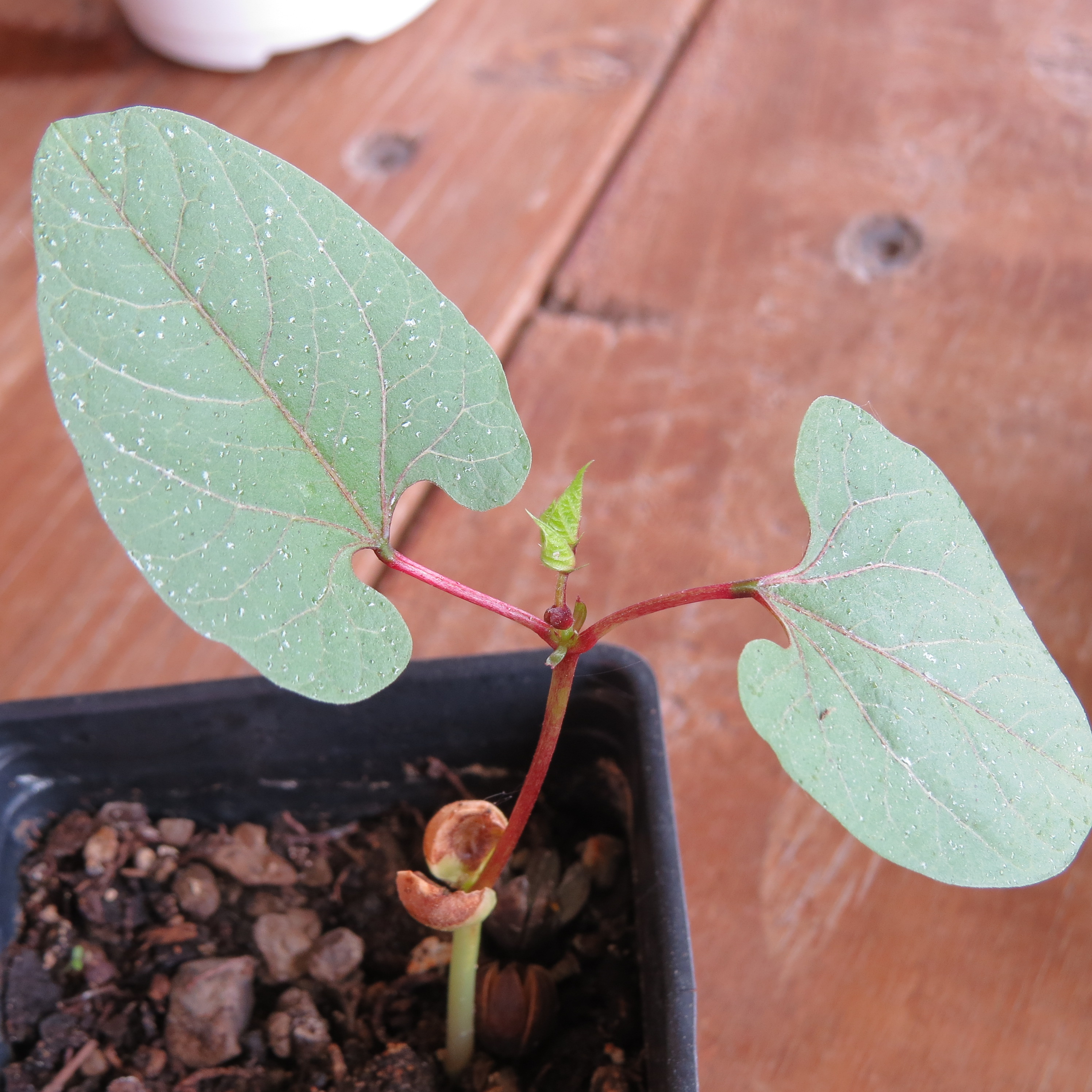
Above:Hyacinth Bean Vine Seedling Ready to be Transplanted

Above:Hyacinth Bean Vine Seedling Ready to be Transplanted

As Ann , the Demonstration Garden’s coordinator, said “There is a lot of interest in gardening but so little real depth of knowledge.  I think of some of the things I hear at the garden centers when I am shopping and feel so bad that plants and seeds are going home with very little chance of survival.  Young gardeners are so handy on the computer but not always in the dirt.  Maybe we can help with that.”

So, put on your creative gardening hat and let us know your suggestion for a way to easily remember the five  elements for successfully starting transplants from seed. The best suggestion, as judged by several of the Joe Field  gardeners, will receive  5  packets of seeds collected from our Demonstration Garden.

Help us teach the general public how to easily remember how to germinate seeds.

Carolyn

Picture by Starla

Seed Starting Indoors

Treat Seeds With Loving Hands

     It’s that time again when a gardener’s mailbox is filled with tempting seed catalogues; and the dreary winter days of January and February give rise to dreams of spring’s colorful flowers and bountiful vegetable gardens.  For those gardeners who want to save money, or may be interested in trying a new variety of plant not found in local nurseries, or who enjoy the educational challenge of growing plants from seed, January and February are the times to start sowing your seeds indoors.

So what are some critical pointers to follow when starting plants from seeds?  Perhaps a mnemonic phrase will help.  As any botany student recalls, two ways to remember the classification of plants from Kingdom to Species are:  “King Phillip Came Over For Good Spaghetti” or “King Phillip Came Over From Gloria Spain.”

To remember the important considerations when germinating seeds, perhaps the mnemonic, Treat Seeds With Loving Hands will help.

Treat Seeds With Loving Hands

Treat Seeds With Loving Hands

     T  =  Timing :  The back of all seed packets contains a lot of information about the plant:  how deep to plant it, days to harvest, etc.  It also usually gives a general recommendation on when it is safe to plant the seeds outside (after the last frost, for example).  Therefore, if you desire to get a head start on growing plants from seeds, most flower and vegetable plants require about four to eight weeks of growing time before transplanting successfully into the garden.  Counting back from when the seeds are recommended to be planted outside will give one the approximate time to start seedlings indoors.

S  =  Soil  :   A soilless medium in which to start seeds is a must.  Garden centers sell seed starting mixtures that are sterile, light, and drain well.  You can also find recipes on the internet to make your own mixture.  However, the important thing to remember is to not use ordinary garden soil to start your seedlings.  Not only does it often not drain well, but it harbors pathogens that can infect the seedlings.  “Damping Off,” a common fungal disease, is bane of any gardener germinating seedlings indoors.  The use of a soilless, sterile growing medium may help prevent this.

Above: Michele using soil mix for seed starting

Above: Michele using soil mix for seed starting

W  =  Water  :  Just a realtors talk about the importance of “location, location, location,” “drainage, drainage, drainage” should be the motto of gardeners.  Seeds may be started in any type of containers, from commercially available seed starting kits to recycled plastic containers.  Just remember, if you are recycling old pots or plastic containers, that they must have adequate drainage holes and they should be sterilized in a dilute mixture of water and bleach.  After the seeds are planting to the correct depth in the soilless medium, very gently water them to thoroughly wet the soil (a spray bottle works well for this), cover with plastic, then place the containers in a warm place (some people put them on top of the refrigerator).  As soon as the seeds germinate, remove the plastic cover and move to a light source.  Keep the soil damp, but do not over water as this may encourage diseases.

L  =  Light  :  Along with drainage, light is the most critical part of growing successful, bushy transplants.  Growing plants on a window sill that gets only a few hours of direct sunlight will often result in failure or, at best, spindly plants.  In general, seedlings need 16-18 hours of light a day to grow into lush, healthy transplants.  Greenhouses with supplemental lighting and heat can be used, or you can purchase commercially made light stands.  There are also many instructions on the internet and magazines on how to make do-it-yourself light stands.

H  =  Hardening Off  :  As the little seedlings outgrow their pots, keep moving them into gradually larger pots using potting soil as the mixture.  If the potting soil does not contain fertilizer, a little slow release fertilizer, either synthetic or organic, can be added to the soil.  Since the plants have been “babied” indoors, gradually start introducing them to the outside temperatures and conditions about one to two weeks before transplanting them to the garden.  Start hardening them off in a protected, shaded area and gradually leave them outside for longer times.   Depending on the weather, they may need to be moved in and out of the house until the correct time to plant them in the garden.   If you remember to Treat Seeds With Loving Hands, your transplants should be off to a successful start.  Happy Seeding !!

Carolyn

Pictures by Starla

More Seed Saving Information Here:

Separating the Seeds From the Chaff

Seed Saving: It’s a Good Thing