Thank you, Maddie Shires!
Video by Starla Willis
This is a KOAN or paradoxical thought koans are used to open the mind so new ways of thinking can find room. So will it work?? It’s worth at least a try.
The first part is easy. No matter what one’s belief system, there surely have been warnings of the danger inherent in a reliance on earthy possessions.
The second part—A weed is a treasure—That does seem to require an open mind and a new way of thinking.
How can it be that a weed becomes a treasure?
The first step—get into the garden and get to work. Already the gardener is reaping benefits both physical and mental—looking for weeds just cannot be done from a distance.
Finding weeds develops the mind—each green thing must be evaluated—remember self-seeding annuals and baby perennials are there too so care is needed. Learning to identify plants is a valuable skill—now you have more to share with others!
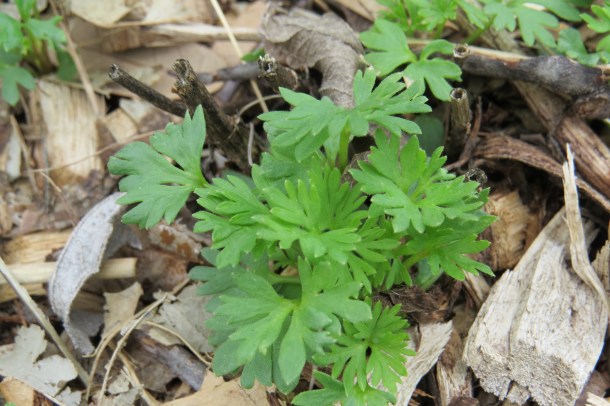
Larkspur is a self seeding annual, so it gets to stay!
Careful garden work can reveal when a plant has taken more than its fair share of resources—its become a weed—action can be taken before this overly ambitious plant smothers its neighbors.

Henbit, you are crowding verbena. You must go!
When a weed is removed space and water and nutrients are now available for another plant to thrive.
While looking for weeds—don’t forget to look around—at weed level beautiful tiny things are seen that would be missed otherwise.
The gardener sees the space become more beautiful—what a happy sense of accomplishment that all started with seeing a weed. So maybe weeds are more like TREASURE MAPS. Valuable because they lead us to see what can be done to make our spaces beautiful.
Susan Thornbury
Pictures by Starla
|
Maddi Shires, graduate student, Texas A&M University, will be at Raincatcher’s Garden of Midway Hills Shade Pavilion (north garden) on Tuesday, March 13th, at 10am to bring us an update on Rose Rosette Disease plant trials, research and recommendations and to help us plant some new roses in our research plot, which have been bred for potential resistance to the disease. She will also show us what to look for when identifying the disease, which we believe has affected additional roses in our trial rose bed. Maddi works with Dr. Kevin Ong, an Associate Professor and Extension Plant Pathologist who directs the Texas Plant Disease Diagnostic Laboratory, a service lab of the Department of Plant Pathology and Microbiology at Texas A&M University in conjunction with Texas A&M AgriLife Extension Service (http://plantclinic.tamu.edu) Raincatcher’s Garden is on the campus of Midway Hills Christian Church, 11001 Midway Road in Dallas, just north of Royal Lane. Please park in the west parking lot to allow preschool parents use of the north parking area. More information on rose rosette here.
|
|
We have planted 4 varieties of apple trees at The Raincatcher’s Garden. Jim gives us the names of the apples and a lesson in espalier in this utube video.
Tomorrow morning, March 6th between 9 and noon, Jeff Raska will be at The Raincatcher’s Garden to prune our new apple trees and our peach and plum trees. Join us!
Video by Starla Willis
Apple talk by Jim Dempsey
More about out orchard varieties here.
Just when you need it the most, Lonicera fragrantissima, also known as Winter Honeysuckle bursts on the scene with its powerful scent and dainty little creamy flowers.
 The blooms provide pollen and nectar to bees who are foraging on a winter’s day.
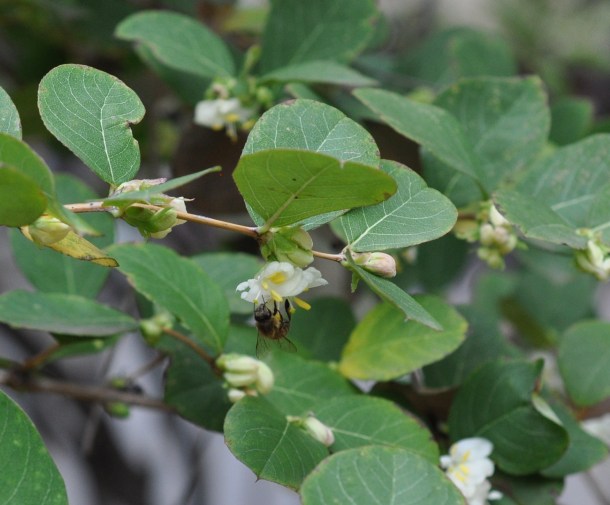 When you plan your garden, get used to including other’s needs, especially our pollinators. Winter can be a bleak time for overwintering butterflies and bees.
Dr. William Welch suggests planting Winter Honeysuckle by a gate so when you brush by it you can enjoy the scent. It can be grown in partial shade or full sun. For a look at it in full sun, click here.
If you arrive early at the next *Texas Discovery Garden sale, you might be able to take home your own small start of this fast growing fragrant bush.
Ann Lamb
*Texas Discovery Garden Sale-April 6-8, 2018
More info about Lonicera fragrantissima right here on Dallas Garden Buzz!
“If you leave a thing alone you leave it to a torrent of change. If a white post is left alone it will soon be a black post” GK Chesterton said that in 1908. He went on to say that it takes constant vigilance just to keep things the same.
Perhaps garden cleaning is not the first thing that comes to mind when reading Mr. Chesterton’s words. Perhaps the healthy eating plan was not carefully followed during the holiday and sadly things did not remain the same.
But now think about the garden. The natural look is wonderful however it actually requires the constant vigilance to maintain. When a few plants overtake their companions and then move on to cover paths and obliterate borders, that is no longer really any look at all. The fact is action is required if a space is to be a garden.

Roger cleaning up the garden and putting fallen leaves to good use by shredding them for garden mulch. Yeah Roger!
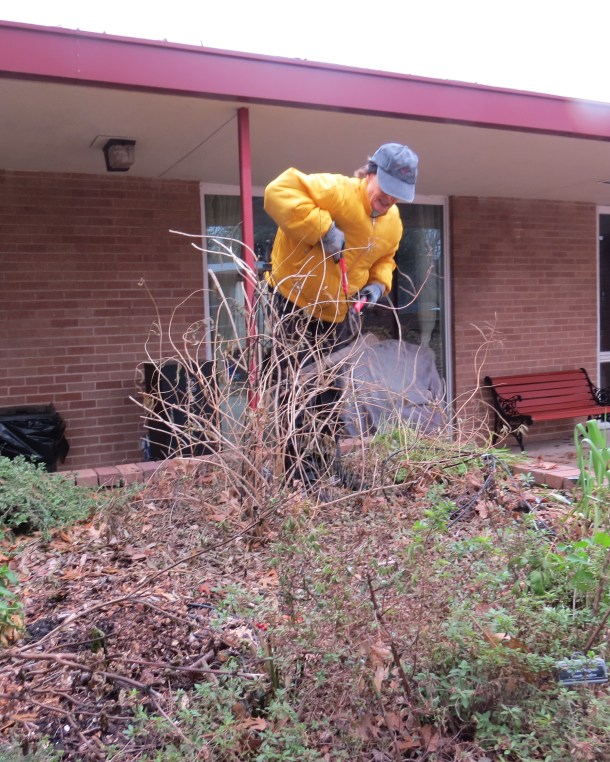 Susan trimming back plants in our herb garden.
So, it is time for garden clean up. It’s a job with no glamour and little thanks but gardeners are tough and the time is NOW.
Susan Thornbury
pictures by Starla Willis
Though curses aren’t usually the words usually associated with seeing beautiful butterflies soaring around your garden, if you are a home vegetable gardener or part of a community garden that donates produce to food pantries, there is one butterfly that you may dislike.

Large Cabbage White Butterfly on Cabbage
No, it is not the butterflies whose larval host plants are dill, parsley and fennel. Many people who have butterfly gardens purposely grow extras of these plants as host plants for the butterfly larva. By following the rule “one for me, and one for the birds and butterflies.” you can have your share and the butterflies/caterpillars can have theirs. However for vegetable gardeners, the sight of pretty white butterflies flitting around members of the brassica family (ex- kale, cabbage, mustard, turnips, etc) can mean only one thing: an invasion of hungry larva caterpillars that will soon damage their crops.
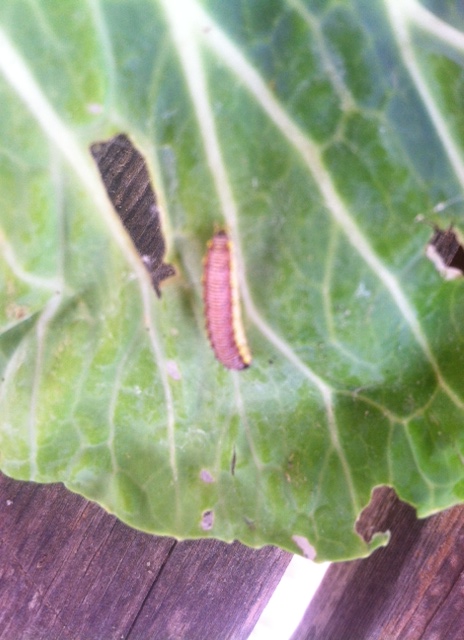
Large Cabbage White Butterfly Larvae, note larvae color is green not pink as this photo shows
Cabbage white butterflies, also known by butterfly-lovers as “summer snowflakes,” are found in two sizes, the Small Cabbage White Butterfly (Pieris rapae) and the Large Cabbage White Butterfly (Pieris brassicae.) The small cabbage white butterfly, though still considered an agricultural pest, is not as voracious a feeder as the Large Cabbage White Butterfly and will be the focus of this article.
The Small Cabbage White Butterfly is found throughout Europe, Asia and North Africa. It was accidentally introduced to Quebec around 1860 and spread rapidly throughout North America. By 1898 it had spread to Hawaii and by 1929 to New Zealand. Often, one of the first butterflies to appear in the spring, it lays eggs on the underside of a leaf. The eggs are laid singly and are yellow making them difficult to spot. The eggs hatch after about five to fourteen days and then the damage to members of the mustard family begins. Using their powerful mandibles, the larva munch holes in the leaves. Sometimes they will even eat into the heart of a cabbage, leaving a shell in its place. The larva then pupate, to start the whole cycle again.
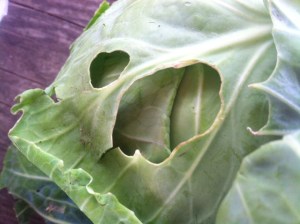
Cabbage Damage Due to White Butterfly Larvae
Thankfully there are safe biological and barrier controls for this pest butterfly. In the mid 19th century the Australian government introduced parasitic wasps to control the damage produced by both species of butterflies. However this approach is only suitable for large commercial growers. There are other insects however that can help. These include ladybird beetles, lacewings, and some species of insect-eating birds. A physical control might include covering the plants with mosquito netting or other barriers. Be sure to secure all the edges.
Perhaps the easiest organic method of control is to use Bt (Bacillus thuringiensis), a naturally occurring bacteria that kills a caterpillar but leaves beneficial insects unharmed. When the caterpillar eats a treated leaf, it will get an upset stomach, stop eating, and die within four days. Just be sure not to apply it in wet weather as the spray will wash off.
By using Bt or other methods of control, you should be able to “have your cabbage and eat it too.”
Carolyn Bush

Good morning, I am sending you this article on an interesting perennial phenomenon from a favorite blog of mine, called Portraits of Wildflowers. You can find it via this morning’s post: The Frostweed, Yes!
We also have several wonderful pictures and write ups about Frostweed on Dallas Garden Buzz. You can find them by using our search or clicking here.
Happy 2018 to all our readers!
Ann Lamb
A few more tips from our gardeners:
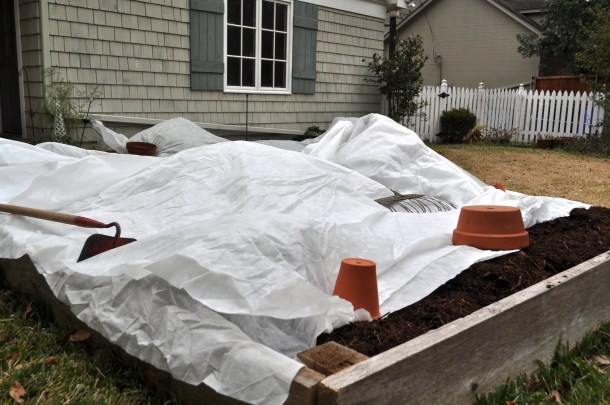
I always cover our variegated pittosporum and cyclamen when it gets down to low 20’s. I use frost cloth now but old sheets have worked just fine in the past. I’ll cover the garlic, radishes and collards in my garden to be safe. Susan Swinson
Water well and cover with frost cloth being sure the cloth is held down but not smashing the leaves–pick some now if it’s at that stage and hope for the best. It’s not too late to replant after the artic blast–must think positive!! Susan Thornbury
Good night garden, stay warm!
 Ann Lamb

A Winter Garden of Black Seeded Simpson Lettuce, Red Sails Lettuce, Rainbow Swiss Chard, Artichoke, Spinach and Broccoli. Frost Cover to be Applied!
Low temperatures are bringing in the new year. You can bet many of us are hoping to protect our winter gardens. Here’s a helpful article to help you prepare!
Ann Lamb



 DALLAS GARDEN BUZZ