Starla and I decided to post a few of our favorite things from past plant sales. Save May 1, 2025 for an extradoinoary plant shopping experience at The Raincatcher’s annual plant sale.
Location: Midway Hills Christian Church ,11001 Midway Road,Dallas, Texas 75229
Thursday, May 1st, 2025
10 AM – 3 PM
Great selection of annuals, perennials, herbs and veggies, succulents and sedums, tropicals and house plants, shrubs and trees, groundcovers, bulbs and irises grown by the intrepid Raincatchers volunteers.
Bears Breeches-the green leafy plant by the japanese maple, a Starla purchase from The Raincatcher’s plant sale.Phlox, John Fanick purchased several years ago-now a hedge of beauty.Scented Rose Geranium-we will have these again this yearVariegated Artemesia, lovely fillerYucca in bloom, this has trippled in size since purchased.This palm and the pot cost $8. It has flourished.
All proceeds go to Dallas County Master Gardener projects.
Thank you for supporting Raincatchers’ Garden.
.
Ann Lamb and Starla Willis, Dallas County Master Gardeners class of 2005 and 2008
Raincatcher’s Garden of Midway Hills 11001 Midway Rd, Dallas, TX 75229 Classroom 1, North Church Building 10-11 AM, Tuesday, February 4, 2025
Join us for a practical and informative class on maintaining your investment in your garden tools taught by Tim Allsup, an experienced and knowledgeable garden volunteer.
Rusted clippers? Dull loppers? Broken shovel handle? Tim can help you learn how to repair, restore and protect your tools in anticipation of spring garden tasks ahead.
To find the class, please enter the Midway Hills Christian Church campus from the south drive, follow the signs and park in the west parking lot. Enter the south building through the courtyard. The Community Hall is on your right.
Lisa Centala, Dallas County Master Gardener Class of 2010
The first week of January was warm—high temperature in the 60’s, maybe even higher. But, this is Texas. Give it a little time and the weather will change.
Weather reports started warning of incoming weather –COLD TO VERY COLD.
And, our tomatoes are still blooming and setting fruit, but not ripening. What should we do? In the past, we’ve harvested the green tomatoes and put them in a cool dark place (under the bed was one suggestion) or we could just let them freeze and use them in the compost bin.
We had five plants. I remembered one year Dorothy Shockley, a fellow Master Gardener at Raincatcher’s RED Garden had inviterd us to her home to take care of that year’s abundant crop of green tomatoes. She had a recipe for B&B CHOW CHOW (also know n as Cool Point Relish in Louisiana). It was the same pickled green tomatoes I had eaten with my fried catfish years ago, but never knew how to make it. Dorothy shared her recipe and I dug it out of my files.
When Roger & I started picking, we didn’t know if we would have enough green tomatoes to make a batch. Not to worry—we had 10 pounds of varying sizes, some beginning to blush, but most were green rocks.
Cindy and green tomatoes!
We went to the store to purchase the rest of the ingredients: onions, jalapenos, white vinegar, more sugar, canning lids. I already had jars and rings in the pantry.
After a couple of false starts at preparation (I’m not as young as I used to be) we got our batch of chow-chow jarred and ready to refrigerate .We even saved the excess picking solution per Dorothy’s recommendation to use with cucumbers and other salad ingredients.
Personally I like this solution better than lemonade.
Bon Appetite!
Cindy Bicking, Dallas County Master Gardener Class of 2006
Here we are in January–its cold and can be dark and gloomy. So how to appreciate it?
January is named for the great Roman God Janus. This God could look to the front and to the back–seeing both the past and the future–thats a lot right? But really his powers were far greater. Janus was a God of practical importance. When asked by mere mortals assistance could be given to turn dreams into reality. Janus had the power to help the followers to see and understand what actions were needed to recognize an abstract goal and take the necessary actions to make it real.
There seem to have been other powers but those seem quite enough for us to think about in this time of the year that can seem a bit bleak.
In fact it seems very possible that Janus was fond of gardening and was able to use the powers to make gardeners happier.
Well it is hard to say it was all a very long time ago now–but some things don’t change. We want things to be brighter and more cheerful. we know we can’t just wait for it to happen–its up to us–we are going to have to be inspired by ancient wisdom but we are the ones who must make it happen. OK lets turn the idea “make things brighter” into action to make it so. Remember–no just hoping for a good day–make it a good day!
Let’s decide on what to do:
Go and pick some of the lettuce and arugula in the garden make and enjoy a salad–delicious and healthy too.
Take a walk around the yard–Yes its cold but the hellebores are starting to bloom but you will never know unless you go out and look. Winter honeysuckle is covered in lovely white flowers a treat for people and bees but again it requires a good close look those flowers are beautiful but they are small.
Houseplants are right there for enjoyment. Don’t take them for granted and let them become just part of the furniture. Of course do the routine care but take the time to really look closely they will appreciate it and you will reap the benefits. Even the most common of the plants are amazing on close inspection.
Even January can be a wonderful time for gardeners. Lets learn from Janus and take action to make it so!
Enjoy every bloom of the Christmas Cactus!Eveyone including the bees can enjoy the pretty flowers of winter honey suckle. If you have orchids, apppreciate the amazing long lasting flowers.Growing lettuce just makes good sense. It is delicious and healthy.Arugula doesn’t give up and neither should you.Begonias are very easy to grow and not boring!Foliage plants are worth a careful look.What a treat; the Hellebores are starting to bloom.
Susan Thornbury, Dallas County Master Gardener Class of 2008
First some good news; the persimmons that we are featuring won’t cause you to pucker up after taking a bite. These are locally grown, non-astringent Fuyu persimmons that have been ripening on the tree for the last few weeks. Honestly, they are sweet, delicious and ready to enjoy plucked straight from the tree. We’ve also included a few recipes that might convince you to become a persimmon enthusiast, as well!
A few weeks ago, I received a message from Susan Thornbury, a master gardener friend. We went through the Dallas County Master Gardener program together in 2008 and have volunteered at the same demonstration garden since that time. Susan’s message to me was delivered in the form of a special gift. Knowing how much I really like persimmons, she graciously shared over 25 juicy, ripe Fuyu persimmons with me from the tree in her backyard. I was thrilled to have them just in time for a big autumn bread baking project.
Anxious to see Susan’s tree, I headed over to her house a few weeks ago. We had a lovely visit sitting on a bench under her spectacular persimmon tree. Here a few things I asked Susan about persimmons.
Where and when did you find your persimmon tree?
“I found it about 12 years ago at North Haven gardens. It was in a 5 gallon pot and approximately 2 – 3 feet tall. I planted it in a full sun area of my backyard.”
When does the fruit appear?
“Hard, green orbs start appearing after flowering and continue developing until early fall. Persimmons are usually ready to be picked in early to mid-November.”
Approximately, how many persimmons does it produce during the season?
“Each year is different. Last year (2023) there was hardly any. This year, I’ve harvested over 200 beautiful persimmons.”
How do you pick the persimmons at the top of your 12’ tall tree?
“Well, the persimmons on those upper branches get harvested by the opossums. That’s my gift to them!”
Susan has a totally organic garden and doesn’t worry about fertilizing her persimmon tree other than with fresh compost from her bins, as needed. It has been a fairly low maintenance tree that sparkles with a beautiful display of colorful leaves each autumn.
If you are ready to add a jewel of a tree to your yard, here is some helpful information to get you started.
Fuyu persimmon trees (Diospyros kaki) bear a glowing, yellow-orange fruit that is sweet and filled with flavor once the color appears. In zone 8 look for fruits in mid-October that transition to a glowing orange. Be patient when planting a small seedling as it can take several years to bear fruit. Irrigate regularly, especially during the early years when it is getting established.
USDA Hardiness Zone: 7-1
Sun Exposure: Full Sun
Soil Type: Rich, Well-drained
Water Requirements: Medium
Maintenance: Low
Height: 20 – 30 feet
Bloom Time: Spring
Fruit Size: 2’ – 3’ across
Flower Color: Creamy white, pink
Resistant To: Heat, drought
Plant Spacing 20+ feet
The best reason for growing a Fuyu persimmon tree in your yard is for the abundance of sweet, non-astringent fruit. Enjoy persimmons fresh from the tree or in jams, jellies, puddings, breads, cookies and salads. Here are three of our very favorite persimmon recipes but, don’t tell, as they will be part of my Christmas gift giving this year!
Linda Alexander and Susan Thornbury, Dallas County Master Gardeners class of 2008
In observance of National Cookie Day yesterday we included a arecipe for Persimmon Cookies made with fresh persimmons from Susan’s tree.
Where, Oh Where is Dear Little Susie? (Answer: She’s Way Down Yonder in the Paw Paw Patch)
Where, Oh Where is Dear Little Susie? (Answer: She’s Way Down Yonder in the Paw Paw Patch)
Four years ago (Spring 2020) two small Paw Paw trees were planted in the Raincatcher’s Garden of Midway Hills Edible Landscape. As advised by the grower in Florida, we ordered two different varieties to ensure cross-pollination and fruit set; Collins Select and Eastern Seedling. At planting time, they were about 18” tall. Now, four years later our little trees are continuing to grow and have reached over 5 feet in height.
Paw Paw Tree ‘Collins Select’ Spring 2024‘Eastern Seedling’ September 2024
However, what we have yet to experience are those vibrant, maroon-colored spring blossoms.
Patience, according to the growth characteristics of paw paws, will need to be exercised for a few more years. In other words, if we consider the projected time frame for fruit production, a range of five to eight years is to be expected. Waiting will be a challenge but, hopefully, we’ve done all the right things to get our trees started on their journey to a delicious tropical harvest.
Hoping for a pleasant surprise in Spring 2025!
Paw paw Asimina triloba, is a species in the plant family Annonaceae, which is the largest family of the magnolia order and includes many tropical plants. They are the largest edible fruit trees native to the eastern United States.
Linda Alexander, Dallas County Master Gardener Class of 2008
For a fascinating article about paw paw trees, their characteristics and history, follow this link.
Raincatcher’s Pansy and Plant Sale 2024 Raincatcher’s Garden of Midway Hills is offering fall annuals for your fall and winter landscape color. Pansies and violas are $21/flat of 18 4″ pots, which includes tax. The sale begins at 6 AM on Wednesday, 10/16, and ends on Sunday, 10/27, at midnight. Flats will be delivered to the garden on Thursday, 11/7, and will be available to be picked up from 10 AM until 2 PM or by appointment.
Summer’s official calendar date began on Sunday, June 21, 2024. The high that day was 95 degrees F. It was only the beginning of a miserably hot, humid summer. But now, exactly three months later, we have been rescued from the blast of heat that seemed to overstay its welcome. Once again, according to the calendar date of September 22, 2024, we have almost made it to the end of summer and will finally have some relief.
For all the bloomers and plant warriors that never gave up the fight, we celebrate you for gifting us with those bold and long lasting splashes of summer color. Our gardens were decorated with your presence. Throughout the months of June, July, August and September, early morning trips to the garden gave us a plentiful supply of dainty blossoms and gorgeous flowers, amazing vegetables and tasty culinary herbs.
Freshly harvested and carefully snipped, you filled our vases with stunning natural beauty. Charcuterie boards and chilled summer soups garnished with tiny treasures from the garden created an irresistible “feast for the eyes”. Your perseverance was remarkable. Thank you for giving us a summer filled with stunning landscapes, spectacular flowers, and fresh, flavorful edibles. Most of all we our honored that you leave us with the everlasting promise of returning next year!
*All photos in the attached video were taken from June 21, 2024, through September 18, 2024.
Linda Alexander, Dallas County Master Gardener Class of 2008
The Dallas County Master Gardener Association Japanese Maple Sale opens October 9 Once again, we are offering a large selection of Japanese Maples from Metro Maples for purchase with all proceeds going to DCMGA. These are very small young trees that will do well in a container until you find a place for them in your garden; in fact, many of them would be perfectly happy in containers for several years, although you can certainly plant them directly in the ground. If your interests lean toward the unusual and rare, we have several varieties that qualify including the dwarf Kotohime, Beni hagoromo, Chiri hime, Nuresagi and Ogon Sarasa. Get online early to make your selections. The SignUpGenius website for ordering and purchasing maples will go live October 9 at 8 a.m. At that time, you can order and pay for your selection(s).
One-gallon trees are $35.00 (including tax) Two-gallon trees are $46.00 (including tax)
The SignUpGenius will close at 5 p.m. on October 16, or earlier if all trees are sold. This fall we have 20% more trees for sale, but don’t procrastinate because our inventory of trees has sold out within hours in the past. Please bring your confirmation to the pickup on Saturday, October 26 between 10 a.m. and 1 p.m. at 3015 Randy Ln., Farmers Branch (note: this is a new pick-up location.)
Master Gardeners are really gracious about sharing plants! Have you ever, at some point in your garden journey, heard about a particular plant but couldn’t seem to find it? Or have you visited a friend’s garden and then dreamed about creating a similar look? Consider this, your greatest resource might be a master gardener!
At the Raincatcher’s Garden plant sale this past May, I just happened to mention something about a certain plant that would be a nice addition to my garden. Finding it had been problematic. Fortunately, another master gardener overheard my comments and spoke up. Master Gardener Linda Seidel smiled and told me that she had an abundance of it in her garden. And, at that very moment, she offered to make a quick trip to her house, dig some up and bring it back to me.
These are the three plants Linda Seidel shared with me that day
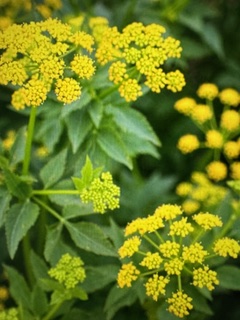
You may be wondering, why all the fuss about a plant? Well, it was the plant’s name that first piqued my interest a few years ago. If your last name was Alexander, wouldn’t you want the wildflower Golden Alexander growing in your garden, as well? Even the description sounds enticing – “a tough native that lights up the spring garden with its bright yellow flowers that attract pollinators.”
They were planted in an area of my garden that receives morning to mid-day sun and afternoon dappled shade. And then, a few months later, something unfortunate happened. Our weekly yard crew had a new person working with them. His job was to help with pulling weeds. And, as you’ve probably guessed by now, he unknowingly pulled up all three of my carefully managed Golden Alexander plants. The crew was already on their way to the next job before I even noticed.
Disappointed and somewhat embarrassed by the mistake, I sent a text to Linda explaining the situation. She assured me that it would be no problem to replace them. I was so relieved at her response and can happily say that I am now the proud owner of three new plants. As you can see from the photo, they have been planted, labeled and identified. Yard guys, beware, these plants are not to be removed!
Here is one of the three plants in the ground, labeled and temporarily protected!
Golden Alexander is an herbaceous, short-lived perennial in the carrot family. It has a yellow flat top cluster flower, similar to the lacy, umbrella-shaped flowers on dill, wild parsnip and Queen Anne’s Lace. The flowers are attractive to a variety of butterflies, native bees, bumble bees and honeybees. It serves as the primary larval host for the Black Swallowtail Butterfly.
General Information
Botanical Name – Zizia aurea
Common Name – Golden Alexanders
Family – Apiaceae
USDA Zone – 3 thru 8
Light Requirement – Full Sun to Part Shade
Height and Spread – 1.5-3ft x 1.5-2ft
Flower Color – Yellow
Soil Type – Loamy, clay
Bloom Time – April – June
Linda Seidel shares growing information below:
“Everyone needs a Golden Alexander,” a volunteer told me at a Native Plant Society of Texas plant sale. I’d never heard of the plant, but if everyone needs one, I’ll take one. I planted it near the top of my hillside pollinator garden where it would get morning sun and dappled shade of a crabapple tree in the afternoon. It does fine in my mostly clay soil which drains well on the hillside. It doesn’t seem to need fertilizer. It gets watered twice a week along with the rest of the garden. I would not say it is a drought tolerant plant, but even with our super-hot summer days the foliage has not burned since it is shaded in the afternoon. It provides a lovely dark green, soft textured background in the garden. Pollinators love the yellow flower clusters. Birds love the seeds. And speaking of seeds, Golden Alexander spreads its seeds prolifically. If you don’t want lots of little Golden Alexanders next spring, spend some time deadheading, before the seed heads have a chance to pop open. I now know why the plant sale volunteer told me I only needed one Golden Alexander!
Next May at the 2025 Raincatcher’s Garden Plant Sale, we plan to have Golden Alexander plants potted and ready for purchase. Come take a look!
Linda Alexander, Dallas County Master Gardener Class of 2008





 DALLAS GARDEN BUZZ