Are you ready to bid farewell to January and move into the next month of the year? If so, welcome to the first phase of our patriotic journey with a salute to the “month of love”. It seems very fitting to celebrate the occasion by recognizing Valentine’s Day, February 14th as the perfect time to focus on the vibrant, romantic color of red flowers. And what could be more appropriate than geraniums and Gerber daisies to get us started?
As we experience a seasonal “rebirth of nature”, consider the intensity of hues ranging from deep crimson, scarlet and ruby to cherry, maroon and burgundy found in red flowers. Our first arrangement allows blue hydrangeas to make a quiet appearance while the brilliance of red geraniums establishes boldness. Also irresistible are the Harmony Double Scarlet Anemone’s with white eyes encircling a black center. The regal look of Gerber daisies unifies the composition.
*February’s featured flavor is the Southern classic known as Red Velvet Cake. Embraced for its deep red color and velvety soft crumb, this moist and tender cake is embellished with a delicate touch of red rose petals. It’s time to indulge!
Linda Alexander, Dallas County Master Gardener Class of 2008
My photographic adventure into the bloom-filled world of crape myrtle’s was joyful. They can be enjoyed, literally, everywhere you look. Hopefully, you will grow in your appreciation of these wonderful southern icons as much as I have over the past three weeks. Take time to admire their beauty while driving around the neighborhoods, parks, shopping centers and roadways of Dallas. May you be blessed with a moment of happiness while viewing my ‘Grand Finale’ of panoramic crape myrtle treasures!
Lush greenery and blooming white crape myrtle trees along turtle creekPretty In Pink Puts A Smile On Your Face A Border Of Fiery, Red Crape Myrtle’s – Van Alystene, TXMy Favorite ‘Canopy’ Photo Was Of This Big, Beautiful Lavender Crape Myrtle On The Children’s Playground At A Local Day SchoolAn intriguing combination – from two different environments
Linda Alexander, Dallas County Master Gardener Class of 2008
Crape Myrtles are not native plants, but we take our opinion from the bumper sticker, “Not a native Texan but got here as fast as I could.” Crape Myrtles fit in with Texas water wise goals and some say that crape myrtles are a beneficial nectar and pollen source for honeybees, especially the lavender flowered varieties. The flowers, the fall color, the beautiful bark enhance Texas landscapes and many Texas gardeners, like me, embrace them.
Ann Lamb, Dallas County Master Gardener Class of 2005
Just a little over 18 years ago, my husband and I moved into our home on Shadywood Lane. Charles Dilbeck built the Monterey Ranch style one story house for the Runyan family in 1948. The 77 year old property was, and still is, filled with a wonderful assortment of mature trees, shrubs, perennials and evergreens.
Fourteen large magnolias, seven majestic red oaks, four stately live oaks, two towering cedar elms, a half dozen American elms, pecans, yaupons, dogwoods, Texas mountain laurel, cherry laurels, hackberries and redbuds were planted long before we arrived. But one magnificent red oak tree in the backyard was our favorite. Standing at over 40 feet tall along with a canopy spreading out over 40 feet in diameter, it provided an abundant covering of shade for our backyard. Under its protective branches were lovely Japanese maples, three Chindo viburnums and a large bed of endless summer hydrangeas. And then, the story changed.
Rushing outside to try and understand what had just happened, I was stunned to see the damage. Over one third of the canopy was gone. We would need a professional tree company to remove the limb and evaluate the overall condition of the tree. The tree was treated for insect damage, and we moved forward.
And then another chapter with our majestic red oak unfolded just a few months ago. On September 2nd, labor day, very early in the morning, an even larger limb snapped and crashed to the ground. Thankfully, no one was outside when it fell across the driveway and onto the guest house. Our youngest son was kind enough to rush over and cut the limb into smaller pieces so that we could get our vehicles out of the garage. Completing the task of cutting the limb into more manageable pieces for bulky trash pickup took two guys almost three hours.
With only half of the original canopy remaining, we decided to bring in an arborist to assess the condition of the tree. At over 80 years old, a difficult decision was unanimously reached to have the beautiful old red oak taken down completely. Alex, the arborist, carefully explained that there were simply too many issues involving the overall health of the tree to treat it. The most important consideration was related to safety. The tree was leaning too far in one direction and would totally destroy our small guest house if it fell over or, even worse, hurt a family member or anyone else who happened to be in the backyard.
Our affection for the old tree had grown immensely over the years. We loved the amount of shade it provided when the grandkids came over to play games in the backyard. Summer picnics and dinner around the firepit wouldn’t have been possible without its lush canopy shielding us from the scorching sun as it moved across the sky. In a fleeting moment the microclimate transitioned from lush, dappled shade to full sun.
As the arborist recommended, we would need to select a different variety of tree and move the placement approximately 6-8 feet away from where the majestic, old, red oak stood. The next step was to visit to a local tree farm. Fortunately, our family had lived next to the Fannin’s of Fannin Tree Farm over 35 years ago so after a quick call, we scheduled an appointment to visit their retail facility on Highway 121. A decision had already been made to replace the oak with a cedar elm. Touring their inventory of wonderful trees gave us many options. Here is the cedar elm we selected. My husband is 6’ 4” which gives a better perspective on the size of the tree.
With some hesitancy, we scheduled the removal of our old red oak for Monday, September 21st. It was a two-day event which included several nail-biting moments of suspense. Starting with the remaining canopy, branches were very strategically roped and secured before any cutting began. Watching the four men maneuver their way around the tree was truly amazing. With each ‘tug’ of the rope, they carefully orchestrated the exact spot where the falling limb would land. Nothing on the ground was damaged due to the safety measures that were kept in place.
Once completed, stump grinding was next on the agenda. It took over four hours to slowly and carefully remove the remainder of the tree. And then, it was completely gone. I stood silent for a moment and tried to imagine it still standing there, beautiful and thriving for over 80+ years. Whispering a soft prayer of thankfulness for the joy we had received over the years, my eyes opened to an empty landscape filled with new possibilities. Now It was time to move forward with a renewed hope about our next adventure.
Installation of the 18’ tall cedar elm was an incredible experience. The challenge of bringing it down our rather tight and winding back driveway took a measured amount of skill. The crew sent to do our installation amazed me with their ability to lift and place the tree at just the right angle in the pre-dug hole. A few tweaks of the chain positioned it for maximum beauty.
We are adjusting to the new tree a little better than expected. But there are times when I find myself reminiscing about the beautiful canopy of the old red oak that we benefited from and enjoyed immensely for over 18 years. Treasured memories of that majestic tree are still in my heart and will remain there for a lifetime. But, thankfully now, Joyce Kilmer’s lovely tree poem has spoken to me once again!
A view of 3 Snowball Viburnums, looking thru my blackberry bushes.Eleagnus flanking the west side, hellebores underneath.
Spring comes and this is what I see every year out my south-facing windows. What a sight! I planted these 3 snowball viburnums 11 years ago. They have been the showiest, easiest plant choice I have ever made. The buds are chartreuse and and bloom into softball size white blossoms.
As you can see from my picture above, mine are now feet 15 tall and slightly crowded but I don’t mind. The winter honeysuckle that has gotten bigger than I ever expected is pushing one snowball to the East. It is going to be pruned!
Last year even with the unbearably hot temperatures, my viburnums bloomed a second time. There were’t as many blossoms but in that terrible summer heat it was nice to see a few snowballs.
Plant Attributes
This picture from Neil Sperry’s website shows the early chartreuse bloom.
Common Name: Chinese snowball viburnum, Chinese snowball tree
Botanical Name: Viburnum macrocephalum
Family: Adoxaceae
Plant Type: Perennial, Tree, Shrub
Mature Size: 6–20 ft. tall, 6–15 ft. wide (grows larger in warmer climates)
Sun Exposure: Full, Partial
Soil Type: Well-drained loamy, sandy, or clay soil
Soil pH: Acidic
Bloom Time: Spring
Flower Color: begins chartreuse then becomes white
Hardiness Zones: 6–9 (USDA)
In Dallas, Snowball Viburnums do not loose their leaves in winter
Excellent cut flower with long vase life!
Ann Lamb, Dallas County Master Gardener Class of 2005
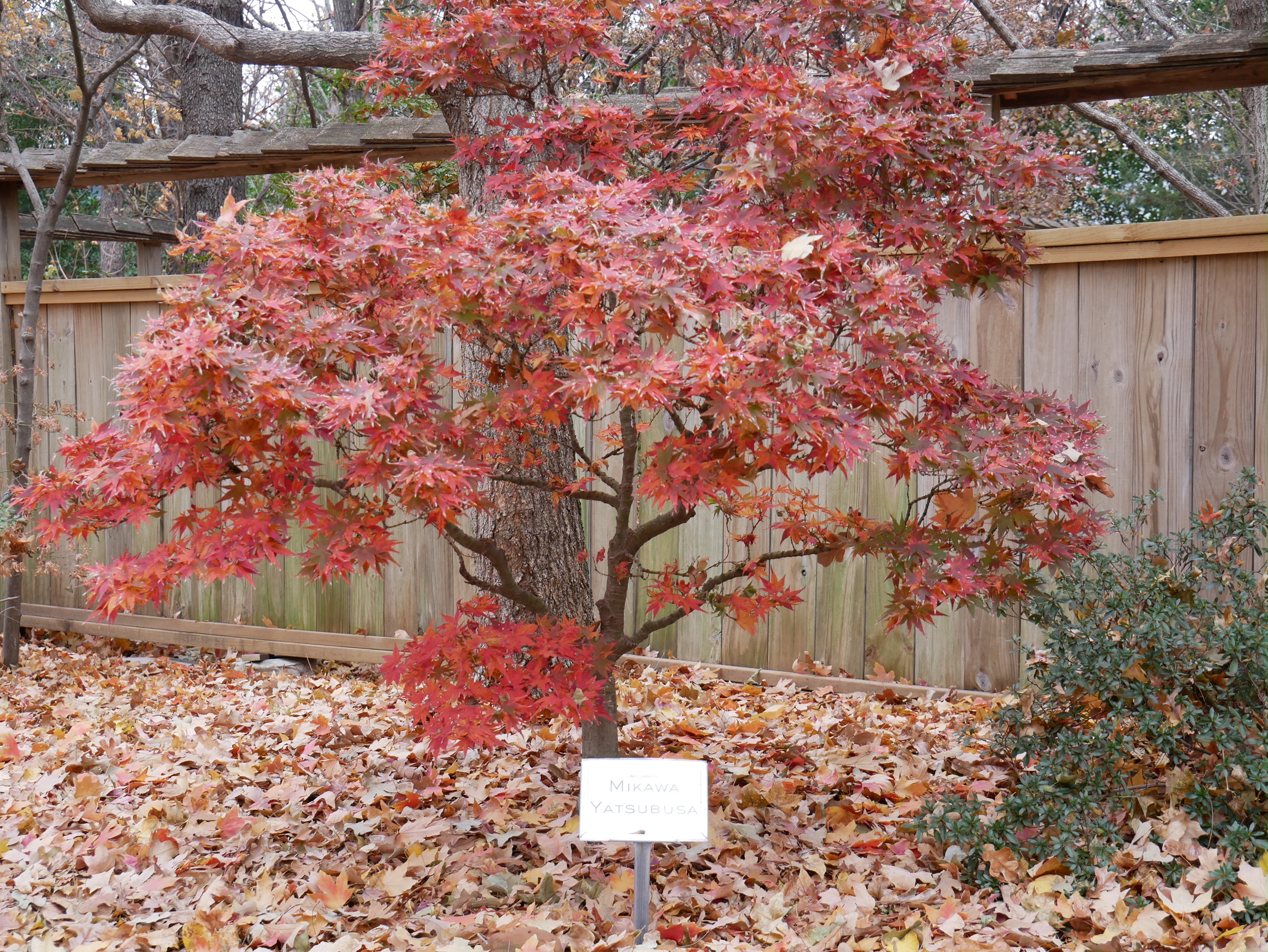
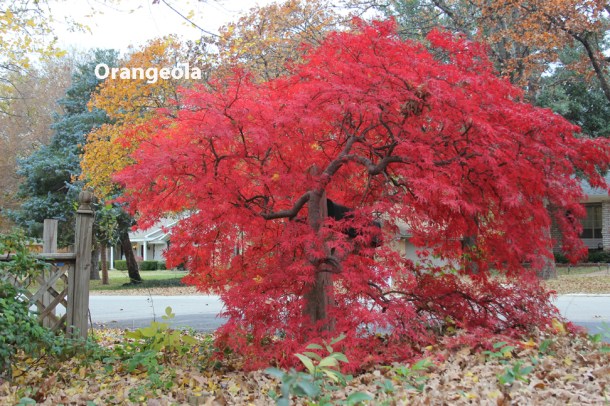
You may have noticed the brilliant reds and golds of Japanese Maples around town in recent months. The foliage colors and textures were more reminiscent of an autumn drive through New England than fall in North Texas!
The Dallas County Master Gardeners are hosting a sale of Japanese Maples in March. Many of us are familiar with the variety “Bloodgood,” however the Maples we are offering are varieties not often available at local nurseries. This is your opportunity to purchase these trees in one- and two-gallon sizes.
There is a place in every garden for a Japanese Maple. They thrive in afternoon shade (the perfect understory tree!) and will make that special spot in your garden a focal point year-round.
Watch for the sign-up genius link and additional information including varieties available, pricing, and contactless pick-up details, in February.
Cindy Bolz Dallas County Master Gardener Class of 2013
Before shopping for your Japanese Maple, please read these two articles:
During the stay at home order, I found myself watching most of the Texas A&M AgriLife’s Water University online training classes. The classes were great but one thing I particularly liked was that a lot of the classes are at 6 or 6:30 PM – HAPPY HOUR!!! I would set up my laptop on the kitchen table, pour myself a glass of something and get out a bag of chips and salsa. When I knew my friend Sarah Sanders was also watching the class, she would do the same and we would text back and forth about the plants we liked. It was not the same as attending a meeting together but we are doing the best we can under these unusual circumstances.
We noticed one tree that was mentioned in almost every class. It was the Rising Sun Redbud tree (Cercis canadensis). The instructor, Daniel Cunningham (Horticulturist) said he has one planted outside his kitchen window. Sarah and I were determined to find a spot for one in the courtyard at the Raincatcher’s Garden at Midway Hills Christian Church. We have a large, square brick planter that was initially planted as an herb garden, which was a great idea since it was so close to the kitchen where we do all our cooking for the garden luncheons. However, years passed and we now have a huge fabulous edible garden just a few steps away. It seemed like a great time to repurpose the area for a beautiful view from the church windows.
Rising Sun Redbud Tree, so aptly named. Look at that foliage!
Here is what we love about this tree. It’s a compact tree (10-12 feet tall with a 10-15 foot spread) and has multiple seasons of interest. It blooms pink flowers in the spring and attracts birds and butterflies. Then, the heart shaped leaves start out as yellow, orange and apricot and turn to lime green when it gets hot. The very best part is that, at some point during the growing season, all of these colors are on the tree at the same time. Then in the fall, the leaves turn orange. I’ve also read that the bark is smooth and yellow, making it attractive in the winter months. It almost seems too good to be true!
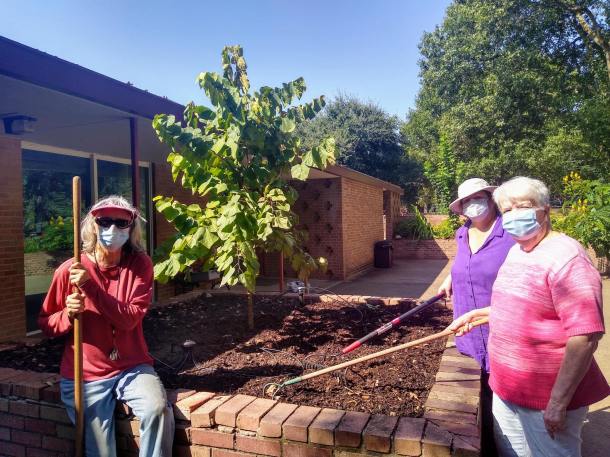
Since September is an ideal time to plant trees, Beverly Allen, Sarah Sanders and I strapped on our masks and headed to the courtyard with shovels and rakes in hand. Eight bags of compost were added to the bed. We dug a hole and hoisted a 15 gallon Rising Sun Redbud tree into the planter.
Jackie James, Sarah Sanders and Beverly Allen, the planters.
We are hoping we chose just the right tree to plant in just the right spot so it will be a beautiful and fun addition to the courtyard and also easily visible from the Fellowship Hall window. Can’t wait until we can get together again to attend a monthly meeting or enjoy one of our delicious luncheons and have the added bonus of getting to look at this tree out the window. Thanks for the idea, Daniel!
Jackie James – MG Class of 1993
As Jackie said, this is a great time to plant trees and here are two videos to help you:
I should have realized that gardening was going to be an important part of my adult life as I stood in front of a candlestick tree as a child at the State Fair of Texas. I stood staring at this beautiful, tropical-looking plant with a corn dog in one hand, cotton candy in another and a lizard on a string “leash” pinned to my shirt. (As far as the lizard is concerned, I feel compelled to quote Maya Angelou: “Do the best you can until you know better. Then when you know better, do better”!!!).
Years went by and I didn’t give that fabulous plant a thought until I volunteered as a docent for one of the first Master Gardener fall garden tours. I spent several hours at Kay Passmore’s garden that day and found myself staring at the candlestick tree again. She had many in her yard and commented that they reseed freely.
For the past couple of years, we have been planting candlestick trees in the courtyard at Raincatcher’s Garden at Midway Hills Christian Church. At this very moment, there is a big candlestick tree in the courtyard that just starting blooming. Every time I work in the courtyard, I find myself standing and staring at this awesome plant, but without the corn dog (vegetarian now) and cotton candy (yikes!). And, thank goodness, the only lizards in the vicinity are the ones running freely in our garden rather than pinned to my shirt (what were we thinking?)!!!
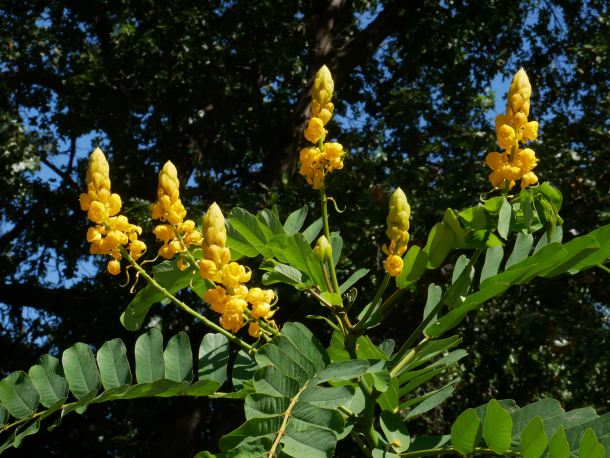
Our lopsided well loved Candlestick Tree in the Raincatcher’s courtyard
The candlestick tree (Cassia alata)is native to Central and South America. It is an annual in Dallas and grows easily from seed. It is best to soak the seeds in water overnight and then plant them directly in the ground in full sun after the danger of frost has passed. It can grow from 6 to 15 feet in a season and it blooms late summer to fall. It is a drought tolerant plant and it attracts pollinators to the garden. Another fun fact about this plant is that the leaves fold up at night.
Next time you’re at the garden, take the time to check out this plant. Or make a special trip to the courtyard just to see it – it will be worth your effort!
If you have never grown this plant, I strongly suggest you try one next spring. Hopefully, we’ll have some seeds to share by then!
When you visit the Pollinator Garden at Raincatcher’s, please take a moment to walk in the garden and see how beautiful and large the desert willow has grown. Tom Wilten would be proud! He gave us this tree just last year, and it’s happily blooming away. I wonder how many trees owe their lives to Tom’s passion for propagating and teaching us how to do it, too? What a wonderful legacy.
Desert Willow given to The Raincatcher’s Garden by Tom Wilten
Lisa Centala
Other Dallas Garden Buzz articles with Tom’s advice:
Tornadoes ripped through Dallas, October 20, 2019. What a loss for our city when you count property destroyed and trees uprooted or damaged.
Many of our beautiful trees were destroyed.
Eric Larner, Dallas County Master Gardener and Citizen Forester and Steve Houser, also a Dallas County Master Gardener and President of Arborilogical Services discuss what happened and what to expect in the paragraphs below. They also remind us-we have a lot of tree planting ahead!
Eric, do you have anything you would like to tell the readers of our blog about trees after the tornado?
Have there been any estimates of the loss in terms of trees? I wonder what percentage of our tree canopy in Dallas was destroyed?
What recommendations would you give?
Maybe we should have a class so people could come ask questions and see our tree selection.
Ann Lamb
From Eric Larner-Great questions – Of course, the damage a tornado (100+mph winds) against ANY tree is almost always 100% fatal to the survival of the tree no matter the size of the tree. But tornados take weird and strange paths(i.e. total destruction on one side of the street and very little damage on the other side).
I would refer you to Steve Houser on estimates of destruction to the city’s overall tree canopy. I do know that to replace the benefits of one very LARGE tree( 40-50” caliper) takes 150+ 3” trees planted and that would take around 25+ years to achieve. So you see, we will need to plant a lot of trees in our city.
A neighborhood class talking about medium – large shade trees would probably focus on alternative choices to red oaks and live oaks in the metroplex.
Eric Larner
From Steve Houser-As Eric noted, the damage often follow unusual paths. We had a storm in late June with 70 MPH winds that damaged properties in south Richardson all the way to downtown Dallas. One of the ten recent tornados contained over 140 MPH winds that took out houses and most (or all) of the trees on a property. Many huge Oaks were blown over and those that survived often had extensive damage.
Eric’s notes are accurate calculations regarding how long it takes to replace the biomass (or foliage) of one large tree. Although it replaces the biomass in 25 years, it does not replace a cool and old tree for around 100 years.
If you consider the losses from both the events noted above, a guess at the loss in canopy cover would be between 4 to 5%. Although it does not sound extensive, it was easily over 100,000 trees lost or damaged.
Trees lost or damaged included up to 90% of the canopy coverage in specific areas with 140 MPH winds and less in areas with 60-100 MPH winds.
We have handouts on recommended species. As Eric noted, Raincatcher’s Garden is a great demonstration garden for some of the choices.
It is always best to check with a consulting arborist and ask for a full assessment of all trees. Keep in mind that it may take some time to get them out but they can help to detect trees that can fail structurally in the future and determine the best course of action for a damaged tree.
DCMG`s have already been taught about cabling/bracing, reducing end weight on long limbs and determining weak forks in trees, to help reduce future damage or losses.
If a tree lost 20-30% of its foliage, it may be salvageable and recover.
If a tree lost 40-60% of its foliage, it will never look the same again but may have a chance to survive.
If a tree lost 70-100% of its foliage, most arborists recommend removal and replacement. However, if the primary branching structure is not severely damaged, they will not look good but some of them can be saved. Some folks may leave the tree for a year or two to see if it grows back and how it looks. In some cases, another tree or two will be planted nearby and to possibly replace the damaged tree at later date.
Steve Houser
The Raincatcher’s Garden will host a tree class in early 2020.
As Eric said, it will be about tree selection, and also care of trees.
We will announce the date of the class in January, 2020.
To read some of our previous material about tree care, click on the links below.
Everyone loves Japanese Maples! Dallas County Master Gardeners were able to learn about them from expert, Scott Hubble, at our September meeting last week.
Scott works at Metro Maples in Fort Worth and shared a wealth of information about these trees which come in all shapes, sizes and many colors.
Our Texas sun is the most important factor to consider when picking a location for a Japanese Maple. Morning sun with shade in the afternoon is generally perfect.
Japanese Maples are well situated when they are under the canopy of larger trees receiving dappled light throughout the day.
Remember they do not like soggy roots so plant them in areas with drainage.
No more words, let’s gaze at these beauties.
Look carefully inside this Japanese Maple to see homeowner’s mailbox. This 25-30 year old tree grew around the mailbox.
Thank you Metro Maples for the presentation and pictures.
Ann Lamb
All Master Gardener meetings are held the 4th Thursday of the month at varying locations are open to the public.
Tool Time and education for all Thursday, October 3rd at 10am at The Raincatcher’s Garden. Click here for details.











 DALLAS GARDEN BUZZ