Earlier this week, we heard the news that the possibility of our first “freeze or frost” was in the forecast. For gardeners, that sends a signal to start preparing for the big event. Fortunately, my master gardener friend, Ann, sent a text on Friday morning asking if I had any extra basil to spare. My answer was a resounding, “YES”, and I was ready to share as much as she needed.
This year I was growing some of my favorite varieties; Balsamic Blooms, Cardinal, Cinnamon and Red Rubin. There was a plentiful amount of most, but especially the Cardinal. And so, the clipping began. As a bonus, Ann had offered to share a new recipe with me in exchange for the basil. We would both being making basil pesto, as requested in the recipe.
One of my favorite basil recipes is in the 2016 master gardener cookbook, “A Year on the Plate”. I decided to make 4 recipes of spinach basil to use when preparing Ann’s recipe and then freezing the remaining jars.
Basil Pesto: Two Back Jars, ‘Cardinal’, Front Jar ‘Red Rubin’
From Ann…
Chicken Pesto Meatballs
My good friend, Nancy, who survived junior high and high school with me gave me a recipe which allowed me to use up end of season basil. Chicken Pesto Meatballs uses ground chicken infused with 3/4 cup pesto. The flavor is complex and in a short time you have a beautiful dinner with it’s major ingredient coming from your very own garden or your friend’s garden!
Linda Alexander and Ann Lamb, Dallas County Master Gardeners
This past Saturday, September 6th, marked the end of season schedule for St. Michael’s Farmer’s Market. Like many of our readers, I’ve been attending the Saturday market for years! Getting to meet so many of the vendors and following them each week has always been a delightful experience for me.
People like The Baugh Family (now with two young children) drive in early from Wylie to bring an amazing assortment of east Texas vegetables, blueberries, blackberries and more. But it’s always those juicy, ripe peaches that create the long lines of anxious customers with everyone hoping there will be enough once it’s their turn. Wayne and his wife get up around 2:30am to harvest their magnificent bouquets of freshly cut flowers. Driving in to Dallas from Henderson is about 2 hours but these long-time flower farmers have us drooling over the rainbow of colorful blossoms that are bundled up and ready for purchase.
Master Gardener, Janet Smith class of 2008, became a regular this summer with her west Texas pecans. What a special treat! And new to the market was Honey Apple Farm in Canton, Texas. This small, family owned and operated farm produces a variety of artisan honeys. They are also passionate about strengthening the bee population by providing tips on planting a bee garden and going chemical free.
My end of season trip to the market on September 6th was bittersweet. While some of the vendors will return for a one-time only October appearance, we’ll have to wait until May 2026 for the weekly schedule to resume. Until then, I’m thankful for the bountiful blessings given to us by the farmers, flower growers, beekeepers and more whose hard work provided us with fresh, flavorful food this summer. I’ll be first in line to welcome them back next May.
Looking back through one of my herb cookbooks, I landed on a recipe that had been “tabbed” many years ago but never prepared. Things were about to change. Jerry Traunfeld wrote “The Herbal Kitchen” in 2005 as a handbook for incorporating fresh herbs, from his own herb garden, into everyday home meals. I would be using fresh tomatoes from the Saturday market to prepare his recipe for Tomato Bread. From my own garden, freshly picked basil and thyme along with cured garlic from late spring would supply most of the ingredients.
Let me go on record as declaring that this new recipe exceeded my expectations. And for those of you who already have your autumn tomato crop in the ground, please give this incredibly delicious dish a try. You might want to serve it as an accompaniment to salad, soup or with any grilled meats. I’ve made the recipe three times in the last month and shared it with family and friends. Everyone agreed that this is an exceptional way to enjoy fresh juicy tomatoes!
Start with chewy cubes of Italian-style bread drizzled with olive oil then topped with minced garlic and “torn” basil leaves. Finish with juicy, sliced tomatoes and a generous sprinkling of fresh thyme.
Have you been feeling somewhat listless or despondent over the last few weeks? Are you experiencing a period of inactivity or lack of energy? If so, you are not alone. It may be that those summer doldrums have many of us in a wearisome summer slump!
We’ve all, no doubt, spoken those words many times over the years. However, for the first time, my curiosity motivated me to do a little investigating into the meaning of “doldrums”. Much to my surprise the doldrums are for real! In oceanographic terms, they are a part of the ocean near the equator abounding in calms and light shifting winds.
In the early 19th century, the word doldrums came to be applied to certain tropical regions of the ocean marked by the absence of strong winds. Sailing vessels, depending on wind propulsion, struggled to make headway in these regions, leading to long, challenging journeys.
While the exact etymology of doldrums is not certain, it is believed to be related to the Old English dol, meaning “foolish” – a history it shares with our adjective dull.
Click here for a much more scientific and very fascinating explanation from NOAA
If you are like other gardeners waiting for the winds to “pick up”, here are a few refreshing ideas to help you navigate through the summertime blues! One of the most delightful ways to celebrate the hot, sticky last few weeks of summer is found in the herb garden. When I’m in search of a culinary treat, summer herbs seem to have the answer. Let’s look at a few of the heat-tolerant, dependable standouts that satisfy the craving.
Whatever your preference, vibrant flavors ranging from sweet and floral to savory and pungent can be found in herbs that persevere through the high heat and icky humidity of summer.
Offering aromatic qualities from minty and citrusy to earthy and woodsy, consider these flavor profiles to suit your preference:
*Sweet and floral: basil, lavender and anise hyssop
*Citrusy: lemon verbena, lemon balm and French sorrel
*Minty: various mints (spearmint, ginger mint, peppermint, etc.), nepitella, oregano and thyme
*Earthy: sage, rosemary and thyme
*Pungent/Spicy: chives, papalo, French tarragon
Enjoy the simple pleasures of growing and harvesting summer herbs. Some of the most satisfying ways for using fresh herbs are found in sprinkling, scattering and tossing over fruits, salads, vegetables and desserts for a delectable finish. Other than a quick trip to the grill, bake free is the best way to savor the gifts of our summer gardens. Use freshly gathered herbs to elevate your food from tasty to irresistible!
Here are a few ideas for a cool ending to summer:
Grilled Peach and Blueberry Salad with Fresh Mint
Peaches grilling in a nonstick grill panHoney infused balsamico used as a dressing for the saladGrilled Peach and Blueberry Salad
Creamy Chilled Cantaloupe Soup Garnished with French Tarragon and Blue Borage Blossoms
Ground sumac spice for cantaloupe soupCantaloupe growing in my August garden.Creamy chilled cantaloupe soup
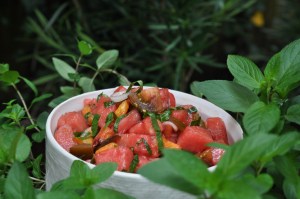
Yellow Pear Tomato Salad with Red Rubin Basil, Nasturtium Blossoms, Basil Pesto and Mozzarella Pearls
Yellow pear tomatoes growing in my August gardenYellow Pear Tomato Salad with nasturtium blossoms
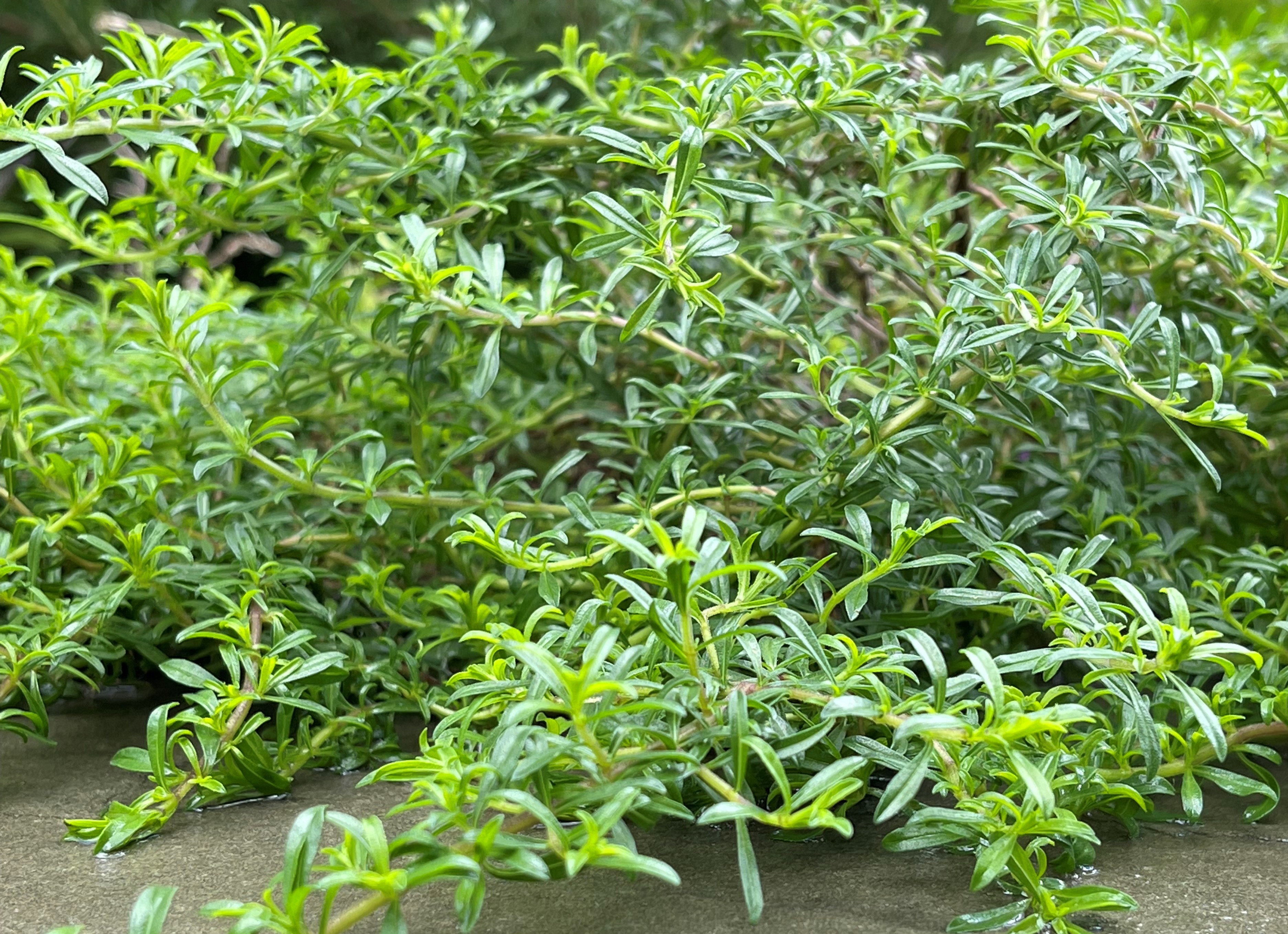
One is known as having a special affinity for beans of every sort, the other is considered “not worth the trouble of growing” because it lasts for such a short time in the hot South. Differences aside, both are worthy of consideration. Summer Savory (Satureja hortensis) and Winter Savory (Satureja montana) are aromatic, flavorful and make delightful additions to the herb garden. Both varieties are currently growing in the Edible Landscape at Raincather’s Garden of Midway Hills.
Summer Savory is a cold-tender annual herb native to Southeastern Europe and the Mediterranean. It is the sariette (savory) of France, otherwise known as an essential ingredient in the herbs de Provence blend. Though not as popular as its perennial cousin, some believe it has the most superior flavor.
Winter Savory is also called dwarf savory or mountain savory. It is an especially decorative, low-growing and densely spreading shrub. Classical Greeks and Romans were familiar with this herb. Virgil, the Roman master of poetry, advised putting honey (saturated with the aroma of roses, thyme and savory) into the bee house as a solution to swarm’s disease. Hippocrates ascribed medicinal properties to it. Early American settlers treated colds and fever with savory tea.
Planting: Start seed in the winter, set out transplants in the spring.
Height: 8 to12 inches or somewhat taller
Spread: 20 inches
Bloom/Fruit: Blooms are small, white-to-lilac whorls of small star-shaped flowers.
Growth Habits/Culture: Summer savory is more upright with aromatic, dark green leaves and grows a little taller. It features square-shaped stems covered in tiny hairs. The ideal temperature range is 55-85˚F. Winter savory is more compact, low and spreading with needle-like, dark green leaves. It is a stiffer, woodier evergreen plant that will survive winter temperatures to around 23˚F. Savory requires rich, moist well-drained soil.
Taste: While both have a definite peppery bite reminiscent of thyme and marjoram, summer savory is fruitier, like apples and floral with a hint of lavender and basil. Winter savory with its coarser aroma and flavor is welcome at summer’s end when a fresh herb is desired during the cooler months.
Harvesting: When summer savory reaches 6 to 8 inches in height, start harvesting. After blooming, the plant is not as vigorous so be attentive about snipping off buds. Once summer savory flowers, its leaves are at their most flavorful. At this time, the entire plant can be clipped and used. Winter savory can be harvested for fresh use at any time.
Culinary Uses: Both summer and winter savory are traditional companions to all kinds of bean dishes, including soups, salads and spreads. Winter savory can be an alternative to sage in poultry dressing. Milder summer savory adds a flavorful punch to egg dishes, creamy soups and rich, cheesy casseroles. A liberal sprinkling of fresh leaves from either one gives new life to cooked vegetables. The good news is that both varieties can be used in much the same ways and are fairly interchangeable. When replacing winter savory with summer savory, add a touch more than called for in the recipe. When substituting summer savory with winter savory, start with about half the amount called for in the recipe and adjust according to taste.
Linda Alexander, Dallas County Master Gardener Class of 2008
When was the last time a stroll through the garden refreshed your spirit and awakened your soul? Did early morning dew falling gently on the roses capture your senses? Brushing up against the cinnamon basil were you soothed by the spicy essence of cinnamon filling the air? Or did the mild, anise-like flavor of freshly snipped French tarragon inspire you to use it on a special fish dish?
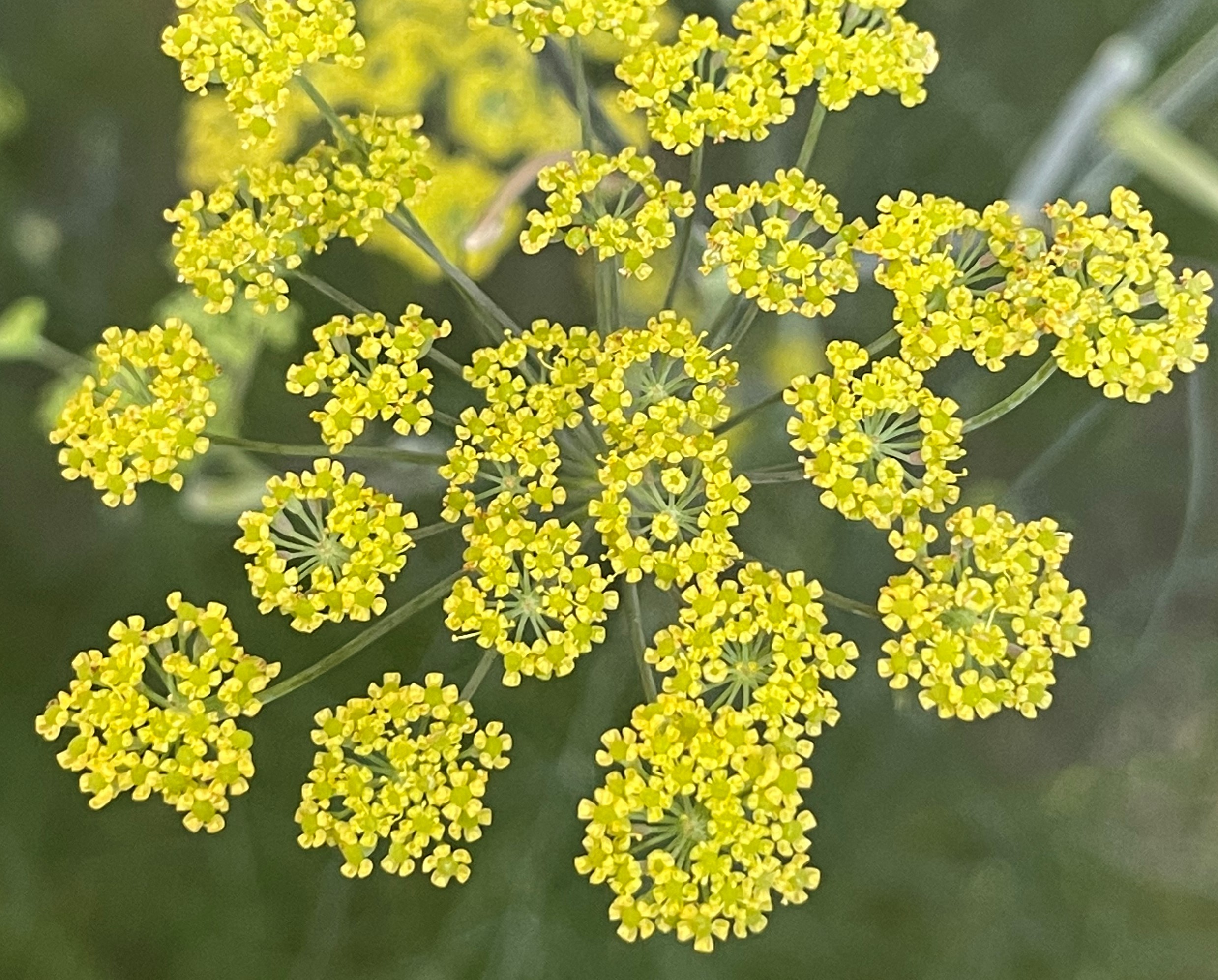
Gardens have the ability to shower us with those divine moments. Nature blesses us as we take time to pause and allow silent expressions from the garden to fill our senses with joy and peace. For me, a quiet place of summer pleasure is found in the fennel bed. Grasping a small branch filled with feathery fennel leaves is an on-the-spot chewy taste experience I find very refreshing. A little “pop” of those delicate, tiny yellow blossoms makes for a grand finale!
Just a few weeks ago, a most surprising “fennel” find caught my attention. Located in the spice area of our local grocery store, a small, turban shaped jar of Fennel & Salt intrigued me. Reading the list of ingredients was like a trip to the garden; 90% Italian sea salt mixed with fennel seeds, black pepper, oregano, white pepper, laurel, grass pepper, curry, thyme, juniper, pimento and organic fennel pollen. (I especially liked the marketing description; Every jar contains an intensely aromatic blend of Italian sea salt and organic fennel pollen.)
At $16.99 a jar, I was hesitant for only a moment before adding it to my shopping cart. The Alexander Family Reunion was just days away and I had already planned for one of our evening buffet menus to include a large tray of sliced east Texas tomatoes. Little did I know until all 43 family members lined up for dinner on the second night, was that the culinary highlight of the entire gathering would be that tomato dish.
An hour before the dinner over fifteen vine ripened, heirloom east Texas tomatoes were thickly sliced, drizzled with a lovely bottle of Balsamic Vinegar of Modena then lightly sprinkled with my new discovery, the small jar of Fennel & Salt. Freshly harvested basil from my garden was cut, chiffonade-style, and strewn generously over the entire tray. It was irresistible!
During dinner that evening, and for the next few days, everyone kept commenting on how unbelievably tasty those tomatoes were. Knowing, secretly, that the enchanting powers of a special “fairy dust” had transformed the dynamic of an otherwise ordinary dish, my explanation was simple. “Yes, it was indeed a heavenly experience thanks to a highly coveted item affectionately known as… fennel pollen, “the spice of angels!” Like fennel seed, it has an anise-like licorice flavor with notes of citrus and honey that is perfect for enhancing sweet and savory dishes alike.
Linda Alexander, Dallas County Master Gardener Class of 2008
Video by Starla Willis, Dallas County Master Gardener Class of 2011
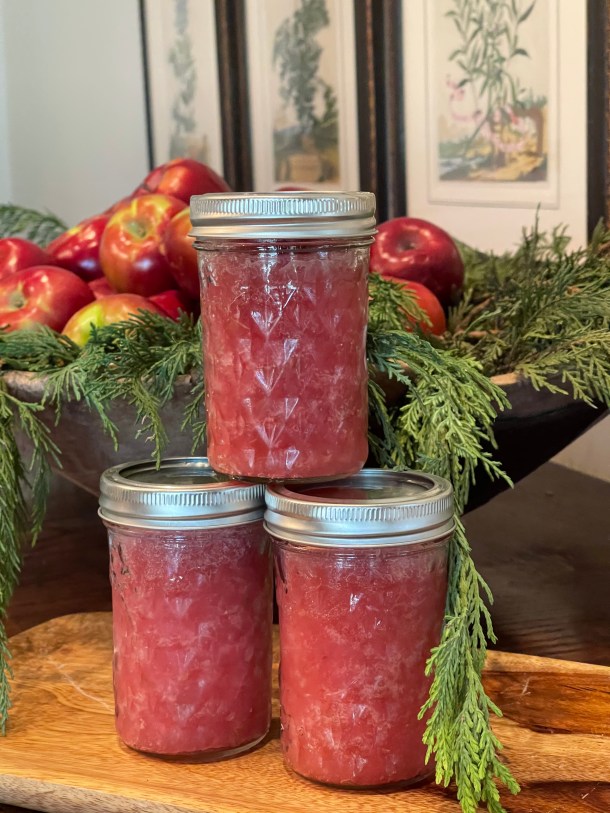
Master Gardeners fell in love with this recipe almost five years ago. McIntosh apples are a must and can be found at Central Market now.
Very Best Homemade Applesauce
Ingredients
6 large McIntosh apples (use only this variety)
¾ cup white sugar, use more or less
1 ⅔ cups water
12 whole cloves
Directions
Wash and quarter apples, but do not peel. Remove seeds, if desired, before cooking. Place apple pieces in a large saucepan along with the rest of the ingredients. Before cooking stir some to dissolve sugar. Bring to a simmer and cook slowly with lid on until apples are mushy.
This doesn’t take long. Allow to cool for a few minutes.
Put cooked apples through an “old timey” cone-shaped metal ricer, pushing with wooden large- fitted dowel or wooden spoon, catching sauce in a large glass bowl. (Can use metal wired sieve with a large bowl underneath). Push apple pulp through sieve with wooden spoon. Seeds, whole cloves and peels will be removed. Stir sieved applesauce and refrigerate. Serve with sugar cookies.
Note: This recipe came from the University Park Elementary School Kindergarten class in 1989 via Patty Brewer. Apple peels will make sauce a beautiful rosy pink color so there is no need to add red food coloring.
No matter the season, there’s always work to be done in the garden. Seasonal challenges many times involve weather related temperature extremes serving as the determining factor. In north central Texas, we typically get socked in with sweltering temperatures mid June to early September. This week is no exception. The forecast is for temperatures over 100°. Our weather forecasters have advised caution for any type of outdoor activity. Staying hydrated is of supreme importance as we are reminded to drink lots of water.
While doing those garden chores, how about some fresh ideas using herbal infusions to flavor your water? Easy to make and so refreshing, follow these simple steps for a cool thirst quencher:
Select the fruits, vegetables and herbs of your choosing
Give everything a gentle wash
Fill a pitcher with tap or filtered water
Add your preferred combination
Refrigerate and allow the fruit and herbs enough time to infuse the water
Fruit and herbs should be removed after 10 hours, or less, but continue to enjoy the water
Create a different flavor combination each day
At Raincatcher’s, taking a water break is a tasty and satisfying experience. We enjoy our time to “pause” and visit with each other. Sipping on herbal infused water gives us that refreshing lift needed to continue caring for our beloved gardens.
Thirst no more! Here are the herbal infused waters from left to right in the picture above:
Cucumber, Salad Burnet and Borage Blossoms (Starla’s favorite) Watermelon, Watermelon Flavored Mint Orange Slices, Blueberries, Lemon Verbena (Linda’s Favorite) Lemon and Lime Slices, Pineapple Sage Strawberries, Balsamic Blooms Basil (Ann’s Favorite) Apricots, French Tarragon
Other flavorful combinations to try:
Parsley and Lemon Peaches and French tarragon Cucumber and lemon thyme Grapefruit and rosemary Lavender and lemons Oranges and sage Strawberries, blueberries and mint
Look for seasonal inspiration in your garden and be creative with your combinations.
Linda Alexander
Photo by Starla Willis
Note: When using borage flower heads for culinary purposes, pick off by grasping the black stamen tips and gently separating the flower from its green back. Sprinkle over salads, or use to flavor water and other beverages.
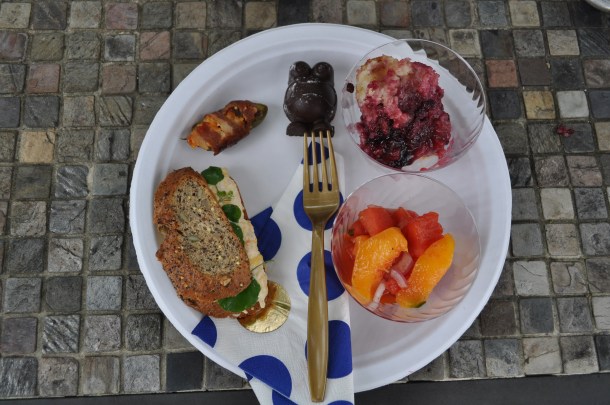
The edible garden team of Raincatcher’s put together this 4th of July menu. We thought you might want to recreate this easy lunch while celebrating this weekend.
Red, White and Blue Menu
Jalapeno Poppers
Papalo and Pimento Cheese
Peach, Watermelon and Tomato Salad with Mint and Basil
Blackberry Cobbler
Blueberry Marshmallows in a Chocolate Shell
Papalo is an herb we began growing this season. Next week we will reveal what we have learned about papalo. We love the taste of it and think you will want to grow it in your garden.
Jalapeno-Pimento Cheese Spread
Want a little extra heat? Add more jalapeno juice.
Ingredients
3 cups grated Cheddar cheese
1½ cups grated Monterey Jack cheese
½ cup chopped pimentos
2 tablespoons chopped pickled jalapenos with juice
1 cup good quality mayonnaise
1 cup Miracle Whip
Directions
Combine all ingredients and mix well.
Yield: 6 cups
Peach, Watermelon and Tomato Salad with Mint and Basil
Vibrant colors are the perfect match for this summer salad.
Ingredients:
½ medium size watermelon, cubed
3 medium peaches, cubed
2 medium size heirloom tomatoes (green variety) cubed
½ red onion, thinly sliced
1-2 stalk’s worth of basil leaves
1-2 stalk’s worth of mint leaves
Juice of one lime
1 teaspoon salt
¼ teaspoon freshly ground pepper
1 teaspoon sugar
¼ teaspoon chili powder
1 teaspoon white wine vinegar
¼ cup good quality olive oil
Directions:
Combine the watermelon, peaches, tomato and onion in a large bowl. Chiffonade the basil and mint and add to the fruit mixture.
In a separate bowl, whisk the remaining ingredients and toss with the fruit mixture. Chill or serve at room temperature.
Last week at our local farmer’s market I was taken by surprise. Crowds arrived early creating lines at most stands. After a first pass at a few of my usual stops, something caught my eye. A local grower from Irving was offering freshly pulled carrots straight from her garden. While that may not seem unusual, it was the carrot tops that made me swoon. Lush and lovely, their feathery formation in vibrant shades of green jogged my memory.
A few weeks earlier, my husband and I had dinner at one of our favorite Dallas restaurants. Janice Provost, chef/owner of Parigi’s, is a good friend who loves to “talk garden” with me and enjoys sourcing locally grown, fresh produce. That night she was featuring an appetizer we decided to try.
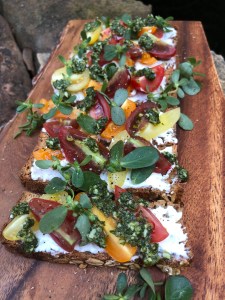
Appropriately named, our ‘Garden Board Special’ with Carrot Top Pesto was stunning. A colorful combination of bread “planks” slathered with whipped feta and cream cheese then topped with perky little red and yellow cherry tomatoes tumbling across the next layer had us drooling. The finishing touch was a light sprinkling of micro greens drizzled with carrot top pesto. For me, the meal was complete, and a new pesto experience stayed in my head.
Garden Board Special
It must have been somewhat providential that those carrots spoke to me at the market, but it was also the surprising discovery of locally grown edible purslane that motivated me to recreate our appetizer experience. And, thankfully, I had stumbled upon the necessary ingredients to complete the task.
Here is my slightly adapted version of the pesto. If you find it intriguing, start thinking now about your fall carrot crop and a flavorful new way to use them from top to bottom. And, check back in early January for a preview of our ‘Grow and Graze’ lineup of 2021 classes.
Carrot Top Pesto
Ingredients:
1 cup carrot tops (lightly packed)
½ cup flat-leaf parsley or fresh spinach
¼ cup walnuts
1 garlic clove
½ cup freshly shredded parmesan cheese
1 tablespoon lemon juice
Zest of 1 lemon
¼ teaspoon sea salt
2 tablespoons olive oil
Directions:
Lightly toast the walnuts over medium heat until they start to become fragrant. Stir constantly, toasting just until slightly golden brown.
In a food processor, pulse all the ingredients, including the toasted walnuts, until everything is well-combined and forms a coarse paste. For a thinner pesto, add a few more tablespoons of olive oil, one at a time, until reaching a desired consistency.
Serve over roasted vegetables, soups, baked chicken, or fresh tomatoes.
Highly prized, beautiful umbel-shaped blossoms of the carrot tops
This summer, in the edible landscape, we took the advice of Dallas County Interim Extension Agent, Jeff Raska, and let our carrots grow for two seasons. By early summer we were treated to a carrot blossom extravaganza. Beautiful umbel-shaped blossoms soon became lovely spherical, lacy white flowers ready for both the bees and our garden guests to enjoy. We’re now using those delicate Queen Anne’s Lace looking flowers as a topper for salads, soups and appetizer trays. Our garden adventure was a delightful surprise!









 DALLAS GARDEN BUZZ