Dig a hole through time and you will hit a fig tree’s roots. Figs are one of the oldest cultivated plants.
Figs are interesting little fruits but not in the traditional sense. The structure of the fig is a called a syconium, a fleshy sac lined with tiny flowers inside. When you eat a fig, you’re technically eating hundreds of tiny inverted flowers that bloomed inside the syconium.
The word “fig” comes from the Latin ficus
There are over 700 species of fig trees worldwide
Figs grown in the USA are self pollinating but in other countries pollination is provided by fig wasps which crawl into the fig, complete their mission and then die inside the fruit.
Figs conatin fiber, copper, potassium, maganese, vitamin K and other nutrients
Plant your fig tree in full sun in soil with good drainage, mulch regularly and monitor moisture needs
My experience with growing figs started with a fig tree propagated by Master Gardener, Jim Dempsey. It was planted in my backyard about 10 years ago. Every year I have looked up into my trees large, deeply lobed leaves longing for figs. The winter storm of 2021 nicknamed “Snowmagdeddon” caused the tree to die back and it would be several more years of waiting and hoping as it recuperated.
Finally this year my family tasted the fruit! About 12 pounds of figs were harvested from our Celeste fig tree. We let it grow to a height of over 20 feet. Rather than try to protect the tree from birds with a net or other artificial means, we let the birds eat the fruit in the branches way up high leaving the rest for us. There’s nothing like the taste of a fig eaten at peak ripeness from your own backyard tree.
Our Celeste Fig Tree, note the neighbor’s two story chimney for height comparison.
Another personal story: My son and wife and three little children moved to a new house last year. They have a “Texas Everbearing” fig tree. To my great delight, my grandchildren are eating figs from thier own tree. Imagine me walking into their kitchen and seeing figs on their high chair plates. Surely this is tender hearted beauty!
Ann Lamb, Dallas County Master Gardener Class of 2005
“Fresh peaches are nature’s candy”. From an unknown source, comes this quote that my husband embraces fully. It’s especially true at our house around late June to mid-July when those much-anticipated east Texas, Parker County and Hill Country peaches hit the local fruit stands and farmer’s markets. We’ve been known to buy several bushels during that time.
On a recent weekend trip to the deep piney woods of east Texas, we experienced an exceptionally flavorful peach event. Hosted by our dear friends, Sharon and Jason Romano, developers of a stunning place near Overton known as High Hill Resort Community, what could be more appropriate than to celebrate their annual peach-themed dinner extravaganza!
Bushels of peaches from local growers arrived at their doorstep a few days prior to the dinner. The restaurant’s chef had already created the menu so preparations for feeding 64 guests went immediately into action.
At 6:00pm diners were welcomed to their seats and the “peachy” feast began. Please enjoy reading through the menu and viewing photos of a masterfully curated “Philley Peach Dinner”. Congratulations to Executive Chef, Ryan Dove, and Sous Chef, Matt Frazier, for treating us to a truly memorable event!
And thanks to our friends for sending us back to Dallas with 2 bushels of those summer jewels from east Texas!
Here is a short list of several recipes we will be enjoying over the next few weeks:
Dining locally at Suze restaurant for dinner is something my husband and I enjoy doing a few times a month. So, for my birthday just a few weeks ago, it was my first choice. As always, the appetizers and entrées were superb, but it was the dessert that left us swooning.
Gilbert Garza, our dear friend and chef-owner, said he would be bringing out an “off the menu” dessert for us. He mentioned that one of the ingredients was only seasonally available and in his words, “difficult to get my hands on”. But, as luck would have it, that special ingredient had been delivered to the restaurant earlier in the day.
As we leisurely finished the main course, Gilbert appeared with a bowl of something so intriguing it required an explanation. As told to us by Gilbert, once a year he puts in a request for a very hard to obtain plum from California known as Green Gage Plum. His dessert presentation was an artfully designed bowl of caramelized Green Gage plums warmed and served with house made vanilla gelato, crushed almond tuille and crème anglaise. Freshly harvested spearmint with a splash of balsamic was the final touch. It was a perfectly delicious, light and refreshing birthday treat!
Curious as to the unusually sweet taste of the rather small green plums, we did an internet search later that evening to learn more. The story behind Green Gage plums was fascinating.
‘Green Gage’ Plum (Prunus domestica) produces fruit that is sublimely sweet. They are a naturally occurring hybrid of the European plum, Prunus domestica and P. insititia, a species that includes Damsons and Mirabelles. Possibly, first grown in Iran in ancient times, the plums were spread to early civilizations along the Silk Road. In the 16th century they were planted in the royal gardens of Francis I in France.
Green Gage plums were brought to England by Sir William Gage in the 18th century. The story is told that Gage purchased a tree from Paris and planted it in his home garden. Having lost the label that identified the tree, Gage eventually renamed the tree after himself. Green Gage plums then spread throughout Europe, Asia, New Zealand and Australia.
On March 31, 1773, Thomas Jefferson recorded sending slips of the tree to Monticello. In 1783, he planted twenty-one of these trees in the South Orchard. Records from Monticello show that Green Gage Plum was the most intensively documented variety of fruit that Jefferson grew at Monticello.
In describing the look, texture and taste of Green Gage plums, we found the following information helpful. Green Gage plums are small, averaging 2 to 4 centimeters in diameter with a round, ovate to oval shape, curved shoulders and a slightly flattened base. The plum’s skin is smooth, taut, and thin, ranging in color with variegated hues of green and yellow to gold. Beneath the surface, the flesh is dense, finely textured and succulent, displaying yellow-green hues with a translucent quality.
After finishing every tiny morsel of our dessert, Gilbert brought out a few Green Gage plums for us to sample. We agreed with the vivid description from Specialty Produce…” Greengage plums have a sweet, honeyed and syrup-like flesh with a balanced and ambrosial flavor composed of dried apricot, ripe mango and citrus marmalade nuances.”
Don’t be misled by their green-colored appearance, which is often associated with unripe, sour flavors. What we experienced was an exceptionally sweet tasting plums, both enjoyable and suitable for eating fresh!
An update on our plum journey: The next morning, we ordered two Green Gage plum trees from plantmegreen.com. They arrived last week and are now at home in our Texas garden.
Growing Information
Green Gage Plums can be grown in USDA zones 5 through 9. They thrive in regions with sunny, hot summers combined with cool nights. We followed the planting instructions and placed them in a sheltered, sunny area of our garden with well-draining, fertile soil. We are hoping that the trees will be ready for a bountiful plum harvest by summer to late fall of 2024.
Linda Alexander, Dallas County Master Gardener Class of 2008
What’s happening at Raincatcher’s Garden: We are harvesting okra, peppers, eggplant, black-eyed peas, and long beans. Radish seeds are being planted anywhere there is unused growing space.
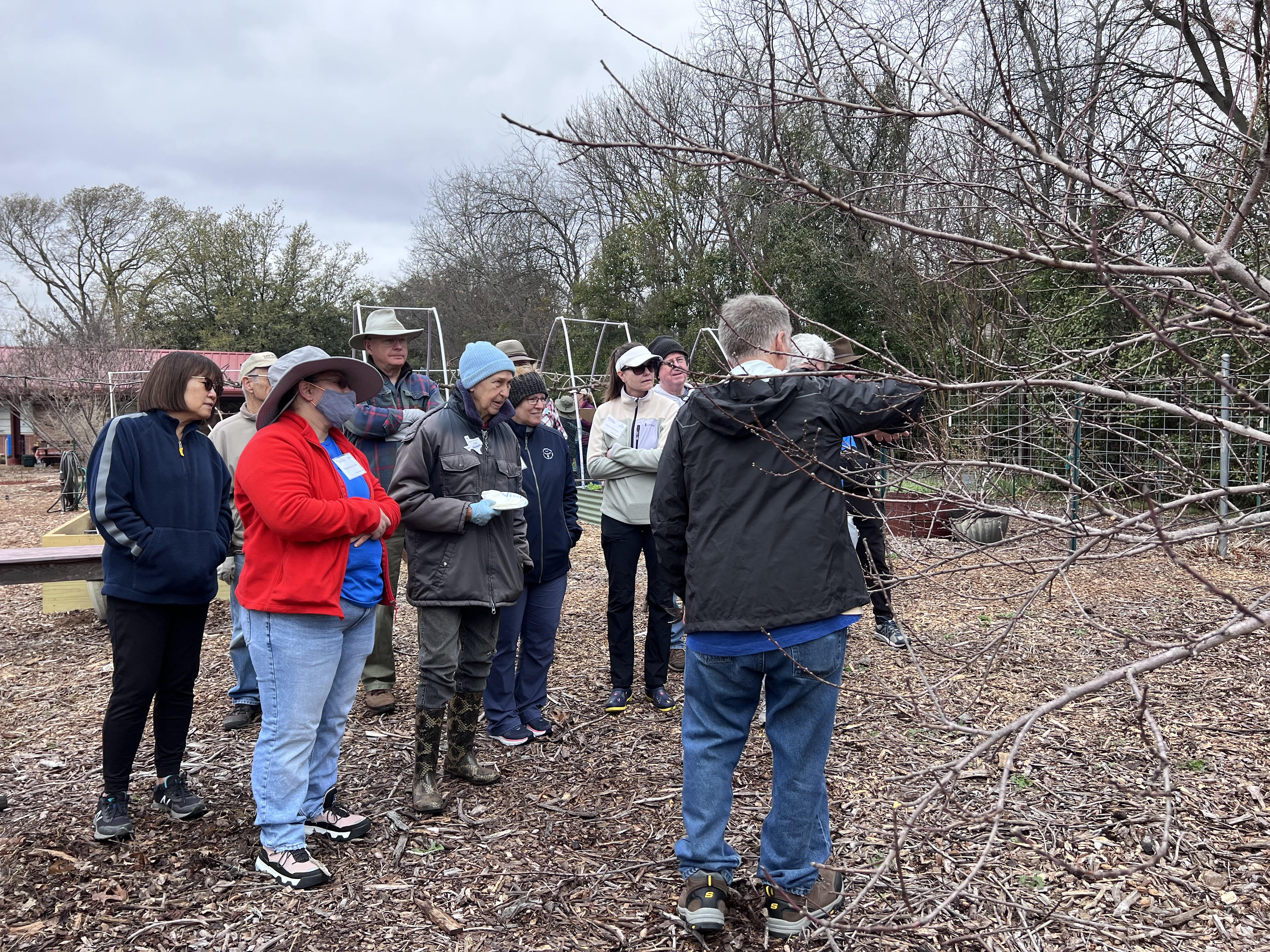
It was a grey day in March when Raincatcher’s volunteers gathered in the orchard to learn about fruit tree pruning with Jeff Raska.
Fruit trees are pruned to stimulate the growth of new fruit bearing wood and control the direction of the new growth, allowing for maximum harvest, sunlight and airflow.
You may feel like I do and would like to have Jeff standing beside you as you begin. We have provided this video and *some very good notes you can use next year before wielding those shears.
Seasoned Master Gardener Volunteers and Interns in the Orchard, happy with their work having learned the secrets of pruning from our Dallas County Extension Agents
We have planted 4 varieties of apple trees at The Raincatcher’s Garden. Jim gives us the names of the apples and a lesson in espalier in this utube video.
Tomorrow morning, March 6th between 9 and noon, Jeff Raska will be at The Raincatcher’s Garden to prune our new apple trees and our peach and plum trees. Join us!
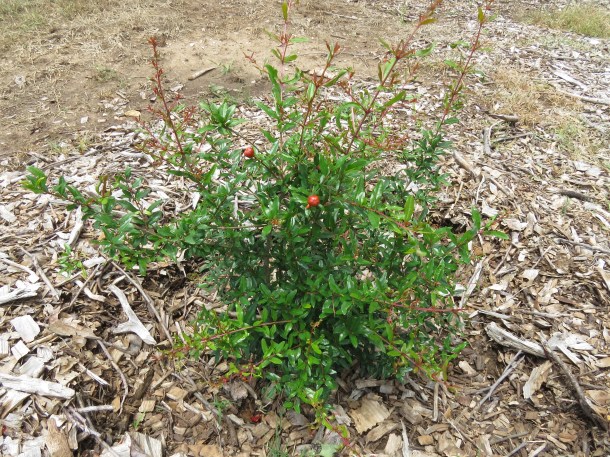
The orchard was one of the first things planned when we started up at Raincatcher’s garden of Midway Hills. Six different trees were chosen and then planted in January 2015. Most of these were purchased, but the pomegranate was brought over from our previous location. One of the things about planning and planting an orchard is to realize that it usually takes 3 years for the trees to bear fruit. So we planted, pruned, and then waited. The first season was as expected – we could see the growth pattern of the different trees, but there was no fruit.
Our Very Own Pom Transplant
The winter came, and the trees lost their leaves and once again we waited till early February – and we pruned according to the type of tree – pears wrap around and grow vertically, while plums and peaches are pruned to a bowl type shape.
The last 2, persimmon and pomegranate, are more shrub-like and were not touched by the pruners. They were about 2-3 feet tall at this time.
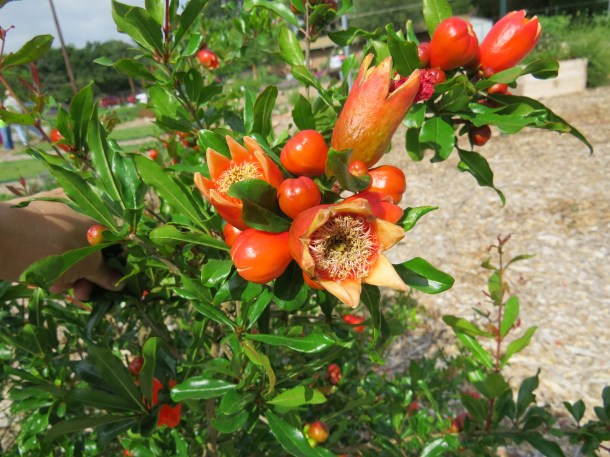
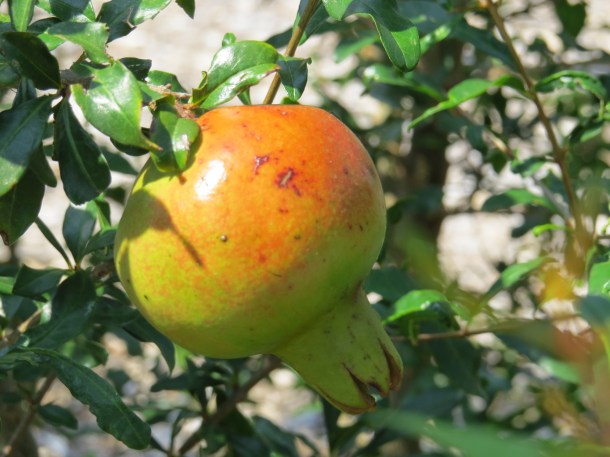
By March new growth was appearing and the effects of pruning was taking shape — a few blossoms appeared on the plums and peaches, but fruit did not follow. The pomegranate, however, was a different story – it began to grow, — and then blossoms appeared in March and April with this beautiful orange bud which then became a flower – the bees came to pollinate , and then fruit started to form. The shrub is now over 5 feet tall and is laden with beautiful orangey pomegranates -Yes it’s only the second year, but we will have pomegranates in the late Fall.
Pomegranate Flowers Followed by Fruit
Pomegranates are ready to harvest about 6 months after the flowers appear, so come later October or November our pomegranates will be ready. They should be the size of an orange and the color will vary from yellow to bright red. We are looking forward to celebrating this harvest by making some pomegranate jelly !
We are excited about our new orchard. Peaches, plums, pears, persimmons, pomegranates, and grapes, figs, and blackberries will be part of our future crops and future recipes.
Dig in to this video to learn the purpose of a berm. We built berms around our trees in the orchard. This is also useful information for other types of tree planting.
Next Tuesday, March 3rd 10-noon, we will be awaiting the arrival and planting of large container grown and balled and burlapped trees. Last week a Ginkgo tree was planted. Next week: Chinquapin oak ,Mexican Oak, Lacey Oak, and Cedar Elm. All tree huggers invited!






 DALLAS GARDEN BUZZ