Happy New Year from
The Earth-Kind® WaterWise Demonstration Garden
on Joe Field Road.
We hope you will take steps in 2013 to cure Nature Deficit Order.
Excerpts from the Great American Campout website and American Academy of Pediatrics:
- An “indoor childhood” hurts bodies & spirits.
- Today’s kids are more likely to “tag” a friend on Facebook than outdoors in a game of “freeze tag.”
- Kids today run from school to activities to sports w/ barely a minute to catch their breath. Loss of free time can contribute to stress, anxiety, & depression in children. (American Academy of Pediatrics)
- Studies show being outdoors is the perfect anecdote. Time in green spaces reduces children’s tension levels & enhances their social interactions, helping them to feel more connected to self and others.
Learning in the Garden
Sources cited:
- Growing Food LiFE Curriculum Series
- Botany on Your Plate (Univ. of CA & NGA)
- Math in the Garden (Univ. of CA & NGA)
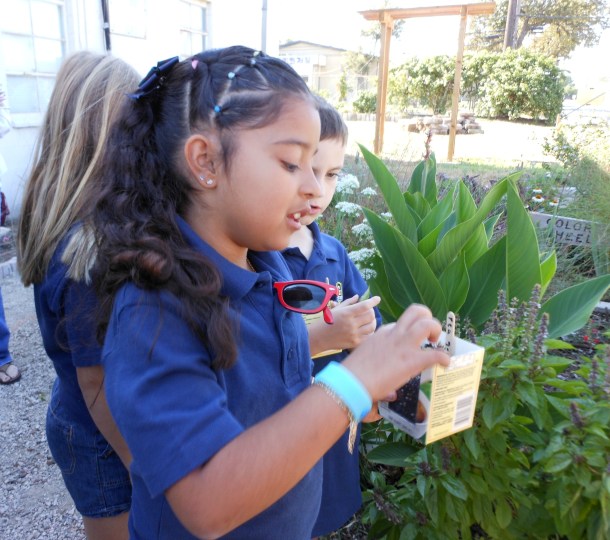
Using a garden helps teach the core concepts to diverse learners in an untraditional setting and grow into a relevant teaching tool.
Simple truths about working w/ students in a garden setting:
- Students can better understand their environment by exploring it and hone their knowledge and skills while doing so.
- An “outdoor learning center/classroom” creates a destination, a reason to outdoors.
- Enhancing the outdoor learning center creates a schoolyard habitat: “If you build it, they will come.”
- Students become stewards, stakeholders, creators by having a stake in planning and sustaining a school garden.
- Gardening fosters teamwork, builds community, encourages sharing and understanding which in turn, creates decision-makers and problem-solvers.
- Gardens are multi-sensory environments; students can use all of their senses to observe, predict, and understand how the world works.
- Connections are created w/ the natural world & our region’s uniqueness.
- Interdisciplinary learning is possible – connects Math, History, Language Arts (journaling, botanical names/Latin roots), Creative Arts, Social Sciences (bio-diversity and interdependence in plant and animal communities as in human communities), Life Sciences (nutrition, healthy choices, life skills).
A garden setting is ripe for inquiry learning, doing & thinking rather than learning a set of predetermined facts by rote. Einstein said the most important thing is to never stop asking questions. Knowing how to find answers to those questions is every bit as important as knowing the answers.
Since the early 1970s, research on how students learn Science stressed the importance of starting instruction based upon student perceptions & experiences. In other words, you start w/ what they know or perceive to know and make meaningful connections between new knowledge and existing knowledge. What teachers need to remember is children build their ideas over many years of explorations. They tend to hold onto these ideas/beliefs tenaciously. Time and countless repetitions (in large groups, small groups, or individually) are needed for them to examine new evidence, new explanations and new ideas and draw meaningful connections w/ their preexisting knowledge. For new concepts to take root, they must make sense and fit into the students’ experiences that have been created outside the classroom.
Unfortunately, Science is taught by “rote learning.” No consideration is given to what science ideas students might bring to the classroom. To cultivate meaningful learning of real world concepts, we need to draw upon their experiences, whether the experiences are misconceptions or incomplete learning, & connect the content currently being taught to their world.
Science in the Garden can encompass the following concepts:
Humans rely upon a world of complex systems – the Earth, its ecosystems, its food systems. Human activities impact our natural world for better or worse. In a garden, students can grow food while maintaining a living lab. They can investigate & monitor weather changes & the impact on a garden ecosystem. Or, they might study decomposition, observe life cycles (seed to food, egg to butterfly), or see how matter and energy flow through ecosystems (the process of food production and the release of energy).
Math in the Garden: allows students to hone their mathematics knowledge and skills to carry out investigations in the garden environment. This is an untapped source of patterns, comparisons, problem-solving, measurement, number operations, Algebra, Geometry, and data analysis.
At the base of all of this is Journaling, keeping an account of the natural world around you. Your Journal will be a guide, developed over a period of time, of noticing and noting changes, monthly and seasonally, of life cycle events.
Annette
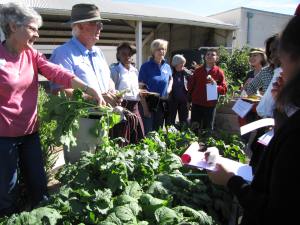 Fifth grade students from West Dallas learn about root crops from Jim and Abbe. Did you know that the turnip or white turnip is a member of the parsley family, Brassica rapa var. rapa? It is a root vegetable known for its bulbous tap root which is high in vitamin C and grown as a food crop for both humans and livestock. Turnips are easy and quick to grow (35-70 days) and can be eaten raw (roots) or cooked (roots and leaves). Turnips like well-tilled soil and constant water. Both of these conditions are provided in our raised organic beds via our home-made compost and drip irrigation system.
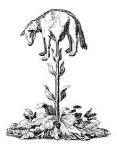
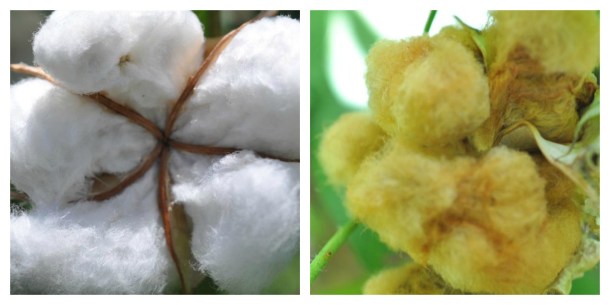
 Carolyn demonstrates the technique of hand-spinning cotton thread to the fifth grade students . Did you know that cotton is the most important non-food crop in the world? Cotton has been spun, woven & dyed since prehistoric times. Today, industrial uses for cotton are just as important as the cloth that originally was woven. These products vary widely from cloth-based such as diapers, bandages, and paper to cosmetics, soap and oils; dynamite and plastics; and that sidewalk scourge, chewing gum (cellulose). There are 39 different species of the genus Gossypium, 4 of which were commercially grown since all cotton was domesticated in antiquity. The variety G. hirsutum became known as “upland cotton” and comprises 90% of the world’s cotton crop.
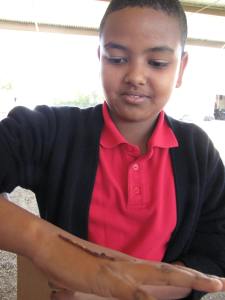 A 5th grade student from West Dallas Community School gets up close & personal with a “red wiggler” worm. During our Vermi-composting lesson, he & his classmates learned that this little ‘Eisenia fetida’ is one of approximately 2700 different kinds of worms of a large variety of species. Did you know that “red wigglers” (aka brown-nose or red worms) work best in container/bin composting. That’s because they are non-burrowing and move horizontally through the soil.
 Journaling is an integral component of the educational program offered by the Demonstration Garden. Our Nature Journals, made from recycled materials are constructed by our student visitors and personalized to reflect their connections with the garden. A 5th grader from West Dallas Community School proudly proclaims, “Nature is My Life.” Her journal became her memory book of observations, descriptions, illustrationsand connections; a special way of carrying a piece of the garden home with her.
 Meet Opal, named for Judy’s Aunt Opal.






 DALLAS GARDEN BUZZ