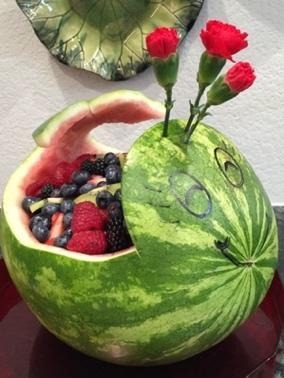
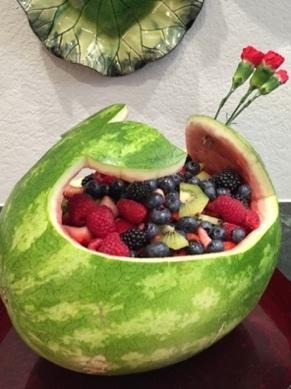
Watermelon is the most popular holiday fruit with around 700 million pounds consumed during the week of July 4th. From “eating races” and seed-spitting” contests to “grower competitions”, prizes are awarded annually to participants across the United States.
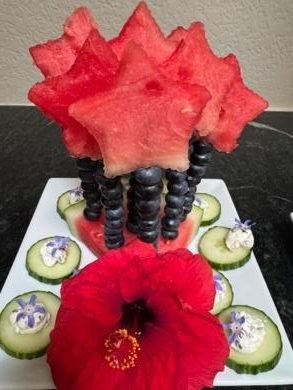
Grammy and Sadie with our Watermelon and Blueberry Sparklers
If you are thinking about growing watermelon in your garden, here are some things to consider:
There are over 1,200 varieties of watermelon globally which are categorized into the following types:
Picnic: Large, oblong or round melons. Typically weigh 15 – 45 pounds. (Charleston Gray)
Icebox (Mini): Round or oval melons. They weigh 5-15 pounds. (Sugar Baby)
Personal: Ultra-compact, single-serving melons, weight 3-7 pounds. (Mini Love or Golden Midget)
Seedless: Most common commercial variety specially bred to contain no mature black seeds.
Yellow/Orange Fleshed: Colorful interiors instead of red. (Orangelo or Yellow Doll)
In our Zone 8 climate, these are a few the varieties you might want to try:
Crimson Sweet: This variety is recognized as the most popular and is prized by home gardeners and commercial growers alike. The average weight is around 25 pounds. It features a light green rind with dark green stripes. The bright red flesh is firm and fine-textured and exceptionally sweet.
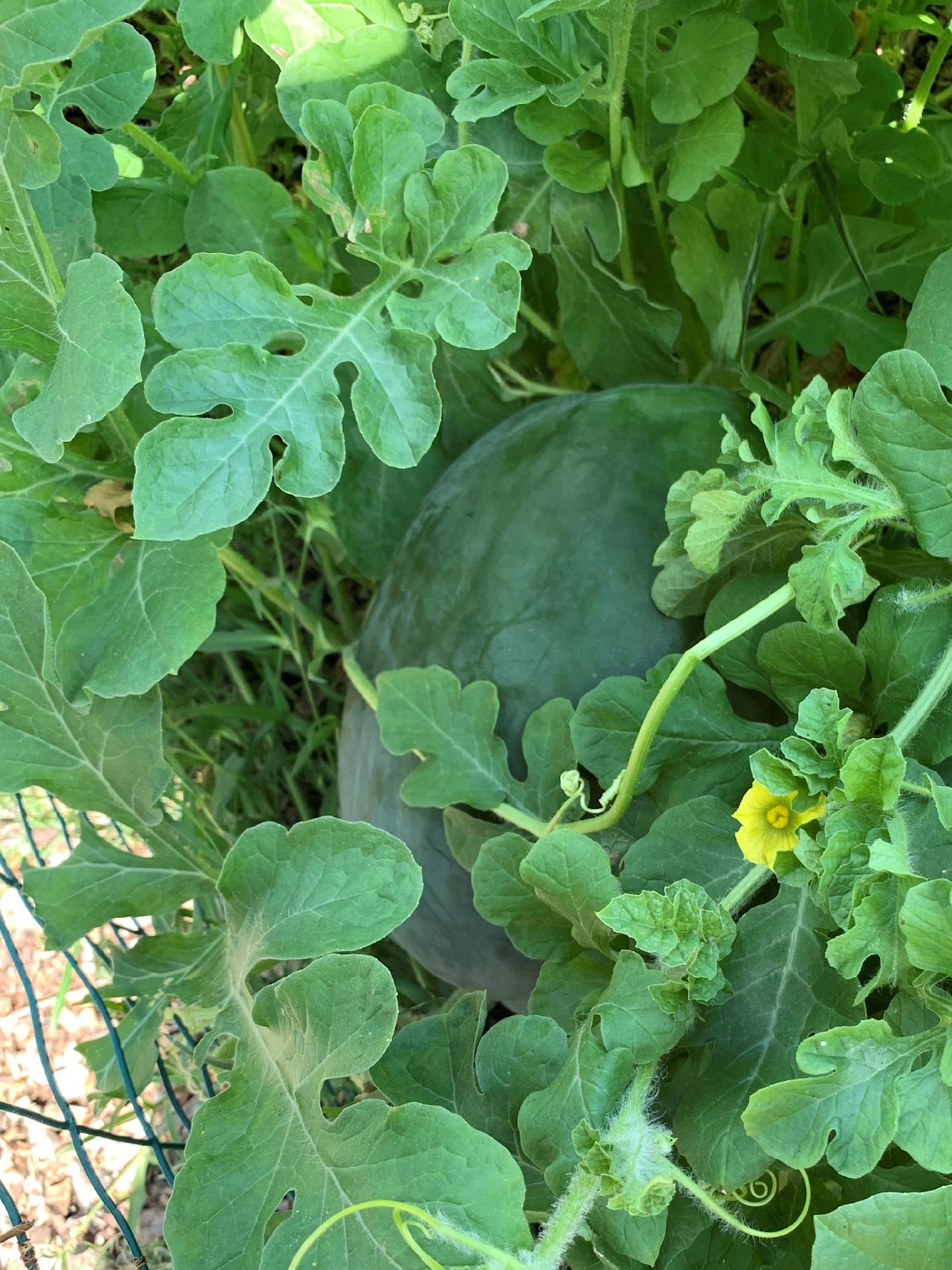
This is the variety I chose to plant in my garden about a month ago. It receives about 6+ hours of full sun daily. Just a baby now but with 80 days to maturity, it should be ready to harvest sometime in mid-August.
Other top varieties for Zone 8 include: Sugar Baby, Charleston Gray and Jubilee.
And finally, if you are craving watermelon, here are several reasons why:
*Watermelon is composed of about 92% water, making it one of the most hydrating foods available.
*Watermelon is a natural sugar fix. It provides natural sugars in the form of fructose, offering a subtle yet effective energy surge without the pitfalls of processed sugars.
*Watermelon is a rich source of lycopene, a powerful antioxidant known for its numerous health advantages.
*It is an electrolyte balance. Potassium, an essential electrolyte found in watermelon, helps regulate fluid balance, muscle contractions and nerve signals.
*Watermelon is a good source of Vitamin C, vital for skin health, immune function and the absorption of iron from plant-based foods.
*Dietary Fiber. Though it’s mostly water, watermelon also offers dietary fiber which aids digestion and promotes a feeling of fullness.
Linda Alexander, Dallas County Master Gardener Class of 2008
Read Jon Maxwell’s article on Black Diamond Watermelon here.
Some people argue that watermelons are a fruit, others a vegetable, and still others that it is both!
The argument for both is that the watermelon is a fruit (the seed bearing ovary of a plant), and a vegetable (an edible plant). Watermelon has a place with the Cucurbitaceae family, which includes cucumbers, gourds, pumpkins and different things that are traditionally known as vegetables. Its logical name being Citrullus lanatus. Regardless of its classification it has been a welcome addition to our Raincatchers’ garden this year.
Watermelon Patch at The Raincatcher’s Garden
Our vegetable team took over an in-ground planting bed and planted watermelon seeds earlier this spring, but they didn’t just plant any old watermelon, no they chose what has been called the “king” of the garden, Texas Black Diamond watermelons! Texas Black Diamond watermelons are an heirloom, open-pollinated, oblong variety of watermelon, which grows on vigorous vines and produces a black-green rind. Its bright red flesh is noted for its juiciness and sweet taste, best eaten ice cold after sitting in tubs of ice for several hours!
Growing up in Oklahoma we called this variety, “Rush Springs” watermelons, since they were mostly grown around that small south central town – but they are the same variety as Texas Black Diamonds. Rush Springs’ citizens, population about 1,300, call their town the “Watermelon Capital of the World”. The town’s largest event, in mid August, is the annual Rush Springs Watermelon Festival, which attracts more than 20,000 people each year, who consume about 50,000 pounds of locally grown watermelons.
When my family and I lived in San Antonio it was always a big event when the Texas Black Diamond watermelons were brought into town, up from the “valley” or from Luling, TX. Even some of the radio stations would get involved by broadcasting the locations of the make shift farmer’s markets, where the watermelon farmers would sell their prized produce off the back of their farm trucks.
One of my fondest memories involving watermelons, was taking a very long drive from Oklahoma City to Carlsbad, NM to tour the unbelievable caverns, when I was about 8 or 9 years old. On our return leg we stopped overnight in Midland, TX for a visit with relatives. A tremendous panhandle thunderstorm roared through the town taking down the electricity – not a problem for our gaggle of 14 kids, we still enjoyed the ice cold Texas Black Diamond watermelons and had a fun filled evening participating in a spontaneous seed-spitting contest followed by a rowdy game of tiddlywinks, using the seeds as the game pieces! Oh what fun, but oh what a mess to clean-up in the light of the coming day!
The Texas Black Diamond Watermelons do take up a lot of valuable land and the farmers have been switching to different varieties that consume less land and produce more prodigiously. The demand for Texas Black Diamonds is still quite strong and those that are grown hardly ever make it up into Dallas area anymore, unfortunately.
When to start growing watermelon?
Most gardeners choose to plant their seeds early in the spring so they can enjoy their ripe fruits during the hottest summer months, as watermelon needs about 90 – 120 days to fully grow, from start to finish.
Where do you plant watermelons?
Plant your watermelon seeds outside when there’s no more danger of frost. Watermelons must be planted in soil that is warm a few inches (centimeters) below the surface. You can place mulch on the soil to keep it warm.
Seeds may be planted in hills or in rows. Space watermelon plants 6 feet apart in hills. Thin to the best three plants per hill. If planting in rows, watermelon seeds or seedlings should be seven to 10 feet apart.
How tall do watermelon plants grow?
Generally, watermelon plants will grow to a height of approximately 24 inches, and sprawl approximately 3 to 20 feet wide. The vine produces coarse, medium-green leaves, while the fruit can weigh anywhere from 10 to 50 pounds with solid dark green skin.
Young Watermelon
When Is a Black Diamond Watermelon ready?
Calculate the age of the plant, starting with the day of planting. Black Diamond watermelons take 90 to 120 days to reach maturity, so if the plant is younger than that, the fruit is probably not ripe.
Feel the skin of the watermelon. When Black Diamond watermelons are ripe, the skin is somewhat rough. I generally also use the “thump” method, if you get a somewhat hollow sound it generally means the watermelon is ready to be picked.
Even if you only have space for one or two Texas Black Diamond Watermelon plants, you will enjoy the results of your labor and maybe make your own memories.
Jon Maxwell, Dallas County Master Gardener Class of 2015
Pictures and additional input by Beverly Allen, Dallas County Master Gardener Class of 2018