A Springtime Treat 

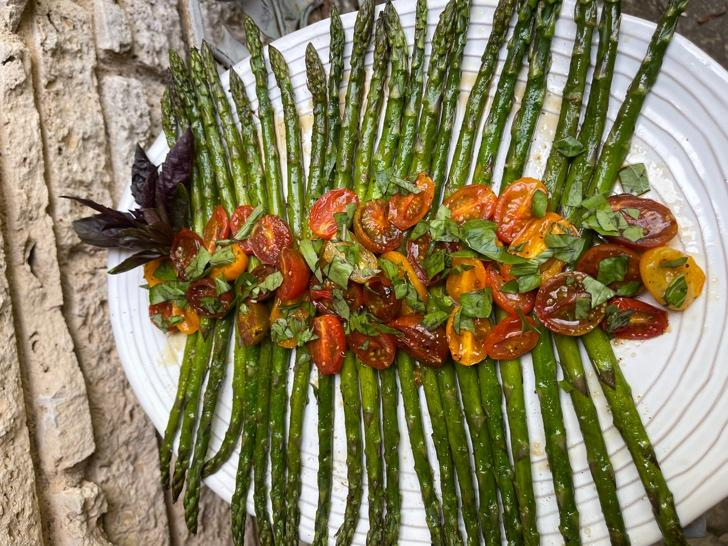
Asparagus Caprese Salad

Last week I made one of my favorite seasonal dishes. If you imagined a multi-layered cake enrobed in a sublime chocolate frosting or a deep-dish fruit cobbler oozing with a syrupy filling and the perfect cinnamon-dusted crust, think again. 

Instead, I’m especially drawn to the simplicity of a different springtime jewel. Colorful, tasty and nutritious, this one is a winner for me. 

Roasted Caprese Salad is easy to prepare and lovely to serve. If you already have asparagus growing in your springtime garden, chances are the other ingredients may be found there, as well. Gather up some cherry, grape or Campari tomatoes, several sprigs of basil and head to the kitchen. For the past few years, I’ve developed a fondness for Balsamic Blooms and Cardinal basil. Both are growing in my garden now. The leaves hold up well using the chiffonade method and maintain their color nicely. 

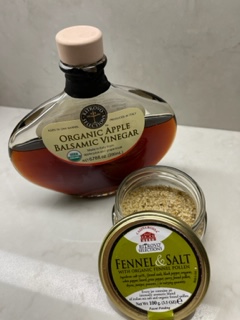
After reviewing the recipe, you might want to follow it, as is, or try my suggestions for adding a little punch to the flavor profile. Once roasted and out of the oven, I like to drizzle the tomatoes with a generous splash of Apple Balsamic Vinegar. Next comes a sprinkling of Fennel Salt with Pollen. Finish the dish with chopped basil and prepare to dazzle your family or guests.
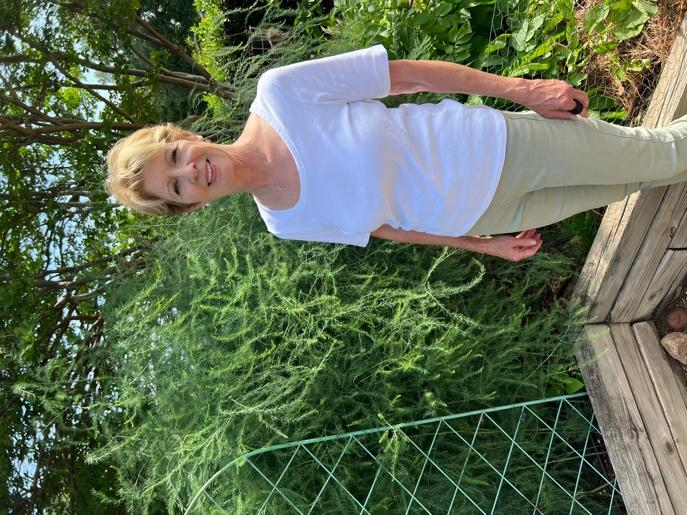
Sheila Standing in Front of her Asparagus Bed

Master Gardener, Sheila Kostelny, graciously shared her asparagus growing tips in a short Q & A. 

When did you first plant asparagus in your lovely backyard garden?

“I planted 2-year crowns from Redenta’s in 2014. I believe the variety is UC 157. I lean on the wisdom of Dr. Sam Cotner, Dr. Joseph Masabni and Skip Richter for advice regarding all my vegetables.”

When do you start harvesting?

“I harvest them from about the second to third week in February for about 6 weeks. Then they present foliage that I will use for flower arrangements for the rest of the growing season.”

How long do you expect your asparagus to produce?

“In North Texas, the crowns should continue to produce for 12-15 years. That’s quite a bonus for little effort on our part.”

What do you enjoy most about having asparagus growing in your garden?

“Asparagus are a ‘no fuss’ no muss’ vegetable. They require little and reward you with a sweet, bountiful harvest. What I especially love about them is that they grace your garden in the dead of winter when there is nothing else to bring to the table.”

Happy Growing Sheila! We appreciate your asparagus “tips”.

Linda Alexander, Dallas County Master Gardener Class of 2008
National Wildflower Week

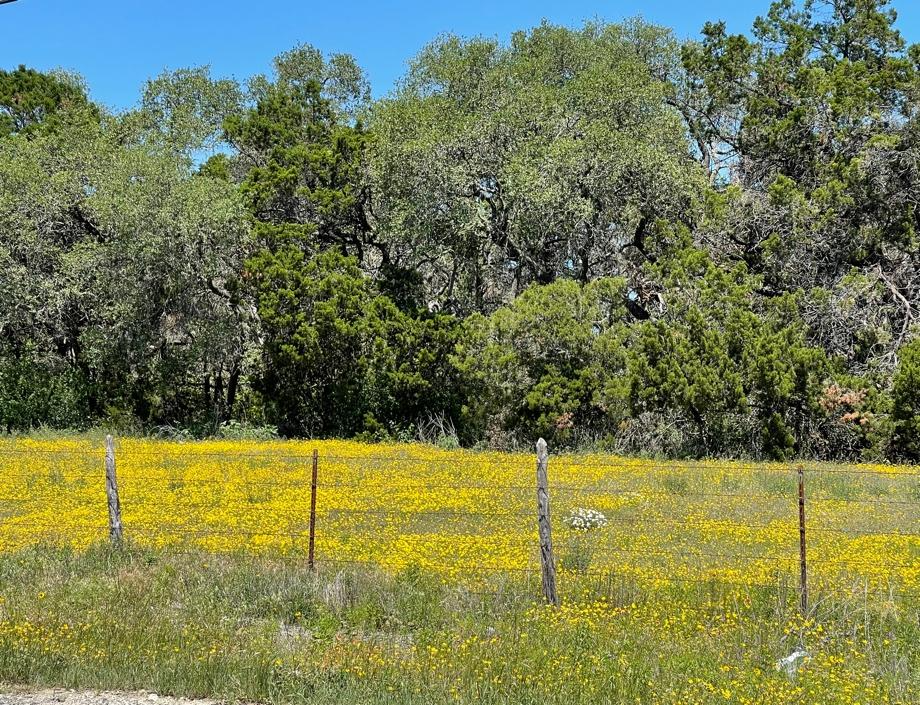
National Wildflower Week takes place each year the first week of May. This weeklong tradition was started in 1987 by The Lady Bird Johnson Wildflower Center to celebrate the beauty and importance of native wildflowers across the United States. If you haven’t taken a “road trip” through the Texas Hill Country this spring, there’s still time to enjoy the profusion of wildflower blooms on the highways, byways and Farm to Market roads of Texas. 

 Our journey started with a smart decision to head back to Dallas from Austin last weekend by avoiding 135 and choosing, instead, to travel leisurely up 281. From Marble Falls to Hico, the panoramic views of fields blanketed by wildflowers was spectacular. Roadside stops were frequent, as patches of colorful Texas natives caught our eye.

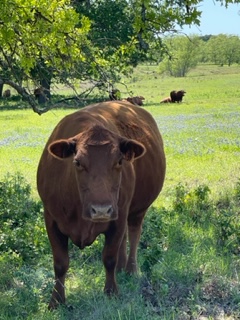
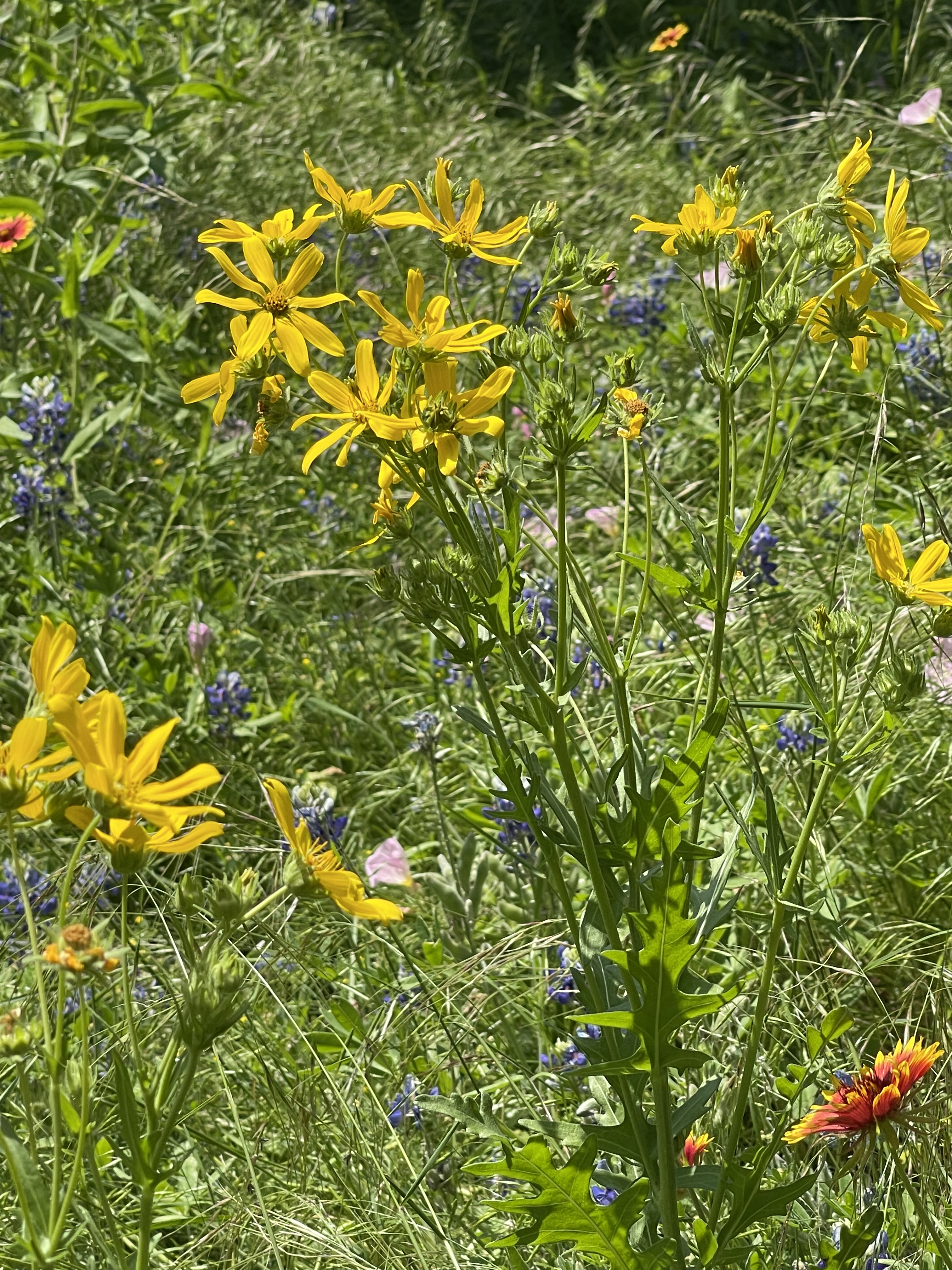
Cattle grazing in and among pastures of bluebonnets didn’t seem to mind the closeness of our visit. Barbed wire fences stretching through the fields of yellow gave testimony to the hill country vistas so typical of our great state. Even the iconic windmills served to remind us to simply slow down and take in the sights and sounds of country life.

Sometime next week we hope to travel down another favorite route, highway 16 from Goldthwaite to the Willow City Loop. It’s a trip we’ve made countless times with each one somehow surpassing our expectations. A necessary stop at Cooper’s Barbeque in Llano will satisfy our hunger for the remainder of the drive. Here’s hoping you enjoy a few images of the scenic Texas hill country.

Linda Alexander, Dallas County Master Gardener Class of 2008
The wildflowers at Raincatcher’s were beautiful this year. We hope you made a “local” road trip to see them on Midway Road.

Here’s a little more information to promote seeds of thought:

How to grow bluebonnets.

Our Texas Wildflower

Plant Sale Today at Raincatcher’s

Raincatcher’s Garden  Annual Plant Sale  

Thursday, May 4th 2023 

10 AM – 3 PM 

Midway Hills Christian Church 

11001 Midway Road 

Dallas, Texas 75229 

We will have annuals, perennials, herbs, peppers,  succulents, shrubs, trees, groundcover, bulbs,  houseplants, decorative pots, yard art, compost and  so much more!! 

All proceeds from this sale go to Dallas County  Master Gardener Projects.

CASH, CHECK, CREDIT CARD ACCEPTED

“Happy Together”

‘Brilliant Pink Iceberg’ Floribunda and onion chives at Raincatcher’s in the edible landscape


Imagine me and you, I do…
I think about you day and night, it’s only right!

Just as the Turtles sang to us in 1967, some things belong together. In the plant world this loving and beneficial relationship is commonly referred to as “companion planting.” You might even have heard the popular expression…” roses love garlic.” Let’s consider several reasons why.

From the New York Botanical Garden

*Members of the onion family such as chives, ornamental alliums and edible onions are rumored to increase the perfume of roses, ward off aphids and prevent black spot. Herbs and other aromatic plants make wonderful rose companions. 

According to Birds and Booms

*Garlic protects roses from not only bad bugs, it can also help prevent fungal diseases. Aphids don’t love garlic, they hate it!

The Garlic Farm offers this advice – 

*Plant three to four cloves in a circle around each rose bush, and the sulphur present in the garlic will disperse into the soil and be taken up by the roses – making it a less palatable treat for little bugs.

Gardening Know How says – 

*Rose lovers have planted garlic, chives, garlic chives and onions in their rose beds for many years. Garlic has been known to repel many pests that bother rose bushes. Garlic chives have interesting foliage, repel some pests and their pretty little clusters of white or purple flowers look wonderful with the rose bush’s foliage. 

Seasoned gardeners offer these tips – 

Included in the list of rose companion plants are alyssum, lavender, marigolds and parsley. 

Be sure to check on the companion plant’s growth habit as to height. In many cases, you might want lower-growing companion plants. Herbs will work well planted in the rose beds but, again, check their growth habits to be sure.  

Pairing members of the allium family with your roses helps to ward off aphids with their strong scent and may prevent black spot.

So glad we knew about this dynamic relationship when planting our beautiful rose topiary a few years ago and surrounding it with garlic chives. As you can see from the photo, they seem to be saying… yes, we are indeed happy together!

Linda Alexander, Dallas County Master Gardener Class of 2008


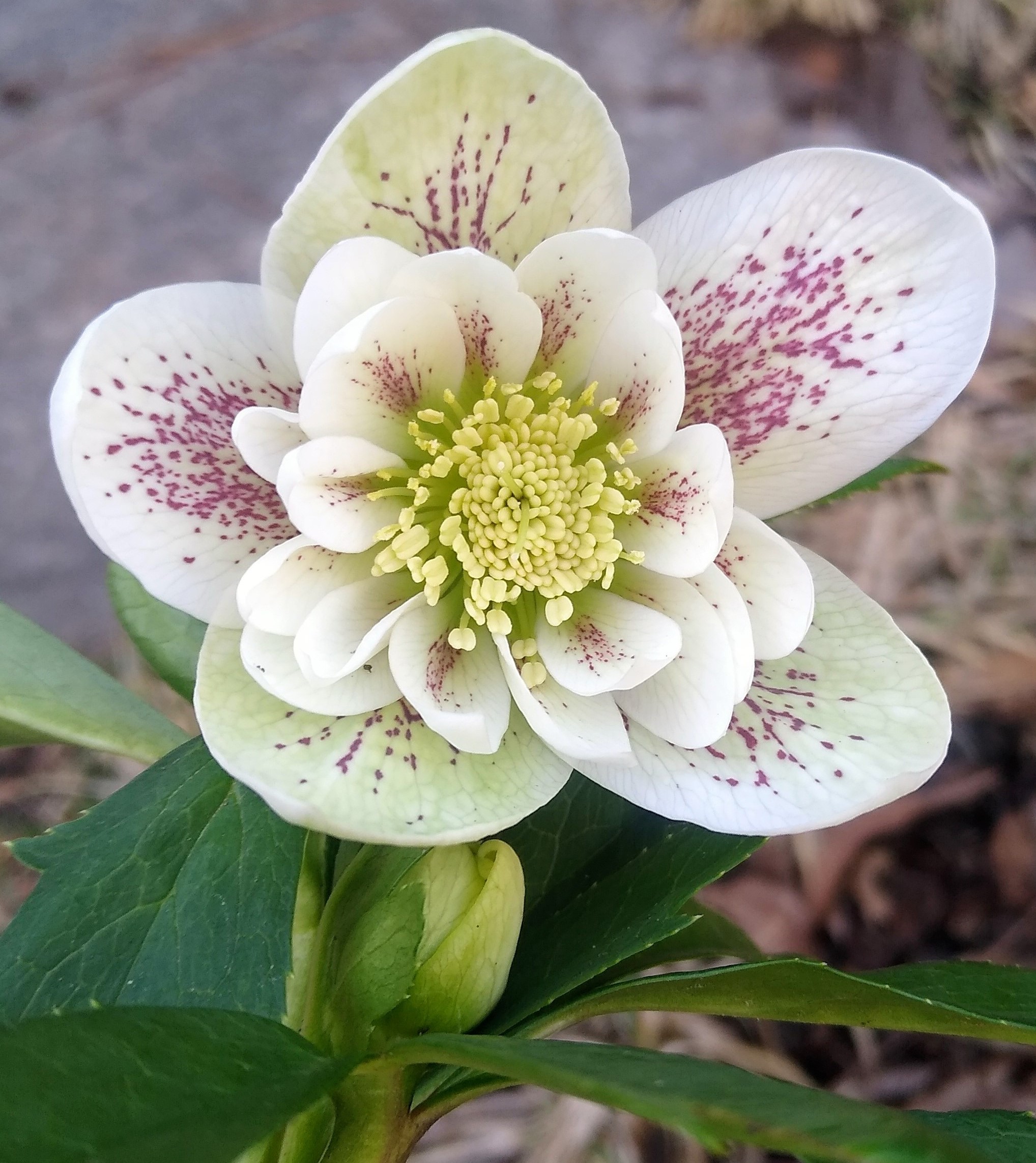
Lenten Rose 

May 2, 2023

Lenten Rose in bloom

Lenten rose plants (Helleborus x hybridus) are not roses at all but a hellebore hybrid. It was given its name because the flower looks similar to a rose and it blooms in early spring often during Lent.  This is another plant that we will have at our annual Raincatcher’s Plant sale on Thursday, May 4th.  

It is an evergreen, slow growing perennial and the blooms on the heirloom varieties are downward facing.  The flowers are very long lived, sometimes remaining for eight to ten weeks.  

Lenten rose thrives in partial to full shade which makes it a good plant for adding color and texture to dark areas of the garden.  Try planting it in small groups of 3 to 5 plants (18 to 24 inches apart) or plant along walkways and edging.   As you can see from the photo, it looks great planted alongside purple oxalis and holly fern.  It is best to keep the soil moist but it can tolerate drier conditions once established.


Lenten Rose foliage with Holly Fern and Purple Oxalis

We hope to see you at our plant sale on Thursday, May 4 from 10 AM to 3 PM.  Raincatcher’s Garden is located at 11001 Midway Road, Dallas, Texas on the campus of Midway Hills Christian Church.  Raincatcher’s is a Dallas County Master Gardener program and all proceeds from this sale benefit master gardener programs.   

Jackie James Dallas County Master Gardener 1993 

Come shop the sale on Thursday, May 4th, 10am until 3pm.

Midway Hills Christian Church 11001 Midway Road Dallas, Texas 75229

Feed the Bees…A Smorgasbord of Plants for Zone 8

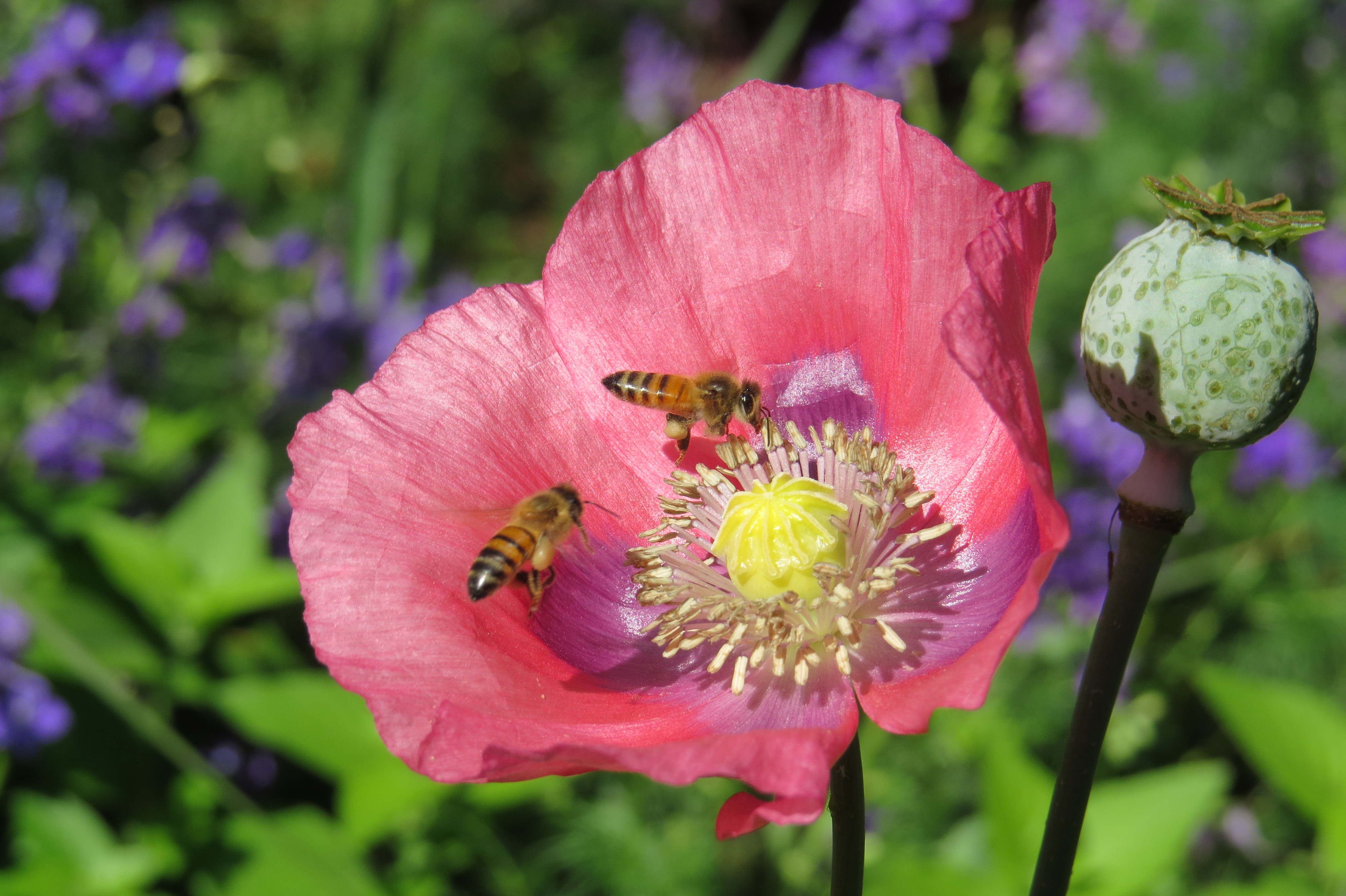
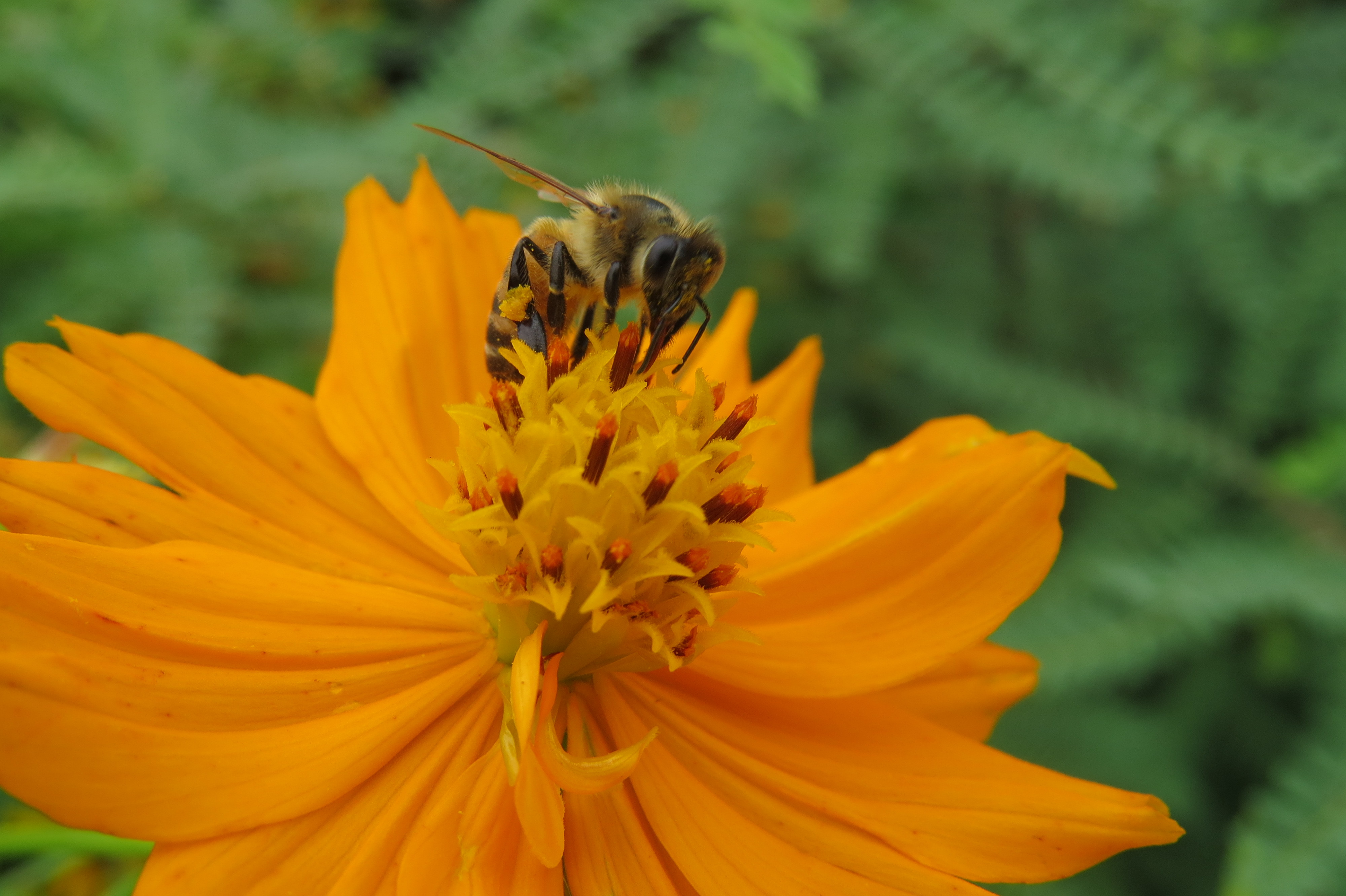
Bees require both nectar and pollen sources for survival. Each source has a specific purpose, nectar for energy and pollen for protein. Let’s do our part by offering them blooming plants throughout the seasons and help to avoid a feast or famine situation for the bees. Included in this post is a partial listing of nectar and pollen sources along with photos of seasonal plants loved by honeybees. Be proactive and intentionally plant flowers that bloom at different times of the year.

Annuals

*Alyssum

*Basil (especially African Blue and Cinnamon)

*Cockscomb

*Fuchsia

*Larkspur

*Love-in-a-Mist

*Mexican Sunflower 

*Moss Rose

*Snapdragon

*Stock

*Sweet Pea

*Zinnia

Perennials

*Anise Hyssop

*Fall Aster

*Borage

*Clovers

*Columbine

*Chrysanthemums

*Scented Geranium

*Lambs Ear

*Lavender

*Mallows

*Scabiosa

*Shrimp Plant

*Statice

Vines

*Black-eyed Susan Vine

*Cantaloupe

*Clematis

*Cucumber

*Gourds

*Honeysuckle

*Jasmine

*Morning Glory

*Passionflower

*Pumpkin

*Squash

Shrubs

*Azalea

*Barberry

*American Beautyberry

*Boxwood

*Butterfly Bush

*Cherry Laurel

*Cotoneaster

*Crepe Myrtle

*Fire Thorn

*Flowering Quince

*Hydrangea

*Spirea

*Viburnum 

*Weigela

*Wisteria

Linda Alexander, Dallas County Master Gardener Class of 2008
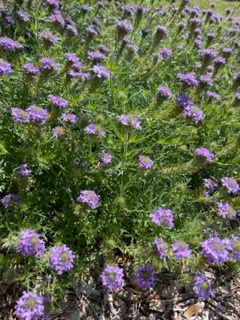
Pictures by Starla Willis, Dallas County Master Gardener Class of 2009

Mealy Blue Sage 

Mealy Blue Sage (Salvia farinacea) is a low maintenance, perennial plant that is native to Texas and Mexico and is heat and drought tolerant.   It is a 2 – 3 foot sprawling plant that forms a mound as wide as the plant is tall.  Its upright growth and showy flowers make it ideal for the back of a perennial garden.   The leaves have a grayish cast which makes a good contrast to the green foliage of other plants. 

Mealy Blue Sage has numerous flowers on a terminal spike and it requires at least 6 hours of sun for optimal growth and flower production. The stunning purple-blue flower spike brightens the landscape and attracts pollinators to the garden.  Once the flowers are spent, it produces a small, papery capsule that some birds enjoy as food.   The plant will reseed itself after established and the seedlings can be easily transplanted to other areas of the garden. This plant will grow thicker and will flower better in the fall if cut back in mid-summer 

This is yet another fabulous perennial plant that we will have available at our plant sale at Raincatcher’s Garden at Midway Hill Christian Church (11001 Midway Road, Dallas Texas 75229) on Thursday May 4th from 10 AM – 3 PM.  Hope to see you there!!!  

Jackie James, Dallas County Master Gardener 1993

Veggie Greenrose

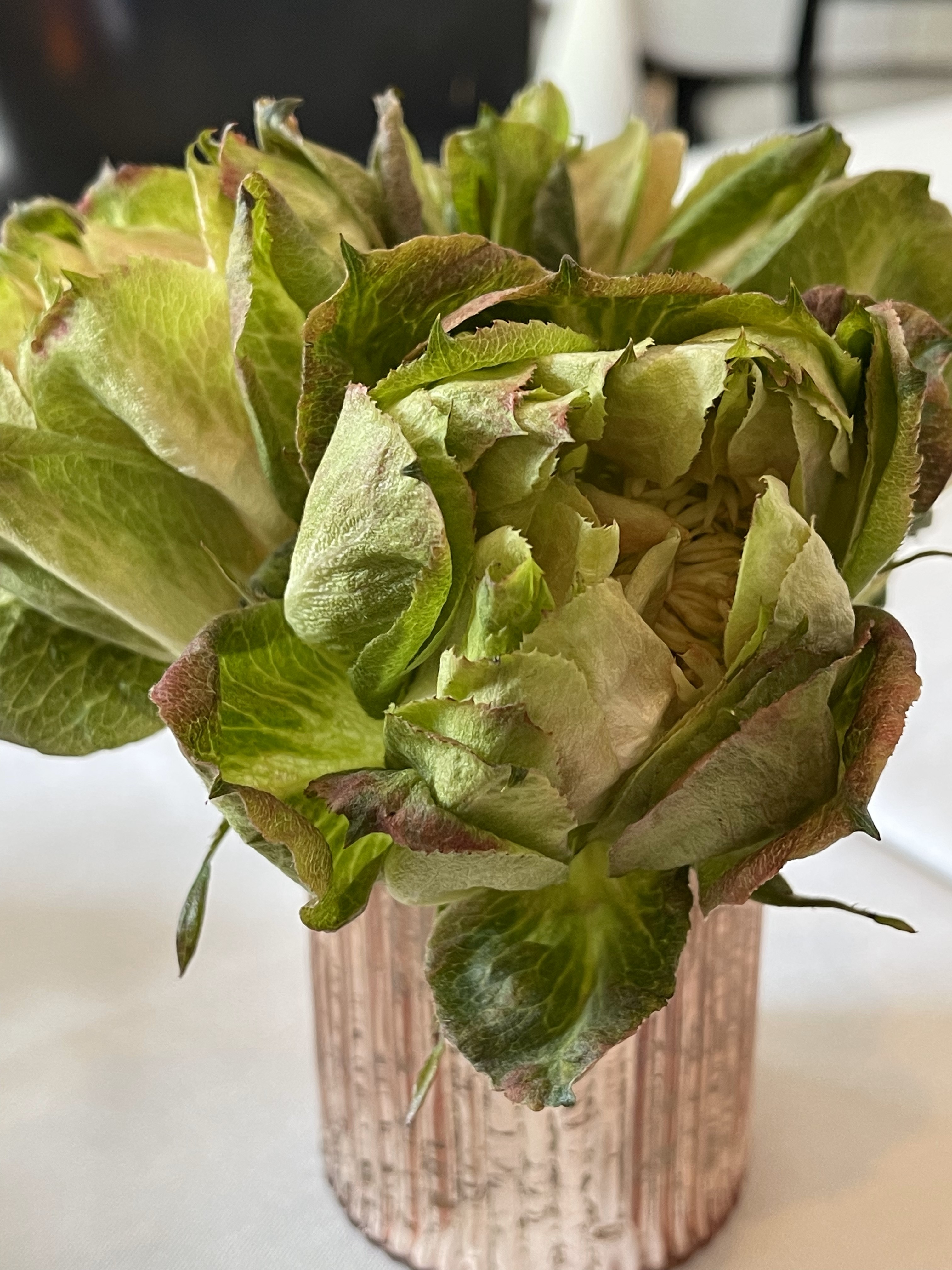
Green Rose in a Vase

On a typical Sunday morning following church, my husband and I can be found enjoying brunch at our favorite local bistro. A few weeks ago, was no exception. Parigi is owned by a dear friend of ours who, in “oh so chic” Parisian style, never fails to greet guests with a petite tabletop centerpiece of fresh flowers.

Taking a seat at our usual window table, we were mesmerized by the small but stunning floral display in front of us. Our server smiled as we inquired about the apple-green petals with bronze tips resembling a rose but tightly connected in a lettuce-type formation. Her answer was and short and simple… “I only know that it is called ‘Veggie Greenrose’.”

Brunch was delightful and relaxing but once in the car, a google search took me to a source that provided the best explanation. Here is an abbreviated version of what I learned. 

Our admiration was for a unique rose known as Green Rose, thought to be a descendant of Old Bush, a two-hundred-year-old form of Rosa chinensis viridiflora. China roses are extremely hardy and well suited to Zone 8. One grower observed that many winters, in Zone 8, the Green Rose never loses its leaves but remains a vibrant green with a tinge of red. 

While the buds on Green Rose bloom like any other rose, when open, there are never any petals. Interestingly, the rose bloom is made up of sepals on top of sepals followed by more sepals. Characteristic of its design, the sepals usually come together to form the “holder” of the flower. This holder is called a calyx, but the Green Rose never makes a true flower. Without a flower, there is no seed and no next generation of the plant. 

Thankfully, gardeners throughout the years who held Green Rose in high esteem, chose to take cuttings that were graciously shared with family and friends. Today, this rose exists due to the kindness and love of these special admirers. 

However, locating a source for Green Rose can be challenging. Once again, thanks to the internet, Mountain Valley Growers in Squaw Valley, California had them in stock. I ordered three small plants. Joyfully, my order arrived two weeks ago.

Following their instructions, Green Rose spent a few days acclimating to our climate. After a carefully selected location, it is now growing in my garden. And my dear friend and fellow master gardener, Ann Lamb, agreed to grow one of the plants in her garden. We plan to compare their growth over the next few months and eventually start taking cuttings to share with family and friends.

Ann and Linda with our beginner Green Roses

It is enchanting to consider a diminutive and wonderful rose that first appeared as early as 1743 in the area that later was named China. Even more intriguing is the fact that, at one time, it was forbidden for anyone outside of the Forbidden City to grow this rose. It was the sole property of the emperors!

Emperors aside, Ann and I have no walls or thoughts forbidding anyone to grow a beautiful rose that should have a place of honor in any rose garden! Let us know if you would be interested in having a cutting someday.

Linda Alexander, Dallas County Master Gardener Class of 2008
We have several rosarians amongst our Master Gardener crowd. Has anyone grown the Green Rose? If you have, send us a picture.

Four Nerve Daisy

Four-Nerve Daisy (Tetraneuris Scaposa) is a Texas native perennial plant that blooms almost year round.  It is evergreen with gray green foliage and bright yellow flowers that bloom on long leafless stems.  The plant itself is 6 – 12 inches tall (including the flower stem) with a 1 foot spread.  It is heat and drought tolerant and pest and disease free.  It also attracts butterflies and bees!


I have been growing this plant for about 10 years now and it has become my favorite plant.  I have paired it with grape hyacinth and have found this to be a great combination because they both bloom in early spring.  It’s a great border plant or rock garden plant and does well in full sun.  It does not tolerate over watering which is a good thing in my book!!!
This plant has a long taproot and does not transplant well.  It spreads from seeds and does well if dug when the seedlings are small.  I have been digging these tiny seedlings and will have some available at our plant sale at Raincatcher’s Garden on May 4th.

Raincatcher’s Annual Plant Sale

May 4th, 10 AM – 3 PM

We will have annuals, perennials, herbs, peppers, succulents, shrubs, trees, groundcover, bulbs, houseplants, decorative pots, yard art, and more.

Location: The courtyard at 11001 Midway Road, Dallas, Texas 75229

Jackie James, Dallas County Master Gardener Class of 1998

Friends of the Garden

Many of you have seen these color change artists in your own gardens but do you really know what they are and how they help to limit plant pests?

The green anole, Anolis carolinensis, is a small to medium-sized lizard, with a slender body and a long tail.  Its head is elongated and has numerous ridges between its eyes and nostrils, and smaller ones on the top of its head.  Its toes have adhesive pads to facilitate climbing.  The males are 15% larger than the females, and the male dewlap (throat fan) is three times the size of the female’s and ranges in color from bright orange to a light pink, whereas the females dewlap is lighter in color.  The extension of the dewlap from the throat is used for communications.  Males can also form a dorsal ridge behind the head when displaying or when under stress.

The green anole’s body coloration can vary from dark brown to bright green and can be changed like many other kinds of lizards, but anoles are closely related to iguanas and are not true chameleons.  The anole changes it color depending on mood, level of stress, activity level and as a social signal, (for example, displaying dominance).  Although often claimed, evidence does not support that they do it in response to the color of their background.

Ever seen one with either no tail or a very short one? An interesting fact is that the anole, like many lizards, has an autotomic tail, which will wiggle when broken off to distract a predator and allow the anole to escape.

This species is native to North America, where it is found mainly in the subtropical parts of the continent.

An anole’s diet consists primarily of small insects such as crickets, grasshoppers, flies, moths, cockroaches, small beetles, and other arthropods, including spiders, as well as occasionally feeding on various mollusks, (think snails and slugs), grains and seeds.

Jon Maxwell, Dallas County Master Gardener