Monthly Archives: March 2014

Bee Expert, Local Honey Tastings & Lunch

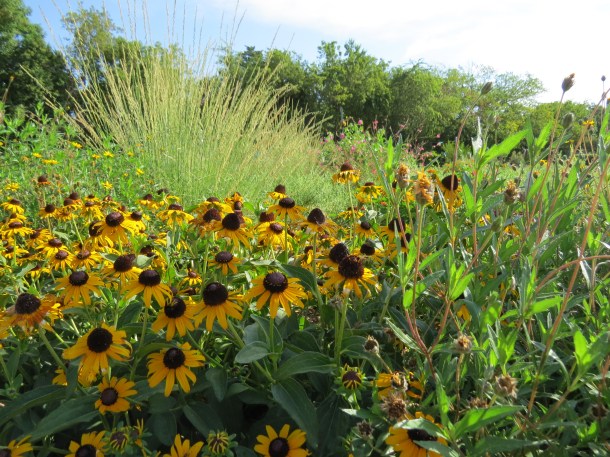
Bee on Blanket Flower

 TAKE THE “STING” OUT OF TAXES

Bee Expert, Local Honey Tastings & Lunch

It’s a Honey of a Deal!

Tuesday April 15 Ÿ10:30 a.m.-12:00 noon

$20 per person Ÿ Limited Reservations

EARTH-KIND®/WaterWise Demonstration Garden Ÿ 2311 Joe Field Rd.

Bee Expert David McCarty will tell you:

Ÿ Why are honeybees brilliant?

Ÿ Which bees produce the most honey?

Ÿ Why is the honeybee referred to as a well-designed engine?

Ÿ Why is the “waggle” dance a kind of honeybee GPS?

 Hello, Honey! Menu 

Appetizer Tray featuring Marcona Almonds & Artisanal Cheeses

Drizzled with Tranquility Hill Honey RanchŸ

Goat Cheese Handkerchiefs with Tart Cherries & SageŸ

Smoked Turkey, Red Grape & Pistachio Salad

With Creamy Honey-Dijon DressingŸ

Honey-Pecan Tart with Honey Ice CreamŸ

Iced Honey Lemon Tea

Your check is your reservation and must be received by April 5th.  No refunds.

Make checks payable to: DCMGA.

Email: dallasgardenbuzz@gmail for the address of where to send your checks.

Harbinger of Spring


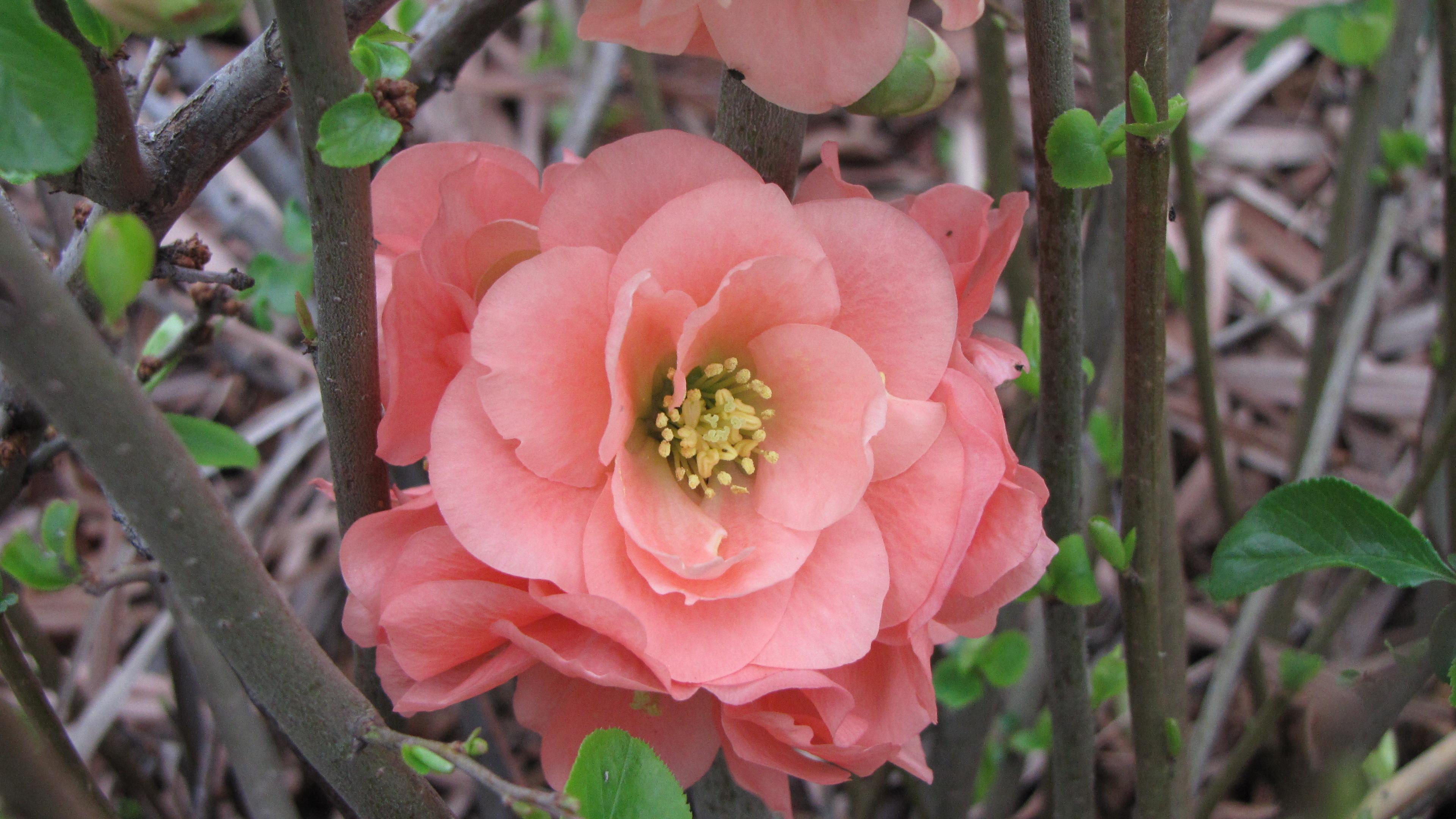
Quince BranchAlmost no other plant screams as loudly “Spring is just around the corner!! “ as the cheerful sight of a Flowering Quince in full bloom in the dreary winter landscape.

Native to eastern Asia, Japan and China, Flowering Quince is highly adaptable to growing well the United States, including Texas.  Because of its Asian origins, an old-time name for the plant was Japonica and the pink and white blossoms of Flowering Quince and its fruit are often depicted in Japanese paintings.

quince

Flowering Quince, genus Chaenomeles, can range in size from 2-10 feet tall and wide depending on the variety.  They tend to be a rounded shrub and nearly all have thorns, though some of the newest varieties are thornless.  Except for their brief moment of glory when they bloom in shades of red, white, pink or salmon in late winter, they are a nondescript, glossy green shrub which some consider too ungainly and rambling to be given a prominent place in the landscape.  They are very hardy, will live for years, and require only moderate maintenance.  In highly alkaline soils they may become chlorotic but even in Dallas County this does not present much of a problem.  Though some of the newer varieties are said to grow in partial shade, the more sun they are given, the more flowers they will produce. 

     Here at the Demonstration Garden we grow a variety called Texas Scarlet Flowering Quince, Chaenomeles japonica ‘Texas Scarlet.’  It grows from 3-6 feet tall and wide and has very fiery tomato-red, apple-blossom-like flowers that precede the deciduous leaves.  After blooming it produces a greenish-yellow fruit which can be harvested in the fall.  It is considered best when used in a shrub border or as a background plant.

    The fruit of Flowering Quince, including Texas Scarlet, can be used to make jellies and jams.  The fruit is very hard and must be cooked before eating; and the seeds, which contain amygdalin, must be removed before cooking.  Because the fruit contains more Vitamin C than lemons, in Estonia, it is called a Nordic Lemons.  There are several recipes for Flowering Quince jelly on the internet.  However, because of the small size of most of the fruit from ornamental varieties, most cooks consider it too labor intensive to make jelly from varieties such as Texas Scarlet.

   quince-flowering  Though nurseries are carrying Flowering Quince now that are in full bloom, just remember that glory of these shrubs may only last for ten days to two weeks.  However, if you plant and establish Flowering Quince now, just wait until next year.   You will be greeted with a flamboyant harbinger of spring. 

Carolyn


Daffodil, Jonquil, Narcissus


What’s in a name? That which we call a rose by any other name would smell as sweet.

–Shakespeare’s Romeo and Juliet

     Picture the flower: daffodil, jonquil, narcissus.  If you are like most people, probably a particular flower comes to mind.  However depending in which part of the country you grew up or lived, or even your age, the specific flowers associated with each of these terms may be different.  This confusion, when using common names for plants, is why botanists classify plants using their Latin or scientific names.

So what exactly is the difference between a daffodil, a narcissus, and a jonquil?  The simple answer, according to University of Illinois   Extension specialist Jennifer Schultz Nelson,  “is nothing, or “it depends.”  All three terms are used as common names in many cases and used incorrectly.  Narcissus is technically the only correct scientific name identifying the genus of this group of plants.  It is not a common name, though some use it as such.  Daffodil is typically used as a collective name for all these plants, but is more often used to describe the larger flowered types.  Jonquil is a name sometimes used for this group as well, but actually only applies to a very small subgroup, Narcissus jonquilla and related hybrids, which typically have several small, fragrant flowers on each stem with flat petals.  The foliage is very narrow and reed-like, according to the American Daffodil Society (ADS).”

 
Daffodil 'Unsurpassable'

Daffodil ‘Unsurpassable’

The American Daffodil Society (ADS) designates 13 divisions of daffodils with, depending on which botanist is asked, over 40 to 200 different daffodil species, subspecies and varieties of species and over 25,000 registered cultivars or named hybrids.  Daffodils are members of the Amaryllis family, of the genus Narcissus.  Narcissus is derived from the Greek word narke, meaning numbness or stupor.   Perhaps the name was given because in Greek mythology Narcissus was a young man so enamored of himself that he stared at his reflection in a pool of water until he eventually drowned as he tried to embrace himself.  Supposedly flowers grew up around the site.  Or the name Narcissus may refer to the flower’s intoxicating fragrance, or because all parts of the daffodil are poisonous.  In fact, not only animals but even humans who have occasionally mistaken a daffodil bulb for an onion, have become ill upon eating the bulb.  There is even a contact dermatitis called “daffodil picker’s rash” which can occur upon repeated handling of the stems.

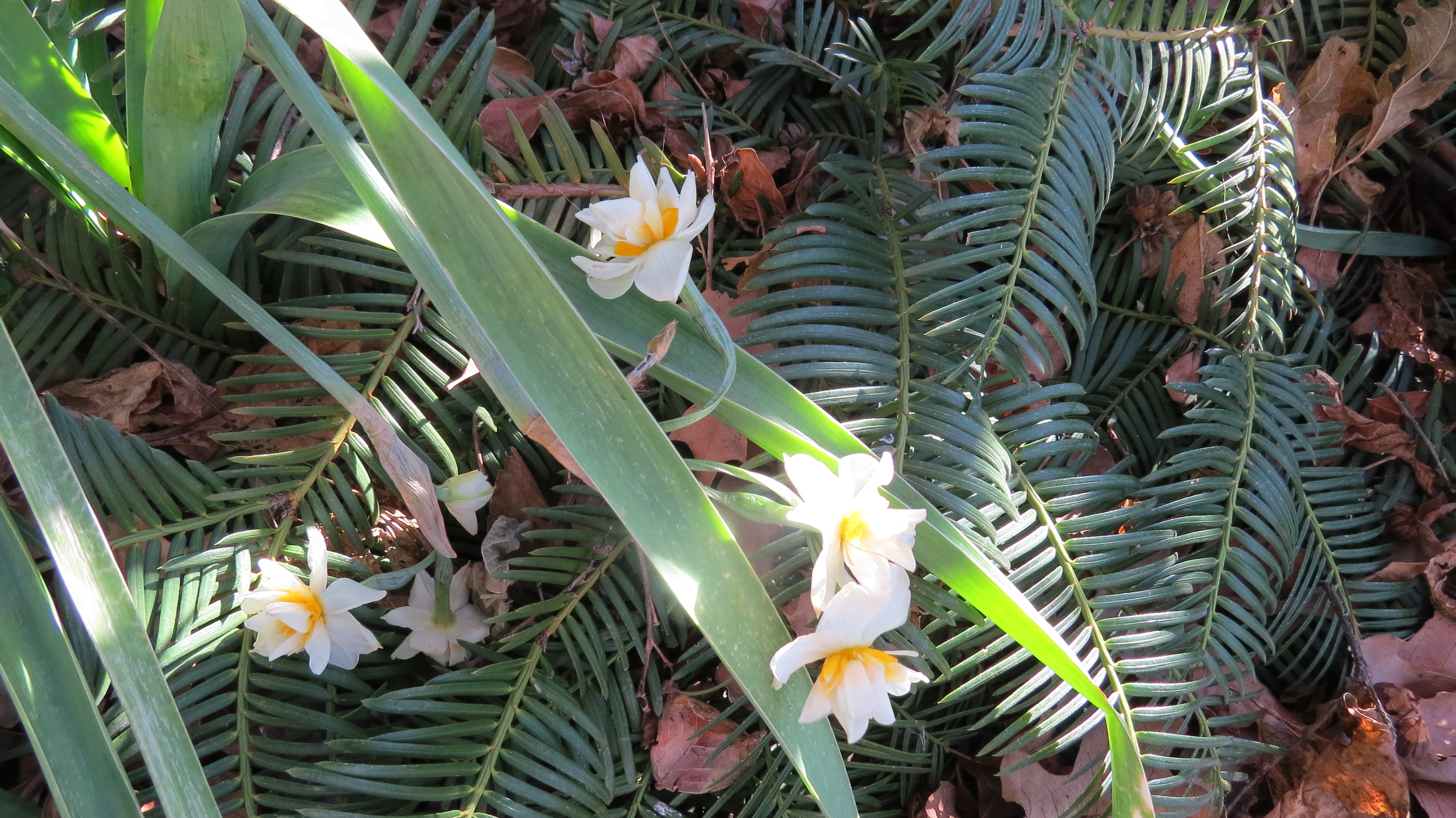
Above: Narcissus tazetta Double Roman peeking our thru leaves of our yew at The Demonstration Garden

Above: Narcissus tazetta Double Roman peeking our thru leaves of our yew at The Demonstration Garden

Daffodils found growing wild in Texas around old homesteads or cemeteries were probably brought over here from Europe by early settlers, according to Dr. Jerry Parsons, retired AgriLife Extension Horticulturist. Daffodils will grow best in a well drained area in full sun though they can naturalize in part shade under deciduous trees.  The bulbs should be planted and divided in the fall or late summer.   It is extremely important that the foliage be allowed to grow, mature and ripen naturally.  According to Dr. Parsons, it should never be cut off or “tied in cute little knots.”  It is the foliage that stores up the food reserves for the next year’s blooms and new bulbs.  In a flower bed, the withering foliage can be disguised by other plants.

Narcissus tazetta '‘Grand Primo’', a bulb that will naturalize in Texas

Narcissus tazetta ‘‘Grand Primo’’, a bulb that will naturalize in Texas

To naturalize daffodils in Texas, it is important to plant the correct varieties.  In general, according to Dr. Parsons, Southern grown stock is genetically superior in vigor to the commercial Dutch forms.  His article on daffodils in Plant Answers lists some of his favorite varieties.  Another excellent source for bulbs of all kinds collected from Texas and neighboring states is The Southern Bulb Company www.southernbulbs.com.  The owner, Chris Wiesinger, collects heirloom and sometimes rare bulbs that will perform very well for the warm-weather gardener.  Many of the daffodils and bulbs planted at the DemonstrationGarden have come from his stock.

So, whether you call them daffodil, narcissus or jonquil,

now is the time to enjoy these delightful flowers.

Carolyn

Picture of ‘Double Roman’ and ‘Grand Primo’ by Starla

Daffodil ‘Unsurpassable’: DaffSeek, American Daffodil Society, Inc., Unsurpassable retrieved on Mar 6, 2014’, available at www.daffseek.org

Take in all things Daffodil at The Annual Texas Daffodil Society Show  this weekend at the Dallas Arboretum.

Companion Plants and Plantings

Onions and potatoes…not only do they taste great together – they grow great together!  A few weeks ago, we planted our onions (yellow 1015, otherwise known as Texas Sweet) and potatoes (red LaSoda) in one of our raised beds.  We planted the onions from seedlings, and prepared seed potatoes.

Above: Calloused Potatoes, ready to plant

Above: Calloused Potatoes, ready to plant

To prepare the potatoes, they were quartered – making sure there were a couple of eyes in each section, dipped in sulfur powder (you may know it as the stuff you sprinkle on yourself to keep chiggers at bay), and then left in a cool, dry, dark place to callous over.   By callousing over the cut parts of the potatoes, excess moisture evaporates and the chance of mold growing underground where the potato was cut is reduced. Usually, 7-10 days is sufficient for callousing.

Since the onions didn’t require any special work, they got planted a couple of weeks earlier, at the top of two rows we’d made in the bed.  They were planted about an inch deep, and roughly four inches apart from one another.  These are bulb onions, so we wanted to make sure there’d be plenty of room for them to grow nice and big.  The potatoes, once they were ready, got planted in the furrow made between the two rows of onions, cut side down (eyes up), about four inches deep and roughly six inches apart.  Six inches may seem a little close, but our goal was to plant all our sets, and that’s how the spacing worked out in our raised bed.

Above: Sue and Christina planting our potatoes inside rows of onions

Above: Sue and Christina planting our potatoes inside rows of onions

So why plant these two together?  It goes like this:  as the onion grows, to help facilitate bulb production, we’ll start removing some of the soil off of the tops of the bulbs.  Meanwhile, the potato plant grows upwards, but the potato is formed off of the part of the stem that is underground.  So as the potato grows upwards, we’ll use the soil we’re removing off of the onion to help bury the potato plant stem so there’s more stem to swell into more potatoes!  Pretty nifty, eh?

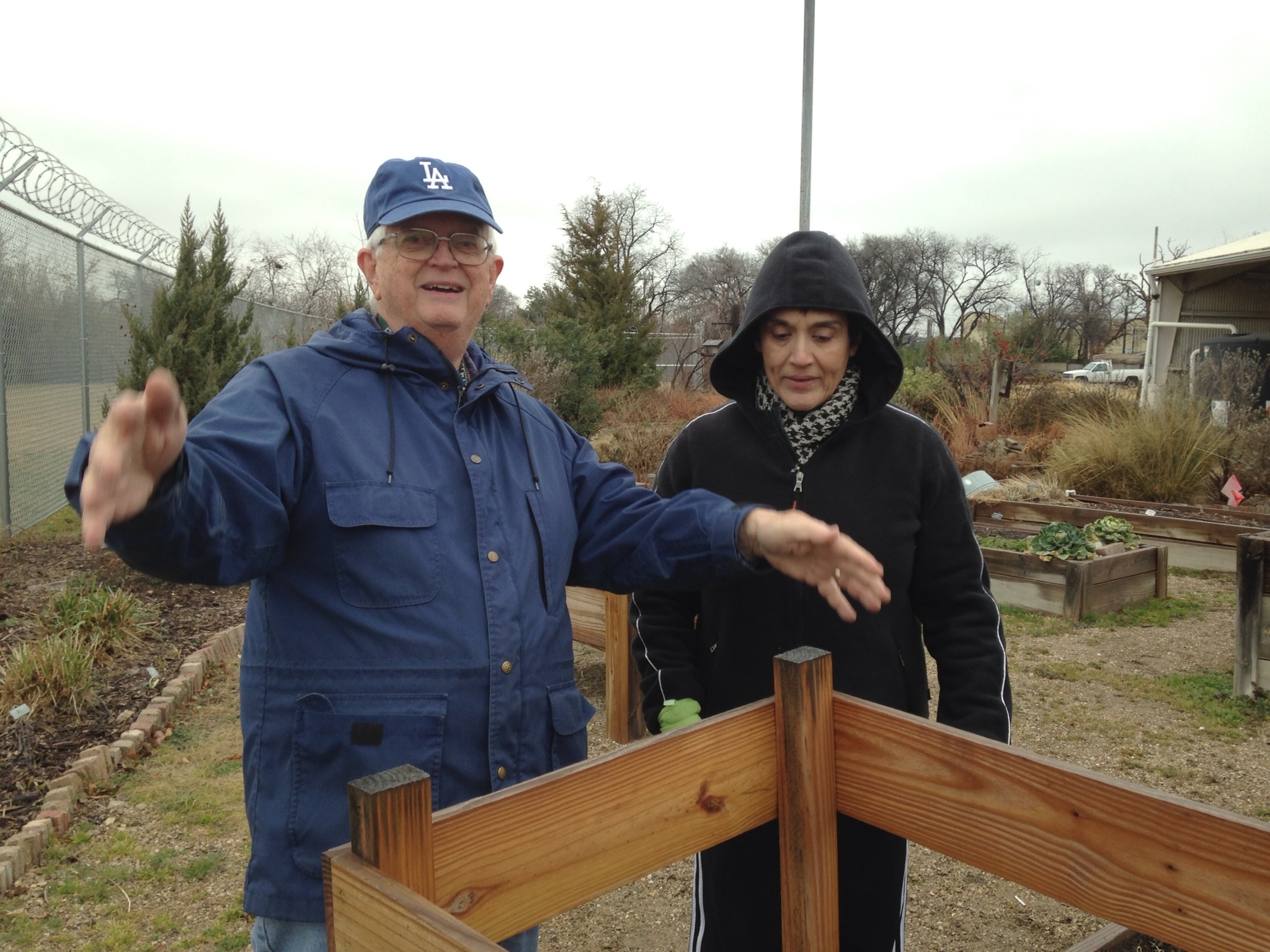
Finally, at the end of the bed we have a boxlike structure made of wood.  There, we’re experimenting with growing the potatoes really tall – covering the stems with compost as the plant grows upwards.  We’ve planted five potato pieces in there – one in each corner, and one in the middle – and our drip line extends into the box area.  As the plants grow up and we add more compost, we’ll lift the drip line (we’ve left a little play in there) so it stays near the top of the soil.

Above: Jim explaining the potato growing process

Above: Jim explaining the potato growing process

It’ll be a few months before we can harvest the roots and tubers of our labors, but it’s good to keep in mind that if you plant a short-day/spring/sweet onion, it’s not considered a storage onion.  If cured properly, it may last a couple of months, but the high sugar content works against long storage.  So it’s best to cook ’em up and eat ’em quick!

Lila Rose

More about our Potatoes: One Potato, Two Potato, Hopefully More, A Better Mouse Trap, and Vegetable Planting in January and more about Onions: The Lowly Onion.

WELCOME TO DALLAS GARDEN BUZZ

Gardening in North Central Texas is enough to make you throw away your trowel.  Our summers are hot enough for a blast furnace.  Our winter chill can freeze pipes and coat trees with ice.  We’re pummeled with spring storms and hail, but when we most need the rain, not a cloud is on the horizon.  Dallas’ unforgiving black clay forms clods hard as rocks and is so alkaline, its pH is off the chart.

DALLAS GARDEN BUZZ shares our journey through the triumphs and missteps of gardening in our North Texas heat, clay soil, limited water, and high alkalinity.  In the world of gardening, there is always a story to be told and sage advice to share.  As we dig, trim, harvest, and cook, we’ll give you the best information we can gather from our “hands on” work in  The Raincatcher’s Garden of Midway Hills, a Research, Education and Demonstration garden at 11001 Midway Road in Dallas.

DALLAS GARDEN BUZZ is written by Dallas County Master Gardeners, volunteers trained by the Texas A&M AgriLife Extension Service.

dcmga_logo_20160109-jpg-2017 agrilife_logo_9-12-jpg-2017