We have three female Yaupon Holly (Ilex vomitoria) trees in the Wildlife Habitat of the Raincatcher’s Garden. The fruit ripens in the fall and will attract Northern Mockingbirds, Cedar Waxwings, and other fruit-eating birds. The evergreen foliage provides good cover and sometimes nesting sites, for songbirds. Although the the foliage will be more dense in full sun than in part-shade, this species is well adapted to both. Pruning practices also affect the density of the cover it provides.

When buying yaupon trees, the easiest way to be sure you will get fruiting trees is to select them in the late summer or fall, when you should be able to see fruits on a female tree. Because yaupons are dioecious, pollination by a male tree is required for the female tree to produce fruit, so you may want to plant a male (non-fruiting) tree among your females. However, Dallas has many yaupons, and female trees often seem to be pollinated by males from other gardens. Fortunately, fall is our best season for planting trees.
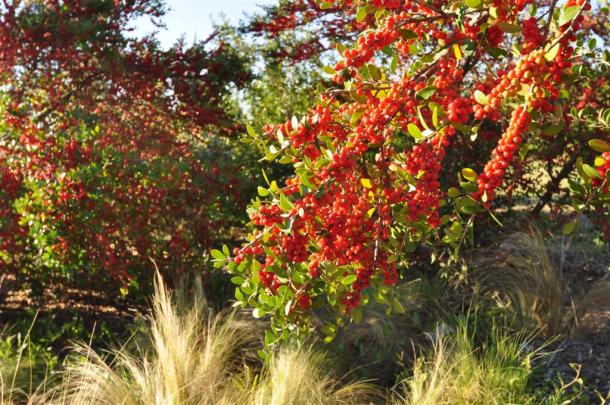
The beautiful fruits are properly called drupes rather than berries, because there is a single seed in the center of the fruit, surrounded by an outer skin and a fleshy middle layer.
Deirdre

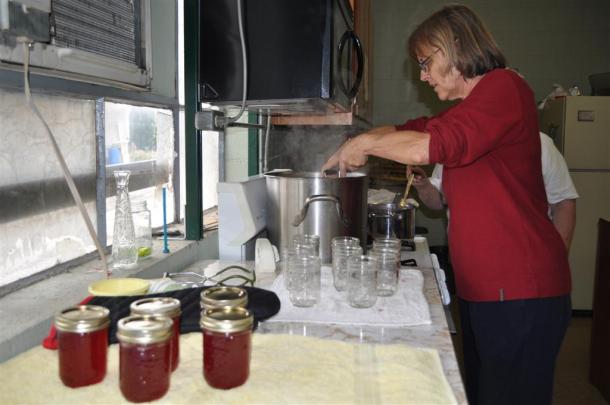
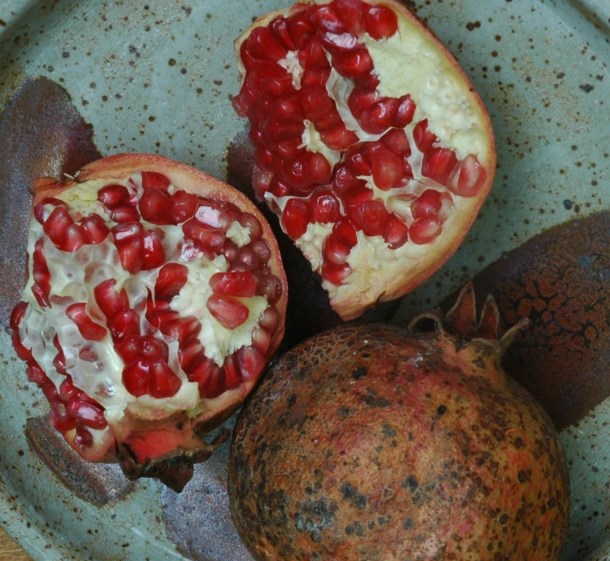 We are wild about pomegranates at the Demonstration Garden. Our three year old tree produced enough pomegranates to fill 12 quart bags of pomegranate seeds and make two dozen jars of jelly.


 Meet Opal, named for Judy’s Aunt Opal.


 The ‘Berggarten’ sage leaves are quite a bit larger and more rounded than oval-leafed garden sage. If dried, this sage can lose its flavor and taste more medicinal after awhile. Try freezing the fresh leaves for better flavor. ‘Berggarten’ translates to ‘mountain garden’ in German. The name comes from the gardening plots of the Herrenhausen Gardens in Hanover, Germany, built in 1666 to supply produce for the Herrenhauser Castle in Lower Saxony.
 a garnish for roasted turkeys. Crushed or chopped leaves add a wonderful flavor to soups, teas, vegetables, salmon or tilapia fillets. If you want to keep the lovely pink edge on this sage, be sure to plant it in sufficient sunlight. Otherwise, the leaves will fade to just green and white.


 DALLAS GARDEN BUZZ