And then it happened…
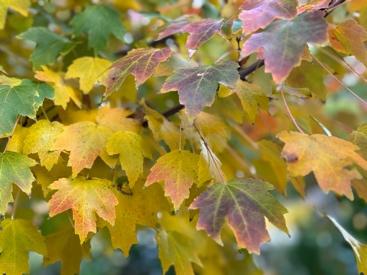
October ushered us into the colorful changes of fall. And then, November arrived with waves of crimson, yellow and orange. Mary Ann Evans, known by her pen name, George Eliot, gave us these endearing words from a letter written to Miss Lewis, October 1, 1841…
“Delicious autumn! My very soul is wedded to it, and if I were a bird I would fly about the earth seeking the successive autumns.”
How eloquently her words capture the essence of autumn in this beautiful quote. Hopefully, you have taken notice of trees bursting with color, fall foliage ablaze with seasonal splendor and tables graced with a harvest of plenty. As the gathering of family and friends begins, let’s celebrate the abundance of blessings found in the natural world.
Japanese Maples: For the past few years, the Dallas County Master Gardener Association has hosted a fundraiser featuring countless varieties of Japanese maples. Trees are usually “sold out” within hours. This speaks to the popularity of Japanese maples found in landscapes throughout Dallas County and beyond. Everyone seems to have a favorite but for many homeowners, the options typically include several types.
When we purchased our seventy-five-year-old house in 2006, previous owners (six total) had planted Japanese maples in various locations on the property. One maple, in particular, struggled to survive the below freezing temperatures of 2021, 2022 and 2023. As you can see from the photo, we chose to give it time to recover. After consulting with several arborists, the stately 30+ year-old tree is continuing to fight its way back. Still requiring some special attention, our tree is determined to overcome the odds. Its canopy provides wonderful afternoon shade in an area where we gather by the pool during the heat of the day.

Over the years we’ve added several dwarf Japanese maples and our new favorite variety, coral bark. It is a beautiful small tree with red-coral bark on its young branches with color that intensifies in the winter.
You’ll find them growing somewhere in most yards, especially on older properties. Overlooked, undervalued, neglected and dismissed, why have they lost favor in the landscaping world? It’s time to revisit a plant with so much to offer but rarely considered for its dramatic effect. More commonly known as heavenly bamboo or sacred bamboo, we know it as Nandina Domestica.
Nandina is native to China, cultivated significantly in Japan, then intentionally introduced to the United States as an ornamental in 1804 for its year-round interest and beauty. As a native Texan who spent my K-College years in southeastern Oklahoma, l am very familiar with nandina. It was growing in yards throughout my small hometown of Durant. However, from what I remember, nandina shrubs were typically used as background plants and located where they didn’t offer much more than a lame effort for “filling in”.
Over the years it has proven to be a very reliable asset for homeowners. Especially desirable for its dependability in extreme temperatures and striking seasonal foliage, it ranks high on the performance scale. Landscapers seem to be taking a fresh, new approach to using it in more creative and eye-catching ways, even with modern architecture. Hopefully this trend will continue with nandina giving us the “heavenly” mention it deserves!
Follow these recommendations when considering nandina for your landscape:
*Nandina is still considered invasive in some areas so choose wisely.
*Two sterile cultivars that might be a better option are ‘Firepower’ and ‘Blush Pink’.
*Nandina should not be sheared as it destroys the natural beauty of the plant. When nandina becomes too large, irregular in shape or leggy, carefully prune using the one-third rule.
*Nandina thrives in USDA zones 6 to 9 and grows best in full sun or partial shade. Choose from the numerous cultivars available in most garden centers. ‘Firepower’, Gulfstream’, ‘Obsession’ and ‘Sienna Sunrise’ are strong recommendations.
We’ve just added three new ‘Obsession’ nandinas to a south facing area in our backyard. They are already starting to show those brilliant shades of red in their leaves.
November’s ever-changing tapestry is filled with botanical color. Take a few moments to experience some especially magnificent images of autumn’s brilliance. It may not be Vermont but our local landscapes really know how to take center stage!
Linda Alexander, Dallas County Master Gardener Class of 2008



 DALLAS GARDEN BUZZ
Beautiful information, Linda