September 16, 2023
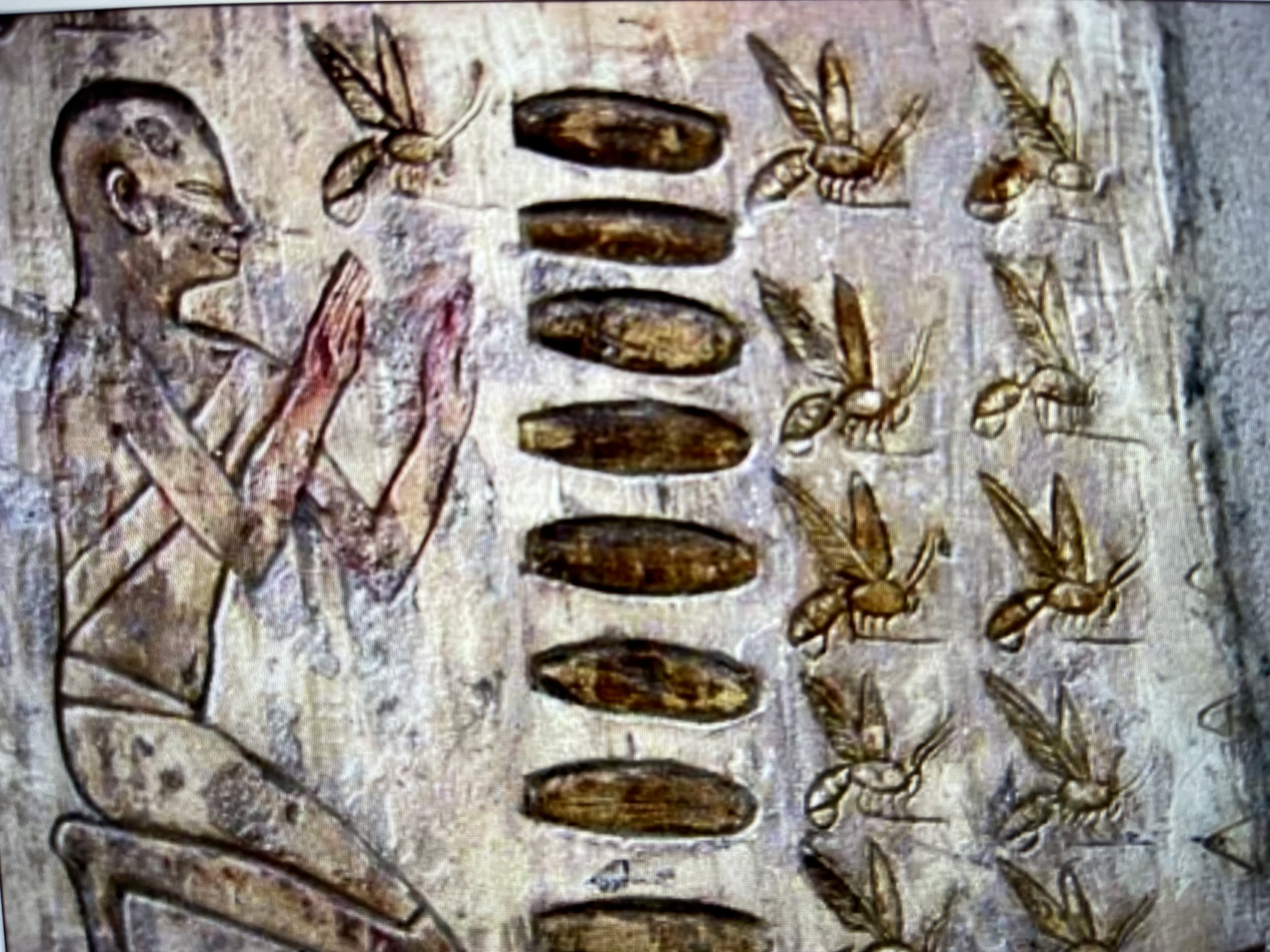
Almost every country on the planet has a story about the relationship between humans and their bees. Let’s cruise through some of the more entertaining facts pertaining to one of the most fascinating insects in the world.
Consider how the flowing sweetness of honey has, since ancient times, given us eloquent phrases associated with “honeyed words”. Even bee behavior has been identified with our own in phrases such as a dominate female being referred to as a “queen bee”, or when hard at work it might imply that we are “as busy as a bee”. Such symbolism has its roots in ancient cultures of the world.
Bees in Mythology
*San (Bushman) of southern Africa left prehistoric spiritual rock drawings of bees and their nests suggesting that bees had a special importance in the Stone Age.
*Prehistoric cave drawings in La Cueva de la Arana in eastern Spain show images of how early humans plundered wild bees’ nests for honey.
*The Myceneans, an indigenous Greek civilization dating back to the 16 th century BC, used images of bees on their beehive shaped tombs.
*Ancient Mayas of Mesoamerica kept native stingless bees and celebrated the bee god, Ah Mucan Cab, by downing honey and balche, an alcoholic honey drink.
*In 1653, construction workers near the church of Saint-Brice in Tournai discovered over 300 beautiful gold and garnet cloisonne bees in the tomb of Childeric (440-482), king of the Franks. Sadly, in 1831, thieves broke into the library of the Bibliotheque nationale de France, where they were stored, stealing hundreds of pounds of gold artifacts, including Childeric’s treasure. A significant portion was melted down, leaving only two little bees in existence today.
The story of Childeric’s bees made such a strong impression on Napoleon Bonaparte that, ultimately, the bee became the new emblem of the French Empire. Even more specifically, the bee came to represent Napoleon intimately, serving as his personal emblem. He was given the nickname, the Bee. Shortly afterwards, Napoleon’s friend and miniature portraitist, Jean-Baptiste Isabey, took to the task of redesigning Childeric’s bees. His resulting design was immensely handsome. Soon enough it became suitable for fashionable wear, and would come to dominate the interiors, decorative art, fashion and material culture of the Napoleonic court. Even today, the bee emblem is used on French glassware, cutlery, linens, upholstery fabric and cosmetics.
Globally, we continue to celebrate the influence of the honeybee found in themed fabrics, jewelry, paper goods, decorative items and so much more. Looking back across time, it is an enduring reminder of the indelible mark bees have left on mankind.
Enjoy these timeless images of the impact honeybees and their beloved honey have in our world today!
September’s featured honey recipe transitions us from a cherished summer fruit…peaches…to some time-honored autumn favorites…pecans and sweet potatoes. Feast on a stack of these warm and lightly spiced pancakes and you’ll be swooning with joy. Just don’t forget the maple syrup!

Linda Alexander, Dallas County Master Gardener Class of 2008
Sweet Potato Pancakes with Spiced Pecans and Fresh Peach Butter



 DALLAS GARDEN BUZZ
What a wonderful article on ancient bee history!!! The articles always amaze me, so thank you very much for sharing with all of us.
Diane Washam