July 20, 2023
In 2016, a wonderful new cookbook was published by the Dallas County Master
Gardener Association. The title was ‘A Year on the Plate’. One of the cookbook
committees’ favorite photographs was taken late in the afternoon with long
shadows stretching across the yard as sunlight drifted slowly behind the trees.
The dish to be photographed was from the honey section of the book. It was a
charcuterie board featuring an assortment of salty cheeses and nuts with a lovely
round honeycomb serving as the main attraction. Looking through several
options, we were thrilled with the dreamy look of one particular photograph that
captured the essence of our star ingredient.
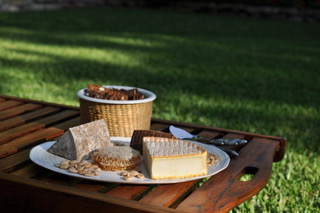
Since that day over seven years ago every imaginable type of charcuterie board
has been created. And, as you might have guessed, each one is almost always
designed around a honeycomb. Carefully cut and oozing with sweet honey, it is a
magical gift of nature that comes from honeybees.
During the months of July and August, we’ll take a look inside the hive to discover
some of the most amazing facts about honeycomb construction and why it is
considered to be the building block of the hive.

What is honeycomb?
Honeycomb is a cluster of repeating hexagonal beeswax cells made by honeybees
and used for raising brood and storing honey and pollen. Honeycombs store
honey because honey is valuable to bees. It feeds their young and sustains the
hive.
Why are honeycombs constructed using the hexagonal shape?
First consider spheres, pentagons and octagons. All of these produce gaps. Bees
are efficient creatures so anything with gaps isn’t the answer. As it turns out,
there are only three geometrical figures with equal sides that can fit together on a
flat surface without leaving gaps: equilateral triangles, squares and hexagons. So,
which one is best?
It’s a very old question and one that a Roman soldier/scholar/writer named
Marcus Terentius Varro proposed an answer to in 36 B.C. Ever since then, Varro’s
answer has been referred to as “The Honeybee Conjecture”. Simply stated, he
thought that a honeycomb built of hexagons could hold more honey and, maybe,
hexagons require less building wax. Why is the issue of wax important?
It takes thousands and thousands of bee hours, tens of thousands of flights back
and forth to the foraging source to gather nectar from countless flowers just to
start the process of building a honeycomb. Is it, therefore, reasonable to assume
that bees want a tight, secure structure that is as simple to build as possible?
As was eventually determined, compactness matters. The more compact your
structure, the less wax needed to construct the honeycomb. Wax is a precious
material. A honeybee must consume about eight ounces of honey to produce a
single ounce of wax. It is an accepted fact that the hexagon shape uses the least
amount of wax.
Additionally, years and years of research have demonstrated that honeybees use
the shape of their bodies as rulers to build each cell exactly the same. Even
Charles Darwin himself once wrote, the honeycomb is a masterpiece of
engineering. It is “absolutely perfect in economizing labor and wax.”
Linda Alexander, Dallas County Master Gardener Class of 2008



 DALLAS GARDEN BUZZ
I have been enjoying each of the bee articles this year and look forward to each month!!! It is amazing how they knew to use the hexagon shape for the honeycomb. Thank all of you so much for sharing this information.
Diane Washam