Though it is not quite time yet for “autumn leaves to drift by my window,” it is getting to be time for gardeners to start thinking about saving seeds from their favorite plants and flowers. Dr. Tom Wilten, when he taught the Dallas County Master Gardener class on propagation, developed a list of ten reasons why someone might want to propagate plants from seeds and cuttings. Some of these reasons included to save money, produce a genetically identical plant from cuttings, etc. However, for some gardeners, it just seems inherently “right” to connect with the entire life cycle of a plant.
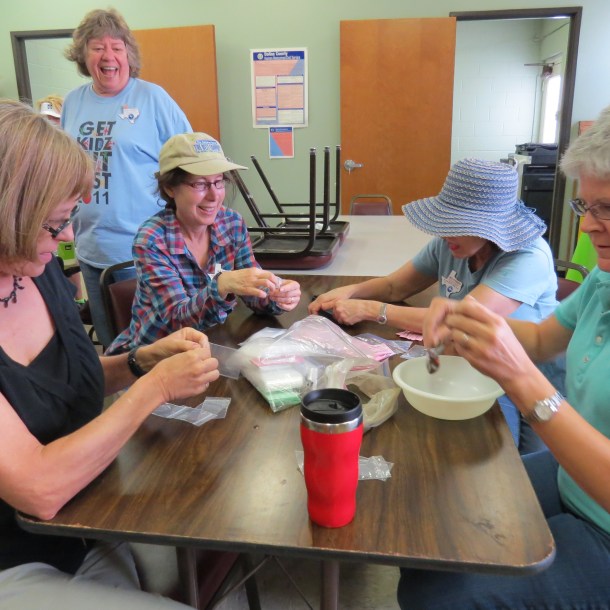
Here we are connecting with the entire life cycle of the plant, in our kitchen, saving seeds.
When thinking about saving seeds, there are several factors that one should consider. It is important to remember that not all seeds can be legally, or should be, saved. According to Willaim Woys Weaver, author of Heirloom Vegetable Gardening, there are basically three different kinds of seeds. Only one of these three kinds of seeds can, or should, be saved:
1) Genetically modified seeds (GM seeds): These are seeds that have been artificially changed to make them resistant to pathogens and/or herbicides. No matter what you may philosophically or medically think about the use and consumption of plants grown from GM seeds, it is against the law to save GM seeds since they are patented. One cannot legally save seeds from or reproduce a GM patented plant unless you pay the maker a royalty. In general, the average homeowner does not have to worry about this as currently GM seeds are used by huge commercial growers who grow monocultures, such as corn, soybeans, etc. However, if growing a patented plant, just be aware of this.
2) F1 Hybrid seeds: This is another type of patented seed that is a cross between different plant species. F1 refers to Filial 1: the first filial generation of seeds/plants resulting from a cross mating of distinctly different parental types. These are commonly found in seed catalogues and purchased by homeowners. One should not however save seeds from F1 hybrid plants because they will not grow true to type, plus after a few generations F1 hybrid plants will eventually lose the traits for which they were bred. Most plants and seed packets are prominently labeled if they are F! Hybrid seeds or plants.
3) Open-pollinated seed: Open-pollinated plants are those plants that are pollinated by nature which may be bees, wind, birds, etc. Seeds from these open-pollinated plants have often been passed down from generation to generation (heirloom seeds) though they may be more recently developed.
To save seed from open-pollinated plants there are several things to consider. First, the seed must be fully ripe/developed. This may seem obvious, but for some plants such as cucumbers, it means that the fruit must be left on the vine until it turns yellow, and gourds, beans and peas must be left on the vine until the seeds rattle in their hardened shells.
The second thing to remember is that because open-pollinated seeds are pollinated by nature, it is very easy to get cross pollination since bees fly from flower to flower and the wind may carry pollen across a yard or field. Basil and mint are notorious for being “promiscuous” with different varieties easily cross pollinating. Therefore, if you are saving basil seed you should not save seed from, for example, a lime basil planted too close to a sweet basil. Seed from this cross may, or most likely may not, be good tasting.
Finally, when storing seeds it is important to let them dry thoroughly, and then store them in a cool, dry place. If kept properly, most seeds will be viable for several years.
Do you have a favorite plant from which you save seeds? Let us know, and tell us your technique for saving them. Not just pass-a-long plants but pass-a-long knowledge is, as Martha Stewart would say, “a good thing.”
Carolyn
Picture by Starla



 DALLAS GARDEN BUZZ