Tag Archives: Hellebores

 January appreciation–it can be hard

January 11, 2025

Here we are in January–its cold and can be dark and gloomy.  So how to  appreciate it?

January is named for the great Roman God Janus.  This God could look to the front and to the back–seeing both the past and the future–thats a lot right?  But really his powers were far greater. Janus was a God of practical importance.  When asked by mere mortals assistance could be given to turn dreams into reality.  Janus had the power to help the followers to see and understand what  actions were needed to recognize an abstract goal  and take the necessary actions to make it real.  

There seem to have been other powers but those seem quite enough for us to think about in this time of the year that can seem a bit bleak.

In fact it seems very possible that Janus was fond of gardening and was able to use the powers to make gardeners happier.

Well it is  hard to say it was all a very long time ago now–but some things don’t change.  We want things to be brighter and more cheerful.  we know we can’t just wait for it to happen–its up to us–we are going to have to be inspired by ancient wisdom but we are the ones who must make it happen.  OK lets turn the idea “make things brighter” into action to make it so.   Remember–no just hoping for a good day–make it a good day!

Let’s decide on what to do:

Go and pick some of the lettuce and arugula in the garden make and enjoy a salad–delicious and healthy too.

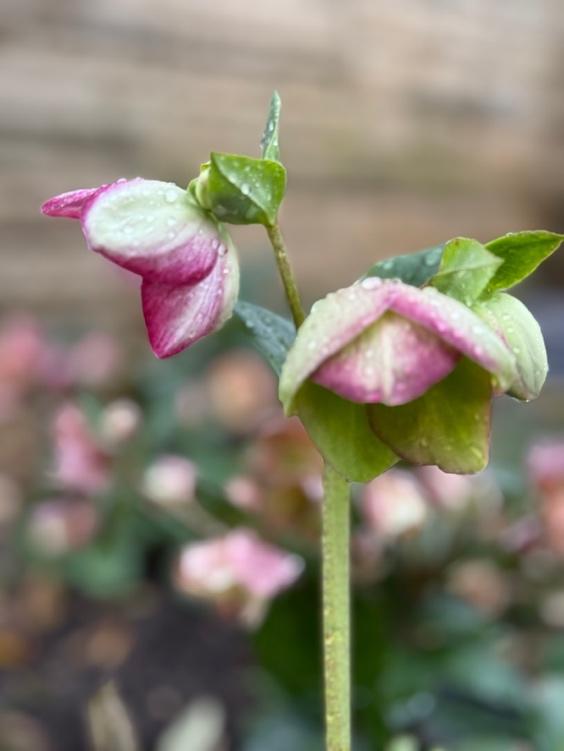
Take a walk around the yard–Yes its cold but the hellebores are starting to bloom but you will never know unless you go out and look.  Winter honeysuckle  is covered in lovely white flowers a treat for people and bees but again it requires a good close look those flowers are beautiful but they are small.

Houseplants are right there for enjoyment.  Don’t take them for granted and let them become just part of the furniture.  Of course do the routine care but take the time to really look closely they will appreciate it and you will reap the benefits.  Even the most common of the plants are amazing on close inspection.

Even January can be a wonderful time for gardeners.  Lets learn from Janus and take action to make it so! 

Susan Thornbury, Dallas County Master Gardener Class of 2008

More information on:
Christmas Cactus

Winter Honeysuckle

Hellebores

Flowers of Frost and Freezes

February 25, 2024

In our Zone 8 climate they are not only survivors of winter’s chill but soon after a January freeze, Hellebores lift their lovely heads and shower us with an abundance of February color. Starting now and continuing into late March and early April, refresh your home by selectively snipping and arranging their decorative blossoms. 

A close-up of a flower

Description automatically generated

If you aren’t already growing Hellebores in your garden, now is a really good time to give them a try. Many of our local garden centers currently have a wide selection of varieties with colors ranging from ivory and pale green to pink and dark burgundy. You might find comfort in knowing that the symbolic meaning of hellebores includes peace, serenity and tranquility.

My hellebores were planted three years ago and were used to make each of the featured arrangements. However, this was my first time to use hellebores as a cut flower, but it won’t be my last. It has been impressive to see how well their strong and sturdy stems hold up when anchored in a “frog-type” holder. 

Here are my top three reasons for growing hellebores:

  1. During the dreary backdrop of winter, hellebores bring joy to your garden with a rainbow of beautiful colors. 
  2. As a cut flower, hellebores hold up well and can be arranged in unique and beautiful ways.
  3. As you can see from the photos, hellebores provide honeybees with a much-needed nectar source when options are extremely limited.

Linda Alexander, Dallas County Master Gardener class of 2008

Other Hellebore articles from our archives:

Hellebores

Lenten Rose

Helleborus, ‘Glenda’s Gloss’ will be planted
along the wavy wall in memory of Raincatcher’s volunteer
and dear friend, Glenda Nix. She was loved and is missed.

Hellebores, Helleborus x hybridus

Above: 10 Hellebores were planted here 20 years ago

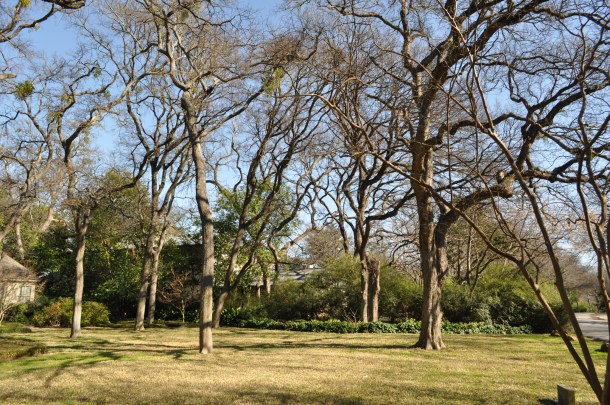
Twenty years ago a California couple bought a house in a heavily wooded area of Dallas because of the beautiful Cedar Elm trees.

As they set about landscaping the shady lot, Hellebores were chosen being easy-care perennials that brighten winter landscapes and prefer partial shade. We will read later about the other good qualities of Hellebores also known as Lenten Roses.

From a few Hellebores came many. Over the years they have self-seeded and now carpet the south side of the property. Linda Alexander and I had the pleasure of walking through this garden recently with the homeowners.

Above: Hellebores under Cedar Elms

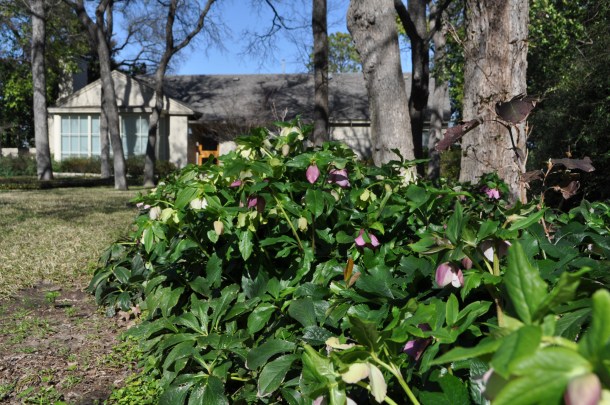
Above: A view of the Hellebore garden from the street

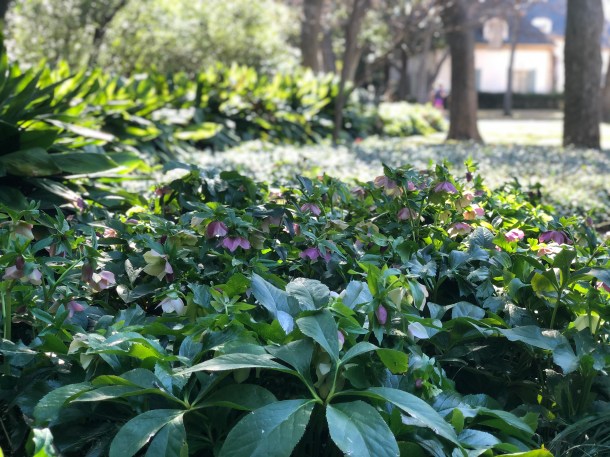
Above: A shady bed of Hellebores, Cast Iron Plant and Ophiopogon

These are the seedlings beneath the large leaves, it takes 3 years for these to become blooming plants.

Hellebore seedlings

Husband and wife say they mulch and leave the rest up to nature. In the last few years, husband has sprayed Miracle-Gro on the Hellebores in the spring. Every year they add mulch. Wife adds this has been their most successful gardening project.

Hellebore blooms dazzle in a variety of colors including green, white, yellow, red, black, and many variations of pink and purple. They bloom in this garden from January-March.

Pink Hellebore

More about Hellebores

  • Timing-it’s  nice to have  winter flowers and blooms that last so long
  • Beauty-nodding, cup shaped flowers, with enchanting colors
  •  Reproduction-Hellebores are self-sowing and will naturalize to make large clumps. The offspring are not always like the parent; surprises welcome!
  •  Location-Dappled shade is preferred but they can survive in full shade or with some sun. They grow in almost any kind of soil except except the extremes of overly dry soil or poorly drained wet soil.
  • Evergreen-glossy dark green multi-lobed leaves with a serrated edge and leathery texture. You may want to remove the tattered leaves during fall clean-up.

Ann Lamb

Fine Gardening gives excellent advice on growing Hellebores. Good advice: to get what you want, buy them in bloom.

If you would like to use Hellebores as a cut flower, read this article from Gardenista.