What a great plant larkspur is. Coming up from the seeds of last springs plants–living all winter as little fluffy greenery and suddenly growing tall and blooming before most other flowers.
Winter can be a challenge but finding the tiny larkspur seedlings and thinking of whats to come lifts the spirits. What a bonus that they honestly do not need a great deal of help from the gardener to grow and thrive.
As with most self seeding plants they come up where they wish to and may require some editing. If they are too crowded they won’t be their best so don’t hesitate to thin out the smaller ones. This will allow the remaining plants to grow tall. This adds structure to the spring garden. The color honestly goes with everything. Pink poppies–nigella–combined with the blues and purples of the larkspur–its a picture waiting to be painted–at least admired by you and anyone lucky enough to pass by.
Watch carefully larkspur is a magnet for native bumblebees. As we know bumblebees have been struggling. Seeing so many enjoying the larkspur makes growing them worthwhile in itself.
But wait–there is more!! When you grow larkspur you are growing a plant that has been grown by gardeners for hundreds of years. The Victorians were very fond of them–they were popular gift flowers.
In medieval times they were grown in monastery gardens. These gardens had to be useful not just beautiful.
Now–lets pause–important information will follow: all parts of larkspur are toxic. Do not consider internal use. But its great to know that people tried their best to help and use what they saw around them. Potions were made to treat a variety of problems including depression and anxiety. The seeds were used to make a solution to kill lice. That had to be a welcome relief as lice were a horribly common problem. In fact this use continued for a long time –soldiers used it during the revolutionary war..
The flowers can be used to make a dye and were used by the monks to make a blue ink.
So think of all those before you as you work in your garden–and remember you are a link in this long chain. Remember yes–but as always–there is more.You obviously must let the plants finish their blooming and go to seed–yes this can be a bit untidy but its essential. Lots of seeds will fall and they will lie in wait until next winter when the cycle starts again. But don’t let them all fall–gather some seeds.
Share some seeds with friends and neighbors–answer their questions about how to grow larkspur.
So the chain that links the plant and the gardener to the distant past will extend into the future–and you are and will be a link in that chain.
Larkspur and Poppies far better togetherLarkspur comes in white, this one has tinges of lavender look closelyThis one might be more lavender than whiteBe tolerant. A few larkspur in a vegetable bed is hardly a problem-in fact it is healthyNotice the variation in color, this one is very dark purple.This one is a bit lighter and blooms close to a tall verbena.Amazingly intricate flowersThe foliage is lovely itself- so delicate!A bumblebee, look close-they love larkspur.
Susan Thornbury, Dallas County Master Gardener Class of 2008
“The best cottage gardens look like they planted themselves”.
Raincatcher’s Cottage Garden Beginnings
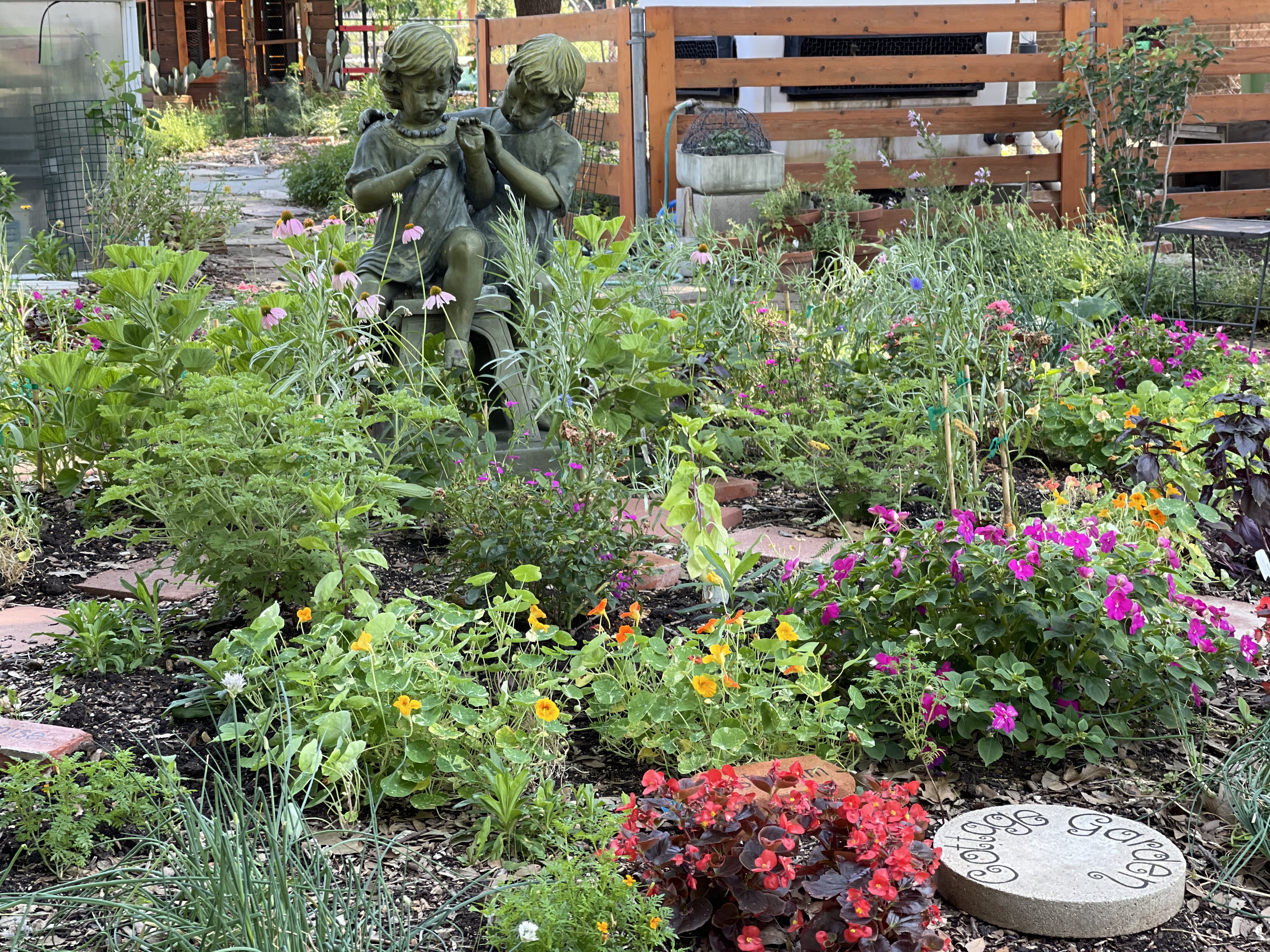
January 2021 our cottage garden was still in the dream phase. Researching, studying and looking at pictures on the internet filled up most of our time. We had envisioned the look, but a great deal of work lay ahead before this distinctive style could be implemented into our existing Statuary bed. Our goal was to find the perfect blend of colorful edibles transitioning from season to season, much like a butterfly gently flutters among flowers blooming in the garden. We hoped the rhythm of a good design would guide us along the way.
The English invented the cottage garden, probably in the 1400’s when even the humblest plots of land were pressed into service to produce food for families. Every inch of earth counted—with herbs, fruit trees, and flowers (which attracted bees to pollinate crops) jammed close together. Aside from being practical, the effect was charming. And so, we chose two descriptive words to guide us in our adventure…we wanted our garden to be graceful and charming.
While studying Gertrude Jekyll’s philosophy (1843-1932), we learned that she popularized the informal borders associated with country houses in England and picket fences in the U.S. Instead of the fussy formal planting of the Victorian era, she advocated a more natural look with plants arranged by color, height and flowering season.
After a series of discussions with our team of volunteers, ideas were tossed out for consideration as we started the process of ordering seeds for a Spring presentation. Our time spent learning about the cottage garden style was especially beneficial as flowers were specifically chosen for the role they would play. Variety would create interest while selecting plants with the proper form and texture promised a more pleasing landscape design.
Guidelines used to establish a Texas version of our edible modern cottage garden were:
*Expand Boundaries – plant flowers at the edge of garden beds, allowing them to spill over onto paths.
*Consider Climate – select flowers, herbs and vegetables that are known to thrive locally.
*Embellish Gracefully – provide ways to produce focal points and places of interest. Plant shrubs among flowers to add height and structure.
*Lure Pollinators – use “bee and butterfly” friendly plants.
*Edit Sensibly – remove annuals at the proper time and groom perennials to maintain beauty.
*Evaluate and Experiment – cottage gardens evolve, seasonally. Remove plants that failed to flourish. Add new plant material, as needed, for variety.
Edible plants selected for our cottage garden include, but are not limited to, the following:
Spillers-to expand boundaries: having used scented pelargoniums in previous years, we were familiar with their growth habits and characteristics. For this project the varieties we chose were ‘Old Fashioned Rose’ and ‘Mrs. Tabor’s Red’. Tucked in between the pelargoniums we planted nasturtiums ‘Alaskan Mix’ to satisfy our 2021 variegated theme and to promote the spiller effect. The herbaceous evergreen perennial ‘Pink Chintz’ creeping thyme with its ground-hugging habit of growth brings a delicate texture to the perimeter of the garden.
Thrivers-previously used plant material proven to flourish in our Zone 8 climate: herbs in this category are the familiar basil varieties ‘Cardinal’ and ‘Red Rosie’. Onion chives were planted around the perimeter over two years ago and continue to thrive. Summer Phlox ‘Party Girl’ is a new addition with vintage appeal. ‘Iron Cross’ Oxalis is a frost tender perennial in bloom from June to November.
Embellishers-bring interest to the garden: two varieties of marigolds (tangerine and lemon gem) will bring delicate pops of yellow and orange to the design. ‘Pinks’ (Dianthus) that grew prolifically in many of our grandmother’s gardens provide little dots of color amongst the herbs and flowers. Wax leaf begonias and purple impatiens give long lasting seasonal color to the garden. For a striking touch of blue, Bachelor’s Buttons (Cornflower) add both drama and height. One carefully chosen coral drift rose bush was planted to grace each wedge. Three upright lavender scented pelargoniums softly embrace the centrally located garden statue.
Pollinators-bee and butterfly friendly plants: blue borage has been growing in our edible landscape for the past two years. Adding it to the cottage garden was an easy decision. Bees love those adorable star-shaped blue blossoms as much as we do. Echinacea is a reliable perennial that adds color and height. Radish flowers are not only tasty but attract beneficial insects to the garden. Some will be harvested, others will be allowed to bolt. Yellow yarrow is a pollinator friendly plant that is known to attract butterflies, bees and other beneficial insects. We added one yarrow plant to each wedge.
In conclusion: Six months later, the circular bed once referred to as our Statuary Garden has been reclaimed and given a new identity. Yes, the adorable bronze statue of a little boy and girl remained in its original location, a constant reminder that the entire edible landscape was once a much-loved children’s playground. The same four pie-shaped wedges now feel more relaxed with their harmonious gathering of edible flowers, herbs and a few vegetables. We are overjoyed with the seasonal arrangement of jewel tones displaying their glowy color palette. Varying shades of green gracefully weave their way through a tapestry of color bringing a sense of harmony to each bed. Our new ‘Cottage Garden’ stands proudly as the focal point of the edible landscape. As with the cottage gardens of old, we are hopeful that ours will evolve slowly over time, changing with the seasons yet always impressing with its charm. Please enjoy your visit to our garden whenever possible.
Linda Alexander, Dallas County Master Gardener Class of 2008
Some cottage garden favorites just do not work for us. Towering foxgloves just rarely tower, but Love in the Mist that’s a happier story.
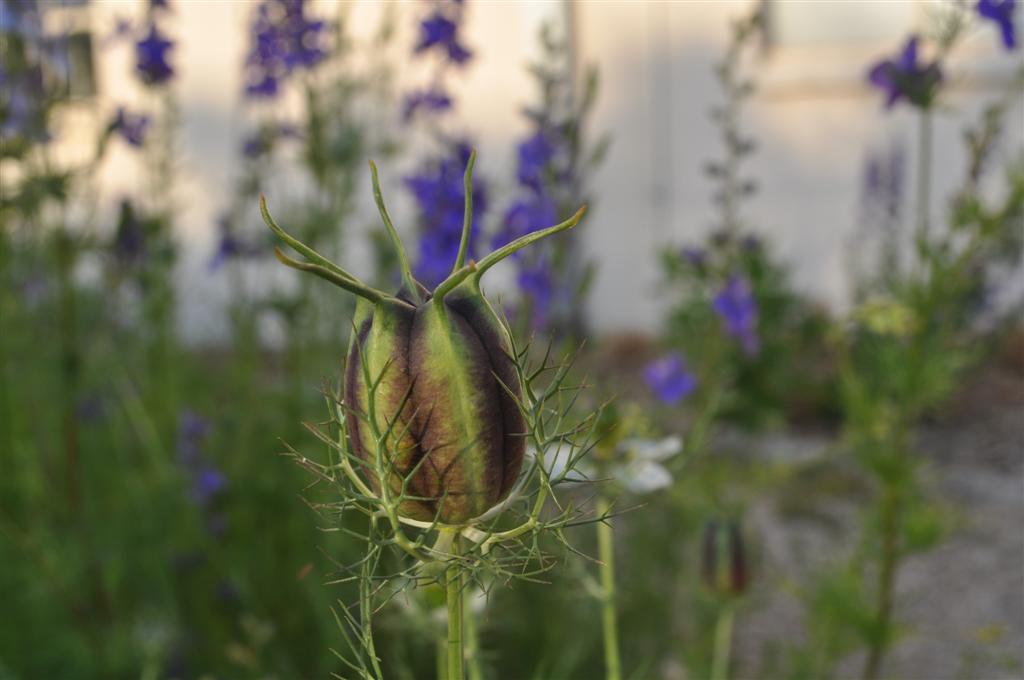
It’s true it doesn’t care for heat but still it loves spring here and adds a pretty airy charm to the early garden. Its easy care as long as you remember Love in the Mist doesn’t like heat. So the seeds are best planted in fall or early winter; the plants establish themselves over the dreary months and then grow amazingly fast and start to bloom when warm days arrive. The flowers are in shades of blue as well as pink and white with fine foliage that is a treat in itself. When flowering is done, the seed pods form.
Remember,self seeding annual, means you have to allow the seed pods to become mature but in this case it’s really an added bonus as the pods are intricate stripped balloons that add interest to the flower bed and can be saved for arrangements as well. Just be sure that some seeds fall to the ground. It’s the circle of life right there in your garden; the seeds will find their way and when winter comes they start to grow and soon…







 DALLAS GARDEN BUZZ